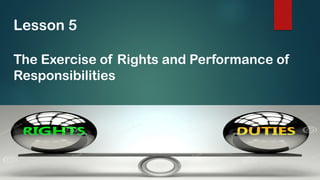
Lesson 5
The Exercise of Rights and Performance of
Responsibilities
Learning Competencies
At the end of this lesson, you should be able to:
1.Explain the rights and responsibilities of a human
person;
2.Analyze violations of human rights in the family,
school ,community, or country;
3.Testify how rights can be relevant; and
4.Carry out appropriate actions to correct violations
of human rights done or observed in the
family, school, community, or country.
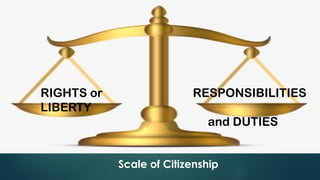
Scale of Citizenship
RIGHTS or
LIBERTY
RESPONSIBILITIES
and DUTIES
Read the poem below and reflect on its message.
No matter who you are what you do,
Your life is of great value
Your worth,your dignity is innate,
It has to be protected by the state.
As a human ,you have your rights.
Human rights are your strength and might!
No matter your color, status,race,or religion,
Your life and dignity are worthy of protection!
. Essential Question:
Why is it important to know your rights and
the corresponding responsibilities?
Key Concept:
Rights can only be relevant if people carry
out their responsibilities using their reason to
understand and recognize that human
dignity is equally present in all human
beings. These responsibilities ensure that
The exercise of rights will not be abused.
Human Rights
A right is an entitlement or a power by a virtue of
a person’s citizenship, to do or not to do
something.
According to Delfin Felipe, a Filipino author,
karapatan, the Filipino word
For right, comes from the Tagalog root word
dapat. It means
“an ownership of power or claim given to a
person to develop one’s full potentials.”
Human rights are the entitlements inherent in all
human beings regardless of nationality, race, sex
ethnicity, language, religion, or status. According
to the United Nations(UN) human rights belong to
every person in the world from the time of his/her
conception until death. These rights are based on
shared values like dignity, fairness, equality, respect
and independence. These values are defined and
protected by law.
In 1948,the UN released the Universal
Declaration Of Human Rights (page 71-72)
which provides the basic rights every
person should enjoy and is the basis of
governments in creating or establishing a
law.
 Human Rights and Their Corresponding Responsibilities
1. If you are privileged with the right to education,
your responsibility is to study.
2. It is your right to express your thoughts and ideas
through social media, but it is your responsibility
That what you post is not offensive, destructive, or
misleading.
3. You have the right to participate in the development
of the community, so it is your responsibility to vote
wisely and choose the right leader for the
community through a fair election.
4. You have the right to do the things you want to do
freely, but you should be aware of the law that keeps
the community in order. You are accountable
for whether actions you do that may distract, bother,
or harm others.
5. You the rights as a citizen of this country, so you
are responsible for defending your country from any
form of destruction or occupation.
6. You may enjoy your rights, but you have to make
sure that you also respect the rights of others.
“To deny people of their human rights is to
challenge their very humanity”
Nelson Mandela
Learning Summary
It is important to prioritize and value basic
human rights to protect human dignity
If rights are abused, violated, or taken for
granted, it will not be possible to attain,
maximize and live a dignified life.
Justice is attained only if each and every
individual is able to receive or is given what
due to him/her.
When you understand your basic human rights, you
empower yourself to protect and fight for them.
 Every right must have a corresponding responsibility.
No matter how much you know about your rights, if
you do not know how to use them properly, they
will be meaningless.
Exercising your rights properly is the most powerful
way to perform your responsibilities to others and the
nation.
Lesson 5  VALUES. EDUCATION ABOUT EQUALITY..pptx

Lesson 5 VALUES. EDUCATION ABOUT EQUALITY..pptx

  • 1.
    Lesson 5 The Exerciseof Rights and Performance of Responsibilities
  • 2.
    Learning Competencies At theend of this lesson, you should be able to: 1.Explain the rights and responsibilities of a human person; 2.Analyze violations of human rights in the family, school ,community, or country; 3.Testify how rights can be relevant; and 4.Carry out appropriate actions to correct violations of human rights done or observed in the family, school, community, or country.
  • 3.
    Scale of Citizenship RIGHTSor LIBERTY RESPONSIBILITIES and DUTIES
  • 4.
    Read the poembelow and reflect on its message. No matter who you are what you do, Your life is of great value Your worth,your dignity is innate, It has to be protected by the state. As a human ,you have your rights. Human rights are your strength and might! No matter your color, status,race,or religion, Your life and dignity are worthy of protection!
  • 5.
    . Essential Question: Whyis it important to know your rights and the corresponding responsibilities? Key Concept: Rights can only be relevant if people carry out their responsibilities using their reason to understand and recognize that human dignity is equally present in all human beings. These responsibilities ensure that The exercise of rights will not be abused.
  • 6.
    Human Rights A rightis an entitlement or a power by a virtue of a person’s citizenship, to do or not to do something. According to Delfin Felipe, a Filipino author, karapatan, the Filipino word For right, comes from the Tagalog root word dapat. It means “an ownership of power or claim given to a person to develop one’s full potentials.”
  • 7.
    Human rights arethe entitlements inherent in all human beings regardless of nationality, race, sex ethnicity, language, religion, or status. According to the United Nations(UN) human rights belong to every person in the world from the time of his/her conception until death. These rights are based on shared values like dignity, fairness, equality, respect and independence. These values are defined and protected by law.
  • 8.
    In 1948,the UNreleased the Universal Declaration Of Human Rights (page 71-72) which provides the basic rights every person should enjoy and is the basis of governments in creating or establishing a law.
  • 10.
     Human Rightsand Their Corresponding Responsibilities 1. If you are privileged with the right to education, your responsibility is to study. 2. It is your right to express your thoughts and ideas through social media, but it is your responsibility That what you post is not offensive, destructive, or misleading.
  • 11.
    3. You havethe right to participate in the development of the community, so it is your responsibility to vote wisely and choose the right leader for the community through a fair election. 4. You have the right to do the things you want to do freely, but you should be aware of the law that keeps the community in order. You are accountable for whether actions you do that may distract, bother, or harm others.
  • 12.
    5. You therights as a citizen of this country, so you are responsible for defending your country from any form of destruction or occupation. 6. You may enjoy your rights, but you have to make sure that you also respect the rights of others. “To deny people of their human rights is to challenge their very humanity” Nelson Mandela
  • 13.
    Learning Summary It isimportant to prioritize and value basic human rights to protect human dignity If rights are abused, violated, or taken for granted, it will not be possible to attain, maximize and live a dignified life. Justice is attained only if each and every individual is able to receive or is given what due to him/her.
  • 14.
    When you understandyour basic human rights, you empower yourself to protect and fight for them.  Every right must have a corresponding responsibility. No matter how much you know about your rights, if you do not know how to use them properly, they will be meaningless. Exercising your rights properly is the most powerful way to perform your responsibilities to others and the nation.