EPR Annual conference 2021
Digital skills transformation workshops
30 Sept., 14.30-17.00 CEST
Social services digitalisation in Wallonia
Experience sharing from an employer outlook
Mathieu de Poorter
Economic Advisor
EPR Annual conference 2021 | 30/09/2021 2
Digitalisation of social services providers in Wallonia
1. Presentation of UNIPSO
2. Main findings of the DIGI-SERV Research
3. The DigitalEES project
EPR Annual conference 2021 | 30/09/2021 3
1. What is UNIPSO and the social profit sector?
▸ UNIPSO represents the employers of the social profit sector (non-profit) at the
regional (Wallonia) and community levels (French- and German-speaking)
▸ UNIPSO is a cross-sectoral and pluralistic confederation getting together 31
(pluri-) sectoral federations
▸ Social profit enterprises provide support to individuals throughout their lives
▸ UNIPSO missions
▹ Provide the (cross-sectoral) social profit employers’ vision
▹ Defend a strong social model, garanteeing accessible and quality services provision to all
▸ 2 main areas of work
▹ Represent and defend the (cross-sectoral) interests of social profit employers through social
dialogue and mandates
▹ Equip, sensitize and anticipate through trainings, studies and regional & European projects
EPR Annual conference 2021 | 30/09/2021 4
2. The DIGI-SERV Research
▸ DIGI-SERV (2017-2018) = research study on the impacts of digitalisation on care
services
▸ Public funding from the Government of Wallonia
▸ 3 research centres, 1 steering committee (including social partners)
▸ Objectives
▹ Identify innovative and emerging digital technologies
▹ Identify main issues and controversies at stake (employment, organisational processes,
quality of services + online platform focus)
▹ Identify feature of social economy enterprise dynamics re. technology evolutions
▹ (Co-)Formulate political recommendations
EPR Annual conference 2021 | 30/09/2021 5
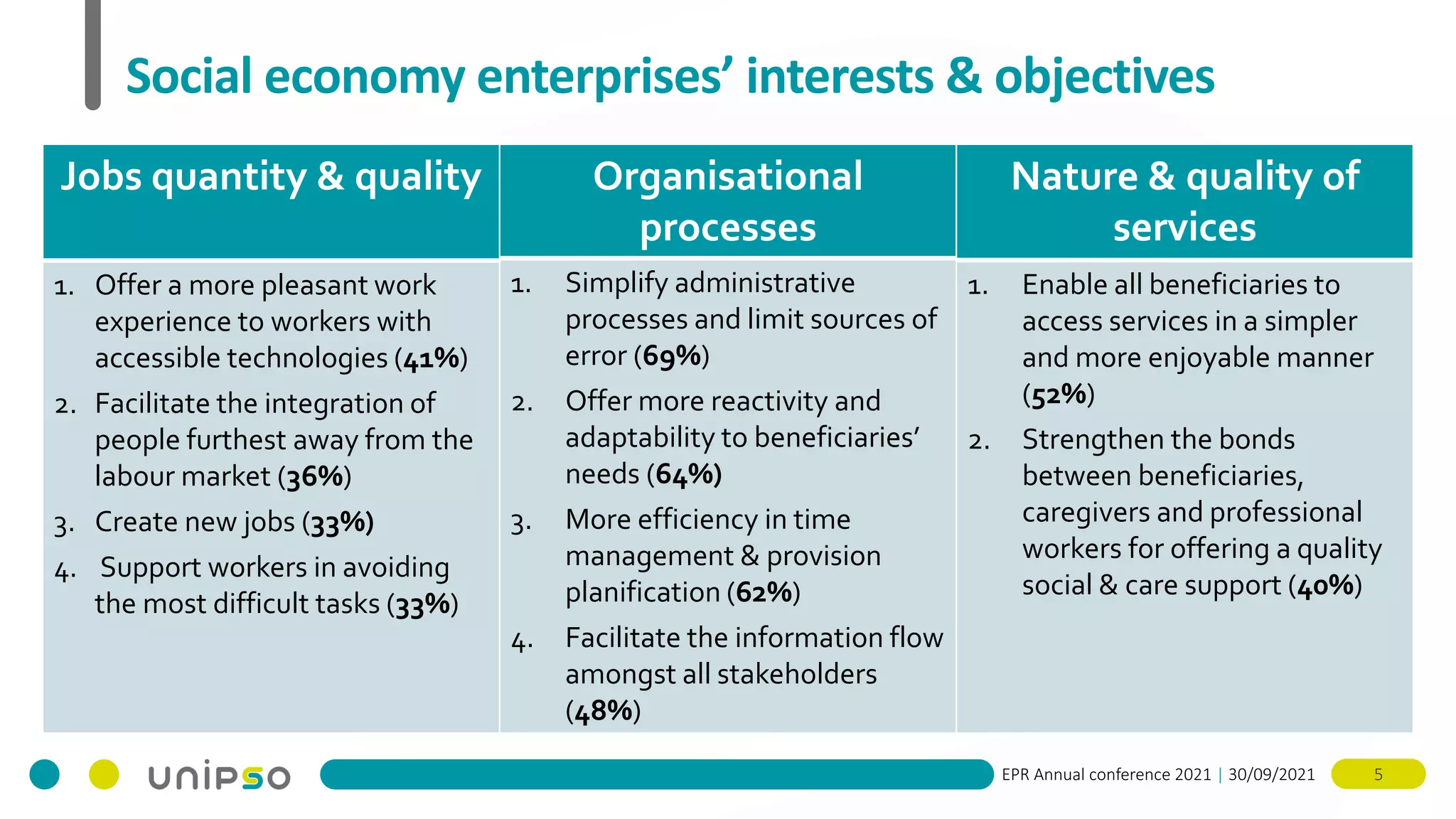
Social economy enterprises’ interests & objectives
Jobs quantity & quality
1. Offer a more pleasant work
experience to workers with
accessible technologies (41%)
2. Facilitate the integration of
people furthest away from the
labour market (36%)
3. Create new jobs (33%)
4. Support workers in avoiding
the most difficult tasks (33%)
Organisational
processes
1. Simplify administrative
processes and limit sources of
error (69%)
2. Offer more reactivity and
adaptability to beneficiaries’
needs (64%)
3. More efficiency in time
management & provision
planification (62%)
4. Facilitate the information flow
amongst all stakeholders
(48%)
Nature & quality of
services
1. Enable all beneficiaries to
access services in a simpler
and more enjoyable manner
(52%)
2. Strengthen the bonds
between beneficiaries,
caregivers and professional
workers for offering a quality
social & care support (40%)
EPR Annual conference 2021 | 30/09/2021 6
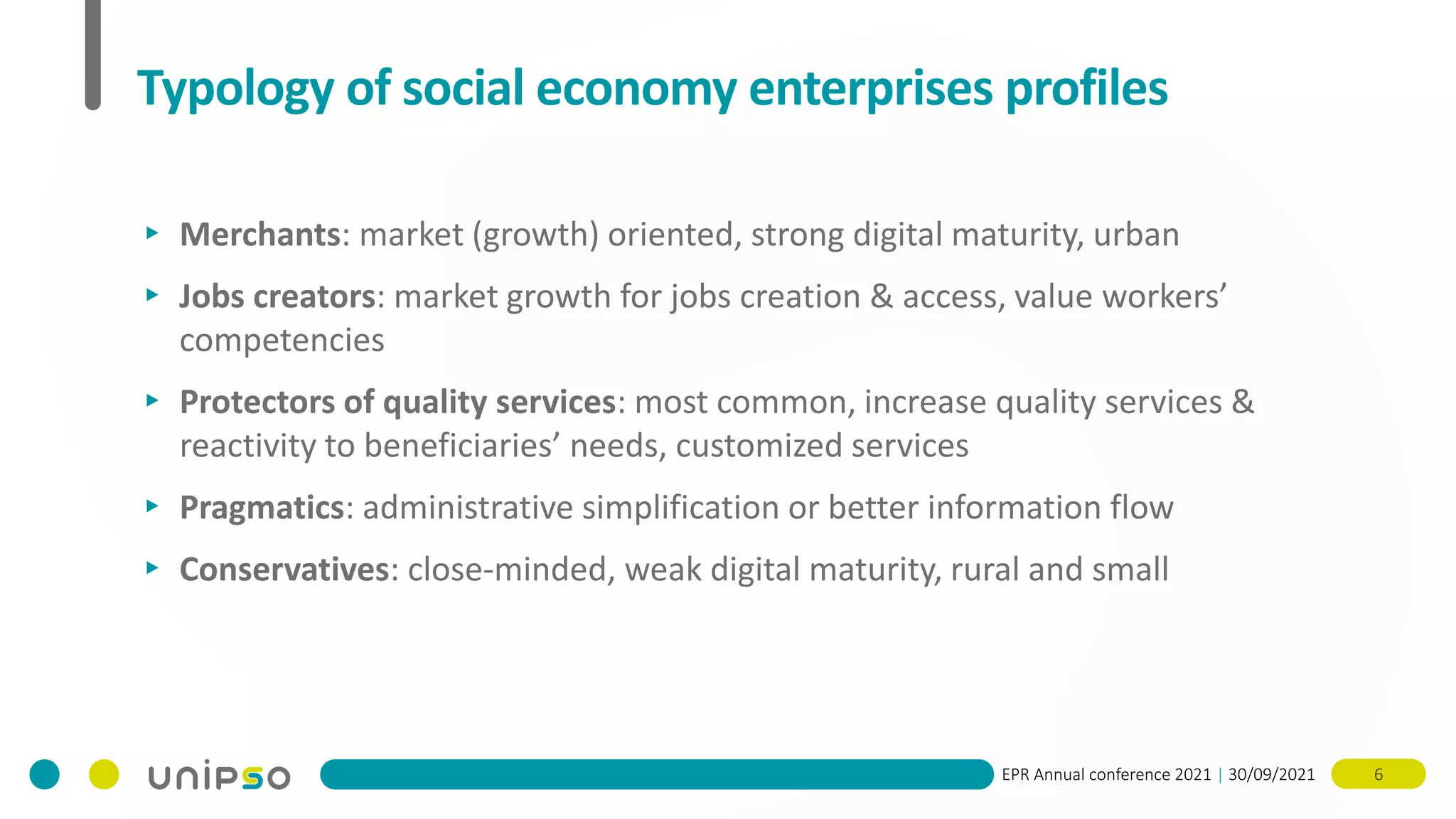
Typology of social economy enterprises profiles
▸ Merchants: market (growth) oriented, strong digital maturity, urban
▸ Jobs creators: market growth for jobs creation & access, value workers’
competencies
▸ Protectors of quality services: most common, increase quality services &
reactivity to beneficiaries’ needs, customized services
▸ Pragmatics: administrative simplification or better information flow
▸ Conservatives: close-minded, weak digital maturity, rural and small
EPR Annual conference 2021 | 30/09/2021 7
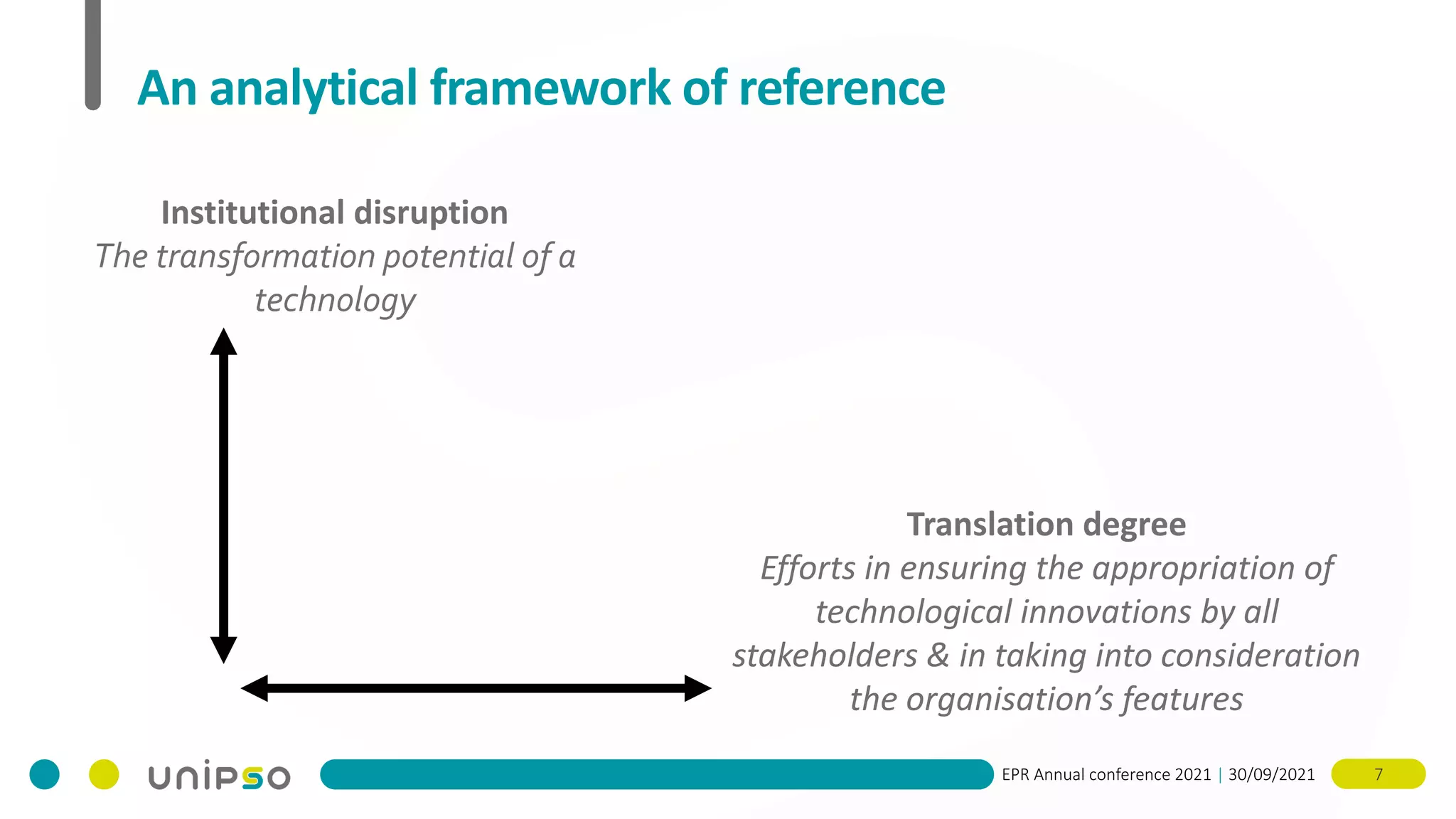
An analytical framework of reference
Institutional disruption
The transformation potential of a
technology
Translation degree
Efforts in ensuring the appropriation of
technological innovations by all
stakeholders & in taking into consideration
the organisation’s features
EPR Annual conference 2021 | 30/09/2021 8
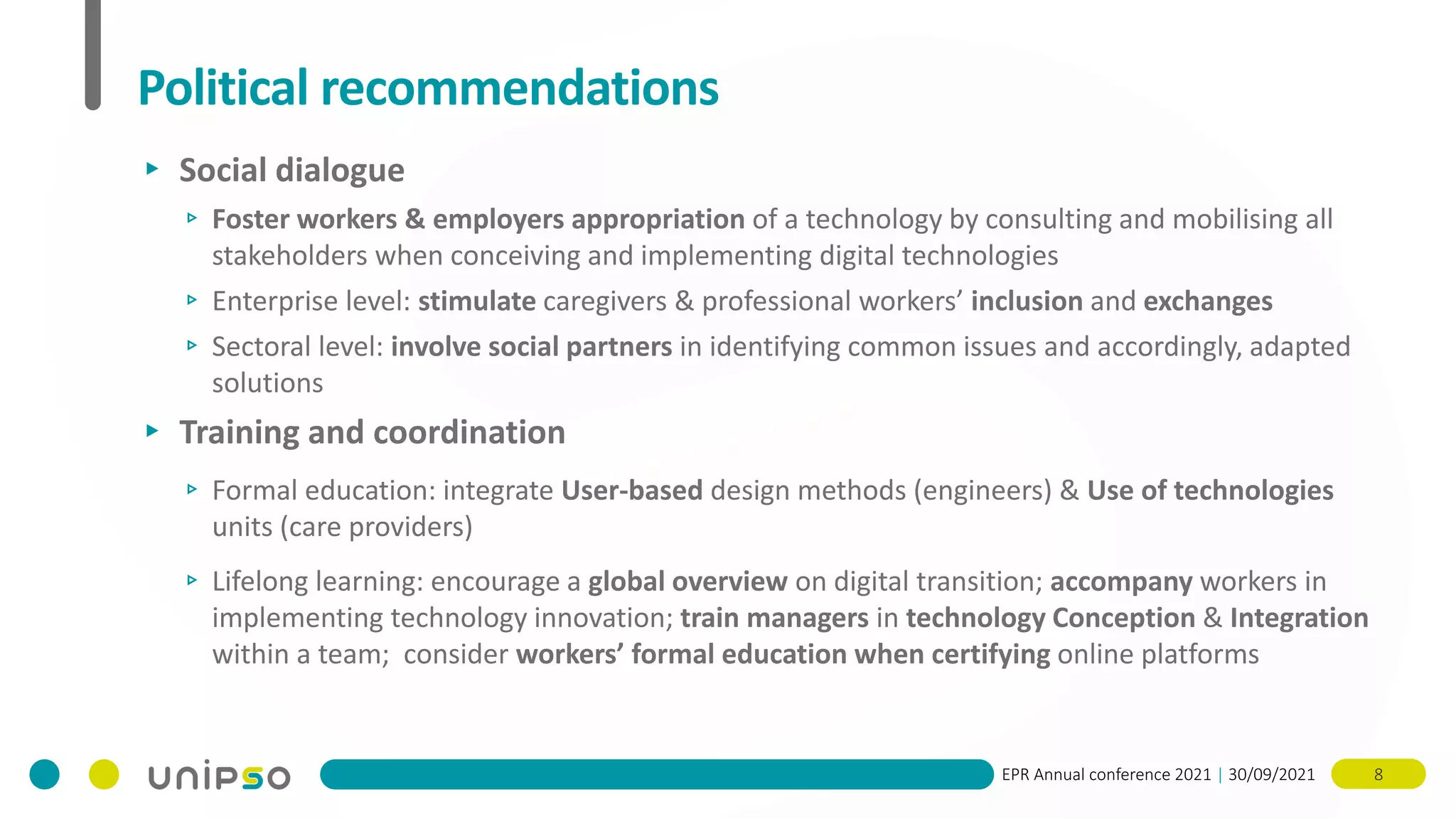
Political recommendations
▸ Social dialogue
▹ Foster workers & employers appropriation of a technology by consulting and mobilising all
stakeholders when conceiving and implementing digital technologies
▹ Enterprise level: stimulate caregivers & professional workers’ inclusion and exchanges
▹ Sectoral level: involve social partners in identifying common issues and accordingly, adapted
solutions
▸ Training and coordination
▹ Formal education: integrate User-based design methods (engineers) & Use of technologies
units (care providers)
▹ Lifelong learning: encourage a global overview on digital transition; accompany workers in
implementing technology innovation; train managers in technology Conception & Integration
within a team; consider workers’ formal education when certifying online platforms
EPR Annual conference 2021 | 30/09/2021 9
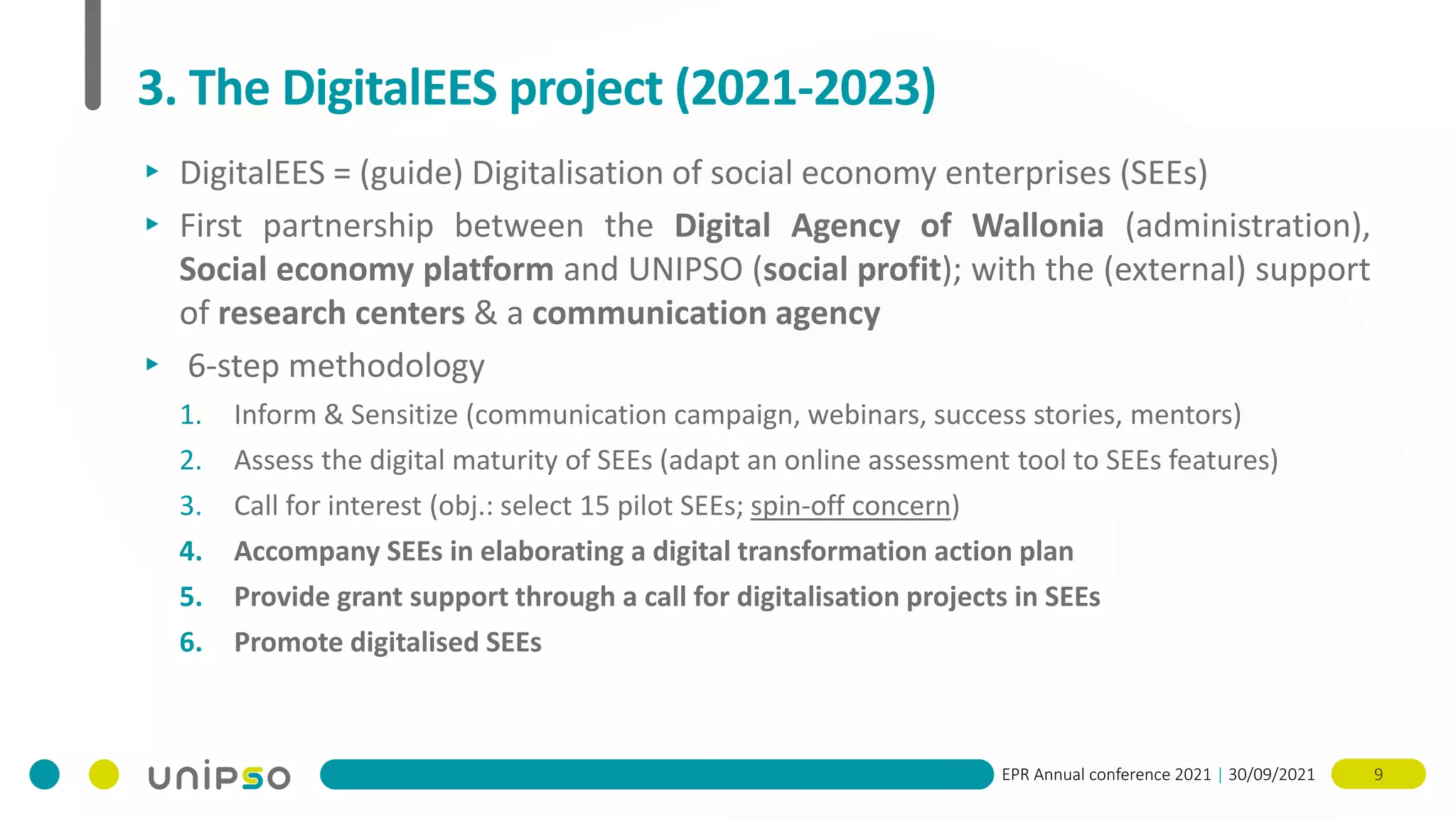
3. The DigitalEES project (2021-2023)
▸ DigitalEES = (guide) Digitalisation of social economy enterprises (SEEs)
▸ First partnership between the Digital Agency of Wallonia (administration),
Social economy platform and UNIPSO (social profit); with the (external) support
of research centers & a communication agency
▸ 6-step methodology
1. Inform & Sensitize (communication campaign, webinars, success stories, mentors)
2. Assess the digital maturity of SEEs (adapt an online assessment tool to SEEs features)
3. Call for interest (obj.: select 15 pilot SEEs; spin-off concern)
4. Accompany SEEs in elaborating a digital transformation action plan
5. Provide grant support through a call for digitalisation projects in SEEs
6. Promote digitalised SEEs
EPR Annual conference 2021 | 30/09/2021 10
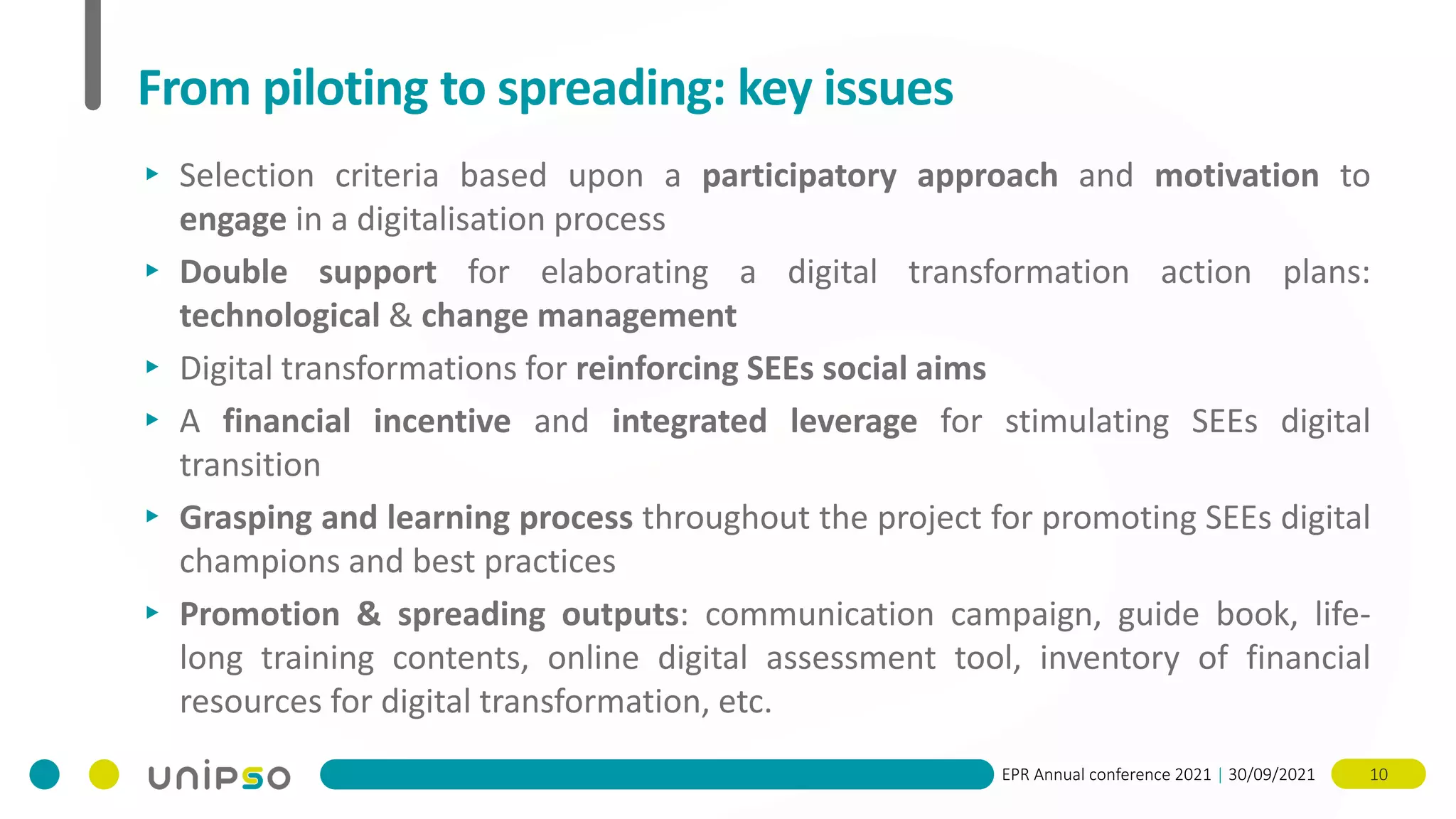
From piloting to spreading: key issues
▸ Selection criteria based upon a participatory approach and motivation to
engage in a digitalisation process
▸ Double support for elaborating a digital transformation action plans:
technological & change management
▸ Digital transformations for reinforcing SEEs social aims
▸ A financial incentive and integrated leverage for stimulating SEEs digital
transition
▸ Grasping and learning process throughout the project for promoting SEEs digital
champions and best practices
▸ Promotion & spreading outputs: communication campaign, guide book, life-
long training contents, online digital assessment tool, inventory of financial
resources for digital transformation, etc.
EPR Annual conference 2021 | 30/09/2021 11
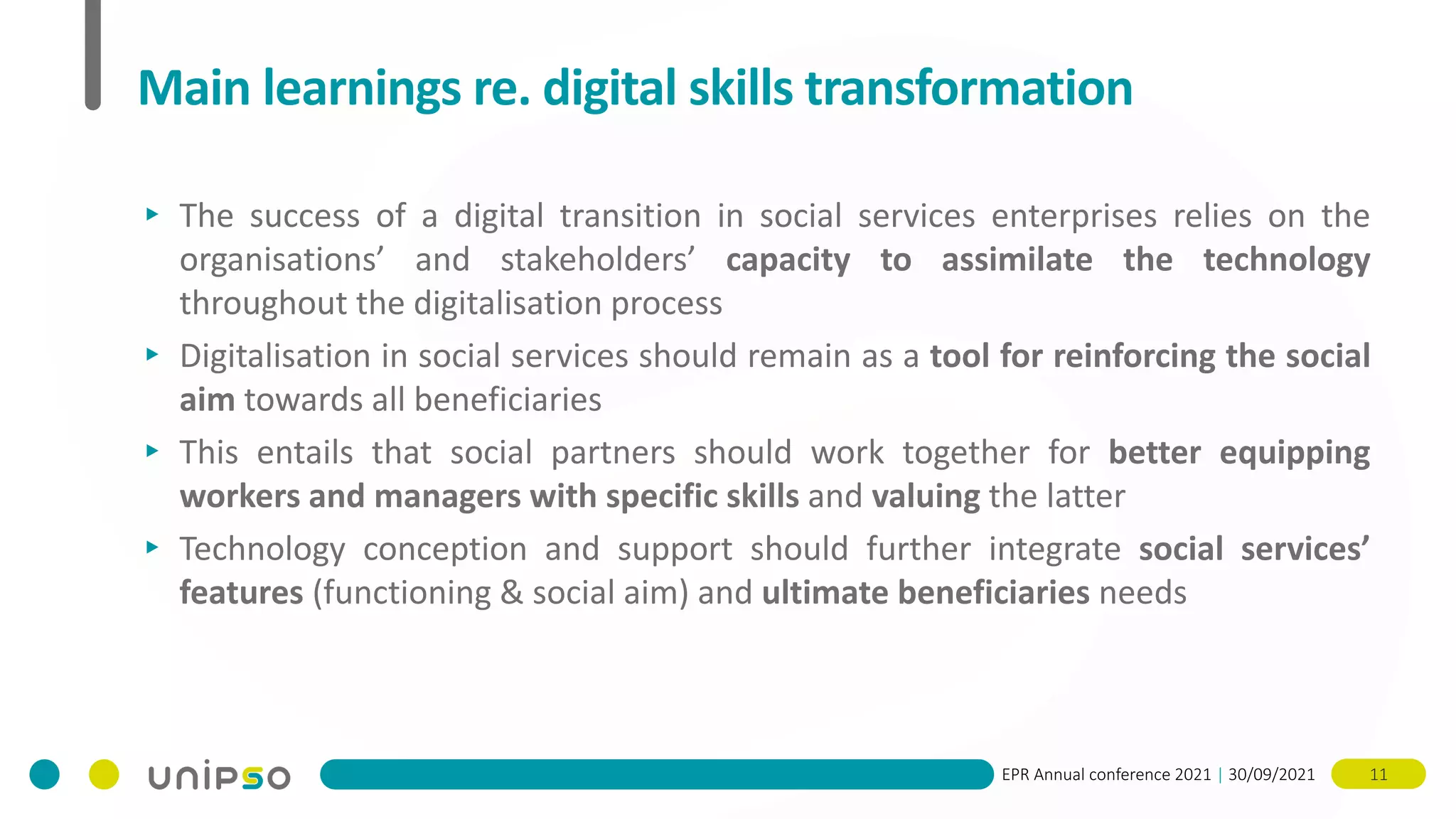
Main learnings re. digital skills transformation
▸ The success of a digital transition in social services enterprises relies on the
organisations’ and stakeholders’ capacity to assimilate the technology
throughout the digitalisation process
▸ Digitalisation in social services should remain as a tool for reinforcing the social
aim towards all beneficiaries
▸ This entails that social partners should work together for better equipping
workers and managers with specific skills and valuing the latter
▸ Technology conception and support should further integrate social services’
features (functioning & social aim) and ultimate beneficiaries needs
EPR Annual conference 2021 | 30/09/2021 12
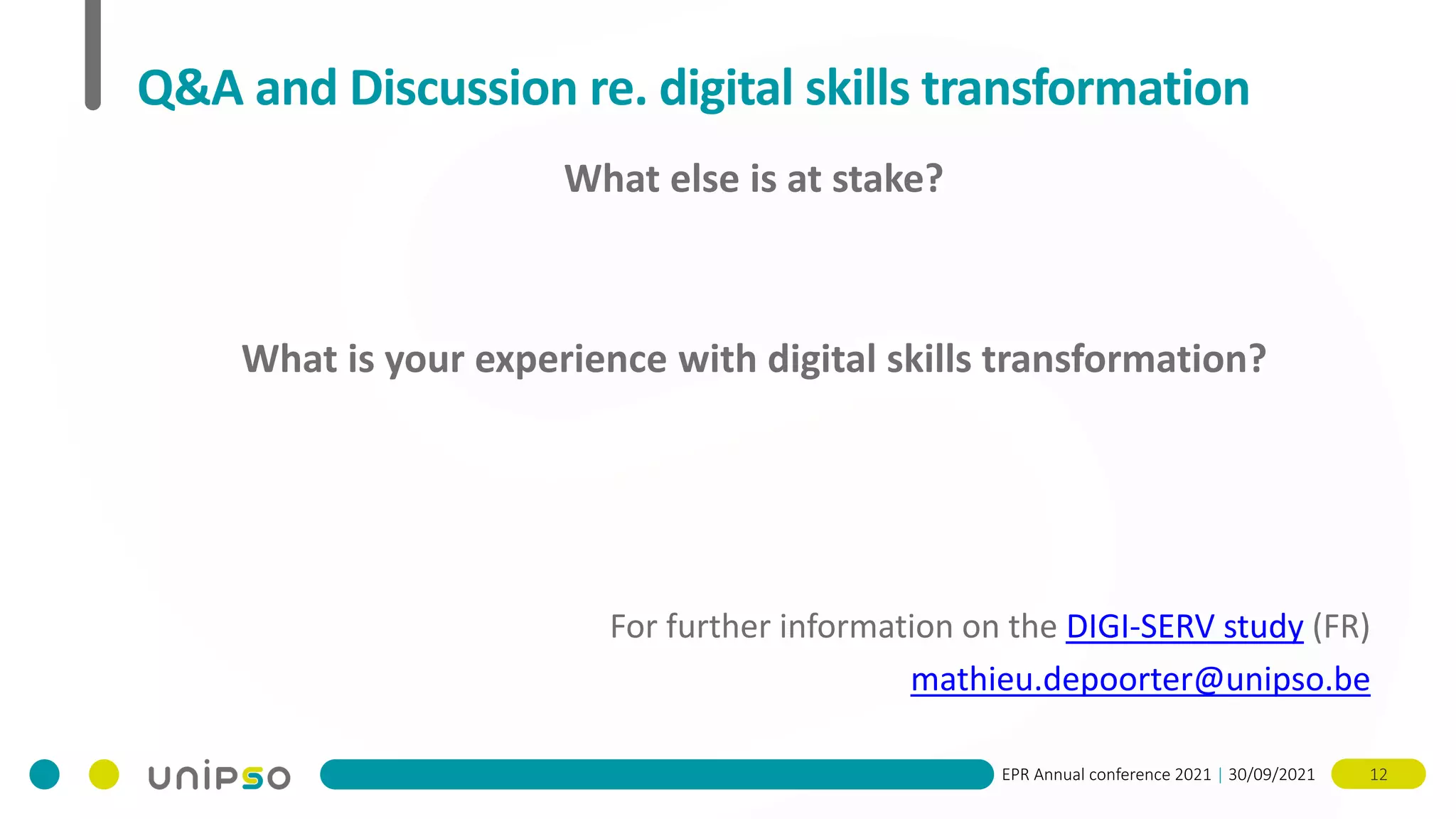
Q&A and Discussion re. digital skills transformation
What else is at stake?
What is your experience with digital skills transformation?
For further information on the DIGI-SERV study (FR)
mathieu.depoorter@unipso.be

Mathieu de Poorter: Digital skills transformation

  • 1.
    EPR Annual conference2021 Digital skills transformation workshops 30 Sept., 14.30-17.00 CEST Social services digitalisation in Wallonia Experience sharing from an employer outlook Mathieu de Poorter Economic Advisor
  • 2.
    EPR Annual conference2021 | 30/09/2021 2 Digitalisation of social services providers in Wallonia 1. Presentation of UNIPSO 2. Main findings of the DIGI-SERV Research 3. The DigitalEES project
  • 3.
    EPR Annual conference2021 | 30/09/2021 3 1. What is UNIPSO and the social profit sector? ▸ UNIPSO represents the employers of the social profit sector (non-profit) at the regional (Wallonia) and community levels (French- and German-speaking) ▸ UNIPSO is a cross-sectoral and pluralistic confederation getting together 31 (pluri-) sectoral federations ▸ Social profit enterprises provide support to individuals throughout their lives ▸ UNIPSO missions ▹ Provide the (cross-sectoral) social profit employers’ vision ▹ Defend a strong social model, garanteeing accessible and quality services provision to all ▸ 2 main areas of work ▹ Represent and defend the (cross-sectoral) interests of social profit employers through social dialogue and mandates ▹ Equip, sensitize and anticipate through trainings, studies and regional & European projects
  • 4.
    EPR Annual conference2021 | 30/09/2021 4 2. The DIGI-SERV Research ▸ DIGI-SERV (2017-2018) = research study on the impacts of digitalisation on care services ▸ Public funding from the Government of Wallonia ▸ 3 research centres, 1 steering committee (including social partners) ▸ Objectives ▹ Identify innovative and emerging digital technologies ▹ Identify main issues and controversies at stake (employment, organisational processes, quality of services + online platform focus) ▹ Identify feature of social economy enterprise dynamics re. technology evolutions ▹ (Co-)Formulate political recommendations
  • 5.
    EPR Annual conference2021 | 30/09/2021 5 Social economy enterprises’ interests & objectives Jobs quantity & quality 1. Offer a more pleasant work experience to workers with accessible technologies (41%) 2. Facilitate the integration of people furthest away from the labour market (36%) 3. Create new jobs (33%) 4. Support workers in avoiding the most difficult tasks (33%) Organisational processes 1. Simplify administrative processes and limit sources of error (69%) 2. Offer more reactivity and adaptability to beneficiaries’ needs (64%) 3. More efficiency in time management & provision planification (62%) 4. Facilitate the information flow amongst all stakeholders (48%) Nature & quality of services 1. Enable all beneficiaries to access services in a simpler and more enjoyable manner (52%) 2. Strengthen the bonds between beneficiaries, caregivers and professional workers for offering a quality social & care support (40%)
  • 6.
    EPR Annual conference2021 | 30/09/2021 6 Typology of social economy enterprises profiles ▸ Merchants: market (growth) oriented, strong digital maturity, urban ▸ Jobs creators: market growth for jobs creation & access, value workers’ competencies ▸ Protectors of quality services: most common, increase quality services & reactivity to beneficiaries’ needs, customized services ▸ Pragmatics: administrative simplification or better information flow ▸ Conservatives: close-minded, weak digital maturity, rural and small
  • 7.
    EPR Annual conference2021 | 30/09/2021 7 An analytical framework of reference Institutional disruption The transformation potential of a technology Translation degree Efforts in ensuring the appropriation of technological innovations by all stakeholders & in taking into consideration the organisation’s features
  • 8.
    EPR Annual conference2021 | 30/09/2021 8 Political recommendations ▸ Social dialogue ▹ Foster workers & employers appropriation of a technology by consulting and mobilising all stakeholders when conceiving and implementing digital technologies ▹ Enterprise level: stimulate caregivers & professional workers’ inclusion and exchanges ▹ Sectoral level: involve social partners in identifying common issues and accordingly, adapted solutions ▸ Training and coordination ▹ Formal education: integrate User-based design methods (engineers) & Use of technologies units (care providers) ▹ Lifelong learning: encourage a global overview on digital transition; accompany workers in implementing technology innovation; train managers in technology Conception & Integration within a team; consider workers’ formal education when certifying online platforms
  • 9.
    EPR Annual conference2021 | 30/09/2021 9 3. The DigitalEES project (2021-2023) ▸ DigitalEES = (guide) Digitalisation of social economy enterprises (SEEs) ▸ First partnership between the Digital Agency of Wallonia (administration), Social economy platform and UNIPSO (social profit); with the (external) support of research centers & a communication agency ▸ 6-step methodology 1. Inform & Sensitize (communication campaign, webinars, success stories, mentors) 2. Assess the digital maturity of SEEs (adapt an online assessment tool to SEEs features) 3. Call for interest (obj.: select 15 pilot SEEs; spin-off concern) 4. Accompany SEEs in elaborating a digital transformation action plan 5. Provide grant support through a call for digitalisation projects in SEEs 6. Promote digitalised SEEs
  • 10.
    EPR Annual conference2021 | 30/09/2021 10 From piloting to spreading: key issues ▸ Selection criteria based upon a participatory approach and motivation to engage in a digitalisation process ▸ Double support for elaborating a digital transformation action plans: technological & change management ▸ Digital transformations for reinforcing SEEs social aims ▸ A financial incentive and integrated leverage for stimulating SEEs digital transition ▸ Grasping and learning process throughout the project for promoting SEEs digital champions and best practices ▸ Promotion & spreading outputs: communication campaign, guide book, life- long training contents, online digital assessment tool, inventory of financial resources for digital transformation, etc.
  • 11.
    EPR Annual conference2021 | 30/09/2021 11 Main learnings re. digital skills transformation ▸ The success of a digital transition in social services enterprises relies on the organisations’ and stakeholders’ capacity to assimilate the technology throughout the digitalisation process ▸ Digitalisation in social services should remain as a tool for reinforcing the social aim towards all beneficiaries ▸ This entails that social partners should work together for better equipping workers and managers with specific skills and valuing the latter ▸ Technology conception and support should further integrate social services’ features (functioning & social aim) and ultimate beneficiaries needs
  • 12.
    EPR Annual conference2021 | 30/09/2021 12 Q&A and Discussion re. digital skills transformation What else is at stake? What is your experience with digital skills transformation? For further information on the DIGI-SERV study (FR) mathieu.depoorter@unipso.be