KEY ISSUES FOR DIGITAL
TRANSFORMATION
Brasilia, 28 June 2018
Anne.Carblanc@oecd.org
GOING DIGITAL
KEY ISSUES AND
STRATEGY FOR DIGITAL TRANSFORMATION
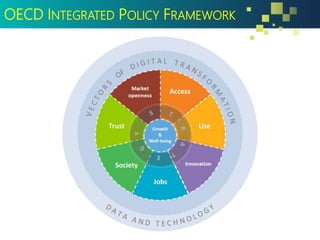
OECD INTEGRATED POLICY FRAMEWORK
FOR DIGITAL TRANSFORMATION
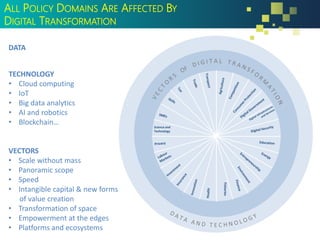
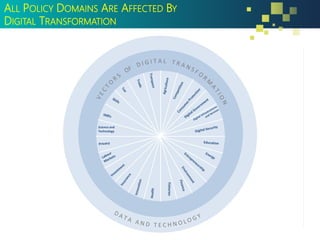
ALL POLICY DOMAINS ARE AFFECTED BY
DIGITAL TRANSFORMATION
Science and
Technology
Fisheries
VECTORS
• Scale without mass
• Panoramic scope
• Speed
• Intangible capital & new forms
of value creation
• Transformation of space
• Empowerment at the edges
• Platforms and ecosystems
TECHNOLOGY
• Cloud computing
• IoT
• Big data analytics
• AI and robotics
• Blockchain…
DATA
V I S I O N
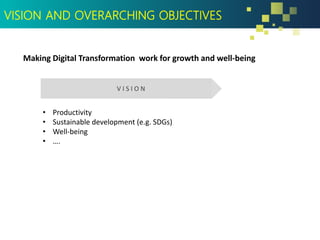
VISION AND OVERARCHING OBJECTIVES
• Productivity
• Sustainable development (e.g. SDGs)
• Well-being
• ….
Making Digital Transformation work for growth and well-being
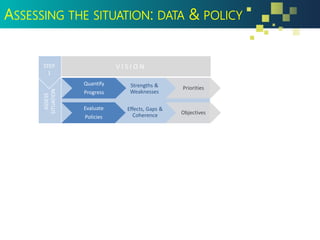
Strengths &
Weaknesses
Priorities
Effects, Gaps &
Coherence Objectives
V I S I O NSTEP
1
ASSESSING THE SITUATION: DATA & POLICY
ASSESS
SITUATION
Quantify
Progress
Evaluate
Policies
ALL POLICY DOMAINS ARE AFFECTED BY
DIGITAL TRANSFORMATION
Science and
Technology
Fisheries
OECD INTEGRATED POLICY FRAMEWORK
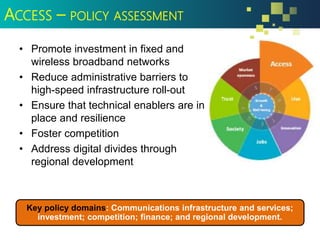
• Promote investment in fixed and
wireless broadband networks
• Reduce administrative barriers to
high-speed infrastructure roll-out
• Ensure that technical enablers are in
place and resilience
• Foster competition
• Address digital divides through
regional development
Key policy domains: Communications infrastructure and services;
investment; competition; finance; and regional development.
ACCESS – POLICY ASSESSMENT
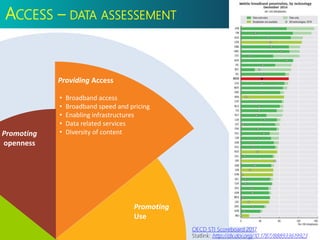
Promoting
openness
Promoting
Use
Providing Access
• Broadband access
• Broadband speed and pricing
• Enabling infrastructures
• Data related services
• Diversity of content
ACCESS – DATA ASSESSEMENT
OECD STI Scoreboard 2017
Statlink: http://dx.doi.org/10.1787/888933619923
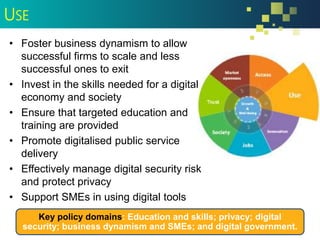
• Foster business dynamism to allow
successful firms to scale and less
successful ones to exit
• Invest in the skills needed for a digital
economy and society
• Ensure that targeted education and
training are provided
• Promote digitalised public service
delivery
• Effectively manage digital security risk
and protect privacy
• Support SMEs in using digital tools
Key policy domains: Education and skills; privacy; digital
security; business dynamism and SMEs; and digital government.
USE
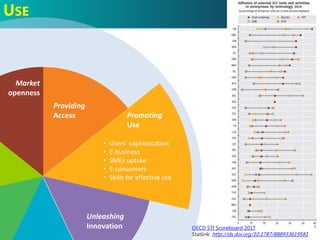
Market
openness
Unleashing
Innovation
Promoting
Use
Providing
Access
• Users’ sophistication
• E-business
• SMEs uptake
• E-consumers
• Skills for effective use
OECD STI Scoreboard 2017
Statlink: http://dx.doi.org/10.1787/888933619581
USE
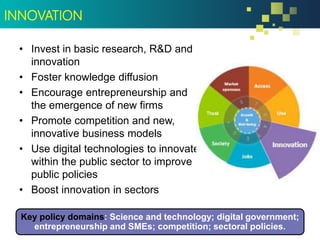
• Invest in basic research, R&D and
innovation
• Foster knowledge diffusion
• Encourage entrepreneurship and
the emergence of new firms
• Promote competition and new,
innovative business models
• Use digital technologies to innovate
within the public sector to improve
public policies
• Boost innovation in sectors
Key policy domains: Science and technology; digital government;
entrepreneurship and SMEs; competition; sectoral policies.
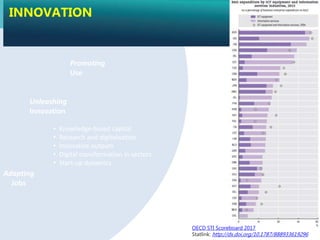
INNOVATION
Adapting
Jobs
Unleashing
Innovation
Promoting
Use
• Knowledge-based capital
• Research and digitalisation
• Innovative outputs
• Digital transformation in sectors
• Start-up dynamics
OECD STI Scoreboard 2017
Statlink: http://dx.doi.org/10.1787/888933619296
INNOVATION
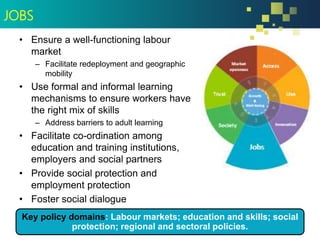
• Ensure a well-functioning labour
market
– Facilitate redeployment and geographic
mobility
• Use formal and informal learning
mechanisms to ensure workers have
the right mix of skills
– Address barriers to adult learning
• Facilitate co-ordination among
education and training institutions,
employers and social partners
• Provide social protection and
employment protection
• Foster social dialogue
Key policy domains: Labour markets; education and skills; social
protection; regional and sectoral policies.
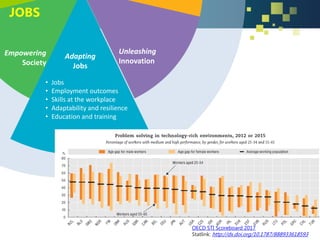
JOBS
Empowering
Society
Adapting
Jobs
Unleashing
Innovation
• Jobs
• Employment outcomes
• Skills at the workplace
• Adaptability and resilience
• Education and training
OECD STI Scoreboard 2017
Statlink: http://dx.doi.org/10.1787/888933618593
JOBS
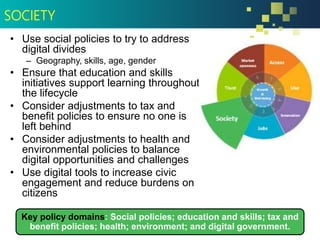
• Use social policies to try to address
digital divides
– Geography, skills, age, gender
• Ensure that education and skills
initiatives support learning throughout
the lifecycle
• Consider adjustments to tax and
benefit policies to ensure no one is
left behind
• Consider adjustments to health and
environmental policies to balance
digital opportunities and challenges
• Use digital tools to increase civic
engagement and reduce burdens on
citizens
Key policy domains: Social policies; education and skills; tax and
benefit policies; health; environment; and digital government.
SOCIETY
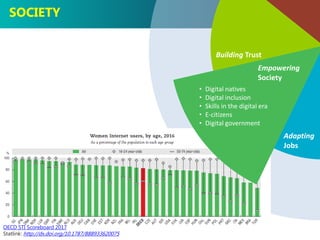
Empowering
Society
Building Trust
Adapting
Jobs
• Digital natives
• Digital inclusion
• Skills in the digital era
• E-citizens
• Digital government
OECD STI Scoreboard 2017
Statlink: http://dx.doi.org/10.1787/888933620075
SOCIETY
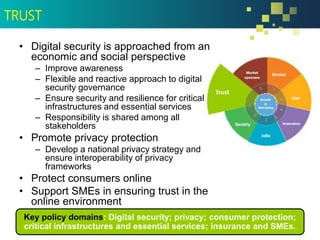
• Digital security is approached from an
economic and social perspective
– Improve awareness
– Flexible and reactive approach to digital
security governance
– Ensure security and resilience for critical
infrastructures and essential services
– Responsibility is shared among all
stakeholders
• Promote privacy protection
– Develop a national privacy strategy and
ensure interoperability of privacy
frameworks
• Protect consumers online
• Support SMEs in ensuring trust in the
online environment
Key policy domains: Digital security; privacy; consumer protection;
critical infrastructures and essential services; insurance and SMEs.
TRUST
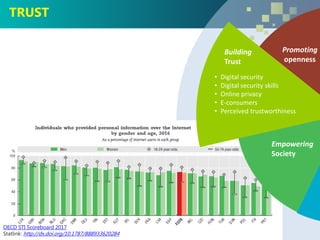
Empowering
Society
Building
Trust
Promoting
openness
• Digital security
• Digital security skills
• Online privacy
• E-consumers
• Perceived trustworthiness
OECD STI Scoreboard 2017
Statlink: http://dx.doi.org/10.1787/888933620284
TRUST
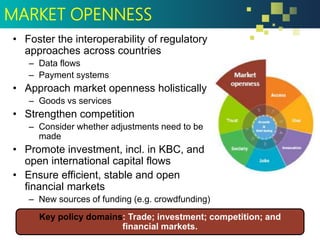
• Foster the interoperability of regulatory
approaches across countries
– Data flows
– Payment systems
• Approach market openness holistically
– Goods vs services
• Strengthen competition
– Consider whether adjustments need to be
made
• Promote investment, incl. in KBC, and
open international capital flows
• Ensure efficient, stable and open
financial markets
– New sources of funding (e.g. crowdfunding)
Key policy domains: Trade; investment; competition; and
financial markets.
MARKET OPENNESS
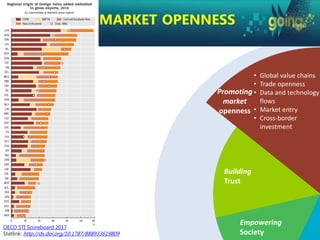
MARKET OPENNESS
Empowering
Society
Building
Trust
Promoting
market
openness
• Global value chains
• Trade openness
• Data and technology
flows
• Market entry
• Cross-border
investment
OECD STI Scoreboard 2017
Statlink: http://dx.doi.org/10.1787/888933619809
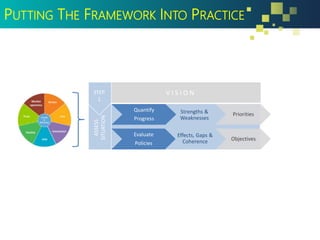
Strengths &
Weaknesses
Priorities
Effects, Gaps &
Coherence Objectives
V I S I O NSTEP
1
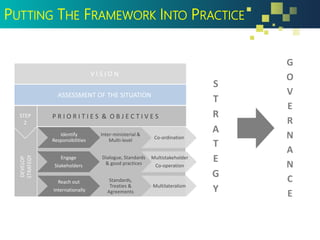
PUTTING THE FRAMEWORK INTO PRACTICE
ASSESS
SITUATION
Quantify
Progress
Evaluate
Policies
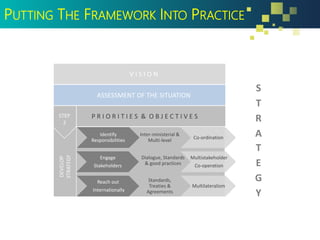
ASSESSMENT OF THE SITUATION
S
T
R
A
T
E
G
Y
PUTTING THE FRAMEWORK INTO PRACTICE
P R I O R I T I E S & O B J E C T I V E S
Identify
Responsibilities
Inter-ministerial &
Multi-level Co-ordination
Engage
Stakeholders
Dialogue, Standards
& good practices
Multistakeholder
Co-operation
Reach out
Internationally
Standards,
Treaties &
Agreements
Multilateralism
V I S I O N
STEP
2
DEVELOP
STRATEGY
S
T
R
A
T
E
G
Y
PUTTING THE FRAMEWORK INTO PRACTICE
G
O
V
E
R
N
A
N
C
E
ASSESSMENT OF THE SITUATION
P R I O R I T I E S & O B J E C T I V E S
Identify
Responsibilities
Inter-ministerial &
Multi-level Co-ordination
Engage
Stakeholders
Dialogue, Standards
& good practices
Multistakeholder
Co-operation
Reach out
Internationally
Standards,
Treaties &
Agreements
Multilateralism
V I S I O N
STEP
2
DEVELOP
STRATEGY
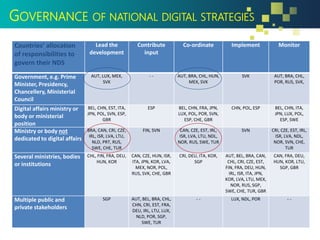
GOVERNANCE OF NATIONAL DIGITAL STRATEGIES
Countries’ allocation
of responsibilities to
govern their NDS
Lead the
development
Contribute
input
Co-ordinate Implement Monitor
Government, e.g. Prime
Minister, Presidency,
Chancellery, Ministerial
Council
AUT, LUX, MEX,
SVK
- - AUT, BRA, CHL, HUN,
MEX, SVK
SVK AUT, BRA, CHL,
POR, RUS, SVK,
Digital affairs ministry or
body or ministerial
position
BEL, CHN, EST, ITA,
JPN, POL, SVN, ESP,
GBR
ESP BEL, CHN, FRA, JPN,
LUX, POL, POR, SVN,
ESP, CHE, GBR
CHN, POL, ESP BEL, CHN, ITA,
JPN, LUX, POL,
ESP, SWE
Ministry or body not
dedicated to digital affairs
BRA, CAN, CRI, CZE,
IRL, ISR, LVA, LTU,
NLD, PRT, RUS,
SWE, CHE, TUR
FIN, SVN CAN, CZE, EST, IRL,
ISR, LVA, LTU, NDL,
NOR, RUS, SWE, TUR
SVN CRI, CZE, EST, IRL,
ISR, LVA, NDL,
NOR, SVN, CHE,
TUR
Several ministries, bodies
or institutions
CHL, FIN, FRA, DEU,
HUN, KOR
CAN, CZE, HUN, ISR,
ITA, JPN, KOR, LVA,
MEX, NOR, POL,
RUS, SVK, CHE, GBR
CRI, DEU, ITA, KOR,
SGP
AUT, BEL, BRA, CAN,
CHL, CRI, CZE, EST,
FIN, FRA, DEU, HUN,
IRL, ISR, ITA, JPN,
KOR, LVA, LTU, MEX,
NOR, RUS, SGP,
SWE, CHE, TUR, GBR
CAN, FRA, DEU,
HUN, KOR, LTU,
SGP, GBR
Multiple public and
private stakeholders
SGP AUT, BEL, BRA, CHL,
CHN, CRI, EST, FRA,
DEU, IRL, LTU, LUX,
NLD, POR, SGP,
SWE, TUR
- - LUX, NDL, POR - -
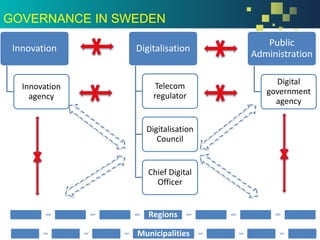
GOVERNANCE IN SWEDEN
Innovation
Innovation
agency
Digitalisation
Telecom
regulator
Digitalisation
Council
Chief Digital
Officer
Public
Administration
Digital
government
agency
Regions
Municipalities
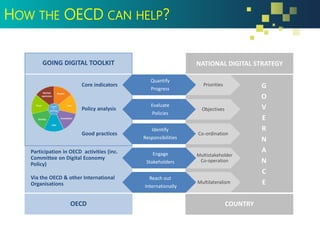
HOW THE OECD CAN HELP?
Policy analysis
Good practices
Participation in OECD activities (inc.
Committee on Digital Economy
Policy)
Via the OECD & other International
Organisations
Core indicators
GOING DIGITAL TOOLKIT
Identify
Responsibilities
Engage
Stakeholders
Reach out
Internationally
NATIONAL DIGITAL STRATEGY
Evaluate
Policies
G
O
V
E
R
N
A
N
C
E
Priorities
Objectives
Co-ordination
Multistakeholder
Co-operation
Multilateralism
OECD
Quantify
Progress
COUNTRY
OECD’s “Going Digital” project
Going Digital Interim Report:
http://www.oecd.org/mcm/documents/C-MIN-2018-6-EN.pdf
Going Digital website: http://oecd.org/going-digital
Twitter: @OECDinnovation
Subscribe to the STI newsletter: www.oecd.org/sti/news.htm

Key issues for digital transformation

  • 1.
    KEY ISSUES FORDIGITAL TRANSFORMATION Brasilia, 28 June 2018 Anne.Carblanc@oecd.org
  • 2.
    GOING DIGITAL KEY ISSUESAND STRATEGY FOR DIGITAL TRANSFORMATION OECD INTEGRATED POLICY FRAMEWORK FOR DIGITAL TRANSFORMATION
  • 3.
    ALL POLICY DOMAINSARE AFFECTED BY DIGITAL TRANSFORMATION Science and Technology Fisheries VECTORS • Scale without mass • Panoramic scope • Speed • Intangible capital & new forms of value creation • Transformation of space • Empowerment at the edges • Platforms and ecosystems TECHNOLOGY • Cloud computing • IoT • Big data analytics • AI and robotics • Blockchain… DATA
  • 4.
    V I SI O N VISION AND OVERARCHING OBJECTIVES • Productivity • Sustainable development (e.g. SDGs) • Well-being • …. Making Digital Transformation work for growth and well-being
  • 5.
    Strengths & Weaknesses Priorities Effects, Gaps& Coherence Objectives V I S I O NSTEP 1 ASSESSING THE SITUATION: DATA & POLICY ASSESS SITUATION Quantify Progress Evaluate Policies
  • 6.
    ALL POLICY DOMAINSARE AFFECTED BY DIGITAL TRANSFORMATION Science and Technology Fisheries
  • 7.
  • 8.
    • Promote investmentin fixed and wireless broadband networks • Reduce administrative barriers to high-speed infrastructure roll-out • Ensure that technical enablers are in place and resilience • Foster competition • Address digital divides through regional development Key policy domains: Communications infrastructure and services; investment; competition; finance; and regional development. ACCESS – POLICY ASSESSMENT
  • 9.
    Promoting openness Promoting Use Providing Access • Broadbandaccess • Broadband speed and pricing • Enabling infrastructures • Data related services • Diversity of content ACCESS – DATA ASSESSEMENT OECD STI Scoreboard 2017 Statlink: http://dx.doi.org/10.1787/888933619923
  • 10.
    • Foster businessdynamism to allow successful firms to scale and less successful ones to exit • Invest in the skills needed for a digital economy and society • Ensure that targeted education and training are provided • Promote digitalised public service delivery • Effectively manage digital security risk and protect privacy • Support SMEs in using digital tools Key policy domains: Education and skills; privacy; digital security; business dynamism and SMEs; and digital government. USE
  • 11.
    Market openness Unleashing Innovation Promoting Use Providing Access • Users’ sophistication •E-business • SMEs uptake • E-consumers • Skills for effective use OECD STI Scoreboard 2017 Statlink: http://dx.doi.org/10.1787/888933619581 USE
  • 12.
    • Invest inbasic research, R&D and innovation • Foster knowledge diffusion • Encourage entrepreneurship and the emergence of new firms • Promote competition and new, innovative business models • Use digital technologies to innovate within the public sector to improve public policies • Boost innovation in sectors Key policy domains: Science and technology; digital government; entrepreneurship and SMEs; competition; sectoral policies. INNOVATION
  • 13.
    Adapting Jobs Unleashing Innovation Promoting Use • Knowledge-based capital •Research and digitalisation • Innovative outputs • Digital transformation in sectors • Start-up dynamics OECD STI Scoreboard 2017 Statlink: http://dx.doi.org/10.1787/888933619296 INNOVATION
  • 14.
    • Ensure awell-functioning labour market – Facilitate redeployment and geographic mobility • Use formal and informal learning mechanisms to ensure workers have the right mix of skills – Address barriers to adult learning • Facilitate co-ordination among education and training institutions, employers and social partners • Provide social protection and employment protection • Foster social dialogue Key policy domains: Labour markets; education and skills; social protection; regional and sectoral policies. JOBS
  • 15.
    Empowering Society Adapting Jobs Unleashing Innovation • Jobs • Employmentoutcomes • Skills at the workplace • Adaptability and resilience • Education and training OECD STI Scoreboard 2017 Statlink: http://dx.doi.org/10.1787/888933618593 JOBS
  • 16.
    • Use socialpolicies to try to address digital divides – Geography, skills, age, gender • Ensure that education and skills initiatives support learning throughout the lifecycle • Consider adjustments to tax and benefit policies to ensure no one is left behind • Consider adjustments to health and environmental policies to balance digital opportunities and challenges • Use digital tools to increase civic engagement and reduce burdens on citizens Key policy domains: Social policies; education and skills; tax and benefit policies; health; environment; and digital government. SOCIETY
  • 17.
    Empowering Society Building Trust Adapting Jobs • Digitalnatives • Digital inclusion • Skills in the digital era • E-citizens • Digital government OECD STI Scoreboard 2017 Statlink: http://dx.doi.org/10.1787/888933620075 SOCIETY
  • 18.
    • Digital securityis approached from an economic and social perspective – Improve awareness – Flexible and reactive approach to digital security governance – Ensure security and resilience for critical infrastructures and essential services – Responsibility is shared among all stakeholders • Promote privacy protection – Develop a national privacy strategy and ensure interoperability of privacy frameworks • Protect consumers online • Support SMEs in ensuring trust in the online environment Key policy domains: Digital security; privacy; consumer protection; critical infrastructures and essential services; insurance and SMEs. TRUST
  • 19.
    Empowering Society Building Trust Promoting openness • Digital security •Digital security skills • Online privacy • E-consumers • Perceived trustworthiness OECD STI Scoreboard 2017 Statlink: http://dx.doi.org/10.1787/888933620284 TRUST
  • 20.
    • Foster theinteroperability of regulatory approaches across countries – Data flows – Payment systems • Approach market openness holistically – Goods vs services • Strengthen competition – Consider whether adjustments need to be made • Promote investment, incl. in KBC, and open international capital flows • Ensure efficient, stable and open financial markets – New sources of funding (e.g. crowdfunding) Key policy domains: Trade; investment; competition; and financial markets. MARKET OPENNESS
  • 21.
    MARKET OPENNESS Empowering Society Building Trust Promoting market openness • Globalvalue chains • Trade openness • Data and technology flows • Market entry • Cross-border investment OECD STI Scoreboard 2017 Statlink: http://dx.doi.org/10.1787/888933619809
  • 22.
    Strengths & Weaknesses Priorities Effects, Gaps& Coherence Objectives V I S I O NSTEP 1 PUTTING THE FRAMEWORK INTO PRACTICE ASSESS SITUATION Quantify Progress Evaluate Policies
  • 23.
    ASSESSMENT OF THESITUATION S T R A T E G Y PUTTING THE FRAMEWORK INTO PRACTICE P R I O R I T I E S & O B J E C T I V E S Identify Responsibilities Inter-ministerial & Multi-level Co-ordination Engage Stakeholders Dialogue, Standards & good practices Multistakeholder Co-operation Reach out Internationally Standards, Treaties & Agreements Multilateralism V I S I O N STEP 2 DEVELOP STRATEGY
  • 24.
    S T R A T E G Y PUTTING THE FRAMEWORKINTO PRACTICE G O V E R N A N C E ASSESSMENT OF THE SITUATION P R I O R I T I E S & O B J E C T I V E S Identify Responsibilities Inter-ministerial & Multi-level Co-ordination Engage Stakeholders Dialogue, Standards & good practices Multistakeholder Co-operation Reach out Internationally Standards, Treaties & Agreements Multilateralism V I S I O N STEP 2 DEVELOP STRATEGY
  • 25.
    GOVERNANCE OF NATIONALDIGITAL STRATEGIES Countries’ allocation of responsibilities to govern their NDS Lead the development Contribute input Co-ordinate Implement Monitor Government, e.g. Prime Minister, Presidency, Chancellery, Ministerial Council AUT, LUX, MEX, SVK - - AUT, BRA, CHL, HUN, MEX, SVK SVK AUT, BRA, CHL, POR, RUS, SVK, Digital affairs ministry or body or ministerial position BEL, CHN, EST, ITA, JPN, POL, SVN, ESP, GBR ESP BEL, CHN, FRA, JPN, LUX, POL, POR, SVN, ESP, CHE, GBR CHN, POL, ESP BEL, CHN, ITA, JPN, LUX, POL, ESP, SWE Ministry or body not dedicated to digital affairs BRA, CAN, CRI, CZE, IRL, ISR, LVA, LTU, NLD, PRT, RUS, SWE, CHE, TUR FIN, SVN CAN, CZE, EST, IRL, ISR, LVA, LTU, NDL, NOR, RUS, SWE, TUR SVN CRI, CZE, EST, IRL, ISR, LVA, NDL, NOR, SVN, CHE, TUR Several ministries, bodies or institutions CHL, FIN, FRA, DEU, HUN, KOR CAN, CZE, HUN, ISR, ITA, JPN, KOR, LVA, MEX, NOR, POL, RUS, SVK, CHE, GBR CRI, DEU, ITA, KOR, SGP AUT, BEL, BRA, CAN, CHL, CRI, CZE, EST, FIN, FRA, DEU, HUN, IRL, ISR, ITA, JPN, KOR, LVA, LTU, MEX, NOR, RUS, SGP, SWE, CHE, TUR, GBR CAN, FRA, DEU, HUN, KOR, LTU, SGP, GBR Multiple public and private stakeholders SGP AUT, BEL, BRA, CHL, CHN, CRI, EST, FRA, DEU, IRL, LTU, LUX, NLD, POR, SGP, SWE, TUR - - LUX, NDL, POR - -
  • 26.
    GOVERNANCE IN SWEDEN Innovation Innovation agency Digitalisation Telecom regulator Digitalisation Council ChiefDigital Officer Public Administration Digital government agency Regions Municipalities
  • 27.
    HOW THE OECDCAN HELP? Policy analysis Good practices Participation in OECD activities (inc. Committee on Digital Economy Policy) Via the OECD & other International Organisations Core indicators GOING DIGITAL TOOLKIT Identify Responsibilities Engage Stakeholders Reach out Internationally NATIONAL DIGITAL STRATEGY Evaluate Policies G O V E R N A N C E Priorities Objectives Co-ordination Multistakeholder Co-operation Multilateralism OECD Quantify Progress COUNTRY
  • 28.
    OECD’s “Going Digital”project Going Digital Interim Report: http://www.oecd.org/mcm/documents/C-MIN-2018-6-EN.pdf Going Digital website: http://oecd.org/going-digital Twitter: @OECDinnovation Subscribe to the STI newsletter: www.oecd.org/sti/news.htm

Editor's Notes

  • #26 This table provides you an overview of the responsibilities for governing national digital strategies.
  • #29 The first phase of the Going Digital project will culminate in a high-level conference on 11-12 March 2019 in Paris.