MATHEMATICSCurriculum and Assessment Policy Statement (CAPS)Intermediate PhaseGrades 4 - 6Presented by: Peggy Seeliger and Ina Nel
Background (Task Team Report)Review of the Implementation of the NCS(Oct 2009)NCS should be rationalised … in the form of CAPS
Clear, to the point, measurable …
Content, concepts and skills …
Organised around knowledge, recommended methods and assessment requirements.Tuesday, October 12, 2010Mathematics Curriculum and Assessment Policy (CAPS)2
Brief of the CAPS team(from MPC)Repackagethe current NCS into a simple content-based curriculum by:Filling gaps within the Phase
Presenting it in a teacher-friendly format
Ensuring seamless transition between Phases Develop a single Curriculum and Assessment Policy Statement (CAPS)Give guidelines per grade on what teachers must teach and assessTuesday, October 12, 2010Mathematics Curriculum and Assessment Policy (CAPS)3
Intermediate Phase Focus Mental calculations are important Pocket calculators are NOT recommended for basic calculationsStrong focus  on concept development – CONTENT-BASEDTeaching programme/ work schedule is suggestedExamples give guidance andrepresent MINIMUM standardsProblem-solving as an integral part of Mathematics teaching and learningTuesday, October 12, 2010Mathematics Curriculum and Assessment Policy (CAPS)4
Three important QuestionsTuesday, October 12, 2010Mathematics Curriculum and Assessment Policy (CAPS)5
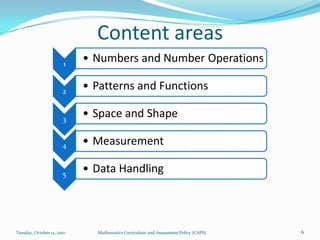
Content areasTuesday, October 12, 2010Mathematics Curriculum and Assessment Policy (CAPS)6
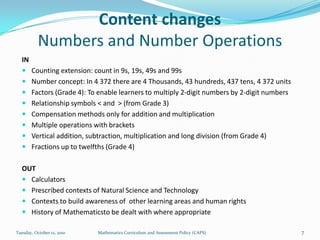
Content changesNumbers and Number Operations INCounting extension: count in 9s, 19s, 49s and 99sNumber concept: In 4 372 there are 4 Thousands, 43 hundreds, 437 tens, 4 372 unitsFactors (Grade 4): To enable learners to multiply 2-digit numbers by 2-digit numbersRelationship symbols < and  > (from Grade 3)Compensation methods only for addition and multiplication Multiple operations with bracketsVertical addition, subtraction, multiplication and long division (from Grade 4)Fractions up to twelfths (Grade 4) OUTCalculatorsPrescribed contexts of Natural Science and TechnologyContexts to build awareness of  other learning areas and human rights History of Mathematicsto be dealt with where appropriate Tuesday, October 12, 2010Mathematics Curriculum and Assessment Policy (CAPS)7
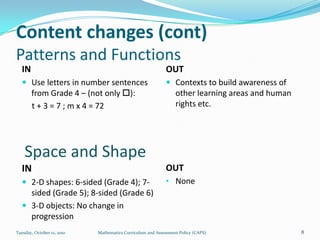
Content changes (cont)Patterns and Functions INUse letters in number sentences from Grade 4 – (not only ):     t + 3 = 7 ; m x 4 = 72OUTContexts to build awareness of  other learning areas and human rights etc. Tuesday, October 12, 2010Mathematics Curriculum and Assessment Policy (CAPS)8Space and Shape IN2-D shapes: 6-sided (Grade 4); 7-sided (Grade 5); 8-sided (Grade 6)
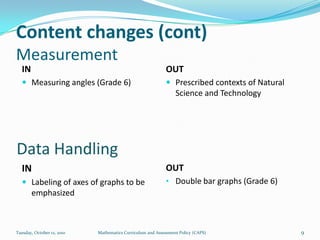
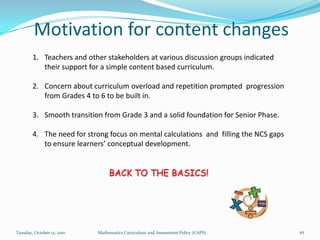
3-D objects: No change in progressionOUTNoneContent changes (cont)Measurement INMeasuring angles (Grade 6)OUTPrescribed contexts of Natural Science and TechnologyTuesday, October 12, 2010Mathematics Curriculum and Assessment Policy (CAPS)9Data Handling INLabeling of axes of graphs to be emphasized OUTDouble bar graphs (Grade 6) Motivation for content changesTeachers and other stakeholders at various discussion groups indicated their support for a simple content based curriculum.Concern about curriculum overload and repetition prompted  progression from Grades 4 to 6 to be built in. Smooth transition from Grade 3 and a solid foundation for Senior Phase.The need for strong focus on mental calculations  and  filling the NCS gaps to ensure learners’ conceptual development.BACK TO THE BASICS!Tuesday, October 12, 2010Mathematics Curriculum and Assessment Policy (CAPS)10
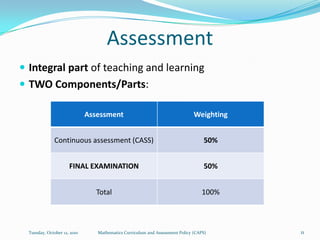
AssessmentIntegral part of teaching and learningTWO Components/Parts:Tuesday, October 12, 2010Mathematics Curriculum and Assessment Policy (CAPS)11
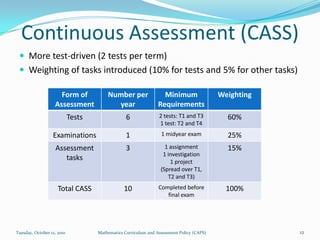
Continuous Assessment (CASS)More test-driven (2 tests per term)Weighting of tasks introduced (10% for tests and 5% for other tasks)Tuesday, October 12, 2010Mathematics Curriculum and Assessment Policy (CAPS)12

Mathematics caps intermediate phase

  • 1.
    MATHEMATICSCurriculum and AssessmentPolicy Statement (CAPS)Intermediate PhaseGrades 4 - 6Presented by: Peggy Seeliger and Ina Nel
  • 2.
    Background (Task TeamReport)Review of the Implementation of the NCS(Oct 2009)NCS should be rationalised … in the form of CAPS
  • 3.
    Clear, to thepoint, measurable …
  • 4.
  • 5.
    Organised around knowledge,recommended methods and assessment requirements.Tuesday, October 12, 2010Mathematics Curriculum and Assessment Policy (CAPS)2
  • 6.
    Brief of theCAPS team(from MPC)Repackagethe current NCS into a simple content-based curriculum by:Filling gaps within the Phase
  • 7.
    Presenting it ina teacher-friendly format
  • 8.
    Ensuring seamless transitionbetween Phases Develop a single Curriculum and Assessment Policy Statement (CAPS)Give guidelines per grade on what teachers must teach and assessTuesday, October 12, 2010Mathematics Curriculum and Assessment Policy (CAPS)3
  • 9.
    Intermediate Phase FocusMental calculations are important Pocket calculators are NOT recommended for basic calculationsStrong focus on concept development – CONTENT-BASEDTeaching programme/ work schedule is suggestedExamples give guidance andrepresent MINIMUM standardsProblem-solving as an integral part of Mathematics teaching and learningTuesday, October 12, 2010Mathematics Curriculum and Assessment Policy (CAPS)4
  • 10.
    Three important QuestionsTuesday,October 12, 2010Mathematics Curriculum and Assessment Policy (CAPS)5
  • 11.
    Content areasTuesday, October12, 2010Mathematics Curriculum and Assessment Policy (CAPS)6
  • 12.
    Content changesNumbers andNumber Operations INCounting extension: count in 9s, 19s, 49s and 99sNumber concept: In 4 372 there are 4 Thousands, 43 hundreds, 437 tens, 4 372 unitsFactors (Grade 4): To enable learners to multiply 2-digit numbers by 2-digit numbersRelationship symbols < and > (from Grade 3)Compensation methods only for addition and multiplication Multiple operations with bracketsVertical addition, subtraction, multiplication and long division (from Grade 4)Fractions up to twelfths (Grade 4) OUTCalculatorsPrescribed contexts of Natural Science and TechnologyContexts to build awareness of other learning areas and human rights History of Mathematicsto be dealt with where appropriate Tuesday, October 12, 2010Mathematics Curriculum and Assessment Policy (CAPS)7
  • 13.
    Content changes (cont)Patternsand Functions INUse letters in number sentences from Grade 4 – (not only ): t + 3 = 7 ; m x 4 = 72OUTContexts to build awareness of other learning areas and human rights etc. Tuesday, October 12, 2010Mathematics Curriculum and Assessment Policy (CAPS)8Space and Shape IN2-D shapes: 6-sided (Grade 4); 7-sided (Grade 5); 8-sided (Grade 6)
  • 14.
    3-D objects: Nochange in progressionOUTNoneContent changes (cont)Measurement INMeasuring angles (Grade 6)OUTPrescribed contexts of Natural Science and TechnologyTuesday, October 12, 2010Mathematics Curriculum and Assessment Policy (CAPS)9Data Handling INLabeling of axes of graphs to be emphasized OUTDouble bar graphs (Grade 6) Motivation for content changesTeachers and other stakeholders at various discussion groups indicated their support for a simple content based curriculum.Concern about curriculum overload and repetition prompted progression from Grades 4 to 6 to be built in. Smooth transition from Grade 3 and a solid foundation for Senior Phase.The need for strong focus on mental calculations and filling the NCS gaps to ensure learners’ conceptual development.BACK TO THE BASICS!Tuesday, October 12, 2010Mathematics Curriculum and Assessment Policy (CAPS)10
  • 15.
    AssessmentIntegral part ofteaching and learningTWO Components/Parts:Tuesday, October 12, 2010Mathematics Curriculum and Assessment Policy (CAPS)11
  • 16.
    Continuous Assessment (CASS)Moretest-driven (2 tests per term)Weighting of tasks introduced (10% for tests and 5% for other tasks)Tuesday, October 12, 2010Mathematics Curriculum and Assessment Policy (CAPS)12