National Curriculum Statement (NCS)

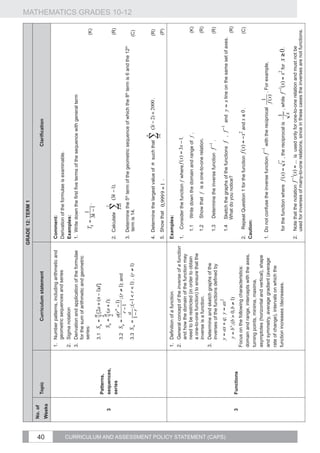
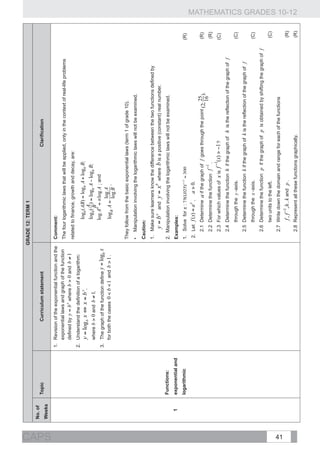
                                 Curriculum and Assessment
                                       Policy Statement
MATHEMATICS


                       Further Education and Training Phase
                                  Grades 10-12


      basic education
      Department:
      Basic Education
      REPUBLIC OF SOUTH AFRICA
Curriculum and Assessment Policy Statement
                  GRADES 10-12


                  MATHEMATICS


CAPS
MATHEMATICS GRADES 10-12


Department of Basic Education


222 Struben Street
Private Bag X895
Pretoria 0001
South Africa
Tel: +27 12 357 3000
Fax: +27 12 323 0601


120 Plein Street Private Bag X9023
Cape Town 8000
South Africa
Tel: +27 21 465 1701
Fax: +27 21 461 8110
Website: http://www.education.gov.za


© 2011 Department of Basic Education


Isbn: 978-1-4315-0573-9


Design and Layout by: Ndabase Printing Solution

Printed by: Government Printing Works


                     CURRICULUM AND ASSESSMENT POLICY STATEMENT (CAPS)
AGRICULTURAL MANAGEMENT PRACTICES GRADES 10-12
                                               MATHEMATICS
FOREWORD by thE ministER

                                 Our national curriculum is the culmination of our efforts over a period of seventeen
                                 years to transform the curriculum bequeathed to us by apartheid. From the start of
                                 democracy we have built our curriculum on the values that inspired our Constitution
                                 (Act 108 of 1996). the Preamble to the Constitution states that the aims of the
                                 Constitution are to:

                                 •	    heal	 the	 divisions	 of	 the	 past	 and	 establish	 a	 society	 based	 on	 democratic	
                                       values, social justice and fundamental human rights;

                                 •	    improve	the	quality	of	life	of	all	citizens	and	free	the	potential	of	each	person;

                                 •	    lay	the	foundations	for	a	democratic	and	open	society	in	which	government	is	
                                       based	on	the	will	of	the	people	and	every	citizen	is	equally	protected	by	law;	
                                       and

•	    build	a	united	and	democratic	South	Africa	able	to	take	its	rightful	place	as	a	sovereign	state	in	the	family	of	
      nations.

Education and the curriculum have an important role to play in realising these aims.

in 1997 we introduced outcomes-based education to overcome the curricular divisions of the past, but the experience
of	implementation	prompted	a	review	in	2000.	This	led	to	the	first	curriculum	revision:	the	Revised National Curriculum
Statement Grades R-9 and the National Curriculum Statement Grades 10-12 (2002).

Ongoing implementation challenges resulted in another review in 2009 and we revised the Revised National
Curriculum Statement (2002) to produce this document.

From 2012 the two 2002 curricula, for Grades R-9 and Grades 10-12 respectively, are combined in a single document
and	will	simply	be	known	as	the	National Curriculum Statement Grades R-12. the National Curriculum Statement for
Grades R-12 builds	on	the	previous	curriculum	but	also	updates	it	and	aims	to	provide	clearer	specification	of	what	
is to be taught and learnt on a term-by-term basis.

the National Curriculum Statement Grades R-12 accordingly replaces the subject statements, Learning Programme
Guidelines and subject Assessment Guidelines with the

(a)   Curriculum and Assessment Policy statements (CAPs) for all approved subjects listed in this document;

(b)   National policy pertaining to the programme and promotion requirements of the National Curriculum Statement
      Grades R-12; and

(c)   National Protocol for Assessment Grades R-12.


MRS ANGIE MOTSHEKGA, MP
MINISTER OF BASIC EDUCATION


CAPS
MATHEMATICS GRADES 10-12


         CURRICULUM AND ASSESSMENT POLICY STATEMENT (CAPS)
MATHEMATICS GRADES 10-12
contents

Section 1: INTRODUCTION TO THE CURRICULUM AND ASSESSMENT POLICY STATEMENTS... 3

1.1	Background .....................................................................................................................................................3

1.2	Overview...........................................................................................................................................................3

1.3	     General aims of the South African Curriculum.............................................................................................4

1.4	     Time allocation.................................................................................................................................................6

	        1.4.1	 Foundation Phase....................................................................................................................................6

	        1.4.2 	Intermediate Phase..................................................................................................................................6

	        1.4.3 	Senior Phase...........................................................................................................................................7

	        1.4.4 	Grades 10-12...........................................................................................................................................7


SECTION 2: INTRODUCTION TO MATHEMATICS................................................................................... 8

2.1	     What is Mathematics?.....................................................................................................................................8

2.2	     Specific Aims....................................................................................................................................................8

2.3	     Specific Skills...................................................................................................................................................8

2.4	     Focus of Content Areas...................................................................................................................................9

2.5	     Weighting of Content Areas............................................................................................................................9

2.6	Mathematics in the FET.................................................................................................................................10


SECTION 3: OVERVIEW OF TOPICS PER TERM AND ANNUAL TEACHING PLANS........................ 11

3.1	     Specification of content to show Progression............................................................................................11

	        3.1.1	Overview of topics..................................................................................................................................12

3.2	     Content clarification with teaching guidelines............................................................................................16

	        3.2.1	 Allocation of teaching time.....................................................................................................................16

	        3.2.2	 Sequencing and pacing of topics...........................................................................................................18

	        3.2.3	 Topic allocation per term........................................................................................................................21

		                Grade 10 Term: 1...................................................................................................................................21

		                Grade 10 Term: 2...................................................................................................................................24

		                Grade 10 Term: 3...................................................................................................................................26

		                Grade 10 Term: 4...................................................................................................................................29

		                Grade 11 Term: 1...................................................................................................................................30

		                Grade 11 Term: 2...................................................................................................................................32

		                Grade 11 Term: 3...................................................................................................................................34


CAPS                                                                                                                                                           1
MATHEMATICS GRADES 10-12
		                 Grade 11 Term: 4...................................................................................................................................39

		Grade 12 Term:1....................................................................................................................................40

		                 Grade 12 Term: 2...................................................................................................................................44

		                 Grade 12 Term: 3...................................................................................................................................48

		                 Grade 12 Term: 4...................................................................................................................................50


SECTION 4: ASSESSMENT IN MATHEMATICS..................................................................................... 51

4.1.	 Introduction....................................................................................................................................................51

4.2.	 Informal or Daily Assessment.......................................................................................................................51

4.3.	 Formal Assessment.......................................................................................................................................52

4.4.	 Programme of Assessment...........................................................................................................................53

4.5.	 Recording and reporting...............................................................................................................................55

4.6.	 Moderation of Assessment...........................................................................................................................56

4.7.	 General............................................................................................................................................................56


          2               CURRICULUM AND ASSESSMENT POLICY STATEMENT (CAPS)
MATHEMATICS GRADES 10-12
sECTION 1

INTRODUCTION TO THE Curriculum and Assessment Policy StatementS for
MATHEMATICS gradeS 10-12


1.1	Background

The National Curriculum Statement Grades R-12 (NCS) stipulates policy on curriculum and assessment in the
schooling sector.

To improve implementation, the National Curriculum Statement was amended, with the amendments coming into
effect in January 2012. A single comprehensive Curriculum and Assessment Policy document was developed for
each subject to replace Subject Statements, Learning Programme Guidelines and Subject Assessment Guidelines
in Grades R-12.


1.2	Overview

(a)	The National Curriculum Statement Grades R-12 (January 2012) represents a policy statement for learning
    and teaching in South African schools and comprises the following:

       (i)	     Curriculum and Assessment Policy Statements for each approved school subject;

       (ii)	    The policy document, National policy pertaining to the programme and promotion requirements of the
                National Curriculum Statement Grades R-12; and

       (iii)	   The policy document, National Protocol for Assessment Grades R-12 (January 2012).

(b)	The National Curriculum Statement Grades R-12 (January 2012) replaces the two current national curricula
    statements, namely the

       (i)	     Revised National Curriculum Statement Grades R-9, Government Gazette No. 23406 of 31 May 2002,
                and

       (ii)	    National Curriculum Statement Grades 10-12 Government Gazettes, No. 25545 of 6 October 2003 and
                No. 27594 of 17 May 2005.

(c)	   The national curriculum statements contemplated in subparagraphs b(i) and (ii) comprise the following policy
       documents which will be incrementally repealed by the National Curriculum Statement Grades R-12 (January
       2012) during the period 2012-2014:

       (i)	     The Learning Area/Subject Statements, Learning Programme Guidelines and Subject Assessment
                Guidelines for Grades R-9 and Grades 10-12;

       (ii)	    The policy document, National Policy on assessment and qualifications for schools in the General
                Education and Training Band, promulgated in Government Notice No. 124 in Government Gazette No.
                29626 of 12 February 2007;

       (iii)	   The policy document, the National Senior Certificate: A qualification at Level 4 on the National
                Qualifications Framework (NQF), promulgated in Government Gazette No.27819 of 20 July 2005;


CAPS                                                                                                      3
MATHEMATICS GRADES 10-12
       (iv)	   The policy document, An addendum to the policy document, the National Senior Certificate: A
               qualification at Level 4 on the National Qualifications Framework (NQF), regarding learners with special
               needs, published in Government Gazette, No.29466 of 11 December 2006, is incorporated in the policy
               document, National policy pertaining to the programme and promotion requirements of the National
               Curriculum Statement Grades R-12; and

       (v)	    The policy document, An addendum to the policy document, the National Senior Certificate: A
               qualification at Level 4 on the National Qualifications Framework (NQF), regarding the National Protocol
               for Assessment (Grades R-12), promulgated in Government Notice No.1267 in Government Gazette
               No. 29467 of 11 December 2006.

(d)	   The policy document, National policy pertaining to the programme and promotion requirements of the
       National Curriculum Statement Grades R-12, and the sections on the Curriculum and Assessment Policy as
       contemplated in Chapters 2, 3 and 4 of this document constitute the norms and standards of the National
       Curriculum Statement Grades R-12. It will therefore, in terms of section 6A of the South African Schools Act,
       1996 (Act No. 84 of 1996,) form the basis for the Minister of Basic Education to determine minimum outcomes
       and standards, as well as the processes and procedures for the assessment of learner achievement to be
       applicable to public and independent schools.


1.3	 General aims of the South African Curriculum

(a)	The National Curriculum Statement Grades R-12 gives expression to the knowledge, skills and values worth
       learning in South African schools. This curriculum aims to ensure that children acquire and apply knowledge
       and skills in ways that are meaningful to their own lives. In this regard, the curriculum promotes knowledge in
       local contexts, while being sensitive to global imperatives.

(b)	   The National Curriculum Statement Grades R-12 serves the purposes of:

       •	 equipping learners, irrespective of their socio-economic background, race, gender, physical ability or
           intellectual ability, with the knowledge, skills and values necessary for self-fulfilment, and meaningful
           participation in society as citizens of a free country;

       •	 providing access to higher education;

       •	 facilitating the transition of learners from education institutions to the workplace; and

       •	 providing employers with a sufficient profile of a learner’s competences.

(c)	   The National Curriculum Statement Grades R-12 is based on the following principles:

       •	 Social transformation: ensuring that the educational imbalances of the past are redressed, and that equal
           educational opportunities are provided for all sections of the population;

       •	 Active and critical learning: encouraging an active and critical approach to learning, rather than rote and
           uncritical learning of given truths;

       •	 High knowledge and high skills: the minimum standards of knowledge and skills to be achieved at each
           grade are specified and set high, achievable standards in all subjects;

       •	 Progression: content and context of each grade shows progression from simple to complex;


       4           CURRICULUM AND ASSESSMENT POLICY STATEMENT (CAPS)
MATHEMATICS GRADES 10-12
       •	 Human rights, inclusivity, environmental and social justice: infusing the principles and practices of social and
          environmental justice and human rights as defined in the Constitution of the Republic of South Africa. The
          National Curriculum Statement Grades R-12 is sensitive to issues of diversity such as poverty, inequality,
          race, gender, language, age, disability and other factors;

       •	 Valuing indigenous knowledge systems: acknowledging the rich history and heritage of this country as
          important contributors to nurturing the values contained in the Constitution; and

       •	 Credibility, quality and efficiency: providing an education that is comparable in quality, breadth and depth to
          those of other countries.

(d)	   The National Curriculum Statement Grades R-12 aims to produce learners that are able to:

       •	 identify and solve problems and make decisions using critical and creative thinking;

       •	 work effectively as individuals and with others as members of a team;

       •	 organise and manage themselves and their activities responsibly and effectively;

       •	 collect, analyse, organise and critically evaluate information;

       •	 communicate effectively using visual, symbolic and/or language skills in various modes;

       •	 use science and technology effectively and critically showing responsibility towards the environment and
          the health of others; and

       •	 demonstrate an understanding of the world as a set of related systems by recognising that problem solving
          contexts do not exist in isolation.

(e)	   Inclusivity should become a central part of the organisation, planning and teaching at each school. This can
       only happen if all teachers have a sound understanding of how to recognise and address barriers to learning,
       and how to plan for diversity.

	      The key to managing inclusivity is ensuring that barriers are identified and addressed by all the relevant support
       structures within the school community, including teachers, District-Based Support Teams, Institutional-Level
       Support Teams, parents and Special Schools as Resource Centres. To address barriers in the classroom,
       teachers should use various curriculum differentiation strategies such as those included in the Department of
       Basic Education’s Guidelines for Inclusive Teaching and Learning (2010).


CAPS                                                                                                             5
MATHEMATICS GRADES 10-12
1.4	Time Allocation

1.4.1	 Foundation Phase

(a)	   The instructional time in the Foundation Phase is as follows:

                                                             GRADE R           GRADES 1-2            GRADE 3
                           SUBJECT
                                                             (HOURS)            (HOURS)              (HOURS)
        Home Language                                           10                  8/7                 8/7
        First Additional Language                                                   2/3                 3/4
        Mathematics                                              7                   7                   7
        Life Skills                                              6                   6                   7

        •	 Beginning Knowledge                                  (1)                 (1)                 (2)

        •	 Creative Arts                                        (2)                 (2)                 (2)

        •	 Physical Education                                   (2)                 (2)                 (2)

        •	 Personal and Social Well-being                       (1)                 (1)                 (1)
        TOTAL                                                   23                  23                  25


(b)	   Instructional time for Grades R, 1 and 2 is 23 hours and for Grade 3 is 25 hours.

(c)	   Ten hours are allocated for languages in Grades R-2 and 11 hours in Grade 3. A maximum of 8 hours and a
       minimum of 7 hours are allocated for Home Language and a minimum of 2 hours and a maximum of 3 hours for
       Additional Language in Grades 1-2. In Grade 3 a maximum of 8 hours and a minimum of 7 hours are allocated
       for Home Language and a minimum of 3 hours and a maximum of 4 hours for First Additional Language.

(d)	   In Life Skills Beginning Knowledge is allocated 1 hour in Grades R-2 and 2 hours as indicated by the hours in
       brackets for Grade 3.

1.4.2	Intermediate Phase

(a)	   The instructional time in the Intermediate Phase is as follows:

                                SUBJECT                                              HOURS
        Home Language                                                                      6
        First Additional Language                                                          5
        Mathematics                                                                        6
        Natural Sciences and Technology                                                    3,5
        Social Sciences                                                                    3
        Life Skills                                                                        4

        •	 Creative Arts                                                                  (1,5)

        •	 Physical Education                                                              (1)

        •	 Personal and Social Well-being                                                 (1,5)
        TOTAL                                                                             27,5


       6              CURRICULUM AND ASSESSMENT POLICY STATEMENT (CAPS)
MATHEMATICS GRADES 10-12
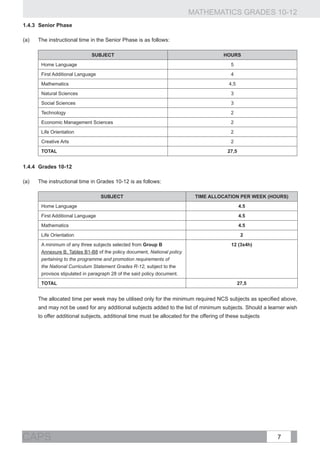
1.4.3	Senior Phase

(a)	   The instructional time in the Senior Phase is as follows:

                               SUBJECT                                                   HOURS
        Home Language                                                                       5
        First Additional Language                                                           4
        Mathematics                                                                        4,5
        Natural Sciences                                                                    3
        Social Sciences                                                                     3
        Technology                                                                          2
        Economic Management Sciences                                                        2
        Life Orientation                                                                    2
        Creative Arts                                                                       2
        TOTAL                                                                             27,5


1.4.4	 Grades 10-12

(a)	   The instructional time in Grades 10-12 is as follows:

                                    Subject                                 Time allocation per week (hours)
        Home Language                                                                            4.5
        First Additional Language                                                                4.5
        Mathematics                                                                              4.5
        Life Orientation                                                                          2
         minimum of any three subjects selected from Group B
        A                                                                                   12 (3x4h)
        Annexure B, Tables B1-B8 of the policy document, National policy
        pertaining to the programme and promotion requirements of
        the National Curriculum Statement Grades R-12, subject to the
        provisos stipulated in paragraph 28 of the said policy document.
        TOTAL                                                                                    27,5


	      The allocated time per week may be utilised only for the minimum required NCS subjects as specified above,
       and may not be used for any additional subjects added to the list of minimum subjects. Should a learner wish
       to offer additional subjects, additional time must be allocated for the offering of these subjects


CAPS                                                                                                        7
MATHEMATICS GRADES 10-12
sECTION 2

Introduction

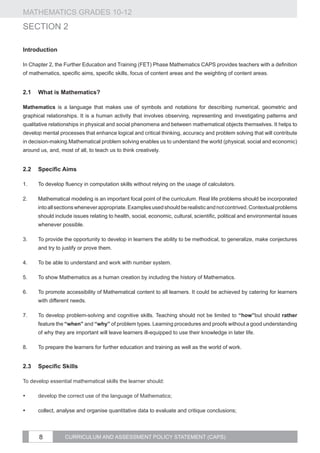
In Chapter 2, the Further Education and Training (FET) Phase Mathematics CAPS provides teachers with a definition
of mathematics, specific aims, specific skills, focus of content areas and the weighting of content areas.


2.1	 What is Mathematics?

Mathematics is a language that makes use of symbols and notations for describing numerical, geometric and
graphical relationships. It is a human activity that involves observing, representing and investigating patterns and
qualitative relationships in physical and social phenomena and between mathematical objects themselves. It helps to
develop mental processes that enhance logical and critical thinking, accuracy and problem solving that will contribute
in decision-making.Mathematical problem solving enables us to understand the world (physical, social and economic)
around us, and, most of all, to teach us to think creatively.


2.2	 Specific Aims

1.	   To develop fluency in computation skills without relying on the usage of calculators.

2.	   Mathematical modeling is an important focal point of the curriculum. Real life problems should be incorporated
      into all sections whenever appropriate. Examples used should be realistic and not contrived. Contextual problems
      should include issues relating to health, social, economic, cultural, scientific, political and environmental issues
      whenever possible.

3.	   To provide the opportunity to develop in learners the ability to be methodical, to generalize, make conjectures
      and try to justify or prove them.

4.	   To be able to understand and work with number system.

5.	   To show Mathematics as a human creation by including the history of Mathematics.

6.	   To promote accessibility of Mathematical content to all learners. It could be achieved by catering for learners
      with different needs.

7.	   To develop problem-solving and cognitive skills. Teaching should not be limited to “how”but should rather
      feature the “when” and “why” of problem types. Learning procedures and proofs without a good understanding
      of why they are important will leave learners ill-equipped to use their knowledge in later life.

8.	   To prepare the learners for further education and training as well as the world of work.


2.3 	 Specific Skills

To develop essential mathematical skills the learner should:

•	    develop the correct use of the language of Mathematics;

•	    collect, analyse and organise quantitative data to evaluate and critique conclusions;


       8          CURRICULUM AND ASSESSMENT POLICY STATEMENT (CAPS)
MATHEMATICS GRADES 10-12
•	     use mathematical process skills to identify, investigate and solve problems creatively and critically;

•	     use spatial skills and properties of shapes and objects to identify, pose and solve problems creatively and
       critically;

•	     participate as responsible citizens in the life of local, national and global communities; and

•	     communicate appropriately by using descriptions in words, graphs, symbols, tables and diagrams.


2.4	 Focus of Content Areas

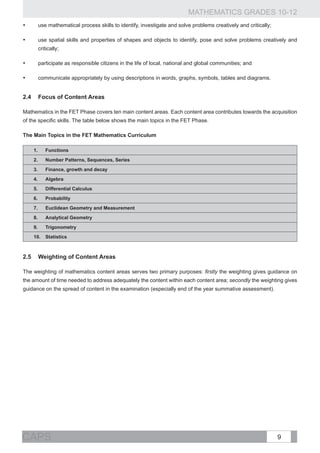
Mathematics in the FET Phase covers ten main content areas. Each content area contributes towards the acquisition
of the specific skills. The table below shows the main topics in the FET Phase.

The Main Topics in the FET Mathematics Curriculum

     1.	   Functions
     2.	   Number Patterns, Sequences, Series
     3.	   Finance, growth and decay
     4.	   Algebra
     5.	   Differential Calculus
     6.	   Probability
     7.	   Euclidean Geometry and Measurement
     8.	   Analytical Geometry
     9.	   Trigonometry
     10.	 Statistics


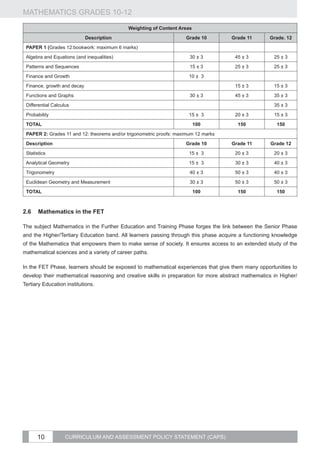
2.5	 Weighting of Content Areas

The weighting of mathematics content areas serves two primary purposes: firstly the weighting gives guidance on
the amount of time needed to address adequately the content within each content area; secondly the weighting gives
guidance on the spread of content in the examination (especially end of the year summative assessment).


CAPS                                                                                                            9
MATHEMATICS GRADES 10-12
                                            Weighting of Content Areas
                             Description                             Grade 10        Grade 11       Grade. 12
 PAPER 1 (Grades 12:bookwork: maximum 6 marks)
 Algebra and Equations (and inequalities)                              30 ± 3         45 ± 3          25 ± 3
 Patterns and Sequences                                                15 ± 3         25 ± 3          25 ± 3
 Finance and Growth                                                    10 ± 3
 Finance, growth and decay                                                            15 ± 3          15 ± 3
 Functions and Graphs                                                  30 ± 3         45 ± 3          35 ± 3
 Differential Calculus                                                                                35 ± 3
 Probability                                                           15 ± 3         20 ± 3          15 ± 3
 TOTAL                                                                   100           150             150
 PAPER 2: Grades 11 and 12: theorems and/or trigonometric proofs: maximum 12 marks
 Description                                                         Grade 10        Grade 11        Grade 12
 Statistics                                                            15 ± 3         20 ± 3          20 ± 3
 Analytical Geometry                                                   15 ± 3         30 ± 3          40 ± 3
 Trigonometry                                                          40 ± 3         50 ± 3          40 ± 3
 Euclidean Geometry and Measurement                                    30 ± 3         50 ± 3          50 ± 3
 TOTAL                                                                   100           150             150


2.6	Mathematics in the FET

The subject Mathematics in the Further Education and Training Phase forges the link between the Senior Phase
and the Higher/Tertiary Education band. All learners passing through this phase acquire a functioning knowledge
of the Mathematics that empowers them to make sense of society. It ensures access to an extended study of the
mathematical sciences and a variety of career paths.

In the FET Phase, learners should be exposed to mathematical experiences that give them many opportunities to
develop their mathematical reasoning and creative skills in preparation for more abstract mathematics in Higher/
Tertiary Education institutions.


      10            CURRICULUM AND ASSESSMENT POLICY STATEMENT (CAPS)
MATHEMATICS GRADES 10-12
sECTION 3

Introduction

Chapter 3 provides teachers with:

•	    specification of content to show progression;

•	    clarification of content with teaching guidelines; and

•	    allocation of time.


3.1	 Specification of Content to show Progression

The specification of content shows progression in terms of concepts and skills from Grade 10 to 12 for each content
area. However, in certain topics the concepts and skills are similar in two or three successive grades. The clarification
of content gives guidelines on how progression should be addressed in these cases. The specification of content
should therefore be read in conjunction with the clarification of content.


CAPS                                                                                                           11
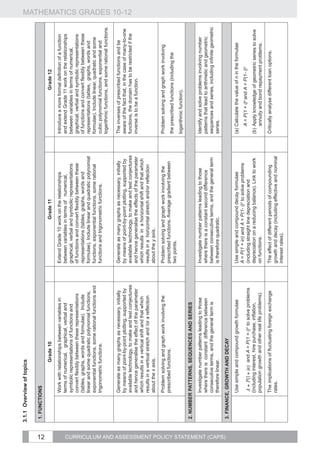
3.1.1	Overview of topics

                                                     1. FUNCTIONS


12
                                                                             Grade 10                                                   Grade 11                                               Grade 12
                                                               Work with relationships between variables in         Extend Grade 10 work on the relationships            Introduce a more formal definition of a function
                                                               terms of numerical, graphical, verbal and            between variables in terms of numerical,             and extend Grade 11 work on the relationships
                                                               symbolic representations of functions and            graphical, verbal and symbolic representations       between variables in terms of numerical,
                                                               convert flexibly between these representations       of functions and convert flexibly between these      graphical, verbal and symbolic representations
                                                               (tables, graphs, words and formulae). Include        representations (tables, graphs, words and           of functions and convert flexibly between these
                                                               linear and some quadratic polynomial functions,      formulae). Include linear and quadratic polynomial   representations (tables, graphs, words and
                                                               exponential functions, some rational functions and   functions, exponential functions, some rational      formulae). Include linear, quadratic and some
                                                               trigonometric functions.                             functions and trigonometric functions.               cubic polynomial functions, exponential and
                                                                                                                                                                         logarithmic functions, and some rational functions.

                                                               Generate as many graphs as necessary, initially      Generate as many graphs as necessary, initially      The inverses of prescribed functions and be
                                                               by means of point-by-point plotting, supported by    by means of point-by-point plotting, supported by    aware of the fact that, in the case of many-to-one
                                                                                                                                                                                                                               MATHEMATICS GRADES 10-12


                                                               available technology, to make and test conjectures   available technology, to make and test conjectures   functions, the domain has to be restricted if the
                                                               and hence generalise the effect of the parameter     and hence generalise the effects of the parameter    inverse is to be a function.
                                                               which results in a vertical shift and that which     which results in a horizontal shift and that which
                                                               results in a vertical stretch and /or a reflection   results in a horizontal stretch and/or reflection
                                                               about the x axis.                                    about the y axis.
                                                               Problem solving and graph work involving the         Problem solving and graph work involving the         Problem solving and graph work involving
                                                               prescribed functions.                                prescribed functions. Average gradient between
                                                                                                                                                                         the prescribed functions (including the
                                                                                                                    two points.
                                                                                                                                                                         logarithmic function).
                                                     2. NUMBER PATTERNS, SEQUENCES AND SERIES
                                                               Investigate number patterns leading to those         Investigate number patterns leading to those         Identify and solve problems involving number
                                                               where there is constant difference between           where there is a constant second difference          patterns that lead to arithmetic and geometric
                                                               consecutive terms, and the general term is           between consecutive terms, and the general term      sequences and series, including infinite geometric
                                                               therefore linear.                                    is therefore quadratic.                              series.


CURRICULUM AND ASSESSMENT POLICY STATEMENT (CAPS)
                                                     3. FINANCE, GROWTH AND DECAY
                                                               Use simple and compound growth formulae              Use simple and compound decay formulae               (a) Calculate the value of n in the formulae
                                                                                                                    A = P(1 + in) and A = P(1- i)n to solve problems
                                                                                                                                                                         	   A = P(1 + i)n and A = P(1- i)n
                                                                              and A = P(1 + i)n to solve problems   (including straight line depreciation and
                                                               (including interest, hire purchase, inflation,       depreciation on a reducing balance). Link to work    (b)	Apply knowledge of geometric series to solve
                                                               population growth and other real life problems).     on functions.                                            annuity and bond repayment problems.
                                                               The implications of fluctuating foreign exchange     The effect of different periods of compounding       Critically analyse different loan options.
                                                               rates.                                               growth and decay (including effective and nominal
                                                                                                                    interest rates).
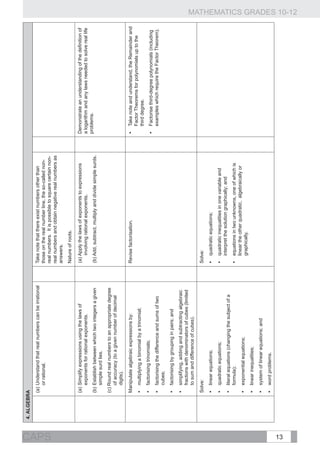
4. ALGEBRA
                (a)	Understand that real numbers can be irrational   Take note that there exist numbers other than
                    or rational.                                     those on the real number line, the so-called non-


CAPS
                                                                     real numbers. It is possible to square certain non-
                                                                     real numbers and obtain negative real numbers as
                                                                     answers.
                                                                     Nature of roots.

                (a)	Simplify expressions using the laws of           (a) Apply the laws of exponents to expressions         Demonstrate an understanding of the definition of
                    exponents for rational exponents.                    involving rational exponents.                      a logarithm and any laws needed to solve real life
                                                                                                                            problems.
                (b)	Establish between which two integers a given     (b) Add, subtract, multiply and divide simple surds.
                    simple surd lies.
                (c) Round real numbers to an appropriate degree
                    of accuracy (to a given number of decimal
                    digits).
                Manipulate algebraic expressions by:                 Revise factorisation.                                  •	 Take note and understand, the Remainder and
                                                                                                                               Factor Theorems for polynomials up to the
                •	 multiplying a binomial by a trinomial;
                                                                                                                               third degree.
                •	 factorising trinomials;
                                                                                                                            •	 Factorise third-degree polynomials (including
                •	 factorising the difference and sums of two                                                                  examples which require the Factor Theorem).
                   cubes;
                •	 factorising by grouping in pairs; and
                •	 simplifying, adding and subtracting algebraic
                   fractions with denominators of cubes (limited
                   to sum and difference of cubes).
                Solve:                                               Solve:
                •	 linear equations;                                 •	 quadratic equations;
                •	 quadratic equations;                              •	 quadratic inequalities in one variable and
                                                                        interpret the solution graphically; and
                •	 literal equations (changing the subject of a
                   formula);                                         •	 equations in two unknowns, one of which is
                                                                        linear the other quadratic, algebraically or
                •	 exponential equations;
                                                                        graphically.
                •	 linear inequalities;
                •	 system of linear equations; and
                •	 word problems.


13
                                                                                                                                                                                 MATHEMATICS GRADES 10-12
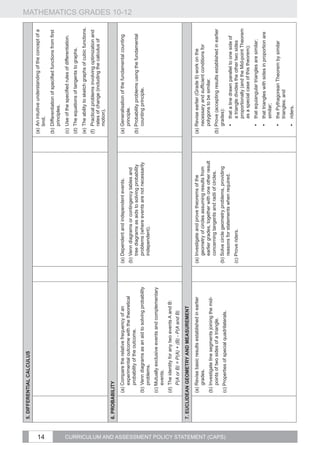
5. DIFFERENTIAL CALCULUS
                                                                                                                                                                       (a)	An intuitive understanding of the concept of a


14
                                                                                                                                                                           limit.
                                                                                                                                                                       (b)	Differentiation of specified functions from first
                                                                                                                                                                           principles.
                                                                                                                                                                       (c)	 Use of the specified rules of differentiation.
                                                                                                                                                                       (d)	The equations of tangents to graphs.
                                                                                                                                                                       (e) 	 he ability to sketch graphs of cubic functions.
                                                                                                                                                                           T
                                                                                                                                                                       (f)	 Practical problems involving optimization and
                                                                                                                                                                            rates of change (including the calculus of
                                                                                                                                                                            motion).
                                                    6. PROBABILITY
                                                             (a) Compare the relative frequency of an             (a) Dependent and independent events.                (a) Generalisation of the fundamental counting
                                                                 experimental outcome with the theoretical                                                                 principle.
                                                                                                                                                                                                                               MATHEMATICS GRADES 10-12


                                                                                                                  (b) Venn diagrams or contingency tables and
                                                                 probability of the outcome.                          tree diagrams as aids to solving probability     (b) Probability problems using the fundamental
                                                             (b)	Venn diagrams as an aid to solving probability       problems (where events are not necessarily           counting principle.
                                                                 problems.                                            independent).
                                                             (c) Mutually exclusive events and complementary
                                                                 events.
                                                             (d) 	 he identity for any two events A and B:
                                                                 T
                                                                P(A or B) = P(A) + (B) - P(A and B)
                                                    7. Euclidean Geometry and Measurement
                                                             (a) Revise basic results established in earlier      (a) Investigate and prove theorems of the            (a) Revise earlier (Grade 9) work on the
                                                                 grades.                                              geometry of circles assuming results from            necessary and sufficient conditions for
                                                             (b) Investigate line segments joining the mid-           earlier grades, together with one other result       polygons to be similar.
                                                                 points of two sides of a triangle.                   concerning tangents and radii of circles.        (b) Prove (accepting results established in earlier
                                                                                                                  (b) Solve circle geometry problems, providing            grades):


CURRICULUM AND ASSESSMENT POLICY STATEMENT (CAPS)
                                                             (c) Properties of special quadrilaterals.
                                                                                                                      reasons for statements when required.               •	 that a line drawn parallel to one side of
                                                                                                                  (c) Prove riders.                                          a triangle divides the other two sides
                                                                                                                                                                             proportionally (and the Mid-point Theorem
                                                                                                                                                                             as a special case of this theorem);
                                                                                                                                                                          •	 that equiangular triangles are similar;
                                                                                                                                                                          •	 that triangles with sides in proportion are
                                                                                                                                                                             similar;
                                                                                                                                                                          •	 the Pythagorean Theorem by similar
                                                                                                                                                                             triangles; and
                                                                                                                                                                          •	 riders.
Solve problems involving volume and surface            Revise Grade 10 work.
                 area of solids studied in earlier grades as well as
                 spheres, pyramids and cones and combinations of
                 those objects.


CAPS
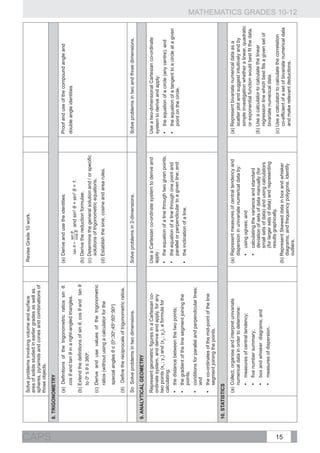
       8. TRIGONOMETRY
                 (a) Definitions of the trigonometric ratios sin θ,     (a) 	 erive and use the identities:
                                                                            D                                                  Proof and use of the compound angle and
                     cos θ and tan θ in a right-angled triangles.                   sin θ                                      double angle identities
                                                                            tan θ = cos θ   and sin2 θ + sin2 θ = 1.
                 (b) Extend the definitions of sin θ, cos θ and tan θ   (b) Derive the reduction formulae.
                     to 0o ≤ θ ≤ 360o.                                  (c) Determine the general solution and / or specific
                 (c) 	
                     Derive and use values of the trigonometric             solutions of trigonometric equations.
                     ratios (without using a calculator for the         (d) Establish the sine, cosine and area rules.


                 (d) Define the reciprocals of trigonometric ratios.
                     special angles θ ∈ {0o;30o;45o;60o;90o}


                 So Solve problems in two dimensions.                   Solve problems in 2-dimensions.                        Solve problems in two and three dimensions.
       9. ANALYTICAL GEOMETRY
                 Represent geometric figures in a Cartesian co-         Use a Cartesian co-ordinate system to derive and       Use a two-dimensional Cartesian co-ordinate
                 ordinate system, and derive and apply, for any         apply :                                                system to derive and apply:
                 two points (x1 ; y1) and (x2 ; y2), a formula for      •	 the equation of a line through two given points;    •	 the equation of a circle (any centre); and
                 calculating:
                                                                        •	 the equation of a line through one point and        •	 the equation of a tangent to a circle at a given
                 •	 the distance between the two points;                   parallel or perpendicular to a given line; and         point on the circle.
                 •	 the gradient of the line segment joining the        •	 the inclination of a line.
                    points;
                 •	 conditions for parallel and perpendicular lines;
                    and
                 •	 the co-ordinates of the mid-point of the line
                    segment joining the points.
       10. STATISTICS
                 (a) 	 ollect, organise and interpret univariate
                     C                                                  (a) 	 epresent measures of central tendency and
                                                                            R                                                  (a) Represent bivariate numerical data as a
                     numerical data in order to determine:                  dispersion in univariate numerical data by:            scatter plot and suggest intuitively and by
                    •	 measures of central tendency;                       •	 using ogives; and                                    simple investigation whether a linear, quadratic
                                                                                                                                   or exponential function would best fit the data.
                    •	 five number summary;                                •	 calculating the variance and standard
                                                                              deviation of sets of data manually (for          (b) Use a calculator to calculate the linear
                    •	 box and whisker diagrams; and
                                                                              small sets of data) and using calculators            regression line which best fits a given set of
                    •	 measures of dispersion.                                (for larger sets of data) and representing           bivariate numerical data.
                                                                              results graphically.
                                                                                                                               (c) Use a calculator to calculate the correlation


15
                                                                        (b) Represent Skewed data in box and whisker               co-efficient of a set of bivariate numerical data
                                                                            diagrams, and frequency polygons. Identify             and make relevant deductions.
                                                                            outliers.
                                                                                                                                                                                       MATHEMATICS GRADES 10-12
MATHEMATICS GRADES 10-12
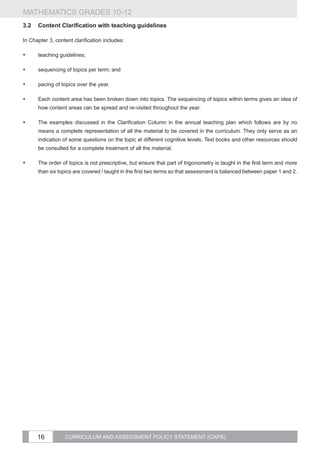
3.2	 Content Clarification with teaching guidelines

In Chapter 3, content clarification includes:

•	    teaching guidelines;

•	    sequencing of topics per term; and

•	    pacing of topics over the year.

•	    Each content area has been broken down into topics. The sequencing of topics within terms gives an idea of
      how content areas can be spread and re-visited throughout the year.

•	    The examples discussed in the Clarification Column in the annual teaching plan which follows are by no
      means a complete representation of all the material to be covered in the curriculum. They only serve as an
      indication of some questions on the topic at different cognitive levels. Text books and other resources should
      be consulted for a complete treatment of all the material.

•	    The order of topics is not prescriptive, but ensure that part of trigonometry is taught in the first term and more
      than six topics are covered / taught in the first two terms so that assessment is balanced between paper 1 and 2.


      16          CURRICULUM AND ASSESSMENT POLICY STATEMENT (CAPS)
MATHEMATICS GRADES 10-12
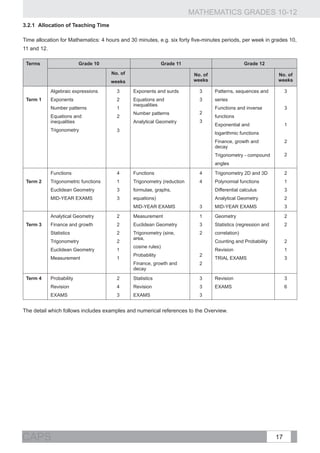
3.2.1 	Allocation of Teaching Time

Time allocation for Mathematics: 4 hours and 30 minutes, e.g. six forty five-minutes periods, per week in grades 10,
11 and 12.

 Terms                     Grade 10                             Grade 11                            Grade 12
                                       No. of                               No. of                                No. of
                                       weeks                                weeks                                 weeks

             Algebraic expressions       3      Exponents and surds           3      Patterns, sequences and           3
 Term 1      Exponents                   2      Equations and                 3      series
                                                inequalities
             Number patterns             1                                           Functions and inverse             3
                                                Number patterns               2
             Equations and               2                                           functions
             inequalities                       Analytical Geometry           3
                                                                                     Exponential and                   1
             Trigonometry                3
                                                                                     logarithmic functions
                                                                                     Finance, growth and               2
                                                                                     decay
                                                                                     Trigonometry - compound           2
                                                                                     angles
             Functions                   4      Functions                     4      Trigonometry 2D and 3D            2
 Term 2      Trigonometric functions     1      Trigonometry (reduction       4      Polynomial functions              1
             Euclidean Geometry          3      formulae, graphs,                    Differential calculus             3
             MID-YEAR EXAMS              3      equations)                           Analytical Geometry               2
                                                MID-YEAR EXAMS                3      MID-YEAR EXAMS                    3
             Analytical Geometry         2      Measurement                   1      Geometry                          2
 Term 3      Finance and growth          2      Euclidean Geometry            3      Statistics (regression and        2
             Statistics                  2      Trigonometry (sine,           2      correlation)
                                                area,
             Trigonometry                2                                           Counting and Probability          2
                                                cosine rules)
             Euclidean Geometry          1                                           Revision                          1
                                                Probability                   2
             Measurement                 1                                           TRIAL EXAMS                       3
                                                Finance, growth and           2
                                                decay
 Term 4      Probability                 2      Statistics                    3      Revision                          3
             Revision                    4      Revision                      3      EXAMS                             6
             EXAMS                       3      EXAMS                         3


The detail which follows includes examples and numerical references to the Overview.


CAPS                                                                                                              17
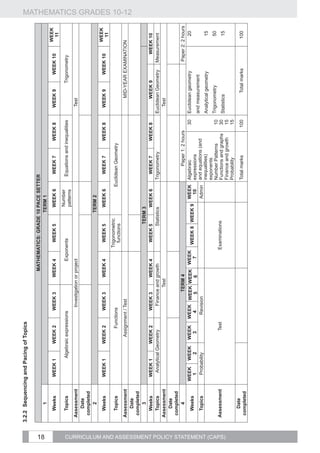
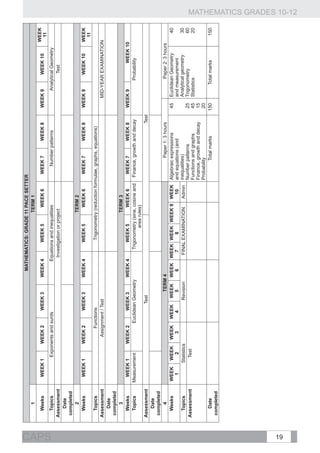
3.2.2	Sequencing and Pacing of Topics

                                                                                                                       MATHEMATICS: GRADE 10 PACE SETTER


18
                                                          1                                                                                TERM 1
                                                                                                                                                                                                                                 WEEK
                                                        Weeks       WEEK 1         WEEK 2            WEEK 3         WEEK 4         WEEK 5         WEEK 6          WEEK 7          WEEK 8         WEEK 9            WEEK 10
                                                                                                                                                                                                                                  11
                                                                                                                                                  Number
                                                        Topics               Algebraic expressions                          Exponents                            Equations and inequalities                    Trigonometry
                                                                                                                                                  patterns
                                                     Assessment                                       Investigation or project                                                                   Test
                                                        Date
                                                      completed
                                                         2                                                                                       TERM 2
                                                                                                                                                                                                                                 WEEK
                                                        Weeks       WEEK 1         WEEK 2            WEEK 3         WEEK 4         WEEK 5         WEEK 6          WEEK 7          WEEK 8         WEEK 9            WEEK 10
                                                                                                                                                                                                                                  11
                                                                                                                                 Trigonometric
                                                        Topics                            Functions                                                          Euclidean Geometry
                                                                                                                                    functions
                                                     Assessment                       Assignment / Test                                                                                              MID-YEAR EXAMINATION
                                                                                                                                                                                                                                            MATHEMATICS GRADES 10-12


                                                         Date
                                                      completed
                                                          3                                                                              TERM 3
                                                        Weeks       WEEK 1        WEEK 2             WEEK 3        WEEK 4          WEEK 5         WEEK 6          WEEK 7          WEEK 8             WEEK 9                 WEEK 10
                                                        Topics       Analytical Geometry              Finance and growth                Statistics             Trigonometry                   Euclidean Geometry         Measurement
                                                     Assessment                                               Test                                                                              Test
                                                         Date
                                                      completed
                                                          4                                                TERM 4                                            Paper 1: 2 hours                                            Paper 2: 2 hours
                                                                   WEEK WEEK         WEEK       WEEK WEEK WEEK WEEK                              WEEK Algebraic                         30    Euclidean geometry                     20
                                                        Weeks                                                                      WEEK 8 WEEK 9
                                                                    1          2      3          4        5    6  7                               10   expressions
                                                                                                                                                                                              and measurement
                                                        Topics       Probability                 Revision                                        Admin and equations (and
                                                                                                                                                       inequalities)                          Analytical geometry                   15
                                                                                                                                                       exponents
                                                                                                                                                       Number Patterns                  10    Trigonometry                          50
                                                     Assessment                          Test                                    Examinations          Functions and graphs             30


CURRICULUM AND ASSESSMENT POLICY STATEMENT (CAPS)
                                                                                                                                                                                              Statistics                            15
                                                                                                                                                       Finance and growth               15
                                                                                                                                                       Probability                      15
                                                        Date
                                                                                                                                                               Total marks             100                 Total marks             100
                                                      completed
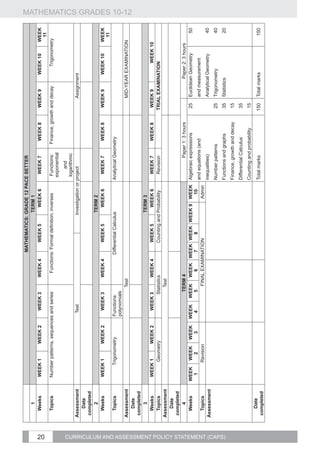
MATHEMATICS: GRADE 11 PACE SETTER
           1                                                                          TERM 1
                                                                                                                                                                               WEEK
         Weeks        WEEK 1        WEEK 2           WEEK 3     WEEK 4       WEEK 5          WEEK 6         WEEK 7         WEEK 8            WEEK 9         WEEK 10
                                                                                                                                                                                11


CAPS
          Topics               Exponents and surds                   Equations and inequalities                Number patterns                      Analytical Geometry
       Assessment                                                     Investigation or project                                                              Test
           Date
        completed
            2                                                                              TERM 2
          Weeks       WEEK 1        WEEK 2           WEEK 3     WEEK 4       WEEK 5          WEEK 6         WEEK 7         WEEK 8            WEEK 9         WEEK 10            WEEK
                                                                                                                                                                                11
          Topics                          Functions                           Trigonometry (reduction formulae, graphs, equations)
       Assessment                      Assignment / Test                                                                                          MID-YEAR EXAMINATION
           Date
        completed
            3                                                                              TERM 3
          Weeks       WEEK 1        WEEK 2         WEEK 3       WEEK 4        WEEK 5          WEEK 6        WEEK 7         WEEK 8            WEEK 9              WEEK 10
          Topics    Measurement              Euclidean Geometry           Trigonometry (sine, cosine and   Finance, growth and decay                     Probability
                                                                                  area rules)
       Assessment                                      Test                                                                          Test
           Date
        completed
            4                                              TERM 4                                      Paper 1: 3 hours                                     Paper 2: 3 hours
          Weeks     WEEK    WEEK WEEK          WEEK      WEEK WEEK WEEK WEEK WEEK 9 WEEK Algebraic expressions                               45   Euclidean Geometry             40
                     1         2      3         4          5      6  7      8          10   and equations (and                                    and measurement
         Topics            Statistics                   Revision    FINAL EXAMINATION Admin inequalities)                                         Analytical geometry            30
                                                                                            Number patterns                                  25   Trigonometry                   60
       Assessment            Test
                                                                                            Functions and graphs                             45   Statistics                     20
                                                                                            Finance, growth and decay                        15
                                                                                            Probability                                      20
         Date                                                                                         Total marks                           150        Total marks              150
       completed


19
                                                                                                                                                                                      MATHEMATICS GRADES 10-12
MATHEMATICS: GRADE 12 PACE SETTER
                                                        1                                                                               TERM 1
                                                      Weeks       WEEK 1         WEEK 2       WEEK 3             WEEK 4       WEEK 5      WEEK 6      WEEK 7                    WEEK 8       WEEK 9            WEEK 10     WEEK


20
                                                                                                                                                                                                                              11
                                                      Topics      Number patterns, sequences and series           Functions: Formal definition; inverses       Functions:     Finance, growth and decay          Trigonometry
                                                                                                                                                               exponential
                                                                                                                                                                   and
                                                                                                                                                                logarithmic
                                                    Assessment                               Test                                            Investigation or project                             Assignment
                                                        Date
                                                     completed
                                                         2                                                                                    TERM 2
                                                       Weeks      WEEK 1         WEEK 2       WEEK 3             WEEK 4         WEEK 5          WEEK 6          WEEK 7          WEEK 8       WEEK 9            WEEK 10       WEEK
                                                                                                                                                                                                                              11
                                                      Topics            Trigonometry        Functions:                    Differential Calculus              Analytical Geometry
                                                                                            polynomials
                                                    Assessment                                            Test                                                                                    MID-YEAR EXAMINATION
                                                                                                                                                                                                                                    MATHEMATICS GRADES 10-12


                                                        Date
                                                     completed
                                                         3                                                                                   TERM 3
                                                       Weeks      WEEK 1     WEEK 2           WEEK 3        WEEK 4              WEEK 5         WEEK 6           WEEK 7          WEEK 8       WEEK 9         WEEK 10
                                                       Topics          Geometry                    Statistics                   Counting and Probability        Revision                    TRIAL EXAMINATION
                                                    Assessment                                        Test
                                                        Date
                                                     completed
                                                         4                                            TERM 4                                    Paper 1: 3 hours                                          Paper 2: 3 hours
                                                       Weeks     WEEK     WEEK WEEK        WEEK     WEEK WEEK WEEK WEEK WEEK 9 WEEK Algebraic expressions                                    25   Euclidean Geometry           50
                                                                  1         2     3         4        5        6     7     8     10
                                                                                                                                     and equations (and                                           and measurement
                                                      Topics             Revision                       FINAL EXAMINATION      Admin
                                                    Assessment                                                                       inequalities)                                                Analytical Geometry          40
                                                                                                                                                             Number patterns                 25   Trigonometry                 40


CURRICULUM AND ASSESSMENT POLICY STATEMENT (CAPS)
                                                                                                                                                             Functions and graphs            35   Statistics                   20
                                                                                                                                                             Finance, growth and decay       15
                                                                                                                                                             Differential Calculus           35
                                                                                                                                                             Counting and probability        15
                                                      Date
                                                                                                                                                             Total marks                    150   Total marks                 150
                                                    completed
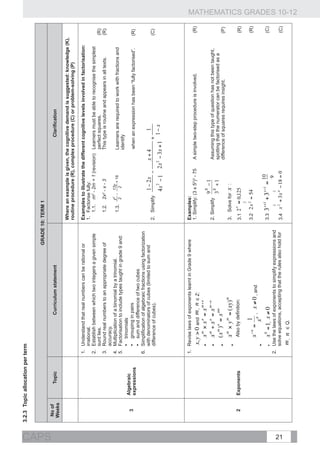
3.2.3	Topic allocation per term


                                                                                            GRADE 10: TERM 1


CAPS
        No of
                      Topic                                Curriculum statement                                                                                  Clarification
        Weeks
                                                                                                       Where an example is given, the cognitive demand is suggested: knowledge (K),
                                                                                                       routine procedure (R), complex procedure (C) or problem-solving (P)

                                      1. 	 Understand that real numbers can be rational or             Examples to illustrate the different cognitive levels involved in factorisation:
                                           irrational.                                                 1. 	 Factorise fully:
                                      2. 	Establish between which two integers a given simple               1.1. 	 m2 - 2m + 1 (revision) Learners must be able to recognise the simplest
                                           surd lies.                                                                                     perfect squares.                                                    (R)
                                      3. 	 Round real numbers to an appropriate degree of                   1.2. 	2x2 - x - 3	            This type is routine and appears in all texts.                      (R)
                                           accuracy.
                                      4. 	 Multiplication of a binomial by a trinomial.                                y2   13y
                                                                                                             1.3. 2 -           + 18 	                     Learners are required to work with fractions and
                                      5. 	 Factorisation to include types taught in grade 9 and:                             2
                                                                                                                                                           identify 	
                                           •	 trinomials
                 Algebraic
           3                               •	 grouping in pairs                                                                                            when an expression has been “fully factorised”.    (R)
                 expressions
                                           •	 sum and difference of two cubes
                                      6. 	 Simplification of algebraic fractions using factorization
                                           with denominators of cubes (limited to sum and
                                           difference of cubes).                                       2.	 Simplify                                                                                           (C)


                                      1. 	 Revise laws of exponents learnt in Grade 9 where            Examples:
                                                                                                       1. Simplify: (3 x 52)3 - 75                     A simple two-step procedure is involved.                (R)
                                               m     n    m +n
                                         •	 x × x = x
                                          x, y  0 and m , n	
  ∈ Z:
                                               m     n    m −n
                                         •	 x ÷ x = x                                                  2. Simplify                                     Assuming this type of question has not been taught,
                                                m n    mn                                                                                              spotting that the numerator can be factorised as a
                              €                                                                                                                        difference of squares requires insight.                 (P)
                                  €           x m × y m = (xy) m                                       3. Solve for         x   :
                                         •	
                                         •	 €(x€) = x 	


                                              Also by definition:                                              x
           2     Exponents        €                                                                    3.1 2       = 0,125                                                                                     (R)
                                                                                                                   3
                                  €                                                                    3.2 2x 2 = 54                                                                                           (R)
                                                           ,
                                  €      •	
                                                0                                                      3.3                                                                                                     (C)
                                                               x ≠ 0 	
  , and

                                      2. 	 Use the laws of exponents to simplify expressions and
                                                                                                €
                                                 equations, accepting that the rules also hold for


21
                                                                                                       3.4                                                                                                     (C)
                                                                                                                                         	
  
                                           solve€
                                           •	 x = 1, x ≠ 0 	
  
                                                                                                                                                                                                                     MATHEMATICS GRADES 10-12


                                  €       €
                                          m , n	
   ∈ Q.


                          € €
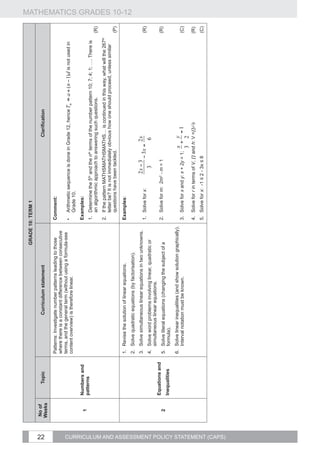
GRADE 10: TERM 1
                                                    No of


22
                                                                 Topic                         Curriculum statement                                                                         Clarification
                                                    Weeks
                                                                            Patterns: Investigate number patterns leading to those            Comment:
                                                                            where there is a constant difference between consecutive
                                                                            terms, and the general term (without using a formula-see
                                                                                                                                              •	 Arithmetic sequence is done in Grade 12, hence                       is
                                                                            content overview) is therefore linear.
                                                                                                                                                 Grade 10.
                                                            Numbers and                                                                       Examples:
                                                                                                                                                                                                                      	
   not used in

                                                      1
                                                            patterns
                                                                                                                                              1. 	 Determine the 5th and the nth terms of the number pattern 10; 7; 4; 1; …. There is
                                                                                                                                                   an algorithmic approach to answering such questions.                                       (R)
                                                                                                                                                                                                                                         th
                                                                                                                                              2. 	 If the pattern MATHSMATHSMATHS… is continued in this way, what will the 267
                                                                                                                                                   letter be? It is not immediately obvious how one should proceed, unless similar
                                                                                                                                                   questions have been tackled.                                                               (P)
                                                                            1. 	 Revise the solution of linear equations.                     Examples:
                                                                                                                                                                                                                                                    MATHEMATICS GRADES 10-12


                                                                            2. 	 Solve quadratic equations (by factorisation).
                                                                            3. 	 Solve simultaneous linear equations in two unknowns.
                                                                                                                                              1. 	 Solve for x: 	                                                                             (R)
                                                                            4. 	 Solve word problems involving linear, quadratic or
                                                                                 simultaneous linear equations.


                                                            Equations and                                                                     2. 	 Solve for m: 2m2 - m = 1                                                                   (R)
                                                      2                     5. 	 Solve literal equations (changing the subject of a
                                                            Inequalities         formula).
                                                                            6. 	 Solve linear inequalities (and show solution graphically).                                         x       y
                                                                                 Interval notation must be known.                             3. 	 Solve for x and y: x + 2y = 1;       +          =1                                         (C)
                                                                                                                                                                                    3       2
                                                                                                                                              4. 	 Solve for r in terms of V, ∏ and h: V =∏r2h                                                (R)
                                                                                                                                              5. 	 Solve for x: -1 ≤ 2 - 3x ≤ 8                                                               (C)


CURRICULUM AND ASSESSMENT POLICY STATEMENT (CAPS)
GRADE 10: TERM 1
       No of
                        Topic                            Curriculum statement                                                                       Clarification
       Weeks


CAPS
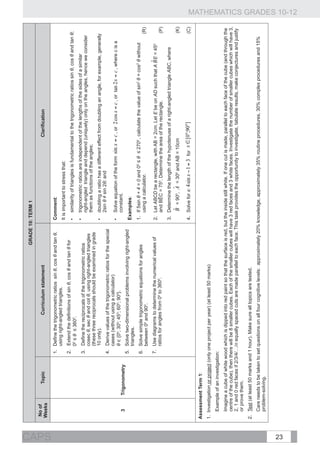
                                      1. 	 Define the trigonometric ratios sin θ, cos θ and tan θ,     Comment:
                                           using right-angled triangles.
                                                                                                       It is important to stress that:
                                      2. Extend the definitions of sin θ, cos θ and tan θ for
                                                                                                       •	 similarity of triangles is fundamental to the trigonometric ratios sin θ, cos θ and tan θ;
                                         00 ≤ θ ≤ 3600.
                                                                                                       •	 	rigonometric ratios are independent of the lengths of the sides of a similar
                                                                                                          t
                                      3. Define the reciprocals of the trigonometric ratios
                                                                                                          right-angled triangle and depend (uniquely) only on the angles, hence we consider
                                         cosec θ, sec θ and cot θ, using right-angled triangles
                                                                                                          them as functions of the angles;
                                         (these three reciprocals should be examined in grade
                                         10 only).                                                     •	 doubling a ratio has a different effect from doubling an angle, for example, generally
                                                                                                          2sin θ ≠ sin 2θ; and
                                      4. Derive values of the trigonometric ratios for the special
                                         cases (without using a calculator)
                                                                                                       •	 Solve equation of the form sin x = c , or 2 cos x = c , or tan 2 x = c , where c is a
           3      Trigonometry                                                                            constant.
                                      5. 	 Solve two-dimensional problems involving right-angled
                                         θ ∈ {00; 300; 450; 600; 900}.

                                                                                                       Examples:
                                           triangles.
                                      6. 	 Solve simple trigonometric equations for angles             1.	 If 5sin θ + 4 = 0 and 00 ≤ θ ≤ 2700 , calculate the value of sin2 θ + cos2 θ without
                                           between 00 and 900.                                             using a calculator.                                                                    (R)

                                      7. 	 Use diagrams to determine the numerical values of           2.	 Let ABCD be a rectangle, with AB = 2cm. Let E be on AD such that A B E =E 0
                                                                                                                                                                              ˆ = ˆ45
                                           ratios for angles from 00 to 3600.                              and BÊC = 750. Determine the area of the rectangle.                                     (P)
                                                                                                       3.	 Determine the length of the hypotenuse of a right-angled triangle ABC, where
                                                                                                               ˆ
                                                                                                           ˆ = 90 ˆ = 30ˆ
                                                                                                           B = E 0, A = D 0 and AB = 10cm                                                          (K)

                                                                                                       4.	 Solve for x:                                                                           (C)

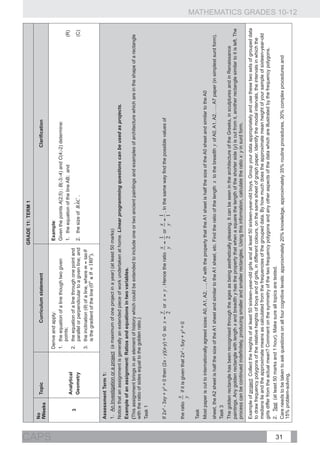
       Assessment Term 1:
                                                                                                                                         	
   for


       1. Investigation or project (only one project per year) (at least 50 marks)
       	Example of an investigation:
       	   Imagine a cube of white wood which is dipped into red paint so that the surface is red, but the inside still white. If one cut is made, parallel to each face of the cube (and through the
           centre of the cube), then there will be 8 smaller cubes. Each of the smaller cubes will have 3 red faces and 3 white faces. Investigate the number of smaller cubes which will have 3,
           2, 1 and 0 red faces if 2/3/4/…/n equally spaced cuts are made parallel to each face. This task provides the opportunity to investigate, tabulate results, make conjectures and justify
           or prove them.
       2. 	 Test (at least 50 marks and 1 hour). Make sure all topics are tested.
       	   Care needs to be taken to set questions on all four cognitive levels: approximately 20% knowledge, approximately 35% routine procedures, 30% complex procedures and 15%
           problem-solving.


23
                                                                                                                                                                                                         MATHEMATICS GRADES 10-12
GRADE 10: TERM 2


24
                                                    Weeks     Topic                    Curriculum statement                                                                     Clarification
                                                                          1. 	 The concept of a function, where a                  Comments:
                                                                               certain quantity (output value) uniquely
                                                                               depends on another quantity (input                  •	 A more formal definition of a function follows in Grade 12. At this level it is enough to investigate
                                                                               value). Work with relationships between                the way (unique) output values depend on how input values vary. The terms independent (input)
                                                                               variables using tables, graphs, words and              and dependent (output) variables might be useful.
                                                                               formulae. Convert flexibly between these            •	 After summaries have been compiled about basic features of prescribed graphs and the effects
                                                                               representations.                                       of parameters a and q have been investigated: a: a vertical stretch (and/or a reflection about the
                                                                                                                                      x-axis) and q a vertical shift. The following examples might be appropriate:
                                                                             Note: that the graph defined by          y=x
                                                                                                                                      R
                                                                                                                                   •	 	 emember that graphs in some practical applications may be either discrete or continuous.
                                                                              should be known from Grade 9.
                                                                                                                                   Examples:
                                                                          2. 	 Point by point plotting of basic graphs

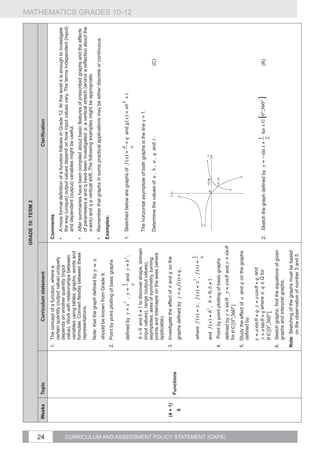
                                                                                                  2         1                x                                                  a
                                                                             defined by y = x , y =             and y = b ;        1.	 Sketched below are graphs of f ( x ) =       + q and               .
                                                                                                                                                                                                                                              MATHEMATICS GRADES 10-12


                                                                                                            x                                                                   x
                                                                              b  0 and        to discover shape, domain
                                                                             (input values), range (output values),                   The horizontal asymptote of both graphs is the line y = 1.
                                                                             asymptotes, axes of symmetry, turning
                                                                                                                                      Determine the values of a , b , n , q and t . 	                                  (C)
                                                                             points and intercepts on the axes (where
                                                                             applicable).
                                                    (4 + 1)                                            a x) +
                                                                                                   y = = f (f ( x) + on
                                                                          3. 	 Investigate the effectyof. a. and q q the                               y
                                                              Functions
                                                      5                      graphs defined by y = a. f ( x) + q ,


                                                                                                                2            1
                                                                              where f ( x ) = x , f ( x ) = x , f ( x ) =
                                                                                                                             x
                                                                                              x                                                                (2; 0)      x
                                                                             and f ( x ) = b , b  0,                                                      O


                                                                          4. 	 Point by point plotting of basic graphs                                         (1; -1)


CURRICULUM AND ASSESSMENT POLICY STATEMENT (CAPS)
                                                                             defined by               ,               and
                                                                             for


                                                                          5. Study the effect = a.a (and q on the graphs
                                                                                           y of f x) +
                                                                             defined by:

                                                                                             ;                      ; and
                                                                                                  f x
                                                                                             where ., ( ) Q                        2.	 Sketch the graph defined by                                            	        (R)
                                                                                           .
                                                                                           y = a. y (= )a+fq x∈ + qfor

                                                                          6. 	 Sketch graphs, find the equations of given
                                                                                                                                                                                       	
  for

                                                                               graphs and interpret graphs.
                                                                          Note: Sketching of the graphs must be based
                                                                                on the observation of number 3 and 5.
GRADE 10: TERM 2

       Weeks      Topic                               Curriculum statement                                                                 Clarification


CAPS
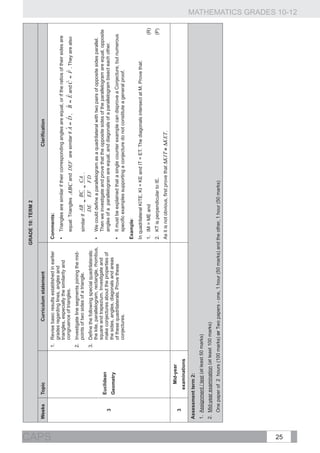
                                        1. 	 Revise basic results established in earlier      Comments:
                                             grades regarding lines, angles and
                                             triangles, especially the similarity and         •	 Triangles are similar if their corresponding angles are equal, or if the ratios of their sides are
                                             congruence of triangles.                                                                        ˆ   ˆ
                                                                                                 equal: Triangles ABC and DEF are similar if A = D ,          ˆ   ˆ     ˆ   ˆ
                                                                                                                                                              B = E and C = F . They are also
                                        2. 	 Investigate line segments joining the mid-
                                             points of two sides of a triangle.                  similar if                     .
                                        3. 	 Define the following special quadrilaterals:
                                             the kite, parallelogram, rectangle, rhombus,     •	 We could define a parallelogram as a quadrilateral with two pairs of opposite sides parallel.
                                             square and trapezium. Investigate and               Then we investigate and prove that the opposite sides of the parallelogram are equal, opposite
                  Euclidean                  make conjectures about the properties of
          3                                                                                      angles of a parallelogram are equal, and diagonals of a parallelogram bisect each other.
                  Geometry                   the sides, angles, diagonals and areas
                                             of these quadrilaterals. Prove these             •	 It must be explained that a single counter example can disprove a Conjecture, but numerous
                                             conjectures.                                        specific examples supporting a conjecture do not constitute a general proof.
                                                                                              Example:
                                                                                              In quadrilateral KITE, KI = KE and IT = ET. The diagonals intersect at M. Prove that:
                                                                                              1. 	 IM = ME and                                                                                        (R)
                                                                                              2. 	 KT is perpendicular to IE.                                                                         (P)
                                                                                              As it is not obvious, first prove that               .
                       Mid-year
          3
                    examinations
       Assessment term 2:
       1. Assignment / test (at least 50 marks)
       2. Mid-year examination (at least 100 marks)
          One paper of 2 hours (100 marks) or Two papers - one, 1 hour (50 marks) and the other, 1 hour (50 marks)


25
                                                                                                                                                                                                            MATHEMATICS GRADES 10-12
GRADE 10: TERM 3
                                                    Weeks   Topic                       Curriculum statement                                                              Clarification


26
                                                                          Represent geometric figures on a Cartesian            Example:
                                                                          co-ordinate system.
                                                                                                                                Consider the points P ( 2;5) and       in the Cartesian plane.
                                                                          Derive and apply for any two points
                                                                                                                                1.1. 	Calculate the distance PQ.	                                   (K)
                                                                                                                                1.2 Find the coordinates of R if M      is the mid-point of PR. 	   (R)
                                                                          ( x1 ; y1 ) and ( x 2 ; y 2 ) the formulae for
                                                            Analytical                                                          1.3 Determine the coordinates of S if PQRS is a parallelogram. 	    (C)
                                                      2                   calculating the:
                                                            Geometry                                                            1.4 Is PQRS a rectangle? Why or why not? 	                          (R)
                                                                          1. 	 distance between the two points;
                                                                          2. 	 gradient of the line segment connecting the
                                                                               two points (and from that identify parallel
                                                                               and perpendicular lines); and
                                                                          3. 	 coordinates of the mid-point of the line
                                                                               segment joining the two points.
                                                                                                                                                                                                          MATHEMATICS GRADES 10-12


                                                                          Use the simple and compound
                                                                          growth formulae

                                                                                              n
                                                            Finance and   and A = P (1 + i ) ] to solve problems,
                                                      2
                                                            growth        including annual interest, hire purchase,
                                                                          inflation, population growth and other real-
                                                                          life problems. Understand the implication of
                                                                          fluctuating foreign exchange rates (e.g. on the
                                                                          petrol price, imports, exports, overseas travel).


CURRICULUM AND ASSESSMENT POLICY STATEMENT (CAPS)
GRADE 10: TERM 3
       Weeks   Topic                     Curriculum statement                                                                     Clarification
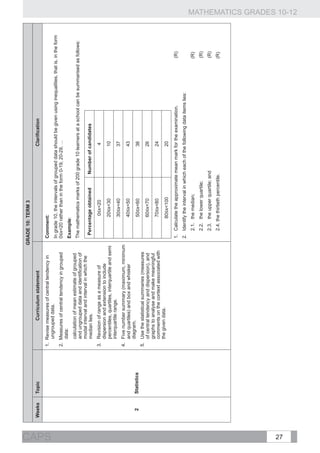
                            1. Revise measures of central tendency in               Comment:


CAPS
                               ungrouped data.
                                                                                    In grade 10, the intervals of grouped data should be given using inequalities, that is, in the form
                            2. Measures of central tendency in grouped              0≤x20 rather than in the form 0-19, 20-29, …
                               data:
                                                                                    Example:
                            	   calculation of mean estimate of grouped
                                and ungrouped data and identification of            The mathematics marks of 200 grade 10 learners at a school can be summarised as follows:
                                modal interval and interval in which the
                                median lies.                                         Percentage obtained            Number of candidates
                            3. 	 Revision of range as a measure of                             0≤x20                              4
                                 dispersion and extension to include
                                 percentiles, quartiles, interquartile and semi                20≤x30                            10
                                 interquartile range.
                                                                                               30≤x40                            37
                            4.	 Five number summary (maximum, minimum
                                and quartiles) and box and whisker                             40≤x50                            43
                                diagram.
         2     Statistics                                                                      50≤x60                            36
                            5. 	 Use the statistical summaries (measures
                                 of central tendency and dispersion), and                      60≤x70                            26
                                 graphs to analyse and make meaningful
                                 comments on the context associated with                       70≤x80                            24
                                 the given data.
                                                                                              80≤x100                            20
                                                                                    1. 	 Calculate the approximate mean mark for the examination.                          (R)
                                                                                    2. 	 Identify the interval in which each of the following data items lies:
                                                                                       2.1.	 the median;                                            	                      (R)
                                                                                       2.2. 	 the lower quartile;                                         	                (R)
                                                                                       2.3. 	 the upper quartile; and                                                	     (R)
                                                                                       2.4. the thirtieth percentile.                                            	         (R)


27
                                                                                                                                                                                          MATHEMATICS GRADES 10-12
GRADE 10: TERM 3
                                                    Weeks      Topic                              Curriculum statement                                                              Clarification


28
                                                                                      Problems in two dimensions.                        Example:

                                                       2       Trigonometry                                                              Two flagpoles are 30 m apart. The one has height 10 m, while the other has height 15 m. Two
                                                                                                                                         tight ropes connect the top of each pole to the foot of the other. At what height above the
                                                                                                                                         ground do the two ropes intersect? What if the poles were at different distance apart?      (P)

                                                                                      Solve problems and prove riders using the          Comment:
                                                                                      properties of parallel lines, triangles and
                                                                                      quadrilaterals.                                    Use congruency and properties of quads, esp. parallelograms.
                                                                                                                                         Example:
                                                                                                                                         EFGH is a parallelogram. Prove that MFNH is a parallelogram.

                                                                                                                                                                   G                                     F
                                                               Euclidean
                                                       1
                                                                                                                                                                                    M
                                                                                                                                                                                                                                               MATHEMATICS GRADES 10-12


                                                               Geometry


                                                                                                                                                                                                N
                                                                                                                                                                           H                                     E
                                                                                                                                                                                                                                        (C)
                                                                                      1. 	 Revise the volume and surface areas of        Example:
                                                                                           right-prisms and cylinders.
                                                                                                                                         The height of a cylinder is 10 cm, and the radius of the circular base is 2 cm. A hemisphere is
                                                                                      2. 	 Study the effect on volume and surface        attached to one end of the cylinder and a cone of height 2 cm to the other end. Calculate the
                                                                                           area when multiplying any dimension by a      volume and surface area of the solid, correct to the nearest cm3 and cm2, respectively.         (R)
                                                       2       Measurement
                                                                                           constant factor k.                            Comments:
                                                                                      3. 	 Calculate the volume and surface areas of     •	 In case of pyramids, bases must either be an equilateral triangle or a square.


CURRICULUM AND ASSESSMENT POLICY STATEMENT (CAPS)
                                                                                           spheres, right pyramids and right cones.
                                                                                                                                         •	 Problem types must include composite figure.

                                                    Assessment term 3: Two (2) Tests (at least 50 marks and 1 hour) covering all topics in approximately the ratio of the allocated teaching time.
GRADE 10: TERM 4
       No of
                  Topic                             Curriculum statement                                                              Clarification
       Weeks


CAPS
                                       1. The use of probability models to               Comment:
                                          compare the relative frequency of              •	 It generally takes a very large number of trials before the relative frequency of a coin falling
                                                                                            heads up when tossed approaches 0,5.
                                          events with the theoretical
                                          probability.
                                                                                         Example:
                                       2. The use of Venn diagrams to solve
                                                                                         In a survey 80 people were questioned to find out how many read newspaper
                                          probability problems, deriving and
                                                                                         S or D or both. The survey revealed that 45 read D, 30 read S and 10 read neither.
                                          applying the following for any two
                                                                                         Use a Venn diagram to find how many read
                                          events A and B in a sample space S:
                                                                                         1.	 S only;                                                                                   (C)
          2       Probability             P( A or                                  ;
                                                                             and B )     2.	 D only; and                                                                               (C)
                                              A and B are mutually exclusive if          3.	 both D and S.                                                                             (C)
                                          P( A and B ) = 0;
                                          A and B are complementary if they
                                          are mutually exclusive ; and

                                          P ( A) + P ( B ) = 1.
                                          Then

                                          P ( B ) = P ( not              .
                                                                                         Comment:
          4       Revision
                                                                                         The value of working through past papers cannot be over emphasised.

          3       Examinations

       Assessment term 4
       1. Test (at least 50 marks)
       2. Examination
          Paper 1: 2 hours (100 marks made up as follows: 15±3 on number patterns, 30±3 on algebraic expressions, equations and inequalities , 30±3 on functions, 10±3 on finance and
                  growth and 15±3 on probability.
          Paper 2: 2 hours (100 marks made up as follows: 40±3 on trigonometry, 15±3 on Analytical Geometry, 30±3 on Euclidean Geometry and Measurement, and 15±3 on Statistics


29
                                                                                                                                                                                               MATHEMATICS GRADES 10-12
GRADE 11: TERM 1

                                                    No


30
                                                             Topic                       Curriculum statement                                                                       Clarification
                                                    fWeeks
                                                                                                                                   Where an example is given, the cognitive demand is suggested: knowledge (K),
                                                                                                                                   routine procedure (R), complex procedure (C) or problem solving (P)
                                                                             1. 	Simplify expressions and solve equations          Example:
                                                                                 using the laws of exponents for rational
                                                                                 exponents where                                                                         3


                                                             Exponents              p                                              1. 	 Determine the value of 9 2 .                                                                (R)
                                                      3                             q    q    p
                                                             and surds            x = x ; x  0; q  0 .                           2. 	 Simplify:                                                                                   (R)
                                                                             2. 	Add, subtract, multiply and divide simple
                                                                                 surds.                                            3. 	 Solve for x :                                                                               (P)
                                                                             3. 	Solve simple equations involving surds.
                                                                                                                                                                                                                                            MATHEMATICS GRADES 10-12


  .

                                                                             1.	 Complete the square.                              Example:
                                                                             2.	 Quadratic equations (by factorisation and         1. 	 I have 12 metres of fencing. What are the dimensions of the largest rectangular area I can
                                                                                 by using the quadratic formula).                       enclose with this fencing by using an existing wall as one side?Hint: let the length of the equal
                                                                                                                                        sides of the rectangle be x metres and formulate an expression for the area of the rectangle.(C)
                                                                             3.	 Quadratic inequalities in one unknown
                                                                                 (Interpret solutions graphically).                   (Without the hint this would probably be problem solving.)

                                                                             NB: It is recommended that the solving of                 2.1. Show that the roots of                                                                  (R)
                                                             Equations and       equations in two unknowns is important to
                                                      3
                                                             Inequalities        be used in other equations like hyperbola-                             2
                                                                                                                                                                                      	
  are irrational.

                                                                                 straight line as this is normal in the case of        2.2. Show that x + x + 1 = 0 has no real roots.                                              (R)
                                                                                 graphs.                                           3. 	 Solve for x :       .                                                                       (R)
                                                                             4.	 Equations in two unknowns, one of which is
                                                                                 linear and the other quadratic.                   4. 	 Solve for x :                        .                                                      (R)
                                                                             5.	 Nature of roots.                                  5. 	 Two machines, working together, take 2 hours 24 minutes to complete a job. Working on its


CURRICULUM AND ASSESSMENT POLICY STATEMENT (CAPS)
                                                                                                                                        own, one machine takes 2 hours longer than the other to complete the job. How long does


                                                                                                                                        the slower machine take on its own?                                                       (P)
                                                                             Patterns: Investigate number patterns leading         Example:
                                                                             to those where there is a constant second
                                                             Number                                                                In the first stage of the World Cup Soccer Finals there are teams from four different countries
                                                      2                      difference between consecutive terms, and the
                                                                             general term is therefore quadratic.                  in each group. Each country in a group plays every other country in the group once. How many
                                                             patterns
                                                                                                                                   matches are there for each group in the first stage of the finals? How many games would there
                                                                                                                                   be if there were five teams in each group? Six teams? n teams?                                  (P)
GRADE 11: TERM 1

       No
                    Topic                                 Curriculum statement                                                                 Clarification
       fWeeks


CAPS
                                            Derive and apply:                                      Example:
                                            1.	 the equation of a line though two given            Given the points A(2;5) ; B(-3;-4) and C(4;-2) determine:
                                                 points;                                           1. 	 the equation of the line AB; and                                                         (R)
                    Analytical
           3                                2.	 the equation of a line through one point and
                    Geometry                     parallel or perpendicular to a given line; and                      ˆ
                                                                                                   2. 	 the size of BAC .                                                                         (C)
                                            3. 	 the inclination (θ) of a line, where
                                                 is the gradient of the line

       Assessment Term 1:
       1.	 An Investigation or a project (a maximum of one project in a year) (at least 50 marks)
       Notice that an assignment is generally an extended piece of work undertaken at home. Linear programming questions can be used as projects.
       Example of an assignment: Ratios and equations in two variables.
       (This assignment brings in an element of history which could be extended to include one or two ancient paintings and examples of architecture which are in the shape of a rectangle
       with the ratio of sides equal to the golden ratio.)
       Task 1


                                                              y                            x 1  x 1
       If 2x2 - 3xy + y2 = 0 then (2x - y)(x-y) = 0 so x =      or x = y . Hence the ratio  = or = . In the same way find the possible values of
                                                              2                            y 2  y 1

                   x
       the ratio     if it is given that 2x2 - 5xy + y2 = 0
                   y

       Task
       Most paper is cut to internationally agreed sizes: A0, A1, A2, …, A7 with the property that the A1 sheet is half the size of the A0 sheet and similar to the A0
                                                                                                                             to the
       sheet, the A2 sheet is half the size of the A1 sheet and similar to the A1 sheet, etc. Find the ratio of the length x = y breadth y of A0, A1, A2, …, A7 paper (in simplest surd form).
                                                                                                                                     x=
       Task 3
       The golden rectangle has been recognised through the ages as being aesthetically pleasing. It can be seen in the architecture of the Greeks, in sculptures and in Renaissance
       paintings. Any golden rectangle with length x and breadth y has the property that when a square the length of the shorter side (y) is cut from it, another rectangle similar to it is left. The
       process can be continued indefinitely, producing smaller and smaller rectangles. Using this information, calculate the ratio x: y in surd form.
       Example of project: Collect the heights of at least 50 sixteen-year-old girls and at least 50 sixteen-year-old boys. Group your data appropriately and use these two sets of grouped data
       to draw frequency polygons of the relative heights of boys and of girls, in different colours, on the same sheet of graph paper. Identify the modal intervals, the intervals in which the
       medians lie and the approximate means as calculated from the frequencies of the grouped data. By how much does the approximate mean height of your sample of sixteen-year-old
       girls differ from the actual mean? Comment on the symmetry of the two frequency polygons and any other aspects of the data which are illustrated by the frequency polygons.
       2. 	Test (at least 50 marks and 1 hour). Make sure all topics are tested.


31
       Care needs to be taken to ask questions on all four cognitive levels: approximately 20% knowledge, approximately 35% routine procedures, 30% complex procedures and
       15% problem-solving.
                                                                                                                                                                                                         MATHEMATICS GRADES 10-12
GRADE 11: TERM 2
                                                    No of
                                                            Topic                             Curriculum statement                                                                Clarification


32
                                                    Weeks
                                                                                1.	 Revise the effect of the parameters a and q         Comment:
                                                                                    and investigate the effect of p on the graphs
                                                                                                                                        •	 Once the effects of the parameters have been established, various problems need to be set:
                                                                                    of the functions defined by:                           drawing sketch graphs, determining the defining equations of functions from sufficient data,
                                                                                                                                           making deductions from graphs. Real life applications of the prescribed functions should be
                                                                                                                    2                      studied.
                                                                                   1.1. y = f ( x) = a( x + p) + q 	
                                                                                                                                        •	 Two parameters at a time can be varied in tests or examinations.
                                                                                                                                        Example:
                                                                                                           a
                                                                                   1.2. y = f ( x) =           +q
                                                                                                          x+ p
                                                                                                                                        Sketch the graphs defined by
                                                                                                            x+ p
                                                                                   1.3. y = f ( x) = a.b           + q where
                                                                                                                                        on the same set of axes, where                    .                                               (C)
                                                                                                                                                                                         and f (x) = cos(2x − 120°) 	


                                                                                         b0, b≠1
                                                                                                                                                                                                                                                MATHEMATICS GRADES 10-12


                                                                                2. 	 Investigate numerically the average


                                                                                     gradient between two points on a curve and                                                   €
                                                                                     develop an intuitive understanding of the
                                                                                     concept of the gradient of a curve at a point.
                                                                                3. 	 Point by point plotting of basic graphs
                                                    4       Functions              defined by                                and
                                                                                                              ,              	
  

                                                                                4. 	 Investigate the effect of the parameter k
                                                                                   for θ ∈ [−360°; 360°] 	
  

                                                                                     on the graphs of the functions defined by
                                                                                   y = sin(kx),
                                                                            €
                                                                                                 .
                                                                                                                   	
  and

                                                                                5.	 Investigate the effect of the parameter
                                                                        €           p on the graphs of the functions defined


CURRICULUM AND ASSESSMENT POLICY STATEMENT (CAPS)
                                                                                                    ,                 ,
                                                                                   by y = sin( x + p) , y = cos( x + p) and
                                                                                                 ,
                                                                                    y = tan(x + p) .
                                                                                6.	 Draw sketch graphs defined by:
                                                                                    𝑦=𝑎  𝑠𝑖𝑛  𝑘  (𝑥+𝑝),
                                                                                    𝑦=𝑎  𝑐𝑜𝑠  𝑘  (𝑥+𝑝) and

                                                                                   at a time.
                                                                                    𝑦=𝑎  𝑡𝑎𝑛  𝑘  (𝑥+𝑝) at most two parameters
GRADE 11: TERM 2
       No of
                   Topic                                Curriculum statement                                                                     Clarification
       Weeks


CAPS
                                                                                              Comment:
                                         1. 	 Derive and use the identities                   •	 Teachers should explain where reduction formulae come from.
                                                         k an odd integer;
                                                                                              Examples:
                                             and                        .
                                         2. 	 Derive and use reduction formulae to            1. 	 Prove that                                                                (R)
                                              simplify the following expressions:


  . 	

                                             2.1.                              ;              2. 	 For which values of     is                                                (R)
                                             2.2.
          4        Trigonometry                     	
                                                                                                                                                         	
   undefined? 	

                                                                                                                 cos(180° − x ) sin( x − 90°) − 1
                                                                                              3. 	 Simplify                                              	(R)


                                                                                                                 2
                                             2.3. 	                                                           tan ( 540° + x ) sin( 90° + x ) cos(−x )
                                                                  and


                                                                                              4. 	 Determine the general solutions of                              .	        (C)
                                              2.4. 	
                                         3. 	 Determine for which values of a variable an      €
                                              identity holds.
                                                                            	
  .


                                         4. 	 Determine the general solutions of
                                              trigonometric equations. Also, determine
                                              solutions in specific intervals.
                   Mid-year
          3
                   examinations
       Assessment term 2:
       1. 	 Assignment ( at least 50 marks)
       2. 	 Mid-year examination:
              Paper 1: 2 hours (100 marks made up as follows: general algebra (25±3) equations and inequalities (35±3); number patterns (15±3); functions (25±3)
              Paper 2: 2 hours (100 marks made up as follows: analytical geometry (30±3) and trigonometry (70±3)).


33
                                                                                                                                                                                   MATHEMATICS GRADES 10-12
GRADE 11: TERM 3
                                                    No. of
                                                                  Topic                 Curriculum Statement                                                                  Clarification


34
                                                    weeks
                                                       1      Measurement   1. 	 Revise the Grade 10 work.
                                                                            Accept results established in earlier grades          Comments:
                                                                            as axioms and also that a tangent to a circle         Proofs of theorems can be asked in examinations, but their converses
                                                                            is perpendicular to the radius, drawn to the          (wherever they hold) cannot be asked.
                                                                            point of contact.                                     Example:
                                                                            Then investigate and prove the theorems of            1.	 AB and CD are two chords of a circle with centre O. M is on AB and N is on CD such that
                                                                            the geometry of circles:                                  radius of the circle and the length of CD.                                              (C)
                                                                                                                                      OM ⊥ AB and ON ⊥ CD. Also, AB = 50mm, OM = 40mm and ON = 20mm. Determine the

                                                                            •	 The line drawn from the centre of a circle
                                                                               perpendicular to a chord bisects the chord;                                                     ˆ
                                                                                                                                  2.	 O is the centre of the circle below and O1 = 2x .
                                                                            •	 The perpendicular bisector of a chord
                                                                                                                                                                                                                                    MATHEMATICS GRADES 10-12


                                                                               passes through the centre of the circle;
                                                                            •	 The angle subtended by an arc at the
                                                                               centre of a circle is double the size of the
                                                                               angle subtended by the same arc at the
                                                             Euclidean         circle (on the same side of the chord as the
                                                       3                       centre);
                                                             Geometry
                                                                            •	 Angles subtended by a chord of the circle,
                                                                               on the same side of the chord, are equal;
                                                                            •	 The opposite angles of a cyclic quadrilateral
                                                                               are supplementary;
                                                                            •	 Two tangents drawn to a circle from the
                                                                               same point outside the circle are equal in
                                                                               length;


CURRICULUM AND ASSESSMENT POLICY STATEMENT (CAPS)
                                                                            •	 The angle between the tangent to a circle                              ˆ      ˆ
                                                                                                                                     2.1. 	 Determine O2 and M in terms of x .                                               (R)
                                                                               and the chord drawn from the point of
                                                                               contact is equal to the angle in the alternate                         ˆ      ˆ
                                                                                                                                     2.2. 	 Determine K1 and K 2 in terms of x .                                             (R)
                                                                               segment.
                                                                            Use the above theorems and their                                          ˆ    ˆ
                                                                                                                                     2.3. 	 Determine K1 + M . What do you notice?                                            (R)
                                                                            converses, where they exist, to solve riders.
                                                                                                                                                                                                ˆ       ˆ
                                                                                                                                     2.4. Write down your observation regarding the measures of K 2 and M .                  (R)
GRADE 11: TERM 3
       No. of
                Topic   Curriculum Statement                                                             Clarification
       weeks


CAPS
                                                 3. 	 O is the centre of the circle above and MPT is a tangent. Also,
                                                      Determine, with reasons, x, y and z .                                                                (C)
                                                                                                                                            	
  .


                                                                           A	
                                              B	
  
                                                                                   z	
                              3	
  
                                                                                                                    2	
  

                                                                                             O	
   y	


                                                                                                   x


                                                       M	
                                       P	
         	
                     T	


                                                 4. Given:             ,                   and   ˆ    ˆ
                                                                                                 A2 = B2 . .


                                                 Prove that:


35
                                                 4.1	 PAL is a tangent to circle ABC;                                                                      (P)
                                                                                                                                                                 MATHEMATICS GRADES 10-12


                                                 4.2 AB is a tangent to circle ADP.                                                                        (P)
GRADE 11: TERM 3
                                                    No. of
                                                             Topic   Curriculum Statement                                                 Clarification


36
                                                    weeks
                                                                                              5. In the accompanying figure, two circles intersect at F and D.
                                                                                                                                                                                   MATHEMATICS GRADES 10-12


                                                                                              BFT is a tangent to the smaller circle at F. Straight line AFE is drawn such
                                                                                              that FD = FE. CDE is a straight line and chord AC and BF cut at K.
                                                                                              Prove that:
                                                                                              5.1	 BT // CE                                                                  (C)
                                                                                              5.2	BCEF is a parallelogram                                                    (P)
                                                                                              5.3	 AC = BF                                                                   (P)


CURRICULUM AND ASSESSMENT POLICY STATEMENT (CAPS)
GRADE 11: TERM 3
       No. of
                     Topic                    Curriculum Statement                                                               Clarification
       weeks


CAPS
                                  1. 	 Prove and apply the sine, cosine and area      Comment:
                                       rules.
                                                                                      •	 The proofs of the sine, cosine and area rules are examinable.
                                  2. 	 Solve problems in two dimensions using the
                                       sine, cosine and area rules.                   Example:

                                                                                          In        D is on BC, ADC = θ, DA = DC = r, bd = 2r, AC = k, and            	
  .	


       2        Trigonometry


                                                                                      Show that           .                                                                           (P)

                                  1.	 Use simple and compound decay formulae:         Examples:


                                     A = P(1 - in) and                                1. 	 The value of a piece of equipment depreciates from R10 000 to R5 000 in four years.
                                                                                           What is the rate of depreciation if calculated on the:
                                     A = P(1- i)n
                                                                                         1.1 straight line method; and                                                                (R)
                                     to solve problems (including straight line
                                     depreciation and depreciation on a reducing         1.2 reducing balance?                                                                        (C)
                                     balance).
                                                                                      2. 	 Which is the better investment over a year or longer: 10,5% p.a. compounded daily or
                                  2.	 The effect of different periods of compound          10,55% p.a. compounded monthly?                                                            (R)
                Finance, growth
           2                          growth and decay, including nominal and
                and decay                                                             3. 	 R50 000 is invested in an account which offers 8% p.a. interest compounded quarterly for
                                      effective interest rates.
                                                                                           the first 18 months. The interest then changes to 6% p.a. compounded monthly. Two years
                                                                                           after the money is invested, R10 000 is withdrawn. How much will be in the account after
                                                                                           4 years?                                                                                   (C)
                                                                                      Comment:
                                                                                      •	 The use of a timeline to solve problems is a useful technique.
                                                                                      •	 Stress the importance of not working with rounded answers, but of using the maximum accuracy
                                                                                         afforded by the calculator right to the final answer when rounding might be appropriate.


37
                                                                                                                                                                                            MATHEMATICS GRADES 10-12
GRADE 11: TERM 3
                                                    No. of
                                                                   Topic               Curriculum Statement                                                                Clarification


38
                                                    weeks
                                                                           1. Revise the addition rule for mutually         Comment:
                                                                              exclusive events:
                                                                                                                            •	   Venn Diagrams or Contingency tables can be used to study dependent and independent
                                                                                                                                 events.
                                                                              the complementary rule:                       Examples:
                                                                               𝑃(𝐴  𝑜𝑟  𝐵)=𝑃𝐴+𝑃(𝐵), 


                                                                                                                            1.	 P(A) = 0,45, P(B) = 0,3 and P(A or B) = 0,615. Are the events A and B mutually exclusive,
                                                                                                                                 independent or neither mutually exclusive nor independent?                         	            (R)
                                                                               𝑃(𝑛𝑜𝑡 𝐴)=1−𝑃(𝐴)  and the identity


                                                                           2. Identify dependent and independent events     2.	 What is the probability of throwing at least one six in four rolls of a regular six sided die?   (C)
                                                                              P(A or B) = P(A) + P(B) - P(A and B)

                                                                              and the product rule for independent          3.	 In a group of 50 learners, 35 take Mathematics and 30 take History, while 12 take neither
                                                                              events:                                            of the two. If a learner is chosen at random from this group, what is the probability that
                                                                                                                                 he/she takes both Mathematics and History?                                                      (C)
                                                                           3. The use of Venn diagrams to solve             4.	 A study was done to test how effective three different drugs, A, B and C were in relieving
                                                                                                                                                                                                                                       MATHEMATICS GRADES 10-12


                                                                               𝑃(𝐴  𝑎𝑛𝑑  𝐵)=𝑃(𝐴)×𝑃(𝐵).


                                                                              probability problems, deriving and                 headaches. Over the period covered by the study, 80 patients were given the opportunity
                                                                                                                                 to use all two drugs. The following results were obtained:from at least one of the drugs?       (R)
                                                    2        Probability      applying formulae for any three
                                                                                                                                 40 reported relief from drug A
                                                                              events A, B and C in a sample space S.
                                                                                                                                 35 reported relief from drug B
                                                                           4. Use tree diagrams for the probability of
                                                                              consecutive or simultaneous events which           40 reported relief from drug C
                                                                              are not necessarily independent.                   21 reported relief from both drugs A and C
                                                                                                                                 18 reported relief from drugs B and C
                                                                                                                                 68 reported relief from at least one of the drugs
                                                                                                                                 7 reported relief from all three drugs.
                                                                                                                            4.1 Record this information in a Venn diagram.                                                       (C)
                                                                                                                            4.2 How many subjects got no relief from any of the drugs?                                           (K)


CURRICULUM AND ASSESSMENT POLICY STATEMENT (CAPS)
                                                                                                                            4.3 How many subjects got relief from drugs A and B, but not C?                                      (R)
                                                                                                                            4.4 What is the probability that a randomly chosen subject got relief from at least one of the
                                                                                                                                drugs?                                                                                           (R)
GRADE 11: TERM 4
       No. of
                          Topic                       Curriculum Statement                                                             Clarification
       weeks


CAPS
                                         1. 	 Histograms                                  Comments:
                                         2. 	 Frequency polygons                          •	 Variance and standard deviation may be calculated using calculators.
                                         3. 	Ogives (cumulative frequency curves)         •	 Problems should cover topics related to health, social, economic, cultural, political and
          3        Statistics            4. 	 Variance and standard deviation of             environmental issues.
                                              ungrouped data                              •	 Identification of outliers should be done in the context of a scatter plot as well as the box and
                                         5. 	 Symmetric and skewed data                      whisker diagrams.
                                         6.	 Identification of outliers

          3        Revision

          3        Examinations

       Assessment term 4:
       1. 	 Test (at least 50 marks)
       2. 	Examination (300 marks)
              Paper 1: 3 hours (150 marks made up as follows: (25±3) on number patterns, on (45±3) exponents and surds, equations and inequalities, (45±3) on functions, (15±3) on finance
              growth and decay, (20±3) on probability).
              Paper 2: 3 hours (150 marks made up as follows: (50±3) on trigonometry, (30±3) on Analytical Geometry, (50±3) on Euclidean Geometry and Measurement, (20±3) on Statistics.


39
                                                                                                                                                                                                 MATHEMATICS GRADES 10-12
GRADE 12: TERM 1
                                                    No. of


40
                                                             Topic                     Curriculum statement                                                                Clarification
                                                    Weeks
                                                                          1.	 Number patterns, including arithmetic and        Comment:
                                                                              geometric sequences and series                   Derivation of the formulae is examinable.
                                                                          2.	 Sigma notation                                   Examples:
                                                                          3.	 Derivation and application of the formulae       1. Write down the first five terms of the sequence with general term
                                                                              for the sum of arithmetic and geometric
                                                                              series:                                                                                                                                                        (K)
                                                                             3.1                             ;
                                                             Patterns,
                                                                                                                                               	
  .

                                                       3     sequences,                           ;
                                                             series                                                            2. Calculate                .                                                                                 (R)
                                                                             3.2                             ; and
                                                                                                                               3. Determine the 5th term of the geometric sequence of which the 8th term is 6 and the 12th
                                                                                                                                                                                                                                                    MATHEMATICS GRADES 10-12


                                                                             3.3                                 ,                term is 14.                                                                                                (C)


                                                                                                                               4. Determine the largest value of n such that                                 .                               (R)
                                                                                                                                                       .
                                                                                                                               5. Show that 0,999 9 = 1 .                                                                                    (P)


                                                                          1.	 Definition of a function.                        Examples:
                                                                          2.	 General concept of the inverse of a function
                                                                                                                               1.	 Consider the function f where                      .
                                                                              and how the domain of the function may
                                                                              need to be restricted (in order to obtain           1.1	   Write down the domain and range of f .                                                               (K)
                                                                              a one-to-one function) to ensure that the
                                                                              inverse is a function.                              1.2	   Show that f is a one-to-one relation.                                                                (R)
                                                                          3.	 Determine and sketch graphs of the
                                                                              inverses of the functions defined by                1.3	   Determine the inverse function                                                                       (R)


CURRICULUM AND ASSESSMENT POLICY STATEMENT (CAPS)
                                                                                                                                  1.4    Sketch the graphs of the functions   f ,
                                                                                                                                                                              	
  .

                                                                                                                                         What do you notice?                                                                                  (R)
                                                       3     Functions


   and y = x line on the same set of axes.

                                                                          Focus on the following characteristics:
                                                                                                                               2.	 Repeat Question 1 for the function                                                                         (C)
                                                                          domain and range, intercepts with the axes,
                                                                                                                               Caution:
                                                                          turning points, minima, maxima,
                                                                                                                                                                                          	
  and    	
  .

                                                                          asymptotes (horizontal and vertical), shape
                                                                          and symmetry, average gradient (average              1. Do not confuse the inverse function
                                                                                                                                                                                                     (
                                                                          rate of change), intervals on which the
                                                                                                                                                                           	
  with the reciprocal f 1x) . For example,

                                                                          function increases /decreases.                          for the function where f ( x) =   x , the reciprocal is 1 , while                      for
                                                                                                                                                                                           x
                                                                                                                               2. Note that the notation
                                                                                                                                                                                                                               x ≥ 0	
  .

                                                                                                                                  used for inverses of many-to-one relations, since in these cases the inverses are not functions.
                                                                                                                                                                   	
  is used only for one-to-one relation and must not be

                                                                                                                                                                                                                    €
GRADE 12: TERM 1
       No. of
                Topic                         Curriculum statement                                                                                 Clarification
       Weeks


CAPS
                                  1.	 Revision of the exponential function and the      Comment:
                                      exponential laws and graph of the function        The four logarithmic laws that will be applied, only in the context of real-life problems
                                      defined by        where        and
                                                                                        related to finance, growth and decay, are:
                                  2.	 Understand the definition of a logarithm:
                                                              ,                                                                                ;

                                     where        and       .                                                                          ;

                                  3. The graph of the function define y = logb    x     	
                                     for both the cases 0  b  1 and b  1 .
                                                                                                                   log A
                                                                                                      log B A =          .
                                                                                        	                          log B
                                                                                                                         	
  ; and


                                                                                        They follow from the basic exponential laws (term 1 of grade 10).
                                                                                        •	 Manipulation involving the logarithmic laws will not be examined.
                                                                                        Caution:
                                                                                        1. Make sure learners know the difference between the two functions defined by
                                                                                            y = b x and y = x b where b is a positive (constant) real number.
                Functions:                                                              2. Manipulation involving the logarithmic laws will not be examined.
          1     exponential and                                                         Examples:
                logarithmic                                                             1. Solve for x :                                                                              (R)
                                                                                                              x
                                                                                            2. Let   f (x) = a ,     a  0.


                                                                                              2.1 Determine a if the graph of f goes through the point                                (R)
                                                                                              2.2 Determine the function                    .                                         (R)
                                                                                              2.3 For which values of x is                          ?                                 (C)


                                                                                              2.4 Determine the function h if the graph of h is the reflection of the graph of f


                                                                                                     through the y -axis.                                                             (C)
                                                                                              2.5 Determine the function k if the graph of k is the reflection of the graph of f
                                                                                                     through the x -axis.                                                             (C)
                                                                                              2.6 Determine the function p if the graph of p is obtained by shifting the graph of f
                                                                                                     two units to the left.                                                           (C)
                                                                                              2.7 Write down the domain and range for each of the functions


41
                                                                                                               ,                                                                       (R)
                                                                                                                                                                                             MATHEMATICS GRADES 10-12


                                                                                              2.8 Represent all these functions graphically.                                           (R)
                                                                                                               	
   k and p .
GRADE 12: TERM 1
                                                    No. of


42
                                                             Topic                      Curriculum statement                                                                  Clarification
                                                    Weeks
                                                                            1.	 Solve problems involving present value and     Comment:
                                                                                future value annuities.
                                                                                                                               Derivation of the formulae for present and future values using the geometric series
                                                                            2.	 Make use of logarithms to calculate
                                                                                the value of n , the time period, in the       formula,                       should be part of the teaching process to ensure that
                                                                                equations
                                                                                                                               the learners understand where the formulae come from.
                                                                                A = P(1 + i)n or               .                                                          n
                                                                                                                                                               x[(1 + i) − 1]
                                                                            3.	 Critically analyse investment and loan         The two annuity formulae: F =                    and                   hold only when
                                                                                options and make informed decisions as to                                             i
                                                                                                                               payment commences one period from the present and ends after n periods.
                                                             Finance,           best option(s) (including pyramid).
                                                                                                                               Comment:	
                                                             growth and
                                                                                                                                                                                                                                         MATHEMATICS GRADES 10-12


                                                       2                                                                       The use of a timeline to analyse problems is a useful technique.
                                                             decay                                                                              €
                                                                                                                               Examples:
                                                                                                                               Given that a population increased from 120 000 to 214 000 in 10 years, at what annual
                                                                                                                               (compound) rate did the population grow?                                                            (R)
                                                                                                                               1.	    In order to buy a car, John takes out a loan of R25 000 from the bank. The bank charges
                                                                                                                                      an annual interest rate of 11%, compounded monthly. The instalments start a month after
                                                                                                                                      he has received the money from the bank.
                                                                                                                               1.1 Calculate his monthly instalments if he has to pay back the loan over a period of 5 years.      (R)
                                                                                                                                                                                                                             th
                                                                                                                               1.2 Calculate the outstanding balance of his loan after two years (immediately after the 24
                                                                                                                                   instalment).                                                                                    (C)
                                                                            Compound angle identities:                         2. Accepting                                           , derive the other compound angle
                                                                                                                                  identities.                                                                                     (C)
                                                                                                                               3. Determine the general solution of
                                                                                                                   ;


CURRICULUM AND ASSESSMENT POLICY STATEMENT (CAPS)
                                                                                                                   ; 	


                                                                                                       ;                             sin 2x + cos x = 0 .                                                                         (R)
                                                       2     Trigonometry
                                                                                                           ;
                                                                                                       ; and                   4. Prove that                              .                                                       (C)

                                                                                               .	
  
GRADE 12: TERM 1
       No. of
                  Topic                              Curriculum statement                                                               Clarification
       Weeks


CAPS
       Assessment Term 1:
       1. Investigation or project. (at least 50 marks)
          Only one investigation or project per year is required.
       •	 Example of an investigation which revises the sine, cosine and area rules:
          Grade 12 Investigation: Polygons with 12 Matches	
       •	 How many different triangles can be made with a perimeter of 12 matches?
       •	 Which of these triangles has the greatest area?
       •	 What regular polygons can be made using all 12 matches?
       •	 Investigate the areas of polygons with a perimeter of 12 matches in an effort to establish the maximum area that can be enclosed by the matches.
          Any extensions or generalisations that can be made, based on this task, will enhance your investigation. But you need to strive for quality, rather than simply
          producing a large number of trivial observations.
       Assessment:
       The focus of this task is on mathematical processes. Some of these processes are: specialising, classifying, comparing, inferring, estimating, generalising, making
       conjectures, validating, proving and communicating mathematical ideas.
       2. Assignment or Test. (at least 50 marks)
       3. Test. (at least 50 marks)


43
                                                                                                                                                                             MATHEMATICS GRADES 10-12
GRADE 12: TERM 2
                                                    No. of


44
                                                             Topic                     Curriculum statement                                                                            Clarification
                                                    Weeks
                                                                            1.	 Solve problems in two and three            Examples:
                                                                                dimensions.                                                                             T


                                                                                                                                                                                                            x     Q
                                                                                                                                                                       P           y                         150°

                                                                                                                                                                                                 a


                                                                                                                                                                                                                      R
                                                                                                                                                                                                                                                          MATHEMATICS GRADES 10-12


                                                                                                                           1.                                                                        and R are on the same horizontal plane.
                                                             Trigonometry
                                                       2                                                                        From Q the angle of elevation to the top of the building is x. Furthermore,                                    ,
                                                             continued
                                                                                                                                       	
  is a tower. Its foot, P , and the points Q


                                                                                                                                                   and the distance between P and R is a metres. Prove that

                                                                                                                                                                                                                                                    (C)
                                                                                                                                           	
  y


                                                                                                                           2. In              ,


                                                                                                                                2.1	       a = b cos C + c cos B where                                     and                                     (R)
                                                                                                                                                            	
  . Prove that:


                                                                                                                                                                                                                                                   (P)
                                                                                                                                                                                          	
                              	
  .

                                                                                                                                2.2	                                 (on condition that                        ).

                                                                                                                                                                                                                                                    (P)


CURRICULUM AND ASSESSMENT POLICY STATEMENT (CAPS)


                                                                                                                                2.3	                                                                         ).
                                                                                                                                                                                                                                                   ( P)
                                                                                                                                2.4	       a + b + c = (b + c) cos A + (c + a) cos B + (a + b) cos C .
                                                                                                                                                                   	
  (on condition that                    	


                                                                            Factorise third-degree polynomials. Apply      Any method may be used to factorise third degree polynomials but it should include examples
                                                                            the Remainder and Factor Theorems to           which require the Factor Theorem.
                                                                            polynomials of degree at most 3 (no proofs     Examples:
                                                             Functions:     required).
                                                       1                                                                   1. Solve for x :                                                                                                         (R)
                                                             polynomials
                                                                                                                           2. If                                                          , the remainder is


                                                                                                                              Determine the value of          p.                                                                                   (P)
                                                                                                                                                                 	
  is divided by                                                	
  .
GRADE 12: TERM 2
       No. of
                Topic                        Curriculum statement                                                                           Clarification
       Weeks


CAPS
          3     Differential   1.	 An intuitive understanding of the limit              Comment:
                                   concept, in the context of approximating
                Calculus                                                                Differentiation from first principles will be examined on any of the types
                                   the rate of change or gradient of a function
                                   at a point.                                          described in 3.1, 3.2 and 3.3.
                               2.	 Use limits to define the derivative                  Examples:

                                  of a function f at any x :                            1.	 In each of the following cases, find the derivative of f (x) at the point where     , using
                                                                                            the definition of the derivative:
                                                                 .
                                                                                                         2                                                                                (R)
                                  Generalise to find the derivative of f at                1.1	 f ( x) = x + 2

                                  any point x in the domain of f , i.e., define                                                                                                            (R)
                                                                                           1.2	
                                  the derivative function f ' ( x) of the function
                                                                                                                                                                                           (R)
                                   f (x) . Understand intuitively that f ' (a) is          1.3	
                                  the gradient of the tangent to the graph of                                                                                                             (C)
                                                                                           1.4


                                   f at the point with x -coordinate a .                      	

                               3.	 Using the definition (first principle), find the     Caution:
                                  derivative, f ' ( x) for a, b and   c constants:      Care should be taken not to apply the sum rule for differentiation 4.1 in a similar way to products.
                                  3.1	
                                                                                           •	 Determine                      .
                                  3.2	                ;
                                                                                           •	 Determine                          .
                                                a
                                  3.3	 f ( x) =   ; and                                    •	 Write down your observation.
                                                x
                                                                                        2. Use differentiation rules to do the following:
                                  3.3	 f ( x) = c .
                                                                                                                    '
                                                                                           2.1	Determine f ( x) if                                                                        (R)

                                                                                                                                    3


                                                                                                           '
                                                                                           2.2	Determine f ( x) if f ( x) = ( x + 2)                                                       (C)
                                                                                                                                 x
                                                                                                                                                                                           (P)


45
                                                                                                                                                                                                 MATHEMATICS GRADES 10-12
GRADE 12: TERM 2
                                                    No. of


46
                                                             Topic                  Curriculum statement                                                                 Clarification
                                                    Weeks


                                                                     4.	 Use the formula                                     2.3	Determine      if                  	                                                     (R)
                                                                        any real number n) together with the rules           2.4	Determine                                                                                (C)
                                                                                                                                                     if
                                                                                                             	
  (for                                        	


                                                                                                                                                                                                          2
                                                                        4.1                                               3.	 Determine the equation of the tangent to the graph defined by y = (2x + 1) ( x + 2)


                                                                              and                                                        3
                                                                                                                             where x =                                                                                    (C)
                                                                                                                                         4.
                                                                                                                          4.	 Sketch the graph defined by                     by:
                                                                        4.2                          ( k a constant)
                                                                                                                             4.1	finding the intercepts with the axes;                                                    (C)
                                                                                                                                                                                                                                MATHEMATICS GRADES 10-12


                                                                                                                             4.2	finding maxima, minima and the co-ordinate of the point of inflection;                   (R)
                                                                     5.	 Find equations of tangents to graphs of
                                                                         functions.                                          4.3	looking at the behaviour of y as            and                                          (P)
                                                                     6.	 Introduce the second derivative                     (Remember: To understand points of inflection, an understanding of concavity is necessary.
                                                                                                                             This is where the second derivative plays a role.)
                                                                                                                                                                             	
   as          	
  .

                                                                                            of f (x) and how it
                                                                                                                          5.	 The radius of the base of a circular cylindrical can is x cm, and its volume is 430 cm3.
                                                                                                                             5.1	Determine the height of the can in terms of x .                                          (R)
                                                                        determines the concavity of a function.
                                                                                                                             5.2	Determine the area of the material needed to manufacture the can (that is, determine
                                                                     7.	 Sketch graphs of cubic polynomial functions             the total surface area of the can) in terms of x .                                       (C)
                                                                         using differentiation to determine the co-
                                                                                                                             5.3	Determine the value of x for which the least amount of material is needed to
                                                                         ordinate of stationary points, and points
                                                                                                                                 manufacture such a can.                                                                  (C)
                                                                         of inflection (where concavity changes).
                                                                         Also, determine the x -intercepts of the
                                                                                                                             5.4	If the cost of the material is R500 per m 2 , what is the cost of the cheapest can
                                                                         graph using the factor theorem and other
                                                                                                                                 (labour excluded)?                                                                       (P)


CURRICULUM AND ASSESSMENT POLICY STATEMENT (CAPS)
                                                                         techniques.
                                                                     8.	 Solve practical problems concerning
                                                                         optimisation and rate of change, including
                                                                         calculus of motion.
GRADE 12: TERM 2
       No. of
                  Topic                             Curriculum statement                                                                                    Clarification
       Weeks


CAPS
          2       Analytical                                                                    Examples:
                                       1.	 The equation                             defines
                  Geometry
                                           a circle with radius   r and centre (a; b) .         1.	 Determine the equation of the circle with centre                                                              (K)
                                       2.	 Determination of the equation of a tangent
                                           to a given circle.                                   2.	 Determine the equation of the circle which has the line segment with endpoints (5;3)
                                                                                                                                                                            	
  and radius 6


                                                                                                   and                                                                                                            (R)

                                                                                                3.	 Determine the equation of a circle with a radius of                6 units, which intersects the x -axis at
                                                                                                               	
  as diameter.


                                                                                                                                                                                                                  (P)
                                                                                                4.	 Determine the equation of the tangent that touches the circle defined by
                                                                                                           	
  and the y -axis at (0;3) . How many such circles are there?

                                                                                                                                                             .                                                    (C)

                                                                                                5.	 The line with the equation y = x + 2 intersects the circle defined by                            at   A and B .
                                                                                                                             	
  at the point


                                                                                                   5.1	 Determine the co-ordinates of            A and B .                                                        (R)
                                                                                                   5.2	 Determine the length of chord                   .                                                         (K)

                                                                                                   5.3	 Determine the co-ordinates of M , the midpoint of                      .                                  (K)

                                                                                                   5.4	 Show that                  , where O is the origin.                                                       (C)
                                                                                                   5.5 Determine the equations of the tangents to the circle at the points
                                                                                                       A and B .                                                                                                  (C)

                                                                                                   5.6 Determine the co-ordinates of the point                   C where the   two tangents in 5.5 intersect.     (C)
                                                                                                   5.7	 Verify that            .                                                                                  (R)
                                                                                                   5.8	 Determine the equations of the two tangents to the circle, both parallel to the line
                                                                                                         with the equation                                                                                        (P)
                  Mid-Year
                                                                                                                                                	
  .

          3       Examinations

       Assessment term 2:
       1. Assignment (at least 50 marks)
       2. Examination (300 marks)


47
                                                                                                                                                                                                                        MATHEMATICS GRADES 10-12
GRADE 12 TERM 3
                                                    No. of


48
                                                             Topic                         Curriculum statement                                                                 Clarification
                                                    Weeks
                                                                               1. Revise earlier work on the necessary and          Example:
                                                                                  sufficient conditions for polygons to be
                                                                                  similar.                                          Consider a right triangle ABC with          . Let            and    .
                                                                               2. Prove (accepting results established in           Let D be on      such that           . Determine the length of                        a and c .   (P)
                                                                                  earlier grades):
                                                                                  •	 that a line drawn parallel to one side
                                                                                                                                                                                                       	
   in terms of

                                                                                     of a triangle divides the other two
                                                             Euclidean
                                                       2                             sides proportionally (and the Mid-point
                                                             Geometry                Theorem as a special case of this
                                                                                     theorem) ;
                                                                                  •	 that equiangular triangles are similar;
                                                                                  •	 that triangles with sides in proportion are
                                                                                      similar; and
                                                                                                                                                                                                                                            MATHEMATICS GRADES 10-12


                                                                                  •	 the Pythagorean Theorem by similar
                                                                                      triangles.
                                                                               1. Revise symmetric and skewed data.                 Example:
                                                                               2.	 Use statistical summaries, scatterplots,         The following table summarises the number of revolutions x (per minute) and the corresponding
                                                                                   regression (in particular the least squares      power output y (horse power) of a Diesel engine:
                                                                                   regression line) and correlation to analyse
                                                                                   and make meaningful comments on the
                                                             Statistics            context associated with given bivariate
                                                       1     (regression and       data, including interpolation, extrapolation      x         400      500      600      700       750
                                                                                   and discussions on skewness.
                                                             correlation)                                                            y         580      1030     1420     1880      2100

                                                                                                                                    1. Find the least squares regression line                                                         (K)
                                                                                                                                    2. Use this line to estimate the power output when the engine runs at 800m.                       (R)


                                                                                                                                    3. Roughly how fast is the engine running when it has an output of 1200 horse power?              (R)


CURRICULUM AND ASSESSMENT POLICY STATEMENT (CAPS)
GRADE 12 TERM 3
       No. of
                    Topic                            Curriculum statement                                                               Clarification
       Weeks


CAPS
                                        1. Revise:                                         Examples:
                                            •	 dependent and independent events;           1. How many three-character codes can be formed if the first character must be a letter and
                                            •	 the product rule for independent events:       the second two characters must be digits?                                                        (K)
                                                                                           2. What is the probability that a random arrangement of the letters BAFANA starts and ends
                                            •	 the sum rule for mutually exclusive            with an ‘A’?                                                                                     (R)
                                               P(A and B) = P(A) × P(B).

                                               events A and B:                             3. A drawer contains twenty envelopes. Eight of the envelopes each contain five blue and
                                                P( A or B) = P( A) + P(B)                     three red sheets of paper. The other twelve envelopes each contain six blue and two red
                                                                                              sheets of paper. One envelope is chosen at random. A sheet of paper is chosen at random
                                            •	 the identity:                                  from it. What is the probability that this sheet of paper is red?                                (C)
                                                                                           4. Assuming that it is equally likely to be born in any of the 12 months of the year, what is the
                    Counting and               P( A or                          and B)
          2                                                                                   probability that in a group of six, at least two people have birthdays in the same month?        (P)
                    probability             •	 the complementary rule:


                                                P( not
                                        2. probability problems using Venn diagrams,
                                           trees, two-way contingency tables and
                                           other techniques (like the fundamental
                                           counting principle) to solve probability
                                           problems (where events are not necessarily
                                           independent).
                                        3. Apply the fundamental counting principle to
                                           solve probability problems.

                    Examinations /
          3
                    Revision
       Assessment Term 3:
       1. Test ( at least 50 marks)
       2. Preliminary examinations (300 marks)
       Important:
       Take note that at least one of the examinations in terms 2 and 3 must consist of two three-hour papers with the same or very similar structure to the final NSC papers. The other
       examination can be replaced by tests on relevant sections.


49
                                                                                                                                                                                                     MATHEMATICS GRADES 10-12
GRADE 12: TERM 4
                                                    No of                                                                                                        Clarification


50
                                                                  Topic                    Curriculum statement
                                                    Weeks
                                                       3          Revision
                                                       6          Examinations
                                                    Assessment Term 4:
                                                    Final examination:
                                                    Paper 1: 150 marks: 3 hours                                   Paper 2: 150 marks: 3 hours
                                                    Patterns and sequences        (25±3)                           Euclidean Geometry and Measurement   (50±3)
                                                    Finance, growth and decay     (15±3)                           Analytical Geometry                  (40±3)
                                                    Functions and graphs          (35±3)                           Statistics and regression            (20±3)
                                                    Algebra and equations         (25±3)                          Trigonometry                          (40±3)
                                                                                                                                                                                 MATHEMATICS GRADES 10-12


                                                    Calculus                      (35±3)
                                                    Probability                   (15±3)


CURRICULUM AND ASSESSMENT POLICY STATEMENT (CAPS)
MATHEMATICS GRADES 10-12
sECTION 4

4.1	Introduction

assessment is a continuous planned process of identifying, gathering and interpreting information about the
performance of learners, using various forms of assessment. It involves four steps: generating and collecting evidence
of achievement; evaluating this evidence; recording the findings and using this information to understand and assist
in the learner’s development to improve the process of learning and teaching.

Assessment should be both informal (Assessment for Learning) and formal (Assessment of Learning). In both cases
regular feedback should be provided to learners to enhance the learning experience.

Although assessment guidelines are included in the Annual Teaching Plan at the end of each term, the following
general principles apply:

1.	    Tests and examinations are assessed using a marking memorandum.

2. 	   Assignments are generally extended pieces of work completed at home. They can be collections of past
       examination questions, but should focus on the more demanding aspects as any resource material can be
       used, which is not the case when a task is done in class under strict supervision.

3.	    At most one project or assignment should be set in a year. The assessment criteria need to be clearly indicated
       on the project specification. The focus should be on the mathematics involved and not on duplicated pictures
       and regurgitation of facts from reference material. The collection and display of real data, followed by deductions
       that can be substantiated from the data, constitute good projects.

4.	    Investigations are set to develop the skills of systematic investigation into special cases with a view to observing
       general trends, making conjecures and proving them. To avoid having to assess work which is copied without
       understanding, it is recommended that while the initial investigation can be done at home, the final write up
       should be done in class, under supervision, without access to any notes. Investigations are marked using
       rubrics which can be specific to the task, or generic, listing the number of marks awarded for each skill:

       •	 40% for communicating individual ideas and discoveries, assuming the reader has not come across the text
          before. The appropriate use of diagrams and tables will enhance the investigation.

       •	 35% for the effective consideration of special cases;

       •	 20% for generalising, making conjectures and proving or disproving these conjectures; and

       •	 5% for presentation: neatness and visual impact.


4.2	Informal or Daily Assessment

the aim of assessment for learning is to collect continually information on a learner’s achievement that can be used
to improve individual] learning.

Informal assessment involves daily monitoring of a learner’s progress. This can be done through observations,
discussions, practical demonstrations, learner-teacher conferences, informal classroom interactions, etc. Although
informal assessment may be as simple as stopping during the lesson to observe learners or to discuss with learners


CAPS                                                                                                             51
MATHEMATICS GRADES 10-12
how learning is progressing. Informal assessment should be used to provide feedback to the learners and to inform
planning for teaching, it need not be recorded. This should not be seen as separate from learning activities taking
place in the classroom. Learners or teachers can evaluate these tasks.

Self assessment and peer assessment actively involve learners in assessment. Both are important as these allow
learners to learn from and reflect on their own performance. Results of the informal daily assessment activities are
not formally recorded, unless the teacher wishes to do so. The results of daily assessment tasks are not taken into
account for promotion and/or certification purposes.

4.3	   Formal Assessment

All assessment tasks that make up a formal programme of assessment for the year are regarded as Formal
Assessment. Formal assessment tasks are marked and formally recorded by the teacher for progress and certification
purposes. All Formal Assessment tasks are subject to moderation for the purpose of quality assurance.

Formal assessments provide teachers with a systematic way of evaluating how well learners are progressing in a
grade and/or in a particular subject. Examples of formal assessments include tests, examinations, practical tasks,
projects, oral presentations, demonstrations, performances, etc. Formal assessment tasks form part of a year-long
formal Programme of Assessment in each grade and subject.Formal assessments in Mathematics include tests, a
June examination, a trial examination(for Grade 12), a project or an investigation.

The forms of assessment used should be age- and developmental- level appropriate. The design of these tasks
should cover the content of the subject and include a variety of activities designed to achieve the objectives of the
subject.

Formal assessments need to accommodate a range of cognitive levels and abilities of learners as shown below:


       52         CURRICULUM AND ASSESSMENT POLICY STATEMENT (CAPS)
4.4	 Programme of Assessment

       The four cognitive levels used to guide all assessment tasks are based on those suggested in the TIMSS study of 1999. Descriptors for each


CAPS
       level and the approximate percentages of tasks, tests and examinations which should be at each level are given below:

             Cognitive levels                       Description of skills to be demonstrated                                                               Examples
        Knowledge                   •	 Straight recall                                                            1. Write down the domain of the function
                                    •	 Identification of correct formula on the information sheet (no changing
                    20%                of the subject)
                                                                                                                                                                    (Grade 10)
                                    Use of mathematical facts
                                    •	 Appropriate use of mathematical vocabulary                                 2. The angle    ˆ
                                                                                                                                 AOB subtended by                 arc   AB at the centre O of a circle


                                                                                                                     .......
        Routine Procedures          •	 Estimation and appropriate rounding of numbers
                                                                                                                  1. Solve for                                                (Grade 10)
                                    •	 Proofs of prescribed theorems and derivation of formulae
                    35%                                                                                           2. Determine the general solution of the equation
                                    •	 Identification and direct use of correct formula on the information


                                       sheet (no changing of the subject)                                                                                                      (Grade 11)
                                    •	 Perform well known procedures
                                                                                                                  2.	 Prove that the angle    ˆ
                                                                                                                                             AOB subtended by                 arc   AB at the centre O


                                    •	 Simple applications and calculations which might involve few steps
                                                                                                                                                                  ˆ
                                                                                                                     of a circle is double the size of the angle ACB which the same arc
                                    •	 Derivation from given information may be involved
                                                                                                                     subtends at the circle.                                 (Grade 11)
                                    •	 Identification and use (after changing the subject) of correct formula
                                    •	 Generally similar to those encountered in class
        Complex Procedures          •	 Problems involve complex calculations and/or higher order reasoning        1. What is the average speed covered on a round trip to and from
                                                                                                                     a destination if the average speed going to the destination is
                                    •	 There is often not an obvious route to the solution                                     and the average speed for the return journey is
                    30%             •	 Problems need not be based on a real world context                            (Grade 11)

                                    •	 Could involve making significant connections between different
                                       representations                                                                               ( x + 2)2
                                                                                                                  2. Differentiate             with respect to x.                       (Grade 12)
                                    •	 Require conceptual understanding                                                                   x
        Problem Solving             •	 Non-routine problems (which are not necessarily difficult)                 Suppose a piece of wire could be tied tightly around the earth at the
                                                                                                                  equator. Imagine that this wire is then lengthened by exactly one metre
                                    •	 Higher order reasoning and processes are involved                          and held so that it is still around the earth at the equator. Would a mouse
                    15%             •	 Might require the ability to break the problem down into its constituent   be able to crawl between the wire and the earth? Why or why not?
                                                                                                                  (Any grade)


53
                                       parts
                                                                                                                                                                                                         MATHEMATICS GRADES 10-12


       The Programme of Assessment is designed to set formal assessment tasks in all subjects in a school throughout the year.
a)	Number of Assessment Tasks and Weighting:

                                                    Learners are expected to have seven (7) formal assessment tasks for their school-based assessment. The number of tasks and their weighting are listed below:


54
                                                                                                               GRADE 10                                           GRADE 11                                           GRADE 12
                                                                                                        TASKS                  WEIGHT (%)                  TASKS                 WEIGHT (%)                   TASKS                  WEIGHT (%)
                                                                                             Project /Investigation                 20          Project /Investigation                 20          Test                                    10
                                                                               Term 1        Test                                   10          Test                                   10          Project /Investigation                  20
                                                                                                                                                                                                   Assignment                              10

                                                                                             Assignment/Test                        10          Assignment/Test                        10          Test                                    10
                                                                               Term 2
                                                                                             Mid-Year Examination                   30          Mid-Year Examination                   30          Mid-Year Examination                    15

                                                                                             Test                                   10          Test                                   10          Test                                    10
                                                                               Term 3
                                                                                             Test                                   10          Test                                   10          Trial Examination                       25
                                                                                                                                                                                                                                                       MATHEMATICS GRADES 10-12


                                                     School-based Assessment
                                                                               Term 4        Test                                   10          Test                                   10

                                                     School-based
                                                                                                                                   100                                                100                                                 100
                                                     Assessment mark

                                                     School-based
                                                     Assessment
                                                                                                                                   25%                                                25%                                                 25%
                                                     mark (as % of
                                                     promotion mark)

                                                     End-of-year
                                                                                                                                   75%                                                75%
                                                     examinations

                                                     Promotion mark                                                               100%                                               100%


CURRICULUM AND ASSESSMENT POLICY STATEMENT (CAPS)
                                                     Note:
                                                     •	 Although the project/investigation is indicated in the first term, it could be scheduled in term 2. Only ONE project/investigation should be set per year.
                                                     •	 Tests should be at least ONE hour long and count at least 50 marks.
                                                     •	 Project or investigation must contribute 25% of term 1 marks while the test marks contribute 75% of the term 1 marks.
                                                        The combination (25% and 75%) of the marks must appear in the learner’s report.

                                                     •	 None graphic and none programmable calculators are allowed (for example, to factorise                              , or to find roots of equations) will be allowed. Calculators should only
                                                        be used to perform standard numerical computations and to verify calculations by hand.
                                                     •	 Formula sheet must not be provided for tests and for final examinations in Grades 10 and 11.  
                                                                                                                                                                           	
  
MATHEMATICS GRADES 10-12
b)	Examinations:

In Grades 10, 11 and 12, 25% of the final promotion mark is a year mark and 75% is an examination mark.

All assessments in Grade 10 and 11 are internal while in Grade 12 the 25% year mark assessment is internally set
and marked but externally moderated and the 75% examination is externally set, marked and moderated.

 Mark distribution for Mathematics NCS end-of-year papers: Grades 10-12
 PAPER 1: Grades 12: bookwork: maximum 6 marks
 Description                                                               Grade 10         Grade 11        Grade. 12
 Algebra and equations (and inequalities)                                  30 ± 3           45 ± 3          25 ± 3
 Patterns and sequences                                                    15 ± 3           25 ± 3          25 ± 3
 Finance and growth                                                        10 ± 3
 Finance, growth and decay                                                                  15 ± 3          15 ± 3
 Functions and graphs                                                      30 ± 3           45 ± 3          35 ± 3
 Differential Calculus                                                                                      35 ± 3
 Probability                                                               15 ± 3           20 ± 3          15 ± 3
 TOTAL                                                                     100              150             150
 PAPER 2: Grades 11 and 12: theorems and/or trigonometric proofs: maximum 12 marks
 Description                                                               Grade 10         Grade 11        Grade 12
 Statistics                                                                15 ± 3           20 ± 3          20 ± 3
 Analytical Geometry                                                       15 ± 3           30 ± 3          40 ± 3
 Trigonometry                                                              40 ± 3           50 ± 3          40 ± 3
 Euclidean Geometry and Measurement                                        30 ± 3           50 ± 3          50 ± 3
 TOTAL                                                                     100              150             150
 Note:
 •	 Modelling as a process should be included in all papers, thus contextual questions can be set on any topic.
 •	 Questions will not necessarily be compartmentalised in sections, as this table indicates. Various topics can be integrated
    in the same question.
 •	 Formula sheet must not be provided for tests and for final examinations in Grades 10 and 11.  


4.5	Recording and reporting

•	     Recording is a process in which the teacher is able to document the level of a learner’s performance in a
       specific assessment task.

       -	      It indicates learner progress towards the achievement of the knowledge as prescribed in the
               Curriculum and Assessment Policy Statements.

       -	      Records of learner performance should provide evidence of the learner’s conceptual progression
               within a grade and her / his readiness to progress or to be promoted to the next grade.

       -	      Records of learner performance should also be used to monitor the progress made by teachers and
               learners in the teaching and learning process.

•	     Reporting is a process of communicating learner performance to learners, parents, schools and other
       stakeholders. Learner performance can be reported in a number of ways.


CAPS                                                                                                                   55
MATHEMATICS GRADES 10-12
      --    These include report cards, parents’ meetings, school visitation days, parent-teacher conferences,
            phone calls, letters, class or school newsletters, etc.

      --    Teachers in all grades report percentages for the subject. Seven levels of competence have been
            described for each subject listed for Grades R-12. The individual achievement levels and their
            corresponding percentage bands are shown in the Table below.

CODES AND PERCENTAGES FOR RECORDING AND REPORTING

     RATING CODE                          DESCRIPTION OF COMPETENCE                            PERCENTAGE
            7                                  Outstanding achievement                            80 – 100
            6                                  Meritorious achievement                            70 – 79
            5                                  Substantial achievement                            60 – 69
            4                                   Adequate achievement                              50 – 59
            3                                   Moderate achievement                              40 – 49
            2                                  Elementary achievement                             30 – 39
            1                                        Not achieved                                  0 - 29


Note: The seven-point scale should have clear descriptors that give detailed information for each level.

Teachers will record actual marks for the task on a record sheet; and indicate percentages for each subject
on the learners’ report cards.


4.6	Moderation of Assessment

Moderation refers to the process that ensures that the assessment tasks are fair, valid and reliable. Moderation
should be implemented at school, district, provincial and national levels. Comprehensive and appropriate moderation
practices must be in place to ensure quality assurance for all subject assessments.


4.7	General

This document should be read in conjunction with:

4.7.1	 National policy pertaining to the programme and promotion requirements of the National Curriculum Statement
      Grades R – 12; and

4.7.2	 The policy document, National Protocol for Assessment Grades R – 12.


      56         CURRICULUM AND ASSESSMENT POLICY STATEMENT (CAPS)
Fet   mathematics   gr 10-12 _ web#1133

Fet mathematics gr 10-12 _ web#1133

  • 1.
    National Curriculum Statement(NCS) Curriculum and Assessment Policy Statement MATHEMATICS Further Education and Training Phase Grades 10-12 basic education Department: Basic Education REPUBLIC OF SOUTH AFRICA
  • 2.
    Curriculum and AssessmentPolicy Statement GRADES 10-12 MATHEMATICS CAPS
  • 3.
    MATHEMATICS GRADES 10-12 Departmentof Basic Education 222 Struben Street Private Bag X895 Pretoria 0001 South Africa Tel: +27 12 357 3000 Fax: +27 12 323 0601 120 Plein Street Private Bag X9023 Cape Town 8000 South Africa Tel: +27 21 465 1701 Fax: +27 21 461 8110 Website: http://www.education.gov.za © 2011 Department of Basic Education Isbn: 978-1-4315-0573-9 Design and Layout by: Ndabase Printing Solution Printed by: Government Printing Works CURRICULUM AND ASSESSMENT POLICY STATEMENT (CAPS)
  • 4.
    AGRICULTURAL MANAGEMENT PRACTICESGRADES 10-12 MATHEMATICS FOREWORD by thE ministER Our national curriculum is the culmination of our efforts over a period of seventeen years to transform the curriculum bequeathed to us by apartheid. From the start of democracy we have built our curriculum on the values that inspired our Constitution (Act 108 of 1996). the Preamble to the Constitution states that the aims of the Constitution are to: • heal the divisions of the past and establish a society based on democratic values, social justice and fundamental human rights; • improve the quality of life of all citizens and free the potential of each person; • lay the foundations for a democratic and open society in which government is based on the will of the people and every citizen is equally protected by law; and • build a united and democratic South Africa able to take its rightful place as a sovereign state in the family of nations. Education and the curriculum have an important role to play in realising these aims. in 1997 we introduced outcomes-based education to overcome the curricular divisions of the past, but the experience of implementation prompted a review in 2000. This led to the first curriculum revision: the Revised National Curriculum Statement Grades R-9 and the National Curriculum Statement Grades 10-12 (2002). Ongoing implementation challenges resulted in another review in 2009 and we revised the Revised National Curriculum Statement (2002) to produce this document. From 2012 the two 2002 curricula, for Grades R-9 and Grades 10-12 respectively, are combined in a single document and will simply be known as the National Curriculum Statement Grades R-12. the National Curriculum Statement for Grades R-12 builds on the previous curriculum but also updates it and aims to provide clearer specification of what is to be taught and learnt on a term-by-term basis. the National Curriculum Statement Grades R-12 accordingly replaces the subject statements, Learning Programme Guidelines and subject Assessment Guidelines with the (a) Curriculum and Assessment Policy statements (CAPs) for all approved subjects listed in this document; (b) National policy pertaining to the programme and promotion requirements of the National Curriculum Statement Grades R-12; and (c) National Protocol for Assessment Grades R-12. MRS ANGIE MOTSHEKGA, MP MINISTER OF BASIC EDUCATION CAPS
  • 5.
    MATHEMATICS GRADES 10-12 CURRICULUM AND ASSESSMENT POLICY STATEMENT (CAPS)
  • 6.
    MATHEMATICS GRADES 10-12 contents Section1: INTRODUCTION TO THE CURRICULUM AND ASSESSMENT POLICY STATEMENTS... 3 1.1 Background .....................................................................................................................................................3 1.2 Overview...........................................................................................................................................................3 1.3 General aims of the South African Curriculum.............................................................................................4 1.4 Time allocation.................................................................................................................................................6 1.4.1 Foundation Phase....................................................................................................................................6 1.4.2 Intermediate Phase..................................................................................................................................6 1.4.3 Senior Phase...........................................................................................................................................7 1.4.4 Grades 10-12...........................................................................................................................................7 SECTION 2: INTRODUCTION TO MATHEMATICS................................................................................... 8 2.1 What is Mathematics?.....................................................................................................................................8 2.2 Specific Aims....................................................................................................................................................8 2.3 Specific Skills...................................................................................................................................................8 2.4 Focus of Content Areas...................................................................................................................................9 2.5 Weighting of Content Areas............................................................................................................................9 2.6 Mathematics in the FET.................................................................................................................................10 SECTION 3: OVERVIEW OF TOPICS PER TERM AND ANNUAL TEACHING PLANS........................ 11 3.1 Specification of content to show Progression............................................................................................11 3.1.1 Overview of topics..................................................................................................................................12 3.2 Content clarification with teaching guidelines............................................................................................16 3.2.1 Allocation of teaching time.....................................................................................................................16 3.2.2 Sequencing and pacing of topics...........................................................................................................18 3.2.3 Topic allocation per term........................................................................................................................21 Grade 10 Term: 1...................................................................................................................................21 Grade 10 Term: 2...................................................................................................................................24 Grade 10 Term: 3...................................................................................................................................26 Grade 10 Term: 4...................................................................................................................................29 Grade 11 Term: 1...................................................................................................................................30 Grade 11 Term: 2...................................................................................................................................32 Grade 11 Term: 3...................................................................................................................................34 CAPS 1
  • 7.
    MATHEMATICS GRADES 10-12 Grade 11 Term: 4...................................................................................................................................39 Grade 12 Term:1....................................................................................................................................40 Grade 12 Term: 2...................................................................................................................................44 Grade 12 Term: 3...................................................................................................................................48 Grade 12 Term: 4...................................................................................................................................50 SECTION 4: ASSESSMENT IN MATHEMATICS..................................................................................... 51 4.1. Introduction....................................................................................................................................................51 4.2. Informal or Daily Assessment.......................................................................................................................51 4.3. Formal Assessment.......................................................................................................................................52 4.4. Programme of Assessment...........................................................................................................................53 4.5. Recording and reporting...............................................................................................................................55 4.6. Moderation of Assessment...........................................................................................................................56 4.7. General............................................................................................................................................................56 2 CURRICULUM AND ASSESSMENT POLICY STATEMENT (CAPS)
  • 8.
    MATHEMATICS GRADES 10-12 sECTION1 INTRODUCTION TO THE Curriculum and Assessment Policy StatementS for MATHEMATICS gradeS 10-12 1.1 Background The National Curriculum Statement Grades R-12 (NCS) stipulates policy on curriculum and assessment in the schooling sector. To improve implementation, the National Curriculum Statement was amended, with the amendments coming into effect in January 2012. A single comprehensive Curriculum and Assessment Policy document was developed for each subject to replace Subject Statements, Learning Programme Guidelines and Subject Assessment Guidelines in Grades R-12. 1.2 Overview (a) The National Curriculum Statement Grades R-12 (January 2012) represents a policy statement for learning and teaching in South African schools and comprises the following: (i) Curriculum and Assessment Policy Statements for each approved school subject; (ii) The policy document, National policy pertaining to the programme and promotion requirements of the National Curriculum Statement Grades R-12; and (iii) The policy document, National Protocol for Assessment Grades R-12 (January 2012). (b) The National Curriculum Statement Grades R-12 (January 2012) replaces the two current national curricula statements, namely the (i) Revised National Curriculum Statement Grades R-9, Government Gazette No. 23406 of 31 May 2002, and (ii) National Curriculum Statement Grades 10-12 Government Gazettes, No. 25545 of 6 October 2003 and No. 27594 of 17 May 2005. (c) The national curriculum statements contemplated in subparagraphs b(i) and (ii) comprise the following policy documents which will be incrementally repealed by the National Curriculum Statement Grades R-12 (January 2012) during the period 2012-2014: (i) The Learning Area/Subject Statements, Learning Programme Guidelines and Subject Assessment Guidelines for Grades R-9 and Grades 10-12; (ii) The policy document, National Policy on assessment and qualifications for schools in the General Education and Training Band, promulgated in Government Notice No. 124 in Government Gazette No. 29626 of 12 February 2007; (iii) The policy document, the National Senior Certificate: A qualification at Level 4 on the National Qualifications Framework (NQF), promulgated in Government Gazette No.27819 of 20 July 2005; CAPS 3
  • 9.
    MATHEMATICS GRADES 10-12 (iv) The policy document, An addendum to the policy document, the National Senior Certificate: A qualification at Level 4 on the National Qualifications Framework (NQF), regarding learners with special needs, published in Government Gazette, No.29466 of 11 December 2006, is incorporated in the policy document, National policy pertaining to the programme and promotion requirements of the National Curriculum Statement Grades R-12; and (v) The policy document, An addendum to the policy document, the National Senior Certificate: A qualification at Level 4 on the National Qualifications Framework (NQF), regarding the National Protocol for Assessment (Grades R-12), promulgated in Government Notice No.1267 in Government Gazette No. 29467 of 11 December 2006. (d) The policy document, National policy pertaining to the programme and promotion requirements of the National Curriculum Statement Grades R-12, and the sections on the Curriculum and Assessment Policy as contemplated in Chapters 2, 3 and 4 of this document constitute the norms and standards of the National Curriculum Statement Grades R-12. It will therefore, in terms of section 6A of the South African Schools Act, 1996 (Act No. 84 of 1996,) form the basis for the Minister of Basic Education to determine minimum outcomes and standards, as well as the processes and procedures for the assessment of learner achievement to be applicable to public and independent schools. 1.3 General aims of the South African Curriculum (a) The National Curriculum Statement Grades R-12 gives expression to the knowledge, skills and values worth learning in South African schools. This curriculum aims to ensure that children acquire and apply knowledge and skills in ways that are meaningful to their own lives. In this regard, the curriculum promotes knowledge in local contexts, while being sensitive to global imperatives. (b) The National Curriculum Statement Grades R-12 serves the purposes of: • equipping learners, irrespective of their socio-economic background, race, gender, physical ability or intellectual ability, with the knowledge, skills and values necessary for self-fulfilment, and meaningful participation in society as citizens of a free country; • providing access to higher education; • facilitating the transition of learners from education institutions to the workplace; and • providing employers with a sufficient profile of a learner’s competences. (c) The National Curriculum Statement Grades R-12 is based on the following principles: • Social transformation: ensuring that the educational imbalances of the past are redressed, and that equal educational opportunities are provided for all sections of the population; • Active and critical learning: encouraging an active and critical approach to learning, rather than rote and uncritical learning of given truths; • High knowledge and high skills: the minimum standards of knowledge and skills to be achieved at each grade are specified and set high, achievable standards in all subjects; • Progression: content and context of each grade shows progression from simple to complex; 4 CURRICULUM AND ASSESSMENT POLICY STATEMENT (CAPS)
  • 10.
    MATHEMATICS GRADES 10-12 • Human rights, inclusivity, environmental and social justice: infusing the principles and practices of social and environmental justice and human rights as defined in the Constitution of the Republic of South Africa. The National Curriculum Statement Grades R-12 is sensitive to issues of diversity such as poverty, inequality, race, gender, language, age, disability and other factors; • Valuing indigenous knowledge systems: acknowledging the rich history and heritage of this country as important contributors to nurturing the values contained in the Constitution; and • Credibility, quality and efficiency: providing an education that is comparable in quality, breadth and depth to those of other countries. (d) The National Curriculum Statement Grades R-12 aims to produce learners that are able to: • identify and solve problems and make decisions using critical and creative thinking; • work effectively as individuals and with others as members of a team; • organise and manage themselves and their activities responsibly and effectively; • collect, analyse, organise and critically evaluate information; • communicate effectively using visual, symbolic and/or language skills in various modes; • use science and technology effectively and critically showing responsibility towards the environment and the health of others; and • demonstrate an understanding of the world as a set of related systems by recognising that problem solving contexts do not exist in isolation. (e) Inclusivity should become a central part of the organisation, planning and teaching at each school. This can only happen if all teachers have a sound understanding of how to recognise and address barriers to learning, and how to plan for diversity. The key to managing inclusivity is ensuring that barriers are identified and addressed by all the relevant support structures within the school community, including teachers, District-Based Support Teams, Institutional-Level Support Teams, parents and Special Schools as Resource Centres. To address barriers in the classroom, teachers should use various curriculum differentiation strategies such as those included in the Department of Basic Education’s Guidelines for Inclusive Teaching and Learning (2010). CAPS 5
  • 11.
    MATHEMATICS GRADES 10-12 1.4 TimeAllocation 1.4.1 Foundation Phase (a) The instructional time in the Foundation Phase is as follows: GRADE R GRADES 1-2 GRADE 3 SUBJECT (HOURS) (HOURS) (HOURS) Home Language 10 8/7 8/7 First Additional Language 2/3 3/4 Mathematics 7 7 7 Life Skills 6 6 7 • Beginning Knowledge (1) (1) (2) • Creative Arts (2) (2) (2) • Physical Education (2) (2) (2) • Personal and Social Well-being (1) (1) (1) TOTAL 23 23 25 (b) Instructional time for Grades R, 1 and 2 is 23 hours and for Grade 3 is 25 hours. (c) Ten hours are allocated for languages in Grades R-2 and 11 hours in Grade 3. A maximum of 8 hours and a minimum of 7 hours are allocated for Home Language and a minimum of 2 hours and a maximum of 3 hours for Additional Language in Grades 1-2. In Grade 3 a maximum of 8 hours and a minimum of 7 hours are allocated for Home Language and a minimum of 3 hours and a maximum of 4 hours for First Additional Language. (d) In Life Skills Beginning Knowledge is allocated 1 hour in Grades R-2 and 2 hours as indicated by the hours in brackets for Grade 3. 1.4.2 Intermediate Phase (a) The instructional time in the Intermediate Phase is as follows: SUBJECT HOURS Home Language 6 First Additional Language 5 Mathematics 6 Natural Sciences and Technology 3,5 Social Sciences 3 Life Skills 4 • Creative Arts (1,5) • Physical Education (1) • Personal and Social Well-being (1,5) TOTAL 27,5 6 CURRICULUM AND ASSESSMENT POLICY STATEMENT (CAPS)
  • 12.
    MATHEMATICS GRADES 10-12 1.4.3 SeniorPhase (a) The instructional time in the Senior Phase is as follows: SUBJECT HOURS Home Language 5 First Additional Language 4 Mathematics 4,5 Natural Sciences 3 Social Sciences 3 Technology 2 Economic Management Sciences 2 Life Orientation 2 Creative Arts 2 TOTAL 27,5 1.4.4 Grades 10-12 (a) The instructional time in Grades 10-12 is as follows: Subject Time allocation per week (hours) Home Language 4.5 First Additional Language 4.5 Mathematics 4.5 Life Orientation 2 minimum of any three subjects selected from Group B A 12 (3x4h) Annexure B, Tables B1-B8 of the policy document, National policy pertaining to the programme and promotion requirements of the National Curriculum Statement Grades R-12, subject to the provisos stipulated in paragraph 28 of the said policy document. TOTAL 27,5 The allocated time per week may be utilised only for the minimum required NCS subjects as specified above, and may not be used for any additional subjects added to the list of minimum subjects. Should a learner wish to offer additional subjects, additional time must be allocated for the offering of these subjects CAPS 7
  • 13.
    MATHEMATICS GRADES 10-12 sECTION2 Introduction In Chapter 2, the Further Education and Training (FET) Phase Mathematics CAPS provides teachers with a definition of mathematics, specific aims, specific skills, focus of content areas and the weighting of content areas. 2.1 What is Mathematics? Mathematics is a language that makes use of symbols and notations for describing numerical, geometric and graphical relationships. It is a human activity that involves observing, representing and investigating patterns and qualitative relationships in physical and social phenomena and between mathematical objects themselves. It helps to develop mental processes that enhance logical and critical thinking, accuracy and problem solving that will contribute in decision-making.Mathematical problem solving enables us to understand the world (physical, social and economic) around us, and, most of all, to teach us to think creatively. 2.2 Specific Aims 1. To develop fluency in computation skills without relying on the usage of calculators. 2. Mathematical modeling is an important focal point of the curriculum. Real life problems should be incorporated into all sections whenever appropriate. Examples used should be realistic and not contrived. Contextual problems should include issues relating to health, social, economic, cultural, scientific, political and environmental issues whenever possible. 3. To provide the opportunity to develop in learners the ability to be methodical, to generalize, make conjectures and try to justify or prove them. 4. To be able to understand and work with number system. 5. To show Mathematics as a human creation by including the history of Mathematics. 6. To promote accessibility of Mathematical content to all learners. It could be achieved by catering for learners with different needs. 7. To develop problem-solving and cognitive skills. Teaching should not be limited to “how”but should rather feature the “when” and “why” of problem types. Learning procedures and proofs without a good understanding of why they are important will leave learners ill-equipped to use their knowledge in later life. 8. To prepare the learners for further education and training as well as the world of work. 2.3 Specific Skills To develop essential mathematical skills the learner should: • develop the correct use of the language of Mathematics; • collect, analyse and organise quantitative data to evaluate and critique conclusions; 8 CURRICULUM AND ASSESSMENT POLICY STATEMENT (CAPS)
  • 14.
    MATHEMATICS GRADES 10-12 • use mathematical process skills to identify, investigate and solve problems creatively and critically; • use spatial skills and properties of shapes and objects to identify, pose and solve problems creatively and critically; • participate as responsible citizens in the life of local, national and global communities; and • communicate appropriately by using descriptions in words, graphs, symbols, tables and diagrams. 2.4 Focus of Content Areas Mathematics in the FET Phase covers ten main content areas. Each content area contributes towards the acquisition of the specific skills. The table below shows the main topics in the FET Phase. The Main Topics in the FET Mathematics Curriculum 1. Functions 2. Number Patterns, Sequences, Series 3. Finance, growth and decay 4. Algebra 5. Differential Calculus 6. Probability 7. Euclidean Geometry and Measurement 8. Analytical Geometry 9. Trigonometry 10. Statistics 2.5 Weighting of Content Areas The weighting of mathematics content areas serves two primary purposes: firstly the weighting gives guidance on the amount of time needed to address adequately the content within each content area; secondly the weighting gives guidance on the spread of content in the examination (especially end of the year summative assessment). CAPS 9
  • 15.
    MATHEMATICS GRADES 10-12 Weighting of Content Areas Description Grade 10 Grade 11 Grade. 12 PAPER 1 (Grades 12:bookwork: maximum 6 marks) Algebra and Equations (and inequalities) 30 ± 3 45 ± 3 25 ± 3 Patterns and Sequences 15 ± 3 25 ± 3 25 ± 3 Finance and Growth 10 ± 3 Finance, growth and decay 15 ± 3 15 ± 3 Functions and Graphs 30 ± 3 45 ± 3 35 ± 3 Differential Calculus 35 ± 3 Probability 15 ± 3 20 ± 3 15 ± 3 TOTAL 100 150 150 PAPER 2: Grades 11 and 12: theorems and/or trigonometric proofs: maximum 12 marks Description Grade 10 Grade 11 Grade 12 Statistics 15 ± 3 20 ± 3 20 ± 3 Analytical Geometry 15 ± 3 30 ± 3 40 ± 3 Trigonometry 40 ± 3 50 ± 3 40 ± 3 Euclidean Geometry and Measurement 30 ± 3 50 ± 3 50 ± 3 TOTAL 100 150 150 2.6 Mathematics in the FET The subject Mathematics in the Further Education and Training Phase forges the link between the Senior Phase and the Higher/Tertiary Education band. All learners passing through this phase acquire a functioning knowledge of the Mathematics that empowers them to make sense of society. It ensures access to an extended study of the mathematical sciences and a variety of career paths. In the FET Phase, learners should be exposed to mathematical experiences that give them many opportunities to develop their mathematical reasoning and creative skills in preparation for more abstract mathematics in Higher/ Tertiary Education institutions. 10 CURRICULUM AND ASSESSMENT POLICY STATEMENT (CAPS)
  • 16.
    MATHEMATICS GRADES 10-12 sECTION3 Introduction Chapter 3 provides teachers with: • specification of content to show progression; • clarification of content with teaching guidelines; and • allocation of time. 3.1 Specification of Content to show Progression The specification of content shows progression in terms of concepts and skills from Grade 10 to 12 for each content area. However, in certain topics the concepts and skills are similar in two or three successive grades. The clarification of content gives guidelines on how progression should be addressed in these cases. The specification of content should therefore be read in conjunction with the clarification of content. CAPS 11
  • 17.
    3.1.1 Overview of topics 1. FUNCTIONS 12 Grade 10 Grade 11 Grade 12 Work with relationships between variables in Extend Grade 10 work on the relationships Introduce a more formal definition of a function terms of numerical, graphical, verbal and between variables in terms of numerical, and extend Grade 11 work on the relationships symbolic representations of functions and graphical, verbal and symbolic representations between variables in terms of numerical, convert flexibly between these representations of functions and convert flexibly between these graphical, verbal and symbolic representations (tables, graphs, words and formulae). Include representations (tables, graphs, words and of functions and convert flexibly between these linear and some quadratic polynomial functions, formulae). Include linear and quadratic polynomial representations (tables, graphs, words and exponential functions, some rational functions and functions, exponential functions, some rational formulae). Include linear, quadratic and some trigonometric functions. functions and trigonometric functions. cubic polynomial functions, exponential and logarithmic functions, and some rational functions. Generate as many graphs as necessary, initially Generate as many graphs as necessary, initially The inverses of prescribed functions and be by means of point-by-point plotting, supported by by means of point-by-point plotting, supported by aware of the fact that, in the case of many-to-one MATHEMATICS GRADES 10-12 available technology, to make and test conjectures available technology, to make and test conjectures functions, the domain has to be restricted if the and hence generalise the effect of the parameter and hence generalise the effects of the parameter inverse is to be a function. which results in a vertical shift and that which which results in a horizontal shift and that which results in a vertical stretch and /or a reflection results in a horizontal stretch and/or reflection about the x axis. about the y axis. Problem solving and graph work involving the Problem solving and graph work involving the Problem solving and graph work involving prescribed functions. prescribed functions. Average gradient between the prescribed functions (including the two points. logarithmic function). 2. NUMBER PATTERNS, SEQUENCES AND SERIES Investigate number patterns leading to those Investigate number patterns leading to those Identify and solve problems involving number where there is constant difference between where there is a constant second difference patterns that lead to arithmetic and geometric consecutive terms, and the general term is between consecutive terms, and the general term sequences and series, including infinite geometric therefore linear. is therefore quadratic. series. CURRICULUM AND ASSESSMENT POLICY STATEMENT (CAPS) 3. FINANCE, GROWTH AND DECAY Use simple and compound growth formulae Use simple and compound decay formulae (a) Calculate the value of n in the formulae A = P(1 + in) and A = P(1- i)n to solve problems A = P(1 + i)n and A = P(1- i)n and A = P(1 + i)n to solve problems (including straight line depreciation and (including interest, hire purchase, inflation, depreciation on a reducing balance). Link to work (b) Apply knowledge of geometric series to solve population growth and other real life problems). on functions. annuity and bond repayment problems. The implications of fluctuating foreign exchange The effect of different periods of compounding Critically analyse different loan options. rates. growth and decay (including effective and nominal interest rates).
  • 18.
    4. ALGEBRA (a) Understand that real numbers can be irrational Take note that there exist numbers other than or rational. those on the real number line, the so-called non- CAPS real numbers. It is possible to square certain non- real numbers and obtain negative real numbers as answers. Nature of roots. (a) Simplify expressions using the laws of (a) Apply the laws of exponents to expressions Demonstrate an understanding of the definition of exponents for rational exponents. involving rational exponents. a logarithm and any laws needed to solve real life problems. (b) Establish between which two integers a given (b) Add, subtract, multiply and divide simple surds. simple surd lies. (c) Round real numbers to an appropriate degree of accuracy (to a given number of decimal digits). Manipulate algebraic expressions by: Revise factorisation. • Take note and understand, the Remainder and Factor Theorems for polynomials up to the • multiplying a binomial by a trinomial; third degree. • factorising trinomials; • Factorise third-degree polynomials (including • factorising the difference and sums of two examples which require the Factor Theorem). cubes; • factorising by grouping in pairs; and • simplifying, adding and subtracting algebraic fractions with denominators of cubes (limited to sum and difference of cubes). Solve: Solve: • linear equations; • quadratic equations; • quadratic equations; • quadratic inequalities in one variable and interpret the solution graphically; and • literal equations (changing the subject of a formula); • equations in two unknowns, one of which is linear the other quadratic, algebraically or • exponential equations; graphically. • linear inequalities; • system of linear equations; and • word problems. 13 MATHEMATICS GRADES 10-12
  • 19.
    5. DIFFERENTIAL CALCULUS (a) An intuitive understanding of the concept of a 14 limit. (b) Differentiation of specified functions from first principles. (c) Use of the specified rules of differentiation. (d) The equations of tangents to graphs. (e) he ability to sketch graphs of cubic functions. T (f) Practical problems involving optimization and rates of change (including the calculus of motion). 6. PROBABILITY (a) Compare the relative frequency of an (a) Dependent and independent events. (a) Generalisation of the fundamental counting experimental outcome with the theoretical principle. MATHEMATICS GRADES 10-12 (b) Venn diagrams or contingency tables and probability of the outcome. tree diagrams as aids to solving probability (b) Probability problems using the fundamental (b) Venn diagrams as an aid to solving probability problems (where events are not necessarily counting principle. problems. independent). (c) Mutually exclusive events and complementary events. (d) he identity for any two events A and B: T P(A or B) = P(A) + (B) - P(A and B) 7. Euclidean Geometry and Measurement (a) Revise basic results established in earlier (a) Investigate and prove theorems of the (a) Revise earlier (Grade 9) work on the grades. geometry of circles assuming results from necessary and sufficient conditions for (b) Investigate line segments joining the mid- earlier grades, together with one other result polygons to be similar. points of two sides of a triangle. concerning tangents and radii of circles. (b) Prove (accepting results established in earlier (b) Solve circle geometry problems, providing grades): CURRICULUM AND ASSESSMENT POLICY STATEMENT (CAPS) (c) Properties of special quadrilaterals. reasons for statements when required. • that a line drawn parallel to one side of (c) Prove riders. a triangle divides the other two sides proportionally (and the Mid-point Theorem as a special case of this theorem); • that equiangular triangles are similar; • that triangles with sides in proportion are similar; • the Pythagorean Theorem by similar triangles; and • riders.
  • 20.
    Solve problems involvingvolume and surface Revise Grade 10 work. area of solids studied in earlier grades as well as spheres, pyramids and cones and combinations of those objects. CAPS 8. TRIGONOMETRY (a) Definitions of the trigonometric ratios sin θ, (a) erive and use the identities: D Proof and use of the compound angle and cos θ and tan θ in a right-angled triangles. sin θ double angle identities tan θ = cos θ and sin2 θ + sin2 θ = 1. (b) Extend the definitions of sin θ, cos θ and tan θ (b) Derive the reduction formulae. to 0o ≤ θ ≤ 360o. (c) Determine the general solution and / or specific (c) Derive and use values of the trigonometric solutions of trigonometric equations. ratios (without using a calculator for the (d) Establish the sine, cosine and area rules. (d) Define the reciprocals of trigonometric ratios. special angles θ ∈ {0o;30o;45o;60o;90o} So Solve problems in two dimensions. Solve problems in 2-dimensions. Solve problems in two and three dimensions. 9. ANALYTICAL GEOMETRY Represent geometric figures in a Cartesian co- Use a Cartesian co-ordinate system to derive and Use a two-dimensional Cartesian co-ordinate ordinate system, and derive and apply, for any apply : system to derive and apply: two points (x1 ; y1) and (x2 ; y2), a formula for • the equation of a line through two given points; • the equation of a circle (any centre); and calculating: • the equation of a line through one point and • the equation of a tangent to a circle at a given • the distance between the two points; parallel or perpendicular to a given line; and point on the circle. • the gradient of the line segment joining the • the inclination of a line. points; • conditions for parallel and perpendicular lines; and • the co-ordinates of the mid-point of the line segment joining the points. 10. STATISTICS (a) ollect, organise and interpret univariate C (a) epresent measures of central tendency and R (a) Represent bivariate numerical data as a numerical data in order to determine: dispersion in univariate numerical data by: scatter plot and suggest intuitively and by • measures of central tendency; • using ogives; and simple investigation whether a linear, quadratic or exponential function would best fit the data. • five number summary; • calculating the variance and standard deviation of sets of data manually (for (b) Use a calculator to calculate the linear • box and whisker diagrams; and small sets of data) and using calculators regression line which best fits a given set of • measures of dispersion. (for larger sets of data) and representing bivariate numerical data. results graphically. (c) Use a calculator to calculate the correlation 15 (b) Represent Skewed data in box and whisker co-efficient of a set of bivariate numerical data diagrams, and frequency polygons. Identify and make relevant deductions. outliers. MATHEMATICS GRADES 10-12
  • 21.
    MATHEMATICS GRADES 10-12 3.2 Content Clarification with teaching guidelines In Chapter 3, content clarification includes: • teaching guidelines; • sequencing of topics per term; and • pacing of topics over the year. • Each content area has been broken down into topics. The sequencing of topics within terms gives an idea of how content areas can be spread and re-visited throughout the year. • The examples discussed in the Clarification Column in the annual teaching plan which follows are by no means a complete representation of all the material to be covered in the curriculum. They only serve as an indication of some questions on the topic at different cognitive levels. Text books and other resources should be consulted for a complete treatment of all the material. • The order of topics is not prescriptive, but ensure that part of trigonometry is taught in the first term and more than six topics are covered / taught in the first two terms so that assessment is balanced between paper 1 and 2. 16 CURRICULUM AND ASSESSMENT POLICY STATEMENT (CAPS)
  • 22.
    MATHEMATICS GRADES 10-12 3.2.1 Allocation of Teaching Time Time allocation for Mathematics: 4 hours and 30 minutes, e.g. six forty five-minutes periods, per week in grades 10, 11 and 12. Terms Grade 10 Grade 11 Grade 12 No. of No. of No. of weeks weeks weeks Algebraic expressions 3 Exponents and surds 3 Patterns, sequences and 3 Term 1 Exponents 2 Equations and 3 series inequalities Number patterns 1 Functions and inverse 3 Number patterns 2 Equations and 2 functions inequalities Analytical Geometry 3 Exponential and 1 Trigonometry 3 logarithmic functions Finance, growth and 2 decay Trigonometry - compound 2 angles Functions 4 Functions 4 Trigonometry 2D and 3D 2 Term 2 Trigonometric functions 1 Trigonometry (reduction 4 Polynomial functions 1 Euclidean Geometry 3 formulae, graphs, Differential calculus 3 MID-YEAR EXAMS 3 equations) Analytical Geometry 2 MID-YEAR EXAMS 3 MID-YEAR EXAMS 3 Analytical Geometry 2 Measurement 1 Geometry 2 Term 3 Finance and growth 2 Euclidean Geometry 3 Statistics (regression and 2 Statistics 2 Trigonometry (sine, 2 correlation) area, Trigonometry 2 Counting and Probability 2 cosine rules) Euclidean Geometry 1 Revision 1 Probability 2 Measurement 1 TRIAL EXAMS 3 Finance, growth and 2 decay Term 4 Probability 2 Statistics 3 Revision 3 Revision 4 Revision 3 EXAMS 6 EXAMS 3 EXAMS 3 The detail which follows includes examples and numerical references to the Overview. CAPS 17
  • 23.
    3.2.2 Sequencing and Pacingof Topics MATHEMATICS: GRADE 10 PACE SETTER 18 1 TERM 1 WEEK Weeks WEEK 1 WEEK 2 WEEK 3 WEEK 4 WEEK 5 WEEK 6 WEEK 7 WEEK 8 WEEK 9 WEEK 10 11 Number Topics Algebraic expressions Exponents Equations and inequalities Trigonometry patterns Assessment Investigation or project Test Date completed 2 TERM 2 WEEK Weeks WEEK 1 WEEK 2 WEEK 3 WEEK 4 WEEK 5 WEEK 6 WEEK 7 WEEK 8 WEEK 9 WEEK 10 11 Trigonometric Topics Functions Euclidean Geometry functions Assessment Assignment / Test MID-YEAR EXAMINATION MATHEMATICS GRADES 10-12 Date completed 3 TERM 3 Weeks WEEK 1 WEEK 2 WEEK 3 WEEK 4 WEEK 5 WEEK 6 WEEK 7 WEEK 8 WEEK 9 WEEK 10 Topics Analytical Geometry Finance and growth Statistics Trigonometry Euclidean Geometry Measurement Assessment Test Test Date completed 4 TERM 4 Paper 1: 2 hours Paper 2: 2 hours WEEK WEEK WEEK WEEK WEEK WEEK WEEK WEEK Algebraic 30 Euclidean geometry 20 Weeks WEEK 8 WEEK 9 1 2 3 4 5 6 7 10 expressions and measurement Topics Probability Revision Admin and equations (and inequalities) Analytical geometry 15 exponents Number Patterns 10 Trigonometry 50 Assessment Test Examinations Functions and graphs 30 CURRICULUM AND ASSESSMENT POLICY STATEMENT (CAPS) Statistics 15 Finance and growth 15 Probability 15 Date Total marks 100 Total marks 100 completed
  • 24.
    MATHEMATICS: GRADE 11PACE SETTER 1 TERM 1 WEEK Weeks WEEK 1 WEEK 2 WEEK 3 WEEK 4 WEEK 5 WEEK 6 WEEK 7 WEEK 8 WEEK 9 WEEK 10 11 CAPS Topics Exponents and surds Equations and inequalities Number patterns Analytical Geometry Assessment Investigation or project Test Date completed 2 TERM 2 Weeks WEEK 1 WEEK 2 WEEK 3 WEEK 4 WEEK 5 WEEK 6 WEEK 7 WEEK 8 WEEK 9 WEEK 10 WEEK 11 Topics Functions Trigonometry (reduction formulae, graphs, equations) Assessment Assignment / Test MID-YEAR EXAMINATION Date completed 3 TERM 3 Weeks WEEK 1 WEEK 2 WEEK 3 WEEK 4 WEEK 5 WEEK 6 WEEK 7 WEEK 8 WEEK 9 WEEK 10 Topics Measurement Euclidean Geometry Trigonometry (sine, cosine and Finance, growth and decay Probability area rules) Assessment Test Test Date completed 4 TERM 4 Paper 1: 3 hours Paper 2: 3 hours Weeks WEEK WEEK WEEK WEEK WEEK WEEK WEEK WEEK WEEK 9 WEEK Algebraic expressions 45 Euclidean Geometry 40 1 2 3 4 5 6 7 8 10 and equations (and and measurement Topics Statistics Revision FINAL EXAMINATION Admin inequalities) Analytical geometry 30 Number patterns 25 Trigonometry 60 Assessment Test Functions and graphs 45 Statistics 20 Finance, growth and decay 15 Probability 20 Date Total marks 150 Total marks 150 completed 19 MATHEMATICS GRADES 10-12
  • 25.
    MATHEMATICS: GRADE 12PACE SETTER 1 TERM 1 Weeks WEEK 1 WEEK 2 WEEK 3 WEEK 4 WEEK 5 WEEK 6 WEEK 7 WEEK 8 WEEK 9 WEEK 10 WEEK 20 11 Topics Number patterns, sequences and series Functions: Formal definition; inverses Functions: Finance, growth and decay Trigonometry exponential and logarithmic Assessment Test Investigation or project Assignment Date completed 2 TERM 2 Weeks WEEK 1 WEEK 2 WEEK 3 WEEK 4 WEEK 5 WEEK 6 WEEK 7 WEEK 8 WEEK 9 WEEK 10 WEEK 11 Topics Trigonometry Functions: Differential Calculus Analytical Geometry polynomials Assessment Test MID-YEAR EXAMINATION MATHEMATICS GRADES 10-12 Date completed 3 TERM 3 Weeks WEEK 1 WEEK 2 WEEK 3 WEEK 4 WEEK 5 WEEK 6 WEEK 7 WEEK 8 WEEK 9 WEEK 10 Topics Geometry Statistics Counting and Probability Revision TRIAL EXAMINATION Assessment Test Date completed 4 TERM 4 Paper 1: 3 hours Paper 2: 3 hours Weeks WEEK WEEK WEEK WEEK WEEK WEEK WEEK WEEK WEEK 9 WEEK Algebraic expressions 25 Euclidean Geometry 50 1 2 3 4 5 6 7 8 10 and equations (and and measurement Topics Revision FINAL EXAMINATION Admin Assessment inequalities) Analytical Geometry 40 Number patterns 25 Trigonometry 40 CURRICULUM AND ASSESSMENT POLICY STATEMENT (CAPS) Functions and graphs 35 Statistics 20 Finance, growth and decay 15 Differential Calculus 35 Counting and probability 15 Date Total marks 150 Total marks 150 completed
  • 26.
    3.2.3 Topic allocation perterm GRADE 10: TERM 1 CAPS No of Topic Curriculum statement Clarification Weeks Where an example is given, the cognitive demand is suggested: knowledge (K), routine procedure (R), complex procedure (C) or problem-solving (P) 1. Understand that real numbers can be rational or Examples to illustrate the different cognitive levels involved in factorisation: irrational. 1. Factorise fully: 2. Establish between which two integers a given simple 1.1. m2 - 2m + 1 (revision) Learners must be able to recognise the simplest surd lies. perfect squares. (R) 3. Round real numbers to an appropriate degree of 1.2. 2x2 - x - 3 This type is routine and appears in all texts. (R) accuracy. 4. Multiplication of a binomial by a trinomial. y2 13y 1.3. 2 - + 18 Learners are required to work with fractions and 5. Factorisation to include types taught in grade 9 and: 2 identify • trinomials Algebraic 3 • grouping in pairs when an expression has been “fully factorised”. (R) expressions • sum and difference of two cubes 6. Simplification of algebraic fractions using factorization with denominators of cubes (limited to sum and difference of cubes). 2. Simplify (C) 1. Revise laws of exponents learnt in Grade 9 where Examples: 1. Simplify: (3 x 52)3 - 75 A simple two-step procedure is involved. (R) m n m +n • x × x = x x, y 0 and m , n  ∈ Z: m n m −n • x ÷ x = x 2. Simplify Assuming this type of question has not been taught, m n mn spotting that the numerator can be factorised as a € difference of squares requires insight. (P) € x m × y m = (xy) m 3. Solve for x : • • €(x€) = x   Also by definition: x 2 Exponents € 3.1 2 = 0,125 (R) 3 € 3.2 2x 2 = 54 (R) , € • 0 3.3 (C) x ≠ 0  , and 2. Use the laws of exponents to simplify expressions and € equations, accepting that the rules also hold for 21 3.4 (C)   solve€ • x = 1, x ≠ 0   MATHEMATICS GRADES 10-12   € € m , n   ∈ Q. € €
  • 27.
    GRADE 10: TERM1 No of 22 Topic Curriculum statement Clarification Weeks Patterns: Investigate number patterns leading to those Comment: where there is a constant difference between consecutive terms, and the general term (without using a formula-see • Arithmetic sequence is done in Grade 12, hence is content overview) is therefore linear. Grade 10. Numbers and Examples:   not used in 1 patterns 1. Determine the 5th and the nth terms of the number pattern 10; 7; 4; 1; …. There is an algorithmic approach to answering such questions. (R) th 2. If the pattern MATHSMATHSMATHS… is continued in this way, what will the 267 letter be? It is not immediately obvious how one should proceed, unless similar questions have been tackled. (P) 1. Revise the solution of linear equations. Examples: MATHEMATICS GRADES 10-12 2. Solve quadratic equations (by factorisation). 3. Solve simultaneous linear equations in two unknowns. 1. Solve for x: (R) 4. Solve word problems involving linear, quadratic or simultaneous linear equations.   Equations and 2. Solve for m: 2m2 - m = 1 (R) 2 5. Solve literal equations (changing the subject of a Inequalities formula). 6. Solve linear inequalities (and show solution graphically). x y Interval notation must be known. 3. Solve for x and y: x + 2y = 1; + =1 (C) 3 2 4. Solve for r in terms of V, ∏ and h: V =∏r2h (R) 5. Solve for x: -1 ≤ 2 - 3x ≤ 8 (C) CURRICULUM AND ASSESSMENT POLICY STATEMENT (CAPS)
  • 28.
    GRADE 10: TERM1 No of Topic Curriculum statement Clarification Weeks CAPS 1. Define the trigonometric ratios sin θ, cos θ and tan θ, Comment: using right-angled triangles. It is important to stress that: 2. Extend the definitions of sin θ, cos θ and tan θ for • similarity of triangles is fundamental to the trigonometric ratios sin θ, cos θ and tan θ; 00 ≤ θ ≤ 3600. • rigonometric ratios are independent of the lengths of the sides of a similar t 3. Define the reciprocals of the trigonometric ratios right-angled triangle and depend (uniquely) only on the angles, hence we consider cosec θ, sec θ and cot θ, using right-angled triangles them as functions of the angles; (these three reciprocals should be examined in grade 10 only). • doubling a ratio has a different effect from doubling an angle, for example, generally 2sin θ ≠ sin 2θ; and 4. Derive values of the trigonometric ratios for the special cases (without using a calculator) • Solve equation of the form sin x = c , or 2 cos x = c , or tan 2 x = c , where c is a 3 Trigonometry constant. 5. Solve two-dimensional problems involving right-angled θ ∈ {00; 300; 450; 600; 900}. Examples: triangles. 6. Solve simple trigonometric equations for angles 1. If 5sin θ + 4 = 0 and 00 ≤ θ ≤ 2700 , calculate the value of sin2 θ + cos2 θ without between 00 and 900. using a calculator. (R) 7. Use diagrams to determine the numerical values of 2. Let ABCD be a rectangle, with AB = 2cm. Let E be on AD such that A B E =E 0 ˆ = ˆ45 ratios for angles from 00 to 3600. and BÊC = 750. Determine the area of the rectangle. (P) 3. Determine the length of the hypotenuse of a right-angled triangle ABC, where ˆ ˆ = 90 ˆ = 30ˆ B = E 0, A = D 0 and AB = 10cm (K) 4. Solve for x: (C) Assessment Term 1:   for 1. Investigation or project (only one project per year) (at least 50 marks) Example of an investigation: Imagine a cube of white wood which is dipped into red paint so that the surface is red, but the inside still white. If one cut is made, parallel to each face of the cube (and through the centre of the cube), then there will be 8 smaller cubes. Each of the smaller cubes will have 3 red faces and 3 white faces. Investigate the number of smaller cubes which will have 3, 2, 1 and 0 red faces if 2/3/4/…/n equally spaced cuts are made parallel to each face. This task provides the opportunity to investigate, tabulate results, make conjectures and justify or prove them. 2. Test (at least 50 marks and 1 hour). Make sure all topics are tested. Care needs to be taken to set questions on all four cognitive levels: approximately 20% knowledge, approximately 35% routine procedures, 30% complex procedures and 15% problem-solving. 23 MATHEMATICS GRADES 10-12
  • 29.
    GRADE 10: TERM2 24 Weeks Topic Curriculum statement Clarification 1. The concept of a function, where a Comments: certain quantity (output value) uniquely depends on another quantity (input • A more formal definition of a function follows in Grade 12. At this level it is enough to investigate value). Work with relationships between the way (unique) output values depend on how input values vary. The terms independent (input) variables using tables, graphs, words and and dependent (output) variables might be useful. formulae. Convert flexibly between these • After summaries have been compiled about basic features of prescribed graphs and the effects representations. of parameters a and q have been investigated: a: a vertical stretch (and/or a reflection about the x-axis) and q a vertical shift. The following examples might be appropriate: Note: that the graph defined by y=x R • emember that graphs in some practical applications may be either discrete or continuous. should be known from Grade 9. Examples: 2. Point by point plotting of basic graphs 2 1 x a defined by y = x , y = and y = b ; 1. Sketched below are graphs of f ( x ) = + q and . MATHEMATICS GRADES 10-12 x x b 0 and to discover shape, domain (input values), range (output values), The horizontal asymptote of both graphs is the line y = 1. asymptotes, axes of symmetry, turning Determine the values of a , b , n , q and t . (C) points and intercepts on the axes (where applicable). (4 + 1) a x) + y = = f (f ( x) + on 3. Investigate the effectyof. a. and q q the y Functions 5 graphs defined by y = a. f ( x) + q , 2 1 where f ( x ) = x , f ( x ) = x , f ( x ) = x x (2; 0) x and f ( x ) = b , b 0, O 4. Point by point plotting of basic graphs (1; -1) CURRICULUM AND ASSESSMENT POLICY STATEMENT (CAPS) defined by , and for   5. Study the effect = a.a (and q on the graphs y of f x) + defined by: ; ; and f x where ., ( ) Q 2. Sketch the graph defined by (R) . y = a. y (= )a+fq x∈ + qfor 6. Sketch graphs, find the equations of given  for graphs and interpret graphs. Note: Sketching of the graphs must be based on the observation of number 3 and 5.
  • 30.
    GRADE 10: TERM2 Weeks Topic Curriculum statement Clarification CAPS 1. Revise basic results established in earlier Comments: grades regarding lines, angles and triangles, especially the similarity and • Triangles are similar if their corresponding angles are equal, or if the ratios of their sides are congruence of triangles. ˆ ˆ equal: Triangles ABC and DEF are similar if A = D , ˆ ˆ ˆ ˆ B = E and C = F . They are also 2. Investigate line segments joining the mid- points of two sides of a triangle. similar if . 3. Define the following special quadrilaterals: the kite, parallelogram, rectangle, rhombus, • We could define a parallelogram as a quadrilateral with two pairs of opposite sides parallel. square and trapezium. Investigate and Then we investigate and prove that the opposite sides of the parallelogram are equal, opposite Euclidean make conjectures about the properties of 3 angles of a parallelogram are equal, and diagonals of a parallelogram bisect each other. Geometry the sides, angles, diagonals and areas of these quadrilaterals. Prove these • It must be explained that a single counter example can disprove a Conjecture, but numerous conjectures. specific examples supporting a conjecture do not constitute a general proof. Example: In quadrilateral KITE, KI = KE and IT = ET. The diagonals intersect at M. Prove that: 1. IM = ME and (R) 2. KT is perpendicular to IE. (P) As it is not obvious, first prove that . Mid-year 3 examinations Assessment term 2: 1. Assignment / test (at least 50 marks) 2. Mid-year examination (at least 100 marks) One paper of 2 hours (100 marks) or Two papers - one, 1 hour (50 marks) and the other, 1 hour (50 marks) 25 MATHEMATICS GRADES 10-12
  • 31.
    GRADE 10: TERM3 Weeks Topic Curriculum statement Clarification 26 Represent geometric figures on a Cartesian Example: co-ordinate system. Consider the points P ( 2;5) and in the Cartesian plane. Derive and apply for any two points 1.1. Calculate the distance PQ. (K) 1.2 Find the coordinates of R if M is the mid-point of PR. (R) ( x1 ; y1 ) and ( x 2 ; y 2 ) the formulae for Analytical 1.3 Determine the coordinates of S if PQRS is a parallelogram. (C) 2 calculating the: Geometry 1.4 Is PQRS a rectangle? Why or why not? (R) 1. distance between the two points; 2. gradient of the line segment connecting the two points (and from that identify parallel and perpendicular lines); and 3. coordinates of the mid-point of the line segment joining the two points. MATHEMATICS GRADES 10-12 Use the simple and compound growth formulae n Finance and and A = P (1 + i ) ] to solve problems, 2 growth including annual interest, hire purchase, inflation, population growth and other real- life problems. Understand the implication of fluctuating foreign exchange rates (e.g. on the petrol price, imports, exports, overseas travel). CURRICULUM AND ASSESSMENT POLICY STATEMENT (CAPS)
  • 32.
    GRADE 10: TERM3 Weeks Topic Curriculum statement Clarification 1. Revise measures of central tendency in Comment: CAPS ungrouped data. In grade 10, the intervals of grouped data should be given using inequalities, that is, in the form 2. Measures of central tendency in grouped 0≤x20 rather than in the form 0-19, 20-29, … data: Example: calculation of mean estimate of grouped and ungrouped data and identification of The mathematics marks of 200 grade 10 learners at a school can be summarised as follows: modal interval and interval in which the median lies. Percentage obtained Number of candidates 3. Revision of range as a measure of 0≤x20 4 dispersion and extension to include percentiles, quartiles, interquartile and semi 20≤x30 10 interquartile range. 30≤x40 37 4. Five number summary (maximum, minimum and quartiles) and box and whisker 40≤x50 43 diagram. 2 Statistics 50≤x60 36 5. Use the statistical summaries (measures of central tendency and dispersion), and 60≤x70 26 graphs to analyse and make meaningful comments on the context associated with 70≤x80 24 the given data. 80≤x100 20 1. Calculate the approximate mean mark for the examination. (R) 2. Identify the interval in which each of the following data items lies: 2.1. the median; (R) 2.2. the lower quartile; (R) 2.3. the upper quartile; and (R) 2.4. the thirtieth percentile. (R) 27 MATHEMATICS GRADES 10-12
  • 33.
    GRADE 10: TERM3 Weeks Topic Curriculum statement Clarification 28 Problems in two dimensions. Example: 2 Trigonometry Two flagpoles are 30 m apart. The one has height 10 m, while the other has height 15 m. Two tight ropes connect the top of each pole to the foot of the other. At what height above the ground do the two ropes intersect? What if the poles were at different distance apart? (P) Solve problems and prove riders using the Comment: properties of parallel lines, triangles and quadrilaterals. Use congruency and properties of quads, esp. parallelograms. Example: EFGH is a parallelogram. Prove that MFNH is a parallelogram. G F Euclidean 1 M MATHEMATICS GRADES 10-12 Geometry N H E (C) 1. Revise the volume and surface areas of Example: right-prisms and cylinders. The height of a cylinder is 10 cm, and the radius of the circular base is 2 cm. A hemisphere is 2. Study the effect on volume and surface attached to one end of the cylinder and a cone of height 2 cm to the other end. Calculate the area when multiplying any dimension by a volume and surface area of the solid, correct to the nearest cm3 and cm2, respectively. (R) 2 Measurement constant factor k. Comments: 3. Calculate the volume and surface areas of • In case of pyramids, bases must either be an equilateral triangle or a square. CURRICULUM AND ASSESSMENT POLICY STATEMENT (CAPS) spheres, right pyramids and right cones. • Problem types must include composite figure. Assessment term 3: Two (2) Tests (at least 50 marks and 1 hour) covering all topics in approximately the ratio of the allocated teaching time.
  • 34.
    GRADE 10: TERM4 No of Topic Curriculum statement Clarification Weeks CAPS 1. The use of probability models to Comment: compare the relative frequency of • It generally takes a very large number of trials before the relative frequency of a coin falling heads up when tossed approaches 0,5. events with the theoretical probability. Example: 2. The use of Venn diagrams to solve In a survey 80 people were questioned to find out how many read newspaper probability problems, deriving and S or D or both. The survey revealed that 45 read D, 30 read S and 10 read neither. applying the following for any two Use a Venn diagram to find how many read events A and B in a sample space S: 1. S only; (C) 2 Probability P( A or ; and B ) 2. D only; and (C) A and B are mutually exclusive if 3. both D and S. (C) P( A and B ) = 0; A and B are complementary if they are mutually exclusive ; and P ( A) + P ( B ) = 1. Then P ( B ) = P ( not . Comment: 4 Revision The value of working through past papers cannot be over emphasised. 3 Examinations Assessment term 4 1. Test (at least 50 marks) 2. Examination Paper 1: 2 hours (100 marks made up as follows: 15±3 on number patterns, 30±3 on algebraic expressions, equations and inequalities , 30±3 on functions, 10±3 on finance and growth and 15±3 on probability. Paper 2: 2 hours (100 marks made up as follows: 40±3 on trigonometry, 15±3 on Analytical Geometry, 30±3 on Euclidean Geometry and Measurement, and 15±3 on Statistics 29 MATHEMATICS GRADES 10-12
  • 35.
    GRADE 11: TERM1 No 30 Topic Curriculum statement Clarification fWeeks Where an example is given, the cognitive demand is suggested: knowledge (K), routine procedure (R), complex procedure (C) or problem solving (P) 1. Simplify expressions and solve equations Example: using the laws of exponents for rational exponents where 3 Exponents p 1. Determine the value of 9 2 . (R) 3 q q p and surds x = x ; x 0; q 0 . 2. Simplify: (R) 2. Add, subtract, multiply and divide simple surds. 3. Solve for x : (P) 3. Solve simple equations involving surds. MATHEMATICS GRADES 10-12  . 1. Complete the square. Example: 2. Quadratic equations (by factorisation and 1. I have 12 metres of fencing. What are the dimensions of the largest rectangular area I can by using the quadratic formula). enclose with this fencing by using an existing wall as one side?Hint: let the length of the equal sides of the rectangle be x metres and formulate an expression for the area of the rectangle.(C) 3. Quadratic inequalities in one unknown (Interpret solutions graphically). (Without the hint this would probably be problem solving.) NB: It is recommended that the solving of 2.1. Show that the roots of (R) Equations and equations in two unknowns is important to 3 Inequalities be used in other equations like hyperbola- 2  are irrational. straight line as this is normal in the case of 2.2. Show that x + x + 1 = 0 has no real roots. (R) graphs. 3. Solve for x : . (R) 4. Equations in two unknowns, one of which is linear and the other quadratic. 4. Solve for x : . (R) 5. Nature of roots. 5. Two machines, working together, take 2 hours 24 minutes to complete a job. Working on its CURRICULUM AND ASSESSMENT POLICY STATEMENT (CAPS) own, one machine takes 2 hours longer than the other to complete the job. How long does   the slower machine take on its own? (P) Patterns: Investigate number patterns leading Example: to those where there is a constant second Number In the first stage of the World Cup Soccer Finals there are teams from four different countries 2 difference between consecutive terms, and the general term is therefore quadratic. in each group. Each country in a group plays every other country in the group once. How many patterns matches are there for each group in the first stage of the finals? How many games would there be if there were five teams in each group? Six teams? n teams? (P)
  • 36.
    GRADE 11: TERM1 No Topic Curriculum statement Clarification fWeeks CAPS Derive and apply: Example: 1. the equation of a line though two given Given the points A(2;5) ; B(-3;-4) and C(4;-2) determine: points; 1. the equation of the line AB; and (R) Analytical 3 2. the equation of a line through one point and Geometry parallel or perpendicular to a given line; and ˆ 2. the size of BAC . (C) 3. the inclination (θ) of a line, where is the gradient of the line Assessment Term 1: 1. An Investigation or a project (a maximum of one project in a year) (at least 50 marks) Notice that an assignment is generally an extended piece of work undertaken at home. Linear programming questions can be used as projects. Example of an assignment: Ratios and equations in two variables. (This assignment brings in an element of history which could be extended to include one or two ancient paintings and examples of architecture which are in the shape of a rectangle with the ratio of sides equal to the golden ratio.) Task 1 y x 1 x 1 If 2x2 - 3xy + y2 = 0 then (2x - y)(x-y) = 0 so x = or x = y . Hence the ratio = or = . In the same way find the possible values of 2 y 2 y 1 x the ratio if it is given that 2x2 - 5xy + y2 = 0 y Task Most paper is cut to internationally agreed sizes: A0, A1, A2, …, A7 with the property that the A1 sheet is half the size of the A0 sheet and similar to the A0 to the sheet, the A2 sheet is half the size of the A1 sheet and similar to the A1 sheet, etc. Find the ratio of the length x = y breadth y of A0, A1, A2, …, A7 paper (in simplest surd form). x= Task 3 The golden rectangle has been recognised through the ages as being aesthetically pleasing. It can be seen in the architecture of the Greeks, in sculptures and in Renaissance paintings. Any golden rectangle with length x and breadth y has the property that when a square the length of the shorter side (y) is cut from it, another rectangle similar to it is left. The process can be continued indefinitely, producing smaller and smaller rectangles. Using this information, calculate the ratio x: y in surd form. Example of project: Collect the heights of at least 50 sixteen-year-old girls and at least 50 sixteen-year-old boys. Group your data appropriately and use these two sets of grouped data to draw frequency polygons of the relative heights of boys and of girls, in different colours, on the same sheet of graph paper. Identify the modal intervals, the intervals in which the medians lie and the approximate means as calculated from the frequencies of the grouped data. By how much does the approximate mean height of your sample of sixteen-year-old girls differ from the actual mean? Comment on the symmetry of the two frequency polygons and any other aspects of the data which are illustrated by the frequency polygons. 2. Test (at least 50 marks and 1 hour). Make sure all topics are tested. 31 Care needs to be taken to ask questions on all four cognitive levels: approximately 20% knowledge, approximately 35% routine procedures, 30% complex procedures and 15% problem-solving. MATHEMATICS GRADES 10-12
  • 37.
    GRADE 11: TERM2 No of Topic Curriculum statement Clarification 32 Weeks 1. Revise the effect of the parameters a and q Comment: and investigate the effect of p on the graphs • Once the effects of the parameters have been established, various problems need to be set: of the functions defined by: drawing sketch graphs, determining the defining equations of functions from sufficient data, making deductions from graphs. Real life applications of the prescribed functions should be 2 studied. 1.1. y = f ( x) = a( x + p) + q • Two parameters at a time can be varied in tests or examinations. Example: a 1.2. y = f ( x) = +q x+ p Sketch the graphs defined by x+ p 1.3. y = f ( x) = a.b + q where on the same set of axes, where . (C) and f (x) = cos(2x − 120°)   b0, b≠1 MATHEMATICS GRADES 10-12 2. Investigate numerically the average   gradient between two points on a curve and € develop an intuitive understanding of the concept of the gradient of a curve at a point. 3. Point by point plotting of basic graphs 4 Functions defined by and ,   4. Investigate the effect of the parameter k for θ ∈ [−360°; 360°]   on the graphs of the functions defined by y = sin(kx), € .  and 5. Investigate the effect of the parameter € p on the graphs of the functions defined CURRICULUM AND ASSESSMENT POLICY STATEMENT (CAPS) , , by y = sin( x + p) , y = cos( x + p) and , y = tan(x + p) . 6. Draw sketch graphs defined by: 𝑦=𝑎 𝑠𝑖𝑛 𝑘 (𝑥+𝑝), 𝑦=𝑎 𝑐𝑜𝑠 𝑘 (𝑥+𝑝) and at a time. 𝑦=𝑎 𝑡𝑎𝑛 𝑘 (𝑥+𝑝) at most two parameters
  • 38.
    GRADE 11: TERM2 No of Topic Curriculum statement Clarification Weeks CAPS Comment: 1. Derive and use the identities • Teachers should explain where reduction formulae come from. k an odd integer; Examples: and . 2. Derive and use reduction formulae to 1. Prove that (R) simplify the following expressions:    . 2.1. ; 2. For which values of is (R) 2.2. 4 Trigonometry   undefined? cos(180° − x ) sin( x − 90°) − 1 3. Simplify (R)   2 2.3. tan ( 540° + x ) sin( 90° + x ) cos(−x ) and   4. Determine the general solutions of . (C) 2.4. 3. Determine for which values of a variable an € identity holds.  . 4. Determine the general solutions of trigonometric equations. Also, determine solutions in specific intervals. Mid-year 3 examinations Assessment term 2: 1. Assignment ( at least 50 marks) 2. Mid-year examination: Paper 1: 2 hours (100 marks made up as follows: general algebra (25±3) equations and inequalities (35±3); number patterns (15±3); functions (25±3) Paper 2: 2 hours (100 marks made up as follows: analytical geometry (30±3) and trigonometry (70±3)). 33 MATHEMATICS GRADES 10-12
  • 39.
    GRADE 11: TERM3 No. of Topic Curriculum Statement Clarification 34 weeks 1 Measurement 1. Revise the Grade 10 work. Accept results established in earlier grades Comments: as axioms and also that a tangent to a circle Proofs of theorems can be asked in examinations, but their converses is perpendicular to the radius, drawn to the (wherever they hold) cannot be asked. point of contact. Example: Then investigate and prove the theorems of 1. AB and CD are two chords of a circle with centre O. M is on AB and N is on CD such that the geometry of circles: radius of the circle and the length of CD. (C) OM ⊥ AB and ON ⊥ CD. Also, AB = 50mm, OM = 40mm and ON = 20mm. Determine the • The line drawn from the centre of a circle perpendicular to a chord bisects the chord; ˆ 2. O is the centre of the circle below and O1 = 2x . • The perpendicular bisector of a chord MATHEMATICS GRADES 10-12 passes through the centre of the circle; • The angle subtended by an arc at the centre of a circle is double the size of the angle subtended by the same arc at the Euclidean circle (on the same side of the chord as the 3 centre); Geometry • Angles subtended by a chord of the circle, on the same side of the chord, are equal; • The opposite angles of a cyclic quadrilateral are supplementary; • Two tangents drawn to a circle from the same point outside the circle are equal in length; CURRICULUM AND ASSESSMENT POLICY STATEMENT (CAPS) • The angle between the tangent to a circle ˆ ˆ 2.1. Determine O2 and M in terms of x . (R) and the chord drawn from the point of contact is equal to the angle in the alternate ˆ ˆ 2.2. Determine K1 and K 2 in terms of x . (R) segment. Use the above theorems and their ˆ ˆ 2.3. Determine K1 + M . What do you notice? (R) converses, where they exist, to solve riders. ˆ ˆ 2.4. Write down your observation regarding the measures of K 2 and M . (R)
  • 40.
    GRADE 11: TERM3 No. of Topic Curriculum Statement Clarification weeks CAPS 3. O is the centre of the circle above and MPT is a tangent. Also, Determine, with reasons, x, y and z . (C)  . A   B   z   3   2   O   y   x M   P     T     4. Given: , and ˆ ˆ A2 = B2 . . Prove that: 35 4.1 PAL is a tangent to circle ABC; (P) MATHEMATICS GRADES 10-12 4.2 AB is a tangent to circle ADP. (P)
  • 41.
    GRADE 11: TERM3 No. of Topic Curriculum Statement Clarification 36 weeks 5. In the accompanying figure, two circles intersect at F and D. MATHEMATICS GRADES 10-12 BFT is a tangent to the smaller circle at F. Straight line AFE is drawn such that FD = FE. CDE is a straight line and chord AC and BF cut at K. Prove that: 5.1 BT // CE (C) 5.2 BCEF is a parallelogram (P) 5.3 AC = BF (P) CURRICULUM AND ASSESSMENT POLICY STATEMENT (CAPS)
  • 42.
    GRADE 11: TERM3 No. of Topic Curriculum Statement Clarification weeks CAPS 1. Prove and apply the sine, cosine and area Comment: rules. • The proofs of the sine, cosine and area rules are examinable. 2. Solve problems in two dimensions using the sine, cosine and area rules. Example: In D is on BC, ADC = θ, DA = DC = r, bd = 2r, AC = k, and  . 2 Trigonometry Show that . (P) 1. Use simple and compound decay formulae: Examples:   A = P(1 - in) and 1. The value of a piece of equipment depreciates from R10 000 to R5 000 in four years. What is the rate of depreciation if calculated on the: A = P(1- i)n 1.1 straight line method; and (R) to solve problems (including straight line depreciation and depreciation on a reducing 1.2 reducing balance? (C) balance). 2. Which is the better investment over a year or longer: 10,5% p.a. compounded daily or 2. The effect of different periods of compound 10,55% p.a. compounded monthly? (R) Finance, growth 2 growth and decay, including nominal and and decay 3. R50 000 is invested in an account which offers 8% p.a. interest compounded quarterly for effective interest rates. the first 18 months. The interest then changes to 6% p.a. compounded monthly. Two years after the money is invested, R10 000 is withdrawn. How much will be in the account after 4 years? (C) Comment: • The use of a timeline to solve problems is a useful technique. • Stress the importance of not working with rounded answers, but of using the maximum accuracy afforded by the calculator right to the final answer when rounding might be appropriate. 37 MATHEMATICS GRADES 10-12
  • 43.
    GRADE 11: TERM3 No. of Topic Curriculum Statement Clarification 38 weeks 1. Revise the addition rule for mutually Comment: exclusive events: • Venn Diagrams or Contingency tables can be used to study dependent and independent events. the complementary rule: Examples: 𝑃(𝐴 𝑜𝑟 𝐵)=𝑃𝐴+𝑃(𝐵), 1. P(A) = 0,45, P(B) = 0,3 and P(A or B) = 0,615. Are the events A and B mutually exclusive, independent or neither mutually exclusive nor independent? (R) 𝑃(𝑛𝑜𝑡 𝐴)=1−𝑃(𝐴) and the identity 2. Identify dependent and independent events 2. What is the probability of throwing at least one six in four rolls of a regular six sided die? (C) P(A or B) = P(A) + P(B) - P(A and B) and the product rule for independent 3. In a group of 50 learners, 35 take Mathematics and 30 take History, while 12 take neither events: of the two. If a learner is chosen at random from this group, what is the probability that he/she takes both Mathematics and History? (C) 3. The use of Venn diagrams to solve 4. A study was done to test how effective three different drugs, A, B and C were in relieving MATHEMATICS GRADES 10-12 𝑃(𝐴 𝑎𝑛𝑑 𝐵)=𝑃(𝐴)×𝑃(𝐵). probability problems, deriving and headaches. Over the period covered by the study, 80 patients were given the opportunity to use all two drugs. The following results were obtained:from at least one of the drugs? (R) 2 Probability applying formulae for any three 40 reported relief from drug A events A, B and C in a sample space S. 35 reported relief from drug B 4. Use tree diagrams for the probability of consecutive or simultaneous events which 40 reported relief from drug C are not necessarily independent. 21 reported relief from both drugs A and C 18 reported relief from drugs B and C 68 reported relief from at least one of the drugs 7 reported relief from all three drugs. 4.1 Record this information in a Venn diagram. (C) 4.2 How many subjects got no relief from any of the drugs? (K) CURRICULUM AND ASSESSMENT POLICY STATEMENT (CAPS) 4.3 How many subjects got relief from drugs A and B, but not C? (R) 4.4 What is the probability that a randomly chosen subject got relief from at least one of the drugs? (R)
  • 44.
    GRADE 11: TERM4 No. of Topic Curriculum Statement Clarification weeks CAPS 1. Histograms Comments: 2. Frequency polygons • Variance and standard deviation may be calculated using calculators. 3. Ogives (cumulative frequency curves) • Problems should cover topics related to health, social, economic, cultural, political and 3 Statistics 4. Variance and standard deviation of environmental issues. ungrouped data • Identification of outliers should be done in the context of a scatter plot as well as the box and 5. Symmetric and skewed data whisker diagrams. 6. Identification of outliers 3 Revision 3 Examinations Assessment term 4: 1. Test (at least 50 marks) 2. Examination (300 marks) Paper 1: 3 hours (150 marks made up as follows: (25±3) on number patterns, on (45±3) exponents and surds, equations and inequalities, (45±3) on functions, (15±3) on finance growth and decay, (20±3) on probability). Paper 2: 3 hours (150 marks made up as follows: (50±3) on trigonometry, (30±3) on Analytical Geometry, (50±3) on Euclidean Geometry and Measurement, (20±3) on Statistics. 39 MATHEMATICS GRADES 10-12
  • 45.
    GRADE 12: TERM1 No. of 40 Topic Curriculum statement Clarification Weeks 1. Number patterns, including arithmetic and Comment: geometric sequences and series Derivation of the formulae is examinable. 2. Sigma notation Examples: 3. Derivation and application of the formulae 1. Write down the first five terms of the sequence with general term for the sum of arithmetic and geometric series: (K) 3.1 ; Patterns,  . 3 sequences, ; series 2. Calculate . (R) 3.2 ; and 3. Determine the 5th term of the geometric sequence of which the 8th term is 6 and the 12th MATHEMATICS GRADES 10-12 3.3 , term is 14. (C) 4. Determine the largest value of n such that . (R) . 5. Show that 0,999 9 = 1 . (P)   1. Definition of a function. Examples: 2. General concept of the inverse of a function 1. Consider the function f where . and how the domain of the function may need to be restricted (in order to obtain 1.1 Write down the domain and range of f . (K) a one-to-one function) to ensure that the inverse is a function. 1.2 Show that f is a one-to-one relation. (R) 3. Determine and sketch graphs of the inverses of the functions defined by 1.3 Determine the inverse function (R) CURRICULUM AND ASSESSMENT POLICY STATEMENT (CAPS) 1.4 Sketch the graphs of the functions f ,  . What do you notice? (R) 3 Functions       and y = x line on the same set of axes. Focus on the following characteristics: 2. Repeat Question 1 for the function (C) domain and range, intercepts with the axes, Caution: turning points, minima, maxima,  and  . asymptotes (horizontal and vertical), shape and symmetry, average gradient (average 1. Do not confuse the inverse function ( rate of change), intervals on which the  with the reciprocal f 1x) . For example, function increases /decreases. for the function where f ( x) = x , the reciprocal is 1 , while for x 2. Note that the notation x ≥ 0  . used for inverses of many-to-one relations, since in these cases the inverses are not functions.  is used only for one-to-one relation and must not be €
  • 46.
    GRADE 12: TERM1 No. of Topic Curriculum statement Clarification Weeks CAPS 1. Revision of the exponential function and the Comment: exponential laws and graph of the function The four logarithmic laws that will be applied, only in the context of real-life problems defined by where and related to finance, growth and decay, are: 2. Understand the definition of a logarithm: , ; where and . ; 3. The graph of the function define y = logb x for both the cases 0 b 1 and b 1 . log A log B A = . log B  ; and They follow from the basic exponential laws (term 1 of grade 10). • Manipulation involving the logarithmic laws will not be examined. Caution: 1. Make sure learners know the difference between the two functions defined by y = b x and y = x b where b is a positive (constant) real number. Functions: 2. Manipulation involving the logarithmic laws will not be examined. 1 exponential and Examples: logarithmic 1. Solve for x : (R) x 2. Let f (x) = a , a 0.   2.1 Determine a if the graph of f goes through the point (R) 2.2 Determine the function . (R) 2.3 For which values of x is ? (C)   2.4 Determine the function h if the graph of h is the reflection of the graph of f   through the y -axis. (C) 2.5 Determine the function k if the graph of k is the reflection of the graph of f through the x -axis. (C) 2.6 Determine the function p if the graph of p is obtained by shifting the graph of f two units to the left. (C) 2.7 Write down the domain and range for each of the functions 41 , (R) MATHEMATICS GRADES 10-12 2.8 Represent all these functions graphically. (R)   k and p .
  • 47.
    GRADE 12: TERM1 No. of 42 Topic Curriculum statement Clarification Weeks 1. Solve problems involving present value and Comment: future value annuities. Derivation of the formulae for present and future values using the geometric series 2. Make use of logarithms to calculate the value of n , the time period, in the formula, should be part of the teaching process to ensure that equations the learners understand where the formulae come from. A = P(1 + i)n or . n x[(1 + i) − 1] 3. Critically analyse investment and loan The two annuity formulae: F = and hold only when options and make informed decisions as to i payment commences one period from the present and ends after n periods. Finance, best option(s) (including pyramid). Comment: growth and MATHEMATICS GRADES 10-12 2 The use of a timeline to analyse problems is a useful technique. decay € Examples: Given that a population increased from 120 000 to 214 000 in 10 years, at what annual (compound) rate did the population grow? (R) 1. In order to buy a car, John takes out a loan of R25 000 from the bank. The bank charges an annual interest rate of 11%, compounded monthly. The instalments start a month after he has received the money from the bank. 1.1 Calculate his monthly instalments if he has to pay back the loan over a period of 5 years. (R) th 1.2 Calculate the outstanding balance of his loan after two years (immediately after the 24 instalment). (C) Compound angle identities: 2. Accepting , derive the other compound angle identities. (C) 3. Determine the general solution of ; CURRICULUM AND ASSESSMENT POLICY STATEMENT (CAPS) ;   ; sin 2x + cos x = 0 . (R) 2 Trigonometry ; ; and 4. Prove that . (C) .  
  • 48.
    GRADE 12: TERM1 No. of Topic Curriculum statement Clarification Weeks CAPS Assessment Term 1: 1. Investigation or project. (at least 50 marks) Only one investigation or project per year is required. • Example of an investigation which revises the sine, cosine and area rules: Grade 12 Investigation: Polygons with 12 Matches • How many different triangles can be made with a perimeter of 12 matches? • Which of these triangles has the greatest area? • What regular polygons can be made using all 12 matches? • Investigate the areas of polygons with a perimeter of 12 matches in an effort to establish the maximum area that can be enclosed by the matches. Any extensions or generalisations that can be made, based on this task, will enhance your investigation. But you need to strive for quality, rather than simply producing a large number of trivial observations. Assessment: The focus of this task is on mathematical processes. Some of these processes are: specialising, classifying, comparing, inferring, estimating, generalising, making conjectures, validating, proving and communicating mathematical ideas. 2. Assignment or Test. (at least 50 marks) 3. Test. (at least 50 marks) 43 MATHEMATICS GRADES 10-12
  • 49.
    GRADE 12: TERM2 No. of 44 Topic Curriculum statement Clarification Weeks 1. Solve problems in two and three Examples: dimensions. T x Q P y 150° a R MATHEMATICS GRADES 10-12 1. and R are on the same horizontal plane. Trigonometry 2 From Q the angle of elevation to the top of the building is x. Furthermore, , continued  is a tower. Its foot, P , and the points Q and the distance between P and R is a metres. Prove that (C)  y 2. In ,   2.1 a = b cos C + c cos B where and (R)  . Prove that: (P)    . 2.2 (on condition that ). (P) CURRICULUM AND ASSESSMENT POLICY STATEMENT (CAPS)   2.3 ). ( P) 2.4 a + b + c = (b + c) cos A + (c + a) cos B + (a + b) cos C .  (on condition that   Factorise third-degree polynomials. Apply Any method may be used to factorise third degree polynomials but it should include examples the Remainder and Factor Theorems to which require the Factor Theorem. polynomials of degree at most 3 (no proofs Examples: Functions: required). 1 1. Solve for x : (R) polynomials 2. If , the remainder is   Determine the value of p. (P)  is divided by  .
  • 50.
    GRADE 12: TERM2 No. of Topic Curriculum statement Clarification Weeks CAPS 3 Differential 1. An intuitive understanding of the limit Comment: concept, in the context of approximating Calculus Differentiation from first principles will be examined on any of the types the rate of change or gradient of a function at a point. described in 3.1, 3.2 and 3.3. 2. Use limits to define the derivative Examples: of a function f at any x : 1. In each of the following cases, find the derivative of f (x) at the point where , using the definition of the derivative: . 2 (R) Generalise to find the derivative of f at 1.1 f ( x) = x + 2 any point x in the domain of f , i.e., define (R) 1.2 the derivative function f ' ( x) of the function (R) f (x) . Understand intuitively that f ' (a) is 1.3 the gradient of the tangent to the graph of (C) 1.4   f at the point with x -coordinate a . 3. Using the definition (first principle), find the Caution: derivative, f ' ( x) for a, b and c constants: Care should be taken not to apply the sum rule for differentiation 4.1 in a similar way to products. 3.1 • Determine . 3.2 ; • Determine . a 3.3 f ( x) = ; and • Write down your observation. x 2. Use differentiation rules to do the following: 3.3 f ( x) = c . ' 2.1 Determine f ( x) if (R) 3   ' 2.2 Determine f ( x) if f ( x) = ( x + 2) (C) x (P) 45 MATHEMATICS GRADES 10-12
  • 51.
    GRADE 12: TERM2 No. of 46 Topic Curriculum statement Clarification Weeks 4. Use the formula 2.3 Determine if (R) any real number n) together with the rules 2.4 Determine (C) if  (for   2 4.1 3. Determine the equation of the tangent to the graph defined by y = (2x + 1) ( x + 2) and 3 where x = (C) 4. 4. Sketch the graph defined by by: 4.2 ( k a constant) 4.1 finding the intercepts with the axes; (C) MATHEMATICS GRADES 10-12 4.2 finding maxima, minima and the co-ordinate of the point of inflection; (R) 5. Find equations of tangents to graphs of functions. 4.3 looking at the behaviour of y as and (P) 6. Introduce the second derivative (Remember: To understand points of inflection, an understanding of concavity is necessary. This is where the second derivative plays a role.)   as  . of f (x) and how it 5. The radius of the base of a circular cylindrical can is x cm, and its volume is 430 cm3. 5.1 Determine the height of the can in terms of x . (R) determines the concavity of a function. 5.2 Determine the area of the material needed to manufacture the can (that is, determine 7. Sketch graphs of cubic polynomial functions the total surface area of the can) in terms of x . (C) using differentiation to determine the co- 5.3 Determine the value of x for which the least amount of material is needed to ordinate of stationary points, and points manufacture such a can. (C) of inflection (where concavity changes). Also, determine the x -intercepts of the 5.4 If the cost of the material is R500 per m 2 , what is the cost of the cheapest can graph using the factor theorem and other (labour excluded)? (P) CURRICULUM AND ASSESSMENT POLICY STATEMENT (CAPS) techniques. 8. Solve practical problems concerning optimisation and rate of change, including calculus of motion.
  • 52.
    GRADE 12: TERM2 No. of Topic Curriculum statement Clarification Weeks CAPS 2 Analytical Examples: 1. The equation defines Geometry a circle with radius r and centre (a; b) . 1. Determine the equation of the circle with centre (K) 2. Determination of the equation of a tangent to a given circle. 2. Determine the equation of the circle which has the line segment with endpoints (5;3)  and radius 6 and (R) 3. Determine the equation of a circle with a radius of 6 units, which intersects the x -axis at  as diameter. (P) 4. Determine the equation of the tangent that touches the circle defined by  and the y -axis at (0;3) . How many such circles are there? . (C) 5. The line with the equation y = x + 2 intersects the circle defined by at A and B .  at the point 5.1 Determine the co-ordinates of A and B . (R) 5.2 Determine the length of chord . (K) 5.3 Determine the co-ordinates of M , the midpoint of . (K) 5.4 Show that , where O is the origin. (C) 5.5 Determine the equations of the tangents to the circle at the points A and B . (C) 5.6 Determine the co-ordinates of the point C where the two tangents in 5.5 intersect. (C) 5.7 Verify that . (R) 5.8 Determine the equations of the two tangents to the circle, both parallel to the line with the equation (P) Mid-Year  . 3 Examinations Assessment term 2: 1. Assignment (at least 50 marks) 2. Examination (300 marks) 47 MATHEMATICS GRADES 10-12
  • 53.
    GRADE 12 TERM3 No. of 48 Topic Curriculum statement Clarification Weeks 1. Revise earlier work on the necessary and Example: sufficient conditions for polygons to be similar. Consider a right triangle ABC with . Let and . 2. Prove (accepting results established in Let D be on such that . Determine the length of a and c . (P) earlier grades): • that a line drawn parallel to one side   in terms of of a triangle divides the other two Euclidean 2 sides proportionally (and the Mid-point Geometry Theorem as a special case of this theorem) ; • that equiangular triangles are similar; • that triangles with sides in proportion are similar; and MATHEMATICS GRADES 10-12 • the Pythagorean Theorem by similar triangles. 1. Revise symmetric and skewed data. Example: 2. Use statistical summaries, scatterplots, The following table summarises the number of revolutions x (per minute) and the corresponding regression (in particular the least squares power output y (horse power) of a Diesel engine: regression line) and correlation to analyse and make meaningful comments on the Statistics context associated with given bivariate 1 (regression and data, including interpolation, extrapolation x 400 500 600 700 750 and discussions on skewness. correlation) y 580 1030 1420 1880 2100 1. Find the least squares regression line (K) 2. Use this line to estimate the power output when the engine runs at 800m. (R)   3. Roughly how fast is the engine running when it has an output of 1200 horse power? (R) CURRICULUM AND ASSESSMENT POLICY STATEMENT (CAPS)
  • 54.
    GRADE 12 TERM3 No. of Topic Curriculum statement Clarification Weeks CAPS 1. Revise: Examples: • dependent and independent events; 1. How many three-character codes can be formed if the first character must be a letter and • the product rule for independent events: the second two characters must be digits? (K) 2. What is the probability that a random arrangement of the letters BAFANA starts and ends • the sum rule for mutually exclusive with an ‘A’? (R) P(A and B) = P(A) × P(B). events A and B: 3. A drawer contains twenty envelopes. Eight of the envelopes each contain five blue and P( A or B) = P( A) + P(B) three red sheets of paper. The other twelve envelopes each contain six blue and two red sheets of paper. One envelope is chosen at random. A sheet of paper is chosen at random • the identity: from it. What is the probability that this sheet of paper is red? (C) 4. Assuming that it is equally likely to be born in any of the 12 months of the year, what is the Counting and P( A or and B) 2 probability that in a group of six, at least two people have birthdays in the same month? (P) probability • the complementary rule:   P( not 2. probability problems using Venn diagrams, trees, two-way contingency tables and other techniques (like the fundamental counting principle) to solve probability problems (where events are not necessarily independent). 3. Apply the fundamental counting principle to solve probability problems. Examinations / 3 Revision Assessment Term 3: 1. Test ( at least 50 marks) 2. Preliminary examinations (300 marks) Important: Take note that at least one of the examinations in terms 2 and 3 must consist of two three-hour papers with the same or very similar structure to the final NSC papers. The other examination can be replaced by tests on relevant sections. 49 MATHEMATICS GRADES 10-12
  • 55.
    GRADE 12: TERM4 No of Clarification 50 Topic Curriculum statement Weeks 3 Revision 6 Examinations Assessment Term 4: Final examination: Paper 1: 150 marks: 3 hours Paper 2: 150 marks: 3 hours Patterns and sequences (25±3) Euclidean Geometry and Measurement (50±3) Finance, growth and decay (15±3) Analytical Geometry (40±3) Functions and graphs (35±3) Statistics and regression (20±3) Algebra and equations (25±3) Trigonometry (40±3) MATHEMATICS GRADES 10-12 Calculus (35±3) Probability (15±3) CURRICULUM AND ASSESSMENT POLICY STATEMENT (CAPS)
  • 56.
    MATHEMATICS GRADES 10-12 sECTION4 4.1 Introduction assessment is a continuous planned process of identifying, gathering and interpreting information about the performance of learners, using various forms of assessment. It involves four steps: generating and collecting evidence of achievement; evaluating this evidence; recording the findings and using this information to understand and assist in the learner’s development to improve the process of learning and teaching. Assessment should be both informal (Assessment for Learning) and formal (Assessment of Learning). In both cases regular feedback should be provided to learners to enhance the learning experience. Although assessment guidelines are included in the Annual Teaching Plan at the end of each term, the following general principles apply: 1. Tests and examinations are assessed using a marking memorandum. 2. Assignments are generally extended pieces of work completed at home. They can be collections of past examination questions, but should focus on the more demanding aspects as any resource material can be used, which is not the case when a task is done in class under strict supervision. 3. At most one project or assignment should be set in a year. The assessment criteria need to be clearly indicated on the project specification. The focus should be on the mathematics involved and not on duplicated pictures and regurgitation of facts from reference material. The collection and display of real data, followed by deductions that can be substantiated from the data, constitute good projects. 4. Investigations are set to develop the skills of systematic investigation into special cases with a view to observing general trends, making conjecures and proving them. To avoid having to assess work which is copied without understanding, it is recommended that while the initial investigation can be done at home, the final write up should be done in class, under supervision, without access to any notes. Investigations are marked using rubrics which can be specific to the task, or generic, listing the number of marks awarded for each skill: • 40% for communicating individual ideas and discoveries, assuming the reader has not come across the text before. The appropriate use of diagrams and tables will enhance the investigation. • 35% for the effective consideration of special cases; • 20% for generalising, making conjectures and proving or disproving these conjectures; and • 5% for presentation: neatness and visual impact. 4.2 Informal or Daily Assessment the aim of assessment for learning is to collect continually information on a learner’s achievement that can be used to improve individual] learning. Informal assessment involves daily monitoring of a learner’s progress. This can be done through observations, discussions, practical demonstrations, learner-teacher conferences, informal classroom interactions, etc. Although informal assessment may be as simple as stopping during the lesson to observe learners or to discuss with learners CAPS 51
  • 57.
    MATHEMATICS GRADES 10-12 howlearning is progressing. Informal assessment should be used to provide feedback to the learners and to inform planning for teaching, it need not be recorded. This should not be seen as separate from learning activities taking place in the classroom. Learners or teachers can evaluate these tasks. Self assessment and peer assessment actively involve learners in assessment. Both are important as these allow learners to learn from and reflect on their own performance. Results of the informal daily assessment activities are not formally recorded, unless the teacher wishes to do so. The results of daily assessment tasks are not taken into account for promotion and/or certification purposes. 4.3 Formal Assessment All assessment tasks that make up a formal programme of assessment for the year are regarded as Formal Assessment. Formal assessment tasks are marked and formally recorded by the teacher for progress and certification purposes. All Formal Assessment tasks are subject to moderation for the purpose of quality assurance. Formal assessments provide teachers with a systematic way of evaluating how well learners are progressing in a grade and/or in a particular subject. Examples of formal assessments include tests, examinations, practical tasks, projects, oral presentations, demonstrations, performances, etc. Formal assessment tasks form part of a year-long formal Programme of Assessment in each grade and subject.Formal assessments in Mathematics include tests, a June examination, a trial examination(for Grade 12), a project or an investigation. The forms of assessment used should be age- and developmental- level appropriate. The design of these tasks should cover the content of the subject and include a variety of activities designed to achieve the objectives of the subject. Formal assessments need to accommodate a range of cognitive levels and abilities of learners as shown below: 52 CURRICULUM AND ASSESSMENT POLICY STATEMENT (CAPS)
  • 58.
    4.4 Programme ofAssessment The four cognitive levels used to guide all assessment tasks are based on those suggested in the TIMSS study of 1999. Descriptors for each CAPS level and the approximate percentages of tasks, tests and examinations which should be at each level are given below: Cognitive levels Description of skills to be demonstrated Examples Knowledge • Straight recall 1. Write down the domain of the function • Identification of correct formula on the information sheet (no changing 20% of the subject) (Grade 10) Use of mathematical facts • Appropriate use of mathematical vocabulary 2. The angle ˆ AOB subtended by arc AB at the centre O of a circle   ....... Routine Procedures • Estimation and appropriate rounding of numbers 1. Solve for (Grade 10) • Proofs of prescribed theorems and derivation of formulae 35% 2. Determine the general solution of the equation • Identification and direct use of correct formula on the information   sheet (no changing of the subject) (Grade 11) • Perform well known procedures 2. Prove that the angle ˆ AOB subtended by arc AB at the centre O   • Simple applications and calculations which might involve few steps ˆ of a circle is double the size of the angle ACB which the same arc • Derivation from given information may be involved subtends at the circle. (Grade 11) • Identification and use (after changing the subject) of correct formula • Generally similar to those encountered in class Complex Procedures • Problems involve complex calculations and/or higher order reasoning 1. What is the average speed covered on a round trip to and from a destination if the average speed going to the destination is • There is often not an obvious route to the solution and the average speed for the return journey is 30% • Problems need not be based on a real world context (Grade 11) • Could involve making significant connections between different representations ( x + 2)2 2. Differentiate with respect to x. (Grade 12) • Require conceptual understanding x Problem Solving • Non-routine problems (which are not necessarily difficult) Suppose a piece of wire could be tied tightly around the earth at the equator. Imagine that this wire is then lengthened by exactly one metre • Higher order reasoning and processes are involved and held so that it is still around the earth at the equator. Would a mouse 15% • Might require the ability to break the problem down into its constituent be able to crawl between the wire and the earth? Why or why not? (Any grade) 53 parts MATHEMATICS GRADES 10-12 The Programme of Assessment is designed to set formal assessment tasks in all subjects in a school throughout the year.
  • 59.
    a) Number of AssessmentTasks and Weighting: Learners are expected to have seven (7) formal assessment tasks for their school-based assessment. The number of tasks and their weighting are listed below: 54 GRADE 10 GRADE 11 GRADE 12 TASKS WEIGHT (%) TASKS WEIGHT (%) TASKS WEIGHT (%) Project /Investigation 20 Project /Investigation 20 Test 10 Term 1 Test 10 Test 10 Project /Investigation 20 Assignment 10 Assignment/Test 10 Assignment/Test 10 Test 10 Term 2 Mid-Year Examination 30 Mid-Year Examination 30 Mid-Year Examination 15 Test 10 Test 10 Test 10 Term 3 Test 10 Test 10 Trial Examination 25 MATHEMATICS GRADES 10-12 School-based Assessment Term 4 Test 10 Test 10 School-based 100 100 100 Assessment mark School-based Assessment 25% 25% 25% mark (as % of promotion mark) End-of-year 75% 75% examinations Promotion mark 100% 100% CURRICULUM AND ASSESSMENT POLICY STATEMENT (CAPS) Note: • Although the project/investigation is indicated in the first term, it could be scheduled in term 2. Only ONE project/investigation should be set per year. • Tests should be at least ONE hour long and count at least 50 marks. • Project or investigation must contribute 25% of term 1 marks while the test marks contribute 75% of the term 1 marks. The combination (25% and 75%) of the marks must appear in the learner’s report. • None graphic and none programmable calculators are allowed (for example, to factorise , or to find roots of equations) will be allowed. Calculators should only be used to perform standard numerical computations and to verify calculations by hand. • Formula sheet must not be provided for tests and for final examinations in Grades 10 and 11.  
  • 60.
    MATHEMATICS GRADES 10-12 b) Examinations: InGrades 10, 11 and 12, 25% of the final promotion mark is a year mark and 75% is an examination mark. All assessments in Grade 10 and 11 are internal while in Grade 12 the 25% year mark assessment is internally set and marked but externally moderated and the 75% examination is externally set, marked and moderated. Mark distribution for Mathematics NCS end-of-year papers: Grades 10-12 PAPER 1: Grades 12: bookwork: maximum 6 marks Description Grade 10 Grade 11 Grade. 12 Algebra and equations (and inequalities) 30 ± 3 45 ± 3 25 ± 3 Patterns and sequences 15 ± 3 25 ± 3 25 ± 3 Finance and growth 10 ± 3 Finance, growth and decay 15 ± 3 15 ± 3 Functions and graphs 30 ± 3 45 ± 3 35 ± 3 Differential Calculus 35 ± 3 Probability 15 ± 3 20 ± 3 15 ± 3 TOTAL 100 150 150 PAPER 2: Grades 11 and 12: theorems and/or trigonometric proofs: maximum 12 marks Description Grade 10 Grade 11 Grade 12 Statistics 15 ± 3 20 ± 3 20 ± 3 Analytical Geometry 15 ± 3 30 ± 3 40 ± 3 Trigonometry 40 ± 3 50 ± 3 40 ± 3 Euclidean Geometry and Measurement 30 ± 3 50 ± 3 50 ± 3 TOTAL 100 150 150 Note: • Modelling as a process should be included in all papers, thus contextual questions can be set on any topic. • Questions will not necessarily be compartmentalised in sections, as this table indicates. Various topics can be integrated in the same question. • Formula sheet must not be provided for tests and for final examinations in Grades 10 and 11. 4.5 Recording and reporting • Recording is a process in which the teacher is able to document the level of a learner’s performance in a specific assessment task. - It indicates learner progress towards the achievement of the knowledge as prescribed in the Curriculum and Assessment Policy Statements. - Records of learner performance should provide evidence of the learner’s conceptual progression within a grade and her / his readiness to progress or to be promoted to the next grade. - Records of learner performance should also be used to monitor the progress made by teachers and learners in the teaching and learning process. • Reporting is a process of communicating learner performance to learners, parents, schools and other stakeholders. Learner performance can be reported in a number of ways. CAPS 55
  • 61.
    MATHEMATICS GRADES 10-12 -- These include report cards, parents’ meetings, school visitation days, parent-teacher conferences, phone calls, letters, class or school newsletters, etc. -- Teachers in all grades report percentages for the subject. Seven levels of competence have been described for each subject listed for Grades R-12. The individual achievement levels and their corresponding percentage bands are shown in the Table below. CODES AND PERCENTAGES FOR RECORDING AND REPORTING RATING CODE DESCRIPTION OF COMPETENCE PERCENTAGE 7 Outstanding achievement 80 – 100 6 Meritorious achievement 70 – 79 5 Substantial achievement 60 – 69 4 Adequate achievement 50 – 59 3 Moderate achievement 40 – 49 2 Elementary achievement 30 – 39 1 Not achieved 0 - 29 Note: The seven-point scale should have clear descriptors that give detailed information for each level. Teachers will record actual marks for the task on a record sheet; and indicate percentages for each subject on the learners’ report cards. 4.6 Moderation of Assessment Moderation refers to the process that ensures that the assessment tasks are fair, valid and reliable. Moderation should be implemented at school, district, provincial and national levels. Comprehensive and appropriate moderation practices must be in place to ensure quality assurance for all subject assessments. 4.7 General This document should be read in conjunction with: 4.7.1 National policy pertaining to the programme and promotion requirements of the National Curriculum Statement Grades R – 12; and 4.7.2 The policy document, National Protocol for Assessment Grades R – 12. 56 CURRICULUM AND ASSESSMENT POLICY STATEMENT (CAPS)