Welcome all
Mathematical Physics and
Statistical Mechanics
Dr.S.Amudha
by
Statistical mechanics, branch of physics that combines the
principles and procedures of statistics with the laws of both
classical and quantum mechanics, particularly with respect to
the field of thermodynamics.
It aims to predict and explain the measurable properties of
macroscopic systems on the basis of the properties and behavior
of the microscopic constituents of those systems.
Definition for statistical
mechanics
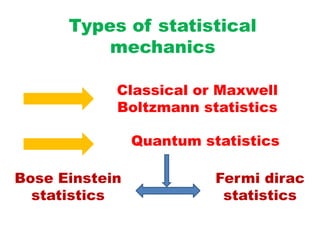
Types of statistical
mechanics
Classical or Maxwell
Boltzmann statistics
Quantum statistics
Bose Einstein
statistics
Fermi dirac
statistics
Classical or Maxwell Boltzmann statistics
explains temperature, pressure, energy.
But it does not explain the concept such as
Black body radiation
Photo-electric effect
Specific heat capacity at low temperatures
Classical or Maxwell Boltzmann [MB]
Statistics Characteristics
 Identical
 Distinguishable
 Any spin
 Example: Molecules of gas
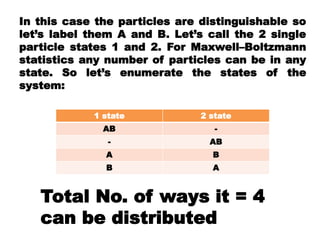
In this case the particles are distinguishable so
let’s label them A and B. Let’s call the 2 single
particle states 1 and 2. For Maxwell–Boltzmann
statistics any number of particles can be in any
state. So let’s enumerate the states of the
system:
1 state 2 state
AB -
- AB
A B
B A
Total No. of ways it = 4
can be distributed
Bose Einstein [BE] Statistics
Characteristics
 Identical
 Indistinguishable
 Zero or integral spin
 Particles are called bosons
 Example: Helium atoms at low
temperature, photons
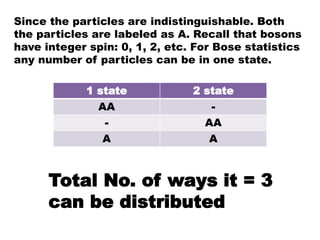
Since the particles are indistinguishable. Both
the particles are labeled as A. Recall that bosons
have integer spin: 0, 1, 2, etc. For Bose statistics
any number of particles can be in one state.
1 state 2 state
AA -
- AA
A A
Total No. of ways it = 3
can be distributed
Fermi dirac [FD] Statistics
Characteristics
 Identical
 Indistinguishable
 Half integral spin [eg:1/2, 3/2 etc]
 Particles are called fermions
 Example: electrons,protons,neutrons
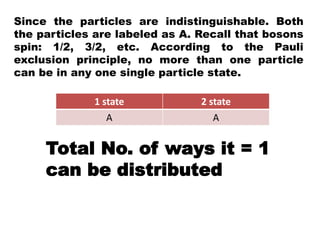
Since the particles are indistinguishable. Both
the particles are labeled as A. Recall that bosons
spin: 1/2, 3/2, etc. According to the Pauli
exclusion principle, no more than one particle
can be in any one single particle state.
1 state 2 state
A A
Total No. of ways it = 1
can be distributed
Questions
1. Define statistical mechanics
2. Mention the types of statistical mechanics
3. Explain the drawback of classical statistics
4. Mention the characteristics of MB statistics
5. Mention the characteristics of FD statistics
6. Mention the characteristics of BE statistics
7. Define pauli’s exclusion principle
Mathematical physics and statistical mechanics

Mathematical physics and statistical mechanics

  • 1.
  • 2.
    Mathematical Physics and StatisticalMechanics Dr.S.Amudha by
  • 3.
    Statistical mechanics, branchof physics that combines the principles and procedures of statistics with the laws of both classical and quantum mechanics, particularly with respect to the field of thermodynamics. It aims to predict and explain the measurable properties of macroscopic systems on the basis of the properties and behavior of the microscopic constituents of those systems. Definition for statistical mechanics
  • 4.
    Types of statistical mechanics Classicalor Maxwell Boltzmann statistics Quantum statistics Bose Einstein statistics Fermi dirac statistics
  • 5.
    Classical or MaxwellBoltzmann statistics explains temperature, pressure, energy. But it does not explain the concept such as Black body radiation Photo-electric effect Specific heat capacity at low temperatures
  • 6.
    Classical or MaxwellBoltzmann [MB] Statistics Characteristics  Identical  Distinguishable  Any spin  Example: Molecules of gas
  • 7.
    In this casethe particles are distinguishable so let’s label them A and B. Let’s call the 2 single particle states 1 and 2. For Maxwell–Boltzmann statistics any number of particles can be in any state. So let’s enumerate the states of the system: 1 state 2 state AB - - AB A B B A Total No. of ways it = 4 can be distributed
  • 8.
    Bose Einstein [BE]Statistics Characteristics  Identical  Indistinguishable  Zero or integral spin  Particles are called bosons  Example: Helium atoms at low temperature, photons
  • 9.
    Since the particlesare indistinguishable. Both the particles are labeled as A. Recall that bosons have integer spin: 0, 1, 2, etc. For Bose statistics any number of particles can be in one state. 1 state 2 state AA - - AA A A Total No. of ways it = 3 can be distributed
  • 10.
    Fermi dirac [FD]Statistics Characteristics  Identical  Indistinguishable  Half integral spin [eg:1/2, 3/2 etc]  Particles are called fermions  Example: electrons,protons,neutrons
  • 11.
    Since the particlesare indistinguishable. Both the particles are labeled as A. Recall that bosons spin: 1/2, 3/2, etc. According to the Pauli exclusion principle, no more than one particle can be in any one single particle state. 1 state 2 state A A Total No. of ways it = 1 can be distributed
  • 12.
    Questions 1. Define statisticalmechanics 2. Mention the types of statistical mechanics 3. Explain the drawback of classical statistics 4. Mention the characteristics of MB statistics 5. Mention the characteristics of FD statistics 6. Mention the characteristics of BE statistics 7. Define pauli’s exclusion principle