AWARDS &
COMPETITIVE EXAMS
IN MATHEMATICS
NTSE(National Talent Search
Examination)
 NTSE is a national level scholarship program
started by NCERT in the year 1963.
 NTSE (National Talent Search Examination) is
organized to identify and recognize students with
high intellect and academic talent.
 The qualified and talented students are provided
with financial assistance in the form of monthly
scholarship for an entire academic career.
 The amount of scholarship will be,
 Rs. 1250 per month for class 11th and 12th.
 Rs. 2000 per month for undergraduates and
post graduates.
ELIGIBILITY
 Students of class X studying in recognized
schools are eligible to appear for stage 1
examination conducted by the state/UTs in
which the schools are located.
 Syllabus of exam : NCERT.
 Medium of exam : English and Hindi.
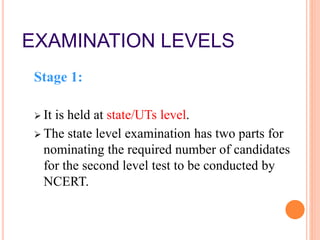
EXAMINATION LEVELS
Stage 1:
 It is held at state/UTs level.
 The state level examination has two parts for
nominating the required number of candidates
for the second level test to be conducted by
NCERT.
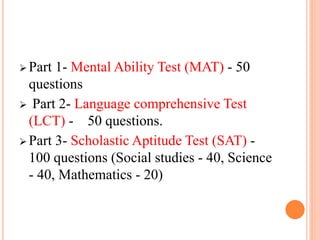
 Part 1- Mental Ability Test (MAT) - 50
questions
 Part 2- Language comprehensive Test
(LCT) - 50 questions.
 Part 3- Scholastic Aptitude Test (SAT) -
100 questions (Social studies - 40, Science
- 40, Mathematics - 20)
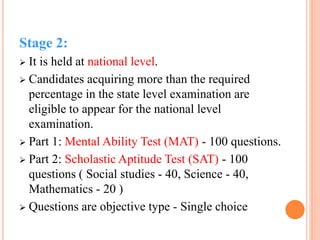
Stage 2:
 It is held at national level.
 Candidates acquiring more than the required
percentage in the state level examination are
eligible to appear for the national level
examination.
 Part 1: Mental Ability Test (MAT) - 100 questions.
 Part 2: Scholastic Aptitude Test (SAT) - 100
questions ( Social studies - 40, Science - 40,
Mathematics - 20 )
 Questions are objective type - Single choice
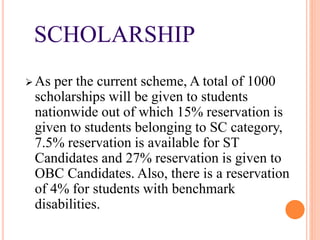
SCHOLARSHIP
 As per the current scheme, A total of 1000
scholarships will be given to students
nationwide out of which 15% reservation is
given to students belonging to SC category,
7.5% reservation is available for ST
Candidates and 27% reservation is given to
OBC Candidates. Also, there is a reservation
of 4% for students with benchmark
disabilities.
MATHS TALENT
SEARCH EXAMINATION
(MTSE)
Group members
● Fida
● Fathima sithara
● Varsha.k
 Maths Talent Search Examination (MTSE) is a
competitive examination conducted at various levels
by the Indian Institute for Studies in Mathematics
(IISMA).
 The focus of this exam is on mathematical reasoning,
mental ability, novel approach, concepts, accuracy
and speed.
ELIGIBILITY FOR MTSE
 MTSE is an open exam.
 Any student studying in Class III, IV, V, VI, VII, VIII,
IX under any educational board (CBSE, ICSE, or any
state board) is eligible to appear for the exam.
 Student can appear only for the class in which he/she
is studying during that academic year.
FEATURES OF MTSE
 The MTSE compels students to think critically.
 It enhances student's reasoning capacities.
 It tests student’s confidence.
 This exam has negative marking, which give
students exposure to the real competitive test.
NATURE OF THE EXAM
 The paper consists of 50 questions.
 Objective type questions.
 Each question has 4 alternatives.
 Questions are to be answered in 90 minutes, on an
OMR answer sheet. The correct answer is awarded with
2 marks, the wrong one carries a negative mark of 0.5.
 There is no negative marking for class 3 and class 4.
Syllabus for the Exam
• Syllabus of respective class covered in CBSE and
ICSE
Tentative Exam Date
• MTSE Exam is normally held in the month of
April
Awards
 Students scoring above 30 or the Benchmark
score, whichever is higher, are declared as
successful.
 The Benchmark score is the average score of all
the students for that class
 The top 5 rank holders of each class are awarded
mementoes.
 The top 200 successful students from each class
are awarded a Certificate of Merit and Cash
prizes worth more than Rs. 3.5 lakh. A
Certificate of Participation is awarded to all
other students writing the examination.
NURTURING MATHEMATICAL
TALENTS IN SCHOOLS
(NuMATS)
Group members
• Linsha VV
• Manju K
• Mrudula P
 NuMATS is a programme initiated by Kerala
Government under the leadership of state council
for educational research.
 The program was launched in 2012.
 It aims at nurturing young mathematical minds in
the Government school.
 The examination is conducted every year for the
students studying in the sixth class.
 The selection of candidates are done by conducting
an state wide aptitude test. The program was
launched in 2012.
Method of selection
 Phase 1 : The aptitude test will be conducted at
all the sub-districts
 Phase 2 : The aptitude test will be conducted at
the state level with the selected candidates of
sub-district level.
 Five persons from each district and four persons
with special skills (74 persons in total) are
selected for the scheme.
 A 15 day study camp is organized for the
selected students.
State Study Camp
 Every year in the months of April-May, a 10
to 15 day study camp is organized at the state
level involving 74 students who are selected
through aptitude test.
 Mathematics teachers from the state and from
other states interact with the students in this
study camp.
 Study camp continues till the students who
are selected in the sixth class complete the
twelfth class
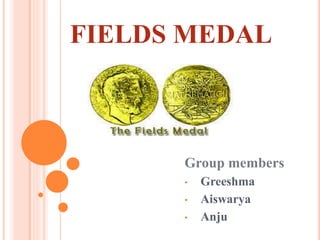
FIELDS MEDAL
Group members
• Greeshma
• Aiswarya
• Anju
 The fields medal is officially known as
International Medal for Outstanding
Discoveries in Mathematics.
 It is regarded as one of the highest honors a
mathematician can receive.
 It has been described as the mathematician’s
Nobel Prize.
 It has several differences, including frequency of
award, number of awards, and age limits.
 It is a prize awarded to two, three, or four
mathematicians under the age of 40 years .
 According to the Annual Academic Excellence
Survey by ARWU, the Fields Medal is consistently
regarded as the top award in the field of
Mathematics world wide.
 Another survey conducted by IREG in 2013-14,
the Fields Medal came closely after the Abel Prize
as the second most prestigious international award
in Mathematics.
 The name of the award is in honor of Canadian
mathematician John Charles Fields.
 The prize comes with a monetary award which,
since 2006, has been CA $15,000.
 The medal was first awarded in 1936 to Finnish
mathematician Lars Ahlfors and American
mathematician Jesse Douglas.
 In 2014, the Iranian mathematician Maryam
Mirzakhani became the first female Fields
Medalist.
 In all, sixty people have been awarded the Fields
Medal.
 The most recent group of Fields Medalist are
Peter Scholze, Alessio Figalli, Akshay
Venkatesh and Caucher Birkar received their
awards on 1 August 2018 at the opening
ceremony of the IMU International Congress.
MATHEMATICS
OLYMPIAD
Group Members
• Ashifa
• Anusree
• Keerthana
 The International Mathematical Olympiad (IMO) is
the World Championship Mathematics Competition
for High School students and is held annually in a
different country.
 This race is proof of who is the best in the field of
Mathematics.
 The Math Olympiad was first held in the year 50’s.
Then in the following years, this competition was
always held and became an annual routine agenda.
 Participants come from countries around the world,
One team consists of six people, and in it there is a
chairman with a vice chairman.
 Participants sent by their country are high school
students under the age of 20 years and have met the
requirements set by the Mathematics Olympiad
committee.
 It was initially founded for eastern European
member countries of the Warsaw Pact, under the
USSR bloc of influence, but later other countries
participated as well.
 The Mathematics Olympiad activity was
undertaken by NBHM from 1986 onwards and is
currently run in collaboration with the Homi
Bhabha Centre for Science Education, Mumbai.
 NBHM has taken the responsibility for selecting
and training the Indian team for participation in
the International Mathematical Olympiad every
year.
 For the purpose of administering Mathematics
Olympiad contests, the country has been divided
in 16 regions.
 A regional coordinator is responsible for
conducting these tests in each region
 The Math Olympiad is held not only as a
competition. This international event is a proof for
countries around the world about who is the best in
the world of mathematics.
 In Mathematics Olympiad, there are several type of
questions that must be done by the participants
 The question given are a collection of various
branches of the field of mathematics that are taught
in secondary schools.
Awards & competitive exams in mathematics

Awards & competitive exams in mathematics

  • 1.
  • 2.
  • 3.
     NTSE isa national level scholarship program started by NCERT in the year 1963.  NTSE (National Talent Search Examination) is organized to identify and recognize students with high intellect and academic talent.  The qualified and talented students are provided with financial assistance in the form of monthly scholarship for an entire academic career.  The amount of scholarship will be,  Rs. 1250 per month for class 11th and 12th.  Rs. 2000 per month for undergraduates and post graduates.
  • 4.
    ELIGIBILITY  Students ofclass X studying in recognized schools are eligible to appear for stage 1 examination conducted by the state/UTs in which the schools are located.  Syllabus of exam : NCERT.  Medium of exam : English and Hindi.
  • 5.
    EXAMINATION LEVELS Stage 1: It is held at state/UTs level.  The state level examination has two parts for nominating the required number of candidates for the second level test to be conducted by NCERT.
  • 6.
     Part 1-Mental Ability Test (MAT) - 50 questions  Part 2- Language comprehensive Test (LCT) - 50 questions.  Part 3- Scholastic Aptitude Test (SAT) - 100 questions (Social studies - 40, Science - 40, Mathematics - 20)
  • 7.
    Stage 2:  Itis held at national level.  Candidates acquiring more than the required percentage in the state level examination are eligible to appear for the national level examination.  Part 1: Mental Ability Test (MAT) - 100 questions.  Part 2: Scholastic Aptitude Test (SAT) - 100 questions ( Social studies - 40, Science - 40, Mathematics - 20 )  Questions are objective type - Single choice
  • 8.
    SCHOLARSHIP  As perthe current scheme, A total of 1000 scholarships will be given to students nationwide out of which 15% reservation is given to students belonging to SC category, 7.5% reservation is available for ST Candidates and 27% reservation is given to OBC Candidates. Also, there is a reservation of 4% for students with benchmark disabilities.
  • 9.
    MATHS TALENT SEARCH EXAMINATION (MTSE) Groupmembers ● Fida ● Fathima sithara ● Varsha.k
  • 10.
     Maths TalentSearch Examination (MTSE) is a competitive examination conducted at various levels by the Indian Institute for Studies in Mathematics (IISMA).  The focus of this exam is on mathematical reasoning, mental ability, novel approach, concepts, accuracy and speed.
  • 11.
    ELIGIBILITY FOR MTSE MTSE is an open exam.  Any student studying in Class III, IV, V, VI, VII, VIII, IX under any educational board (CBSE, ICSE, or any state board) is eligible to appear for the exam.  Student can appear only for the class in which he/she is studying during that academic year.
  • 12.
    FEATURES OF MTSE The MTSE compels students to think critically.  It enhances student's reasoning capacities.  It tests student’s confidence.  This exam has negative marking, which give students exposure to the real competitive test.
  • 13.
    NATURE OF THEEXAM  The paper consists of 50 questions.  Objective type questions.  Each question has 4 alternatives.  Questions are to be answered in 90 minutes, on an OMR answer sheet. The correct answer is awarded with 2 marks, the wrong one carries a negative mark of 0.5.  There is no negative marking for class 3 and class 4.
  • 14.
    Syllabus for theExam • Syllabus of respective class covered in CBSE and ICSE Tentative Exam Date • MTSE Exam is normally held in the month of April
  • 15.
    Awards  Students scoringabove 30 or the Benchmark score, whichever is higher, are declared as successful.  The Benchmark score is the average score of all the students for that class  The top 5 rank holders of each class are awarded mementoes.
  • 16.
     The top200 successful students from each class are awarded a Certificate of Merit and Cash prizes worth more than Rs. 3.5 lakh. A Certificate of Participation is awarded to all other students writing the examination.
  • 17.
    NURTURING MATHEMATICAL TALENTS INSCHOOLS (NuMATS) Group members • Linsha VV • Manju K • Mrudula P
  • 18.
     NuMATS isa programme initiated by Kerala Government under the leadership of state council for educational research.  The program was launched in 2012.  It aims at nurturing young mathematical minds in the Government school.  The examination is conducted every year for the students studying in the sixth class.  The selection of candidates are done by conducting an state wide aptitude test. The program was launched in 2012.
  • 19.
    Method of selection Phase 1 : The aptitude test will be conducted at all the sub-districts  Phase 2 : The aptitude test will be conducted at the state level with the selected candidates of sub-district level.  Five persons from each district and four persons with special skills (74 persons in total) are selected for the scheme.  A 15 day study camp is organized for the selected students.
  • 20.
    State Study Camp Every year in the months of April-May, a 10 to 15 day study camp is organized at the state level involving 74 students who are selected through aptitude test.  Mathematics teachers from the state and from other states interact with the students in this study camp.  Study camp continues till the students who are selected in the sixth class complete the twelfth class
  • 21.
    FIELDS MEDAL Group members •Greeshma • Aiswarya • Anju
  • 22.
     The fieldsmedal is officially known as International Medal for Outstanding Discoveries in Mathematics.  It is regarded as one of the highest honors a mathematician can receive.  It has been described as the mathematician’s Nobel Prize.  It has several differences, including frequency of award, number of awards, and age limits.  It is a prize awarded to two, three, or four mathematicians under the age of 40 years .
  • 23.
     According tothe Annual Academic Excellence Survey by ARWU, the Fields Medal is consistently regarded as the top award in the field of Mathematics world wide.  Another survey conducted by IREG in 2013-14, the Fields Medal came closely after the Abel Prize as the second most prestigious international award in Mathematics.  The name of the award is in honor of Canadian mathematician John Charles Fields.  The prize comes with a monetary award which, since 2006, has been CA $15,000.
  • 24.
     The medalwas first awarded in 1936 to Finnish mathematician Lars Ahlfors and American mathematician Jesse Douglas.  In 2014, the Iranian mathematician Maryam Mirzakhani became the first female Fields Medalist.  In all, sixty people have been awarded the Fields Medal.  The most recent group of Fields Medalist are Peter Scholze, Alessio Figalli, Akshay Venkatesh and Caucher Birkar received their awards on 1 August 2018 at the opening ceremony of the IMU International Congress.
  • 25.
  • 26.
     The InternationalMathematical Olympiad (IMO) is the World Championship Mathematics Competition for High School students and is held annually in a different country.  This race is proof of who is the best in the field of Mathematics.  The Math Olympiad was first held in the year 50’s. Then in the following years, this competition was always held and became an annual routine agenda.  Participants come from countries around the world, One team consists of six people, and in it there is a chairman with a vice chairman.
  • 27.
     Participants sentby their country are high school students under the age of 20 years and have met the requirements set by the Mathematics Olympiad committee.  It was initially founded for eastern European member countries of the Warsaw Pact, under the USSR bloc of influence, but later other countries participated as well.  The Mathematics Olympiad activity was undertaken by NBHM from 1986 onwards and is currently run in collaboration with the Homi Bhabha Centre for Science Education, Mumbai.
  • 28.
     NBHM hastaken the responsibility for selecting and training the Indian team for participation in the International Mathematical Olympiad every year.  For the purpose of administering Mathematics Olympiad contests, the country has been divided in 16 regions.  A regional coordinator is responsible for conducting these tests in each region
  • 29.
     The MathOlympiad is held not only as a competition. This international event is a proof for countries around the world about who is the best in the world of mathematics.  In Mathematics Olympiad, there are several type of questions that must be done by the participants  The question given are a collection of various branches of the field of mathematics that are taught in secondary schools.