Mathematical Induction
1
M.M.A. Hashem, PhD
Professor
Dept. of Computer Science and Engineering
Khulna University of Engineering & Technology
(KUET)
CSE 1107
Discrete Mathematics
April 9, 2024 Dept of CSE, KUET
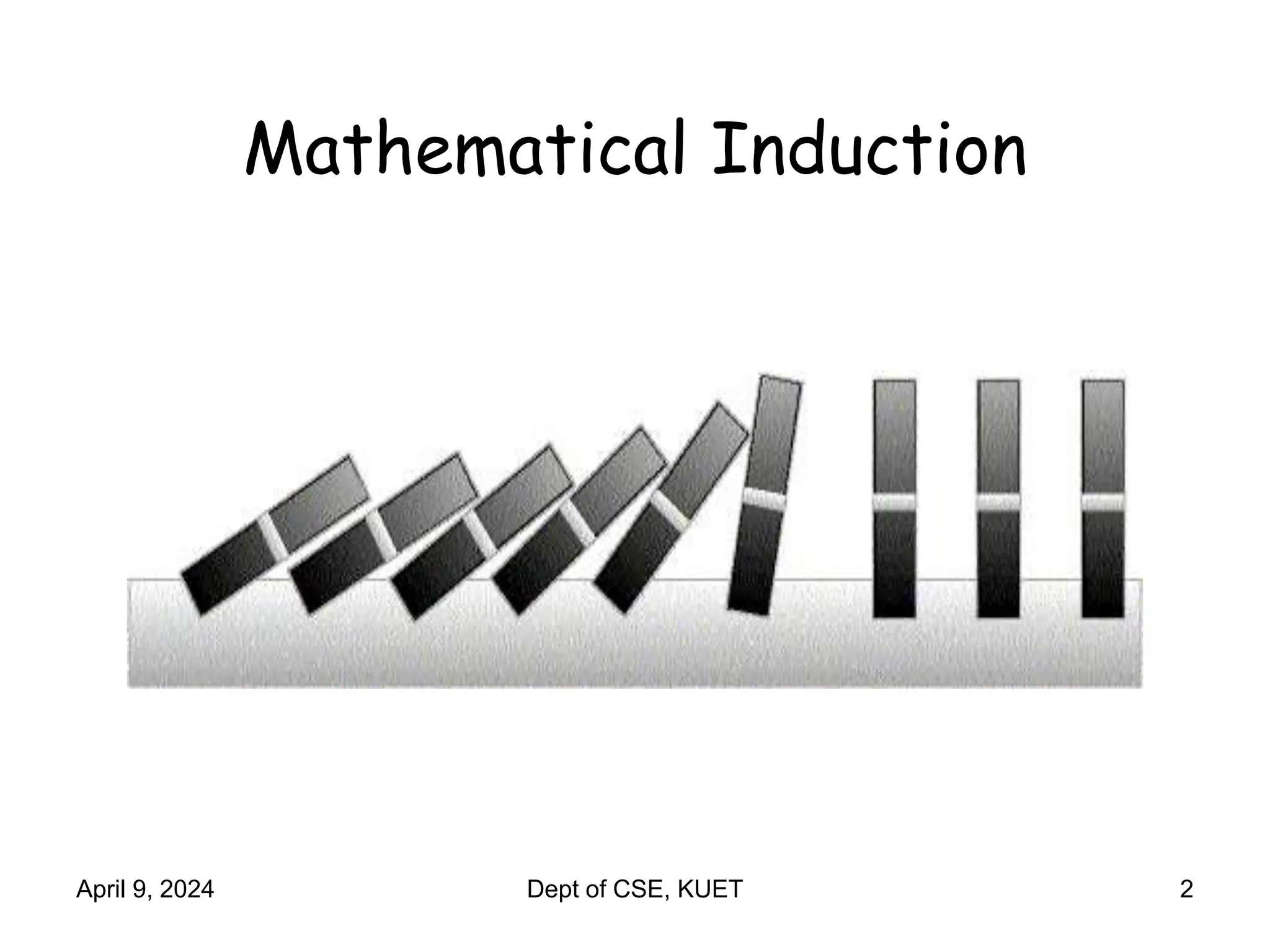
Mathematical Induction
April 9, 2024 Dept of CSE, KUET 2
This Lecture
Last time we have discussed different proof techniques.
This time we will focus on probably the most important one
– mathematical induction.
This lecture’s plan is to go through the following:
• The idea of mathematical induction
• Basic induction proofs (e.g. equality, inequality, property, etc)
• Inductive constructions
• A paradox
April 9, 2024 Dept of CSE, KUET 3
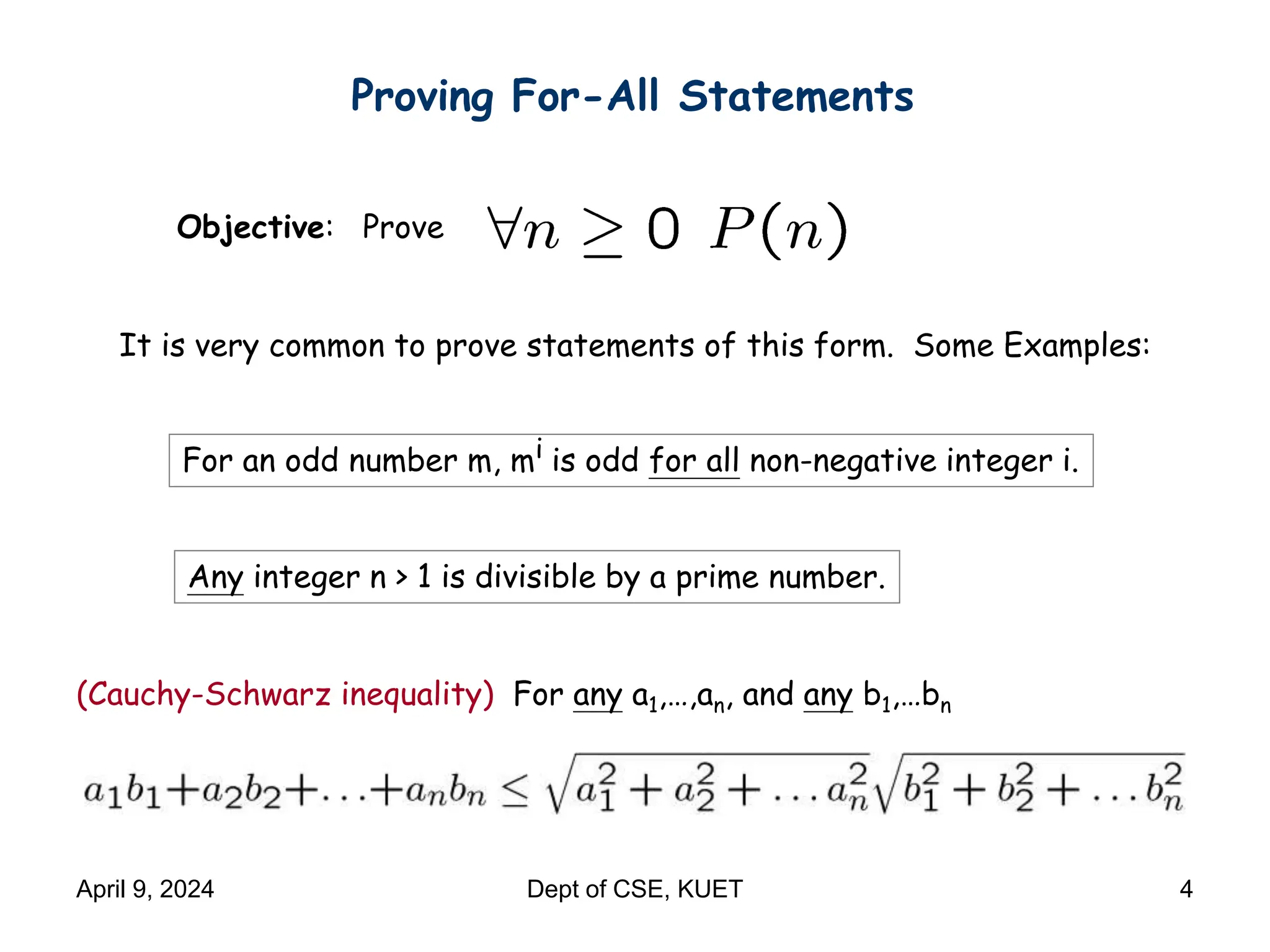
Proving For-All Statements
Objective: Prove
It is very common to prove statements of this form. Some Examples:
For an odd number m, mi is odd for all non-negative integer i.
Any integer n > 1 is divisible by a prime number.
(Cauchy-Schwarz inequality) For any a1,…,an, and any b1,…bn
April 9, 2024 Dept of CSE, KUET 4
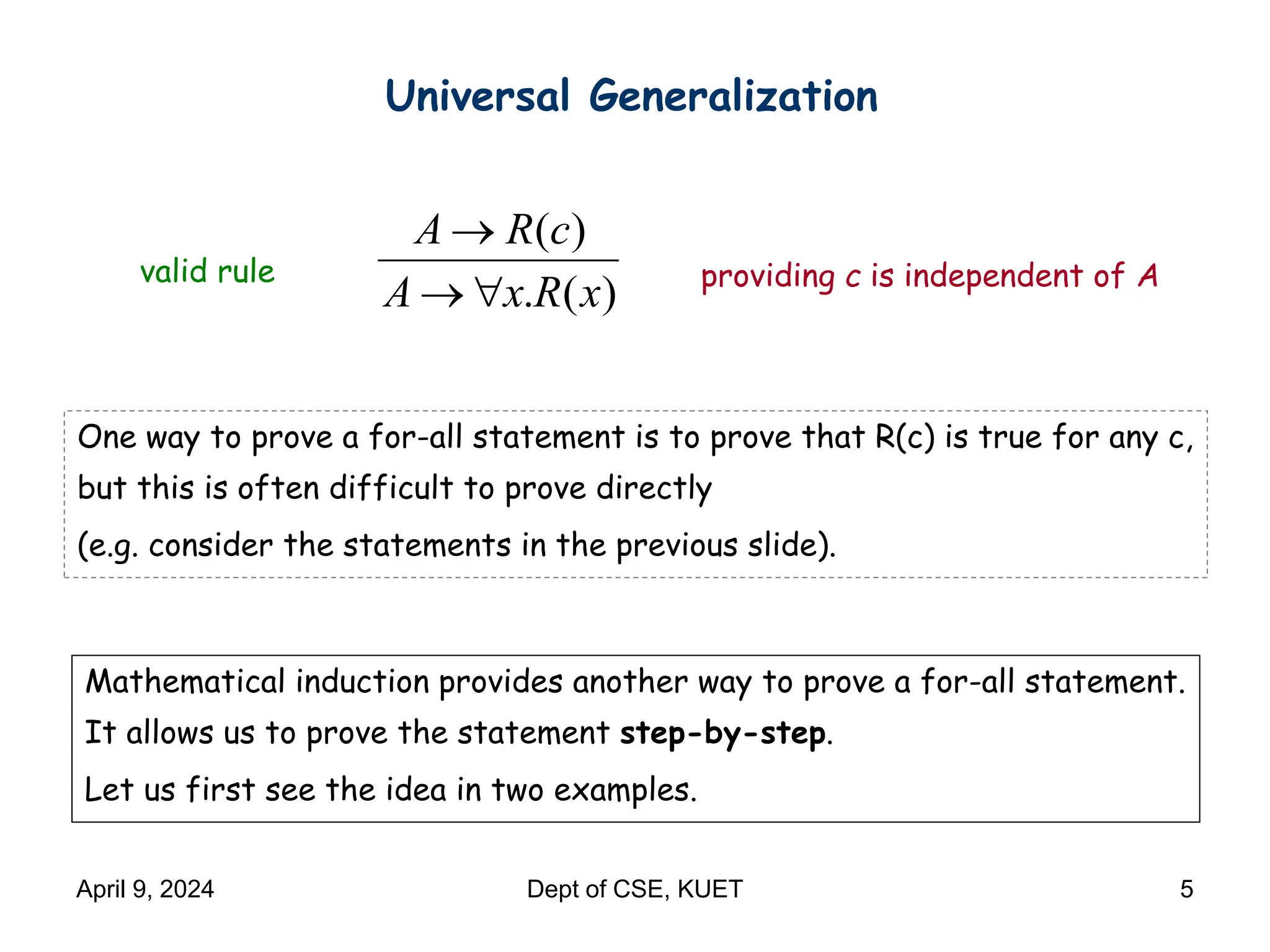
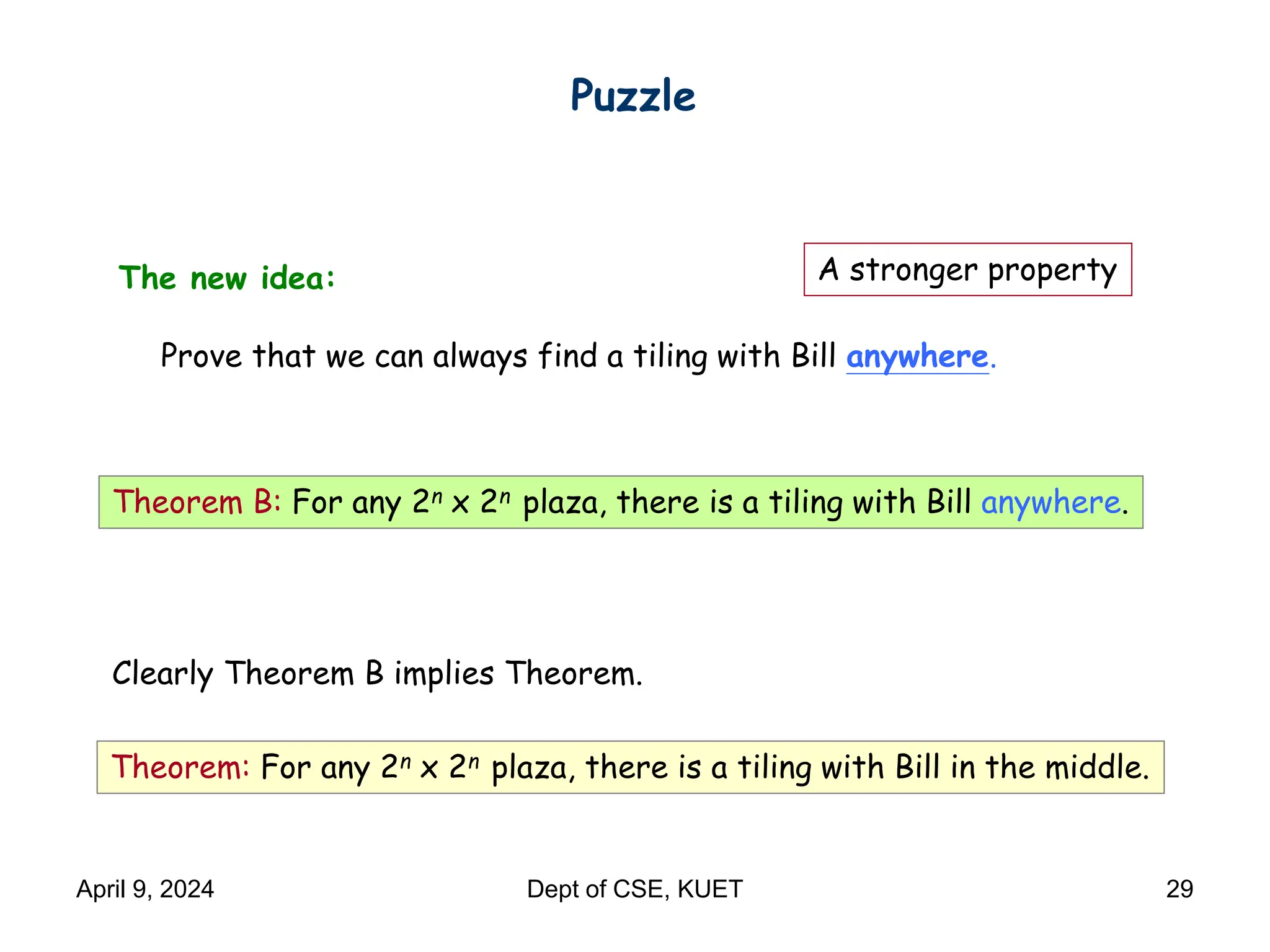
Universal Generalization
( )
. ( )
A R c
A x R x

 
valid rule providing c is independent of A
One way to prove a for-all statement is to prove that R(c) is true for any c,
but this is often difficult to prove directly
(e.g. consider the statements in the previous slide).
Mathematical induction provides another way to prove a for-all statement.
It allows us to prove the statement step-by-step.
Let us first see the idea in two examples.
April 9, 2024 Dept of CSE, KUET 5
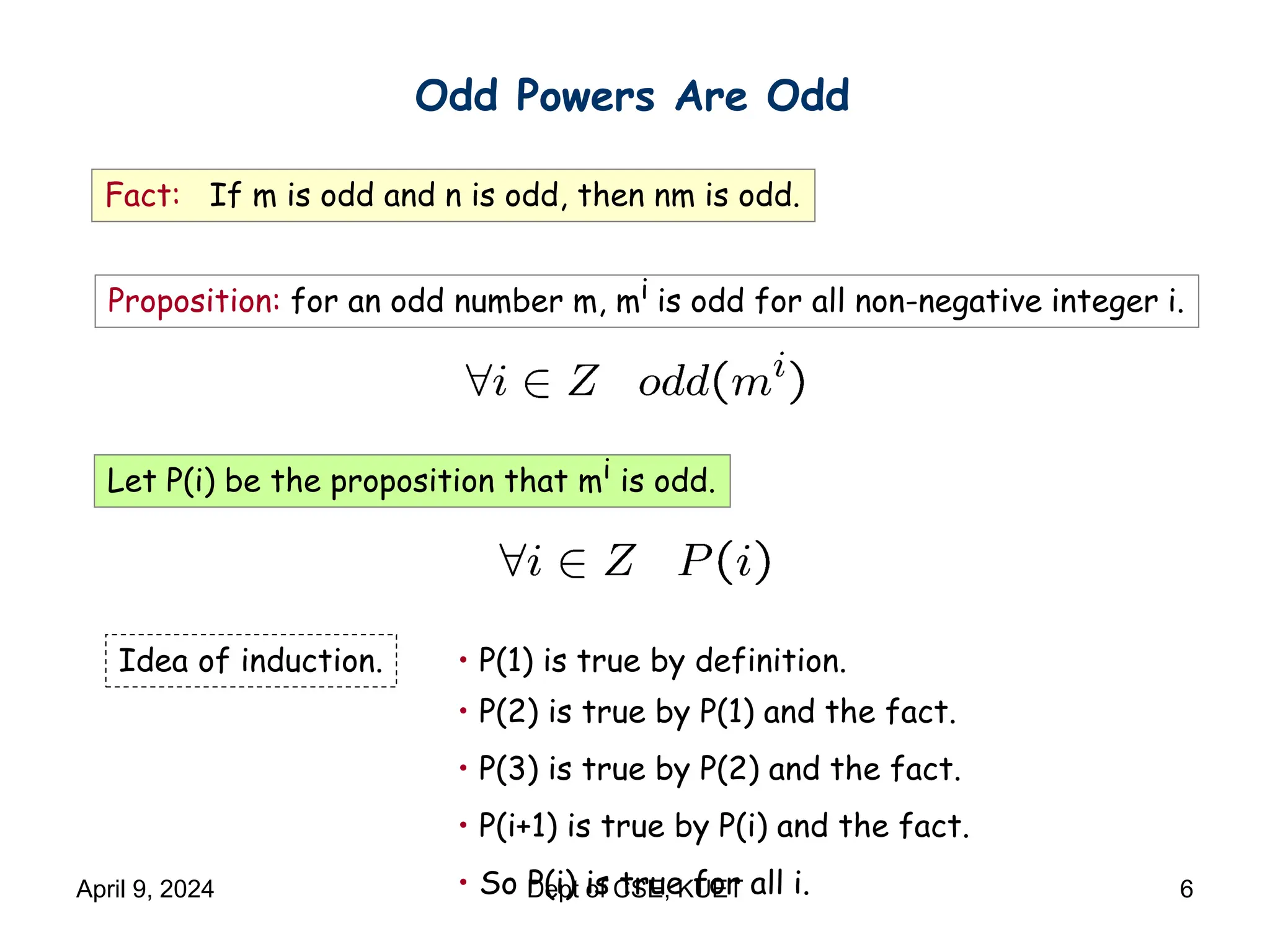
Odd Powers Are Odd
Fact: If m is odd and n is odd, then nm is odd.
Proposition: for an odd number m, mi is odd for all non-negative integer i.
Let P(i) be the proposition that mi is odd.
• P(1) is true by definition.
• P(2) is true by P(1) and the fact.
• P(3) is true by P(2) and the fact.
• P(i+1) is true by P(i) and the fact.
• So P(i) is true for all i.
Idea of induction.
April 9, 2024 Dept of CSE, KUET 6
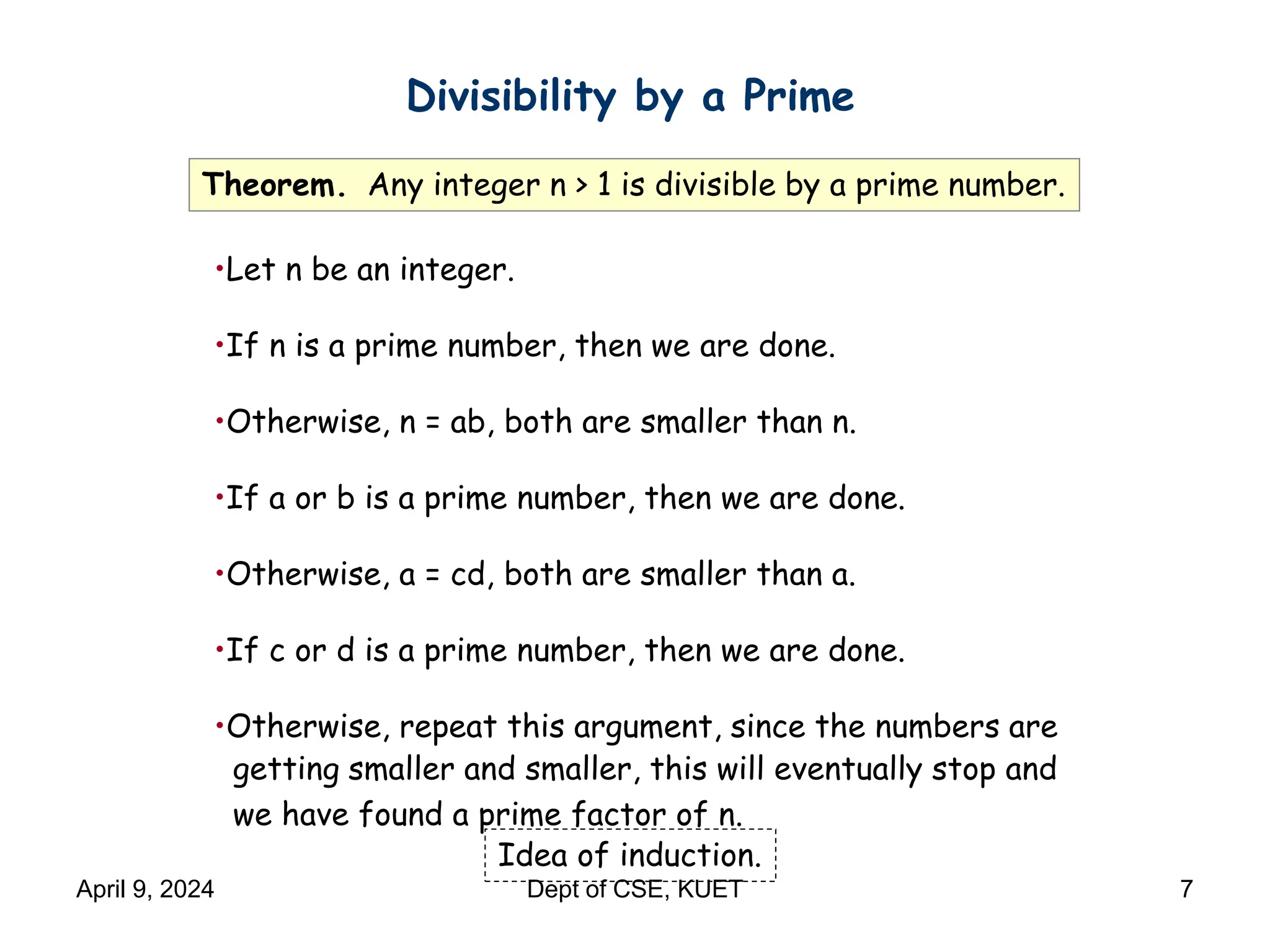
Divisibility by a Prime
Theorem. Any integer n > 1 is divisible by a prime number.
Idea of induction.
•Let n be an integer.
•If n is a prime number, then we are done.
•Otherwise, n = ab, both are smaller than n.
•If a or b is a prime number, then we are done.
•Otherwise, a = cd, both are smaller than a.
•If c or d is a prime number, then we are done.
•Otherwise, repeat this argument, since the numbers are
getting smaller and smaller, this will eventually stop and
we have found a prime factor of n.
April 9, 2024 Dept of CSE, KUET 7
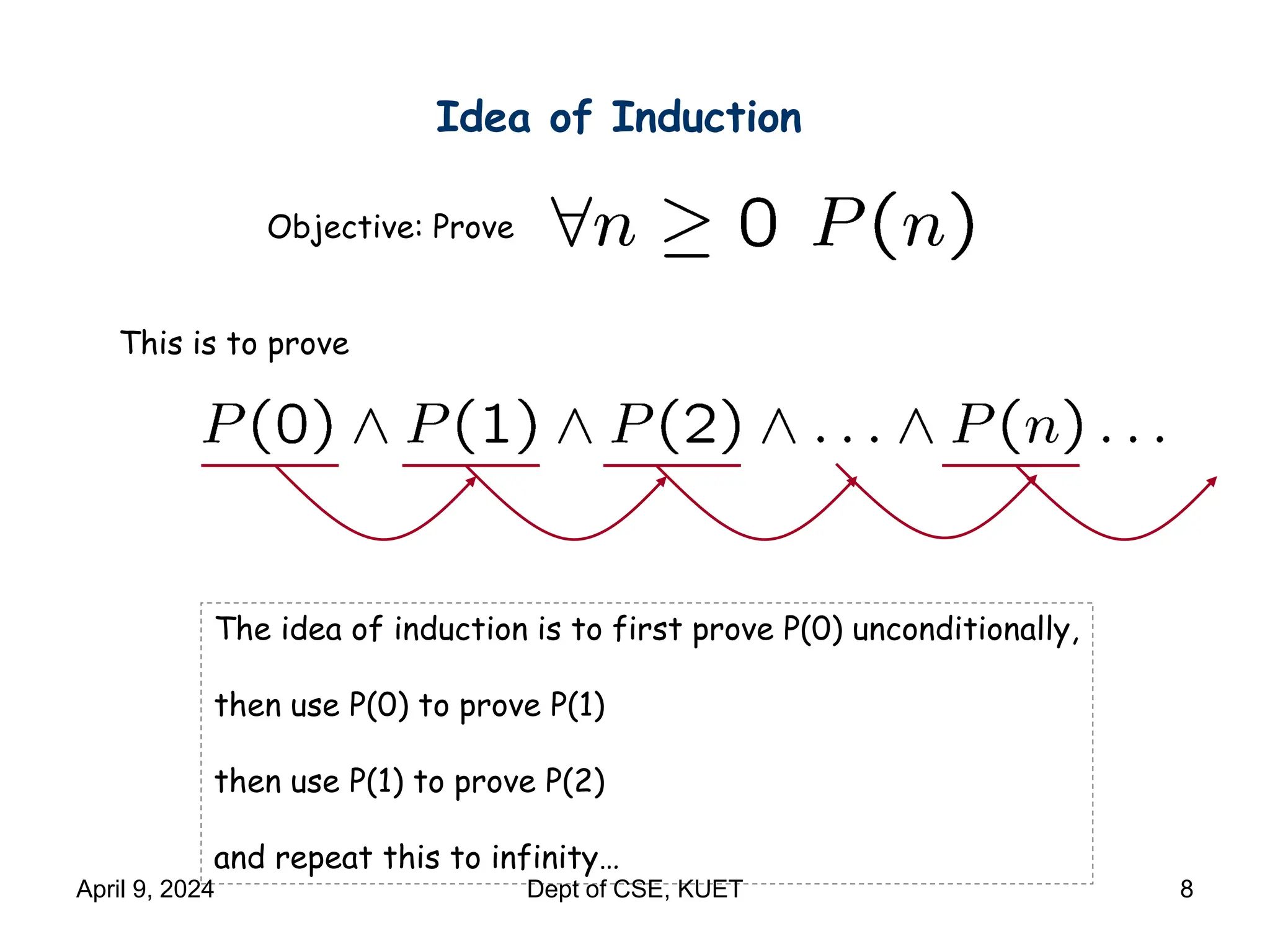
Objective: Prove
Idea of Induction
This is to prove
The idea of induction is to first prove P(0) unconditionally,
then use P(0) to prove P(1)
then use P(1) to prove P(2)
and repeat this to infinity…
April 9, 2024 Dept of CSE, KUET 8
The Induction Rule
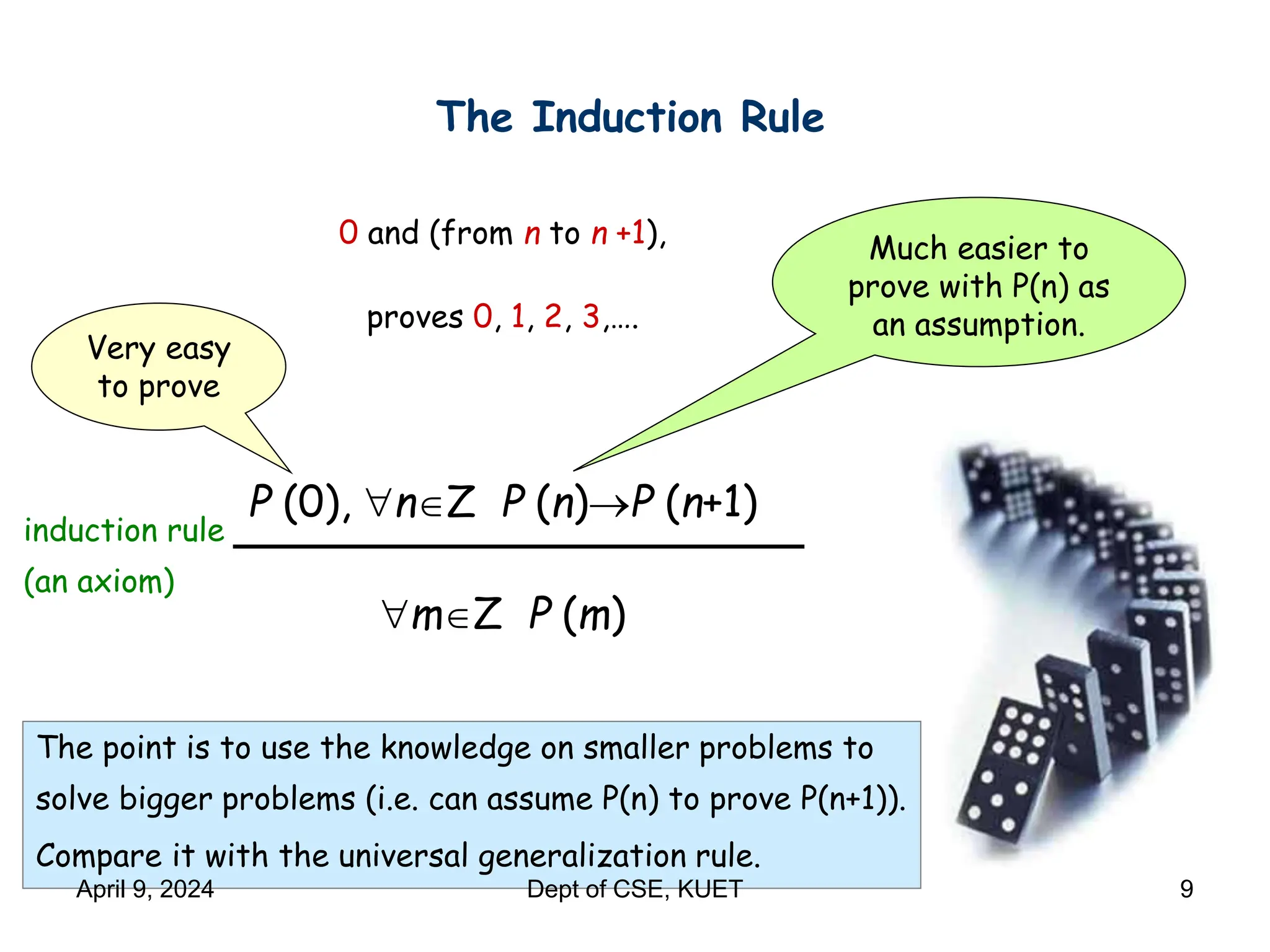
0 and (from n to n +1),
proves 0, 1, 2, 3,….
P (0), nZ P (n)P (n+1)
mZ P (m)
Very easy
to prove
Much easier to
prove with P(n) as
an assumption.
The point is to use the knowledge on smaller problems to
solve bigger problems (i.e. can assume P(n) to prove P(n+1)).
Compare it with the universal generalization rule.
induction rule
(an axiom)
April 9, 2024 Dept of CSE, KUET 9
This Lecture
• The idea of mathematical induction
• Basic induction proofs (e.g. equality, inequality, property,etc)
• Inductive constructions
• A paradox
April 9, 2024 Dept of CSE, KUET 10
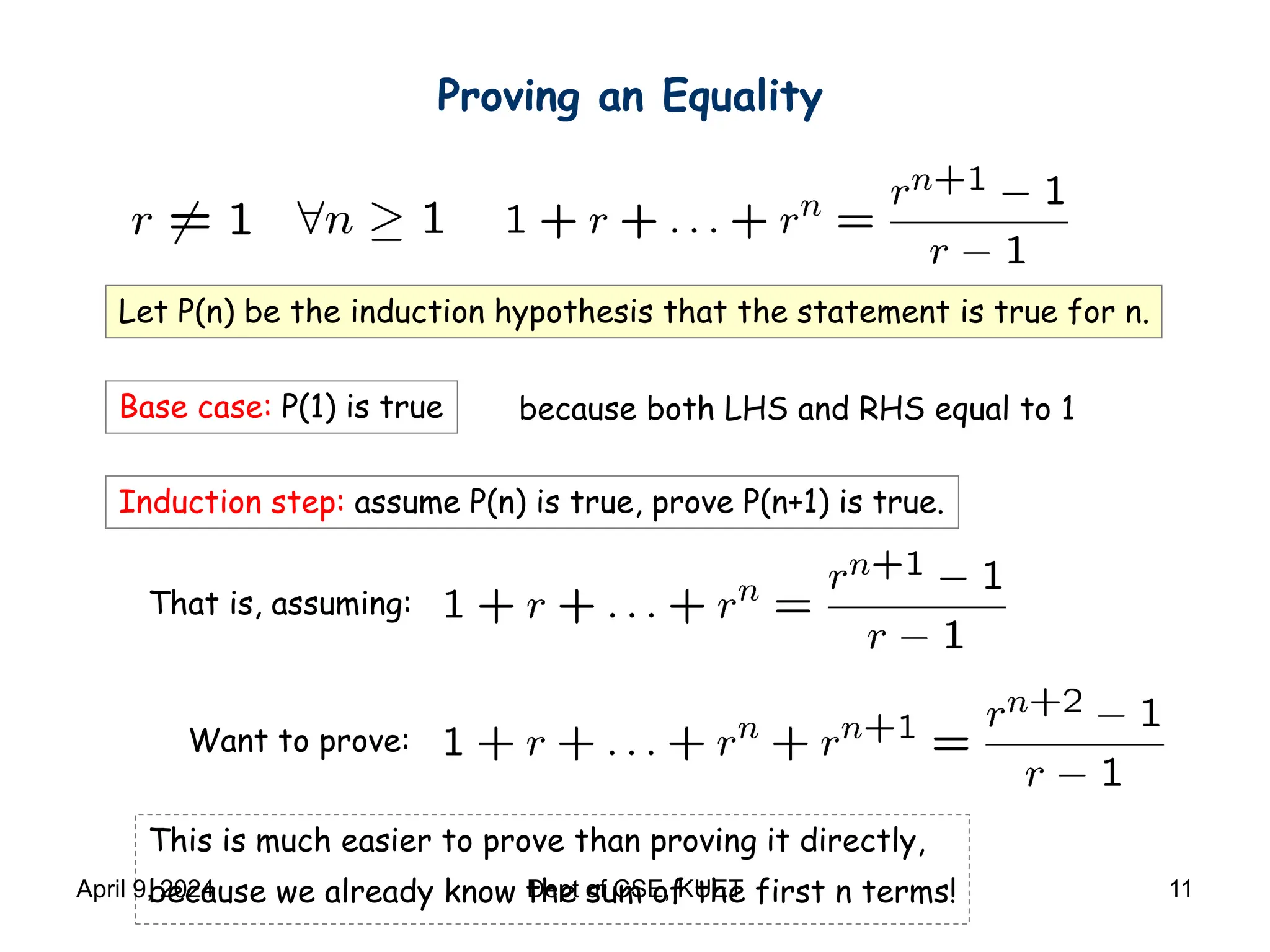
Proving an Equality
Let P(n) be the induction hypothesis that the statement is true for n.
Base case: P(1) is true
Induction step: assume P(n) is true, prove P(n+1) is true.
because both LHS and RHS equal to 1
That is, assuming:
Want to prove:
This is much easier to prove than proving it directly,
because we already know the sum of the first n terms!
April 9, 2024 Dept of CSE, KUET 11
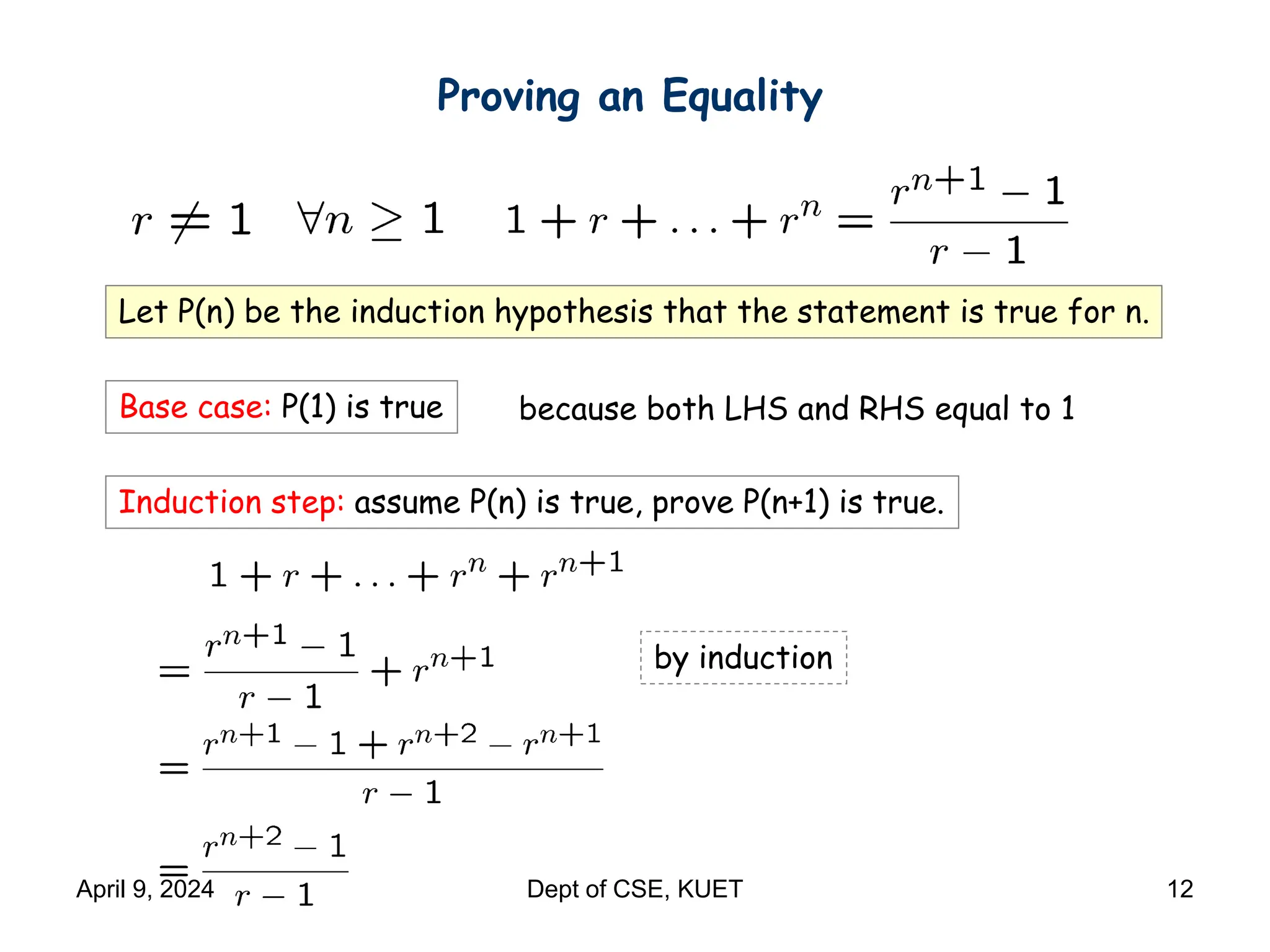
Proving an Equality
Let P(n) be the induction hypothesis that the statement is true for n.
Base case: P(1) is true
Induction step: assume P(n) is true, prove P(n+1) is true.
by induction
because both LHS and RHS equal to 1
April 9, 2024 Dept of CSE, KUET 12
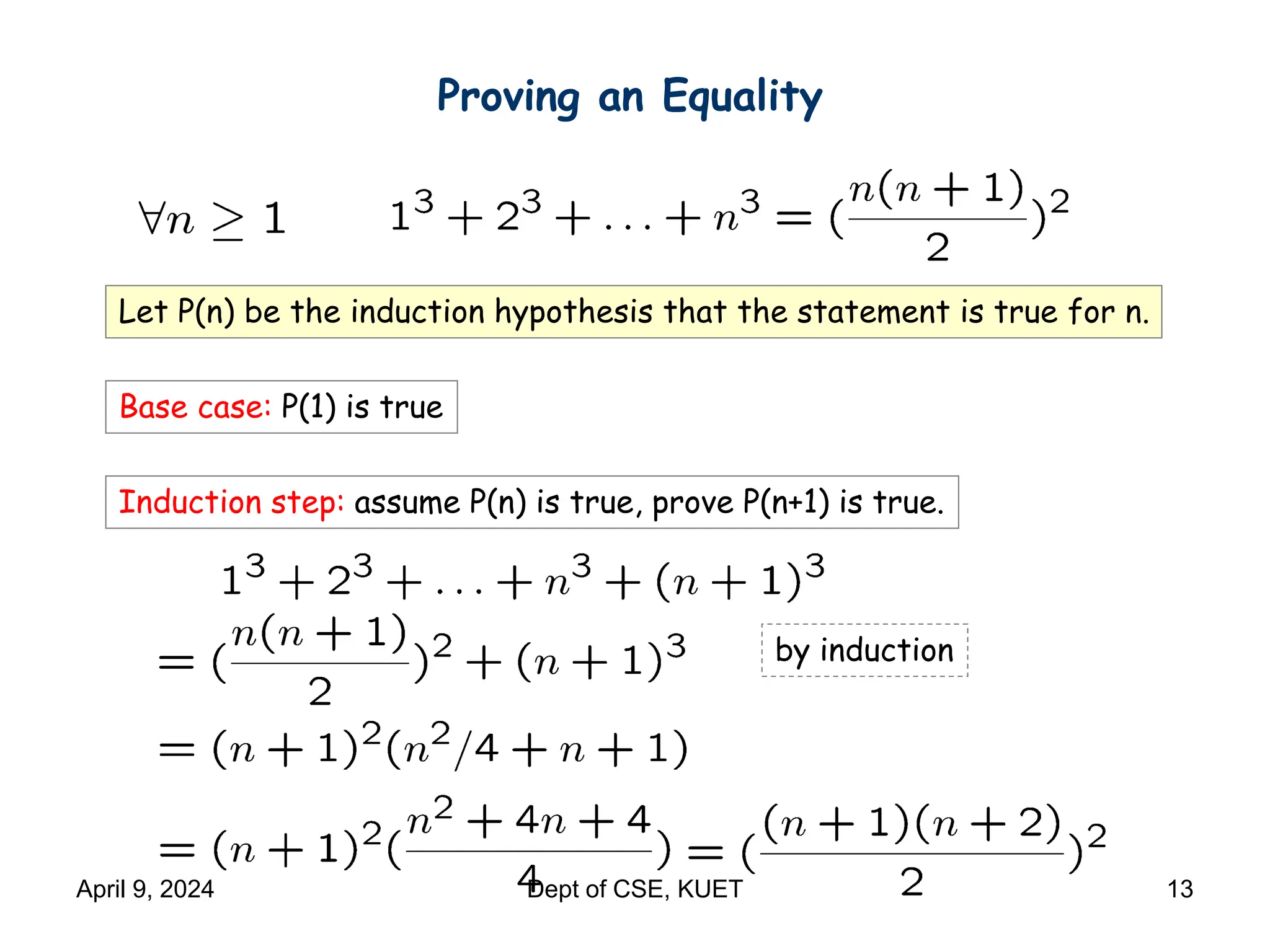
Proving an Equality
Let P(n) be the induction hypothesis that the statement is true for n.
Base case: P(1) is true
Induction step: assume P(n) is true, prove P(n+1) is true.
by induction
April 9, 2024 Dept of CSE, KUET 13
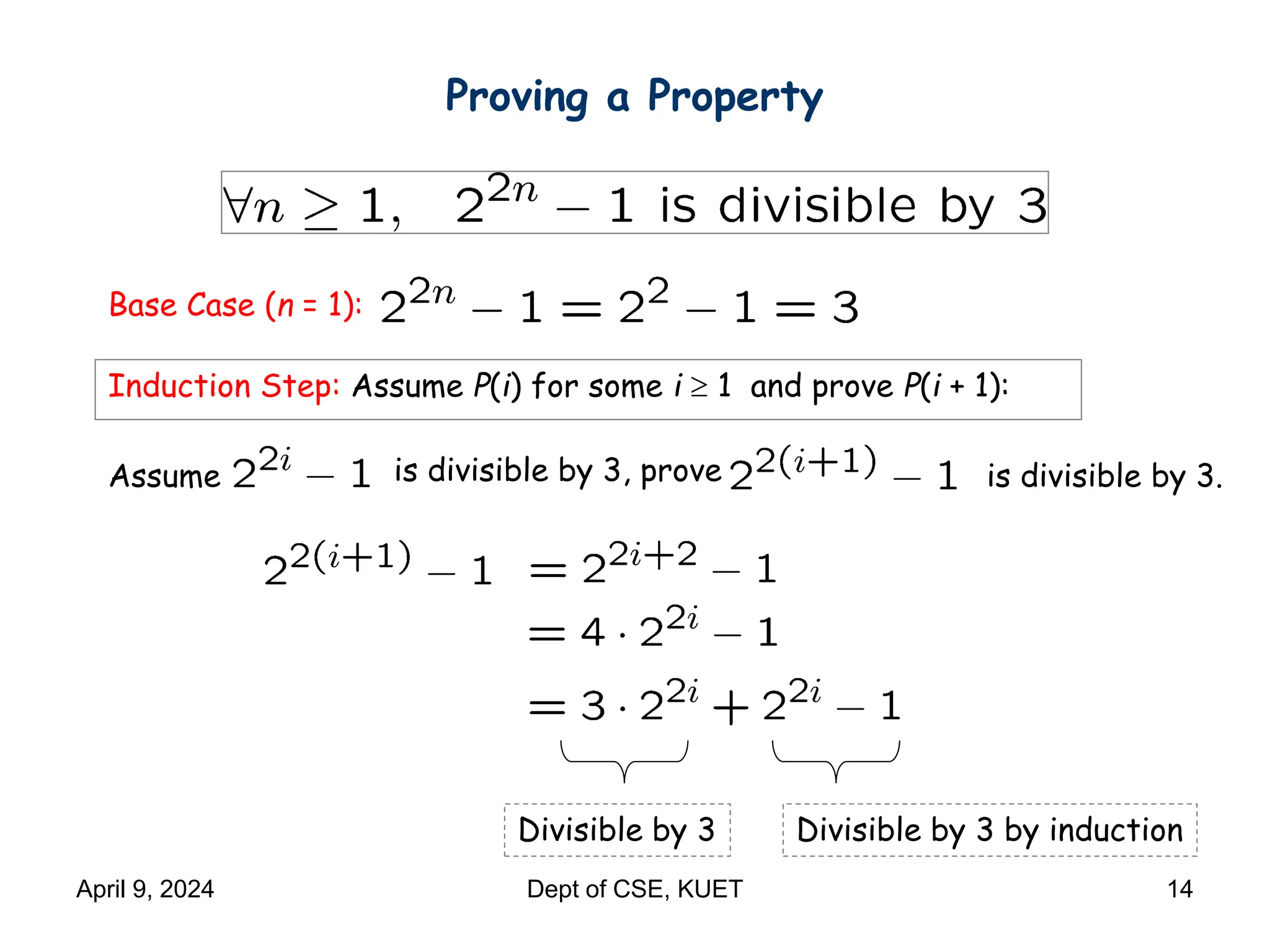
Proving a Property
Base Case (n = 1):
Induction Step: Assume P(i) for some i  1 and prove P(i + 1):
Assume is divisible by 3, prove is divisible by 3.
Divisible by 3 by induction
Divisible by 3
April 9, 2024 Dept of CSE, KUET 14
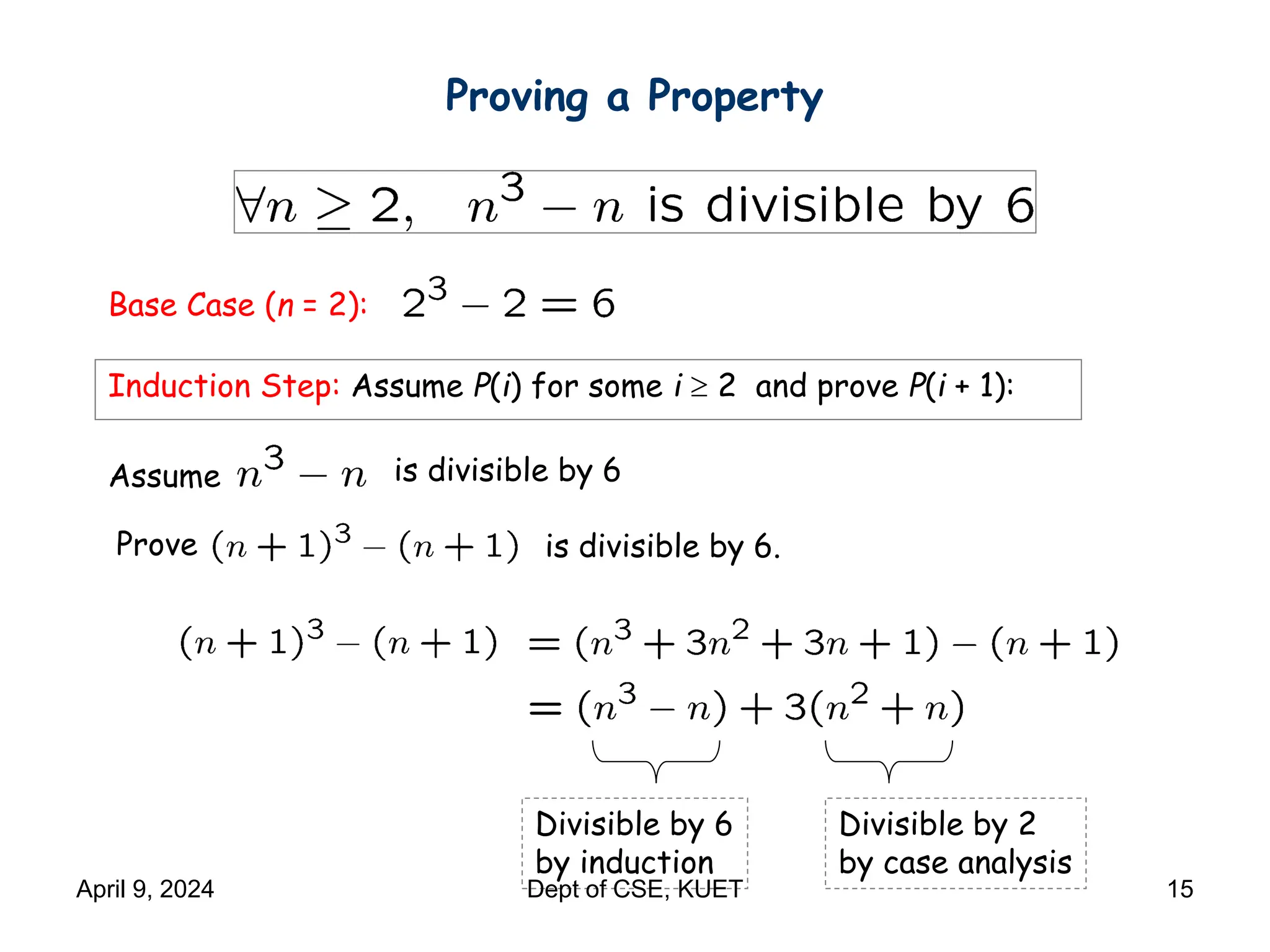
Proving a Property
Base Case (n = 2):
Induction Step: Assume P(i) for some i  2 and prove P(i + 1):
Assume is divisible by 6
is divisible by 6.
Divisible by 2
by case analysis
Divisible by 6
by induction
Prove
April 9, 2024 Dept of CSE, KUET 15
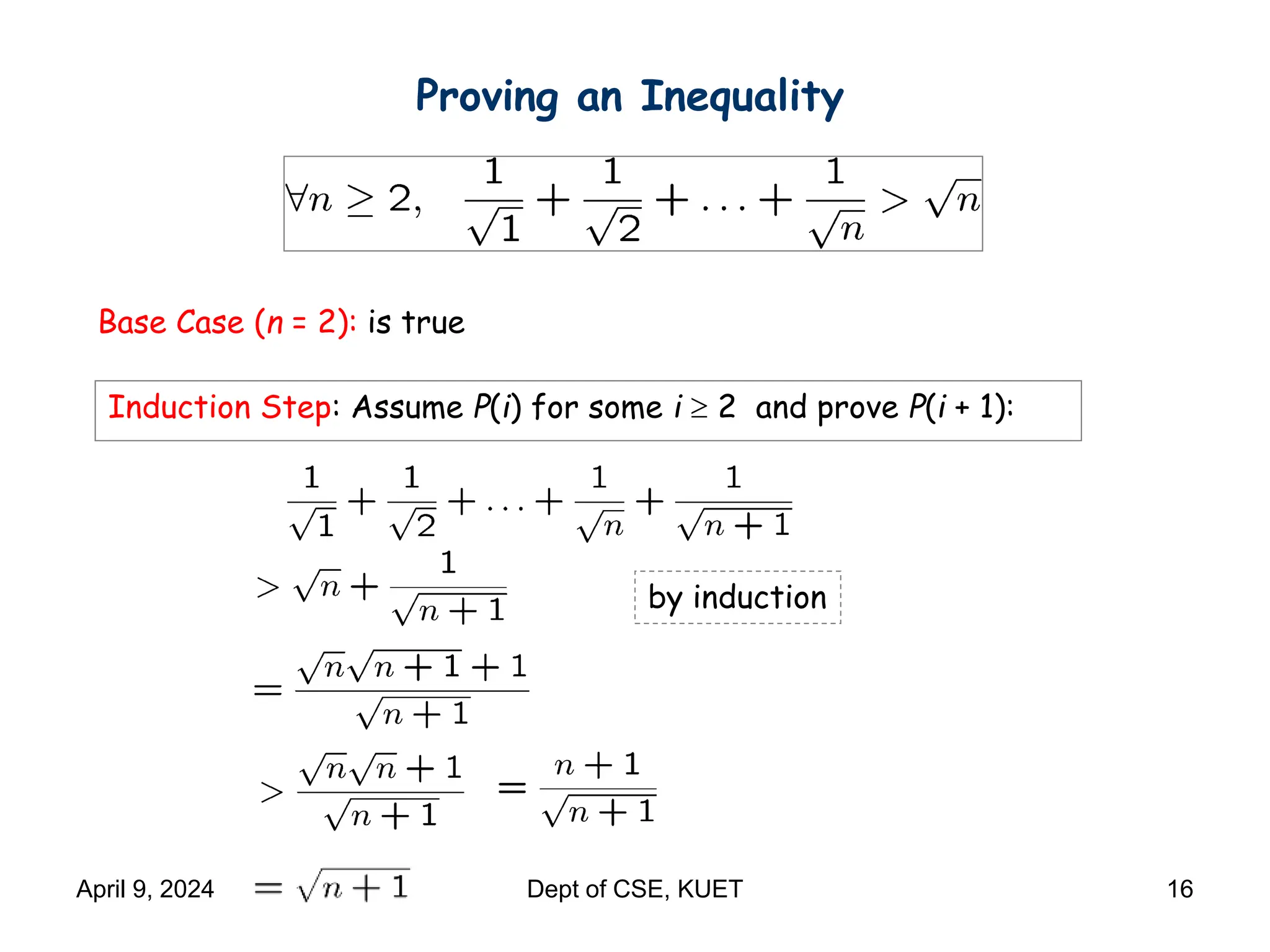
Proving an Inequality
Base Case (n = 2): is true
Induction Step: Assume P(i) for some i  2 and prove P(i + 1):
by induction
April 9, 2024 Dept of CSE, KUET 16
Cauchy-Schwarz
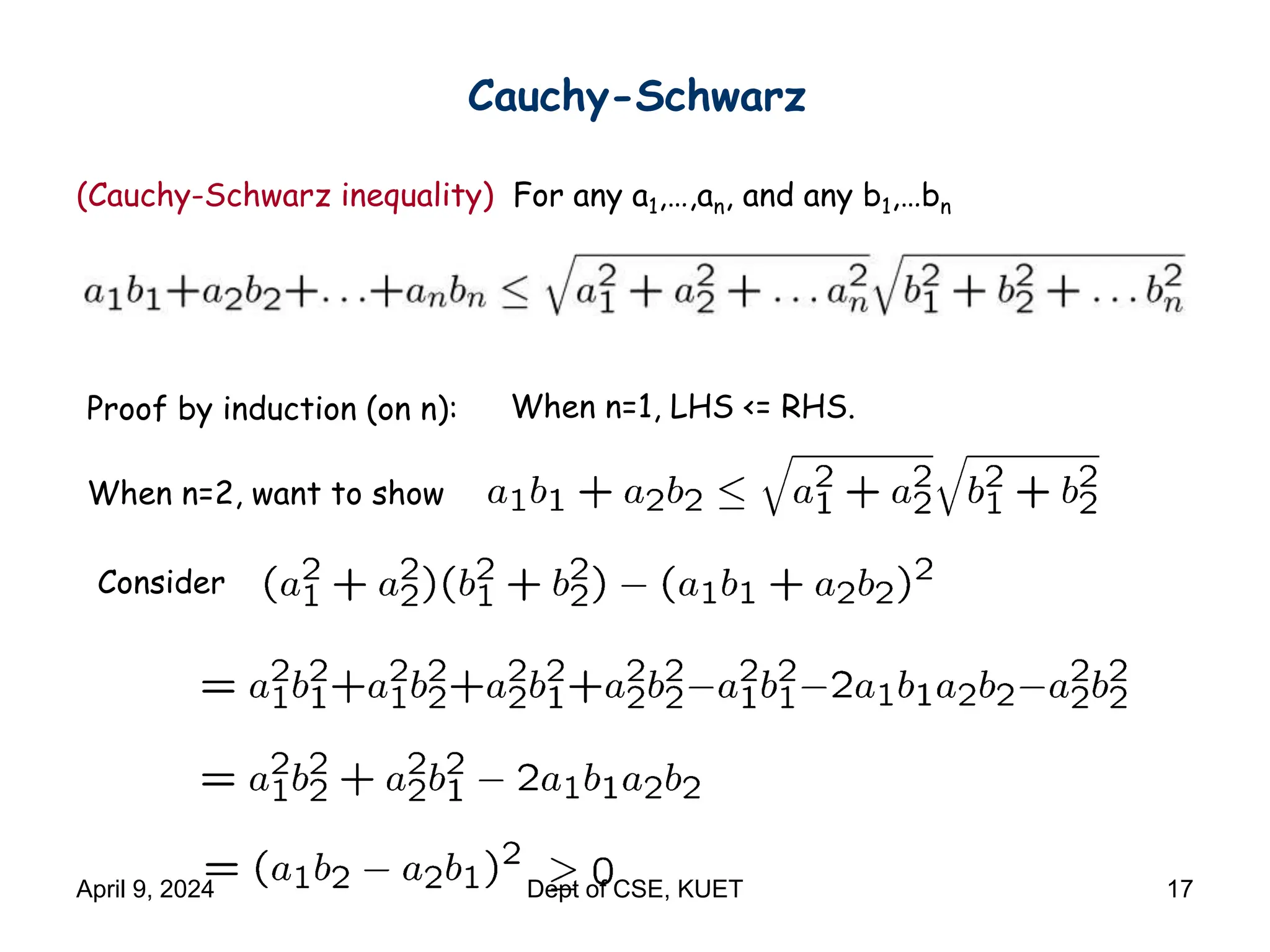
(Cauchy-Schwarz inequality) For any a1,…,an, and any b1,…bn
Proof by induction (on n): When n=1, LHS <= RHS.
When n=2, want to show
Consider
April 9, 2024 Dept of CSE, KUET 17
Cauchy-Schwarz
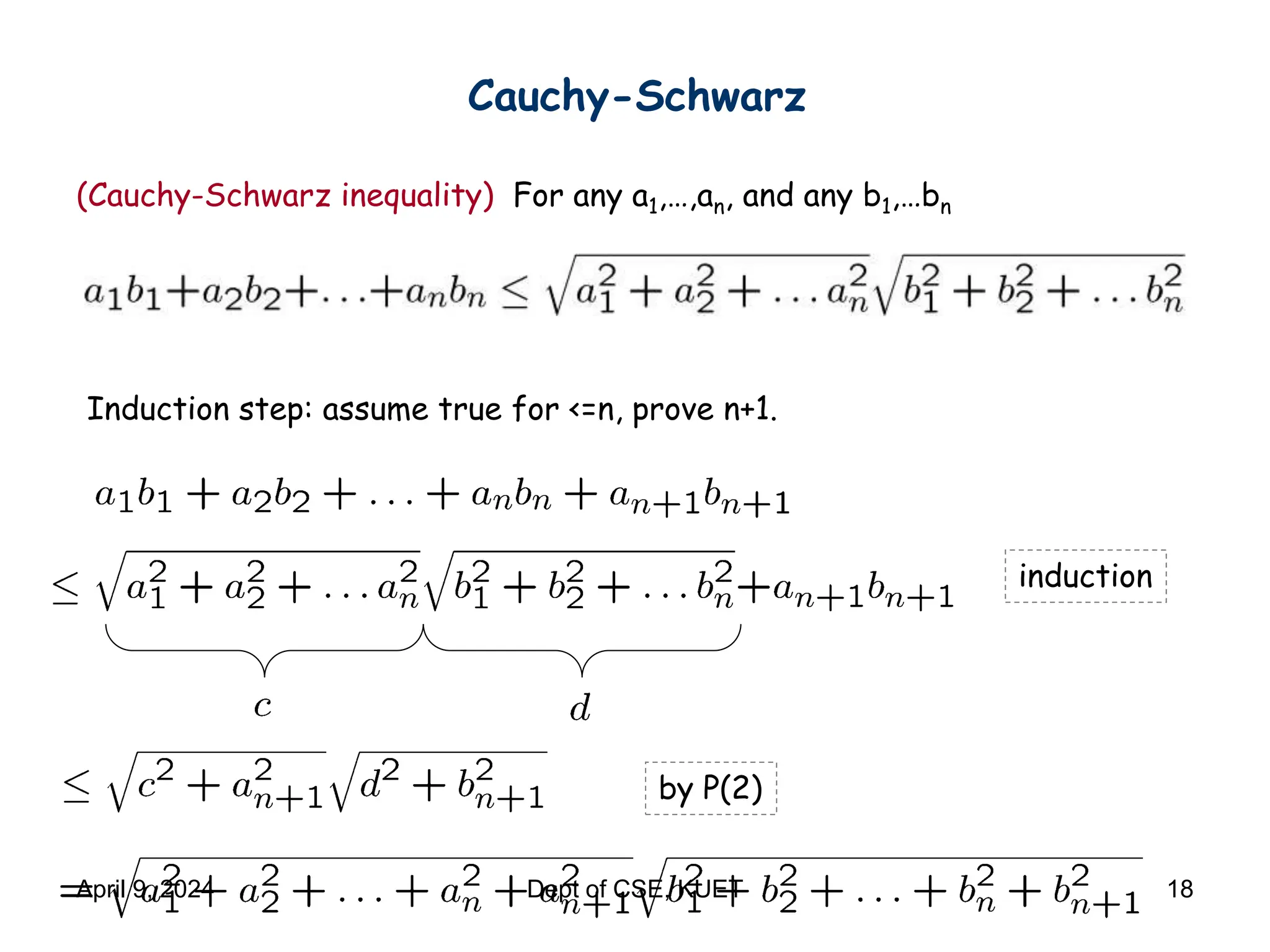
(Cauchy-Schwarz inequality) For any a1,…,an, and any b1,…bn
Induction step: assume true for <=n, prove n+1.
induction
by P(2)
April 9, 2024 Dept of CSE, KUET 18
This Lecture
• The idea of mathematical induction
• Basic induction proofs (e.g. equality, inequality, property,etc)
• Inductive constructions
• A paradox
April 9, 2024 Dept of CSE, KUET 19
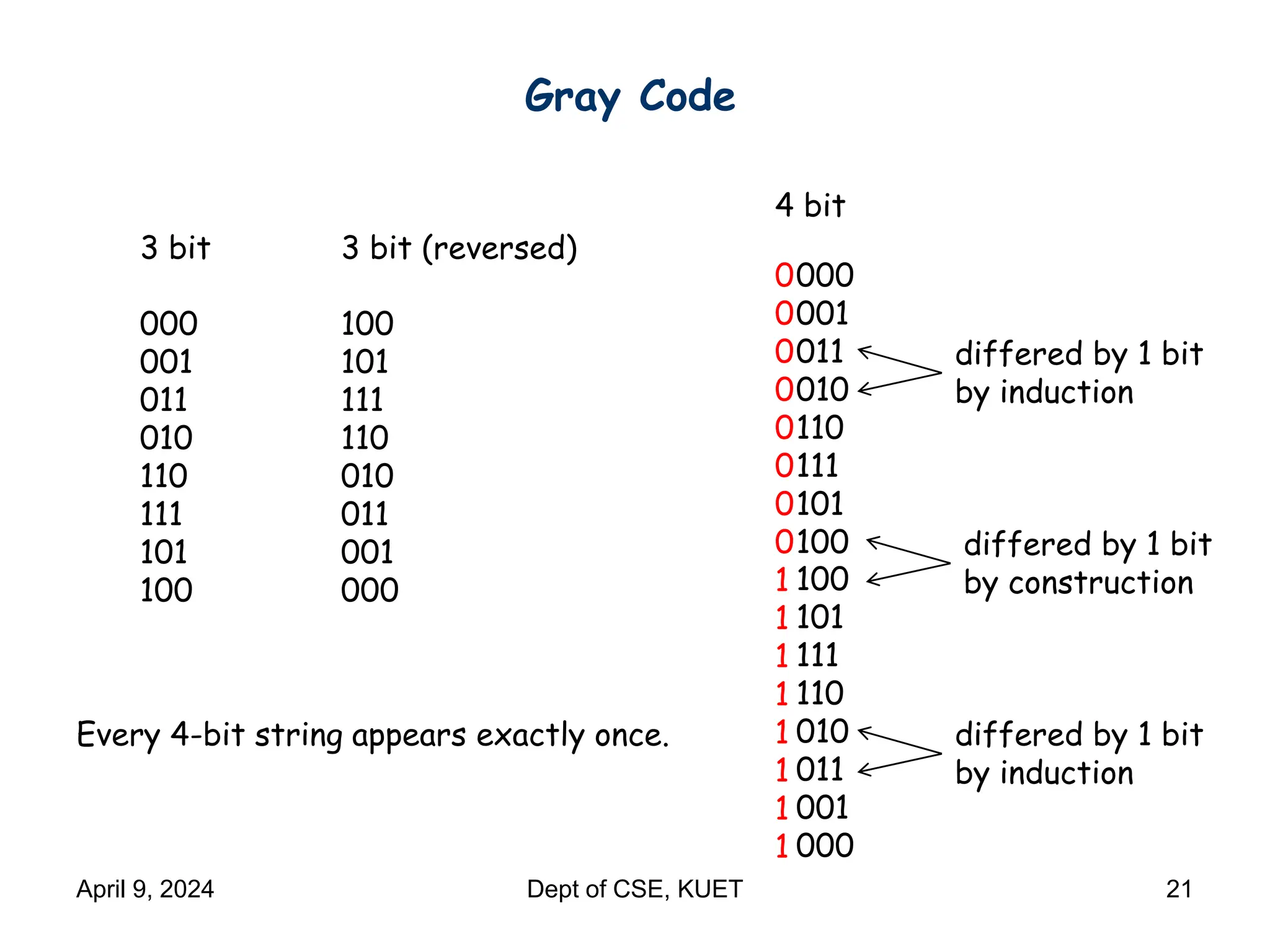
Gray Code
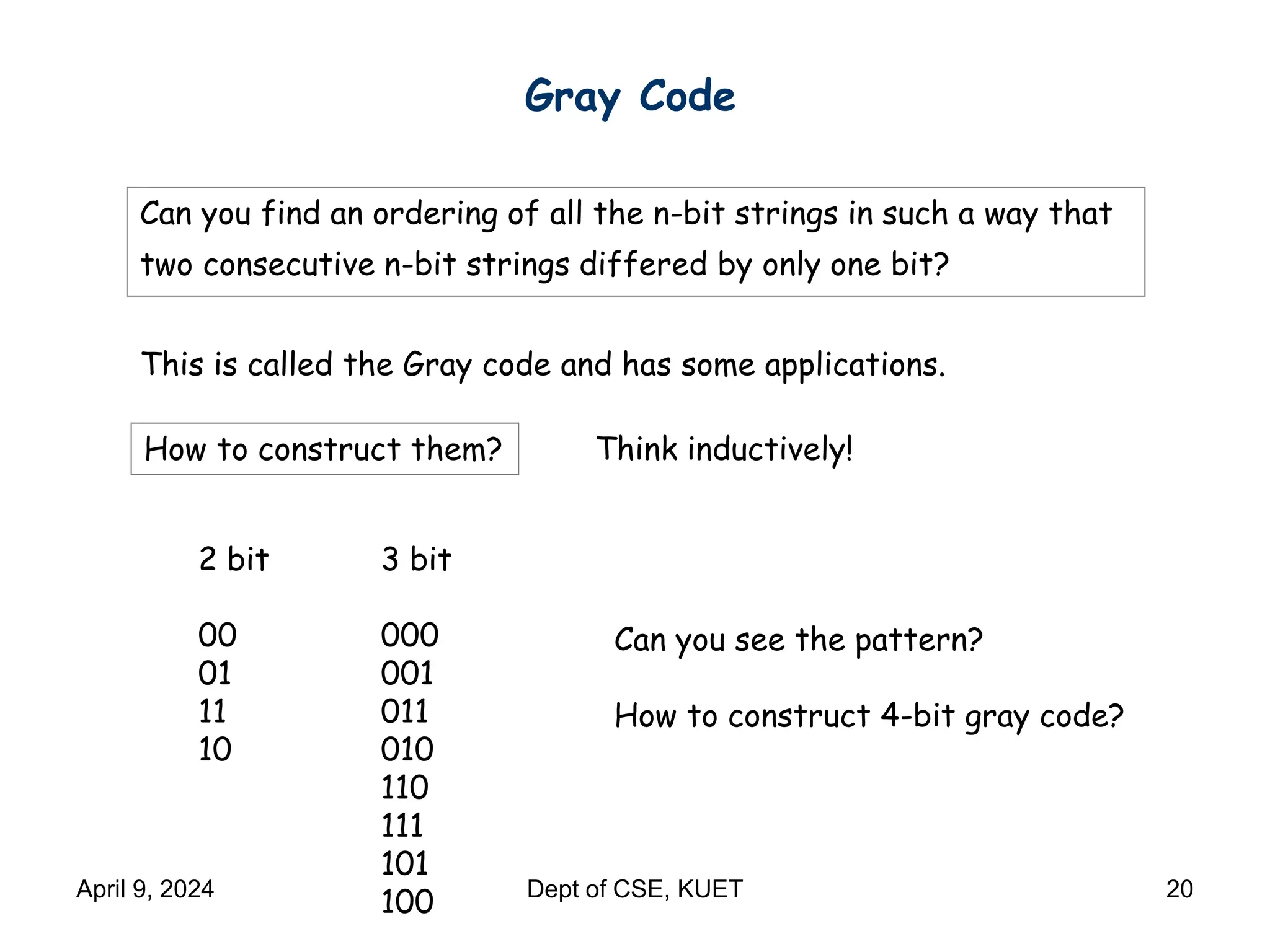
Can you find an ordering of all the n-bit strings in such a way that
two consecutive n-bit strings differed by only one bit?
This is called the Gray code and has some applications.
How to construct them? Think inductively!
2 bit
00
01
11
10
3 bit
000
001
011
010
110
111
101
100
Can you see the pattern?
How to construct 4-bit gray code?
April 9, 2024 Dept of CSE, KUET 20
Gray Code
3 bit
000
001
011
010
110
111
101
100
3 bit (reversed)
100
101
111
110
010
011
001
000
000
001
011
010
110
111
101
100
100
101
111
110
010
011
001
000
0
0
0
0
0
0
0
0
1
1
1
1
1
1
1
1
4 bit
differed by 1 bit
by induction
differed by 1 bit
by induction
differed by 1 bit
by construction
Every 4-bit string appears exactly once.
April 9, 2024 Dept of CSE, KUET 21
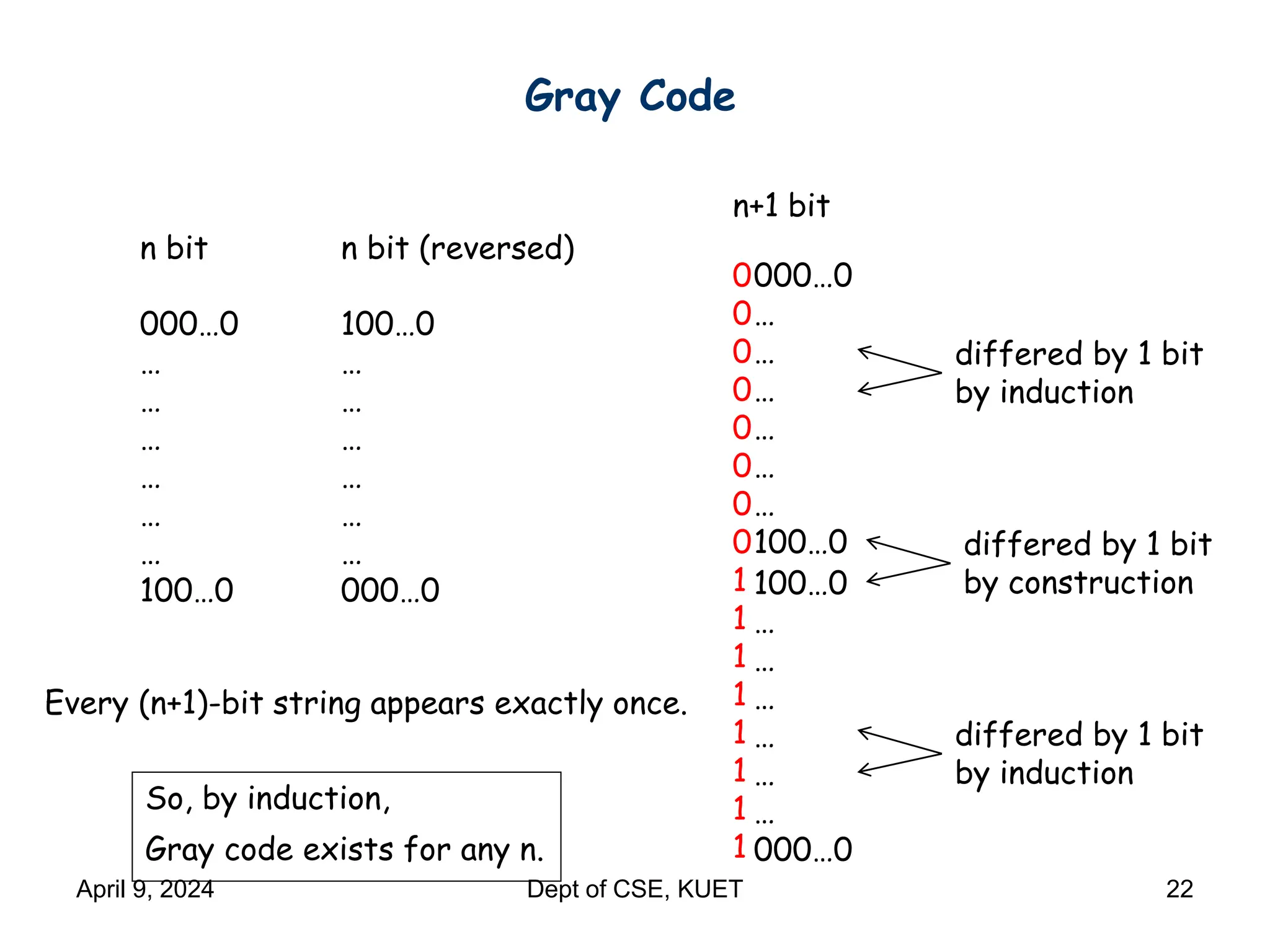
Gray Code
n bit
000…0
…
…
…
…
…
…
100…0
n bit (reversed)
100…0
…
…
…
…
…
…
000…0
000…0
…
…
…
…
…
…
100…0
0
0
0
0
0
0
0
0
1
1
1
1
1
1
1
1
n+1 bit
differed by 1 bit
by induction
differed by 1 bit
by induction
differed by 1 bit
by construction
100…0
…
…
…
…
…
…
000…0
So, by induction,
Gray code exists for any n.
Every (n+1)-bit string appears exactly once.
April 9, 2024 Dept of CSE, KUET 22
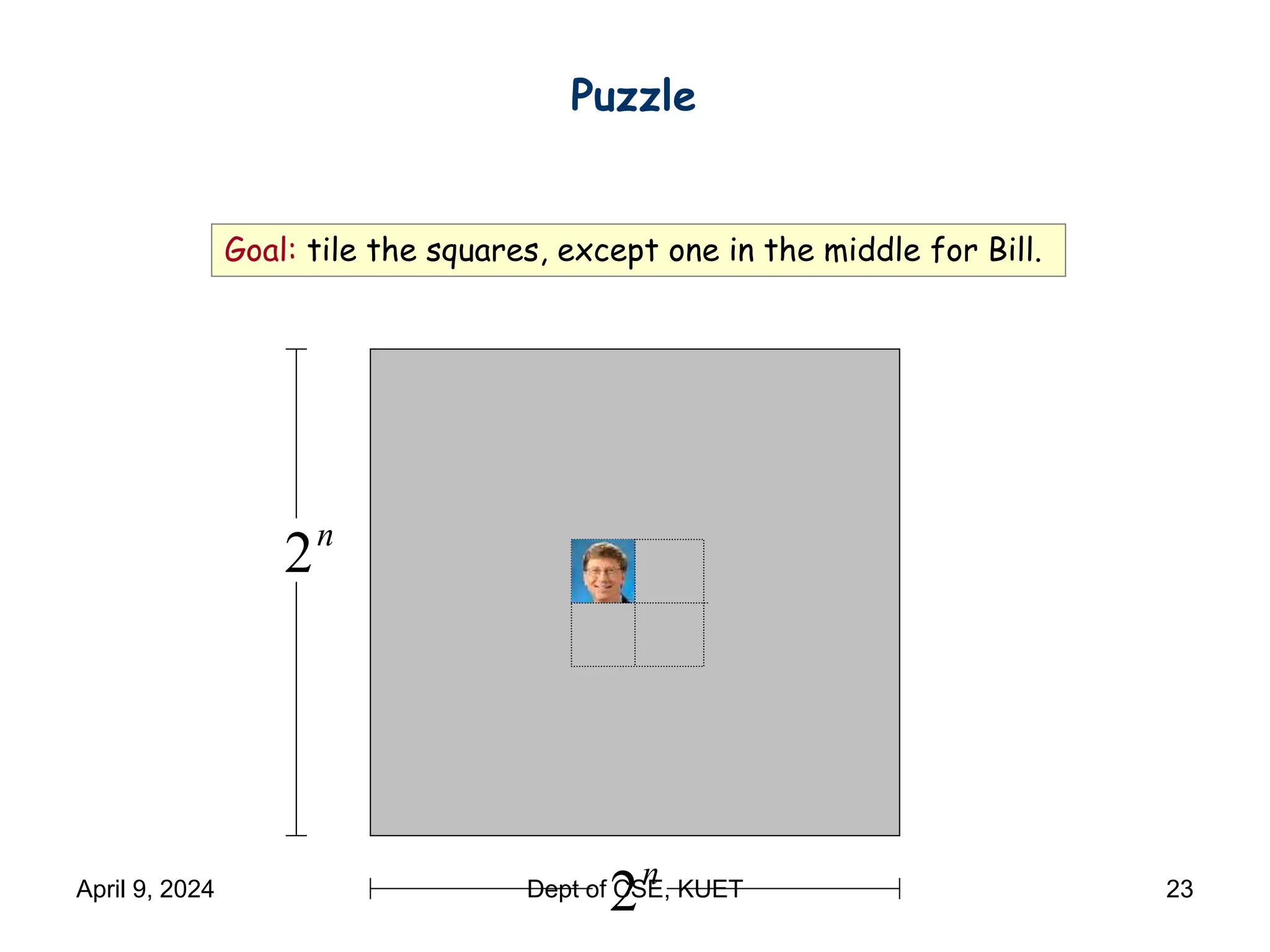
Goal: tile the squares, except one in the middle for Bill.
n
2
n
2
Puzzle
April 9, 2024 Dept of CSE, KUET 23
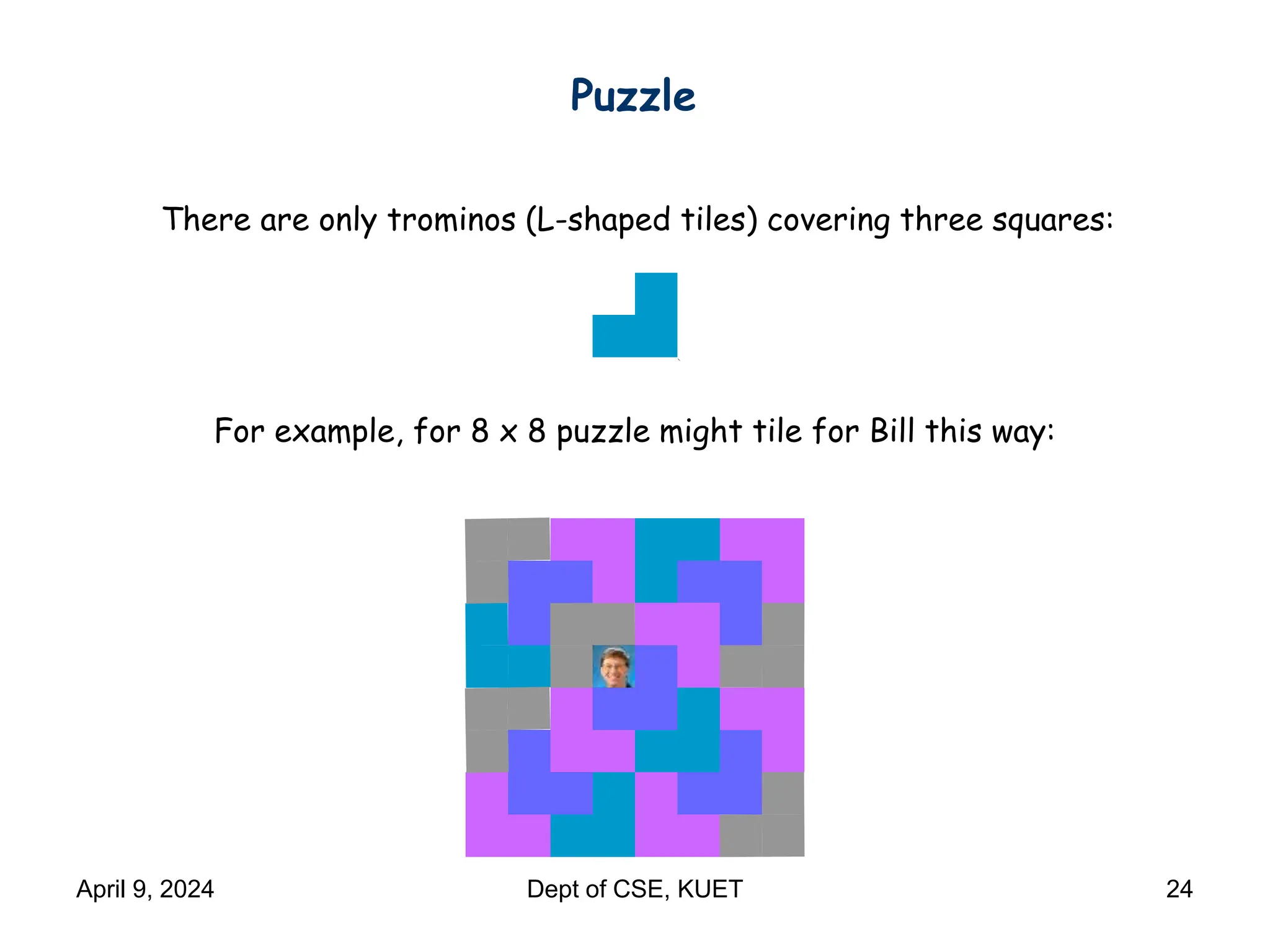
There are only trominos (L-shaped tiles) covering three squares:
For example, for 8 x 8 puzzle might tile for Bill this way:
Puzzle
April 9, 2024 Dept of CSE, KUET 24
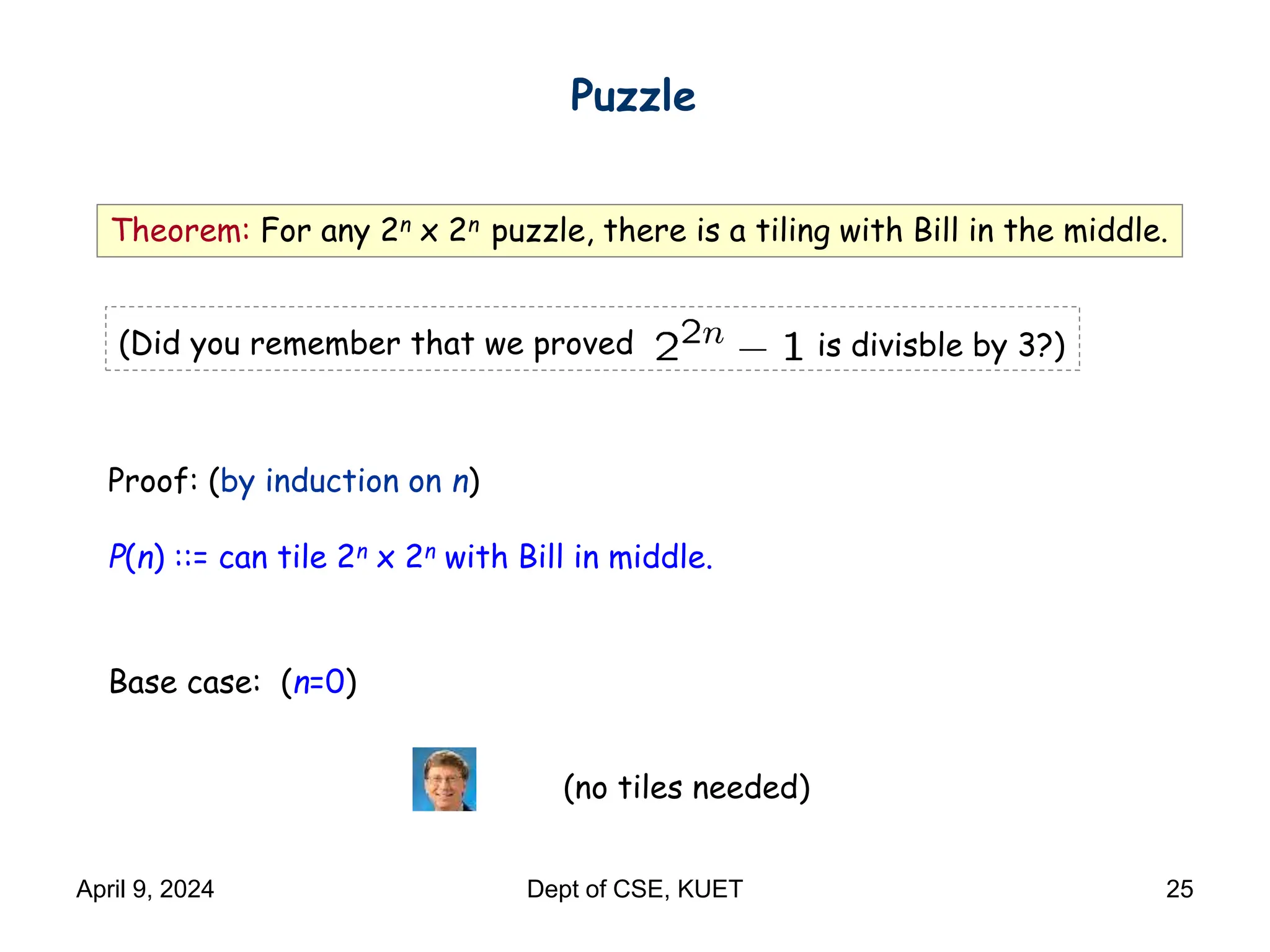
Theorem: For any 2n x 2n puzzle, there is a tiling with Bill in the middle.
Proof: (by induction on n)
P(n) ::= can tile 2n x 2n with Bill in middle.
Base case: (n=0)
(no tiles needed)
Puzzle
(Did you remember that we proved is divisble by 3?)
April 9, 2024 Dept of CSE, KUET 25
n
2
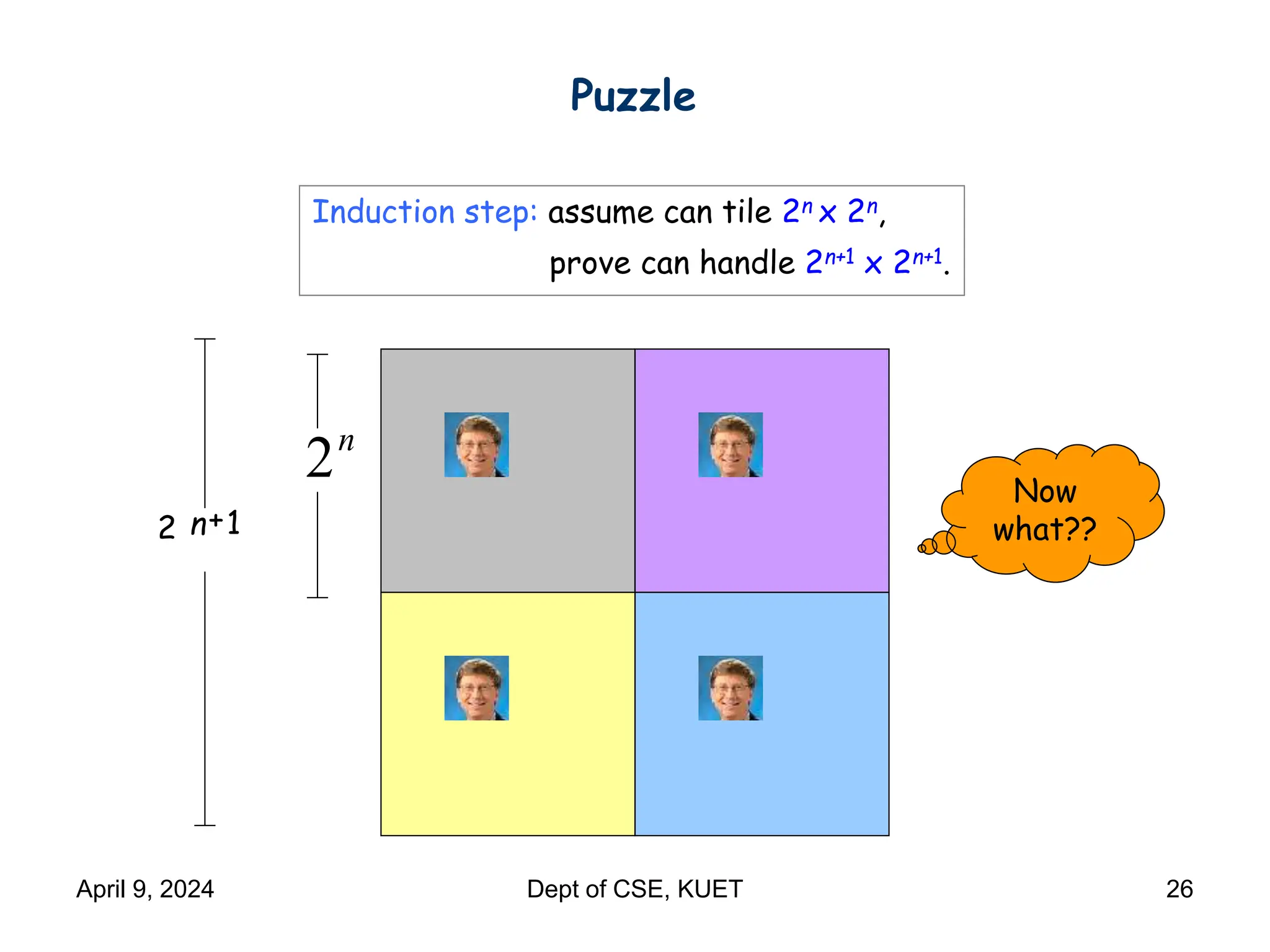
Induction step: assume can tile 2n x 2n,
prove can handle 2n+1 x 2n+1.
1
2 +
n
Puzzle
Now
what??
April 9, 2024 Dept of CSE, KUET 26
Puzzle
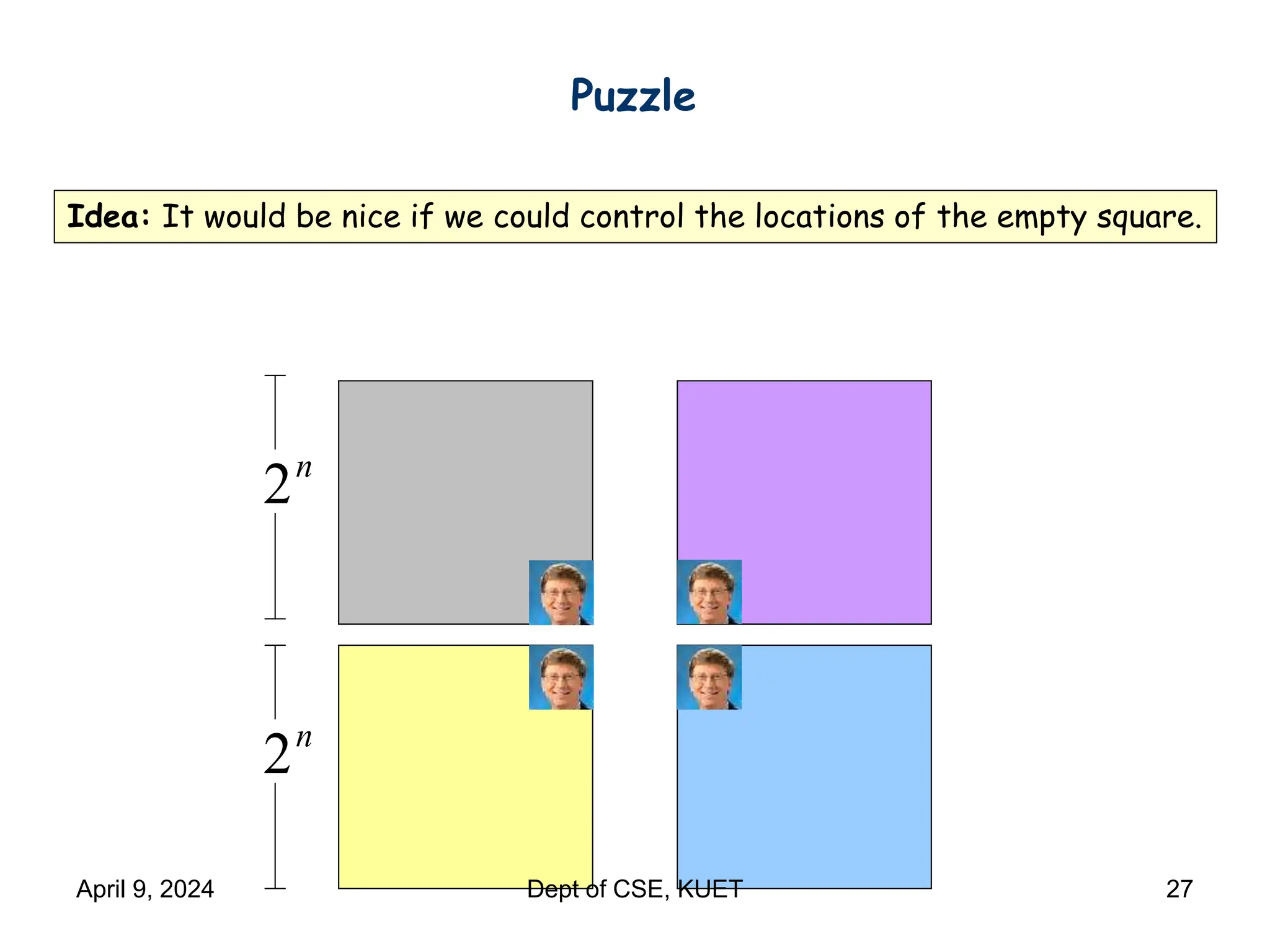
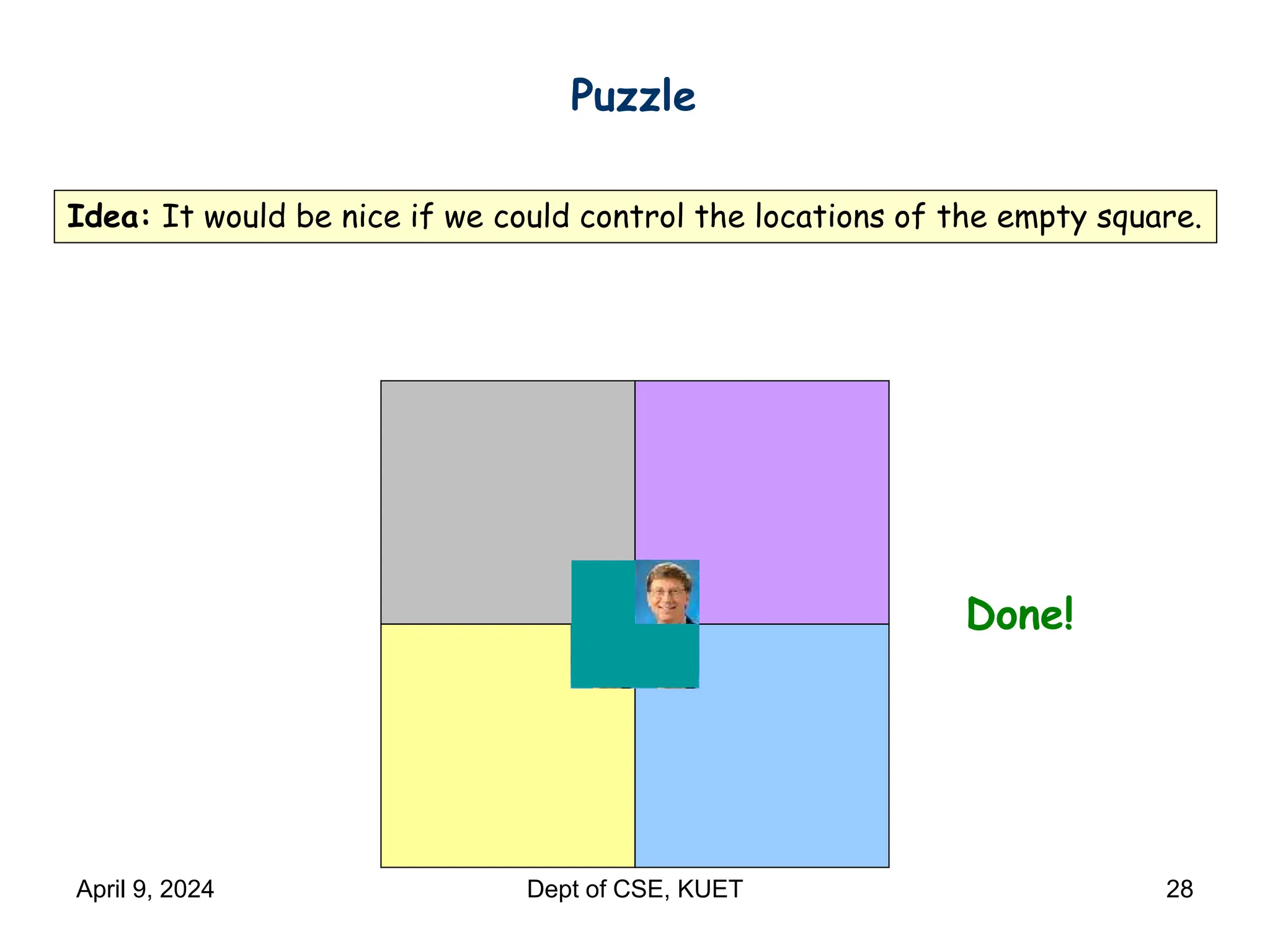
Idea: It would be nice if we could control the locations of the empty square.
n
2
n
2
April 9, 2024 Dept of CSE, KUET 27
Done!
Puzzle
Idea: It would be nice if we could control the locations of the empty square.
April 9, 2024 Dept of CSE, KUET 28
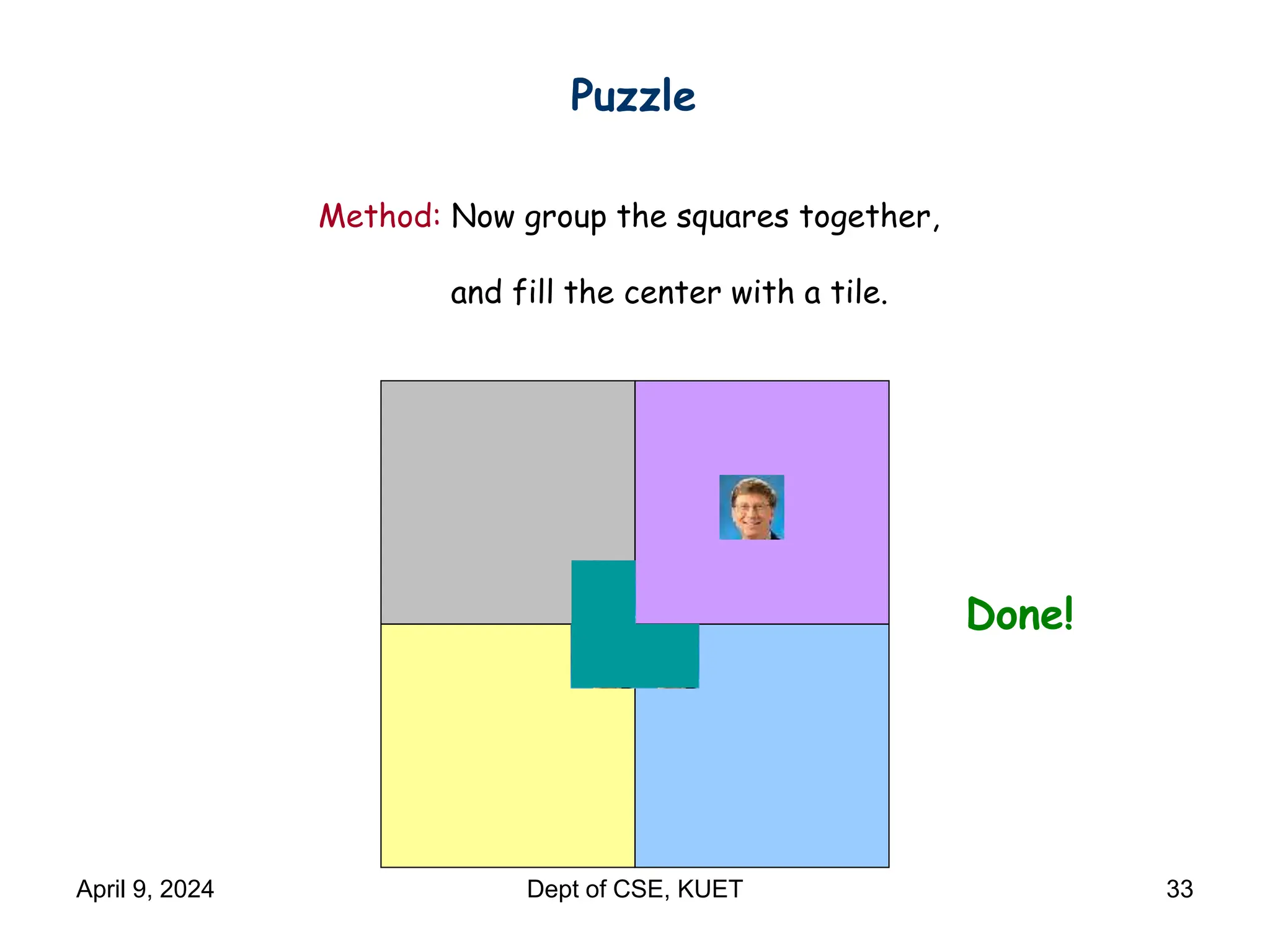
The new idea:
Prove that we can always find a tiling with Bill anywhere.
Puzzle
Theorem B: For any 2n x 2n plaza, there is a tiling with Bill anywhere.
Theorem: For any 2n x 2n plaza, there is a tiling with Bill in the middle.
Clearly Theorem B implies Theorem.
A stronger property
April 9, 2024 Dept of CSE, KUET 29
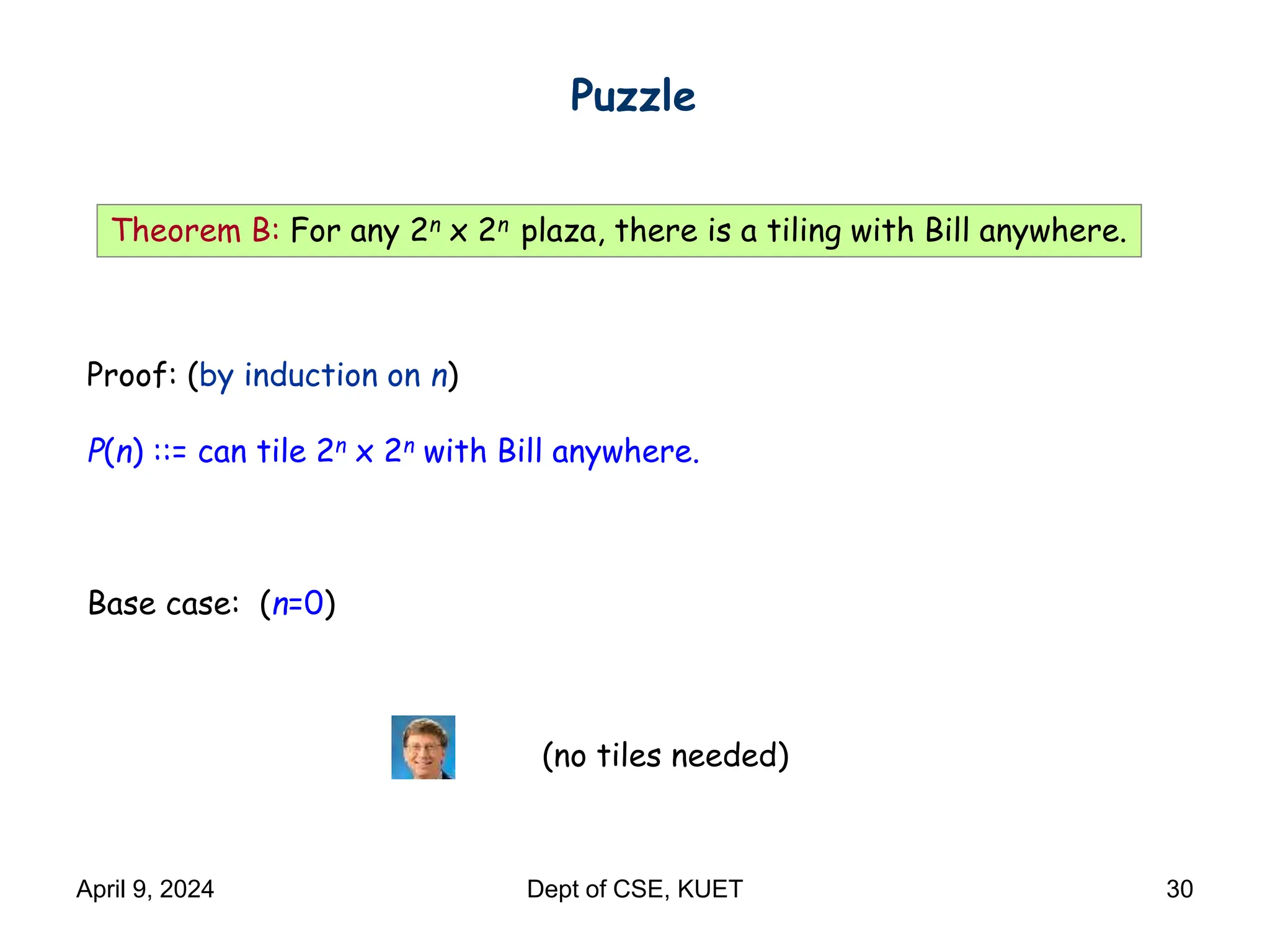
Theorem B: For any 2n x 2n plaza, there is a tiling with Bill anywhere.
Proof: (by induction on n)
P(n) ::= can tile 2n x 2n with Bill anywhere.
Base case: (n=0)
(no tiles needed)
Puzzle
April 9, 2024 Dept of CSE, KUET 30
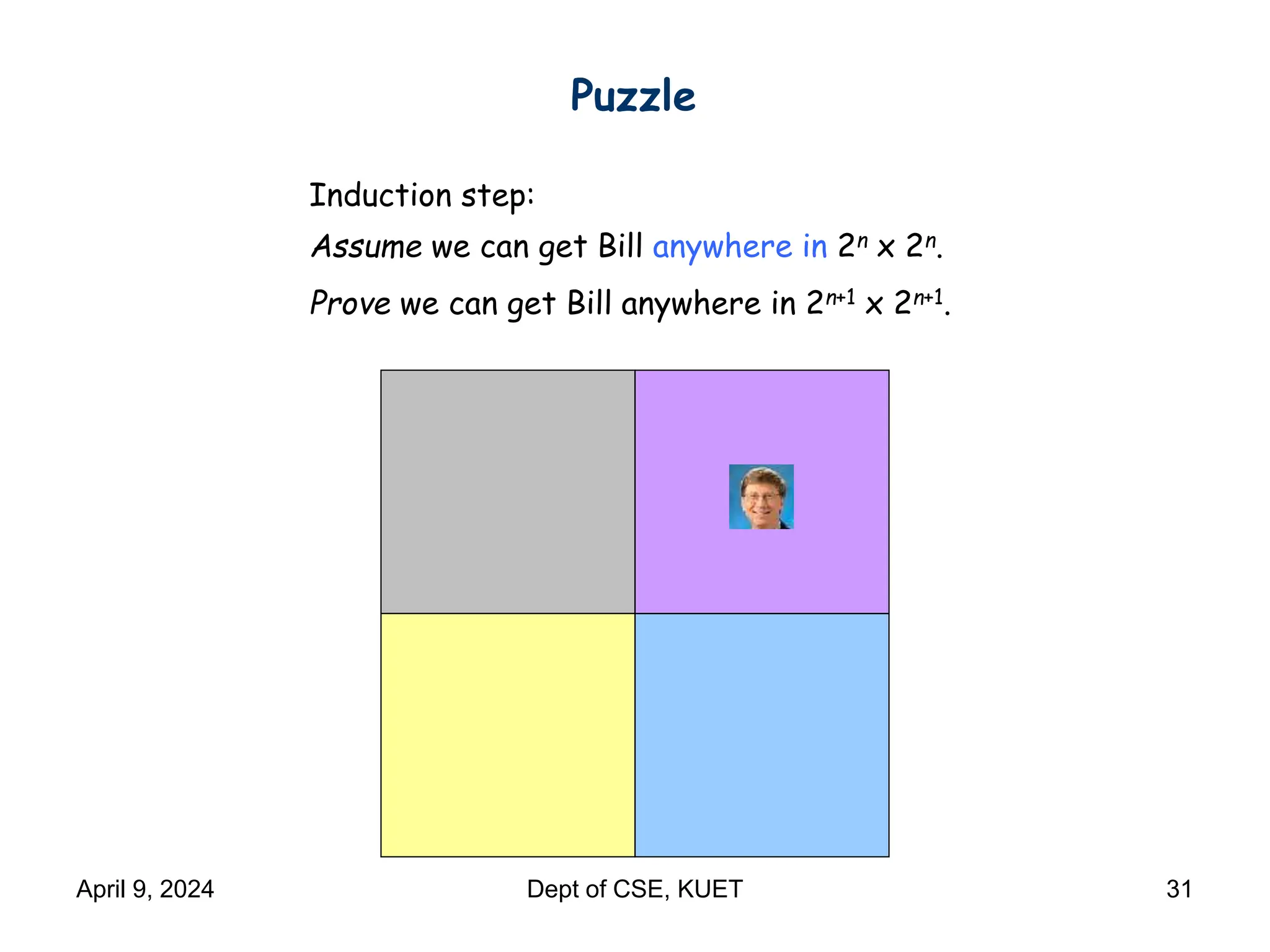
Induction step:
Assume we can get Bill anywhere in 2n x 2n.
Prove we can get Bill anywhere in 2n+1 x 2n+1.
Puzzle
April 9, 2024 Dept of CSE, KUET 31
Puzzle
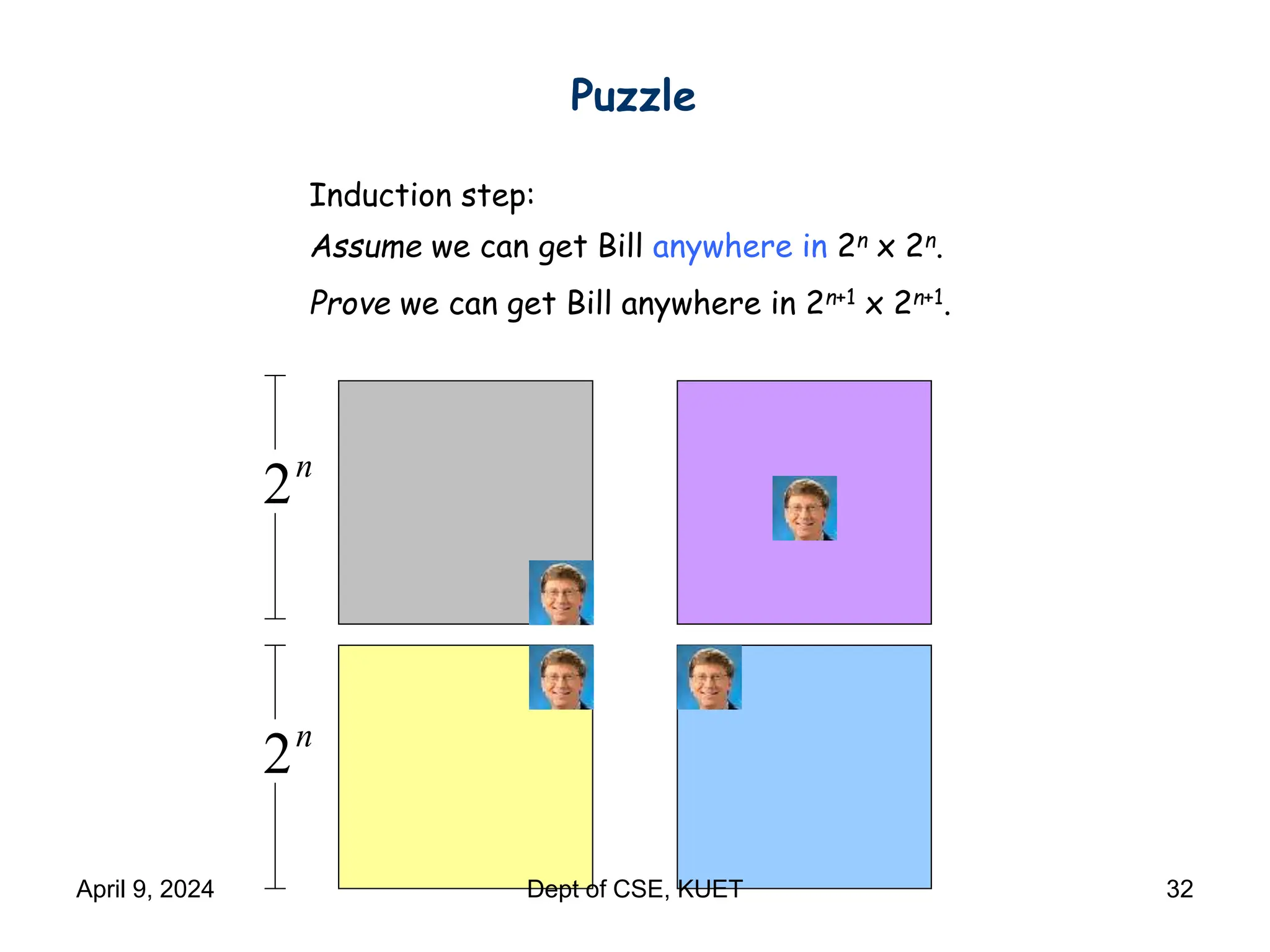
Induction step:
Assume we can get Bill anywhere in 2n x 2n.
Prove we can get Bill anywhere in 2n+1 x 2n+1.
n
2
n
2
April 9, 2024 Dept of CSE, KUET 32
Method: Now group the squares together,
and fill the center with a tile.
Done!
Puzzle
April 9, 2024 Dept of CSE, KUET 33
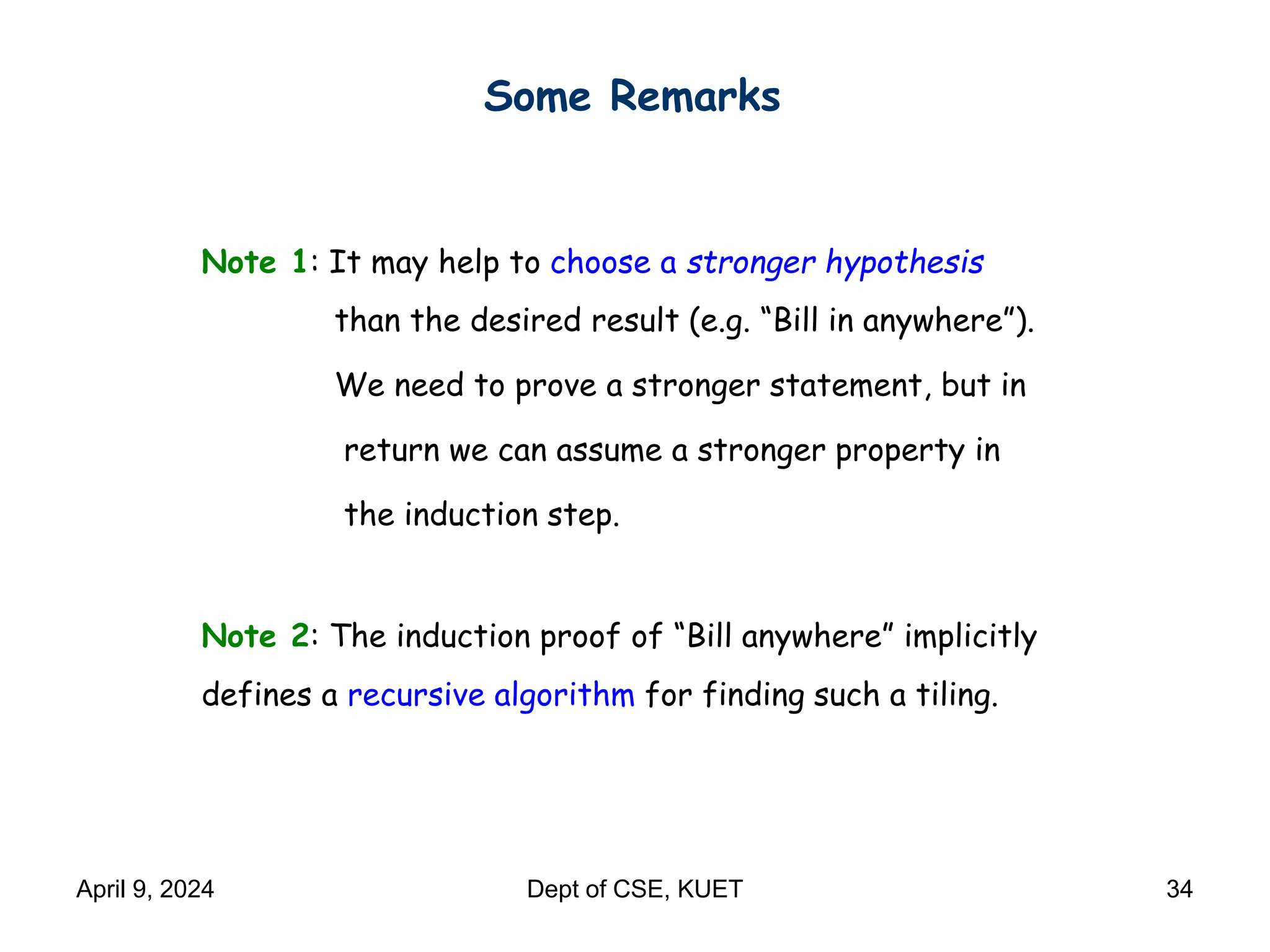
Some Remarks
Note 1: It may help to choose a stronger hypothesis
than the desired result (e.g. “Bill in anywhere”).
We need to prove a stronger statement, but in
return we can assume a stronger property in
the induction step.
Note 2: The induction proof of “Bill anywhere” implicitly
defines a recursive algorithm for finding such a tiling.
April 9, 2024 Dept of CSE, KUET 34
Hadamard Matrix
Can you construct an nxn matrix with all entries +-1 and
all the rows are orthogonal to each other?
Two rows are orthogonal if their inner product is zero.
That is, let a = (a1, …, an) and b = (b1, …, bn),
their inner product ab = a1b1 + a2b2 + … + anbn
This matrix is famous and has applications in coding theory.
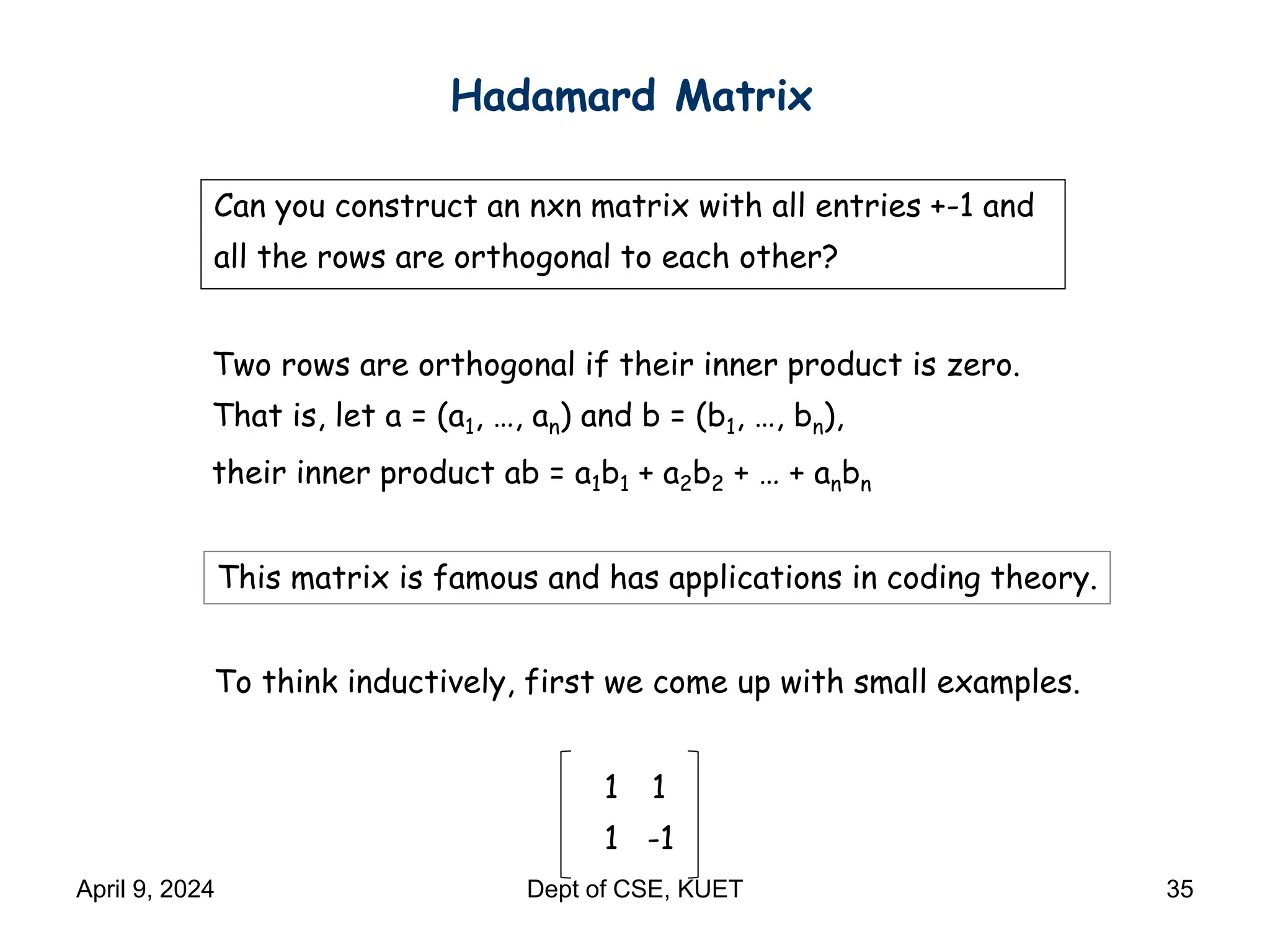
To think inductively, first we come up with small examples.
1 1
1 -1
April 9, 2024 Dept of CSE, KUET 35
Hadamard Matrix
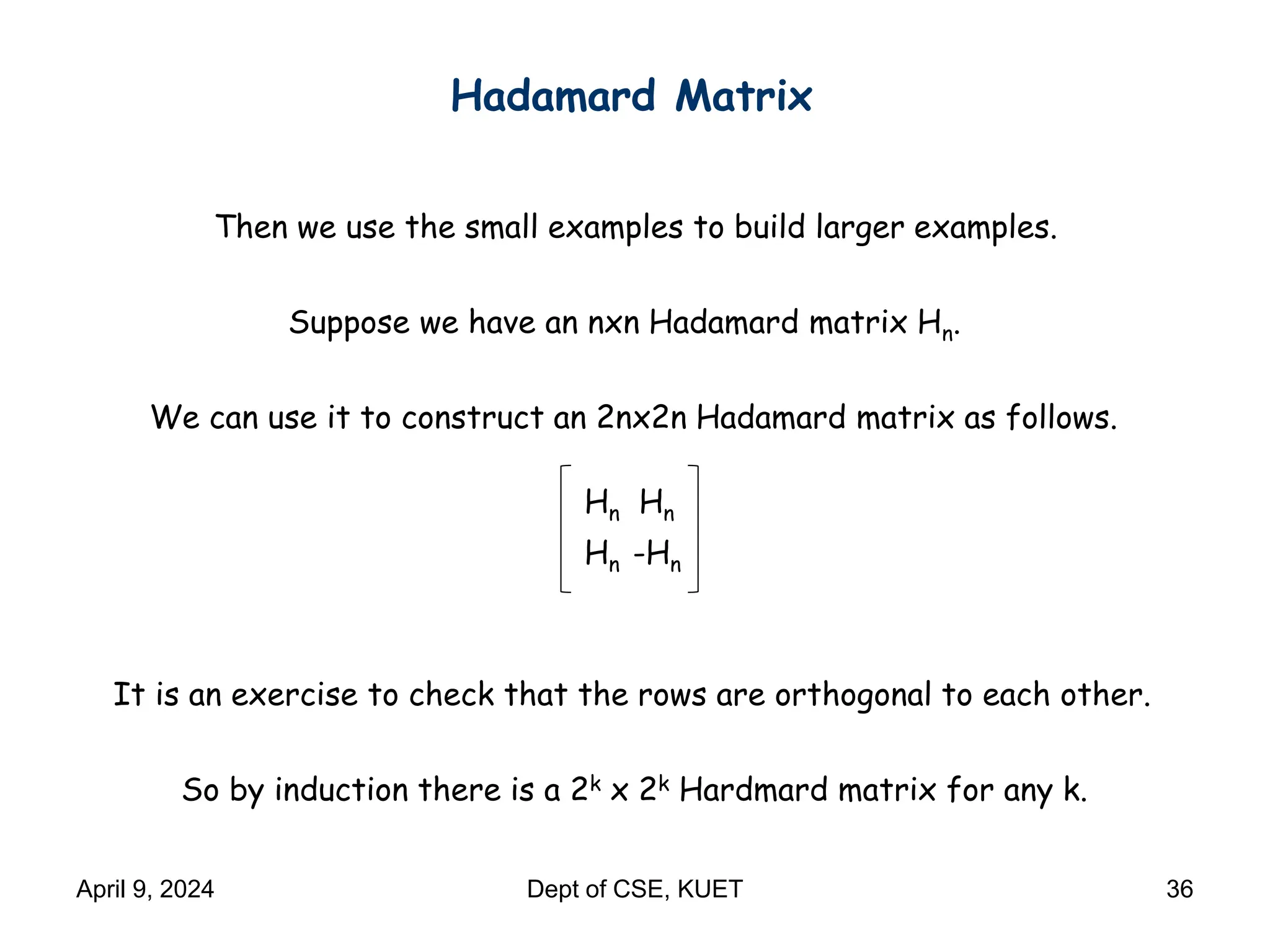
Then we use the small examples to build larger examples.
Suppose we have an nxn Hadamard matrix Hn.
We can use it to construct an 2nx2n Hadamard matrix as follows.
Hn Hn
Hn -Hn
So by induction there is a 2k x 2k Hardmard matrix for any k.
It is an exercise to check that the rows are orthogonal to each other.
April 9, 2024 Dept of CSE, KUET 36
Inductive Construction
This technique is very useful.
We can use it to construct:
- codes
- graphs
- matrices
- circuits
- algorithms
- designs
- proofs
- buildings
- …
April 9, 2024 Dept of CSE, KUET 37
This Lecture
• The idea of mathematical induction
• Basic induction proofs (e.g. equality, inequality, property,etc)
• Inductive constructions
• A paradox
April 9, 2024 Dept of CSE, KUET 38
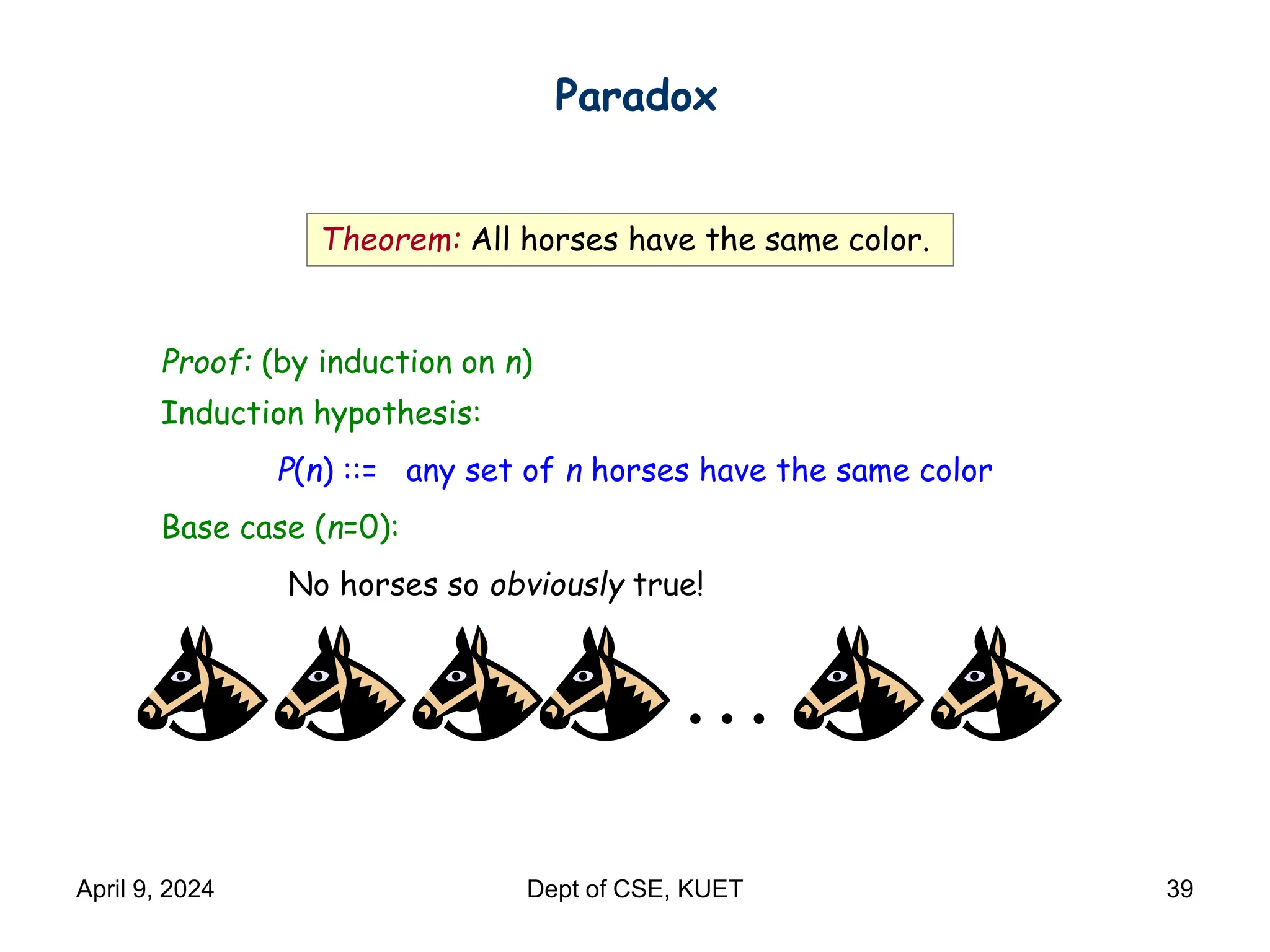
Paradox
Theorem: All horses have the same color.
Proof: (by induction on n)
Induction hypothesis:
P(n) ::= any set of n horses have the same color
Base case (n=0):
No horses so obviously true!
…
April 9, 2024 Dept of CSE, KUET 39
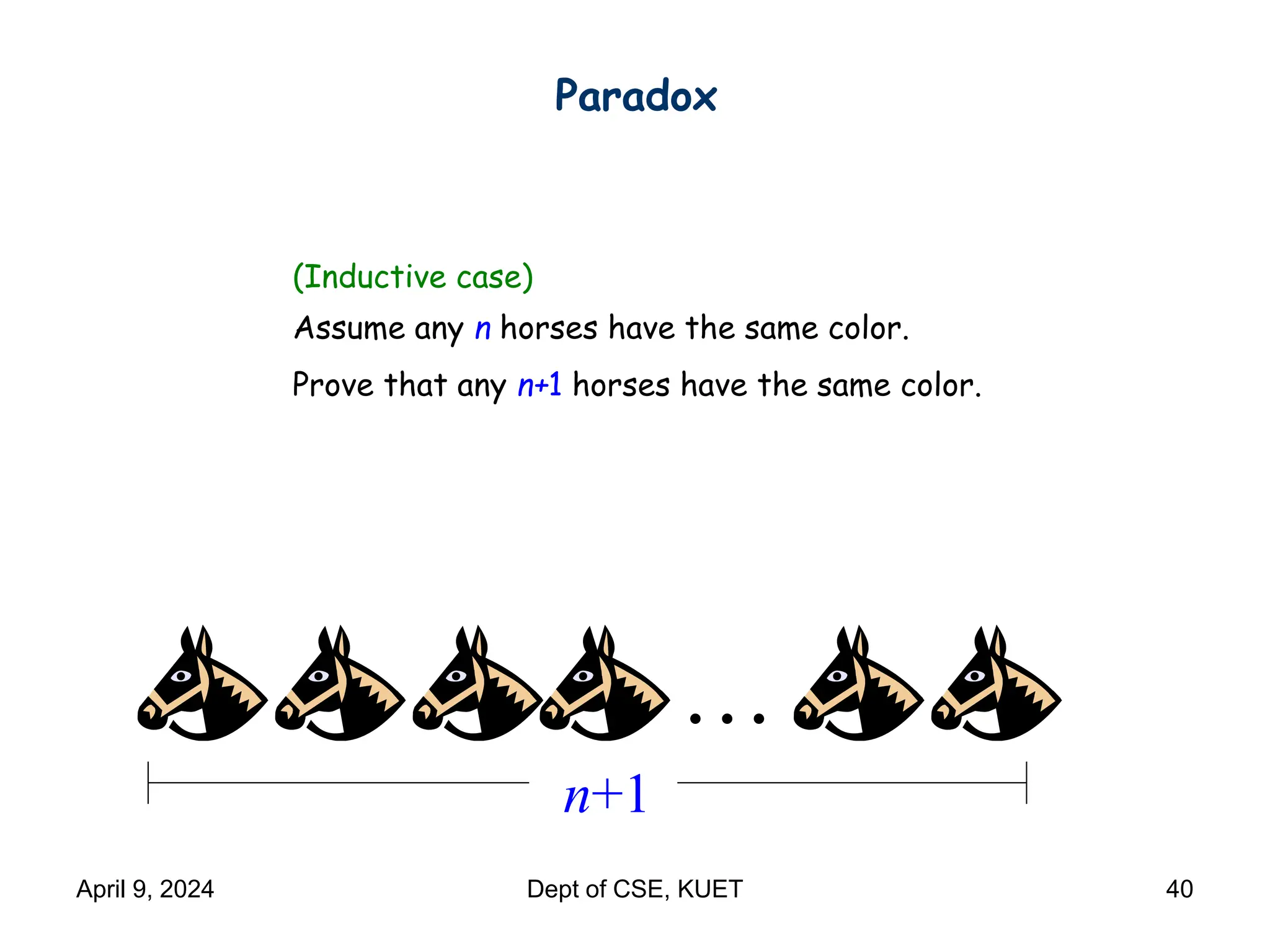
(Inductive case)
Assume any n horses have the same color.
Prove that any n+1 horses have the same color.
Paradox
…
n+1
April 9, 2024 Dept of CSE, KUET 40
…
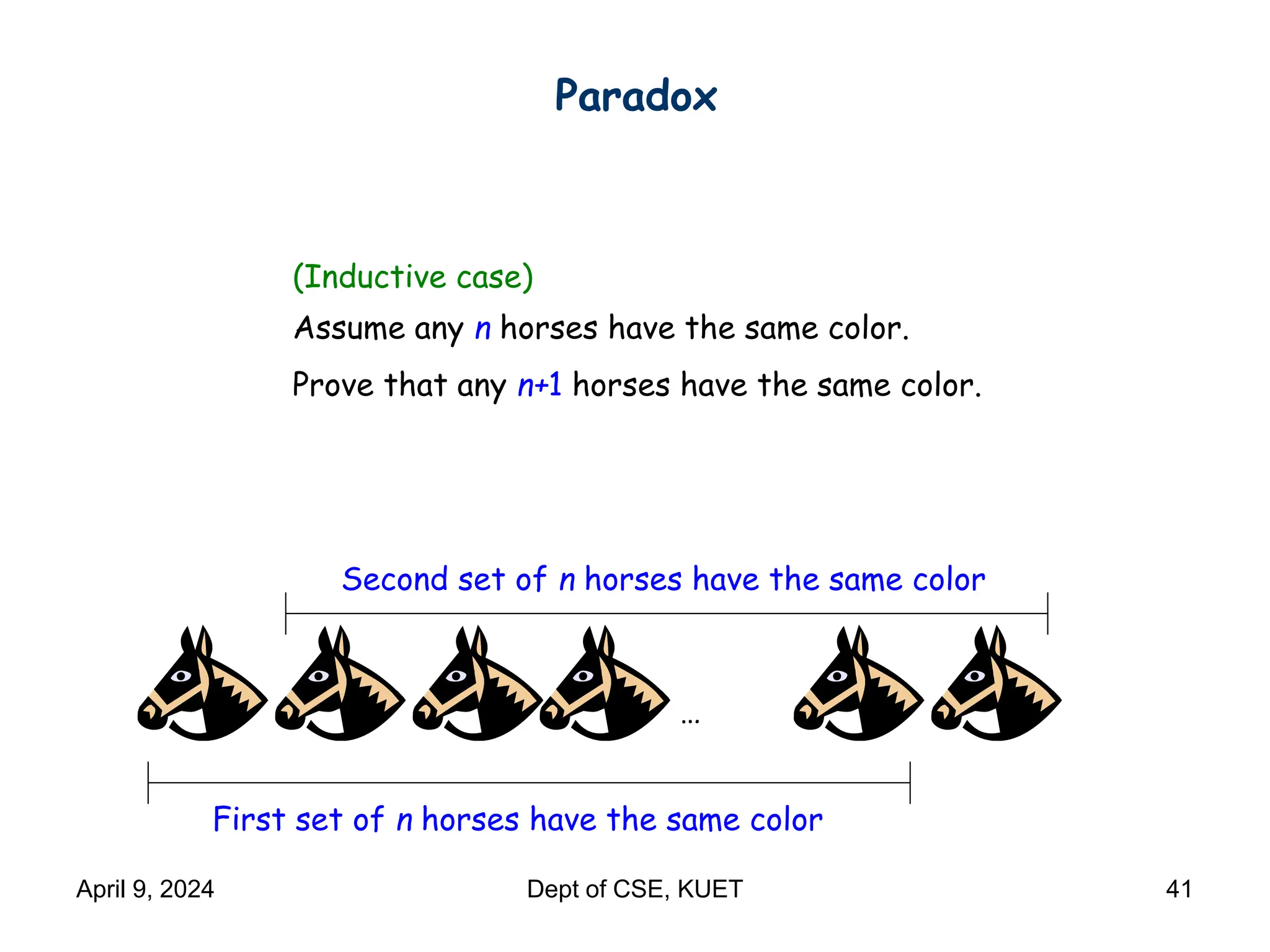
First set of n horses have the same color
Second set of n horses have the same color
(Inductive case)
Assume any n horses have the same color.
Prove that any n+1 horses have the same color.
Paradox
April 9, 2024 Dept of CSE, KUET 41
…
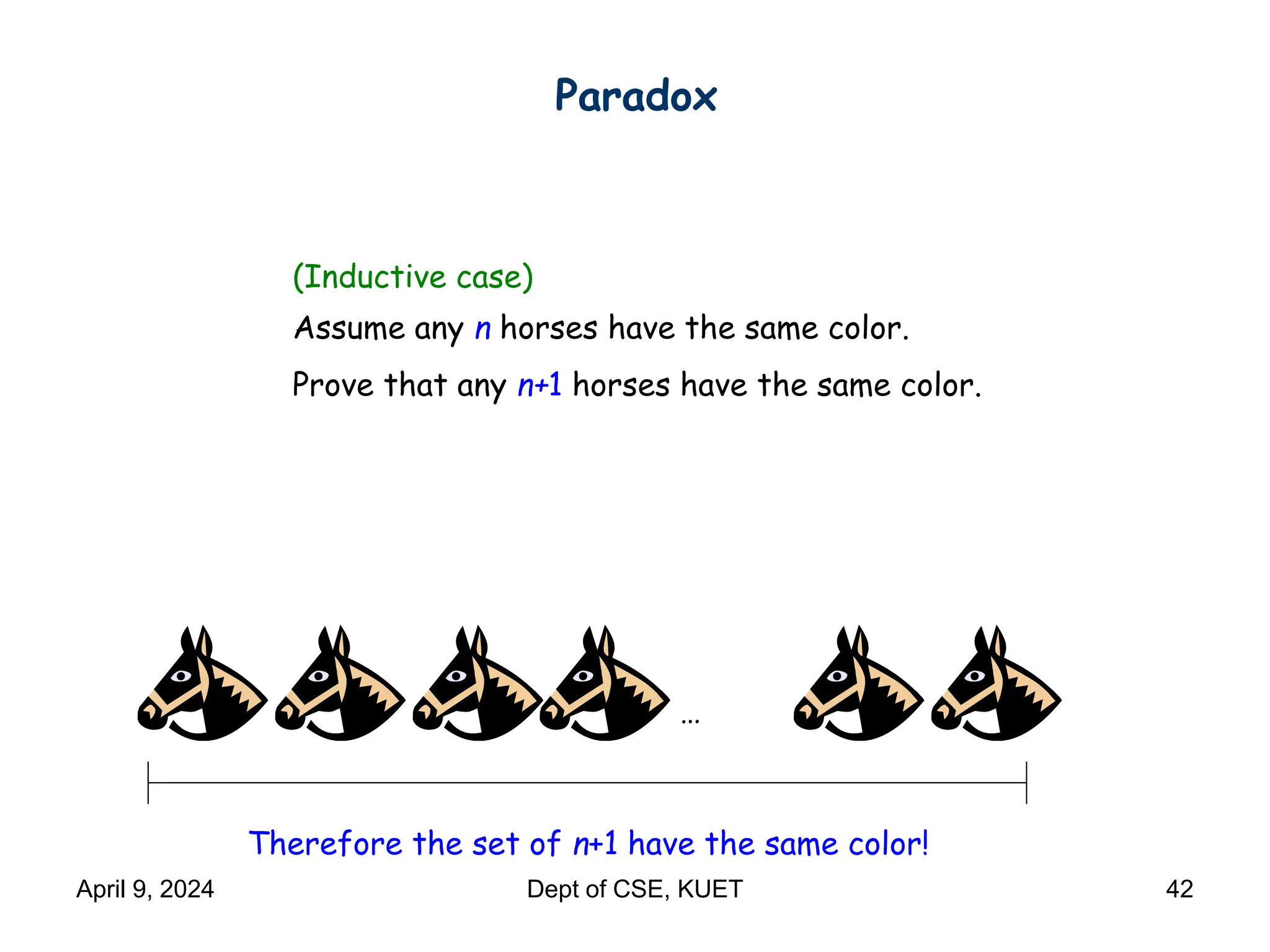
Therefore the set of n+1 have the same color!
(Inductive case)
Assume any n horses have the same color.
Prove that any n+1 horses have the same color.
Paradox
April 9, 2024 Dept of CSE, KUET 42
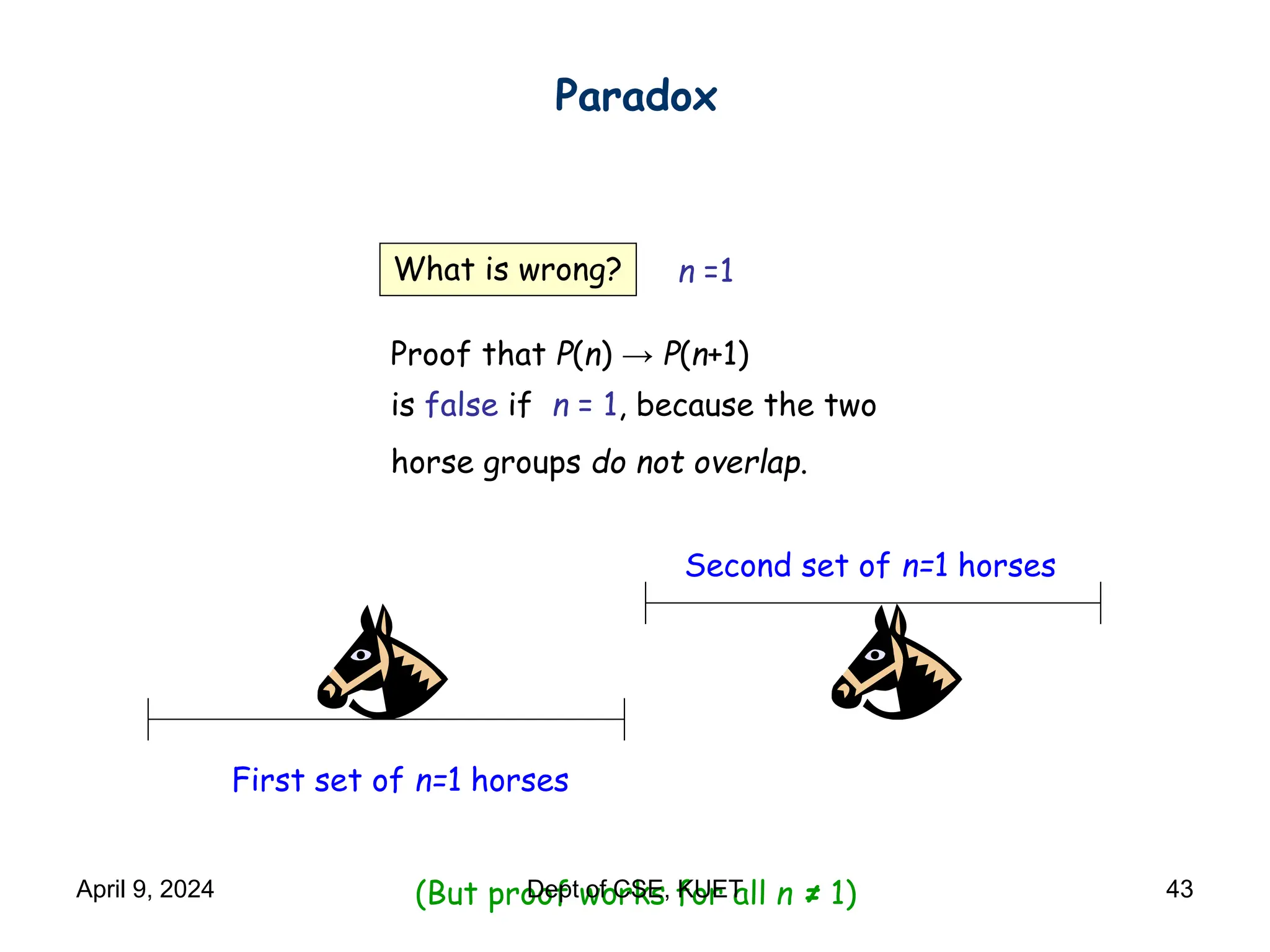
What is wrong?
Proof that P(n) → P(n+1)
is false if n = 1, because the two
horse groups do not overlap.
First set of n=1 horses
n =1
Second set of n=1 horses
Paradox
(But proof works for all n ≠ 1)
April 9, 2024 Dept of CSE, KUET 43
Quick Summary
You should understand the principle of mathematical induction well,
and do basic induction proofs like
• proving equality
• proving inequality
• proving property
Mathematical induction has a wide range of applications in computer science.
In the next lecture we will see more applications and more techniques.
April 9, 2024 Dept of CSE, KUET 44

L05 Mathematical Induction in Discrete Mathmatics.ppt

  • 1.
    Mathematical Induction 1 M.M.A. Hashem,PhD Professor Dept. of Computer Science and Engineering Khulna University of Engineering & Technology (KUET) CSE 1107 Discrete Mathematics April 9, 2024 Dept of CSE, KUET
  • 2.
    Mathematical Induction April 9,2024 Dept of CSE, KUET 2
  • 3.
    This Lecture Last timewe have discussed different proof techniques. This time we will focus on probably the most important one – mathematical induction. This lecture’s plan is to go through the following: • The idea of mathematical induction • Basic induction proofs (e.g. equality, inequality, property, etc) • Inductive constructions • A paradox April 9, 2024 Dept of CSE, KUET 3
  • 4.
    Proving For-All Statements Objective:Prove It is very common to prove statements of this form. Some Examples: For an odd number m, mi is odd for all non-negative integer i. Any integer n > 1 is divisible by a prime number. (Cauchy-Schwarz inequality) For any a1,…,an, and any b1,…bn April 9, 2024 Dept of CSE, KUET 4
  • 5.
    Universal Generalization ( ) .( ) A R c A x R x    valid rule providing c is independent of A One way to prove a for-all statement is to prove that R(c) is true for any c, but this is often difficult to prove directly (e.g. consider the statements in the previous slide). Mathematical induction provides another way to prove a for-all statement. It allows us to prove the statement step-by-step. Let us first see the idea in two examples. April 9, 2024 Dept of CSE, KUET 5
  • 6.
    Odd Powers AreOdd Fact: If m is odd and n is odd, then nm is odd. Proposition: for an odd number m, mi is odd for all non-negative integer i. Let P(i) be the proposition that mi is odd. • P(1) is true by definition. • P(2) is true by P(1) and the fact. • P(3) is true by P(2) and the fact. • P(i+1) is true by P(i) and the fact. • So P(i) is true for all i. Idea of induction. April 9, 2024 Dept of CSE, KUET 6
  • 7.
    Divisibility by aPrime Theorem. Any integer n > 1 is divisible by a prime number. Idea of induction. •Let n be an integer. •If n is a prime number, then we are done. •Otherwise, n = ab, both are smaller than n. •If a or b is a prime number, then we are done. •Otherwise, a = cd, both are smaller than a. •If c or d is a prime number, then we are done. •Otherwise, repeat this argument, since the numbers are getting smaller and smaller, this will eventually stop and we have found a prime factor of n. April 9, 2024 Dept of CSE, KUET 7
  • 8.
    Objective: Prove Idea ofInduction This is to prove The idea of induction is to first prove P(0) unconditionally, then use P(0) to prove P(1) then use P(1) to prove P(2) and repeat this to infinity… April 9, 2024 Dept of CSE, KUET 8
  • 9.
    The Induction Rule 0and (from n to n +1), proves 0, 1, 2, 3,…. P (0), nZ P (n)P (n+1) mZ P (m) Very easy to prove Much easier to prove with P(n) as an assumption. The point is to use the knowledge on smaller problems to solve bigger problems (i.e. can assume P(n) to prove P(n+1)). Compare it with the universal generalization rule. induction rule (an axiom) April 9, 2024 Dept of CSE, KUET 9
  • 10.
    This Lecture • Theidea of mathematical induction • Basic induction proofs (e.g. equality, inequality, property,etc) • Inductive constructions • A paradox April 9, 2024 Dept of CSE, KUET 10
  • 11.
    Proving an Equality LetP(n) be the induction hypothesis that the statement is true for n. Base case: P(1) is true Induction step: assume P(n) is true, prove P(n+1) is true. because both LHS and RHS equal to 1 That is, assuming: Want to prove: This is much easier to prove than proving it directly, because we already know the sum of the first n terms! April 9, 2024 Dept of CSE, KUET 11
  • 12.
    Proving an Equality LetP(n) be the induction hypothesis that the statement is true for n. Base case: P(1) is true Induction step: assume P(n) is true, prove P(n+1) is true. by induction because both LHS and RHS equal to 1 April 9, 2024 Dept of CSE, KUET 12
  • 13.
    Proving an Equality LetP(n) be the induction hypothesis that the statement is true for n. Base case: P(1) is true Induction step: assume P(n) is true, prove P(n+1) is true. by induction April 9, 2024 Dept of CSE, KUET 13
  • 14.
    Proving a Property BaseCase (n = 1): Induction Step: Assume P(i) for some i  1 and prove P(i + 1): Assume is divisible by 3, prove is divisible by 3. Divisible by 3 by induction Divisible by 3 April 9, 2024 Dept of CSE, KUET 14
  • 15.
    Proving a Property BaseCase (n = 2): Induction Step: Assume P(i) for some i  2 and prove P(i + 1): Assume is divisible by 6 is divisible by 6. Divisible by 2 by case analysis Divisible by 6 by induction Prove April 9, 2024 Dept of CSE, KUET 15
  • 16.
    Proving an Inequality BaseCase (n = 2): is true Induction Step: Assume P(i) for some i  2 and prove P(i + 1): by induction April 9, 2024 Dept of CSE, KUET 16
  • 17.
    Cauchy-Schwarz (Cauchy-Schwarz inequality) Forany a1,…,an, and any b1,…bn Proof by induction (on n): When n=1, LHS <= RHS. When n=2, want to show Consider April 9, 2024 Dept of CSE, KUET 17
  • 18.
    Cauchy-Schwarz (Cauchy-Schwarz inequality) Forany a1,…,an, and any b1,…bn Induction step: assume true for <=n, prove n+1. induction by P(2) April 9, 2024 Dept of CSE, KUET 18
  • 19.
    This Lecture • Theidea of mathematical induction • Basic induction proofs (e.g. equality, inequality, property,etc) • Inductive constructions • A paradox April 9, 2024 Dept of CSE, KUET 19
  • 20.
    Gray Code Can youfind an ordering of all the n-bit strings in such a way that two consecutive n-bit strings differed by only one bit? This is called the Gray code and has some applications. How to construct them? Think inductively! 2 bit 00 01 11 10 3 bit 000 001 011 010 110 111 101 100 Can you see the pattern? How to construct 4-bit gray code? April 9, 2024 Dept of CSE, KUET 20
  • 21.
    Gray Code 3 bit 000 001 011 010 110 111 101 100 3bit (reversed) 100 101 111 110 010 011 001 000 000 001 011 010 110 111 101 100 100 101 111 110 010 011 001 000 0 0 0 0 0 0 0 0 1 1 1 1 1 1 1 1 4 bit differed by 1 bit by induction differed by 1 bit by induction differed by 1 bit by construction Every 4-bit string appears exactly once. April 9, 2024 Dept of CSE, KUET 21
  • 22.
    Gray Code n bit 000…0 … … … … … … 100…0 nbit (reversed) 100…0 … … … … … … 000…0 000…0 … … … … … … 100…0 0 0 0 0 0 0 0 0 1 1 1 1 1 1 1 1 n+1 bit differed by 1 bit by induction differed by 1 bit by induction differed by 1 bit by construction 100…0 … … … … … … 000…0 So, by induction, Gray code exists for any n. Every (n+1)-bit string appears exactly once. April 9, 2024 Dept of CSE, KUET 22
  • 23.
    Goal: tile thesquares, except one in the middle for Bill. n 2 n 2 Puzzle April 9, 2024 Dept of CSE, KUET 23
  • 24.
    There are onlytrominos (L-shaped tiles) covering three squares: For example, for 8 x 8 puzzle might tile for Bill this way: Puzzle April 9, 2024 Dept of CSE, KUET 24
  • 25.
    Theorem: For any2n x 2n puzzle, there is a tiling with Bill in the middle. Proof: (by induction on n) P(n) ::= can tile 2n x 2n with Bill in middle. Base case: (n=0) (no tiles needed) Puzzle (Did you remember that we proved is divisble by 3?) April 9, 2024 Dept of CSE, KUET 25
  • 26.
    n 2 Induction step: assumecan tile 2n x 2n, prove can handle 2n+1 x 2n+1. 1 2 + n Puzzle Now what?? April 9, 2024 Dept of CSE, KUET 26
  • 27.
    Puzzle Idea: It wouldbe nice if we could control the locations of the empty square. n 2 n 2 April 9, 2024 Dept of CSE, KUET 27
  • 28.
    Done! Puzzle Idea: It wouldbe nice if we could control the locations of the empty square. April 9, 2024 Dept of CSE, KUET 28
  • 29.
    The new idea: Provethat we can always find a tiling with Bill anywhere. Puzzle Theorem B: For any 2n x 2n plaza, there is a tiling with Bill anywhere. Theorem: For any 2n x 2n plaza, there is a tiling with Bill in the middle. Clearly Theorem B implies Theorem. A stronger property April 9, 2024 Dept of CSE, KUET 29
  • 30.
    Theorem B: Forany 2n x 2n plaza, there is a tiling with Bill anywhere. Proof: (by induction on n) P(n) ::= can tile 2n x 2n with Bill anywhere. Base case: (n=0) (no tiles needed) Puzzle April 9, 2024 Dept of CSE, KUET 30
  • 31.
    Induction step: Assume wecan get Bill anywhere in 2n x 2n. Prove we can get Bill anywhere in 2n+1 x 2n+1. Puzzle April 9, 2024 Dept of CSE, KUET 31
  • 32.
    Puzzle Induction step: Assume wecan get Bill anywhere in 2n x 2n. Prove we can get Bill anywhere in 2n+1 x 2n+1. n 2 n 2 April 9, 2024 Dept of CSE, KUET 32
  • 33.
    Method: Now groupthe squares together, and fill the center with a tile. Done! Puzzle April 9, 2024 Dept of CSE, KUET 33
  • 34.
    Some Remarks Note 1:It may help to choose a stronger hypothesis than the desired result (e.g. “Bill in anywhere”). We need to prove a stronger statement, but in return we can assume a stronger property in the induction step. Note 2: The induction proof of “Bill anywhere” implicitly defines a recursive algorithm for finding such a tiling. April 9, 2024 Dept of CSE, KUET 34
  • 35.
    Hadamard Matrix Can youconstruct an nxn matrix with all entries +-1 and all the rows are orthogonal to each other? Two rows are orthogonal if their inner product is zero. That is, let a = (a1, …, an) and b = (b1, …, bn), their inner product ab = a1b1 + a2b2 + … + anbn This matrix is famous and has applications in coding theory. To think inductively, first we come up with small examples. 1 1 1 -1 April 9, 2024 Dept of CSE, KUET 35
  • 36.
    Hadamard Matrix Then weuse the small examples to build larger examples. Suppose we have an nxn Hadamard matrix Hn. We can use it to construct an 2nx2n Hadamard matrix as follows. Hn Hn Hn -Hn So by induction there is a 2k x 2k Hardmard matrix for any k. It is an exercise to check that the rows are orthogonal to each other. April 9, 2024 Dept of CSE, KUET 36
  • 37.
    Inductive Construction This techniqueis very useful. We can use it to construct: - codes - graphs - matrices - circuits - algorithms - designs - proofs - buildings - … April 9, 2024 Dept of CSE, KUET 37
  • 38.
    This Lecture • Theidea of mathematical induction • Basic induction proofs (e.g. equality, inequality, property,etc) • Inductive constructions • A paradox April 9, 2024 Dept of CSE, KUET 38
  • 39.
    Paradox Theorem: All horseshave the same color. Proof: (by induction on n) Induction hypothesis: P(n) ::= any set of n horses have the same color Base case (n=0): No horses so obviously true! … April 9, 2024 Dept of CSE, KUET 39
  • 40.
    (Inductive case) Assume anyn horses have the same color. Prove that any n+1 horses have the same color. Paradox … n+1 April 9, 2024 Dept of CSE, KUET 40
  • 41.
    … First set ofn horses have the same color Second set of n horses have the same color (Inductive case) Assume any n horses have the same color. Prove that any n+1 horses have the same color. Paradox April 9, 2024 Dept of CSE, KUET 41
  • 42.
    … Therefore the setof n+1 have the same color! (Inductive case) Assume any n horses have the same color. Prove that any n+1 horses have the same color. Paradox April 9, 2024 Dept of CSE, KUET 42
  • 43.
    What is wrong? Proofthat P(n) → P(n+1) is false if n = 1, because the two horse groups do not overlap. First set of n=1 horses n =1 Second set of n=1 horses Paradox (But proof works for all n ≠ 1) April 9, 2024 Dept of CSE, KUET 43
  • 44.
    Quick Summary You shouldunderstand the principle of mathematical induction well, and do basic induction proofs like • proving equality • proving inequality • proving property Mathematical induction has a wide range of applications in computer science. In the next lecture we will see more applications and more techniques. April 9, 2024 Dept of CSE, KUET 44