1
PMAS ARID AGRICULTURE UNIVERSITY RAWALPINDI
BS SE (1B)EVENING.
COURSE TITLE: DISCRETE STRUCTURE
Group member:
1.ASIM SHAH(22-Arid-1019)
2.MASOOD-UR-REHMAN(22-Arid-1018)
3.SALIHA ALTAF(22-Arid-1054)
UNIVERSITY INSTITUTE OF INFORMATION TECHNOLOGY
AGENDA OF TODAY
Principle of mathematical induction 2.
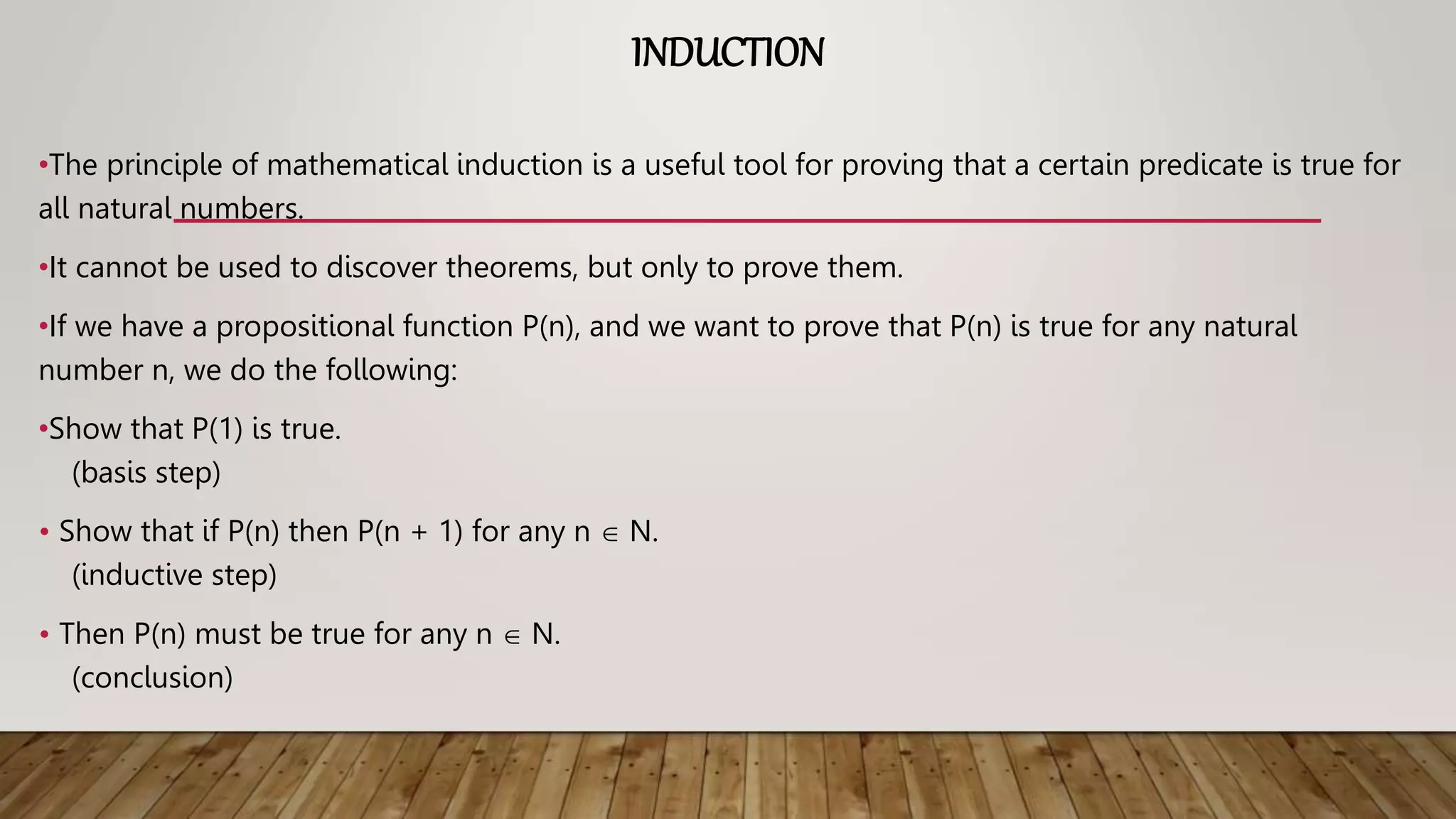
INDUCTION
•The principle of mathematical induction is a useful tool for proving that a certain predicate is true for
all natural numbers.
•It cannot be used to discover theorems, but only to prove them.
•If we have a propositional function P(n), and we want to prove that P(n) is true for any natural
number n, we do the following:
•Show that P(1) is true.
(basis step)
• Show that if P(n) then P(n + 1) for any n  N.
(inductive step)
• Then P(n) must be true for any n  N.
(conclusion)
• Example:
• Show that n < 2n for all positive integers n.
• Let P(n) be the proposition “n < 2n.”
• 1. Show that P(1) is true.
(basis step)
• P(1) is true, because 1 < 21 = 2.
INDUCTION
• 2. Show that if P(n) is true, then P(n + 1) is true.
(inductive step)
• Assume that n < 2n is true.
• We need to show that P(n + 1) is true, i.e.
• n + 1 < 2n+1
• We start from n < 2n:
• n + 1 < 2n + 1  2n + 2n = 2n+1
• Therefore, if n < 2n then n + 1 < 2n+1
INDUCTION
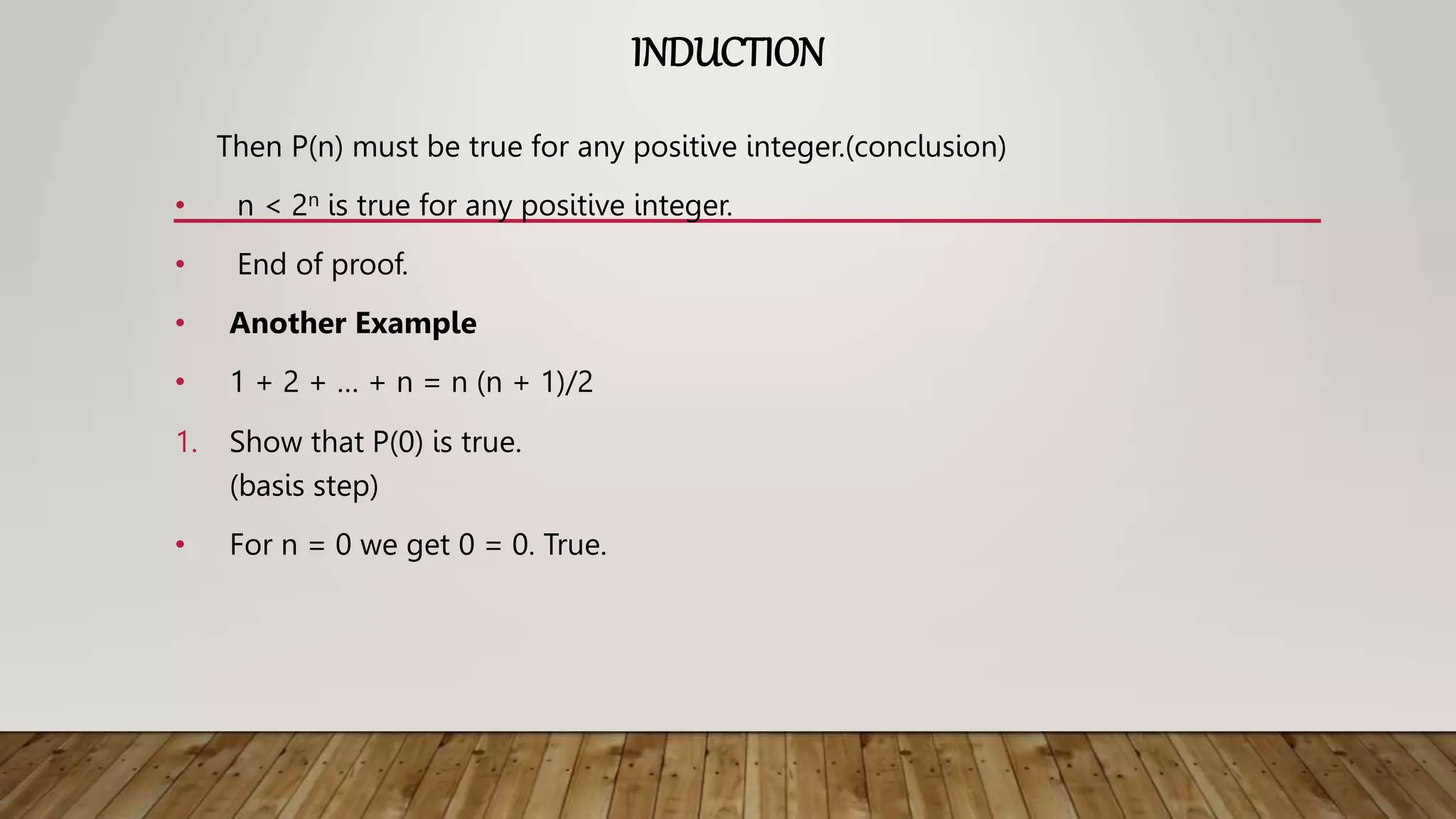
Then P(n) must be true for any positive integer.(conclusion)
• n < 2n is true for any positive integer.
• End of proof.
• Another Example
• 1 + 2 + … + n = n (n + 1)/2
1. Show that P(0) is true.
(basis step)
• For n = 0 we get 0 = 0. True.
INDUCTION
2. Show that if P(n) then P(n + 1) for any n  N. (inductive step)
• 1 + 2 + … + n = n (n + 1)/2
• 1 + 2 + … + n + (n + 1) = n (n + 1)/2 + (n + 1)
• = (2n + 2 + n (n + 1))/2
• = (2n + 2 + n2 + n)/2
• = (2 + 3n + n2 )/2
• = (n + 1) (n + 2)/2
• = (n + 1) ((n + 1) + 1)/2
INDUCTION
3. Then P(n) must be true for any n  N. (conclusion)
• 1 + 2 + … + n = n (n + 1)/2 is true for all n  N.
• End of proof.
8
INDUCTION
•There is another proof technique that is very similar to the
principle of mathematical induction.
•It is called the second principle of mathematical induction.
•It can be used to prove that a propositional function P(n) is true
for any natural number n.
INDUCTION
• The second principle of mathematical induction:
• Show that P(0) is true.
(basis step)
• Show that if P(0) and P(1) and … and P(n),
then P(n + 1) for any n  N.
(inductive step)
• Then P(n) must be true for any n  N.
(conclusion)
INDUCTION
•Example: Show that every integer greater than 1 can be written as the product of
primes.
• Show that P(2) is true.
(basis step)
•2 is the product of one prime: itself.
INDUCTION
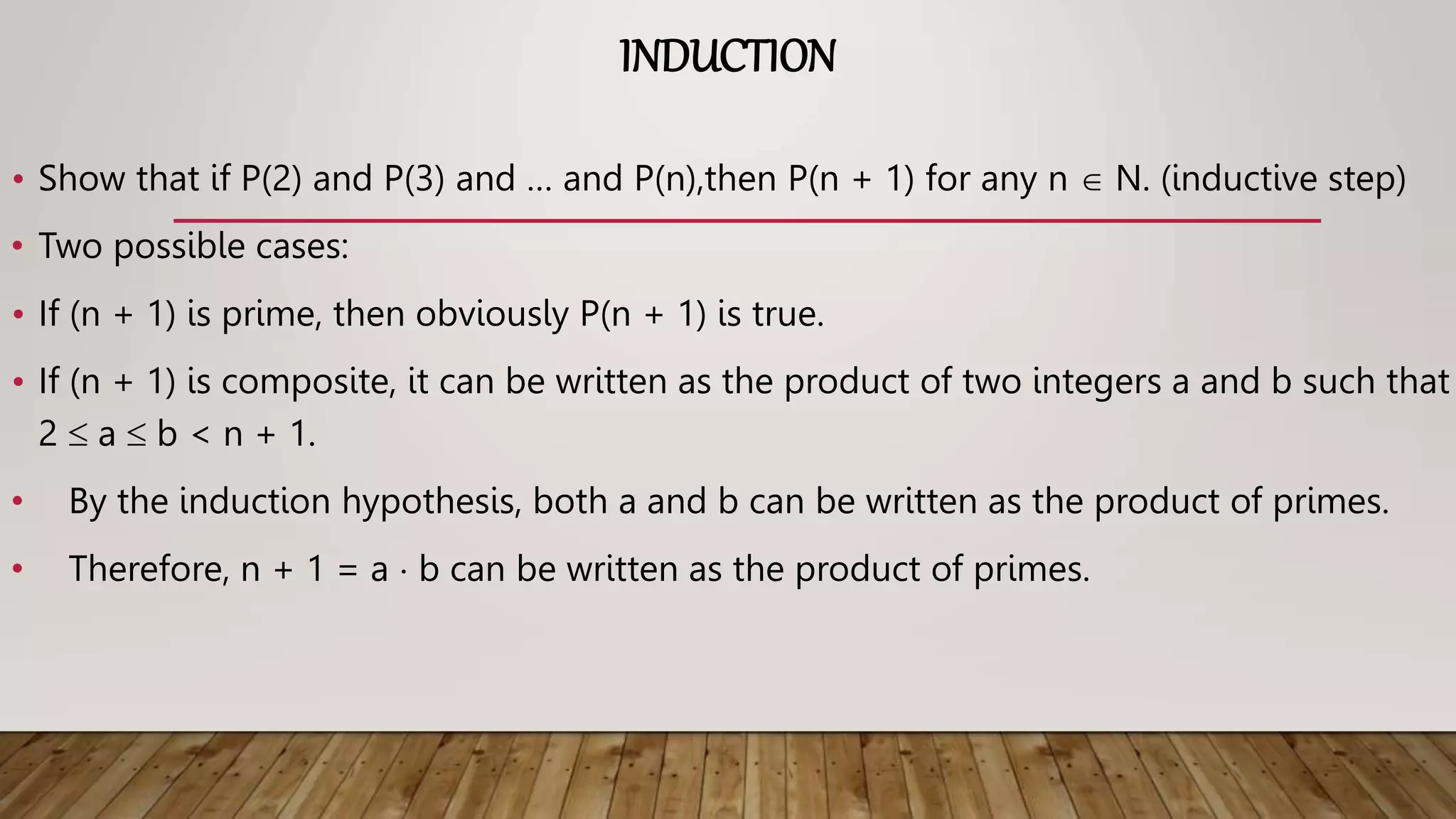
• Show that if P(2) and P(3) and … and P(n),then P(n + 1) for any n  N. (inductive step)
• Two possible cases:
• If (n + 1) is prime, then obviously P(n + 1) is true.
• If (n + 1) is composite, it can be written as the product of two integers a and b such that
2  a  b < n + 1.
• By the induction hypothesis, both a and b can be written as the product of primes.
• Therefore, n + 1 = a  b can be written as the product of primes.
INDUCTION
• Then P(n) must be true for any n  N.
(conclusion)
•End of proof.
•We have shown that every integer greater than 1 can be written as the product of
primes.
•Another example:
1+3+5+…+(2n-1)=n2
INTRODUCTION
14
Step 1: It is true for initial value. So for n=1
P(1):1(1)2
1=1
So p(n) for n=1 is true.
Step 2: We assume that
P(n) is true for n=1,2,3……k
Step: Prove it is true
Then we show that p(n) is true for n=k+1
P(k):1+3+5+…..+(2k-1)=k2
For n=k+1
P(k+1):1+3+5+……+(2K-1)+2(k+1)-1=(k+1)2
K +2k+2-1=(k+1)
K +2k+1=(k+1)
(k+1) =(k+1)
2 2
2 2
2
2

ppt02.ppt

  • 1.
    1 PMAS ARID AGRICULTUREUNIVERSITY RAWALPINDI BS SE (1B)EVENING. COURSE TITLE: DISCRETE STRUCTURE Group member: 1.ASIM SHAH(22-Arid-1019) 2.MASOOD-UR-REHMAN(22-Arid-1018) 3.SALIHA ALTAF(22-Arid-1054) UNIVERSITY INSTITUTE OF INFORMATION TECHNOLOGY
  • 2.
    AGENDA OF TODAY Principleof mathematical induction 2.
  • 3.
    INDUCTION •The principle ofmathematical induction is a useful tool for proving that a certain predicate is true for all natural numbers. •It cannot be used to discover theorems, but only to prove them. •If we have a propositional function P(n), and we want to prove that P(n) is true for any natural number n, we do the following: •Show that P(1) is true. (basis step) • Show that if P(n) then P(n + 1) for any n  N. (inductive step) • Then P(n) must be true for any n  N. (conclusion)
  • 4.
    • Example: • Showthat n < 2n for all positive integers n. • Let P(n) be the proposition “n < 2n.” • 1. Show that P(1) is true. (basis step) • P(1) is true, because 1 < 21 = 2.
  • 5.
    INDUCTION • 2. Showthat if P(n) is true, then P(n + 1) is true. (inductive step) • Assume that n < 2n is true. • We need to show that P(n + 1) is true, i.e. • n + 1 < 2n+1 • We start from n < 2n: • n + 1 < 2n + 1  2n + 2n = 2n+1 • Therefore, if n < 2n then n + 1 < 2n+1
  • 6.
    INDUCTION Then P(n) mustbe true for any positive integer.(conclusion) • n < 2n is true for any positive integer. • End of proof. • Another Example • 1 + 2 + … + n = n (n + 1)/2 1. Show that P(0) is true. (basis step) • For n = 0 we get 0 = 0. True.
  • 7.
    INDUCTION 2. Show thatif P(n) then P(n + 1) for any n  N. (inductive step) • 1 + 2 + … + n = n (n + 1)/2 • 1 + 2 + … + n + (n + 1) = n (n + 1)/2 + (n + 1) • = (2n + 2 + n (n + 1))/2 • = (2n + 2 + n2 + n)/2 • = (2 + 3n + n2 )/2 • = (n + 1) (n + 2)/2 • = (n + 1) ((n + 1) + 1)/2
  • 8.
    INDUCTION 3. Then P(n)must be true for any n  N. (conclusion) • 1 + 2 + … + n = n (n + 1)/2 is true for all n  N. • End of proof. 8
  • 9.
    INDUCTION •There is anotherproof technique that is very similar to the principle of mathematical induction. •It is called the second principle of mathematical induction. •It can be used to prove that a propositional function P(n) is true for any natural number n.
  • 10.
    INDUCTION • The secondprinciple of mathematical induction: • Show that P(0) is true. (basis step) • Show that if P(0) and P(1) and … and P(n), then P(n + 1) for any n  N. (inductive step) • Then P(n) must be true for any n  N. (conclusion)
  • 11.
    INDUCTION •Example: Show thatevery integer greater than 1 can be written as the product of primes. • Show that P(2) is true. (basis step) •2 is the product of one prime: itself.
  • 12.
    INDUCTION • Show thatif P(2) and P(3) and … and P(n),then P(n + 1) for any n  N. (inductive step) • Two possible cases: • If (n + 1) is prime, then obviously P(n + 1) is true. • If (n + 1) is composite, it can be written as the product of two integers a and b such that 2  a  b < n + 1. • By the induction hypothesis, both a and b can be written as the product of primes. • Therefore, n + 1 = a  b can be written as the product of primes.
  • 13.
    INDUCTION • Then P(n)must be true for any n  N. (conclusion) •End of proof. •We have shown that every integer greater than 1 can be written as the product of primes. •Another example: 1+3+5+…+(2n-1)=n2
  • 14.
    INTRODUCTION 14 Step 1: Itis true for initial value. So for n=1 P(1):1(1)2 1=1 So p(n) for n=1 is true. Step 2: We assume that P(n) is true for n=1,2,3……k Step: Prove it is true Then we show that p(n) is true for n=k+1 P(k):1+3+5+…..+(2k-1)=k2 For n=k+1 P(k+1):1+3+5+……+(2K-1)+2(k+1)-1=(k+1)2 K +2k+2-1=(k+1) K +2k+1=(k+1) (k+1) =(k+1) 2 2 2 2 2 2