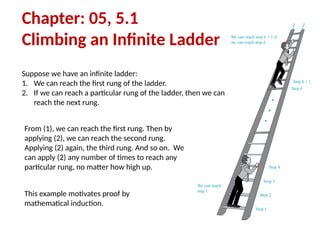
Suppose we havean infinite ladder:
1. We can reach the first rung of the ladder.
2. If we can reach a particular rung of the ladder, then we can
reach the next rung.
From (1), we can reach the first rung. Then by
applying (2), we can reach the second rung.
Applying (2) again, the third rung. And so on. We
can apply (2) any number of times to reach any
particular rung, no matter how high up.
This example motivates proof by
mathematical induction.
Chapter: 05, 5.1
Climbing an Infinite Ladder
3.
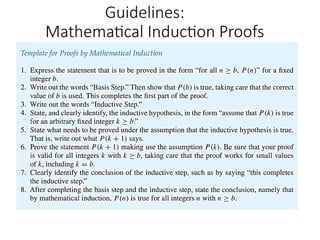
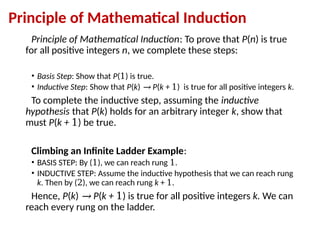
Principle of MathematicalInduction: To prove that P(n) is true
for all positive integers n, we complete these steps:
• Basis Step: Show that P(1) is true.
• Inductive Step: Show that P(k) → P(k + 1) is true for all positive integers k.
To complete the inductive step, assuming the inductive
hypothesis that P(k) holds for an arbitrary integer k, show that
must P(k + 1) be true.
Climbing an Infinite Ladder Example:
• BASIS STEP: By (1), we can reach rung 1.
• INDUCTIVE STEP: Assume the inductive hypothesis that we can reach rung
k. Then by (2), we can reach rung k + 1.
Hence, P(k) → P(k + 1) is true for all positive integers k. We can
reach every rung on the ladder.
Principle of Mathematical Induction
4.
Proving a SummationFormula
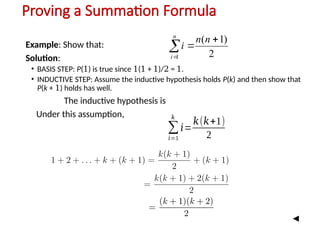
Example: Show that:
Solution:
• BASIS STEP: P(1) is true since 1(1 + 1)/2 = 1.
• INDUCTIVE STEP: Assume the inductive hypothesis holds P(k) and then show that
P(k + 1) holds has well.
The inductive hypothesis is
Under this assumption,
2
)
1
(
1
n
n
i
n
i
∑
𝑖=1
𝑘
𝑖=
𝑘(𝑘+1)
2
5.
Conjecturing and ProvingCorrect a Summation Formula
Example: Conjecture and prove correct a formula for the sum of the first n positive odd integers. Then prove
your conjecture.
Solution: We have: 1= 1, 1 + 3 = 4, 1 + 3 + 5 = 9, 1 + 3 + 5 + 7 = 16, 1 + 3 + 5 + 7 + 9
= 25.
• We can conjecture that the sum of the first n positive odd integers is n2
,
• We prove the conjecture is proved correct with mathematical induction.
• BASIS STEP: P(1) is true since 12
= 1.
• INDUCTIVE STEP: P(k) → P(k + 1) for every positive integer k.
Assume the inductive hypothesis holds and then show that P(k + 1) holds has well.
• So, assuming P(k), it follows that:
• Hence, we have shown that P(k + 1) follows from P(k). Therefore the sum of the first n positive odd integers is n2
.
Inductive Hypothesis: 1 + 3 + 5 + ∙∙∙+ (2k −
1) =k2
1 + 3 + 5 + ∙∙∙+ (2k − 1) + (2k + 1) =[1 + 3 + 5 + ∙∙∙+ (2k − 1)] + (2k + 1)
= k2
+ (2k + 1) (by the inductive
hypothesis)
= k2
+ 2k + 1
= (k + 1) 2
1+3 +5+ …+(2𝑛 −1)=𝑛2
6.
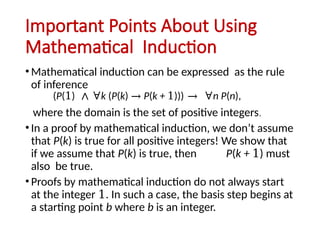
Important Points AboutUsing
Mathematical Induction
• Mathematical induction can be expressed as the rule
of inference
where the domain is the set of positive integers.
• In a proof by mathematical induction, we don’t assume
that P(k) is true for all positive integers! We show that
if we assume that P(k) is true, then P(k + 1) must
also be true.
• Proofs by mathematical induction do not always start
at the integer 1. In such a case, the basis step begins at
a starting point b where b is an integer.
(P(1) ∧ ∀k (P(k) → P(k + 1))) → ∀n P(n),
7.
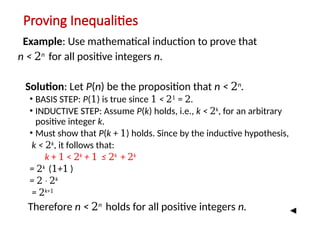
Proving Inequalities
Example: Usemathematical induction to prove that
n < 2n
for all positive integers n.
Solution: Let P(n) be the proposition that n < 2n
.
• BASIS STEP: P(1) is true since 1 < 21
= 2.
• INDUCTIVE STEP: Assume P(k) holds, i.e., k < 2k
, for an arbitrary
positive integer k.
• Must show that P(k + 1) holds. Since by the inductive hypothesis,
k < 2k
, it follows that:
k + 1 < 2k
+ 1 ≤ 2k
+ 2k
= 2k
(1+1 )
= 2 ∙ 2k
= 2k+1
Therefore n < 2n
holds for all positive integers n.
8.
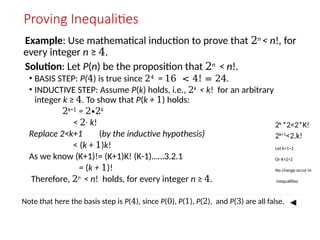
Proving Inequalities
Example: Usemathematical induction to prove that 2n
< n!, for
every integer n ≥ 4.
Solution: Let P(n) be the proposition that 2n
< n!.
• BASIS STEP: P(4) is true since 24 = 16 < 4! = 24.
• INDUCTIVE STEP: Assume P(k) holds, i.e., 2k
< k! for an arbitrary
integer k ≥ 4. To show that P(k + 1) holds:
2k+1
= 2∙2k
< 2 k
∙ !
Replace 2<k+1 (by the inductive hypothesis)
< (k + 1)k!
As we know (K+1)!= (K+1)K! (K-1)……3.2.1
= (k + 1)!
Therefore, 2n
< n! holds, for every integer n ≥ 4.
Note that here the basis step is P(4), since P(0), P(1), P(2), and P(3) are all false.
2k
*2<2*K!
2k+1
<2.k!
Let k+1>2
Or K+2>2
No change occur in
inequalities
9.
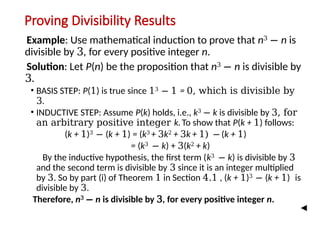
Proving Divisibility Results
Example:Use mathematical induction to prove that n3
− n is
divisible by 3, for every positive integer n.
Solution: Let P(n) be the proposition that n3
− n is divisible by
3.
• BASIS STEP: P(1) is true since 13
− 1 = 0, which is divisible by
3.
• INDUCTIVE STEP: Assume P(k) holds, i.e., k3
− k is divisible by 3, for
an arbitrary positive integer k.To show that P(k + 1) follows:
(k + 1)3
− (k + 1) = (k3
+ 3k2
+ 3k + 1) − (k + 1)
= (k3
− k) + 3(k2
+ k)
By the inductive hypothesis, the first term (k3
− k) is divisible by 3
and the second term is divisible by 3 since it is an integer multiplied
by 3. So by part (i) of Theorem 1 in Section 4.1 , (k + 1)3
− (k + 1) is
divisible by 3.
Therefore, n3
− n is divisible by 3, for every positive integer n.
10.
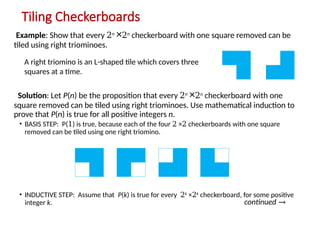
Tiling Checkerboards
Example: Showthat every 2n
×2n
checkerboard with one square removed can be
tiled using right triominoes.
Solution: Let P(n) be the proposition that every 2n
×2n
checkerboard with one
square removed can be tiled using right triominoes. Use mathematical induction to
prove that P(n) is true for all positive integers n.
• BASIS STEP: P(1) is true, because each of the four 2 ×2 checkerboards with one square
removed can be tiled using one right triomino.
• INDUCTIVE STEP: Assume that P(k) is true for every 2k
×2k
checkerboard, for some positive
integer k. continued →
A right triomino is an L-shaped tile which covers three
squares at a time.
11.
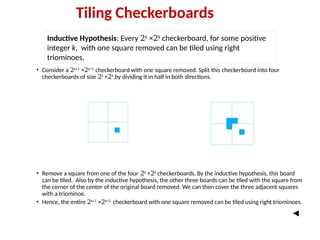
• Consider a2k+1
×2k+1
checkerboard with one square removed. Split this checkerboard into four
checkerboards of size 2k
×2k
,by dividing it in half in both directions.
• Remove a square from one of the four 2k
×2k
checkerboards. By the inductive hypothesis, this board
can be tiled. Also by the inductive hypothesis, the other three boards can be tiled with the square from
the corner of the center of the original board removed. We can then cover the three adjacent squares
with a triominoe.
• Hence, the entire 2k+1
×2k+1
checkerboard with one square removed can be tiled using right triominoes.
Inductive Hypothesis: Every 2k
×2k
checkerboard, for some positive
integer k, with one square removed can be tiled using right
triominoes.
Tiling Checkerboards
12.
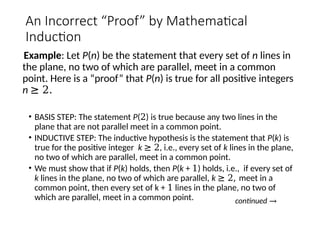
An Incorrect “Proof”by Mathematical
Induction
Example: Let P(n) be the statement that every set of n lines in
the plane, no two of which are parallel, meet in a common
point. Here is a “proof” that P(n) is true for all positive integers
n ≥ 2.
• BASIS STEP: The statement P(2) is true because any two lines in the
plane that are not parallel meet in a common point.
• INDUCTIVE STEP: The inductive hypothesis is the statement that P(k) is
true for the positive integer k ≥ 2, i.e., every set of k lines in the plane,
no two of which are parallel, meet in a common point.
• We must show that if P(k) holds, then P(k + 1) holds, i.e., if every set of
k lines in the plane, no two of which are parallel, k ≥ 2, meet in a
common point, then every set of k + 1 lines in the plane, no two of
which are parallel, meet in a common point. continued →
13.
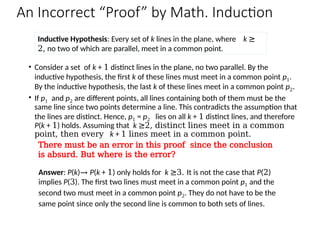
An Incorrect “Proof”by Math. Induction
• Consider a set of k + 1 distinct lines in the plane, no two parallel. By the
inductive hypothesis, the first k of these lines must meet in a common point p1.
By the inductive hypothesis, the last k of these lines meet in a common point p2.
• If p1 and p2 are different points, all lines containing both of them must be the
same line since two points determine a line. This contradicts the assumption that
the lines are distinct. Hence, p1 = p2 lies on all k + 1 distinct lines, and therefore
P(k + 1) holds. Assuming that k ≥2, distinct lines meet in a common
point, then every k + 1 lines meet in a common point.
Inductive Hypothesis: Every set of k lines in the plane, where k ≥
2, no two of which are parallel, meet in a common point.
Answer: P(k)→ P(k + 1) only holds for k ≥3. It is not the case that P(2)
implies P(3). The first two lines must meet in a common point p1 and the
second two must meet in a common point p2. They do not have to be the
same point since only the second line is common to both sets of lines.
There must be an error in this proof since the conclusion
is absurd. But where is the error?
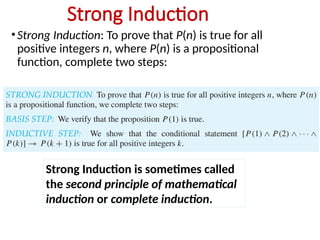
Strong Induction
•Strong Induction:To prove that P(n) is true for all
positive integers n, where P(n) is a propositional
function, complete two steps:
Strong Induction is sometimes called
the second principle of mathematical
induction or complete induction.
17.
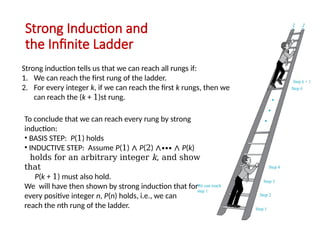
Strong Induction and
theInfinite Ladder
Strong induction tells us that we can reach all rungs if:
1. We can reach the first rung of the ladder.
2. For every integer k, if we can reach the first k rungs, then we
can reach the (k + 1)st rung.
To conclude that we can reach every rung by strong
induction:
• BASIS STEP: P(1) holds
• INDUCTIVE STEP: Assume P(1) ∧ P(2) ∧∙∙∙ ∧ P(k)
holds for an arbitrary integer k, and show
that
P(k + 1) must also hold.
We will have then shown by strong induction that for
every positive integer n, P(n) holds, i.e., we can
reach the nth rung of the ladder.
18.
Proof using StrongInduction
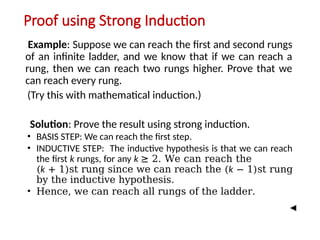
Example: Suppose we can reach the first and second rungs
of an infinite ladder, and we know that if we can reach a
rung, then we can reach two rungs higher. Prove that we
can reach every rung.
(Try this with mathematical induction.)
Solution: Prove the result using strong induction.
• BASIS STEP: We can reach the first step.
• INDUCTIVE STEP: The inductive hypothesis is that we can reach
the first k rungs, for any k ≥ 2. We can reach the
(k + 1)st rung since we can reach the (k − 1)st rung
by the inductive hypothesis.
• Hence, we can reach all rungs of the ladder.
19.
Proof of theSame Example using Mathematical Induction
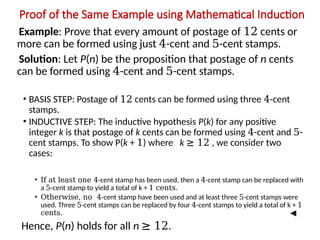
Example: Prove that every amount of postage of 12 cents or
more can be formed using just 4-cent and 5-cent stamps.
Solution: Let P(n) be the proposition that postage of n cents
can be formed using 4-cent and 5-cent stamps.
• BASIS STEP: Postage of 12 cents can be formed using three 4-cent
stamps.
• INDUCTIVE STEP: The inductive hypothesis P(k) for any positive
integer k is that postage of k cents can be formed using 4-cent and 5-
cent stamps. To show P(k + 1) where k ≥ 12 , we consider two
cases:
• If at least one 4-cent stamp has been used, then a 4-cent stamp can be replaced with
a 5-cent stamp to yield a total of k + 1 cents.
• Otherwise, no 4-cent stamp have been used and at least three 5-cent stamps were
used. Three 5-cent stamps can be replaced by four 4-cent stamps to yield a total of k + 1
cents.
Hence, P(n) holds for all n ≥ 12.
20.
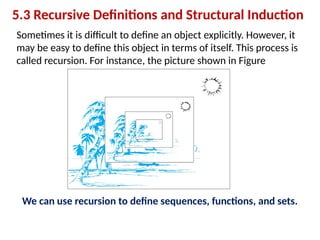
Sometimes it isdifficult to define an object explicitly. However, it
may be easy to define this object in terms of itself. This process is
called recursion. For instance, the picture shown in Figure
5.3 Recursive Definitions and Structural Induction
We can use recursion to define sequences, functions, and sets.
21.
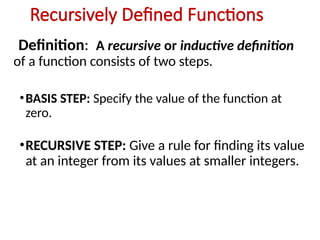
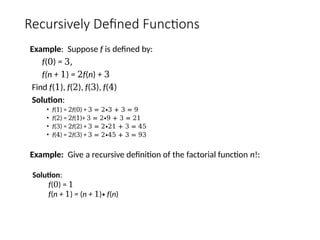
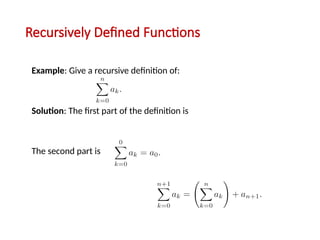
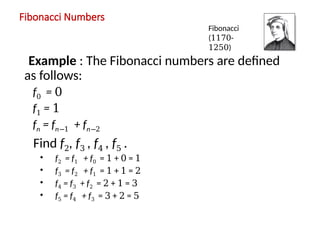
Recursively Defined Functions
Definition:A recursive or inductive definition
of a function consists of two steps.
•BASIS STEP: Specify the value of the function at
zero.
•RECURSIVE STEP: Give a rule for finding its value
at an integer from its values at smaller integers.
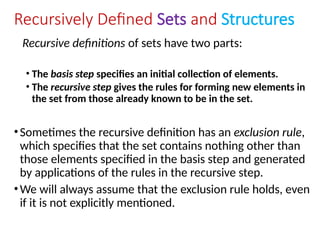
Recursively Defined Setsand Structures
Recursive definitions of sets have two parts:
• The basis step specifies an initial collection of elements.
• The recursive step gives the rules for forming new elements in
the set from those already known to be in the set.
•Sometimes the recursive definition has an exclusion rule,
which specifies that the set contains nothing other than
those elements specified in the basis step and generated
by applications of the rules in the recursive step.
•We will always assume that the exclusion rule holds, even
if it is not explicitly mentioned.
26.
Recursively Defined Setsand Structures
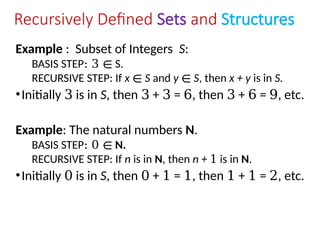
Example : Subset of Integers S:
BASIS STEP: 3 ∊ S.
RECURSIVE STEP: If x ∊ S and y ∊ S, then x + y is in S.
•Initially 3 is in S, then 3 + 3 = 6, then 3 + 6 = 9, etc.
Example: The natural numbers N.
BASIS STEP: 0 ∊ N.
RECURSIVE STEP: If n is in N, then n + 1 is in N.
•Initially 0 is in S, then 0 + 1 = 1, then 1 + 1 = 2, etc.
27.
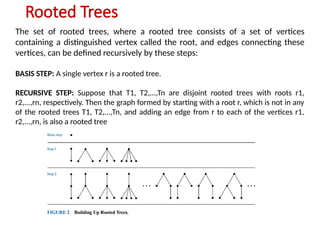
Rooted Trees
The setof rooted trees, where a rooted tree consists of a set of vertices
containing a distinguished vertex called the root, and edges connecting these
vertices, can be defined recursively by these steps:
BASIS STEP: A single vertex r is a rooted tree.
RECURSIVE STEP: Suppose that T1, T2,...,Tn are disjoint rooted trees with roots r1,
r2,...,rn, respectively. Then the graph formed by starting with a root r, which is not in any
of the rooted trees T1, T2,...,Tn, and adding an edge from r to each of the vertices r1,
r2,...,rn, is also a rooted tree
28.
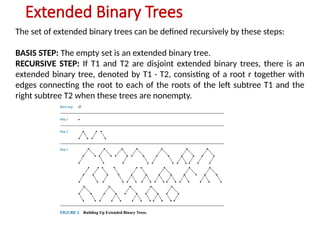
Extended Binary Trees
Theset of extended binary trees can be defined recursively by these steps:
BASIS STEP: The empty set is an extended binary tree.
RECURSIVE STEP: If T1 and T2 are disjoint extended binary trees, there is an
extended binary tree, denoted by T1 · T2, consisting of a root r together with
edges connecting the root to each of the roots of the left subtree T1 and the
right subtree T2 when these trees are nonempty.
29.
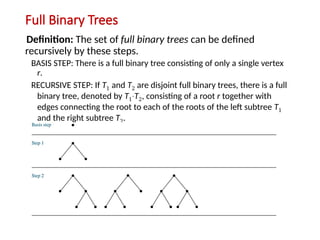
Full Binary Trees
Definition:The set of full binary trees can be defined
recursively by these steps.
BASIS STEP: There is a full binary tree consisting of only a single vertex
r.
RECURSIVE STEP: If T1 and T2 are disjoint full binary trees, there is a full
binary tree, denoted by T1∙T2, consisting of a root r together with
edges connecting the root to each of the roots of the left subtree T1
and the right subtree T2.
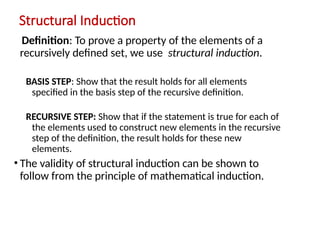
30.
Structural Induction
Definition: Toprove a property of the elements of a
recursively defined set, we use structural induction.
BASIS STEP: Show that the result holds for all elements
specified in the basis step of the recursive definition.
RECURSIVE STEP: Show that if the statement is true for each of
the elements used to construct new elements in the recursive
step of the definition, the result holds for these new
elements.
• The validity of structural induction can be shown to
follow from the principle of mathematical induction.
31.
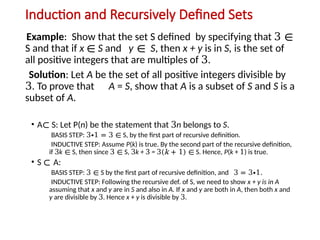
Induction and RecursivelyDefined Sets
Example: Show that the set S defined by specifying that 3 ∊
S and that if x ∊ S and y ∊ S, then x + y is in S, is the set of
all positive integers that are multiples of 3.
Solution: Let A be the set of all positive integers divisible by
3. To prove that A = S, show that A is a subset of S and S is a
subset of A.
• A⊂ S: Let P(n) be the statement that 3n belongs to S.
BASIS STEP: 3∙1 = 3 ∊ S, by the first part of recursive definition.
INDUCTIVE STEP: Assume P(k) is true. By the second part of the recursive definition,
if 3k ∊ S, then since 3 ∊ S, 3k + 3 = 3(k + 1) ∊ S. Hence, P(k + 1) is true.
• S ⊂ A:
BASIS STEP: 3 ∊ S by the first part of recursive definition, and 3 = 3∙1.
INDUCTIVE STEP: Following the recursive def. of S, we need to show x + y is in A
assuming that x and y are in S and also in A. If x and y are both in A, then both x and
y are divisible by 3. Hence x + y is divisible by 3.
32.
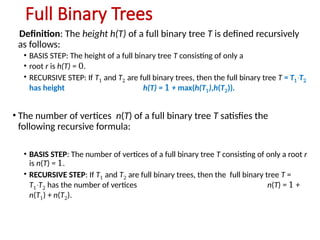
Full Binary Trees
Definition:The height h(T) of a full binary tree T is defined recursively
as follows:
• BASIS STEP: The height of a full binary tree T consisting of only a
• root r is h(T) = 0.
• RECURSIVE STEP: If T1 and T2 are full binary trees, then the full binary tree T = T1 T
∙ 2
has height h(T) = 1 + max(h(T1),h(T2)).
• The number of vertices n(T) of a full binary tree T satisfies the
following recursive formula:
• BASIS STEP: The number of vertices of a full binary tree T consisting of only a root r
is n(T) = 1.
• RECURSIVE STEP: If T1 and T2 are full binary trees, then the full binary tree T =
T1 T
∙ 2 has the number of vertices n(T) = 1 +
n(T1) + n(T2).
33.
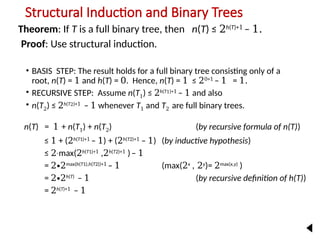
Structural Induction andBinary Trees
Theorem: If T is a full binary tree, then n(T) ≤ 2h(T)+1
– 1.
Proof: Use structural induction.
• BASIS STEP: The result holds for a full binary tree consisting only of a
root, n(T) = 1 and h(T) = 0. Hence, n(T) = 1 ≤ 20+1
– 1 = 1.
• RECURSIVE STEP: Assume n(T1) ≤ 2h(T1)+1
– 1 and also
• n(T2) ≤ 2h(T2)+1
– 1 whenever T1 and T2 are full binary trees.
n(T) = 1 + n(T1) + n(T2) (by recursive formula of n(T))
≤ 1 + (2h(T1)+1
– 1) + (2h(T2)+1
– 1) (by inductive hypothesis)
≤ 2 max(
∙ 2h(T1)+1
,2h(T2)+1
)– 1
= 2∙2max(h(T1),h(T2))+1
– 1 (max(2x
, 2y
)= 2max(x,y)
)
= 2∙2h(T)
– 1 (by recursive definition of h(T))
= 2h(T)+1
– 1
−
2
34.
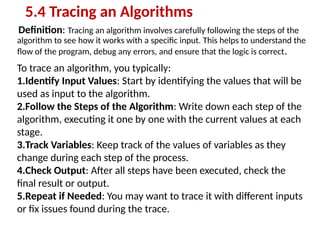
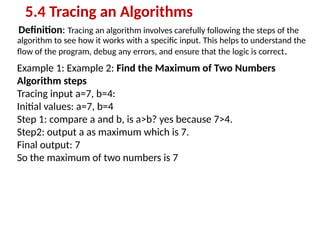
Definition: Tracing analgorithm involves carefully following the steps of the
algorithm to see how it works with a specific input. This helps to understand the
flow of the program, debug any errors, and ensure that the logic is correct.
5.4 Tracing an Algorithms
To trace an algorithm, you typically:
1.Identify Input Values: Start by identifying the values that will be
used as input to the algorithm.
2.Follow the Steps of the Algorithm: Write down each step of the
algorithm, executing it one by one with the current values at each
stage.
3.Track Variables: Keep track of the values of variables as they
change during each step of the process.
4.Check Output: After all steps have been executed, check the
final result or output.
5.Repeat if Needed: You may want to trace it with different inputs
or fix issues found during the trace.
35.
Definition: Tracing analgorithm involves carefully following the steps of the
algorithm to see how it works with a specific input. This helps to understand the
flow of the program, debug any errors, and ensure that the logic is correct.
5.4 Tracing an Algorithms
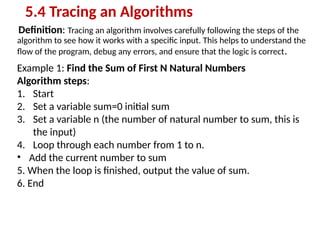
Example 1: Find the Sum of First N Natural Numbers
Algorithm steps:
1. Start
2. Set a variable sum=0 initial sum
3. Set a variable n (the number of natural number to sum, this is
the input)
4. Loop through each number from 1 to n.
• Add the current number to sum
5. When the loop is finished, output the value of sum.
6. End
36.
Definition: Tracing analgorithm involves carefully following the steps of the
algorithm to see how it works with a specific input. This helps to understand the
flow of the program, debug any errors, and ensure that the logic is correct.
5.4 Tracing an Algorithms
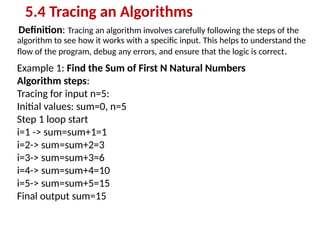
Example 1: Find the Sum of First N Natural Numbers
Algorithm steps:
Tracing for input n=5:
Initial values: sum=0, n=5
Step 1 loop start
i=1 -> sum=sum+1=1
i=2-> sum=sum+2=3
i=3-> sum=sum+3=6
i=4-> sum=sum+4=10
i=5-> sum=sum+5=15
Final output sum=15
37.
Definition: Tracing analgorithm involves carefully following the steps of the
algorithm to see how it works with a specific input. This helps to understand the
flow of the program, debug any errors, and ensure that the logic is correct.
5.4 Tracing an Algorithms
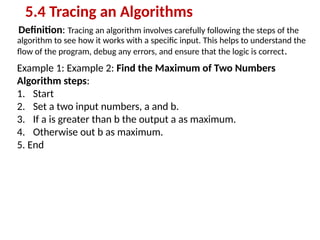
Example 1: Example 2: Find the Maximum of Two Numbers
Algorithm steps:
1. Start
2. Set a two input numbers, a and b.
3. If a is greater than b the output a as maximum.
4. Otherwise out b as maximum.
5. End
38.
Definition: Tracing analgorithm involves carefully following the steps of the
algorithm to see how it works with a specific input. This helps to understand the
flow of the program, debug any errors, and ensure that the logic is correct.
5.4 Tracing an Algorithms
Example 1: Example 2: Find the Maximum of Two Numbers
Algorithm steps
Tracing input a=7, b=4:
Initial values: a=7, b=4
Step 1: compare a and b, is a>b? yes because 7>4.
Step2: output a as maximum which is 7.
Final output: 7
So the maximum of two numbers is 7
39.
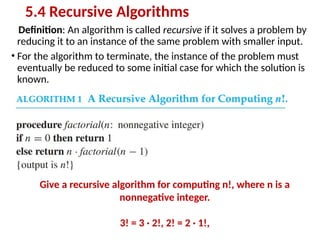
Definition: An algorithmis called recursive if it solves a problem by
reducing it to an instance of the same problem with smaller input.
• For the algorithm to terminate, the instance of the problem must
eventually be reduced to some initial case for which the solution is
known.
5.4 Recursive Algorithms
Give a recursive algorithm for computing n!, where n is a
nonnegative integer.
3! = 3 · 2!, 2! = 2 · 1!,
40.
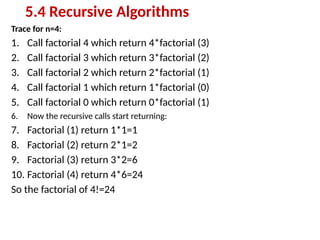
Trace for n=4:
1.Call factorial 4 which return 4*factorial (3)
2. Call factorial 3 which return 3*factorial (2)
3. Call factorial 2 which return 2*factorial (1)
4. Call factorial 1 which return 1*factorial (0)
5. Call factorial 0 which return 0*factorial (1)
6. Now the recursive calls start returning:
7. Factorial (1) return 1*1=1
8. Factorial (2) return 2*1=2
9. Factorial (3) return 3*2=6
10. Factorial (4) return 4*6=24
So the factorial of 4!=24
5.4 Recursive Algorithms
42.
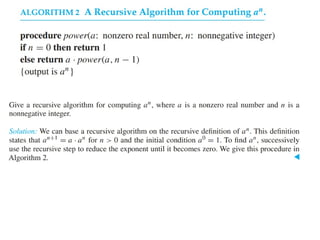
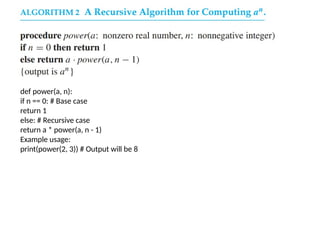
def power(a, n):
ifn == 0: # Base case
return 1
else: # Recursive case
return a * power(a, n - 1)
Example usage:
print(power(2, 3)) # Output will be 8
43.
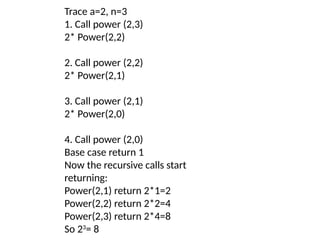
Trace a=2, n=3
1.Call power (2,3)
2* Power(2,2)
2. Call power (2,2)
2* Power(2,1)
3. Call power (2,1)
2* Power(2,0)
4. Call power (2,0)
Base case return 1
Now the recursive calls start
returning:
Power(2,1) return 2*1=2
Power(2,2) return 2*2=4
Power(2,3) return 2*4=8
So 23
= 8
![Conjecturing and Proving Correct a Summation Formula
Example: Conjecture and prove correct a formula for the sum of the first n positive odd integers. Then prove
your conjecture.
Solution: We have: 1= 1, 1 + 3 = 4, 1 + 3 + 5 = 9, 1 + 3 + 5 + 7 = 16, 1 + 3 + 5 + 7 + 9
= 25.
• We can conjecture that the sum of the first n positive odd integers is n2
,
• We prove the conjecture is proved correct with mathematical induction.
• BASIS STEP: P(1) is true since 12
= 1.
• INDUCTIVE STEP: P(k) → P(k + 1) for every positive integer k.
Assume the inductive hypothesis holds and then show that P(k + 1) holds has well.
• So, assuming P(k), it follows that:
• Hence, we have shown that P(k + 1) follows from P(k). Therefore the sum of the first n positive odd integers is n2
.
Inductive Hypothesis: 1 + 3 + 5 + ∙∙∙+ (2k −
1) =k2
1 + 3 + 5 + ∙∙∙+ (2k − 1) + (2k + 1) =[1 + 3 + 5 + ∙∙∙+ (2k − 1)] + (2k + 1)
= k2
+ (2k + 1) (by the inductive
hypothesis)
= k2
+ 2k + 1
= (k + 1) 2
1+3 +5+ …+(2𝑛 −1)=𝑛2](https://image.slidesharecdn.com/ch-5mathematicalinduction-250317073001-2b0e0c36/85/Ch-5-Mathematical-Induction_Discrete_Structure-pptx-5-320.jpg)