Discrete Mathematics
Lecture 09
Rubya Afrin
Lecturer
Northern University of Business and Technology
Mathematical Induction
2
Induction
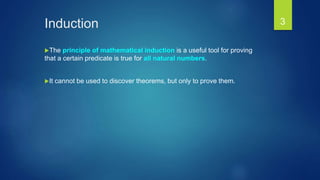
The principle of mathematical induction is a useful tool for proving
that a certain predicate is true for all natural numbers.
It cannot be used to discover theorems, but only to prove them.
3
Induction
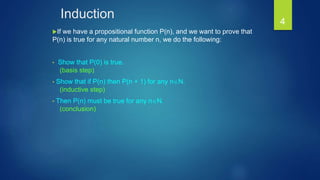
If we have a propositional function P(n), and we want to prove that
P(n) is true for any natural number n, we do the following:
• Show that P(0) is true.
(basis step)
• Show that if P(n) then P(n + 1) for any nN.
(inductive step)
• Then P(n) must be true for any nN.
(conclusion)
4
Induction
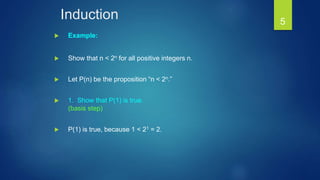
 Example:
 Show that n < 2n for all positive integers n.
 Let P(n) be the proposition “n < 2n.”
 1. Show that P(1) is true.
(basis step)
 P(1) is true, because 1 < 21 = 2.
5
Induction
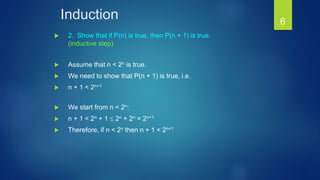
 2. Show that if P(n) is true, then P(n + 1) is true.
(inductive step)
 Assume that n < 2n is true.
 We need to show that P(n + 1) is true, i.e.
 n + 1 < 2n+1
 We start from n < 2n:
 n + 1 < 2n + 1  2n + 2n = 2n+1
 Therefore, if n < 2n then n + 1 < 2n+1
6
Induction
• Then P(n) must be true for any positive integer.
(conclusion)
 n < 2n is true for any positive integer.
 End of proof.
7
Induction
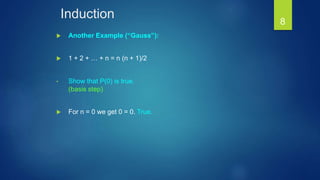
 Another Example (“Gauss”):
 1 + 2 + … + n = n (n + 1)/2
• Show that P(0) is true.
(basis step)
 For n = 0 we get 0 = 0. True.
8
Induction
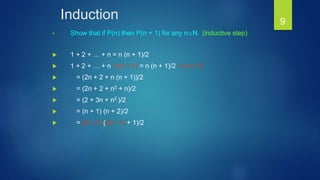
• Show that if P(n) then P(n + 1) for any nN. (inductive step)
 1 + 2 + … + n = n (n + 1)/2
 1 + 2 + … + n + (n + 1) = n (n + 1)/2 + (n + 1)
 = (2n + 2 + n (n + 1))/2
 = (2n + 2 + n2 + n)/2
 = (2 + 3n + n2 )/2
 = (n + 1) (n + 2)/2
 = (n + 1) ((n + 1) + 1)/2
9
Induction
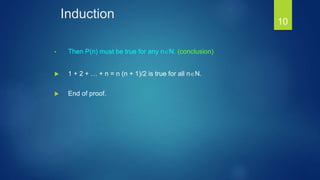
• Then P(n) must be true for any nN. (conclusion)
 1 + 2 + … + n = n (n + 1)/2 is true for all nN.
 End of proof.
10
Induction
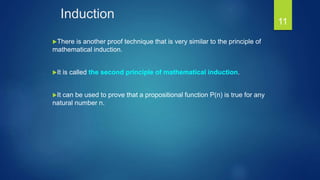
There is another proof technique that is very similar to the principle of
mathematical induction.
It is called the second principle of mathematical induction.
It can be used to prove that a propositional function P(n) is true for any
natural number n.
11
Induction
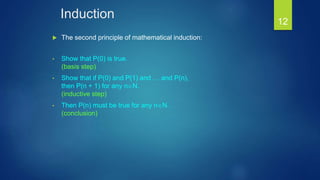
 The second principle of mathematical induction:
• Show that P(0) is true.
(basis step)
• Show that if P(0) and P(1) and … and P(n),
then P(n + 1) for any nN.
(inductive step)
• Then P(n) must be true for any nN.
(conclusion)
12
Induction
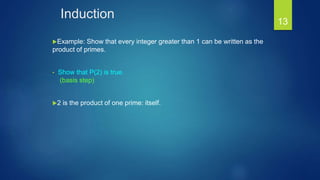
Example: Show that every integer greater than 1 can be written as the
product of primes.
• Show that P(2) is true.
(basis step)
2 is the product of one prime: itself.
13
Induction
• Show that if P(2) and P(3) and … and P(n),
then P(n + 1) for any nN. (inductive step)
 Two possible cases:
• If (n + 1) is prime, then obviously P(n + 1) is true.
• If (n + 1) is composite, it can be written as the product of two integers a
and b such that
2  a  b < n + 1.
 By the induction hypothesis, both a and b can be written as the
product of primes.
 Therefore, n + 1 = ab can be written as the product of primes.
14
Induction
• Then P(n) must be true for any nN.
(conclusion)
End of proof.
We have shown that every integer greater than 1 can be written as
the product of primes.
15
Thank you…

Mathematical Induction DM

  • 1.
    Discrete Mathematics Lecture 09 RubyaAfrin Lecturer Northern University of Business and Technology
  • 2.
  • 3.
    Induction The principle ofmathematical induction is a useful tool for proving that a certain predicate is true for all natural numbers. It cannot be used to discover theorems, but only to prove them. 3
  • 4.
    Induction If we havea propositional function P(n), and we want to prove that P(n) is true for any natural number n, we do the following: • Show that P(0) is true. (basis step) • Show that if P(n) then P(n + 1) for any nN. (inductive step) • Then P(n) must be true for any nN. (conclusion) 4
  • 5.
    Induction  Example:  Showthat n < 2n for all positive integers n.  Let P(n) be the proposition “n < 2n.”  1. Show that P(1) is true. (basis step)  P(1) is true, because 1 < 21 = 2. 5
  • 6.
    Induction  2. Showthat if P(n) is true, then P(n + 1) is true. (inductive step)  Assume that n < 2n is true.  We need to show that P(n + 1) is true, i.e.  n + 1 < 2n+1  We start from n < 2n:  n + 1 < 2n + 1  2n + 2n = 2n+1  Therefore, if n < 2n then n + 1 < 2n+1 6
  • 7.
    Induction • Then P(n)must be true for any positive integer. (conclusion)  n < 2n is true for any positive integer.  End of proof. 7
  • 8.
    Induction  Another Example(“Gauss”):  1 + 2 + … + n = n (n + 1)/2 • Show that P(0) is true. (basis step)  For n = 0 we get 0 = 0. True. 8
  • 9.
    Induction • Show thatif P(n) then P(n + 1) for any nN. (inductive step)  1 + 2 + … + n = n (n + 1)/2  1 + 2 + … + n + (n + 1) = n (n + 1)/2 + (n + 1)  = (2n + 2 + n (n + 1))/2  = (2n + 2 + n2 + n)/2  = (2 + 3n + n2 )/2  = (n + 1) (n + 2)/2  = (n + 1) ((n + 1) + 1)/2 9
  • 10.
    Induction • Then P(n)must be true for any nN. (conclusion)  1 + 2 + … + n = n (n + 1)/2 is true for all nN.  End of proof. 10
  • 11.
    Induction There is anotherproof technique that is very similar to the principle of mathematical induction. It is called the second principle of mathematical induction. It can be used to prove that a propositional function P(n) is true for any natural number n. 11
  • 12.
    Induction  The secondprinciple of mathematical induction: • Show that P(0) is true. (basis step) • Show that if P(0) and P(1) and … and P(n), then P(n + 1) for any nN. (inductive step) • Then P(n) must be true for any nN. (conclusion) 12
  • 13.
    Induction Example: Show thatevery integer greater than 1 can be written as the product of primes. • Show that P(2) is true. (basis step) 2 is the product of one prime: itself. 13
  • 14.
    Induction • Show thatif P(2) and P(3) and … and P(n), then P(n + 1) for any nN. (inductive step)  Two possible cases: • If (n + 1) is prime, then obviously P(n + 1) is true. • If (n + 1) is composite, it can be written as the product of two integers a and b such that 2  a  b < n + 1.  By the induction hypothesis, both a and b can be written as the product of primes.  Therefore, n + 1 = ab can be written as the product of primes. 14
  • 15.
    Induction • Then P(n)must be true for any nN. (conclusion) End of proof. We have shown that every integer greater than 1 can be written as the product of primes. 15
  • 16.