Math 1000
Stuart Jones
Section 1.4 Rational Expressions
Math 1000
Stuart Jones
A rational expression involves a polynomial fraction, where
there’s a polynomial in the numerator and another in the
denominator. One question we often have is what is the
domain of these functions.
Math 1000
Stuart Jones
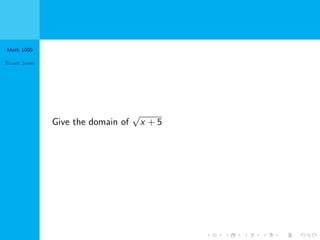
Give the domain of
√
x + 5
Math 1000
Stuart Jones
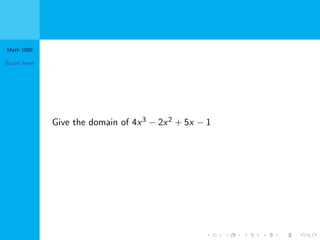
Give the domain of 4x3 − 2x2 + 5x − 1
Math 1000
Stuart Jones
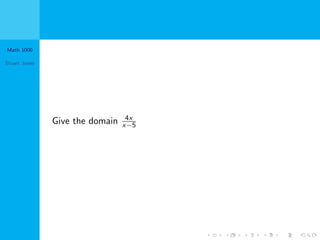
Give the domain 4x
x−5
Math 1000
Stuart Jones
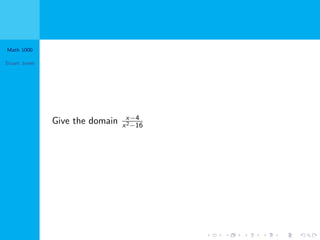
Give the domain x−4
x2−16
Math 1000
Stuart Jones
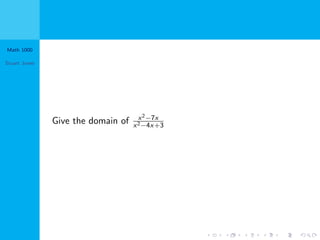
Give the domain of x2−7x
x2−4x+3
Math 1000
Stuart Jones
Often, we can simplify rational expressions, which involves
factoring. If we find the same factor in the numerator and the
denominator, we can cancel it.
Math 1000
Stuart Jones
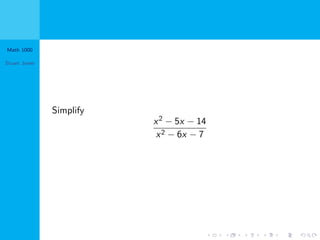
Simplify
x2 − 5x − 14
x2 − 6x − 7
Math 1000
Stuart Jones
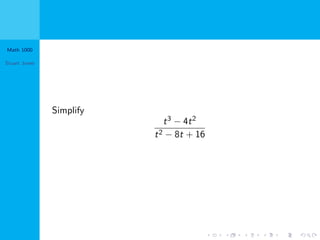
Simplify
t3 − 4t2
t2 − 8t + 16
Math 1000
Stuart Jones
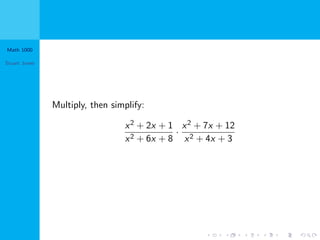
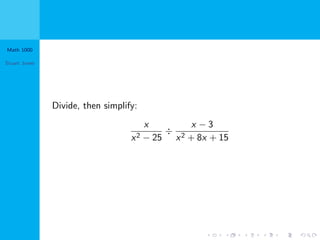
Multiplying and dividing rational expressions work exactly like
fractions, because they essentially are fractions. Remember,
when we divide fractions, we multiply by the reciprocal.
Math 1000
Stuart Jones
Multiply, then simplify:
x2 + 2x + 1
x2 + 6x + 8
·
x2 + 7x + 12
x2 + 4x + 3
Math 1000
Stuart Jones
Divide, then simplify:
x
x2 − 25
÷
x − 3
x2 + 8x + 15
Math 1000
Stuart Jones
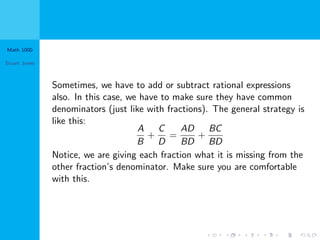
Sometimes, we have to add or subtract rational expressions
also. In this case, we have to make sure they have common
denominators (just like with fractions). The general strategy is
like this:
A
B
+
C
D
=
AD
BD
+
BC
BD
Notice, we are giving each fraction what it is missing from the
other fraction’s denominator. Make sure you are comfortable
with this.
Math 1000
Stuart Jones
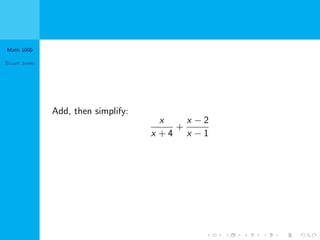
Add, then simplify:
x
x + 4
+
x − 2
x − 1
Math 1000
Stuart Jones
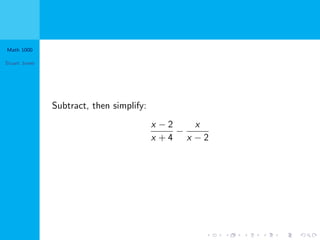
Subtract, then simplify:
x − 2
x + 4
−
x
x − 2
Math 1000
Stuart Jones
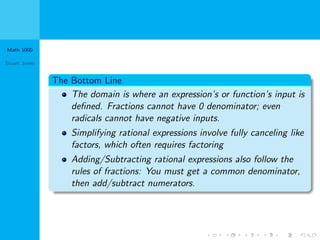
The Bottom Line
The domain is where an expression’s or function’s input is
defined. Fractions cannot have 0 denominator; even
radicals cannot have negative inputs.
Simplifying rational expressions involve fully canceling like
factors, which often requires factoring
Adding/Subtracting rational expressions also follow the
rules of fractions: You must get a common denominator,
then add/subtract numerators.

Math1000 section1.4