Math 1000
Stuart Jones
Section 1.6
Complex Numbers
Math 1000
Stuart Jones
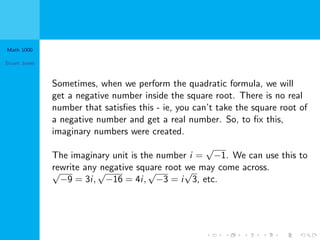
Sometimes, when we perform the quadratic formula, we will
get a negative number inside the square root. There is no real
number that satisfies this - ie, you can’t take the square root of
a negative number and get a real number. So, to fix this,
imaginary numbers were created.
The imaginary unit is the number i =
√
−1. We can use this to
rewrite any negative square root we may come across.√
−9 = 3i,
√
−16 = 4i,
√
−3 = i
√
3, etc.
Math 1000
Stuart Jones
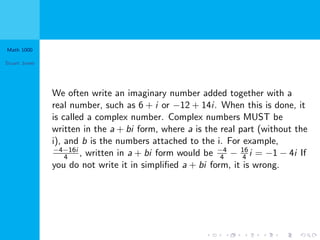
We often write an imaginary number added together with a
real number, such as 6 + i or −12 + 14i. When this is done, it
is called a complex number. Complex numbers MUST be
written in the a + bi form, where a is the real part (without the
i), and b is the numbers attached to the i. For example,
−4−16i
4 , written in a + bi form would be −4
4 − 16
4 i = −1 − 4i If
you do not write it in simplified a + bi form, it is wrong.
Math 1000
Stuart Jones
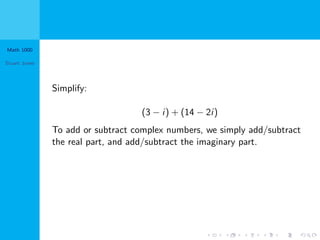
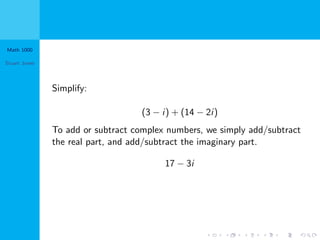
Simplify:
(3 − i) + (14 − 2i)
To add or subtract complex numbers, we simply add/subtract
the real part, and add/subtract the imaginary part.
Math 1000
Stuart Jones
Simplify:
(3 − i) + (14 − 2i)
To add or subtract complex numbers, we simply add/subtract
the real part, and add/subtract the imaginary part.
17 − 3i
Math 1000
Stuart Jones
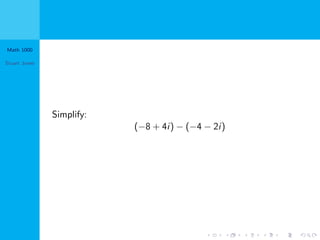
Simplify:
(−8 + 4i) − (−4 − 2i)
Math 1000
Stuart Jones
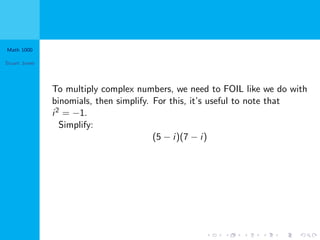
To multiply complex numbers, we need to FOIL like we do with
binomials, then simplify. For this, it’s useful to note that
i2 = −1.
Simplify:
(5 − i)(7 − i)
Math 1000
Stuart Jones
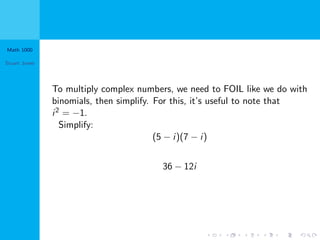
To multiply complex numbers, we need to FOIL like we do with
binomials, then simplify. For this, it’s useful to note that
i2 = −1.
Simplify:
(5 − i)(7 − i)
36 − 12i
Math 1000
Stuart Jones
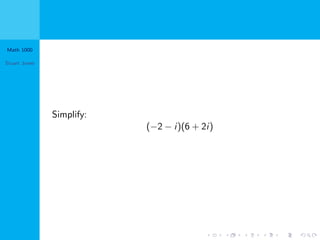
Simplify:
(−2 − i)(6 + 2i)
Math 1000
Stuart Jones
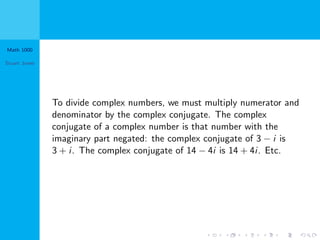
To divide complex numbers, we must multiply numerator and
denominator by the complex conjugate. The complex
conjugate of a complex number is that number with the
imaginary part negated: the complex conjugate of 3 − i is
3 + i. The complex conjugate of 14 − 4i is 14 + 4i. Etc.
Math 1000
Stuart Jones
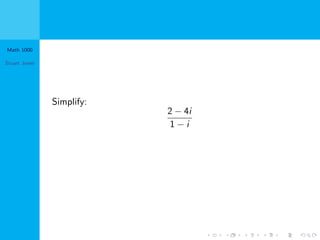
Simplify:
2 − 4i
1 − i
Math 1000
Stuart Jones
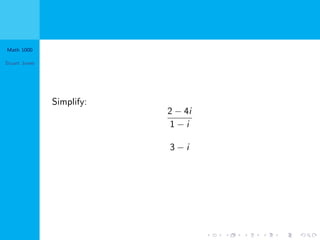
Simplify:
2 − 4i
1 − i
3 − i
Math 1000
Stuart Jones
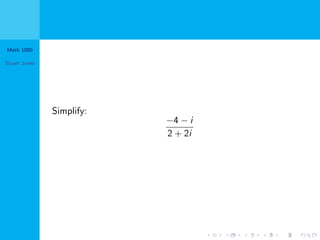
Simplify:
−4 − i
2 + 2i
Math 1000
Stuart Jones
The entire point for us with introducing complex numbers are
their arrival in the quadratic formula. Sometimes, complex
numbers will happen here. Make sure to fully simplify them.
Math 1000
Stuart Jones
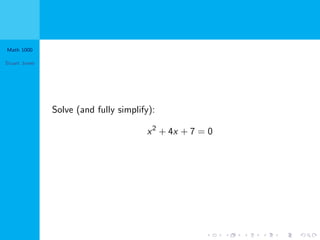
Solve (and fully simplify):
x2
+ 4x + 7 = 0
Math 1000
Stuart Jones
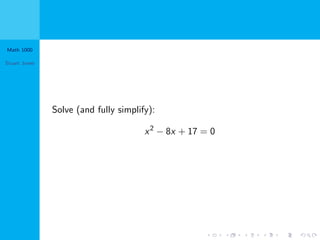
Solve (and fully simplify):
x2
− 8x + 17 = 0
Math 1000
Stuart Jones
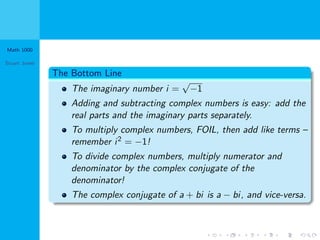
The Bottom Line
The imaginary number i =
√
−1
Adding and subtracting complex numbers is easy: add the
real parts and the imaginary parts separately.
To multiply complex numbers, FOIL, then add like terms –
remember i2 = −1!
To divide complex numbers, multiply numerator and
denominator by the complex conjugate of the
denominator!
The complex conjugate of a + bi is a − bi, and vice-versa.

Math1000 section1.6

  • 1.
    Math 1000 Stuart Jones Section1.6 Complex Numbers
  • 2.
    Math 1000 Stuart Jones Sometimes,when we perform the quadratic formula, we will get a negative number inside the square root. There is no real number that satisfies this - ie, you can’t take the square root of a negative number and get a real number. So, to fix this, imaginary numbers were created. The imaginary unit is the number i = √ −1. We can use this to rewrite any negative square root we may come across.√ −9 = 3i, √ −16 = 4i, √ −3 = i √ 3, etc.
  • 3.
    Math 1000 Stuart Jones Weoften write an imaginary number added together with a real number, such as 6 + i or −12 + 14i. When this is done, it is called a complex number. Complex numbers MUST be written in the a + bi form, where a is the real part (without the i), and b is the numbers attached to the i. For example, −4−16i 4 , written in a + bi form would be −4 4 − 16 4 i = −1 − 4i If you do not write it in simplified a + bi form, it is wrong.
  • 4.
    Math 1000 Stuart Jones Simplify: (3− i) + (14 − 2i) To add or subtract complex numbers, we simply add/subtract the real part, and add/subtract the imaginary part.
  • 5.
    Math 1000 Stuart Jones Simplify: (3− i) + (14 − 2i) To add or subtract complex numbers, we simply add/subtract the real part, and add/subtract the imaginary part. 17 − 3i
  • 6.
  • 7.
    Math 1000 Stuart Jones Tomultiply complex numbers, we need to FOIL like we do with binomials, then simplify. For this, it’s useful to note that i2 = −1. Simplify: (5 − i)(7 − i)
  • 8.
    Math 1000 Stuart Jones Tomultiply complex numbers, we need to FOIL like we do with binomials, then simplify. For this, it’s useful to note that i2 = −1. Simplify: (5 − i)(7 − i) 36 − 12i
  • 9.
  • 10.
    Math 1000 Stuart Jones Todivide complex numbers, we must multiply numerator and denominator by the complex conjugate. The complex conjugate of a complex number is that number with the imaginary part negated: the complex conjugate of 3 − i is 3 + i. The complex conjugate of 14 − 4i is 14 + 4i. Etc.
  • 11.
  • 12.
    Math 1000 Stuart Jones Simplify: 2− 4i 1 − i 3 − i
  • 13.
  • 14.
    Math 1000 Stuart Jones Theentire point for us with introducing complex numbers are their arrival in the quadratic formula. Sometimes, complex numbers will happen here. Make sure to fully simplify them.
  • 15.
    Math 1000 Stuart Jones Solve(and fully simplify): x2 + 4x + 7 = 0
  • 16.
    Math 1000 Stuart Jones Solve(and fully simplify): x2 − 8x + 17 = 0
  • 17.
    Math 1000 Stuart Jones TheBottom Line The imaginary number i = √ −1 Adding and subtracting complex numbers is easy: add the real parts and the imaginary parts separately. To multiply complex numbers, FOIL, then add like terms – remember i2 = −1! To divide complex numbers, multiply numerator and denominator by the complex conjugate of the denominator! The complex conjugate of a + bi is a − bi, and vice-versa.