Multiplication and Division with
Units of 0, 1, 6–9, and Multiples
of 10
Module 3: Lesson 4
Objective: Count by units of 6 to multiply and
divide using number bonds to decompose.
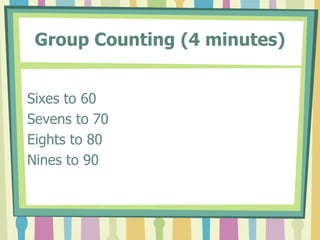
Group Counting (4 minutes)
Sixes to 60
Sevens to 70
Eights to 80
Nines to 90
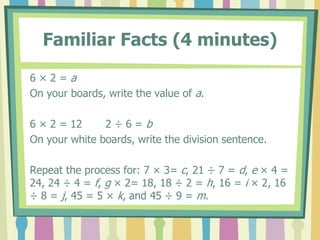
Familiar Facts (4 minutes)
6 × 2 = a
On your boards, write the value of a.
6 × 2 = 12 2 ÷ 6 = b
On your white boards, write the division sentence.
Repeat the process for: 7 × 3= c, 21 ÷ 7 = d, e × 4 =
24, 24 ÷ 4 = f, g × 2= 18, 18 ÷ 2 = h, 16 = i × 2, 16
÷ 8 = j, 45 = 5 × k, and 45 ÷ 9 = m.
Multiply Using the Distributive
Property (4 minutes)
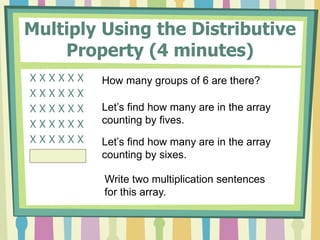
X X X X X X
X X X X X X
X X X X X X
X X X X X X
X X X X X X
X X X X X X
How many groups of 6 are there?
Let’s find how many are in the array
counting by fives.
Let’s find how many are in the array
counting by sixes.
Write two multiplication sentences
for this array.
Multiply Using the Distributive
Property (4 minutes)
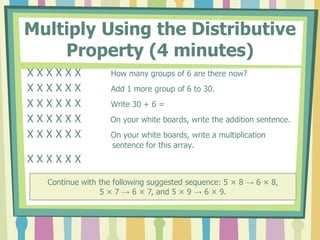
X X X X X X How many groups of 6 are there now?
X X X X X X Add 1 more group of 6 to 30.
X X X X X X Write 30 + 6 =
X X X X X X On your white boards, write the addition sentence.
X X X X X X On your white boards, write a multiplication
sentence for this array.
X X X X X X
Continue with the following suggested sequence: 5 × 8 → 6 × 8,
5 × 7 → 6 × 7, and 5 × 9 → 6 × 9.
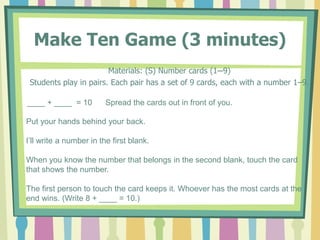
Make Ten Game (3 minutes)
Materials: (S) Number cards (1─9)
Students play in pairs. Each pair has a set of 9 cards, each with a number 1–9.
____ + ____ = 10 Spread the cards out in front of you.
Put your hands behind your back.
I’ll write a number in the first blank.
When you know the number that belongs in the second blank, touch the card
that shows the number.
The first person to touch the card keeps it. Whoever has the most cards at the
end wins. (Write 8 + ____ = 10.)
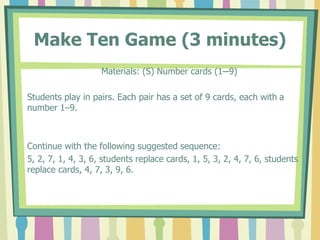
Make Ten Game (3 minutes)
Materials: (S) Number cards (1─9)
Students play in pairs. Each pair has a set of 9 cards, each with a
number 1–9.
Continue with the following suggested sequence:
5, 2, 7, 1, 4, 3, 6, students replace cards, 1, 5, 3, 2, 4, 7, 6, students
replace cards, 4, 7, 3, 9, 6.
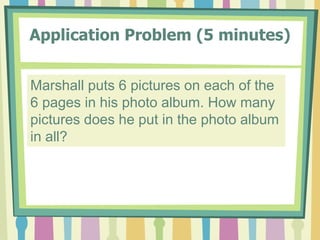
Application Problem (5 minutes)
Marshall puts 6 pictures on each of the
6 pages in his photo album. How many
pictures does he put in the photo album
in all?
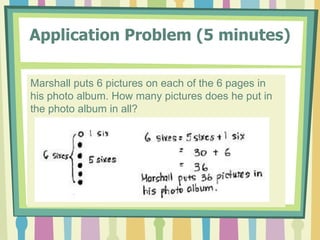
Application Problem (5 minutes)
Marshall puts 6 pictures on each of the 6 pages in
his photo album. How many pictures does he put in
the photo album in all?
Concept Development (30 minutes)
Part 1: Use number bonds to decompose and skip-count using units of 6.
Some of you may have skip-counted by six to get the answer to Marshall’s
problem. When we’re skip-counting by six, how do we get the next number in
our sequence?
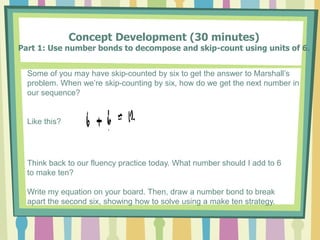
Like this?
Think back to our fluency practice today. What number should I add to 6
to make ten?
Write my equation on your board. Then, draw a number bond to break
apart the second six, showing how to solve using a make ten strategy.
Concept Development (30 minutes)
Part 1: Use number bonds to decompose and skip-count using units of 6.
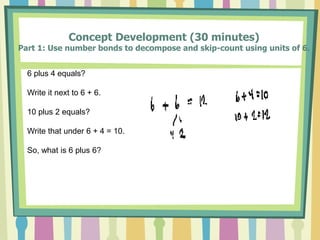
6 plus 4 equals?
Write it next to 6 + 6.
10 plus 2 equals?
Write that under 6 + 4 = 10.
So, what is 6 plus 6?
Concept Development (30 minutes)
Part 1: Use number bonds to decompose and skip-count using units of 6.
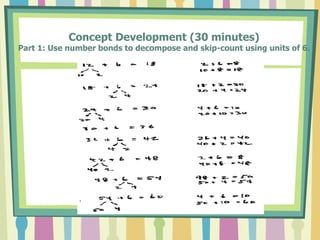
Have students repeat the process for the next two minutes to see how high
they can count by six: 12 + 6 = 18, 18 + 6 = 24, 24 + 6 = 30, 30 + 6 = 36, 36
+6 = 42, 42 + 6 = 48, 48 +6 = 54, 54 + 6 = 60
Concept Development (30 minutes)
Part 1: Use number bonds to decompose and skip-count using units of 6.
What patterns did you notice counting by six?
How did adding 6 and 6 help you add 36 and 6?
How did adding 18 and 6 help you add 48 and 6?
Why is a make ten strategy with number bonds helpful for counting by
sixes?
What other count-bys is it helpful for? Is it helpful for the fives?
Is it helpful for sevens?
Now that we discussed how the make ten strategy makes our skip-counting
sixes more efficient, let’s try it out to solve multiplication and division
problems.
Concept Development (30 minutes)
Part 1: Use number bonds to decompose and skip-count using units of 6.
Concept Development (30 minutes)
Part 2: Use skip-counting sixes to solve multiplication and
division problems.
Skip-count by six 10 times. Write the count-by sequence on your board.
You can also record your addition on your white board.
What is the last number in your sequence?
60 is the same as how many sixes?
Tell a partner what multiplication problem we just solved, then write it on
your white board.
We just used our count by six sequence to help us find that 6 times 10
equals 60.
We can also use skip-counting to solve division problems. Write the last
number in your sequence.
Concept Development (30 minutes)
Part 2: Use skip-counting sixes to solve multiplication and
division problems.
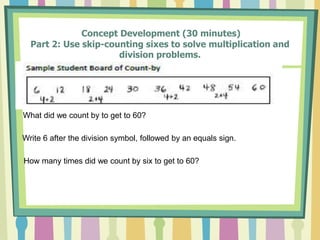
What did we count by to get to 60?
Write 6 after the division symbol, followed by an equals sign.
How many times did we count by six to get to 60?
Concept Development (30 minutes)
Part 2: Use skip-counting sixes to solve multiplication and
division problems.
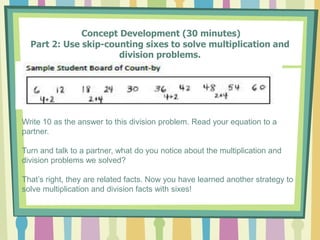
Write 10 as the answer to this division problem. Read your equation to a
partner.
Turn and talk to a partner, what do you notice about the multiplication and
division problems we solved?
That’s right, they are related facts. Now you have learned another strategy to
solve multiplication and division facts with sixes!
Concept Development (30 minutes)
Part 2: Use skip-counting sixes to solve multiplication and
division problems.
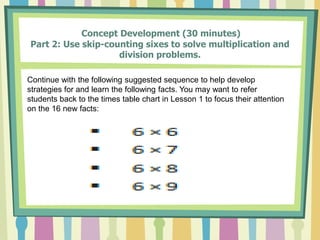
Continue with the following suggested sequence to help develop
strategies for and learn the following facts. You may want to refer
students back to the times table chart in Lesson 1 to focus their attention
on the 16 new facts:
Problem Set (10 minutes)
Student Debrief (10 minutes)
Exit Ticket (3 minutes)
Homework
3-3 Lesson 4
Homework
Is Due Tomorrow!

Math module 3 lesson 4

  • 1.
    Multiplication and Divisionwith Units of 0, 1, 6–9, and Multiples of 10 Module 3: Lesson 4 Objective: Count by units of 6 to multiply and divide using number bonds to decompose.
  • 2.
    Group Counting (4minutes) Sixes to 60 Sevens to 70 Eights to 80 Nines to 90
  • 3.
    Familiar Facts (4minutes) 6 × 2 = a On your boards, write the value of a. 6 × 2 = 12 2 ÷ 6 = b On your white boards, write the division sentence. Repeat the process for: 7 × 3= c, 21 ÷ 7 = d, e × 4 = 24, 24 ÷ 4 = f, g × 2= 18, 18 ÷ 2 = h, 16 = i × 2, 16 ÷ 8 = j, 45 = 5 × k, and 45 ÷ 9 = m.
  • 4.
    Multiply Using theDistributive Property (4 minutes) X X X X X X X X X X X X X X X X X X X X X X X X X X X X X X X X X X X X How many groups of 6 are there? Let’s find how many are in the array counting by fives. Let’s find how many are in the array counting by sixes. Write two multiplication sentences for this array.
  • 5.
    Multiply Using theDistributive Property (4 minutes) X X X X X X How many groups of 6 are there now? X X X X X X Add 1 more group of 6 to 30. X X X X X X Write 30 + 6 = X X X X X X On your white boards, write the addition sentence. X X X X X X On your white boards, write a multiplication sentence for this array. X X X X X X Continue with the following suggested sequence: 5 × 8 → 6 × 8, 5 × 7 → 6 × 7, and 5 × 9 → 6 × 9.
  • 6.
    Make Ten Game(3 minutes) Materials: (S) Number cards (1─9) Students play in pairs. Each pair has a set of 9 cards, each with a number 1–9. ____ + ____ = 10 Spread the cards out in front of you. Put your hands behind your back. I’ll write a number in the first blank. When you know the number that belongs in the second blank, touch the card that shows the number. The first person to touch the card keeps it. Whoever has the most cards at the end wins. (Write 8 + ____ = 10.)
  • 7.
    Make Ten Game(3 minutes) Materials: (S) Number cards (1─9) Students play in pairs. Each pair has a set of 9 cards, each with a number 1–9. Continue with the following suggested sequence: 5, 2, 7, 1, 4, 3, 6, students replace cards, 1, 5, 3, 2, 4, 7, 6, students replace cards, 4, 7, 3, 9, 6.
  • 8.
    Application Problem (5minutes) Marshall puts 6 pictures on each of the 6 pages in his photo album. How many pictures does he put in the photo album in all?
  • 9.
    Application Problem (5minutes) Marshall puts 6 pictures on each of the 6 pages in his photo album. How many pictures does he put in the photo album in all?
  • 10.
    Concept Development (30minutes) Part 1: Use number bonds to decompose and skip-count using units of 6. Some of you may have skip-counted by six to get the answer to Marshall’s problem. When we’re skip-counting by six, how do we get the next number in our sequence? Like this? Think back to our fluency practice today. What number should I add to 6 to make ten? Write my equation on your board. Then, draw a number bond to break apart the second six, showing how to solve using a make ten strategy.
  • 11.
    Concept Development (30minutes) Part 1: Use number bonds to decompose and skip-count using units of 6. 6 plus 4 equals? Write it next to 6 + 6. 10 plus 2 equals? Write that under 6 + 4 = 10. So, what is 6 plus 6?
  • 12.
    Concept Development (30minutes) Part 1: Use number bonds to decompose and skip-count using units of 6. Have students repeat the process for the next two minutes to see how high they can count by six: 12 + 6 = 18, 18 + 6 = 24, 24 + 6 = 30, 30 + 6 = 36, 36 +6 = 42, 42 + 6 = 48, 48 +6 = 54, 54 + 6 = 60
  • 13.
    Concept Development (30minutes) Part 1: Use number bonds to decompose and skip-count using units of 6. What patterns did you notice counting by six? How did adding 6 and 6 help you add 36 and 6? How did adding 18 and 6 help you add 48 and 6? Why is a make ten strategy with number bonds helpful for counting by sixes? What other count-bys is it helpful for? Is it helpful for the fives? Is it helpful for sevens? Now that we discussed how the make ten strategy makes our skip-counting sixes more efficient, let’s try it out to solve multiplication and division problems.
  • 14.
    Concept Development (30minutes) Part 1: Use number bonds to decompose and skip-count using units of 6.
  • 15.
    Concept Development (30minutes) Part 2: Use skip-counting sixes to solve multiplication and division problems. Skip-count by six 10 times. Write the count-by sequence on your board. You can also record your addition on your white board. What is the last number in your sequence? 60 is the same as how many sixes? Tell a partner what multiplication problem we just solved, then write it on your white board. We just used our count by six sequence to help us find that 6 times 10 equals 60. We can also use skip-counting to solve division problems. Write the last number in your sequence.
  • 16.
    Concept Development (30minutes) Part 2: Use skip-counting sixes to solve multiplication and division problems. What did we count by to get to 60? Write 6 after the division symbol, followed by an equals sign. How many times did we count by six to get to 60?
  • 17.
    Concept Development (30minutes) Part 2: Use skip-counting sixes to solve multiplication and division problems. Write 10 as the answer to this division problem. Read your equation to a partner. Turn and talk to a partner, what do you notice about the multiplication and division problems we solved? That’s right, they are related facts. Now you have learned another strategy to solve multiplication and division facts with sixes!
  • 18.
    Concept Development (30minutes) Part 2: Use skip-counting sixes to solve multiplication and division problems. Continue with the following suggested sequence to help develop strategies for and learn the following facts. You may want to refer students back to the times table chart in Lesson 1 to focus their attention on the 16 new facts:
  • 19.
    Problem Set (10minutes) Student Debrief (10 minutes) Exit Ticket (3 minutes)
  • 20.