GRADE 3 ENGLISH TEACHER’S GUIDE 
Unit 3: Week 1 (Lesson 19) 
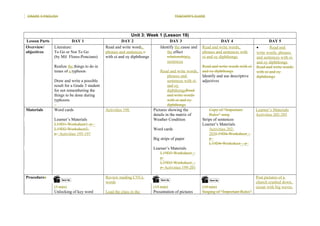
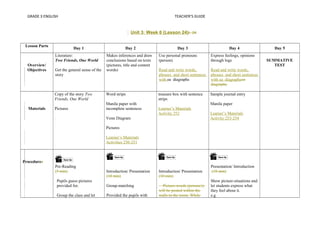
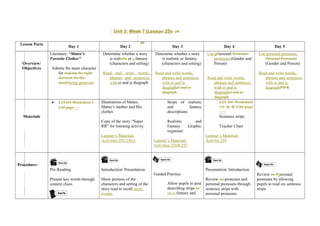
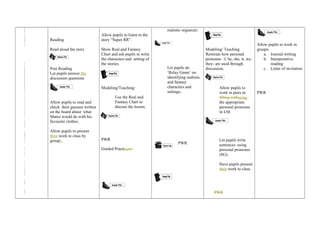
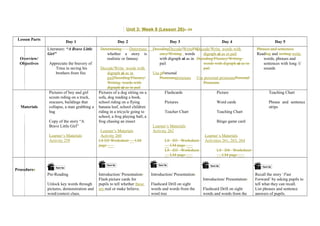
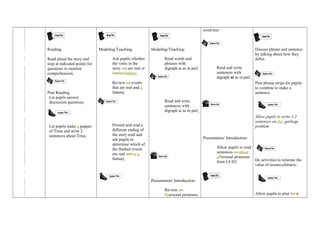
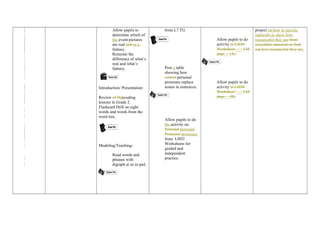
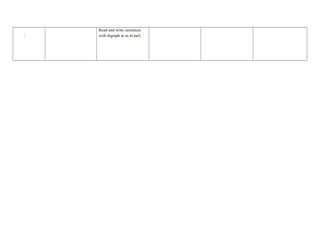
Lesson Parts DAY 1 DAY 2 DAY 3 DAY 4 DAY 5 
Overview/ 
objectives 
Literature: 
To Go or Not To Go 
(by Mil Flores-Ponciano) 
Realize the things to do in 
times of a typhoon. 
Draw and write a possible 
result for a Grade 3 student 
for not remembering the 
things to be done during 
typhoons 
. 
Read and write words, 
phrases and sentences s 
with oi and oy diphthongs 
Identify the cause and 
the effect 
relationshipin 
sentences 
Read and write words, 
phrases and 
sentences with oi 
and oy 
diphthongsRead 
and write words 
with oi and oy 
diphthongs 
Read and write words, 
phrases and sentences with 
oi and oy diphthongs 
Read and write words with oi 
and oy diphthongs 
Identify and use descriptive 
adjectives 
· Read and 
write words, phrases 
and sentences with oi 
and oy diphthongs 
Read and write words 
with oi and oy 
diphthongs 
Materials Word cards 
Learner’s Materials 
L19D1-Worksheet1, p._ 
L19D2-Worksheet2, 
p._Activities 195-197 
Activities 198 Pictures showing the 
details in the matrix of 
Weather Condition 
Word cards 
Big strips of paper 
Learner’s Materials 
L19D3-Worksheet_, 
p_ 
L19D3-Worksheet_, 
p_Activities 199-201 
Copy of “Important 
Rules” song 
Strips of sentences 
Learner’s Materials 
Activities 202- 
203L19D4-Worksheet_, 
p_ 
L19D4-Worksheet_, p_ 
Learner’s Materials 
Activities 202-203 
Procedures 
(3 min) 
Unlocking of key word 
Review reading CVCe 
words 
Lead the class in the 
(15 min) 
Presentation of pictures 
(10 min) 
Singing of “Important Rules” 
Post pictures of a 
church crashed down, 
ocean with big waves.
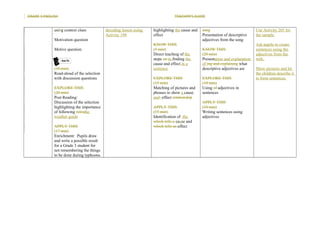
GRADE 3 ENGLISH TEACHER’S GUIDE 
using context clues 
Motivation question 
Motive question 
(10 min) 
Read-aloud of the selection 
with discussion questions 
EXPLORE THIS 
(20 min) 
Post Reading: 
Discussion of the selection 
highlighting the importance 
of following rulesthe 
weather guide 
APPLY THIS 
(17 min) 
Enrichment: Pupils draw 
and write a possible result 
for a Grade 3 student for 
not remembering the things 
to be done during typhoons. 
decoding lesson using 
Activity 198 
highlighting the cause and 
effect 
KNOW THIS 
(5 min) 
Direct teaching of the 
steps on in finding the 
cause and effect in a 
sentence 
EXPLORE THIS 
(15 min) 
Matching of pictures and 
phrases to show a cause 
and- effect relationship 
APPLY THIS 
(15 min) 
Identification of the 
which tells a cause and 
which tells an effect 
song 
Presentation of descriptive 
adjectives from the song 
KNOW THIS 
(20 min) 
Presentation and explanation 
of ing and explaining what 
descriptive adjectives are 
EXPLORE THIS 
(10 min) 
Using of adjectives in 
sentences 
APPLY THIS 
(10 min) 
Writing sentences using 
adjectives 
Use Activity 205 for 
the sample. 
Ask pupils to create 
sentences using the 
adjectives from the 
web. 
Show pictures and let 
the children describe it 
to form sentences.
GRADE 3 ENGLISH TEACHER’S GUIDE 
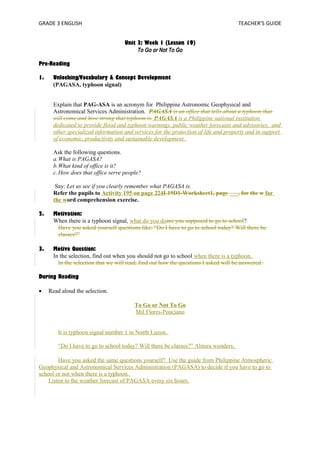
Unit 3: Week 1 (Lesson 19) 
To Go or Not To Go 
Pre-Reading 
1. Unlocking/Vocabulary & Concept Development 
(PAGASA, typhoon signal) 
Explain that PAG-ASA is an acronym for Philippine Astronomic Geophysical and 
Astronomical Services Administration. PAGASA is an office that tells about a typhoon that 
will come and how strong that typhoon is. PAGASA is a Philippine national institution 
dedicated to provide flood and typhoon warnings, public weather forecasts and advisories, and 
other specialized information and services for the protection of life and property and in support 
of economic, productivity and sustainable development. 
Ask the following questions. 
a.What is PAGASA? 
b.What kind of office is it? 
c.How does that office serve people? 
Say: Let us see if you clearly remember what PAGASA is. 
Refer the pupils to Activity 195 on page 224L19D1-Worksheet1, page ___, for the w for 
the word comprehension exercise. 
2. Motivation: 
When there is a typhoon signal, what do you doare you supposed to go to school? 
Have you asked yourself questions like: “Do I have to go to school today? Will there be 
classes?” 
3. Motive Question: 
In the selection, find out when you should not go to school when there is a typhoon. 
In the selection that we will read, find out how the questions I asked will be answered. 
During Reading 
· Read aloud the selection. 
To Go or Not To Go 
Mil Flores-Ponciano 
It is typhoon signal number 1 in North Luzon. 
“Do I have to go to school today? Will there be classes?” Almira wonders. 
Have you asked the same questions yourself? Use the guide from Philippine Atmospheric 
Geophysical and Astronomical Services Administration (PAGASA) to decide if you have to go to 
school or not when there is a typhoon. 
Listen to the weather forecast of PAGASA every six hours.
GRADE 3 ENGLISH TEACHER’S GUIDE 
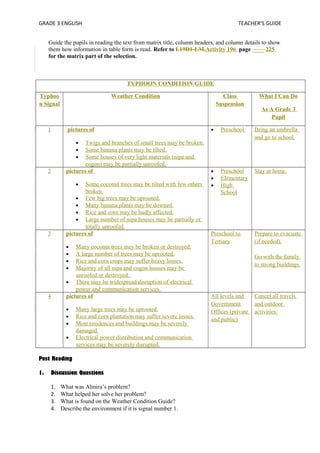
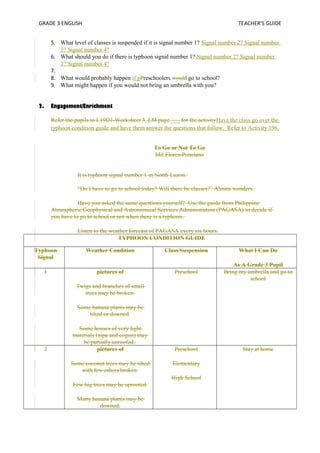
Guide the pupils in reading the text from matrix title, column headers, and column details to show 
them how information in table form is read. Refer to L19D1-LM,Activity 196 page ____ 225 
for the matrix part of the selection. 
TYPHOON CONDITION GUIDE 
Typhoo 
n Signal 
Weather Condition Class 
Suspension 
What I Can Do 
As A Grade 3 
Pupil 
1 pictures of 
· Twigs and branches of small trees may be broken. 
· Some banana plants may be tilted. 
· Some houses of very light materials (nipa and 
cogon) may be partially unroofed. 
· Preschool Bring an umbrella 
and go to school. 
2 pictures of 
· Some coconut trees may be tilted with few others 
broken. 
· Few big trees may be uprooted. 
· Many banana plants may be downed. 
· Rice and corn may be badly affected. 
· Large number of nipa houses may be partially or 
totally unroofed. 
· Preschool 
· Elementary 
· High 
School 
Stay at home. 
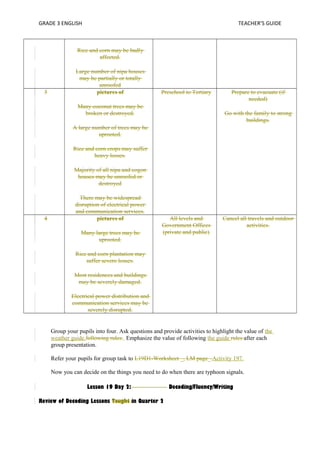
3 pictures of 
· Many coconut trees may be broken or destroyed. 
· A large number of trees may be uprooted. 
· Rice and corn crops may suffer heavy losses. 
· Majority of all nipa and cogon houses may be 
unroofed or destroyed. 
· There may be widespread disruption of electrical 
power and communication services. 
Preschool to 
Tertiary 
Prepare to evacuate 
(if needed). 
Go with the family 
to strong buildings. 
4 pictures of 
· Many large trees may be uprooted. 
· Rice and corn plantation may suffer severe losses. 
· Most residences and buildings may be severely 
damaged. 
· Electrical power distribution and communication 
services may be severely disrupted. 
All levels and 
Government 
Offices (private 
and public) 
Cancel all travels 
and outdoor 
activities. 
Post Reading 
1. Discussion Questions 
1. What was Almira’s problem? 
2. What helped her solve her problem? 
3. What is found on the Weather Condition Guide? 
4. Describe the environment if it is signal number 1.
GRADE 3 ENGLISH TEACHER’S GUIDE 
5. What level of classes is suspended if it is signal number 1? Signal number 2? Signal number 
3? Signal number 4? 
6. What should you do if there is typhoon signal number 1? Signal number 2? Signal number 
3? Signal number 4? 
7. 
8. What would probably happen if pPreschoolers would go to school? 
9. What might happen if you would not bring an umbrella with you? 
2. Engagement/Enrichment 
Refer the pupils to L19D1-Worksheet 3, LM page ___ for the activityHave the class go over the 
typhoon condition guide and have them answer the questions that follow. Refer to Activity 196. 
To Go or Not To Go 
Mil Flores-Ponciano 
It is typhoon signal number 1 in North Luzon. 
“Do I have to go to school today? Will there be classes?” Almira wonders. 
Have you asked the same questions yourself? Use the guide from Philippine 
Atmospheric Geophysical and Astronomical Services Administration (PAGASA) to decide if 
you have to go to school or not when there is a typhoon. 
Listen to the weather forecast of PAGASA every six hours. 
TYPHOON CONDITION GUIDE 
Typhoon 
Signal 
Weather Condition Class Suspension What I Can Do 
As A Grade 3 Pupil 
1 pictures of 
Twigs and branches of small 
trees may be broken. 
Some banana plants may be 
tilted or downed. 
Some houses of very light 
materials (nipa and cogon) may 
be partially unroofed.. 
Preschool Bring my umbrella and go to 
school 
2 pictures of 
Some coconut trees may be tilted 
with few others broken. 
Few big trees may be uprooted. 
Many banana plants may be 
downed. 
Preschool 
Elementary 
High School 
Stay at home
GRADE 3 ENGLISH TEACHER’S GUIDE 
Rice and corn may be badly 
affected. 
Large number of nipa houses 
may be partially or totally 
unroofed 
3 pictures of 
Many coconut trees may be 
broken or destroyed. 
A large number of trees may be 
uprooted. 
Rice and corn crops may suffer 
heavy losses. 
Majority of all nipa and cogon 
houses may be unroofed or 
destroyed 
There may be widespread 
disruption of electrical power 
and communication services. 
Preschool to Tertiary Prepare to evacuate (if 
needed) 
Go with the family to strong 
buildings. 
4 pictures of 
Many large trees may be 
uprooted. 
Rice and corn plantation may 
suffer severe losses. 
Most residences and buildings 
may be severely damaged. 
Electrical power distribution and 
communication services may be 
severely disrupted. 
All levels and 
Government Offices 
(private and public) 
Cancel all travels and outdoor 
activities. 
Group your pupils into four. Ask questions and provide activities to highlight the value of the 
weather guide.following rules. Emphasize the value of following the guide rules after each 
group presentation. 
Refer your pupils for group task to L19D1-Worksheet _, LM page_.Activity 197. 
Now you can decide on the things you need to do when there are typhoon signals. 
Lesson 19 Day 2: Decoding/Fluency/Writing 
Review of Decoding Lessons Taught in Quarter 2
GRADE 3 ENGLISH TEACHER’S GUIDE 
These include CVCe words with long a, e, Ii, o, and u sounds ending in silent e from Quarter 2 and 
the Grade 1 levels of the Dolch Basic Sight Word List. The exercises in this lesson sometimes include 
vocabulary words learned in the literature lesson in Day 1.) 
Skill Lesson: Words with oi and oy diphthongs 
Refer your pupils to L19D2-Worksheet _, LM page_.Activity 198. 
Lesson 19 Day 3: Identifying a Cause and Effect Relationship 
Skill Lesson: Using Descriptive Words 
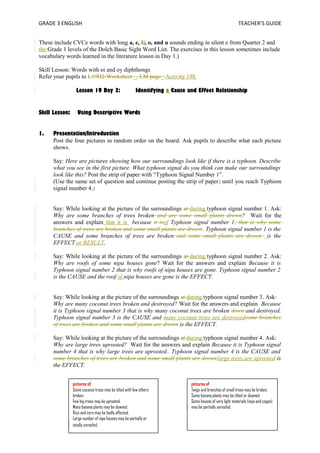
1. Presentation/Introduction 
Post the four pictures in random order on the board. Ask pupils to describe what each picture 
shows. 
Say: Here are pictures showing how our surroundings look like if there is a typhoon. Describe 
what you see in the first picture. What typhoon signal do you think can make our surroundings 
look like this? Post the strip of paper with “Typhoon Signal Number 1”. 
(Use the same set of question and continue posting the strip of paper) until you reach Typhoon 
signal number 4.) 
Say: While looking at the picture of the surroundings at during typhoon signal number 1. Ask: 
Why are some branches of trees broken and are some small plants drown? Wait for the 
answers and explain that it is because it isof Typhoon signal number 1, that is why some 
branches of trees are broken and some small plants are drown. Typhoon signal number 1 is the 
CAUSE and some branches of trees are broken and some small plants are drown is the 
EFFECT or RESULT. 
Say: While looking at the picture of the surroundings at during typhoon signal number 2. Ask: 
Why are roofs of some nipa houses gone? Wait for the answers and explain Because it is 
Typhoon signal number 2 that is why roofs of nipa houses are gone. Typhoon signal number 2 
is the CAUSE and the roof of nipa houses are gone is the EFFECT. 
Say: While looking at the picture of the surroundings at during typhoon signal number 3. Ask: 
Why are many coconut trees broken and destroyed? Wait for the answers and explain Because 
it is Typhoon signal number 3 that is why many coconut trees are broken down and destroyed. 
Typhoon signal number 3 is the CAUSE and many coconut trees are destroyedsome branches 
of trees are broken and some small plants are drown is the EFFECT. 
Say: While looking at the picture of the surroundings at during typhoon signal number 4. Ask: 
Why are large trees uprooted? Wait for the answers and explain Because it is Typhoon signal 
number 4 that is why large trees are uprooted.. Typhoon signal number 4 is the CAUSE and 
some branches of trees are broken and some small plants are drownlarge trees are uprooted is 
the EFFECT. 
pictures of 
Some coconut trees may be tilted with few others 
broken. 
Few big trees may be uprooted. 
Many banana plants may be downed. 
Rice and corn may be badly affected. 
Large number of nipa houses may be partially or 
totally unroofed. 
pictures of 
Twigs and branches of small trees may be broken. 
Some banana plants may be tilted or downed. 
Some houses of very light materials (nipa and cogon) 
may be partially unroofed.
GRADE 3 ENGLISH TEACHER’S GUIDE 
pictures of 
Many large trees may be uprooted. 
Rice and corn plantation may suffer severe losses. 
Most residences and buildings may be severely 
damaged. 
Electrical power distribution and communication 
services may be severely disrupted. 
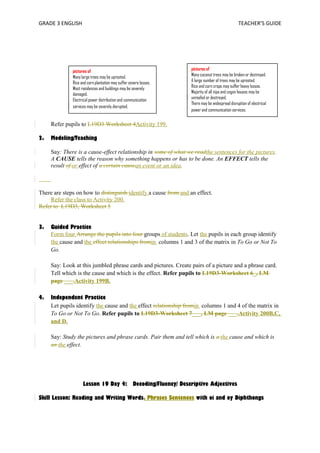
Refer pupils to L19D3 Worksheet 4Activity 199. 
2. Modeling/Teaching 
pictures of 
Many coconut trees may be broken or destroyed. 
A large number of trees may be uprooted. 
Rice and corn crops may suffer heavy losses. 
Majority of all nipa and cogon houses may be 
unroofed or destroyed. 
There may be widespread disruption of electrical 
power and communication services. 
Say: There is a cause-effect relationship in some of what we readthe sentences for the pictures. 
A CAUSE tells the reason why something happens or has to be done. An EFFECT tells the 
result of or effect of a certain causean event or an idea. 
There are steps on how to distinguish identify a cause from and an effect. 
Refer the class to Activity 200. 
Refer to L19D3, Worksheet 5 
3. Guided Practice 
Form four Arrange the pupils into four groups of students. Let the pupils in each group identify 
the cause and the effect relationships fromin columns 1 and 3 of the matrix in To Go or Not To 
Go. 
Say: Look at this jumbled phrase cards and pictures. Create pairs of a picture and a phrase card. 
Tell which is the cause and which is the effect. Refer pupils to L19D3-Worksheet 6_, LM 
page ___.Activity 199B. 
4. Independent Practice 
Let pupils identify the cause and the effect relationship fromin columns 1 and 4 of the matrix in 
To Go or Not To Go. Refer pupils to L19D3-Worksheet 7___, LM page ___.Activity 200B,C, 
and D. 
Say: Study the pictures and phrase cards. Pair them and tell which is a the cause and which is 
an the effect. 
Lesson 19 Day 4: Decoding/Fluency/ Descriptive Adjectives 
Skill Lesson: Reading and Writing Words, Phrases Sentences with oi and oy Diphthongs
GRADE 3 ENGLISH TEACHER’S GUIDE 
Skill Lesson: Words with oi and oy diphthongs 
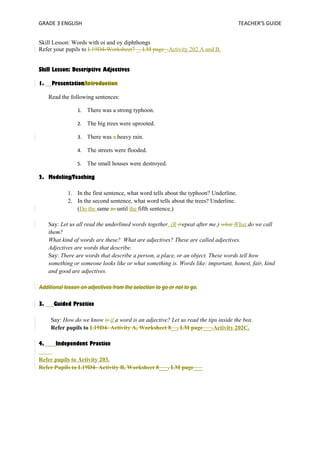
Refer your pupils to L19D4-Worksheet7 _, LM page_.Activity 202 A and B. 
Skill Lesson: Descriptive Adjectives 
1. Presentation/Introduction 
Read the following sentences: 
1. There was a strong typhoon. 
2. The big trees were uprooted. 
3. There was a heavy rain. 
4. The streets were flooded. 
5. The small houses were destroyed. 
2. Modeling/Teaching 
1. In the first sentence, what word tells about the typhoon? Underline. 
2. In the second sentence, what word tells about the trees? Underline. 
(Do the same as until the fifth sentence.) 
Say: Let us all read the underlined words together. (R (repeat after me.) what What do we call 
them? 
What kind of words are these? What are adjectives? These are called adjectives. 
Adjectives are words that describe. 
Say: There are words that describe a person, a place, or an object. These words tell how 
something or someone looks like or what something is. Words like: important, honest, fair, kind 
and good are adjectives. 
Additional lesson on adjectives from the selection to go or not to go. 
3. Guided Practice 
Say: How do we know is if a word is an adjective? Let us read the tips inside the box. 
Refer pupils to L19D4- Activity A, Worksheet 8__, LM page___.Activity 202C. 
4. Independent Practice 
Refer pupils to Activity 203. 
Refer Pupils to L19D4- Activity B, Worksheet 8___, LM page___
GRADE 3 ENGLISH TEACHER’S GUIDE 
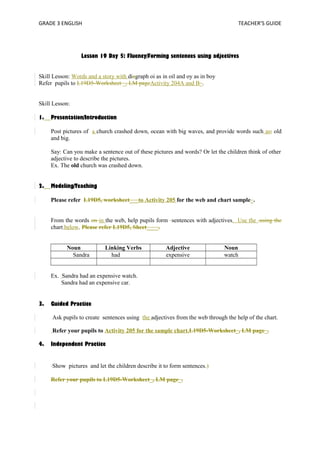
Lesson 19 Day 5: Fluency/Forming sentences using adjectives 
Skill Lesson: Words and a story with diagraph oi as in oil and oy as in boy 
Refer pupils to L19D5-Worksheet _, LM pageActivity 204A and B_. 
Skill Lesson: 
1. Presentation/Introduction 
Post pictures of a church crashed down, ocean with big waves, and provide words such as; old 
and big. 
Say: Can you make a sentence out of these pictures and words? Or let the children think of other 
adjective to describe the pictures. 
Ex. The old church was crashed down. 
2. Modeling/Teaching 
Please refer L19D5, worksheet___to Activity 205 for the web and chart sample_. 
From the words on in the web, help pupils form sentences with adjectives. Use the .using the 
chart below. Please refer L19D5, Sheet____. 
Noun Linking Verbs Adjective Noun 
Sandra had expensive watch 
Ex. Sandra had an expensive watch. 
Sandra had an expensive car. 
3. Guided Practice 
Ask pupils to create sentences using the adjectives from the web through the help of the chart. 
Refer your pupils to Activity 205 for the sample chart.L19D5-Worksheet_, LM page_. 
4. Independent Practice 
Show pictures and let the children describe it to form sentences.) 
Refer your pupils to L19D5-Worksheet_, LM page_.
GRADE 3 ENGLISH TEACHER’S GUIDE
GRADE 3 ENGLISH TEACHER’S GUIDE 
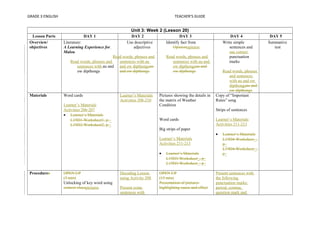
Unit 3: Week 2 (Lesson 20) 
Lesson Parts DAY 1 DAY 2 DAY 3 DAY 4 DAY 5 
Overview/ 
objectives 
Literature: 
A Learning Experience for 
Malou 
Read words, phrases and 
sentences with au and 
ow dipthongs 
Use descriptive 
adjectives 
Read words, phrases and 
sentences with au 
and ow dipthongsau 
and ow dipthongs 
Identify fact from 
Opinionopinion 
Read words, phrases and 
sentences with au and 
ow dipthongsau and 
ow dipthongs 
Write simple 
sentences and 
use correct 
punctuation 
marks 
Read words, phrases 
and sentences 
with au and ow 
dipthongsau and 
ow dipthongs 
Summative 
test 
Materials Word cards 
Learner’s Materials 
Activities 206-207 
· Learner’s Materials 
L19D1-Worksheet1, p._ 
L19D2-Worksheet2, p._ 
Learner’s Materials 
Activities 208-210 
Pictures showing the details in 
the matrix of Weather 
Condition 
Word cards 
Big strips of paper 
Learner’s Materials 
Activities 211-213 
· Learner’s Materials 
L19D3-Worksheet_, p_ 
Copy of “Important 
Rules” song 
Strips of sentences 
Learner’s Materials 
Activities 211-213 
· Learner’s Materials 
L19D4-Worksheet_, 
p_ 
L19D4-Worksheet_, 
p_ 
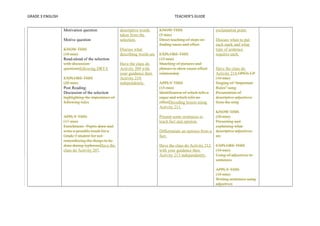
Procedures OPEN UP 
(3 min) 
Unlocking of key word using 
context cluespictures 
Decoding Lesson 
using Activity 208 
Present some 
sentences with 
OPEN UP 
(15 min) 
Presentation of pictures 
highlighting cause and effect 
Present sentences with 
the following 
punctuation marks: 
period, comma, 
question mark and
GRADE 3 ENGLISH TEACHER’S GUIDE 
Motivation question 
Motive question 
KNOW THIS 
(10 min) 
Read-aloud of the selection 
with discussion 
questionsfollowing DRTA 
EXPLORE THIS 
(20 min) 
Post Reading: 
Discussion of the selection 
highlighting the importance of 
following rules 
APPLY THIS 
(17 min) 
Enrichment: Pupils draw and 
write a possible result for a 
Grade 3 student for not 
remembering the things to be 
done during typhoonsHave the 
class do Activity 207. 
descriptive words 
taken from the 
selection. 
Discuss what 
describing words are 
Have the class do 
Activity 209 with 
your guidance then 
Activity 210 
independently. 
KNOW THIS 
(5 min) 
Direct teaching of steps on 
finding cause and effect 
EXPLORE THIS 
(15 min) 
Matching of pictures and 
phrases to show cause-effect 
relationship 
APPLY THIS 
(15 min) 
Identification of which tells a 
cause and which tells an 
effectDecoding lesson using 
Activity 211. 
Present some sentences to 
teach fact and opinion. 
Differentiate an opinion from a 
fact. 
Have the class do Activity 212 
with your guidance then 
Activity 213 independently. 
exclamation point. 
Discuss when to put 
each mark and what 
type of sentence 
requires each. 
Have the class do 
Activity 214.OPEN UP 
(10 min) 
Singing of “Important 
Rules” song 
Presentation of 
descriptive adjectives 
from the song 
KNOW THIS 
(20 min) 
Presenting and 
explaining what 
descriptive adjectives 
are 
EXPLORE THIS 
(10 min) 
Using of adjectives in 
sentences 
APPLY THIS 
(10 min) 
Writing sentences using 
adjectives
GRADE 3 ENGLISH TEACHER’S GUIDE
GRADE 3 ENGLISH TEACHER’S GUIDE 
Unit 3: Week 2 (Lesson 20) 
A Learning Experience for Malou 
Pre-Reading 
1. Unlocking/Vocabulary and Concept Development 
(freedom, patriotic, symbol) 
Show a picture of a dove. Say: This is a dove. It symbolizes peace. Dove is a symbol for 
peace. Show a cut-out of a heart. Say: This is a heart. It symbolizes Valentine’s Day. The cut-out 
of a heart is a symbol. A symbol is a thing that represents or stands for something else, 
especially a material object representing something abstract. Who can give me another symbol 
that you can see in our classroom or outside? 
Call a child in front of the class. (Before he says something, tell the child that he can only do or 
say something that is good in front of the class.) Say to the child: Do whatever you want but 
see see to it you don’t harm other children in the class or destroy the things inside the class. He 
can do whatever he wants that do not harm other people and property because he has freedom. 
Freedom is the power or right to act, speak, or think as one wants without hindrance or 
restraint. 
Show pictures of Philippine heroes. Say: Our heroes are patriotic. They fought for our 
country. Singing Lupang Hinirang with respect is a sign that you are patriotic. A person is 
patriotic if he expresses strong love for his country. Are you patriotic? How else do you show 
it?Unlock the vocabulary words found in the text using context clues. 
Refer the pupils to L20D1-Worksheet_1, LM pageActivity 206__ for the Vocabulary 
vocabulary Developmentdevelopment check up. 
2. Motivation Question: 
Describe how our Philippine flag looks like. What do the colors mean? 
3. Motive Question: 
What do the colors of our national flag mean? 
During Reading 
1. Read aloud the story using DRTA to let the pupils predict as they read along the story. 
A LEARNING EXPERIENCE FOR MALOU 
By: Dinah C. Bonao 
Malou came home from school. She was very happy. 
“You look so happy.” Mother noticed. “How was school?,” she added. 
“It was fine, Mom. I learned many things in school today. I learned that a flag is a national
GRADE 3 ENGLISH TEACHER’S GUIDE 
symbol. It represents our country,” replied Malou. 
“ Yes, the Philippine flag is one of the most beautifully designed flags in the world,” said 
Mother. 
“Our flag is made up of three colors. These are blue, red and white with a golden yellow 
sun. The sun has eight rays. These stand for the eight provinces that fought for the freedom of the 
country. It has also three stars representing the three major islands of the country—Luzon,Visayas 
and Mindanao,” said Malou. 
Father added, “We Filipinos should respect our flag. Doing so shows that we love our 
country.” 
“Yes! I think Filipinos are the most patriotic people in the world. We are willing to give up 
our lives for the Philippines,” Mother explained. 
“ That’s right, Father. That is why I make sure that I always show my love to for our 
country,” Malou said proudly. 
Post- Reading 
Discussion Questions 
1. Who is the girl in the story? 
2. What did she learn? W why she was she so happy in school? 
3. What do the sun’s eight rays stand for? 
4. What do the three stars represent? 
5. Why are Filipinos considered as patriotic people? 
4. Give three ways on how to show respect for our flag. 
5. How can you show your love and concern to for your country? 
Engagement Activity 
Refer the pupils to L20D1-Worksheet__, LM page__ for the Engagement Activityto Activity 
207. 
Lesson 20 Day 2: Decoding/Fluency/Writing/ Descriptive Adjectives 
Skill Lesson: Words and Sentences with au and ow aw diphthongs 
Refer your pupils to Activity 208L20D2-Worksheet _, LM page_. 
Skill Lesson: Using Descriptive Adjectives 
1. Presentation/Introduction 
Present the following sentence strips taken from the selection read. 
Describe the bag of Almira. Her bag 
is _______. ( square) 
1. Almira has a square bag.
GRADE 3 ENGLISH TEACHER’S GUIDE 
2. Modeling/ Teaching 
(Note: Ask the pupils to underline the descriptive words or words that describe. Draw out from 
them that these words are adjectives. Pupils should be able to explain further that adjectives 
describe a noun or a pronoun which show their color and shape. Give more examples of 
descriptive adjectives.) 
Ask: What are adjectives? (describing words) 
Process this sentence by sentence: 
1. In sentence 1, how does the adjective describe the bag?(by telling about it’s shape) 
2. In sentence 2, how does the adjective describe the stars?(by telling about their color) 
Sentence 3, 4, 5, 
What words does an adjective describe? (noun or pronoun) 
The girl is wearing a red dress. 
Mother bakes five cupcakes. 
Describe the stars on our flag. 
( yellow) 
What are the colors of our flag? 
(blue, red and white) 
What shape is our flag? 
(rectangularle) 
What word describes the white part of 
our flag? ( triangularle) 
2. The Philippine flag has yellow 
stars. 
3. Blue, red and white are the 
three colors of our flag. 
4. The Philippine flag is 
rectangularle. 
5. The white part of our flag is 
triangularle.
GRADE 3 ENGLISH TEACHER’S GUIDE 
I have a new toy. 
3. Guided Practice 
Refer your pupils to L20D2 Worksheet ___, LM page___ 
Say: Activity 209. 
4. Independent Practice 
Refer your pupils to Activity 210. 
Refer your pupils to L20D2 Worksheet ___, LM page___ 
Say: 
Lesson 20 Day 3: Decoding/Fluency/Writing/ Fact and Opinion 
Skill Lesson: Sentences with au and aw diphthongs 
Refer your pupils to LM Activity 211.20D3-Worksheet _, LM page_. 
Skill Lesson: Fact and Opinion 
1. Presentation/ Introduction 
Present the following sentences on the board. 
1. The Philippine flag is made up of three colors. 
2. There are three major islands in our country. 
3. The Philippine flag is one of the most beautifully designed flags in the world. 
4. Ms. Almira Santos thinks that Filipinos are all very patriotic people. 
5. Fr. Cruz believes that the Philippines is a peaceful country. 
2. Modeling/ Teaching 
Ask: 
What do you notice with the first two sentences? 
Does it tell something that the truth? Is itis already proven and accepted by everyone? 
What do you notice with the third, fourth and fifth sentences?
GRADE 3 ENGLISH TEACHER’S GUIDE 
Does it show judgment, feeling or attitude about someone or something? 
What word/s in the sentence gives a clue that it is a thought or judgment? 
Say: A sentence states a fact if it can truly happen and it can be proven. 
A sentence states an opinion if it can happen only in the mind of a 
person and it cannot be proven to be true. The words “I think, I believe, in my opinion, 
etc. signals an opinion statement. 
Guide the pupils to make this generalization at the end of Modeling/ Teaching and before the 
Guided Practice. Give more examples of fact and opinion statements.) 
3. Guided Practice: 
Refer your pupils to L20D3: Worksheet__: LM page__Activity 212. 
Say: 
4. Independent Practice: 
Refer your pupils to L20D3: Worksheet__: LM page__ 
Say: 
Refer your pupils to Activity 213. 
Lesson 20 DAY 4: Writing Simple Sentences and Punctuation Marks 
1. Introduction/ Presentation/Modeling 
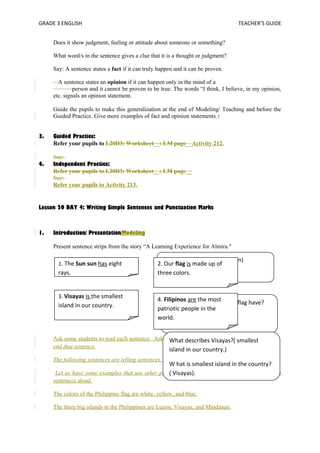
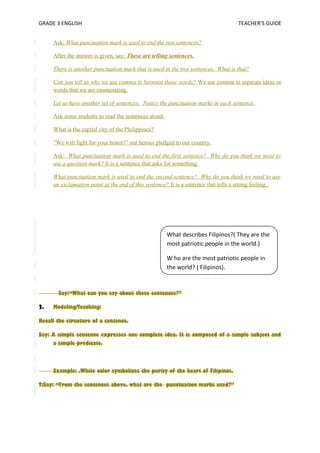
Present sentence strips from the story “A Learning Experience for Almira." 
1. The Sun sun has eight 
rays. 
What has eight rays? ( the sun) 
2. Our flag is made up of 
three colors. 
4. Filipinos are the most 
patriotic people in the 
world. 
How many colors does our flag have? 
3. Visayas is the smallest 
island in our country. 
Ask some students to read each sentence. Ask after What each describes reading: Visayas?( What punctuation smallest 
is used to 
end that sentence. 
island in our country.) 
The following sentences are telling sentences. We use a period to end each sentence. 
W hat is smallest island in the country? 
Let us have some examples that use other punctuation ( Visayas). 
marks. Ask some students to read the 
sentences aloud. 
The colors of the Philippine flag are white, yellow, and blue. 
The three big islands in the Philippines are Luzon, Visayas, and Mindanao.
GRADE 3 ENGLISH TEACHER’S GUIDE 
Ask: What punctuation mark is used to end the two sentences? 
After the answer is given, say: These are telling sentences. 
There is another punctuation mark that is used in the two sentences. What is that? 
Can you tell us why we use comma in between those words? We use comma to separate ideas or 
words that we are enumerating. 
Let us have another set of sentences. Notice the punctuation marks in each sentence. 
Ask some students to read the sentences aloud. 
What is the capital city of the Philippines? 
“We will fight for your honor!” our heroes pledged to our country. 
Ask: What punctuation mark is used to end the first sentence? Why do you think we need to 
use a question mark? It is a sentence that asks for something. 
What punctuation mark is used to end the second sentence? Why do you think we need to use 
an exclamation point at the end of this sentence? It is a sentence that tells a strong feeling.. 
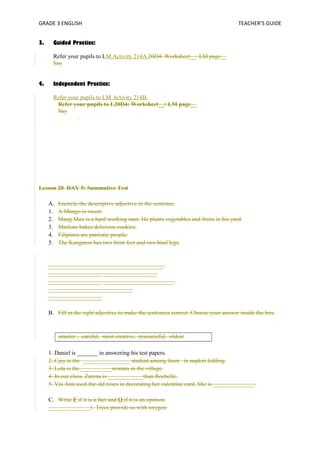
What describes Filipinos?( They are the 
most patriotic people in the world.) 
W ho are the most patriotic people in 
the world? ( Filipinos). 
Say:“What can you say about these sentences?” 
2. Modeling/Teaching: 
Recall the structure of a sentence. 
Say: A simple sentence expresses one complete idea. It is composed of a simple subject and 
a simple predicate. 
Example: .White color symbolizes the purity of the heart of Filipinos. 
T:Say: “From the sentences above, what are the punctuation marks used?”
GRADE 3 ENGLISH TEACHER’S GUIDE 
3. Guided Practice: 
Refer your pupils to LM Activity 214A.20D4: Worksheet__: LM page__ 
Say 
4. Independent Practice: 
Refer your pupils to LM Activity 214B. 
Refer your pupils to L20D4: Worksheet__: LM page__ 
Say 
Lesson 20 DAY 5: Summative Test 
A. Encircle the descriptive adjective in the sentence. 
1. A Mango is sweet. 
2. Mang Max is a hard working man. He plants vegetables and fruits in his yard. 
3. Marlene bakes delicious cookies. 
4. Filipinos are patriotic people. 
5. The Kangaroo has two front feet and two hind legs. 
_______________________________________ 
__________________ __________________ 
__________________ ________________________ 
____________________________. 
__________________ 
B. Fill in the right adjective to make the sentences correct. Choose your answer inside the box. 
smarter , careful, most creative, resourceful, oldest 
1. Daniel is _______ in answering his test papers. 
2. Cjay is the ________________ student among them in napkin folding. 
3. Lola is the___________woman in the village. 
4. In our class, Zarena is ____________than Rochelle. 
5. Via Ann used the old roses in decorating her valentine card. She is ______________. 
C. Write F if it is a fact and O if it is an opinion. 
______________1. Trees provide us with oxygen.
GRADE 3 ENGLISH TEACHER’S GUIDE 
______________2. Girls are more studious than the boys. 
______________3. Visayas is the smallest island in the Philippines. 
______________4. I think my father is the best dad in the whole world. 
______________5. Ghosts do exist. 
D. Write a three-sentence paragraph describing about your bestfriend. Use the correct punctuation 
marks. 
___________________________________________________________________ 
___________________________________________________________________ 
___________________________________________________________________ 
___________________________________________________________________ 
___________________________________________________________________ 
___________________
GRADE 3 ENGLISH TEACHER’S GUIDE 
Unit 3: Week 3 (Lesson 21) 
Lesson Parts DAY 1 DAY 2 DAY 3 DAY 4 DAY 5 
Overview/ 
objectives 
Literature: 
The Monster Who Came to 
School 
Realize the importance 
of following school 
rules 
Act outRole play the 
importance of 
following school 
rules 
Distinguish the a cause 
from an effect 
Read and write words 
with ou and ow 
diphthongs 
Identify and use 
adjectives in 
comparative degree 
Read and write words 
with ou and ow 
diphthongs 
Identifying simple 
and 
compound 
sentences 
Read words, 
phrases and 
story with ou 
and ow 
diphthongs 
Forming 
compound 
sentences 
sentences 
Read and write 
words, 
pharses and 
sentences 
with ou and 
ow 
diphthongs 
Materials Words in envelopes 
Detective Sinegata Chart 
Word cards 
Learner’s Materials 
Activities 215-216 
L21D1-Worksheet_ 
p_ 
C and E chart 
Sentence strips 
Learner’s Materials 
Activities 217-218 
L21D2-Worksheet_ p_ 
L21D2-Worksheet_ p_ 
L21D2-Worksheet_ p_ 
L21D2-Worksheet_ p_ 
L21D2-Worksheet_ p_ 
C and E chart 
Learner’s Materials 
Activities 219-221 
L21D3-Worksheet_ p_ 
L21D3-Worksheet_ p_ 
Worksheet_ p_ 
L21D4-Worksheet_ p_ 
Worksheet_ p_ 
L21D3-Worksheet_ p_ 
Worksheet_ p_ 
L21D3-Worksheet_ p_ 
Worksheet_ p_ 
L21D3-Worksheet_ p_ 
Worksheet_ p_ 
L21D3-Worksheet_ p_ 
Worksheet_ p_ 
L21D3-Worksheet_ p_ 
Sentence chart 
Learner’s Materials 
Activities 222-224 
L21D4- 
Worksheet_ p_ 
L21D4- 
Worksheet_ p_ 
Worksheet_ p_ 
L21D4- 
Worksheet_ p_ 
Worksheet_ p_ 
L21D4- 
Worksheet_ p_ 
Worksheet_ p_ 
L21D4- 
Worksheet_ p_ 
C and E chart 
Pictures 
Learner’s Materials 
Activities 225-227 
L21D5- 
Worksheet_ p_ 
L21D5- 
Worksheet_ p_
GRADE 3 ENGLISH TEACHER’S GUIDE 
Procedures OPEN UP 
(10 min) 
Unlocking of key words 
using the Think-Go-Stop 
Game 
Motivation question 
Motive question 
KNOW THIS 
(10 min) 
Read-aloud of the selection 
using DRTA 
EXPLORE THIS 
(15 min) 
Post Reading: 
Discussion of the selection 
highlighting the importance 
of school rules 
APPLY THIS 
(15 min) 
Enrichment: Act ouRole 
play t the importance of 
following school rules. 
OPEN UP 
(10 min) 
Presentation of sentences 
through the Say-Do-Don’t – 
Game 
KNOW THIS 
(10 min) 
Direct teaching of to 
distinguishing a cause from 
an effect 
EXPLORE THIS 
(15 min) 
Group Activity: 
Students have to distinguish 
which sentence is a cause 
and an effect 
APPLY THIS 
(15 min) 
Group Activity: 
Students have to complete 
the matrixa chart of school 
rules and effects if we break 
them. 
OPEN UP 
(10 min) 
Presentation of pictures 
highlighting cause and effect 
KNOW THIS 
(10 min) 
Direct teaching of steps on 
how to identify findingthe 
cause and effect in a sentence 
EXPLORE THIS 
(15 min) 
Matching of pictures and d 
phrases to show a cause-effect 
relationship 
APPLY THIS 
(15 min) 
Cause and Effect sentence 
identification 
OPEN UP 
(10 min) 
Presentation of a chart 
to show simple and 
compound sentences 
KNOW THIS 
(20 min) 
Presentation ing and 
explainationing of 
how compound 
sentences are is 
formed 
EXPLORE THIS 
(10 min) 
Combining simple 
sentences to form 
compound sentences 
APPLY THIS 
(10 min) 
Completing a chart 
with compound 
sentences 
OPEN UP 
(10 min) 
Completion of a 
table showing 
cartoon and 
sentences about the 
importance of 
following school 
rules 
KNOW THIS 
(10 min) 
Direct teaching of 
determining an 
effect based on a 
given cause 
EXPLORE THIS 
(15 min) 
Writing an effect 
based on a given 
cause 
APPLY THIS 
(15 min) 
Writing an effect 
based on a given 
cause
GRADE 3 ENGLISH TEACHER’S GUIDE
GRADE 3 ENGLISH TEACHER’S GUIDE 
Unit 3: Week 3 (Lesson 21) 
The Monster Who Came To School 
Pre-Reading 
1. Unlocking/Vocabulary & Concept Development 
Say: Let us be energized by playing the HAND-MIND WORD game. Say R U L E S. All R, U, 
L ,E , S will form the groups. 
(Note: Each group will be given five (5) sets of jumbled letters inside the envelope. The sets of 
letters are numbered from one to seven. If you hear the word THINK, listen for the clues 
about the word. If you hear the word GO -start arranging the letters and if you hear the word 
STOP- say the word.) 
Ask the class to get the first envelop. Tell them to get the letters inside the envelop. Say: The 
word starts with a “g” and ends with a “d”. This is the hint. Look at me. (Grab something in 
the table.) What did I do? Form the word GO. Give the group at least one minute to form the 
word, then say STOP. Ask the group one after the other to say the word that they formed. Go 
around to check their output. Put the first word in the web. 
Follow the procedure. Here are the suggested clues: 
Screamed – demonstration 
Pounded – demonstration 
Poked – demonstration 
Dumped - demonstration 
Words inside the envelope are grabbed, screamed, pounded, poked, dumped )These words 
should be written around the word Monster.)Model the unlocking through actions so children 
could have a hint. 
2. Motivation 
monste 
r
GRADE 3 ENGLISH TEACHER’S GUIDE 
Imagine a school with a monster, what do you think will happen? 
(Let pupils their share ideas about the given question. 
As partners share ideas about the question: Imagine a school with a monster. What do you think 
will happen? , pPost and use Detective Sinegata Chart for the pupils’ responses. Let pupils’ 
ideas freely flow.) 
3. Motive Question 
What do you think will Andy and his classmates feel meeting a monster at school? 
During Reading 
(Note: Before the reading time begins, the teacher assigns some pupils for the role play of some 
story parts.) 
The Monster Who Came to School 
When Andy got on the bus on the first day of school, he saw a monster! Andy was very 
surprised. He did not know that monsters were allowed to go to school. But there the monster 
was. It was making all kinds of noise and would not sit down. It climbed on the seats and put 
its head out the window. It took up so much room that Andy had no place to sit. 
“Wow, that monster sure is noisy! I’ll bet it isn’t even supposed to be here,” Andy whispered 
to Vicky. 
STOP AND ASK: What do you think thewill the teacher will feel when she sees seeing a 
monster at in school? 
But Andy’s teacher was not at all surprised to see the monster entered the classroom. It 
pushed ahead of everyone, grabbed a box of toys, and dumped them on the floor. When Andy 
and the other children sat at their places, the monster started to throw the toys. 
Stop that!” said the teacher. “Even monsters are not allowed to throw toys.” 
The monster dropped the toys and started screaming. It screamed so loudly that no one could 
hear the teacher. “Be quiet!” the teacher finally said. 
The monster stopped screaming and the teacher said, “It’s time to play outside.” 
STOP AND ASK: What do you think would the monster do? 
Everyone stood up and walked to the door—everyone except the monster. It ran out the door 
without waiting for directions. 
Outside, the monster continued to behave like a monster. It pushed some children and took 
toys from others. It climbed up the slide the wrong way and sat at the top so no one else could 
slide down.
GRADE 3 ENGLISH TEACHER’S GUIDE 
When the students returned to the classroom, the teacher tried to read them a story. But the 
monster shouted and laughed and no one could hear. Then it pulled the toys off the shelves 
again. It would just not listen! 
At lunchtime, the monster grabbed other people’s sandwiches. It dropped food in on the floor 
on purpose and poured its milk on the table. Later, when it was time to paint, the monster ran 
around the room painting big, black lines on the other children’s pictures! When the children 
formed a circle and tried to sing, the monster jumped around and stepped on their toes. It 
pounded on the piano until the teacher had to close it. 
At rest time, the monster laughed and talked and poked the children and even pulled their 
hair. “Come here!” said the teacher, who was very angry. “You are a real monster! Monsters 
are not allowed at school. Go away and never come back!” 
STOP AND ASK: What do you think will happen to the monster do? 
The monster burst into tears! Everyone was astonished. “I’m sorry!” cried the monster. “I’ve 
never been to school before. I didn’t know it was against the rules to shout and run and push, or 
to grab and throw things. Please don’t tell me I can’t come back! I will try to learn if you all 
will help me.” 
The teacher asked the children what they thought. The children decided to make a list of rules. 
They would let the monster stay---if it followed the rules. The monster worked hard to learn 
how to behave, and soon it knew all the rules, just the way all the children did. 
Post Reading 
1. Discussion Questions 
1. How did Andy feel seeing a monster at school? 
2. How did the monster behave? 
3. 
3. Why do you think did the monster behaved that way? 
4. What did the monster really want? 
5. What rules inside the classroom did the monster learn? 
4. Why d it isis it important to follow school rules?
GRADE 3 ENGLISH TEACHER’S GUIDE 
Say: Let us look at the Detective Sinegata Chart again.what we have What have you written 
about the question: Imagine a school with a monster. What do you think will happen? 
Are your answers similar with to what happened to in the story? What are your proofs? 
How did the monster’s behavior change? 
Do you think following rules is important? Why? 
Say: This time, at the count of one, two, three, start working with your group mates. 
(Note: Have the pupils decide on what they should draw or role play an /act out/make a skit for 
the assigned story part. Before the presentation, ask what self-control is and remind pupils if the 
monster had self-control at the start of the story) 
2. Engagement Activity 
After discussing w/in their groups , whole class will listen to each group presentation and rate 
them after through rubrics. Refer your pupils on the parts of the story they have to /act out/draw 
to L21D1-Worksheet __: LM, page__ 
Group R Make a poster of at least 1 rule inside the class- 
Group U:Act out the part: 
Group L: Make a skit of the part: 
Group E: Draw the part: 
Group S: Act out a part: 
Refer to Activity 216. 
Lesson 21 Day 2: Decoding/Fluency/Writing/Cause and Effect 
Skill Lesson: Words with ou and ow diphthongs 
Refer your pupils to L21D4 Worksheet _, LM page_.Activity 217. 
Skill Lesson: Cause and Effect 
1. Presentation/Introduction Link-lines-in 
Say: Let us have the SAY DO- DON’T game. Say DO if the line I will read or illustration I will 
show is a good thing to be done in school and Don’t if it is not. Ready? 
1. I will walk at the corridor. 
2. I will chew gum during class hours.
GRADE 3 ENGLISH TEACHER’S GUIDE 
3. I will attend class regularly. 
4. I will be attentive during class discussion.. 
5. I will leave my desk clean and orderly. 
Ask: Why did you say Do ? 
Why did you say Don’t ? 
(Note: Post the Cause and Effect Chart. Then write pupil’s ideas on the chart.) 
Cause and Effect Chart 
Cause Effect 
(Note: Refer your pupils at the C and E Chart.) 
Say: 
If you chew gum during class, what will happen? 
If you run at the corridor, what will happen? 
If you attend to class regularly, what will happen? 
Do you r Remember the monster in the story, The Monster Who Came to School? How 
did it behave at school? 
The monster’s misbehavior had effects to on the children, teacher, and to on the school as a 
whole. 
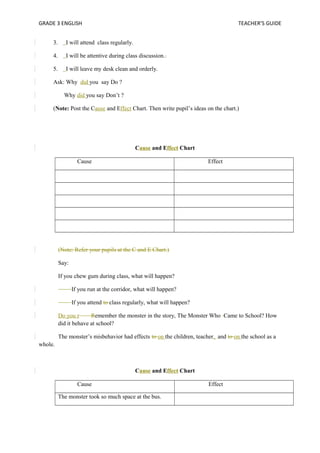
Cause and Effect Chart 
Cause Effect 
The monster took so much space at the bus.
GRADE 3 ENGLISH TEACHER’S GUIDE 
The Monster screamed loudly. 
While the teacher was reading a story, 
Monster laughed and shouted. 
At rest time, the monster pulled children’s hair. 
2. Modeling/Teaching 
Say: In order to find the effect, ask what happens next? To find the cause, ask why something 
happeneds? 
There are some clue words for to identify the cause and effect. These are so, since, 
because and if. 
(Present some sentences with the aforementioned clue words.) 
Can we now complete the C and E Chart? 
Again, what question would you ask to find the cause? To find the effect? 
3. Guided Practice 
Say: At this moment, we are going to work in trios. To deepen our understanding about 
identifying cause and effect, we will have this activity called Show-Cause-Effect.Each group 
will be given an envelope containing different sentence strips. These strips can either show 
cause or an effect. The fFastest trio to get the right answers will receive a ‘Thumbs Up’ Card. 
Say: you You decide together to get the correct signal clue words for cause and effect. 
(Note: In envelopes, each group should receive 2 pairs of sentence strips. Pupils’ answers 
should be posted in the Cause and Effect Chart.) 
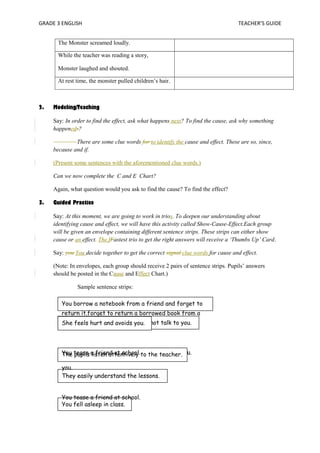
Sample sentence strips: 
You borrow a notebook from a friend and forget to 
return it.forget to return a borrowed book from a 
fYroiuern df.riend feels angry and will not talk to you. 
She feels hurt and avoids you. 
Your friend feels angry and will not talk to you. 
You tease a friend at school. 
you. 
The pupils listen attentively to the teacher. 
They easily understand the lessons. 
You tease a friend at school. 
You fell asleep in class.
GRADE 3 ENGLISH TEACHER’S GUIDE 
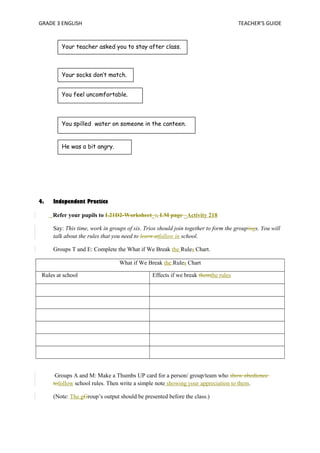
Your teacher asked you to stay after class. 
Your socks don’t match. 
You feel uncomfortable. 
You spilled water on someone in the canteen. 
He was a bit angry. 
4. Independent Practice 
Refer your pupils to L21D2-Worksheet_:, LM page _Activity 218 
Say: This time, work in groups of six. Trios should join together to form the groupings. You will 
talk about the rules that you need to learn atfollow in school. 
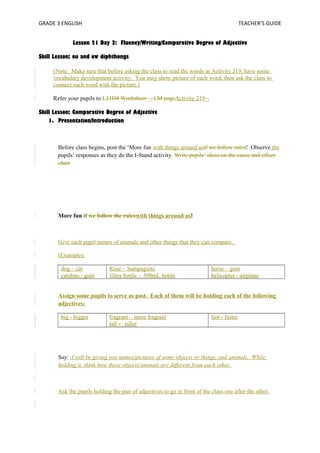
Groups T and E: Complete the What if We Break the Rules Chart. 
What if We Break the Rules Chart 
Rules at school Effects if we break themthe rules 
Groups A and M: Make a Thumbs UP card for a person/ group/team who show obedience 
tofollow school rules. Then write a simple note showing your appreciation to them. 
(Note: The gGroup’s output should be presented before the class.)
GRADE 3 ENGLISH TEACHER’S GUIDE 
Lesson 21 Day 3: Fluency/Writing/Comparative Degree of Adjective 
Skill Lesson: ou and ow diphthongs 
(Note: Make sure that before asking the class to read the words in Activity 219, have some 
vocabulary development activity. You may show picture of each word, then ask the class to 
connect each word with the picture.) 
Refer your pupils to L21D4 Worksheet _, LM pageActivity 219_. 
Skill Lesson: Comparative Degree of Adjective 
1. Presentation/Introduction 
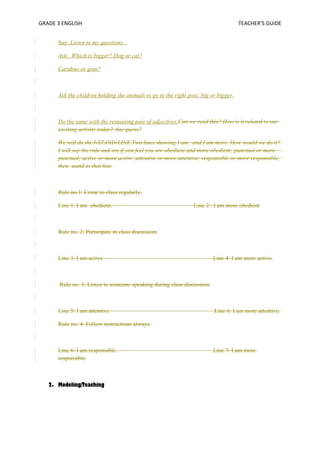
Before class begins, post the ‘More fun with things around usif we follow rules! Observe the 
pupils’ responses as they do the I-Stand activity. Write pupils’ ideas on the cause and effect 
chart 
More fun if we follow the ruleswith things around us! 
Give each pupil names of animals and other things that they can compare. 
(Examples: 
dog – cat 
Rose – Sampaguita 
carabao - goat 
1liter bottle - 500mL bottle 
horse – goat 
helicopter - airplane 
Assign some pupils to serve as post. Each of them will be holding each of the following 
adjectives: 
big - bigger fragrant – more fragrant 
tall -– taller 
fast - faster 
Say: I will be giving you names/pictures of some objects or things, and animals. While 
holding it, think how these objects/animals are different from each other. 
Ask the pupils holding the pair of adjectives to go in front of the class one after the other.
GRADE 3 ENGLISH TEACHER’S GUIDE 
Say: Listen to my questions. 
Ask: Which is bigger? Dog or cat? 
Carabao or goat? 
Ask the children holding the animals to go to the right post: big or bigger. 
Do the same with the remaining pair of adjectives.Can we read this? How is it related to our 
exciting activity today? Any guess? 
We will do the I-STAND-LINE Two lines showing I am and I am more. How would we do it? 
I will say the rule and see if you feel you are obedient and more obedient; punctual or more 
punctual; active or more active ;attentive or more attentive; responsible or more responsible, 
then stand to that line. 
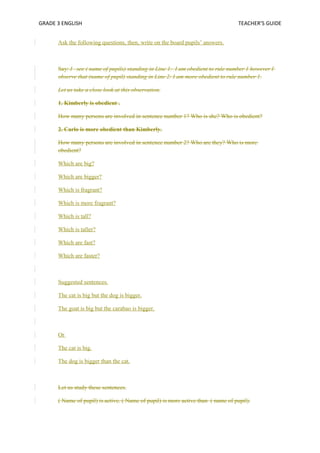
Rule no.1: Come to class regularly. 
Line 1: I am obedient. Line 2 : I am more obedient 
Rule no. 2: Participate in class discussion. 
Line 3: I am active Line 4: I am more active. 
Rule no. 3: Listen to someone speaking during class discussion. 
Line 5: I am attentive Line 6: I am more attentive. 
Rule no. 4: Follow instructions always. 
Line 6: I am responsible. Line 7: I am more 
responsible. 
2. Modeling/Teaching
GRADE 3 ENGLISH TEACHER’S GUIDE 
Ask the following questions, then, write on the board pupils’ answers. 
Say: I see ( name of pupils) standing in Line 1: I am obedient to rule number 1 however I 
observe that (name of pupil) standing in Line 2: I am more obedient to rule number 1. 
Let us take a close look at this observation. 
1. Kimberly is obedient . 
How many persons are involved in sentence number 1? Who is she? Who is obedient? 
2. Carlo is more obedient than Kimberly. 
How many persons are involved in sentence number 2? Who are they? Who is more 
obedient? 
Which are big? 
Which are bigger? 
Which is fragrant? 
Which is more fragrant? 
Which is tall? 
Which is taller? 
Which are fast? 
Which are faster? 
Suggested sentences. 
The cat is big but the dog is bigger. 
The goat is big but the carabao is bigger. 
Or 
The cat is big. 
The dog is bigger than the cat. 
Let us study these sentences. 
( Name of pupil) is active. ( Name of pupil) is more active than ( name of pupil).
GRADE 3 ENGLISH TEACHER’S GUIDE 
( Name of pupil) is happy. ( Name of pupil) is happier than ( name of pupil) 
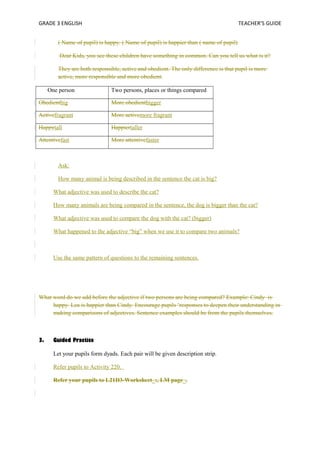
Dear Kids, you see these children have something in common. Can you tell us what is it? 
They are both responsible, active and obedient. The only difference is that pupil is more 
active, more responsible and more obedient. 
One person Two persons, places or things compared 
Obedientbig More obedientbigger 
Activefragrant More activemore fragrant 
Happytall Happiertaller 
Attentivefast More attentivefaster 
Ask: 
How many animal is being described in the sentence the cat is big? 
What adjective was used to describe the cat? 
How many animals are being compared in the sentence, the dog is bigger than the cat? 
What adjective was used to compare the dog with the cat? (bigger) 
What happened to the adjective “big” when we use it to compare two animals? 
Use the same pattern of questions to the remaining sentences. 
What word do we add before the adjective if two persons are being compared? Example: Cindy is 
happy. Lea is happier than Cindy. Encourage pupils ’responses to deepen their understanding in 
making comparisons of adjectives. Sentence examples should be from the pupils themselves. 
3. Guided Practice 
Let your pupils form dyads. Each pair will be given description strip. 
Refer pupils to Activity 220. 
Refer your pupils to L21D3-Worksheet_:, LM page_.
GRADE 3 ENGLISH TEACHER’S GUIDE 
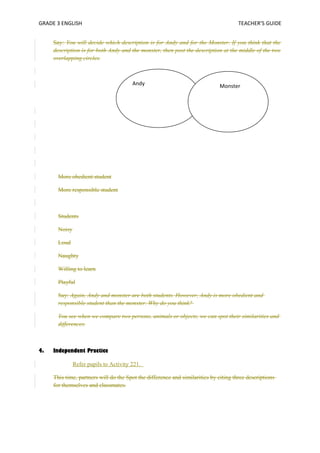
Say: You will decide which description is for Andy and for the Monster. If you think that the 
description is for both Andy and the monster, then post the description at the middle of the two 
overlapping circles. 
Andy Monster 
More obedient student 
More responsible student 
Students 
Noisy 
Loud 
Naughty 
Willing to learn 
Playful 
Say: Again, Andy and monster are both students. However, Andy is more obedient and 
responsible student than the monster. Why do you think? 
You see when we compare two persons, animals or objects, we can spot their similarities and 
differences. 
4. Independent Practice 
Refer pupils to Activity 221. 
This time, partners will do the Spot the difference and similarities by citing three descriptions 
for themselves and classmates.
GRADE 3 ENGLISH TEACHER’S GUIDE 
Refer your pupils to L21D3-Worksheet_:, LM page _. 
Lesson 21 Day 4: Fluency/Writing/Simple and Compound Sentences 
Skill Lesson: A Story with ou and ow diphthongsDiphthongs 
Refer your pupils to L21D4 Worksheet _, LM page_.LM Activity 222. 
Skill Lesson: Cause and Effect 
1. Presentation/Introduction 
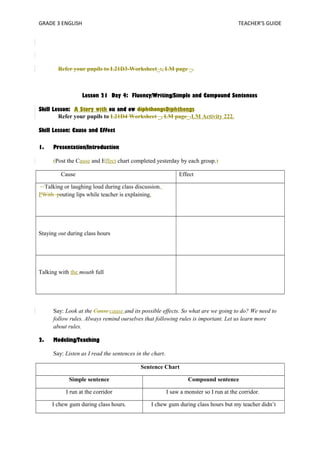
(Post the Cause and Effect chart completed yesterday by each group.) 
Cause Effect 
Talking or laughing loud during class discussion. 
PWith pouting lips while teacher is explaining. 
Staying out during class hours 
Talking with the mouth full 
Say: Look at the Cause cause and its possible effects. So what are we going to do? We need to 
follow rules. Always remind ourselves that following rules is important. Let us learn more 
about rules. 
2. Modeling/Teaching 
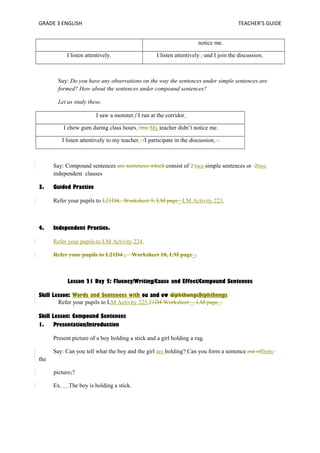
Say: Listen as I read the sentences in the chart. 
Sentence Chart 
Simple sentence Compound sentence 
I run at the corridor I saw a monster so I run at the corridor. 
I chew gum during class hours. I chew gum during class hours but my teacher didn’t
GRADE 3 ENGLISH TEACHER’S GUIDE 
notice me. 
I listen attentively. I listen attentively , and I join the discussion. 
Say: Do you have any observations on the way the sentences under simple sentences are 
formed? How about the sentences under compound sentences? 
Let us study these. 
I saw a monster./ I run at the corridor. 
I chew gum during class hours. /my My teacher didn’t notice me. 
I listen attentively to my teacher. /I participate in the discussion. .. 
Say: Compound sentences are sentences which consist of 2 two simple sentences or 2two 
independent clauses 
3. Guided Practice 
Refer your pupils to L21D4, Worksheet 9, LM page_.LM Activity 223. 
4. Independent Practice. 
Refer your pupils to LM Activity 224. 
Refer your pupils to L21D4 , Worksheet 10, LM page_. 
Lesson 21 Day 5: Fluency/Writing/Cause and Effect/Compound Sentences 
Skill Lesson: Words and Sentences with ou and ow diphthongsDiphthongs 
Refer your pupils to LM Activity 225.21D4 Worksheet _, LM page_. 
Skill Lesson: Compound Sentences 
1. Presentation/Introduction 
Present picture of a boy holding a stick and a girl holding a rug. 
Say: Can you tell what the boy and the girl are holding? Can you form a sentence out offrom 
the 
pictures? 
Ex. The boy is holding a stick.
GRADE 3 ENGLISH TEACHER’S GUIDE 
The girl is holding a rug. 
____________________________________________________________ 
____________________________________________________________ 
____________________________________________________________ 
____________________________________________________________ 
_________________________________________________ 
rules
GRADE 3 ENGLISH TEACHER’S GUIDE 
2. Modeling/Teaching 
Write their answers on the board for discussion. 
Say: How many sentences do we have? 
Can you make these two sentences into 1?how? 
Show some helping words such as:; for, and, nor, but, or, yet, and so to combine these 
sentences. 
Ex. The boy is holding a stick but the girl is holding a rug. 
Let the children form sentences based on from the new pictures.Do the same procedure for 
eliciting. 
Refer your pupils to L21D5 Worksheet _, LM page_ 
3. Guided Practice 
Help Refer your class to LM Activity 226. 
children form simple and compound sentences. 
Refer your pupils to L21D5 Worksheet _, LM page_ 
4. Independent Practice 
Refer your class to LM Activity 227. 
Refer your pupils to L21D5 Worksheet _, LM page_
GRADE 3 ENGLISH TEACHER’S GUIDE
GRADE 3 ENGLISH TEACHER’S GUIDE 
Unit 3: Week 4 (Lesson 22) 
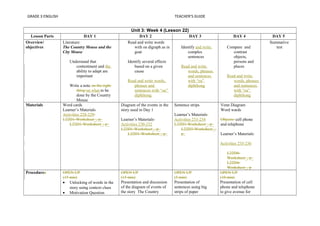
Lesson Parts DAY 1 DAY 2 DAY 3 DAY 4 DAY 5 
Overview/ 
objectives 
Literature: 
The Country Mouse and the 
City Mouse 
Understand that 
contentment and the 
ability to adapt are 
important 
Write a note on the right 
thing on what to be 
done by the Country 
Mouse 
Read and write words 
with oa digraph as in 
goat 
Identify several effects 
based on a given 
cause 
Read and write words, 
phrases and 
sentences with “oa” 
diphthong 
Identify and write 
complex 
sentences 
Read and write 
words, phrases 
and sentences 
with “oa” 
diphthong 
Compare and 
contrast 
objects, 
persons and 
places 
Read and write 
words, phrases 
and sentences 
with “oa” 
diphthong 
Summative 
test 
Materials Word cards 
Learner’s Materials 
Activities 228-229: 
L22D1-Worksheet_, p_ 
Diagram of the events in the 
story used in Day 1 
Learner’s Materials: 
Activities 230-232 
L22D1-Worksheet_, p_ 
Sentence strips 
Learner’s Materials: 
Activities 233-234 
L22D3-Worksheet_, p_ 
L22D3-Worksheet_, 
p_ 
Venn Diagram 
Word wards 
Objects: cell phone 
and telephone 
Learner’s Materials: 
Activities 235-236 
L22D4- 
Worksheet_, p_ 
L22D4- 
Worksheet_, p 
Procedures OPEN UP 
(15 min) 
· Unlocking of words in the 
story using context clues 
· Motivation Question 
OPEN UP 
(15 min) 
Presentation and discussion 
of the diagram of events of 
the story The Country 
OPEN UP 
(5 min) 
Presentation of 
sentences using big 
strips of paper 
OPEN UP 
(10 min) 
Presentation of cell 
phone and telephone 
to give avenue for
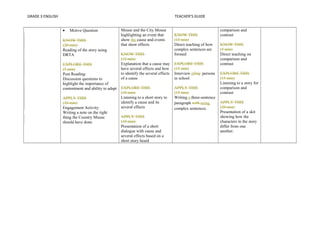
GRADE 3 ENGLISH TEACHER’S GUIDE 
· Motive Question 
KNOW THIS 
(20 min) 
Reading of the story using 
DRTA 
EXPLORE THIS 
(5 min) 
Post Reading: 
Discussion questions to 
highlight the importance of 
contentment and ability to adapt 
APPLY THIS 
(10 min) 
Engagement Activity: 
Writing a note on the right 
thing the Country Mouse 
should have done 
Mouse and the City Mouse 
highlighting an event that 
show the cause and events 
that show effects 
KNOW THIS 
(15 min) 
Explanation that a cause may 
have several effects and how 
to identify the several effects 
of a cause 
EXPLORE THIS 
(10 min) 
Listening to a short story to 
identify a cause and its 
several effects 
APPLY THIS 
(10 min) 
Presentation of a short 
dialogue with cause and 
several effects based on a 
short story heard 
KNOW THIS 
(15 min) 
Direct teaching of how 
complex sentences are 
formed 
EXPLORE THIS 
(15 min) 
Interview ofing persons 
in school 
APPLY THIS 
(15 min) 
Writing a three-sentence 
paragraph with using 
complex sentences. 
comparison and 
contrast 
KNOW THIS 
(5 min) 
Direct teaching on 
comparison and 
contrast 
EXPLORE THIS 
(15 min) 
Listening to a story for 
comparison and 
contrast 
APPLY THIS 
(20 min) 
Presentation of a skit 
showing how the 
characters in the story 
differ from one 
another.
GRADE 3 ENGLISH TEACHER’S GUIDE
GRADE 3 ENGLISH TEACHER’S GUIDE 
Unit 3: Week 4 (Lesson 22) 
The Country Mouse and The the City Mouse 
Pre Reading 
1. Unlocking/Vocabulary & Concept Development 
Unlock the difficult words below using pictures. 
(feast, ham, jellies, nibblenibbling, mouse) 
Refer your pupils to LM Activity 228 to check if the words were understood.L22D1- 
Worksheet_, LM page_. 
2. Motivation Question: 
Have you been in a city/province? What experiences did you have in the city/province? 
3. Motive Questions: 
What are the experiences of the City Mouse in the province? 
What are the experiences of the Country Mouse in the city? 
During Reading 
Say: Listen as I read ‘The Country Mouse and the City Mouse’. 
During the question and answer part, use gestures and voice dynamics to further help the pupils 
know the meaning of some difficult words in the text such as terrible, nibbling, etc. Limit the 
responses of the pupils by calling only two in every question. 
The Country Mouse and the City Mouse 
Adapted 
One summer, the Country Mouse invited his friend, the City Mouse, to have dinner at 
home. So, the Country Mouse prepared corn and camote for dinner. While eating, the 
City Mouse said, “You hardly have anything to eat here. Come to the city and I will 
show you such rich feast in my place.” 
STOP AND ASK: 
1. Who invited his friend to have a dinner? 
2. Who was invited for dinner?
GRADE 3 ENGLISH TEACHER’S GUIDE 
3. What did the Country Mouse prepare for his friend? 
4. Did the City Mouse get satisfied with what his friend offer? Why? Why not? 
The Country Mouse was so curious about the city life. So, he decided to go with his 
friend. 
When they arrived, the Country Mouse looked around the house and he was so 
surprised! There were all kinds of food on the table. There were ham, cheese, jellies, 
cakes, and fruits. The Country Mouse started nibbling the cheese. 
“So delicious! I have never tasted anything like this,” he said. 
STOP AND ASK: 
1. Why did the Country Mouse decide to go to the city? 
2. What were the things the Country Mouse find in the city? 
3. What did the Country Mouse feel about the city? 
4. If you were the Country Mouse, would you stay long in the city? Why? 
Suddenly, before the Country Mouse barely took another bite, he heard some scratching 
sound. “Meow! Meow!” the cat said, approaching the dining table. 
“Run,” yelled the City Mouse. 
They ran to the corner as fast as they could. 
STOP AND ASK:
GRADE 3 ENGLISH TEACHER’S GUIDE 
1. What did the two friends hear ? 
2. What did they do when they saw the catmouse? 
3. If you were the one of the mice, would you also run away from the cat? Why? 
“What is that?” asked the Country Mouse shaking his body. 
“A cat. Once he gets you, he’ll eat you up,” said the City Mouse. 
“This is terrible. I think I will go home. I’d rather have corn and camote in peace than 
sugar and cheese in danger,” said the Country Mouse to his friend. So, he went back to his 
home with a happy heart. 
STOP AND ASK: 
1. What did the County Mouse decide to do? 
2. What did the Country Mouse mean when he said “I’d rather have corn and camote in peace 
than sugar and cheese in danger”? 
3. If you were the Country Mouse, would you also decide to leave the city? Why? Why not? 
Post Reading 
1. Engagement Activity 
How can you help the Country Mouse? Write him a short note of advice. 
For the instruction of the activity, Refer refer your pupils to LM Activity 229.22D1- 
Worksheet_, LM, page_. 
Lesson 22 Day 2: Decoding/Fluency/Writing/Cause and Effect 
Skill Lesson: Words and Phrases with Ddigraph oa as in goat 
Refer your pupils to LM Activity 230.22D2-Worksheet_, LM page_. 
1. Skill Lesson: Cause and Effect Presentation/Introduction 
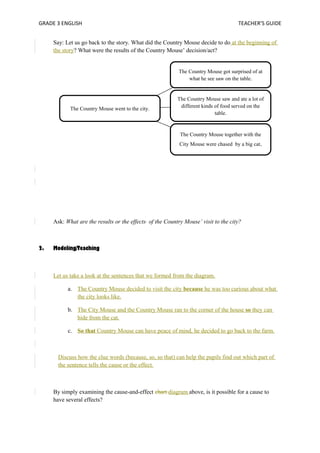
(Note: Present the diagram of events of the story The Country Mouse and The City Mouse.)
GRADE 3 ENGLISH TEACHER’S GUIDE 
Say: Let us go back to the story. What did the Country Mouse decide to do at the beginning of 
the story? What were the results of the Country Mouse’ decision/act? 
The Country Mouse went to the city. 
The Country Mouse got surprised of at 
what he see saw on the table. 
The Country Mouse saw and ate a lot of 
different kinds of food served on the 
table. 
The Country Mouse together with the 
City Mouse were chased by a big cat. 
Ask: What are the results or the effects of the Country Mouse’ visit to the city? 
2. Modeling/Teaching 
Let us take a look at the sentences that we formed from the diagram. 
a. The Country Mouse decided to visit the city because he was too curious about what 
the city looks like. 
b. The City Mouse and the Country Mouse ran to the corner of the house so they can 
hide from the cat. 
c. So that Country Mouse can have peace of mind, he decided to go back to the farm. 
Discuss how the clue words (because, so, so that) can help the pupils find out which part of 
the sentence tells the cause or the effect. 
By simply examining the cause-and-effect chart diagram above, is it possible for a cause to 
have several effects?
GRADE 3 ENGLISH TEACHER’S GUIDE 
Remember: 
· A cause is why something happens. To find a cause, look for a reason that why something 
happened. 
· An effect is what happens because of the cause. To find an effect, look for something that 
happened.the results of the cause. 
· Usually, a cause always happens first. T, then it will beis followed by an the effect. 
· Clue words such as because, so, and so that are often used to help you understand cause 
and effect in a sentence. 
3. Guided Practice 
Say: I will read to you a selection to you. Listen well and complete the diagram of Cause and 
Effect on in your notebook. 
Refer your pupils to L22D2-Worksheet_, LM page_. 
(Note: Read the selection aloud.) 
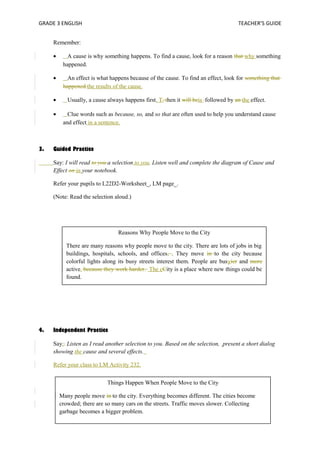
There are many reasons why people move to the city. There are lots of jobs in big 
buildings, hospitals, schools, and offices, . They move in to the city because 
colorful lights along its busy streets interest them. People are busyier and more 
active. because they work harder. The cCity is a place where new things could be 
found. 
4. Independent Practice 
Reasons Why People Move to the City 
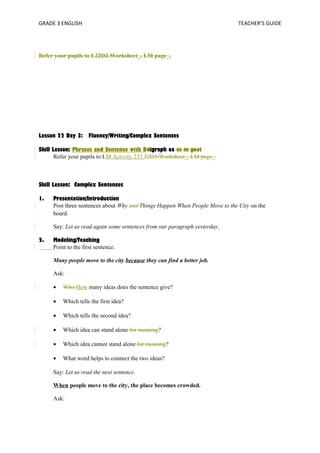
Say:. Listen as I read another selection to you. Based on the selection, present a short dialog 
showing the cause and several effects. 
Refer your class to LM Activity 232. 
Things Happen When People Move to the City 
Many people move in to the city. Everything becomes different. The cities become 
crowded; there are so many cars on the streets. Traffic moves slower. Collecting 
garbage becomes a bigger problem.
GRADE 3 ENGLISH TEACHER’S GUIDE 
Refer your pupils to L22D2-Worksheet_, LM page_. 
Lesson 22 Day 3: Fluency/Writing/Complex Sentences 
Skill Lesson: Phrases and Sentence with Ddigraph oa as in goat 
Refer your pupils to LM Activity 233.22D3-Worksheet_, LM page_. 
Skill Lesson: Complex Sentences 
1. Presentation/Introduction 
Post three sentences about Why and Things Happen When People Move to the City on the 
board. 
Say: Let us read again some sentences from our paragraph yesterday. 
2. Modeling/Teaching 
Point to the first sentence. 
Many people move to the city because they can find a better job. 
Ask: 
· Who How many ideas does the sentence give? 
· Which tells the first idea? 
· Which tells the second idea? 
· Which idea can stand alone for meaning? 
· Which idea cannot stand alone for meaning? 
· What word helps to connect the two ideas? 
Say: Let us read the next sentence. 
When people move to the city, the place becomes crowded. 
Ask:
GRADE 3 ENGLISH TEACHER’S GUIDE 
· Who How many ideas does the sentence give? 
· Which tells the first idea? 
· Which tells the second idea? 
· Which idea can stand alone for meaning? 
· Which idea cannot stand alone for meaning? 
· What word helps to connect the two ideas? 
Say: This These sentences is called complex sentences. We combine two simple sentences 
using conjunctions to form a complex sentence. 
A complex sentence is made up of two parts, an independent calause and a dependent clause 
joined by linking words or conjunction. 
Words like because, when, after, though, as soon as and so that are examples of conjunctions 
that can be used in a complex sentence. These conjunctions make one part of the sentence 
subordinate to the other part. 
3. Guided Practice 
Let us have a fun activity. Interview anyone in the school about: 
1. What does s/he want to do? 
· 
· 3. What would happen if s/he continues doing it? 
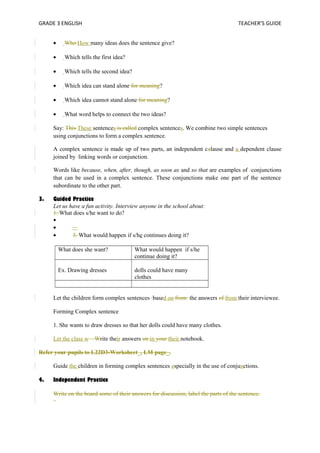
What does she want? What would happen if s/he 
continue doing it? 
Ex. Drawing dresses dolls could have many 
clothes 
Let the children form complex sentences based on from the answers of from their interviewee. 
Forming Complex sentence 
1. She wants to draw dresses so that her dolls could have many clothes. 
Let the class w Write their answers on in your their notebook. 
Refer your pupils to L22D3-Worksheet_, LM page_. 
Guide the children in forming complex sentences especially in the use of conjunctions. 
4. Independent Practice 
Write on the board some of their answers for discussion, label the parts of the sentence.
GRADE 3 ENGLISH TEACHER’S GUIDE 
Based from the interview conducted, let us now write a short three-sentence paragraph with 
complex sentences. Refer the class to LM Activity 234. 
Lesson 22 Day 4: Fluency/Writing/Comparison and Contrast 
Skill Lesson: Poem with oa digraph as in goat 
Refer your pupils to LM Activity 235.22D4-Worksheet_, LM page_. 
. 
Skill Lesson: Comparison and Contrast 
1. Presentation/Introduction 
Post on the board an empty Venn diagram. Show your pupils two objects with similar and 
different features - a cell phone and a telephone. 
Say: I have here a cell phone and a telephone. Let us compare and contrast them. 
In what ways are the cell phone and the telephone the same? Let us compare them. (Tack on 
the board the word “compare”.) 
(can be used to talk with people away from you) 
(can help you communicate with people) 
Write the pupils’ responses at the center space of the Venn diagram. 
In what ways are they different? Let us contrast them. (Tack on the board the word contrast.) 
(A cell phone can be used in texting while a telephone cannot be used as such is not.) 
(A cell phone is movable while a telephone is stationary.) 
Write your students’ descriptions for the cell phone on the left circle and the descriptions for the 
telephone on the right circle. 
2. Modeling/Teaching 
What do we tell show or describe when we compare? (the similarities) 
What do we show or describetell when we contrast? (the differences) 
Say: When we talk about two things, we compare and contrast them. When we compare, we say 
the similarities. When we contrast, we tell the differences. 
Show your pupils a pencil and a crayon 
Say: Look at this pencil and this crayon. Compare them. 
3. Guided Practice 
Say: Let me see if you can compare and contrast the two characters in the story that I will read 
to you. Complete the Venn diagram on in your notebook.
GRADE 3 ENGLISH TEACHER’S GUIDE 
Refer your pupils to L22D4-Worksheet_, LM page_.Refer the class to LM Activity 236. 
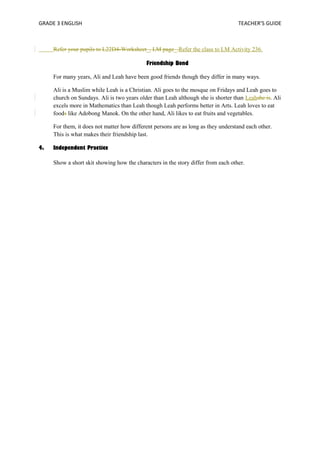
Friendship Bond 
For many years, Ali and Leah have been good friends though they differ in many ways. 
Ali is a Muslim while Leah is a Christian. Ali goes to the mosque on Fridays and Leah goes to 
church on Sundays. Ali is two years older than Leah although she is shorter than Leahshe is. Ali 
excels more in Mathematics than Leah though Leah performs better in Arts. Leah loves to eat 
foods like Adobong Manok. On the other hand, Ali likes to eat fruits and vegetables. 
For them, it does not matter how different persons are as long as they understand each other. 
This is what makes their friendship last. 
4. Independent Practice 
Show a short skit showing how the characters in the story differ from each other.
GRADE 3 ENGLISH TEACHER’S GUIDE 
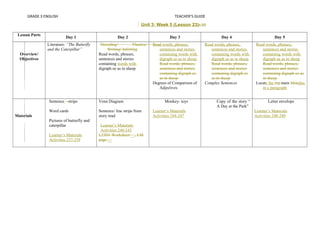
Lesson Parts Day 1 Day 2 Day 3 Day 4 Day 5 
Overview/ 
Objectives 
Literature: “The Butterfly 
and the Caterpillar” 
Decoding/ Fluency/ 
Writing/ Inferring 
Read words, phrases, 
sentences and stories 
containing words with 
digraph ee as in sheep 
Read words, phrases, 
sentences and stories 
containing words with 
digraph ee as in sheep 
Read words, phrases, 
sentences and stories 
containing digraph ee 
as in sheep 
Degrees of Comparison of 
Adjectives 
Read words, phrases, 
sentences and stories 
containing words with 
digraph ee as in sheep 
Read words, phrases, 
sentences and stories 
containing digraph ee 
as in sheep 
Complex Sentences 
Read words, phrases, 
sentences and stories 
containing words with 
digraph ee as in sheep 
Read words, phrases, 
sentences and stories 
containing digraph ee as 
in sheep 
Locate the ing main Ideaidea 
in a paragraph 
Materials 
Sentence –strips 
Word cards 
Pictures of butterfly and 
caterpillar 
Learner’s Materials 
Activities 237-239 
Venn Diagram 
Sentence/ line strips from 
story read 
Learner’s Materials 
Activities 240-243 
L23D1 Worksheet __, LM 
page __ 
Monkey- toys 
Learner’s Materials 
Activities 244-247 
Copy of the story “ 
A Day at the Park” 
Letter envelope 
Learner’s Materials 
Activities 248-249 
Unit 3: Week 5 (Lesson 23)L 23
GRADE 3 ENGLISH TEACHER’S GUIDE 
Procedures 
Pre-Reading 
Unlock key words through 
word cards and sentence 
strips. 
Show a picture of butterfly 
and caterpillar. 
Reading 
Read aloud the story and 
stop at indicated points for 
questions to identify 
similarities and differences 
of butterfly and caterpillar. 
Post Reading 
Let pupils answer the 
discussion questions and 
have pupils describe the 
characters through a 
comparison chart (see TG 
L23 D1.) 
(25 min) 
Phonics lesson 
Show a Venn diagram of the 
story read showing to focus 
on similarities and 
differences. 
Form groups and present 
line strips from the story 
read. 
Modeling/Teaching: 
Ask groups to draw/ 
get one from the 
posted strips and let 
them answer the 
questions. 
Allow pupils to 
organize their 
answers through a 
chart. (see TG L23 
D2) 
Tell pupils how 
inferring is done. 
25 min) 
Phonics Lesson 
Introduction/ Presentation: 
Present monkey- toys and 
allow pupils to describe the 
toys according to size. 
Read a story on monkeys. 
Modeling/Teaching: 
Discuss Degrees 
degrees of 
comparison of 
Adjectives 
adjectives using a 
comparison chart. 
(25 min) 
Phonics Lesson 
Presentation/ Introduction 
Read the story “A Day at 
the Park”. 
Allow pupils to answer 
questions on about the text. 
Modeling/ Teaching 
Discuss how complex 
sentences are written by 
combining sentences and 
by using a chart/ table. 
Allow pupils to 
combine sentences 
on the story read 
toand write 
complex sentences. 
(25 min) 
Phonics Lesson 
Show a letter-envelope and 
ask questions on it to 
jumpstart lesson. 
Discuss the parts of a letter 
through a poem. 
Allow pupils to label parts of 
the letter. 
L23D5 
Do activities to reiterate the
GRADE 3 ENGLISH TEACHER’S GUIDE 
Let pupils do L23D1 
Worksheet __ LM page 
__Activity in the LM 
intended for the day. 
L23 D2 LM 
Allow pupils to do 
inferring activities. 
Allow pupils to 
rewrite sentences 
using the 
comparative and 
superlative degrees 
of adjectives. 
Allow pupils to 
write as many 
comparative and 
superlative degrees 
of adjectives. 
Let pupils present 
work 
Engage pupils in 
writing sentences 
using adjectives. 
Allow pupils to 
find complex 
sentences from the 
books they are 
reading. 
value of resourcefulness 
Allow pupils to plan for a 
project from recyclable 
materials to find out how 
resourceful they are
GRADE 3 ENGLISH TEACHER’S GUIDE 
sipped 
drank ate tasted 
exclaimed 
whispered shouted enjoyed 
ashamed 
proud 
embarrassed 
angry 
Lesson 23 Day 1: Literature: The Butterfly and the Caterpillar 
Pre-Reading 
1. Unlocking/Vocabulary & Concept Development 
(Note: Have the children choose the synonym of the flashedmeaning of the underlined word. 
Use the words in a sentence. Then, the children would choose from the sentence the word or 
word phrase as a clue to the word’s meaning.) 
1. The boy sipped the cold drink offered to him on a hot day. 
a. drank in small quantity 
b. ate 
c. tasted 
2. . My best friend smiled and exclaimed , “Wow!”, when I showed the dress I wore last 
Christmas. 
a. whispered 
b. shouted 
c. enjoyed 
3. 
3. The boy was ashamed to show his poor grades to his mother. 
a. proud 
b. embarrassed 
c. angry
GRADE 3 ENGLISH TEACHER’S GUIDE 
munched 
4. 4. Sheila munched on some cookies for snacks. 
chewed drank sipped 
continued 
stopped paused extended 
d. chewed 
e. drank 
f. sipped 
5. Even when he was sleepy, Father continued telling us the story of the moth. 
a. stopped 
b. paused 
c. kept on 
Refer the class to Activity 237 to test their understanding of the words they learned. 
2. Motivation Question 
Show a picture of a butterfly and a picture of a caterpillar. (Refer to Activity 238.) 
Say: What are in the picture? In what ways are the caterpillar and butterfly similar?different?
GRADE 3 ENGLISH TEACHER’S GUIDE 
3. Motive Question: 
Today, our story is about a butterfly and a caterpillar. Find out in the story their similarities and 
differences. 
During Reading: 
Say: Listen to the story that I will read to you. Be sure to find out the similarities and 
differences of the two characters. 
In between readings, ask the children to act out the following scenes: 
Paragraph 1-2: 
The butterfly saw the caterpillar and it was so ashamed to be seen with the caterpillar 
Paragraph 4: 
The butterfly saw a very different creature. 
Paragraph 5: 
The caterpillar told the butterfly how they were the same a week ago. 
Paragraph 6: 
The caterpillar told the butterfly to go, fly but not to be proud. 
The Butterfly and the Caterpillar 
an adaptation by Joseph Lauren 
One summer morning, a butterfly rested on a beautiful rose. While she sipped the 
sweet nectar from the flower, she saw a caterpillar crawl up the garden wall. 
“Horrors!” the butterfly exclaimed, “Stop! Don’t come near me. I’m ashamed to be 
seen where you are.” 
Ask: Why do you think the butterfly was the butterfly ashamed? 
The caterpillar continued crawling. He munched on the leaf without listening to the 
butterfly’s cry. 
“Where are your wings? What are you eating?” the butterfly asked. 
Ask: Does the caterpillar have wings?If he have has as the butterfly claimed 
then,where are they?
GRADE 3 ENGLISH TEACHER’S GUIDE 
The caterpillar walked ahead. Then he said, “Eight days ago, young butterfly, you 
were the same as I am. One night from today, my wings will grow. I would fly and 
see all the bright and beautiful flowers.” 
Ask: How do did the butterfly looks like eight days ago? 
“I’m sure my wings would be brighter and more beautiful than yours. 
So, go, fly but try not to be so proud. Each caterpillar is given a chance to become a 
butterfly. We are but the same. ” 
Ask: what What will happen to caterpillar in the days to come? What should all 
butterflies need to remember while flying? 
Post Reading 
A. Comprehension Check 
Say: Let us talk about the story. 
1. Who are the characters in the story? 
2. When did the story happen? 
3. Why was the butterfly ashamed to be seen by the caterpillar? 
4. How do you think did the caterpillar feel when the butterfly tell told him 
nnot to come near it? 
5. What was the response of the caterpillar? 
6. Can the caterpillar be like a butterfly? 
After reading, have the children describe the characters 
Butterfly Caterpillar 
appearance 
movement 
Food they eat 
Refer your pupils to L23D1-Worksheet_, LM page_. 
Say: Let’s go back to the activity that you answered before we read the story. 
From the comparison chart, the children would be able to say that the caterpillar and the 
butterfly are different from each other. Let the children find the similarities through the part 
of the story: 
“Eight days ago, young butterfly, you were same as I am. One night from today, my 
wings will grow. I would fly and see all the bright and beautiful flowers.”
GRADE 3 ENGLISH TEACHER’S GUIDE 
B. Engagement Activity 
Refer the class to Activity 239. 
Refer your pupils to L23D1Worksheet_, LM page_. 
Lesson 23 Day 2: Decoding/Fluency/Writing/Inferring 
Skill Lesson: Words and phrases with digraph ee as in sheep 
Refer your pupils to Activity 240. L23D2-Worksheet_, LM page_ 
Skill Lesson: Inferring 
1. Presentation/Introduction 
Show the Venn Diagram of the butterfly and the caterpillar from yesterday’s discussion. 
(Write in the middle part the similarities between the caterpillar and the butterfly. They can 
explore the good qualities they share together.) 
caterpillar 
butterfly 
Write in the middle part the similarities between the 
caterpillar and the butterfly. . They can explore the 
good qualities they share together. 
Form four groups. Get lines from the previous story and write them on strips of paper. 
“Horrors!” the butterfly exclaimed, “Stop! Don’t come near me. 
I’m ashamed to be seen where you are.” 
“Where are your wings? What are you eating?” 
“Eight days ago, young butterfly, you were the same as I 
am. One night from today, my wings will grow. I would 
fly and see all the bright and beautiful flowers.” 
“I’m sure my wings would be brighter and more beautiful 
than yours. So, go, fly but try not to be so proud. Each 
caterpillar is given a chance to become a butterfly. We 
are but the same. ”
GRADE 3 ENGLISH TEACHER’S GUIDE 
2. Modelling/Teaching 
Ask each group to pick one. While holding the story part, let them answer the following 
questions: 
1. What do you think does this character really meant by saying that? 
2. Why did this character (act, think, talk) that way? 
3. What does this character want to do? 
4. What do you think this character might do? 
5. What is the author really trying to say? 
Let each group present their answers. Take note of the children’s answers and organize their 
answers into the chart. (Refer the class to Activity 241 for the copy of the chart.) 
Character Movement Feelings Reasons for his 
Actions 
Butterfly 
Caterpillar 
Say: How do we infer? 
There are steps on how it is done. First, read the sentence/s. Then, make a guess of “what else” 
the sentence/s tells. 
Ex. Butterfly thinks that she the caterpillar is ugly that is why she is ashamed. 
3. Guided Practice 
Refer your pupils to L23D2-Worksheet _, LM page_.LM Activity 242 
4. Independent Practice 
Refer your pupils to LM Activity 243.23D2-Worksheet _, LM page_. 
Making Inferences
GRADE 3 ENGLISH TEACHER’S GUIDE 
Say: I will read a story about Melissa. Infer what kind of person Melissa is. Write it in your 
notebook. 
Melissa sat on the window. She was starring at a small bird outside. The bird kept chirping 
and hopping around in the bushes. 
This chirping and hopping made the tip of Melissa’s tail twist and turn 
The rest of her kept still. If the window had not been in the way, Melissa would have jumped 
right out with the bird. 
B. Infer the trait of the character in each number. 
1. Mother praised me for my good grades. My mother was _______. 
(appreciative, busy, industrious) 
2. I received a gift from my godfather. My godfather was ________. 
(kind, thoughtful, forgetful) 
3. Shaina has a new toy. She went around and showed her new 
toy to her friends. Shaina was _________. 
(proud, playful, selfish) 
4. Paolo found a twenty-peso bill in the room. He picked it up at gave 
it to the teacher. Paolo was __________. 
(obedient, forgetful, honest) 
5. Agatha always comes to school early. She arranges the books in 
the bookshelf and cleans the blackboard. Agatha is ___________. 
(industrious, respectful, obedient) 
Lesson 23 Day 3: Fluency/Writing/Degrees of Comparison of Adjectives 
Skill Lesson: Words, Phrases and Sentences with Ddigraph ee as in sheep 
Refer your pupils to L23D3-Worksheet_, LM page_LM Activity 244. 
Skill Lesson: Degrees of Comparison of Adjectives 
1. Presentation/Introduction 
(Note: Place three toy monkeys, each one bigger than the other, 
in a bag. Let the class describe the monkeys and compare them according to size.) 
Ask: What do you know about monkeys? How are they 
characterized in most stories that you read? 
Say: I will read to you a short story about monkeys. Listen well. 
Three clever cats lived in a house. The white cat was big. The black cat is bigger 
than the white cat. The striped cat was the biggest of the three. 
One day they baked a cake for dinner. “I will eat all the cake”, said the white cat in a 
loud voice. 
“I will eat it alone”, said the black cat in a louder voice.
GRADE 3 ENGLISH TEACHER’S GUIDE 
“I will eat it all by myself” said the striped cat in the loudest voice. 
A clever monkey lived in a tree nearby. He was more more clever than the cats. In 
fact, he was the most clever monkey in the world. He heard what the cats said and came into 
their house. The cats were busy fighting among themselves. They did not see the monkey. 
The monkey ate up the whole cake. 
At last they stopped fighting. “Where’s the cake?” they said. “It ran away because 
you made too much noise,” said the monkey. 
2. Modeling/Teaching 
Using the charts below lead the class in t them answering the following questions. 
Ask: What are the adjectives used to compare the three cats? 
Three cats White cat Black cat Striped cat 
Their voice 
What adjective is used to compare the monkey and the cats? What adjective is used to 
compare the monkey with all monkeys in the world? 
Monkey Monkey and the cats Monkey and all the 
monkeys in the world 
POSITIVE COMPARATIVE SUPERLATIVE 
After the children gave give their answers, write on the orange box POSITIVE, on the green 
box COMPARATIVE and on the red box SUPERLATIVE . Then, ask the children what were 
added to form the comparative and superlative forms and , how many were being compared.
GRADE 3 ENGLISH TEACHER’S GUIDE 
Say: Comparing with using adjectives has three degrees. They These are the positive, 
comparative, and superlative degrees. We use adjectives in the positive degree if we are 
describing only one thing or person. We say Ann is tall. We use adjectives in the comparative 
degree if we are describing two objects or persons. We say The monkey was more clever than 
the cats. We say Sam is taller than Ann. We use adjectives in the superlative degree if we are 
describing three or more things and person. We say In fact, he was the most clever monkey in 
the world. 
For comparative degree of adjective, we add er at the end of some adjectives. We can also 
add more before some adjectives. In sentences using this degree of comparison, we use the 
word than. 
For superlative degree of adjective, we add est at the end of some adjectives. We can also add 
most before some adjectives. In sentences using this degree of comparison, we use the word 
of all.Tom is the tallest among them. 
3. Guided Practice 
Group students into fours and let them think of adjectives and its degrees of comparison. After 
the given time, group presentation follows. Any group who has the same adjective with other 
group should cross it out. The group with the most remaining list, wins. 
POSITIVE COMPARATIVE SUPERLATIVE 
Challenge them to write at least 2 or 3 sentences using the comparative and superlative form of 
each adjective. 
Rewrite each sentence using either the comparative or superlative form of the adjective on your 
notebook. 
Refer your pupils to L23D3-Worksheet_, LM page _. 
4. Independent Practice 
Refer your pupils to LM Activity 247. 
A. Group students into four and let them think of adjectives and its degrees of comparison as 
many as they can. After the given time, group presentation follows. Any group who has the 
same adjective with other group should cross it out. The group with the most remaining list, 
wins. 
POSITIVE COMPARATIVE SUPERLATIVE
GRADE 3 ENGLISH TEACHER’S GUIDE 
B. 
Challenge them to write atleast 2 or 3 sentences using the comparative and 
superlative form of each adjective. 
Lesson 23 Day 4: Fluency/Writing/Complex Sentences 
Skill Lesson: digraph ee as in sheep 
Refer your pupils to L23D4-Worksheet_, LM page_ 
Skill Lesson: Complex Sentences 
1. Presentation/Introduction 
Read the story “A Day at the Park” to students 
Say: Today, I am going to read to you a short story. Listen well because I will ask a few 
questions about it. 
I went to the park. I went on Saturday. I went with my friends. My friends are 
Marie, Connie, and Roy. We rode our bikes. I rode my new bike. Roy brought his 
basketball. We played basketball. We played for two hours. We wereIt was hot. We 
were thirsty. Connie and Roy’s mom brought us lemonade and sandwiches. We ate 
them for lunch. We had a lot of fun. 
Ask: 
What can you say about the story? 
How did it sound? 
What did you notice about it? 
A Day at the Park 
Explain to the students that, many times, weak stories are full of very short, choppy sentences. 
One way writers can make these stories stronger is to learn how to combine short sentences into 
longer sentences. 
2. Modeling/Teaching 
Let us compare some group of words from the story. 
I went to the park. It is Saturday 
I went to the park because it is Saturday.
GRADE 3 ENGLISH TEACHER’S GUIDE 
We combined the two simple sentences. Now, we have I went to the park as the independent 
clause. It expresses a complete thought. Because it is Saturday is a dependent clause. It does 
not express complete thought. The marker because suggest that because it is Saturday is a 
dependent clause. 
To combine the two simple sentences we used the marker because. 
Say: A clause can be dependent because of the presence of a: 
· Marker Word (Before, after, because, since, in order to, although, though, 
whenever, wherever, whether, while, even though, even if) 
· Conjunction (And, or, nor, but, yet) 
Let us have the next group of words. 
We played basketball. We played for two hours. It is hot. 
The new sentence is: We played basketball for two hours even if it’s hot. 
How did we do it? We combined the three sentences. Now, we have an independent clause 
“We played basketball for two hours” and dependent clause “even if it’s hot”. The marker 
“even if” tell us that even if it’s hot is a dependent clause. 
Let us have the next independent and dependent clauses. 
Connie and Roy’s mom brought us lemonade and sandwiches. We ate them for lunch. 
Ask the children to combine sentences below using the chart provided . 
· The butterfly shouted. He saw the caterpillar crawling up the 
· garden wall. 
· The caterpillar did not listen to the butterfly’s cry. He knew he can be a butterfly one day. 
· The caterpillar is wiser than the butterfly. He knew they are the 
same. 
First Sentence Use because or when Second Sentence 
Ex. The butterfly shouted When He saw the caterpillar crawling 
up the garden wall 
The new sentence is: Connie and Roy’s mom brought us lemonade that we ate for lunch. 
How did we do it? What words were omitted? What word did we use to combine the two 
sentences?
GRADE 3 ENGLISH TEACHER’S GUIDE 
Ask: How many sentences were combined? What combine the sentences together? Did the sentences 
sound better than when they are apart? 
Explain to the children that when we combine independent and dependent clauses together we form 
a complex sentence.) 
Say: When we combine independent and dependent clauses together we form a complex sentence. 
3. Guided Practice 
In small groups, have the class combine the set of dependent and independent clauses below. 
Dependent Clause Independent Clause New Sentences 
Because Roy brought his 
We played basketball. 
basketball, 
After riding our bikes, We played volleyball. 
Although it is raining, It is fun to be with friends in 
the park. 
Before dinner time, I should be home to meet my 
cousins who come from the 
province. 
students revise the story by combining independent and dependent clauses into complex 
sentences. 
4. Independent Practice 
Have students find complex sentences in the books they are reading. Have them copy them on 
in their notebook. Have them separate the two clauses in each sentence.bookmarks 
.
GRADE 3 ENGLISH TEACHER’S GUIDE 
Lesson 23 Day 5: Fluency/Writing/Main Idea 
Skill Lesson: digraph ee as in sheep 
Refer your pupils to L23D5-Worksheet_, LM page_ 
Skill Lesson: Main Idea 
1. Presentation/Introduction 
Ask: What comes to mind when you see the object below? 
What is inside the envelope? When do you write a letter? Do you write a letters too?? 
2. Modeling/Teaching 
Say: a A letter has 5 parts: 
Sample letter 
February 19, 2014 (heading) 
heading 
Ms. Ana Lou N. Caspi 
Amiable Ma’am Ana, (greeting) 
It’s hard to have true friends whom we could completely count on but I was lucky enough to 
find you. I lately realized how special friends are until I was cared and saved by an angel liked 
you. I will keep you safe with me forever. 
Always take care and may God will always bless you! 
Your Friend, (closing) 
greeting heading 
body 
closing 
signature body
GRADE 3 ENGLISH TEACHER’S GUIDE 
Rennie Enriquez (signature) 
Lead the class to recite the poem below. 
The HEADING has the date 
The heading has the date 
Hi, ho the letter parts 
The HEADING has the date. 
The GREETING says Dear Friend, 
The greeting says Dear Friend, 
Hi, ho the letter parts 
The greeting says Dear Friend., 
The BODY is the message 
The body is the message 
Hi, ho the letter parts 
The body is the message. 
The CLOSING says Sincerely, 
The closing says Sincerely, 
Hi, ho the letter parts 
The closing says Sincerely., 
The SIGNATURE is my name 
The signature is my name 
Hi, ho the letter parts 
The signature is my name. 
3. Guided Practice 
Prepare a simple letter of invitation. Cut them out by parts. Then, have the class rearrange it to 
come up with the complete letter. 
Label the parts of the letter. 
Refer your pupils to L23D5-Worksheet_, LM page_. 
4. Independent Practice 
Refer your pupils to LM Activity 248 and 249. 
Write a thank you letter to a friend. 
Refer your pupils to L23D5-Worksheet_, LM page_.
GRADE 3 ENGLISH TEACHER’S GUIDE
GRADE 3 ENGLISH TEACHER’S GUIDE 
Unit 3: Week 6 (Lesson 24)L 24 
Lesson Parts Day 1 Day 2 Day 3 Day 4 Day 5 
Overview/ 
Objectives 
Literature: 
Two Friends, One World 
Get the general sense of the 
story 
Makes inferences and draw 
conclusions based on texts 
(pictures, title and content 
words) 
Use personal pronouns 
(person) 
Read and write words, 
phrases and short sentences 
with ea diagraphs 
Express feelings, opinions 
through logs 
Read and write words, 
phrases and short sentences 
with ea diagraphsea 
diagraphs 
SUMMATIVE 
TEST 
Materials 
Copy of the story Two 
Friends, One World 
Pictures 
Word strips 
Manila paper with 
incomplete sentences 
Venn Diagram 
Pictures 
Learner’s Materials 
Activities 250-251 
treasure box with sentence 
strips 
Learner’s Materials 
Activity 252 
Sample journal entry 
Manila paper 
Learner’s Materials 
Activity 253-254 
Procedures 
Pre-Reading 
(5 min) 
Pupils guess pictures 
provided for. 
Group the class and let 
Introduction/ Presentation 
(10 min) 
Group-matching 
Provided the pupils with 
Introduction/ Presentation 
(10 min) 
Picture-words (person/s) 
will be posted within the 
walls in the room. While 
Presentation/ Introduction 
(10 min) 
Show picture-situations and 
let students express what 
they feel about it. 
e.g
GRADE 3 ENGLISH TEACHER’S GUIDE 
them discuss their 
inferences about the 
picture. 
Reading 
(10 min) 
Teacher reads aloud the 
story “Two Friends, One 
World” (Francisca’s Story) 
w/ correct intonation. 
(Please refer back to past 
lessons on delivering read 
aloud stories.) 
Post Reading 
(15 min) 
· Let the pupils answer 
questions to allow 
complete grasp of the 
story 
(20 min) 
Group Work 
incomplete sentences, 
students have to infer or 
draw conclusions by finding 
it with other group. 
e.g. 
If the grasshopper isn’t 
color green_________ 
The first group to find their 
group match wins the game. 
Modeling/Teaching: 
(20 min) 
Discuss how to give 
inferences. See TG 
Guided Activity 
(10 min) 
Let the pupils give 
walking around, students 
infer who is doing the 
action in the picture and 
write down the nouns they 
encounter. 
(20 min) 
Discuss personal pronouns 
and provide examples of 
sentences on how to use 
these pronouns to replace 
nouns. 
Guided Practice 
(10 min) 
Students will pick sentence 
strips in the treasure box. 
How do you feel if u met 
new friends from other 
provinces? 
(10 min) 
Show a sample journal 
entry to the class and let a 
volunteer read it. Ask WH-questions 
about the journal 
entry. 
(20 min) 
Let students guess different 
facial expressions. Instruct 
them to log down their 
feelings. 
Let the students log down 
their feelings and opinions 
and let them talk it with 
their group. 
Prompt:
GRADE 3 ENGLISH TEACHER’S GUIDE 
1. Act out the event in the 
story which shows 
empathy 
2. Draw simple scene 
which shows empathy 
3. Sentence Completion 
a) If I have a friend who 
have no baon I 
will______ 
b) If I have a classmate 
who was bullied I 
will______ 
inferences orally based from 
simples stories. 
Using Venn Diagram, 
compare Francisca and 
Antonio by: what they both 
have and can do-what they 
don’t have and can’t do. 
Individual work 
Let us twist the story. 
Situation: 
Francisca was the blind. 
How does it feel to be like 
Francisca and you as 
Antonio? 
From a sentence strip, e.g 
“Herbert is good in playing 
chess.” 
Let the student rewrite the 
sentence using the 
appropriate pronoun like 
“He is good in playing 
chess.” 
After all of them had write 
several sentences, let them 
talk with their group and 
discuss about the pronouns 
they used. 
Independent Practice 
(10 min) 
You saw a beggar in the 
market. What should you 
do? 
Independent Practice 
(10 min) 
Let the pupils write a 
journal entry. 
Prompt: 
The best thing you did to 
your friend.
GRADE 3 ENGLISH TEACHER’S GUIDE 
Independent Practice 
(10 min) 
Asking Inferential 
Questions from 2 or 3 
sentences story. 
They will compose 
questions about the picture. 
Provide different pictures 
with nouns to the pupils. Let 
students choose several 
pictures they want. Let them 
write about the picture using 
pronoun.
GRADE 3 ENGLISH TEACHER’S GUIDE
Lesson 24 Day 1: Literature: Two Friends, One World 
Pre-Reading 
Pre-Reading Activity 
1. Vocabulary Development 
Ask the class to mention the body parts, then, ask them to connect some body parts with the 
words that are connected to them. 
Pictures Related Words 
1. eyes feel 
2. ears smell 
3. nose sound 
4. tongue taste 
5. skin see 
Ask the class, to pick word strips. Talk over with their seatmates and decide if their word 
matches or describes about the picture. If they match the word right, they geot a prize. 
Let the students guess the picture: 
For the illlustrator 
1.two friends(boy and girl) 
1.asilently feeling the presence of the grasshopper in a grass, 
1.b together holding a tree, 
1.c happily wandering 
2.mother and a boy: 
2.a In a market, 
2.b in a park 
Group the class into four and let them pick any of these picture. 
Let them discuss within their group what is happening in the picture. 
Orally by group, let them discuss it in class their inferences about their picture. 
(make it sure that words wanted to be elicited should be represented with right and clear 
representation of the picture, if hard to- use arrows or gestures ) 
For the illustrator: Illustrate the following: 
rosal bush 
Girl and boy breathing - breathe 
dried grass 
grasshopper in a red stripe 
I complained- show situation(A boy complaining that he can’t find his lunch box during snack 
time) 
grasshopper hide 
golden-yellow- sun 
2. Motivation Question
Who is your best friend? What are the things you do together? 
3. Motive Question 
What do you think do the characters in our story love doing together? 
During Reading 
Note: Before and while reading, lead the class in making inferences. inferring the whereabouts 
of the story 
Teacher reads aloud the story “Two Friends, One World” (Francisca’s Story) 
Two Friends, One World 
Francisca’s Story 
by Ramon C. Sunico and Joanne de leon 
I have a friend who lives in another world. His name is Antonio. The world he lives 
in is full of sounds and smells and tastes and feeling. 
My world is also full of sounds and smells and tastes and feeling, but sometimes, I 
am too busy seeing to notice these other things. 
Every Saturday afternoon, as the sun is about to go down, his mama brings him to 
the park where I am already waiting. I can see him from far away because, Papa 
says, I have such big eyes. 
I run to him and take his hand and his Mama lets us walk around. Antonio teaches 
me to be quiet- so quiet I can hear the wind talk to the leaves, so quiet I can feel the 
air turn cooler as the sun leaves the sky. 
Antonio cannot see. He cannot see but he can smell the white flowers of the rosal 
bush growing beside the broken wall of an old church behind the park –before I can 
even come close enough to see the church. He knows when papa has brought 
mangoes for us to eat, even when these are still in the basket. 
One day, he showed me my first grasshopper. I was trying to tell him what a 
mountain looked like when he said suddenly, “Shh Francisca, listen! There is 
something moving in the grass.” 
“Where, where? I can’t see anything!” I complained. 
“Ay naku. Francisca, quiet or you’ll scare it away. Look with your ears first and 
then with your eyes. Try to listen to yourself breathe and all the other sounds will 
follow.”
And sure enough, I heard something small moving the dried grass aside. I followed 
the sound, first with my ears and then with my eyes. Slowly, very slowly. And 
when I could only hear Antonio and me breathing, I saw the grasshopper-all green 
and pointed, with red stripe down its back. 
And I thanked Antonio for showing me how to find the place where the 
grasshoppers hide. 
And he smiled the same smile he smiles after tasting a cool, ripe mango. 
One day, I will tell him that, maybe, we do not live in two worlds. 
After all, we meet every Saturday afternoon. What I can see, he can hear or taste or 
smell or touch. What he cannot see, I can bring to him with words. 
One day, we will meet one Saturday afternoon and I will tell him that, maybe there 
is only one world. But it is so big and beautiful and there are so many things going 
on inside it, that it takes two friends to enjoy it’s sweetness like a great, cool, sweet, 
smooth, golden-yellow mango. 
(see next page for the copy of the story below) 
Refer the pupils to L24D1-Worksheet 1, LM page 2-3 
Post Reading 
Discussion Questions 
Ask: 
· Who is the “I” in the story? 
· Who is her friend? 
? 
· 3. 3.How did Francisca describe the place Antonio lives in ? 
· 4. How will you describe Antonio? 
· 5. Where do they go every Saturday afternoon? 
· 6.How will you describe Francisca, the main character in the story? 
· 7. If you were Francisca, how are you going to treat Antonio? 
· 8.What did Antonio show Francisca? 
· 6. What did Francisca learn from Antonio? 
Engagement/Enrichment 
Group Work 
1. Role playAct out the event in the story which shows of understanding of other’s feeling. 
2. Draw a simple scene which shows understanding of other’s feeling.
3. Sentence Completion (Complete the sentences by writing what you feel in each situations; 
a. If my classmate lost his money I will________________________________. 
b. If my classmate was bullied I will___________________________________. 
c) If I have a friend who have no baon I will_____ 
d) If I have a classmate who was bullied I will______ 
Presentation of outputs 
Lesson 24 Day 2 
Skill Lesson: Making inferences and drawing conclusions based on texts (pictures, title and 
content words) 
1. Presentation/Introduction 
Group-matching 
Provide the students with incomplete statements sentences, Students have to infer or draw 
conclusions. by finding it with other group. 
e.g. 
Complete the following statements by putting the missing words. Choose your answer from the 
words in the box. 
Leah’s Birthday 
Leah's mother puts icing on ices the_________---- . She puts eight _________------- on the cake. 
After she sets the cake on the________ -----, everyone sings to Leah. The lit candles make her 
face_________ ----. Leah blows out the candles and____________ ------. 
table candles smiles glow cake 
table Candles smiles glow Cake 
Leah's mother ices puts icing on the cake. She puts eight candles on the cake. After she sets the 
cake on the table, everyone sings to Leah. The lit candles make her face glow. Leah blows out 
the candles and smiles. 
When is Leah's birthday? 
a. Tomorrow 
b. Today 
c. Next week 
d. Yesterday 
2. If the grasshopper isn’t color green_________ 
3.
4. The first group to find their group match wins the game. 
5. 
6. Modeling/Teaching 
Say: Why do you think today/yesterday/or tomorrow etc. was her birthday? 
What made you say that today is Leah’s birthday? Can we cite the evidences found in the story? 
Was it easy to infer? 
What questions do usually comes up in our mind? 
What do we need to think first when we are inferring? 
Discuss what inference is. See teaching chart. 
7. Guided Practice 
Teaching Chart: Inferences 
: the act or process of reaching a 
conclusion about something from the 
given information 
: a conclusion or opinion that is formed 
based from the given information 
Inferences 
Read each passage below. Let the pupils give their inferences orally. 
Say: where do you think the passage is happening ? 
1. All felt wonderful to be outside. Swimming suits and trunks were saleable in the market. It’s 
the best time to play outdoor games toin _______________. 
(a. summer b. rainfall) 
2. Mr. Sun reaches out his hand. Everyone is on their way to work. It is ________________. 
(a. morning b. night) 
3. I am so hungry! It’s almost half of the day of school. I will be good to _______________. 
(a. play around b. eat something) 
4. All the items to buy are everywhere. Mom put everything in the cart everything we need for 
the whole week. I kept the cart going straight as it got heavier and heavier. They are in a 
__________. 
( a. (a.pharmacy b. grocery store) 
Let’s play volleyball along the beach. 
a. Summer 
b. Rainfall 
The sun shines brightly. 
What time is it? 
a. Morning 
b. Night 
I’m hungry! 
What will I do? 
a. Play around 
b. Eat something 
Using Venn Diagram, compare Francisca and Antonio by what they both have and can do-what 
they don’t have and can’t do.
Refer the pupils to L24D2-Worksheet , LM page 
Individual work 
Let usmake a twist in the story. 
Situation: 
What if Francisca was the blind. 
How does it feel to be like Francisca and you as Antonio, what will you do? Write your answer. 
Refer the pupils to LM Activity 250 for the next set of activity. 
Refer the pupils to L24D2-Worksheet , LM page 
8. Independent Practice 
Refer the pupils to LM Activity 251.24D2-Worksheet , LM page 
Group Work 
1. Asking Inferential Questions from 2 or 3-sentence story. 
They will compose questions about the picture. 
Raymond woke up early. He took a bath and ate his breakfast. He took his bag and he 
was ready to go. 
Individual Work 
1. Asking Inferential Questions from 2 or 3 sentence-story. 
They will compose questions about the picture. 
Different color of balloons are scattered around. Kids were playing here and there. A 
clown is entertaining the crowd. 
Lesson 24 Day 3 
Skill Lesson: Words, Phrases and Sentences with ea digraphDigraph 
Refer your pupils to LM Activity 252.24D3-Worksheet_, LM page_. 
Skill Lesson: Using Personal Pronouns (person)
1. Presentation/Introduction 
Use the story of Francisca and Antonio as springboard for this lesson. 
1. Antonio goes to the park every afternoon. 
He plays with Francisca. 
2. Francisca plays with Antonio. 
She likes to talk to him. 
3. 3. The grasshopper is on the grass. 
It hops around, 
2. Teaching/Modeling 
From our sentences; 
1. Who goes to the park every afternoon? Underline it._____________ 
2. . 
3. Who plays with FranciscaFrancisca? Encircle it. 
4. What word was used to replace the name Antonio in this sentence? 
5. 
6. Who plays with Antonio? – Underline it. 
7. Who likes to talk to him? – Encircle it. 
8. What word was used to replace the name Francisca in this sentence? 
9. 
10. What is in the grass? Underline it. 
11. Who What hops around? Encircle it. 
12. What word was used to replace the name grasshopper in this sentence? 
Read the words that you underlined. 
Read the words that you encircled. 
What do we call them? 
He, She and It are called pronouns. 
Teaching Chart: Personal Pronoun 
Personal Pronouns are used to replace the name of a noun. 
Examples: 
_______________________________________________________________________ 
Alex plays a lot. He plays a lot 
The word he is a personal pronoun. He is for a boy. 
Ana plays a lot. She plays a lot. 
The word she is a personal pronoun. She is for a girl.
This dog plays a lot. It plays a lot. 
The word it is a personal pronoun. “It” is used to replace a thing or an animal. 
The boys play a lot. They play a lot. 
The word they is a personal pronoun. “They” is used to replace the name of more than 
one animal or thing. 
The boys and I play a lot. We play a lot. 
The word we is a personal pronoun. We is used to replace name of more than one 
person. 
3. Guided Practice 
Students will pick sentence strips in the treasure box. 
Sample sentences: 
Jenny is beautiful. 
Raymond reads books everyday. 
Jenny and Raymond play together. 
The cat runs fast. 
From a sentence strip, e.g “Herbert is good in playing chess,” let a pair of the sstudents rewrite 
the sentence using appropriate pronoun like “He is good in playing chess.” 
After all of them had written several sentences, let them talk with their group and discuss about 
the pronouns they used. 
4. Independent Practice 
Provide different pictures with nouns to the pupils. Let the students choose several pictures they 
want. Let them write something in their notebook about the picture using pronouns in their 
notebook. 
Lesson 24 Day 4
Skill Lesson: Poems with ea digraph 
Refer your pupils to LM Activity 253.24D3-Worksheet_, LM page_. 
Skill Lesson: Expresses Expressing feelings and , opinions through logs 
1. Presentation/Introduction 
Show pictures or -situations and let students express what they feel about it. 
e.g How do you feel if you met new friends from other provinces? 
2. Modeling/Teaching 
Ask a volunteer to read a journal entry of Francisca. 
Note: This should be written on a manila paper or on the board. 
December 5, 2013 
Dear friend, 
I’m so happy today. I went to the park earlier with Antonio, my best friend. I saw a 
grasshopper earlier. It was my first time to see this kind of insect when Antonio told me about 
it. Now I know what a grasshopper looks like. I thank Antonio for showing me how to find the 
place where the grasshoppers hide. I hope to see Antonio again next week. 
Your friend, 
Francisca 
Ask: Who wrote the letter? Describe how the writer feels when she wrote the letter? Why is she 
happy? 
Say: Do you also write a journal? Journal writing is one way of sharing how you feel. You can 
also write your opinions about something. Writing your feeling or sharing your opinion is a 
good way of expressing yourself. 
3. Engagement Activity 
Let students guess different facial expressions.
1. Have one volunteer student, pin an emotion card on his back and let him turn to show the 
word on his classmates many times as needed . 
2. Let the class show the facial expression and the volunteer will identify what expression 
was it was. 
3. If it is a first time activity, give the volunteer a clue by asking his classmates “Who has a 
clue for Bert?” And his classmates will say “I feel that way when I_____” 
Was it easy to infer feelings and emotions? 
What were the things you did to easily infer? 
Can you log them down? 
4. Guided Practice 
Let the students log down their feelings and opinions and let them talk about it with their group 
mates. 
Note: Provide manila paper to the pupils to let them write their output. 
Prompt: 
You saw a beggar in the market. What should you do? How do you feel? 
5. Independent Practice 
Refer the pupils to L24D4-Worksheet , LM page 
Let the pupils write a journal entry. 
Prompt: 
The best thing you did to your friend. 
Refer the class to LM Activity 254.
Unit 3: Week 7 (Lesson 25)L 24 
Unit 3: Week 6 (Lesson 24) L 
25 
Lesson Parts Day 1 Day 2 Day 3 Day 4 Day 5 
Overview/ 
Objectives 
Literature: “Mateo’s 
Favorite Clothes” 
Admire the main character 
for making the right 
decision for the 
needybeing generous 
Determine whether a story 
is realistic or a fantasy 
(characters and setting) 
Read and write words, 
phrases and sentences 
with ei and ie diagraph 
Determine whether a story 
is realistic or fantasy 
(characters and setting) 
Read and write words, 
phrases and sentences 
with ei and ie 
diagraphei and ie 
diagraph 
Use pPersonal Pronouns 
pronouns (Gender and 
Person) 
Read and write words, 
phrases and sentences 
with ei and ie 
diagraphei and ie 
diagraph 
Use personal pronouns 
Personal Pronouns 
(Gender and Person) 
Read and write words, 
phrases and sentences 
with ei and ie 
diagraphPWR 
Materials 
· L25 D1 Worksheet 1 
LM page __ 
Illustrations of Mateo, 
Mateo’s mother and His 
clothes 
Copy of the story “Super 
RR” for listening activity 
Learner’s Materials 
Activities 255-256A 
Strips of realistic 
and fantasy 
descriptions 
Realistic and 
Fantasy Graphic 
organizer 
Learner’s Materials 
Activities 256B-257 
L25 D4 Worksheet 
1A & B LM page 
___ 
Sentence strips 
Teacher Chart 
Learner’s Materials 
Activity 258 
Procedures 
Pre-Reading 
Present key words through 
context clues. 
Introduction/ Presentation: 
Show pictures of the 
characters and setting of the 
story read to recall some 
events. 
Guided Practice: 
Allow pupils to post 
describing strips to 
on a fantasy and 
Presentation/ Introduction 
Review on pronouns and 
personal pronouns through 
sentence strips with 
personal pronouns. 
Review on Ppersonal 
pronouns by allowing 
pupils to read six sentence 
strips
Reading 
Read aloud the story 
Post Reading 
Let pupils answer the 
discussion questions 
Allow pupils to read and 
check their guesses written 
on the board about what 
Mateo would do with his 
favourite clothes. 
Allow pupils to present 
their work to class by 
groups. 
Allow pupils to listen to the 
story “Super RR”. 
Show Real and Fantasy 
Chart and ask pupils to write 
the characters and setting of 
the stories. 
Modeling/Teaching: 
Use the Real and 
Fantasy Chart to 
discuss the lesson. 
PWR 
Guided Practicece: 
realistic organizer. 
Let pupils do 
‘Relay Game’ on 
identifying realistic 
and fantasy 
characters and 
settings. 
PWR 
Modeling/ Teaching 
Reiterate how personal 
pronouns –I, he, she, it, we, 
they- are used through 
discussion. 
Allow pupils to 
work in pairs in 
filling withusing 
the appropriate 
personal pronouns 
in LM. 
Let pupils write 
sentences using 
personal pronouns 
(SG). 
Have pupils present 
their work to class. 
PWR 
Allow pupils to work in 
groups: 
a. Journal writing 
b. Interpretative 
reading 
c. Letter of invitation 
PWR
Independent Practice:
Unit III 
Lesson 25 Day 1 Literature: “Mateo’s Favorite Clothes” 
Pre-Reading 
1. Unlocking Vocabulary and Concept Development 
(favorite, fitting, evacuation center) 
Show the words on the flashcards. Model reading each word. Then ask the pupils to 
read the words on the flashcard in unison. Tell them that they will find out the meaning of the 
words they read. 
favorite fitting evacuation center 
a. favorite 
Marlon has red, blue, green and black toy cars. Every morning he looks at his toy cars in the 
cabinet. He likes them all but the red one is his favorite. The red toy car is the one he likes 
most. What does favorite mean? 
b. evacuation center 
Look at the picture. What do you see? Can you describe the weather? Where do people go to 
keep themselves safe when there is a typhoon? 
c. fitting 
Ask a child to come up front. Tell him to fit each shirt on the table. As he is trying to wear 
each shirt, ask the pupils of what is he doing. Guide the pupils to say that the child is fitting 
each shirt. 
Show the words on the flashcards. Model reading each word. Then ask the pupils to 
read the words on the flashcard in unison. Tell them that they will find out the meaning of the 
words they read. 
2. Motivation 
Ask: Do you have favorite clothes? What do you do with them? 
3. Motive Question 
Ask: What do you think would Mateo do with his favorite clothes? Write the guesses of the 
pupils on the board. 
During Reading: 
Say: I will read a story. In the end, think for a moment and be ready to answer the questions 
that I will ask. Refer to L25D1 Worksheet 1 LM page ___ for the selection- Mateo’s Favorite 
Clothes. 
to be transferred to TG 
Read the story.
Mateo’s Favorite Clothes 
One Saturday afternoon, Mateo found his Mother getting old clothes from his cabinet. 
“What are you doing, Mama?” Mateo asked. 
“I’m taking your old clothes to the evacuation center. Many children lost their clothes because 
of the typhoon,“ Mother explained to him. 
“But wait, Mom! They still fit me. Look,” Mateo said after fitting on his old red shirt. 
“Grandma gave this to me. It’s my favorite,” Mateo added. 
Mateo tried putting on his old jacket, pairs of pants and slippers. They are still fit meokay. 
Mateo remembered who gave them and when he received those items. 
“Oh why did I grow so much? I love these clothes. “Mateo told his mother. 
“Ok, you can take them back,” Mother told Mateo. 
So Mateo got the box with his old shirt, jacket, pants and slippers in it. 
The next day Mother asked Mateo where the box was. She hoped that Mateo would change 
his mind. 
“Mama, the box was gone. I wasn’t able to take it to the evacuation center,” Mateo said. 
“Oh, what happened?” Mother asked. “On my way to the evacuation center, I found a child 
who really needed some new clothes. I gave the box to him,” Mateo said. 
Post Reading 
Discussion Questions: 
1. Who are the characters in the story? 
2. Where did the story happen? 
3. When did it happen? 
4. Why did Mateo’s mother get his old clothes from the cabinet? 
5. Did Mateo give his old clothes at once? Why? Why not 
6. If you were Mateo, would you also keep your favorite clothes? Why? 
7. Did Mateo change his mind? 
8. What did he do with his old clothes? 
9. Did Mateo make a quick and right decision about his favorite clothes? 
10. Do you have any experience similar to Mateo’s? Share it with your classmates. 
Engagement/Enrichment
Go back with to the pupils’ guesses on the tag boards. Ask them to check their 
responses. 
Lesson 25 Day 2:Reading Comprehension: Determine whether a story is realistic or a fantasy 
(characters Characters and settingSetting) 
1. Presentation/ Introduction 
Say: Remember the story we had yesterday? I’ll show you the pictures of the characters and the 
setting of the story. Tell something about each one. 
Make illustration 
of Mateo 
Make illustration 
of Mateo’s mother 
Make illustration 
of Mateo’s mother 
getting his old 
clothes from the 
cabinet. 
Say: after After you have said something about the characters and setting of the story we had 
yesterday, I would like you to listen to this story. As you listen, please find out the difference 
between the characters and setting of Mateo’s Favorites Clothes and the story of Super RR. 
SUPER RR 
By: Jelly Sore 
That Sunday night, Mateo had a dream. He dreamed about Rocky, the boy to whom he 
gave a box of clothes. When Rocky wore Mateo’s old red shirt, Rocky transformed into a 
superhero. Super RR, short for Super Red Rocky was on his shirt. He had a pair of red pants, a 
golden cap and a golden cape. He flew a on top of a golden mountain and looked at the village 
with his pair of red eyeglass. There was a flood. He saw people on top of their houses. They 
were asking for help. Super RR took off his pair of golden shoes and changed them to in to two 
shiny red boats. In a few minutes, he reached the village and saved hundreds of people. Mateo 
was one of them. Just then, Mateo’s clock rang. Mateo opened his eyes. It was already a bright 
Monday morning. 
Have the class aAnswer these questions: 
1. Who is Super RR? 
2. Describe him. 
3. Where did Super RR go? 
4. What did he see? 
5. How did he help the people? 
Show the realistic Realistic –and- Fantasy Chart 
Realistic –and- Fantasy Chart 
REALISTIC FANTASY
Characters: Characters: 
Setting: Setting: 
Lead the Ask the pupils to write the characters and setting of Mateo’s Favorite Clothes on the 
realistic column and the characters and setting of Super RR on Fantasy Column. 
2. Modeling/Teaching 
Ask: Between Mateo and Super RR, who is real? Who is just a make-believe character? 
What did Mateo have that made you think he is real? Write your answer beside his name on the 
chart. How about Super RR? What fantastic things did he have? Write your answer on the 
chart. 
Lead pupils’ attention on to the setting of the story? 
Ask: Where and when did the story of Mateo’s Favorite Clothes happen? 
Write the answer on the chart. 
How about the story of Super RR? 
Do you think the top of the golden mountain is real? Can we find it in a real world? 
Looking at the characters and setting of Mateo’s Favorite Clothes and Super RR, 
which story is true or realistic? Which is just a make-believe or fantasy? Why? 
Note to the teacher: 
Lead the pupils to formulate the concept that the characters and setting of a story are 
realistic if they can be found in a real world while the characters and setting of a fantasy story 
can be found only in a make believe world. 
Skill Lesson: ei and ie digraph 
Refer your pupils to LM Activity 25525D2-Worksheet_, LM page_ and 256. 
Lesson 25 Day 3: fluencyFluency/writingWriting/realistic Realistic or fantasyFantasy
Reading Comprehension: Determine whether a story is realistic or fantasy. (Characters and setting) 
1. Engagement Activity 
Show the phrases on in the flashcards. Ask the pupils to decide what is described by each 
phrase. Lead them to put their answer on in the proper box in the the proper organizer. 
happens in real life real world 
cannot really happen make-believe world 
Real not real 
strange things real things 
Characters and 
setting of a 
realistic story 
Characters and 
setting of a fantasy 
story
Engagement Activity 
Group the pupils into two groups. 
Tell them that they will do the “Message Relay”. 
Here is how to do it: 
· Each group will choose a leader and a secretary. 
· The leader will ask his group’s member to get fall in line. 
· The secretary will stay in front to write whatever the last child on the line will tell him 
or her. 
· The teacher will ask the leader of each group to get a piece of paper with the same 
number. They will determine whether the characters or setting written on it is reality or 
fantasy. Each group leader will whisper the answer to the next pupil on the line and so 
on. The last child will run up front and he/she will whisper the answer to the secretary. 
Then, she will write it on the board. 
· The child who whispers the answer to the secretary will take a seat. 
· The relay will continue until all pieces of paper are drawn in the box. 
· The group with the highest number of correct responses will be the winner. 
Use the character and setting of stories which are familiar to the pupils or the characters and 
setting of stories from their previous lessons. 
Example: 
Captain Goat the monster who came to school 
Country Mouse 
Blind Antonio in Francisca’s 
Story 
in a ship named Combo in school 
2. 
3. 
4. 
5. Independent Practice
Read each story. Determine whether the character or setting is real or fantasy. Refer the class 
to LM Activity 256B. 
Skill Lesson: ei and ie digraph 
Refer your pupils to LM Activity 25725D3-Worksheet_, LM page_. 
Lesson 25 Day 4: fluencyFluency/writingWriting/ Use of personal pronouns (person and 
gender) 
1. Presentation/ Introduction 
Show the pictures used for the stories ‘Mateo’s Favorite Clothes’ and ‘Super RR’ to start the 
lesson. and : 
Say: Let us list the characters in “Mateo’s Favorite Clothes” and “Super RR” 
You may use a chart or the board to enumerate the characters in the story. 
Name of Character Gender Pronoun 
Mateo Male 
Mother Female 
Grandma Female 
Children Neuter 
Rocky Male 
2. Modeling/ Teaching 
For review: Use the chart used in enumerating the characters in the story and tell the pupils that 
they can use pronouns to replace the nouns. 
Mateo is a boy. 
He is a boy 
He is used because Mateo is a boy/ male. 
Mother is happy. 
She is happy 
She is used because Mother is a woman/ female
How about Gradma? What is the pronoun that we could use to take the place ofreplace the 
word Grandma? 
How about for Rocky? 
How about for the noun children? 
We use the pronoun they to refer to persons or people we talk about. 
The children are noisy. 
They are noisy. 
Juriel, Gab and Rey are playing. 
They are playing 
How about when I am talking about myself? 
When I am going to talk about myself then I should use I. 
I(the person talking) am glad to be here. 
How about if I am talking about thereferring to the persons or people I talk to? 
We use you to refer to persons or people we talk to. You use you when you directly talk to 
person/s. 
Ace (directly talking to Ace) to stop dancing. 
You stop dancing. 
Janica, Kat and Marie (to the girls I am talking to), go to the town and buy a basket of bananas. 
You go to the town and buy a basket of bananas. 
How about if I am talking about a thing? 
We use the pronoun it to refer to a thing. 
The book is on the table. 
It is on the table. 
How about if I am referring to manyon things? 
We use they to refer to things. 
The books are on the table. 
They books are on the table. 
We use we when we refer to persons including usourselves. 
My friends and I are singing a song. 
We are singing a song. 
3. Guided Practice: 
Refer to LM Activity 258A.25D5 Worksheet __ LM page __ 
4. Independent Practice: 
Refer to LM Activity 258B. 
Refer to L25D5 Worksheet __ LM page __ 
Skill Lesson: ei and ie digraph 
Refer your pupils to L25D4-Worksheet_, LM pageLM Activity 257_.
Lesson 25 Day 5: Use personal pronouns (person and gender) 
1. Guided Practice: 
Review on personal pronouns by letting the pupils read the following sentence strips. Make a 
point for every strip. 
Sentence/s Strip 1: My name is Dang. I live in Pangasinan. 
Sentence/s Strip 2: Cris is my brother. He is older than me. 
Sentence/s Strip 3: Wing and Mong are brothers. They are playing. 
Sentence/s Strip 4: Gel is a girl. She is a happy girl. 
Sentence/s Strip 5: My friends and I are going to market. We are going to buy eggs. 
Sentence/s Strip 6: “Ben and Greg, stop talking. You are noisy.” 
2. Independent Practice: 
Allow pupils to work in groups for to do the following: 
Group 1: Journal Writing 
Tell pupils that they are going write a journal and they should start with the personal pronoun I 
with in their sentences. 
I learned about _______________ today. 
I feel happy that __________________. 
I want to ________________________. 
Group 2: Interpretative Reading: 
Allow pupils to practice for five minutes to read the following poem interpretatively 
Group 3: Letter of Invitation Writing 
Tell Group three that they will write a letter to the Principal informing him/her to allow them to 
collect unused books from all grade levels for the typhoon victims Yolanda. 
Dear _______, 
Our class will be conducting ______________________________________. We would 
like to ______________________________________. 
You are ________________________. 
Truly yours, 
____________
L 26 Unit 3: Week 8 (Lesson 26)L 24 
Lesson Parts Day 1 Day 2 Day 3 Day 4 Day 5 
Overview/ 
Objectives 
Literature: “A Brave Little 
Girl” 
Appreciate the bravery of 
Trina in saving his 
brothers from fire 
Determining Determine 
whether a story is 
realistic or fantasy 
Decode/Write words with 
digraph ai as in 
pailDecoding/Fluency/ 
Writing words with 
digraph ai as in pail 
DecodingDecode/WriteFlu 
ency/Writing words 
with digraph ai as in 
pail 
Use pPersonal 
Pronounspronouns 
Decode/Write words with 
digraph ai as in pail 
Decoding/Fluency/Writing 
words with digraph ai as in 
pail 
Use personal pronounsPersonal 
Pronouns 
Phrases and sentences 
Reading and writing write 
words, phrases and 
sentences with long /i/ 
sounds 
Materials 
Pictures of boy and girl 
scouts riding on a truck, 
rescuers, buildings that 
collapse, a man grabbing a 
bag 
Copy of the story “A 
Brave Little Girl” 
Learner’s Materials 
Activity 259 
Pictures of a dog sitting on a 
sofa, dog reading a book, 
school riding on a flying 
banana leaf, school children 
riding in a tricycle going to 
school, a frog playing ball, a 
frog chasing an insect 
Learner’s Materials 
Activity 260 
L8 D2 Worksheet __ LM 
page ___ 
Flashcards 
Pictures 
Teacher Chart 
Learner’s Materials 
Activity 262 
L8 D3 Worksheet 
__ LM page ___ 
L8 D3 Worksheet 
__ LM page ___ 
Picture 
Word cards 
Teaching Chart 
Bingo game card 
Learner’s Materials 
Activities 261, 263, 264 
L8 D4 Worksheet 
__ LM page ___ 
Teaching Chart 
Phrase and sentence 
strips 
Procedures 
Pre-Reading 
Unlock key words through 
pictures, demonstration and 
word/context clues. 
Introduction/ Presentation: 
Flash picture cards for 
pupils to tell whether these 
are real or make believe. 
Introduction/ Presentation: 
Flashcard Drill on sight 
words and words from the 
word tree 
Introduction/ Presentation: 
Flashcard Drill on sight 
words and words from the 
Recall the story ‘Fast 
Forward’ by asking pupils to 
tell what they can recall. 
List phrases and sentence 
answers of pupils.
Reading 
Read aloud the story and 
stop at indicated points for 
questions to monitor 
comprehension. 
Post Reading 
Let pupils answer 
discussion questions. 
Let pupils make a puppet 
of Trina and write 2 
sentences about Trina. 
Modeling/Teaching: 
Ask pupils whether 
the vents in the 
story rea are real or 
fantacyfantasy. 
Review on events 
that are real and a 
fantasy. 
Present and read a 
different ending of 
the story read and 
ask pupils to 
determine which of 
the flashed events 
are real and or a 
fantasy. 
Modeling/Teaching: 
Read words and 
phrases with 
digraph ai as in pail. 
Read and write 
sentences with 
digraph ai as in pail. 
Presentation/ Introduction: 
Review on 
Ppersonal pronouns 
word tree 
Read and write 
sentences with 
digraph ai as in pail. 
Presentation/ Introduction: 
Allow pupils to read 
sentences on about 
pPersonal pronouns 
from L8 D3. 
Discuss phrase and sentence 
by talking about how they 
differ. 
Post phrase strips for pupils 
to combine to make a 
sentence. 
Allow pupils to write 1-2 
sentences on the garbage 
problem 
Do activities to reiterate the 
value of resourcefulness. 
Allow pupils to plan for a
Allow pupils to 
determine which of 
the event-pictures 
are real and or a 
fantasy. 
Reiterate the 
difference of what’s 
real and what’s 
fantasy. 
Introduction/ Presentation: 
Review of Ddecoding 
lessons in Grade 2. 
Flashcard Drill on sight 
words and words from the 
word tree. 
Modeling/Teaching: 
Read words and 
phrases with 
digraph ai as in pail. 
from L7 TG 
Post a table 
showing how 
correct personal 
pronouns replace 
nouns in sentences. 
Allow pupils to do 
the activity on 
Personal personal 
Pronouns pronouns 
from L8D3 
Worksheets for 
guided and 
independent 
practice. 
Allow pupils to do 
activity in L8D4 
Worksheet ___ LM 
page__ (A) 
Allow pupils to do 
activity in L8D4 
Worksheet ___ LM 
page__ (B) 
project on how to recycle 
materials to show how 
resourceful they are from 
recyclable materials to find 
out how resourceful they are.
Read and write sentences 
with digraph ai as in pail.
GRADE 3 ENGLISH TEACHER’S GUIDE 
UNIT III 
Lesson 26 Day 1 –The Brave Little Girl 
Pre Reading 
1. Unlocking Vocabulary and Concept Development 
( , grabbed, rescuers, brave, collapsed) 
We have some words that you need to know more to understand the story well. Let us find out 
the following. 
a. a.grabbed – took a seized by or as if sudden motion or grasp.( demonstrate or by pictures) 
Show a picture of a man who grabs a bag from a lady 
The man grabbed the bag of the lady. 
What did the man do with the bag? 
Call pupils to demonstrate the following: 
- grab a key 
- grab a child by the wrist 
Ask: What is another word for grabbed? Took 
b. rescuers – savers 
Show pictures of rescuers 
c. brave – courageous, fearless, not afraid 
(Show through pictures or context clues) 
Say: The rescuers saved the flood victims and brought them to the evacuation center. 
The rescuers are brave. They are not afraid of the raging waters. 
Ask: Which word from the sentence helps you understand the meaning of the word 
rescuers and brave? 
d.d. collapsed – fell ( through pictures and demonstration) 
Show picture of building that collapsed during an earthquake. 
Say: Look at the picture. What happened to the buildings? Fell 
Another word for fell is collapse d . 
Call 5 five pupils to pretend as to be houses and another 10 pupils to pretend as to be strong 
winds. The 10 pupils will blow air as hard as they could on the houses. The houses will 
collapse as the strong wind blows. 
2. 2.Motivation Questions:
Have you heard about stories of people who saved lives? Who are they? 
3. Motive Questions 
Today, we shall read a story about “A Brave Little Girl”. What do you want to know about the 
story? 
List at least 3 three questions that the pupils will give and let them have guesses about the 
questions. 
Our Questions Our Guesses What Really Happened 
During Reading 
Listen as I read a the story about “ A Brave Little Girl” 
Note to the Teacher: 
Read the story aloud. Questions may be asked to the pupils to enable them to predict and to 
interact with the text. 
It was already seven o’clock in the evening. But Trina’s parents have not 
yet arrived home yet from work. She called her three younger brothers for dinner 
but still mother isn’t home until they got slept. 
Ask: What time of the night was it? 
A Brave Little Girl 
Why did Trina call her younger brothers? 
After two hours, Trina woke up feeling hot.. When she opened her eyes, she saw 
that their house was on fire. 
Ask: What happened after two hours? 
What did Trina see? What do you think, will she do? 
She immediately got up, grabbed the youngest brother and ran out of the 
house. Trina suffered from majored burns but her brother wasn’t hurt. She tried to 
get back to the house to get her two other brothers. A neighbor saw her. He warned 
and held her tightly. She cried hard while calling the names of her two brothers.
Ask: What did Trina do with her youngest brother? 
Why did Tina try to go back to their house? 
Was she able to get back to their house? Why? 
What do you think would happen next? 
Soon, rescuers arrived and tried to put off the fire. But after some 
minutes, their house collapsed. Trina’s parents arrived from work. They 
embraced Trina and brought her to the hospital. 
Ask: Why did the mayor offer help to Trina’s family? 
How did the mayor help Tina and her family? 
Because of Trina’s bravery their town mayor offered help to her 
family. They built their new home and gave money to support Trina and her 
brother’s schooling. 
Ask: Why did the mayor offer help to Trina’s family? 
How did the mayor help Trina and her family? 
Note: Before proceeding to the next activity, go back to the questions 
that the pupils gave before listening to the story. 
Say: Let us go back to our chart earlier. Let us fill out the third column 
“What Really Happened” 
Post Reading 
Discussion Questions: 
1. What is the story all about? 
2. Who is the main character in the story? 
3. What can you say about Trina as the oldest sister? 
4. Why was Trina’s parent not around at the time when the house got burned? 
5. What did Trina do when she saw that their house was on fire? 
6. If you were Trina, would you do the same? Why? Why not? 
7. Was Trina able to save her two brothers? Why? Why not? 
8. 
9. How did the mayor recognize and reward Trina’s bravery? 
10. If you were the mayor would you do the same? 
11. If you were Trina’s neighbor, how would you help Trina and her family? 
12. What character traits did Trina show in our story? 
Let us go back to our chart earlier. Let us fill out the third column 
“What Really Happened” 
Writing to Learn Activity 
Refer the class to LM Activity 259.
Make a stick puppet of Trina. Write a 1-2 sentence about her. 
My Sentence: 
Lesson 26 Day 2: ( 1st Half): 
Determines whether a story is realistic or fantasy 
1. Presentation/Introduction 
Some stories are about real things. Some stories are about make believe things. Sometimes, the 
pictures in a story can help you decide whether a story is real or make believe. 
I am going to share with you some pictures. Show me a “thumbs up” sign if it is realistic and 
“stamp your right foot” once if it is a fantasy. 
 
picture of a dog sitting on a 
sofa 
picture of a dog reading a 
book 
Picture of a school boy 
riding in a flying banana leaf 
School children riding in a 
tricycle going to school 
A frog playing ball A frog chasing an insect 
Say: Let us recall our story about “The Brave Little Girl” 
Is the story of “The Brave Little Girl” realistic or fantasy? Why do you say so? 
2. Modeling/Teaching 
Say: Are the characters in our story realistic or fancifula fantasy? Why do you say so? 
I have changed the ending of our story with this paragraph. Let us read. 
Trina could not just stare at their burning house while she knew 
her two other brothers were there. She turned as swift as she could and 
lo! An aluminum basin dropped where she stood and said “Come Trina, 
we will help your brothers”. 
Trina hopped on to the basin and flew fast to their burning 
house. The people were in panic that no one ever noticed Trina and the 
flying basin. After a couple of minutes, Trina was back riding in the
flying basin with her two brothers free from any burn. 
Flash words with the character, setting and some events in the story. 
Say: I will be distributing letter cards with the “R” and “F” and we will be playing a 
game. Raise your “R” letter card if it is realistic and “F” letter card if it is 
a fantasy. 
Trina Talking Aluminum Basin 
In front of the burning house Trina could not just stare at 
their burning house. 
The people were in panic. The basin said “Come Trina, 
we will save your brother.” 
Trina rode on a flying basin 
Ask: How will you know that if the characters, setting or event is realistic or a fantasy? 
the pupils understand that the characters, or are realistic Let the pupils understand that the characters, setting or events are realistic if 
they are real and can happen in real life. On the other hand, they are a fantasy if 
they are make-believe and only are products of one’s imagination. 
Skill Lesson: ai digraph 
Refer your pupils to L26D2-Worksheet_, LM page_.to LM Activity 260. 
Lesson 26 – Day 3: Personal Pronouns 
Skill Lesson: Personal Pronouns 
1. Presentation/ Introduction: 
Review on the lesson presented on Week of Quarter 3 about personal pronouns. Reiterate 
that the lessons that will be given for this day will be practice exercises to enhance their 
capabilities in appropriately using personal pronouns.
2. Teaching/ Modeling: 
What are personal pronouns? Post the table below 
Name of Character Gender Pronoun 
Mateo Male He 
Mother Female She 
Grandma Female She 
Children Female/ Male They 
Rocky Male He 
My friends and I Female/ Male We 
Recall the sentences given. Make sentence strips of those sentences. Allow pupils to read them. 
Mateo is a boy. 
He is a boy 
Mother is happy. 
She is happy 
The children are noisy. 
They are noisy. 
Juriel, Gab and Rey are playing. 
They are playing 
When I am going to talk about myself then I should use I. 
I(the person talking) am glad to be here. 
Ace (directly talking to Ace) stop dancing. 
You stop dancing. 
Janica, Kat and Marie (to the girls I am talking to), go to the town and buy a basket of bananas. 
You go to the town and buy a basket of bananas. 
The book is on the table. 
It is on the table. 
The books are on the table. 
They books are on the table. 
My friends and I are singing a song. 
We are singing a song. 
3. Guided Practice:
Allow pupils to do LM Activity 262.L26 D3 Worksheet ___ on Personal pronouns. Guide them 
and lead them to the correct answer. After answering, let pupils read the sentences and explain 
the answers. 
Skill Lesson: ai digraph 
Refer your pupils to L26D3-Worksheet_, LM page_. 
Lesson 26– Day 4: Personal Pronouns 
Skill Lesson: ai digraph 
Refer your pupils to LM Activity 261 and 263. 
Skill Lesson: ai digraph 
Refer your pupils to L26D4-Worksheet_, LM page_. 
Recall the lessons presented on pronouns by reading the activity-sentences in on Day 3. Let the 
pupils recall the different personal pronouns. Post the personal pronouns on the board when 
deemed necessary. 
Let the pupils do L26 D4 Worksheet ___ A and B on LM page ___ for the Personal pronouns 
activity.LM Activity 264. 
Guide them on the Activity B which is on guided writing using personal pronouns. You may review 
on how a paragraph is formed.
Unit 3: Week 9 (Lesson 27)L 24 
ENGLISH GRADE 3 LEARNER’S MATERIALS 
L 27 
Lesson Parts Day 1 Day 2 Day 3 Day 4 Day 5 
Overview/ 
Objectives 
Literature: 
· Peñaflorida, A 
Modern Hero 
· Appreciate heroism 
showed by the 
character 
UReading comprehension 
using se different sources 
of information in reading 
Read and write words, 
phrases and sentences 
with “ay” diagraphs 
Use demonstrative 
pronouns 
Read and write words, 
phrases and sentences 
with “ay” diagraphay 
diagraphs 
Express feelings and 
opinions through journal 
writings 
Express feelings and 
opinions through journal 
writing s 
Materials 
Copy of the story 
Peñaflorida, A Modern 
Hero 
Posters about a polluted 
environment, placards, 
crayon, picture of a social 
worker, pushcart, and 
coupon bond 
Activity 265 
Pictures taken from the 
selection “Peñaflorida, A 
Modern Hero” 
Activity 266 
Pictures 
Activity 267 and 268 
Cluster map 
provided in the 
LM 
Sample journal 
entry 
Activity 269 and 270 
Activity 271 and 272 
Procedures 
Pre-Reading 
(10 min) 
Vocabulary 
Development: social 
worker, dynamic, 
pushcart, extraordinary, 
and scholarship, see TG. 
Reading 
Introduction/ Presentation 
(10 min) 
Post enlarged copies of 
pictures taken from the 
selection “Peñaflorida, A 
Modern Hero”. 
Modeling/Teaching: 
Introduction/ Presentation 
(5 min) 
Let the pupils look at 
pictures and read the 
sentences about each 
picture. 
Presentation/ Introduction 
(10 min) 
· Recall the selection 
“Peñaflorida, A 
Modern Hero” 
through questions 
Presentation/ Introduction 
(5 min) 
Present a sample jounal 
entry. 
(10 min) 
16
ENGLISH GRADE 3 LEARNER’S MATERIALS 
(20 min) 
Read the selection aloud 
to the pupils using the 
chunking method. 
Ask prediction questions 
on every story stop. 
Post Reading 
(10 min) 
Answer WHWh-questions 
about the 
story. 
(10 min) 
Pupils draw and color 
their hero/the person 
who has done well 
something good to them. 
Let the pupils write two 
sentences that tell about 
their hero. 
(20 min) 
Read of words taken from 
the selection. 
Use the words in writing 
sentences. 
Guided Activity 
(10 min) 
Guided practice on words 
with digraph /ay/ 
(20 min) 
Discuss 
demonstrative 
pronouns by 
giving examples 
and providing 
sentences. 
Guided Practice 
(10 min) 
Group Activity 
Pupils use demonstrative 
pronouns by completing 
sentences. 
Independent Practice 
(15 min) 
Refer to LM for the 
independent practice. 
(15 min) 
Introduce journal writing 
to the pupils. 
Guide the pupils’ in 
thinking of topics through 
clustering. 
(15 min) 
Show a sample journal 
entry provided in the LM. 
Ask questions about the 
mechanics of writing. 
(10 min) 
Read the journal entry. 
Recall and discuss the 
mechanics in writing a 
journal entry. 
(15 min) 
Allow pupils to make a 
cluster of topics for their 
journal entry. 
(20 min) 
Let the pupils write a 
sample journal entry 
following the rules in 
writing sentences 
17
ENGLISH GRADE 3 LEARNER’S MATERIALS 
Lesson 27 Day 1: Literature: “Penaflorida, A Modern Hero” 
Pre-Reading 
1. 
2. 
3. 
4. Vocabulary and Concept Development 
Say:(Read with the pupils the flashcards with the following words social worker, dynamic, 
pushcart, extraordinary and scholarship.) 
What are these words? Let us talk about them. 
(Show a picture of a woman talking to a mother and a child. Ask:)Who do you think is this 
woman? (point on to the social worker in the picture) what What does she do? Do you have a 
social worker in your barangay or town? What do they do to help the children and women? 
What does a social worker mean? 
(For the word dynamic read with them the following :) 
My father is a dynamic man. He works all day in the farm. He also attends 
meetings on Saturdays. He goes to church on Sundays. He keeps himself 
busy. He is a strong man. 
What things does father do? What does the word DYNAMIC mean? (Allow pupils to give the 
correct response. Show choices: active, healthy. 
)( 
For the word pushcart show a picture of a boy pushing his pushcart. ) What is this? 
(Guide them to give the correct response.) 
What can you say about a pushcart? How is it moved? What does is a pushcart mean? 
(show choices: active, healthy,handcart,bicycle) 
(For the word extraordinary, unlock through context clues. Read with the pupils the following 
sentences. ) (choices: amazing, large) 
My grandfather has an extraordinary banana plant. It has so many fruits that 
looks like patola.. 
How does the fruit look like? 
Is the banana plant ordinary? What does extraordinary mean? 
16
ENGLISH GRADE 3 LEARNER’S MATERIALS 
(For the word scholarship unlock through examples.) 
Is there anyone other than your parents who sends you to school for free? The persons or 
groups who support your education are your sponsors. The pupils whom they sponsor are 
called scholars. The scholar is in school for free because of the scholarship. 
Who among you have scholarships grants?? What does scholarship mean? 
5. Motivation: 
Can each one of us be a hero? How? 
6. Motive Question: 
In the story that I am going to read to you, Teacher Efren is a hero. Why do you think he is he 
considered as a hero? 
(Guide pupils to like to find out – Hhow did Teacher Efren become a hero?) 
During Reading 
(Read the selection aloud to the pupils using the Chunking Method. Ask a prediction 
question on every stop. All responses are correct.) 
Peňaflorida, A Modern Hero 
Efren Geronimo Peňaflorida, Jr. is a Filipino teacher and a social worker in 
our country. He and his friends from Dynamic Teen Company teach children during 
Saturdays in their community. They use the pushcart as their classroom. The pushcart 
is loaded with books, pens, tables, and chairs 
What do you think will happen to Teacher Efren? 
Because of Teacher Efren’s extraordinary way of helping, the children 
learned better, h. He was named CNN Hero of the Year for 2009. He received an 
award and money from the Cable News Network to support his pushcart classroom. 
President Gloria Arroyo gave teacher Efren the award Order of Lakandula at 
Malacaňang Palace. 
Do you think Teacher Efren comes ame from a rich family? 
Young Efren came from a poor family in Cavite. His father, Efren 
Peňaflorida, Sr., was a tricycle driver. His mother Lucita Geronimo Peňaflorida was a 
housekeeper. He helped his parents in their small noodle business. 
What do you think did Efren does as a pupil? 
He was a very bright pupil. He received several class awards and honors 
when he was a grader until he finished college. He deserved the scholarship and the 
financial support given to him by his sponsors. 
17
ENGLISH GRADE 3 LEARNER’S MATERIALS 
Post Reading 
1. Discussion Questions: 
· Who is Efren Peňaflorida, Jr.? 
· What does the Dynamic Teen Company do? 
· Why is the pushcart an important thing in Teacher Efren’s life? 
· What was the result of his extraordinary work? 
· Was Teacher Efren a helpful boy when he was young? How did he show it? 
· Why was did Teacher Efren deserving deservefor the scholarship he was givenhad? 
· How can you help Teacher Efren achieve his dream for children like you? 
· How can you be a hero like Teacher Efren? 
2. Engagement/ Enrichment Activity: 
Allow pupils to draw and color their hero/ the person who has done good to them. Let them 
write two sentences that tell about him/her. 
Lesson 27 Day 2 : Reading Comprehension Using Different Sources of Information in 
Reading 
1. Presentation/ Introduction 
(Post enlarged copies of the pictures below one by one on the board and ask questions about 
those pictures.) 
Look at the pictures. These are the pictures taken from the selection “Peňaflorida, A Modern 
Hero.” 
Illustration 
18
ENGLISH GRADE 3 LEARNER’S MATERIALS 
(Ask pupils to say something about each picture. After that flash the following list of words 
using flashcards 
) 
2. Modeling/ Teaching 
Say: Here are important words taken from the selection. Let us read them. 
Refer the class to Activity 265. 
Refer to L27D2 worksheet 
Say: We will use these words in sentences. 
Lead the class to Try reading the following se sentences. (Refer to L27D2 Worksheet ___, 
page ___. Call on pupils to read by group, by pair and individually.) 
· Teacher Efren is a teacher. 
· He has a pushcart classroom. 
· He is also a social worker. 
· He helps in an extraordinary way. 
· He received an award. 
· They had a noodle business. 
· He was an honor pupil. 
· He had a scholarship.He wanted children to be responsible 
3. Guided Practice 
(Refer to LM Activity 266. 
27D2 Worksheet ___ page ___ for the group activities on this lesson.) 
Skill Lesson: Words, and Sentences with ay digraphDigraph 
Refer your pupils to LM Activity 267.27D2 Worksheet ___ , LM page ___. 
an 
19
ENGLISH GRADE 3 LEARNER’S MATERIALS 
Lesson 27 Day 3: Grammar: Using Demonstrative Pronouns 
1. Presentation/ Introduction 
Ask pupils to look at the pictures. Read with the pupils the sentences about each. Refer the class 
to Activity 268A.to L27D3 Worksheet ___ page ____ for this activity. 
Which words are used to point out to objects or friends? 
2. Modeling/ Teaching 
(Observe carefully how near or far the objects or people are from the person speaking.) 
T: Where is Teacher Efren? 
Is he near or far? 
Where are the pupils? 
Are they near or far? 
Where is the house? 
Is it near or far from Teacher Efren? 
Where are Teacher Efren’s friend? 
Are they near or far from him? 
Tell the pupils that the words this, these, that and those are Demonstrative Pronouns. They 
tell how far or near the objects or persons from someone speaking. 
This and that are used to point to one person or object which are near to someone speakingus 
. 
These and those are used to point to more than one objects or persons far from someone 
speakingus. 
. 
Help pupils state the generalization. 
3. Guided Practice 
(Group the pupils into 5 members. Do the following: 
a. Hold an object. 
Pupils Say: This is a/an ________. 
Hold two or more objects. 
Pupils say: These are ________. 
20
ENGLISH GRADE 3 LEARNER’S MATERIALS 
b. Look outside. Point to a thing or a person. 
Pupils say: That is a/an ________. 
c. Look outside. Point to many things or persons. 
Pupils say: Those are _________. 
4. Independent Practice 
Refer the class to Activity 268B. 
Refer to L27D3 Worksheet ___ page ___ for the Independent Practice. 
Skill Lesson: Phrases and Sentences with ay digraphDigraph 
Refer your pupils to LM Activity 269A, B, and C.27D3 Worksheet ___ , LM page ___. 
Lesson 27 Day 4 : Writing: Express feelings Feelings and opinions Opinions through 
journalsJournal Writing 
1. Presentation/ Introduction 
Let us recall the selection “Penaflorida, A Modern Hero”. Answer the following questions 
orally. 
What did Teacher Efren do to help the children? 
How was he awarded for his extraordinary work? 
How do you think did he feel? 
2. Modeling/ Teaching 
Today, you will write a journal entry of your own. A journal could either be a notebook or a 
folder with pages in it. In a journal, you write how you feel and what you do on certain days. 
Make a cluster to help you think of topics for a journal entry. Think of things you have done 
today and how you feel about them. 
Refer the class to LM Activity 27027D4A Worksheet ___ page___ for the journal sample. 
Refer to L27D4 Worksheet ___ page ___ for the clustering. 
3. Guided Practice 
RRefer the class to LM Activity 270B. 
21
ENGLISH GRADE 3 LEARNER’S MATERIALS 
efer to L27D4 Worksheet ___ page___ for the journal sample for reiterating the lesson. 
Let us read the journal entry. 
Were you able to say what you wanted to say? 
Do you want to add something? 
If we have nothing more to add, let us check the journal entry again. 
Is there a date written? 
Did we use the capitalization correctly? 
Did we use the comma and periods correctly? 
Then, let us make a final copy of the journal entry. 
Skill Lesson: Poem with ay digraphDigraph 
Refer your pupils to LM Activity 27127D4 Worksheet ___ , LM page ___. 
Lesson 27 Day 5: WWriting: Express feelings Feelings and opinions Opinions through 
journalsJournal Writing 
1. Independent Practice 
Recall the journal entry made yesterday. . Ask pupils for the essentials of a journal entry- 
What what to write and how to write sentences. 
Tell them that they are going to write their own journal entry. 
Guide the puupils by showing them again the cluster. Have them fill it up out and write them 
as the class did it yesterday. 
Unit 3: Week 6 (Lesson 24) 
22

English tg 3 third quarter

  • 1.
    GRADE 3 ENGLISHTEACHER’S GUIDE Unit 3: Week 1 (Lesson 19) Lesson Parts DAY 1 DAY 2 DAY 3 DAY 4 DAY 5 Overview/ objectives Literature: To Go or Not To Go (by Mil Flores-Ponciano) Realize the things to do in times of a typhoon. Draw and write a possible result for a Grade 3 student for not remembering the things to be done during typhoons . Read and write words, phrases and sentences s with oi and oy diphthongs Identify the cause and the effect relationshipin sentences Read and write words, phrases and sentences with oi and oy diphthongsRead and write words with oi and oy diphthongs Read and write words, phrases and sentences with oi and oy diphthongs Read and write words with oi and oy diphthongs Identify and use descriptive adjectives · Read and write words, phrases and sentences with oi and oy diphthongs Read and write words with oi and oy diphthongs Materials Word cards Learner’s Materials L19D1-Worksheet1, p._ L19D2-Worksheet2, p._Activities 195-197 Activities 198 Pictures showing the details in the matrix of Weather Condition Word cards Big strips of paper Learner’s Materials L19D3-Worksheet_, p_ L19D3-Worksheet_, p_Activities 199-201 Copy of “Important Rules” song Strips of sentences Learner’s Materials Activities 202- 203L19D4-Worksheet_, p_ L19D4-Worksheet_, p_ Learner’s Materials Activities 202-203 Procedures (3 min) Unlocking of key word Review reading CVCe words Lead the class in the (15 min) Presentation of pictures (10 min) Singing of “Important Rules” Post pictures of a church crashed down, ocean with big waves.
  • 2.
    GRADE 3 ENGLISHTEACHER’S GUIDE using context clues Motivation question Motive question (10 min) Read-aloud of the selection with discussion questions EXPLORE THIS (20 min) Post Reading: Discussion of the selection highlighting the importance of following rulesthe weather guide APPLY THIS (17 min) Enrichment: Pupils draw and write a possible result for a Grade 3 student for not remembering the things to be done during typhoons. decoding lesson using Activity 198 highlighting the cause and effect KNOW THIS (5 min) Direct teaching of the steps on in finding the cause and effect in a sentence EXPLORE THIS (15 min) Matching of pictures and phrases to show a cause and- effect relationship APPLY THIS (15 min) Identification of the which tells a cause and which tells an effect song Presentation of descriptive adjectives from the song KNOW THIS (20 min) Presentation and explanation of ing and explaining what descriptive adjectives are EXPLORE THIS (10 min) Using of adjectives in sentences APPLY THIS (10 min) Writing sentences using adjectives Use Activity 205 for the sample. Ask pupils to create sentences using the adjectives from the web. Show pictures and let the children describe it to form sentences.
  • 3.
    GRADE 3 ENGLISHTEACHER’S GUIDE Unit 3: Week 1 (Lesson 19) To Go or Not To Go Pre-Reading 1. Unlocking/Vocabulary & Concept Development (PAGASA, typhoon signal) Explain that PAG-ASA is an acronym for Philippine Astronomic Geophysical and Astronomical Services Administration. PAGASA is an office that tells about a typhoon that will come and how strong that typhoon is. PAGASA is a Philippine national institution dedicated to provide flood and typhoon warnings, public weather forecasts and advisories, and other specialized information and services for the protection of life and property and in support of economic, productivity and sustainable development. Ask the following questions. a.What is PAGASA? b.What kind of office is it? c.How does that office serve people? Say: Let us see if you clearly remember what PAGASA is. Refer the pupils to Activity 195 on page 224L19D1-Worksheet1, page ___, for the w for the word comprehension exercise. 2. Motivation: When there is a typhoon signal, what do you doare you supposed to go to school? Have you asked yourself questions like: “Do I have to go to school today? Will there be classes?” 3. Motive Question: In the selection, find out when you should not go to school when there is a typhoon. In the selection that we will read, find out how the questions I asked will be answered. During Reading · Read aloud the selection. To Go or Not To Go Mil Flores-Ponciano It is typhoon signal number 1 in North Luzon. “Do I have to go to school today? Will there be classes?” Almira wonders. Have you asked the same questions yourself? Use the guide from Philippine Atmospheric Geophysical and Astronomical Services Administration (PAGASA) to decide if you have to go to school or not when there is a typhoon. Listen to the weather forecast of PAGASA every six hours.
  • 4.
    GRADE 3 ENGLISHTEACHER’S GUIDE Guide the pupils in reading the text from matrix title, column headers, and column details to show them how information in table form is read. Refer to L19D1-LM,Activity 196 page ____ 225 for the matrix part of the selection. TYPHOON CONDITION GUIDE Typhoo n Signal Weather Condition Class Suspension What I Can Do As A Grade 3 Pupil 1 pictures of · Twigs and branches of small trees may be broken. · Some banana plants may be tilted. · Some houses of very light materials (nipa and cogon) may be partially unroofed. · Preschool Bring an umbrella and go to school. 2 pictures of · Some coconut trees may be tilted with few others broken. · Few big trees may be uprooted. · Many banana plants may be downed. · Rice and corn may be badly affected. · Large number of nipa houses may be partially or totally unroofed. · Preschool · Elementary · High School Stay at home. 3 pictures of · Many coconut trees may be broken or destroyed. · A large number of trees may be uprooted. · Rice and corn crops may suffer heavy losses. · Majority of all nipa and cogon houses may be unroofed or destroyed. · There may be widespread disruption of electrical power and communication services. Preschool to Tertiary Prepare to evacuate (if needed). Go with the family to strong buildings. 4 pictures of · Many large trees may be uprooted. · Rice and corn plantation may suffer severe losses. · Most residences and buildings may be severely damaged. · Electrical power distribution and communication services may be severely disrupted. All levels and Government Offices (private and public) Cancel all travels and outdoor activities. Post Reading 1. Discussion Questions 1. What was Almira’s problem? 2. What helped her solve her problem? 3. What is found on the Weather Condition Guide? 4. Describe the environment if it is signal number 1.
  • 5.
    GRADE 3 ENGLISHTEACHER’S GUIDE 5. What level of classes is suspended if it is signal number 1? Signal number 2? Signal number 3? Signal number 4? 6. What should you do if there is typhoon signal number 1? Signal number 2? Signal number 3? Signal number 4? 7. 8. What would probably happen if pPreschoolers would go to school? 9. What might happen if you would not bring an umbrella with you? 2. Engagement/Enrichment Refer the pupils to L19D1-Worksheet 3, LM page ___ for the activityHave the class go over the typhoon condition guide and have them answer the questions that follow. Refer to Activity 196. To Go or Not To Go Mil Flores-Ponciano It is typhoon signal number 1 in North Luzon. “Do I have to go to school today? Will there be classes?” Almira wonders. Have you asked the same questions yourself? Use the guide from Philippine Atmospheric Geophysical and Astronomical Services Administration (PAGASA) to decide if you have to go to school or not when there is a typhoon. Listen to the weather forecast of PAGASA every six hours. TYPHOON CONDITION GUIDE Typhoon Signal Weather Condition Class Suspension What I Can Do As A Grade 3 Pupil 1 pictures of Twigs and branches of small trees may be broken. Some banana plants may be tilted or downed. Some houses of very light materials (nipa and cogon) may be partially unroofed.. Preschool Bring my umbrella and go to school 2 pictures of Some coconut trees may be tilted with few others broken. Few big trees may be uprooted. Many banana plants may be downed. Preschool Elementary High School Stay at home
  • 6.
    GRADE 3 ENGLISHTEACHER’S GUIDE Rice and corn may be badly affected. Large number of nipa houses may be partially or totally unroofed 3 pictures of Many coconut trees may be broken or destroyed. A large number of trees may be uprooted. Rice and corn crops may suffer heavy losses. Majority of all nipa and cogon houses may be unroofed or destroyed There may be widespread disruption of electrical power and communication services. Preschool to Tertiary Prepare to evacuate (if needed) Go with the family to strong buildings. 4 pictures of Many large trees may be uprooted. Rice and corn plantation may suffer severe losses. Most residences and buildings may be severely damaged. Electrical power distribution and communication services may be severely disrupted. All levels and Government Offices (private and public) Cancel all travels and outdoor activities. Group your pupils into four. Ask questions and provide activities to highlight the value of the weather guide.following rules. Emphasize the value of following the guide rules after each group presentation. Refer your pupils for group task to L19D1-Worksheet _, LM page_.Activity 197. Now you can decide on the things you need to do when there are typhoon signals. Lesson 19 Day 2: Decoding/Fluency/Writing Review of Decoding Lessons Taught in Quarter 2
  • 7.
    GRADE 3 ENGLISHTEACHER’S GUIDE These include CVCe words with long a, e, Ii, o, and u sounds ending in silent e from Quarter 2 and the Grade 1 levels of the Dolch Basic Sight Word List. The exercises in this lesson sometimes include vocabulary words learned in the literature lesson in Day 1.) Skill Lesson: Words with oi and oy diphthongs Refer your pupils to L19D2-Worksheet _, LM page_.Activity 198. Lesson 19 Day 3: Identifying a Cause and Effect Relationship Skill Lesson: Using Descriptive Words 1. Presentation/Introduction Post the four pictures in random order on the board. Ask pupils to describe what each picture shows. Say: Here are pictures showing how our surroundings look like if there is a typhoon. Describe what you see in the first picture. What typhoon signal do you think can make our surroundings look like this? Post the strip of paper with “Typhoon Signal Number 1”. (Use the same set of question and continue posting the strip of paper) until you reach Typhoon signal number 4.) Say: While looking at the picture of the surroundings at during typhoon signal number 1. Ask: Why are some branches of trees broken and are some small plants drown? Wait for the answers and explain that it is because it isof Typhoon signal number 1, that is why some branches of trees are broken and some small plants are drown. Typhoon signal number 1 is the CAUSE and some branches of trees are broken and some small plants are drown is the EFFECT or RESULT. Say: While looking at the picture of the surroundings at during typhoon signal number 2. Ask: Why are roofs of some nipa houses gone? Wait for the answers and explain Because it is Typhoon signal number 2 that is why roofs of nipa houses are gone. Typhoon signal number 2 is the CAUSE and the roof of nipa houses are gone is the EFFECT. Say: While looking at the picture of the surroundings at during typhoon signal number 3. Ask: Why are many coconut trees broken and destroyed? Wait for the answers and explain Because it is Typhoon signal number 3 that is why many coconut trees are broken down and destroyed. Typhoon signal number 3 is the CAUSE and many coconut trees are destroyedsome branches of trees are broken and some small plants are drown is the EFFECT. Say: While looking at the picture of the surroundings at during typhoon signal number 4. Ask: Why are large trees uprooted? Wait for the answers and explain Because it is Typhoon signal number 4 that is why large trees are uprooted.. Typhoon signal number 4 is the CAUSE and some branches of trees are broken and some small plants are drownlarge trees are uprooted is the EFFECT. pictures of Some coconut trees may be tilted with few others broken. Few big trees may be uprooted. Many banana plants may be downed. Rice and corn may be badly affected. Large number of nipa houses may be partially or totally unroofed. pictures of Twigs and branches of small trees may be broken. Some banana plants may be tilted or downed. Some houses of very light materials (nipa and cogon) may be partially unroofed.
  • 8.
    GRADE 3 ENGLISHTEACHER’S GUIDE pictures of Many large trees may be uprooted. Rice and corn plantation may suffer severe losses. Most residences and buildings may be severely damaged. Electrical power distribution and communication services may be severely disrupted. Refer pupils to L19D3 Worksheet 4Activity 199. 2. Modeling/Teaching pictures of Many coconut trees may be broken or destroyed. A large number of trees may be uprooted. Rice and corn crops may suffer heavy losses. Majority of all nipa and cogon houses may be unroofed or destroyed. There may be widespread disruption of electrical power and communication services. Say: There is a cause-effect relationship in some of what we readthe sentences for the pictures. A CAUSE tells the reason why something happens or has to be done. An EFFECT tells the result of or effect of a certain causean event or an idea. There are steps on how to distinguish identify a cause from and an effect. Refer the class to Activity 200. Refer to L19D3, Worksheet 5 3. Guided Practice Form four Arrange the pupils into four groups of students. Let the pupils in each group identify the cause and the effect relationships fromin columns 1 and 3 of the matrix in To Go or Not To Go. Say: Look at this jumbled phrase cards and pictures. Create pairs of a picture and a phrase card. Tell which is the cause and which is the effect. Refer pupils to L19D3-Worksheet 6_, LM page ___.Activity 199B. 4. Independent Practice Let pupils identify the cause and the effect relationship fromin columns 1 and 4 of the matrix in To Go or Not To Go. Refer pupils to L19D3-Worksheet 7___, LM page ___.Activity 200B,C, and D. Say: Study the pictures and phrase cards. Pair them and tell which is a the cause and which is an the effect. Lesson 19 Day 4: Decoding/Fluency/ Descriptive Adjectives Skill Lesson: Reading and Writing Words, Phrases Sentences with oi and oy Diphthongs
  • 9.
    GRADE 3 ENGLISHTEACHER’S GUIDE Skill Lesson: Words with oi and oy diphthongs Refer your pupils to L19D4-Worksheet7 _, LM page_.Activity 202 A and B. Skill Lesson: Descriptive Adjectives 1. Presentation/Introduction Read the following sentences: 1. There was a strong typhoon. 2. The big trees were uprooted. 3. There was a heavy rain. 4. The streets were flooded. 5. The small houses were destroyed. 2. Modeling/Teaching 1. In the first sentence, what word tells about the typhoon? Underline. 2. In the second sentence, what word tells about the trees? Underline. (Do the same as until the fifth sentence.) Say: Let us all read the underlined words together. (R (repeat after me.) what What do we call them? What kind of words are these? What are adjectives? These are called adjectives. Adjectives are words that describe. Say: There are words that describe a person, a place, or an object. These words tell how something or someone looks like or what something is. Words like: important, honest, fair, kind and good are adjectives. Additional lesson on adjectives from the selection to go or not to go. 3. Guided Practice Say: How do we know is if a word is an adjective? Let us read the tips inside the box. Refer pupils to L19D4- Activity A, Worksheet 8__, LM page___.Activity 202C. 4. Independent Practice Refer pupils to Activity 203. Refer Pupils to L19D4- Activity B, Worksheet 8___, LM page___
  • 10.
    GRADE 3 ENGLISHTEACHER’S GUIDE Lesson 19 Day 5: Fluency/Forming sentences using adjectives Skill Lesson: Words and a story with diagraph oi as in oil and oy as in boy Refer pupils to L19D5-Worksheet _, LM pageActivity 204A and B_. Skill Lesson: 1. Presentation/Introduction Post pictures of a church crashed down, ocean with big waves, and provide words such as; old and big. Say: Can you make a sentence out of these pictures and words? Or let the children think of other adjective to describe the pictures. Ex. The old church was crashed down. 2. Modeling/Teaching Please refer L19D5, worksheet___to Activity 205 for the web and chart sample_. From the words on in the web, help pupils form sentences with adjectives. Use the .using the chart below. Please refer L19D5, Sheet____. Noun Linking Verbs Adjective Noun Sandra had expensive watch Ex. Sandra had an expensive watch. Sandra had an expensive car. 3. Guided Practice Ask pupils to create sentences using the adjectives from the web through the help of the chart. Refer your pupils to Activity 205 for the sample chart.L19D5-Worksheet_, LM page_. 4. Independent Practice Show pictures and let the children describe it to form sentences.) Refer your pupils to L19D5-Worksheet_, LM page_.
  • 11.
    GRADE 3 ENGLISHTEACHER’S GUIDE
  • 12.
    GRADE 3 ENGLISHTEACHER’S GUIDE Unit 3: Week 2 (Lesson 20) Lesson Parts DAY 1 DAY 2 DAY 3 DAY 4 DAY 5 Overview/ objectives Literature: A Learning Experience for Malou Read words, phrases and sentences with au and ow dipthongs Use descriptive adjectives Read words, phrases and sentences with au and ow dipthongsau and ow dipthongs Identify fact from Opinionopinion Read words, phrases and sentences with au and ow dipthongsau and ow dipthongs Write simple sentences and use correct punctuation marks Read words, phrases and sentences with au and ow dipthongsau and ow dipthongs Summative test Materials Word cards Learner’s Materials Activities 206-207 · Learner’s Materials L19D1-Worksheet1, p._ L19D2-Worksheet2, p._ Learner’s Materials Activities 208-210 Pictures showing the details in the matrix of Weather Condition Word cards Big strips of paper Learner’s Materials Activities 211-213 · Learner’s Materials L19D3-Worksheet_, p_ L19D3-Worksheet_, p_ Copy of “Important Rules” song Strips of sentences Learner’s Materials Activities 211-213 · Learner’s Materials L19D4-Worksheet_, p_ L19D4-Worksheet_, p_ Procedures OPEN UP (3 min) Unlocking of key word using context cluespictures Decoding Lesson using Activity 208 Present some sentences with OPEN UP (15 min) Presentation of pictures highlighting cause and effect Present sentences with the following punctuation marks: period, comma, question mark and
  • 13.
    GRADE 3 ENGLISHTEACHER’S GUIDE Motivation question Motive question KNOW THIS (10 min) Read-aloud of the selection with discussion questionsfollowing DRTA EXPLORE THIS (20 min) Post Reading: Discussion of the selection highlighting the importance of following rules APPLY THIS (17 min) Enrichment: Pupils draw and write a possible result for a Grade 3 student for not remembering the things to be done during typhoonsHave the class do Activity 207. descriptive words taken from the selection. Discuss what describing words are Have the class do Activity 209 with your guidance then Activity 210 independently. KNOW THIS (5 min) Direct teaching of steps on finding cause and effect EXPLORE THIS (15 min) Matching of pictures and phrases to show cause-effect relationship APPLY THIS (15 min) Identification of which tells a cause and which tells an effectDecoding lesson using Activity 211. Present some sentences to teach fact and opinion. Differentiate an opinion from a fact. Have the class do Activity 212 with your guidance then Activity 213 independently. exclamation point. Discuss when to put each mark and what type of sentence requires each. Have the class do Activity 214.OPEN UP (10 min) Singing of “Important Rules” song Presentation of descriptive adjectives from the song KNOW THIS (20 min) Presenting and explaining what descriptive adjectives are EXPLORE THIS (10 min) Using of adjectives in sentences APPLY THIS (10 min) Writing sentences using adjectives
  • 14.
    GRADE 3 ENGLISHTEACHER’S GUIDE
  • 15.
    GRADE 3 ENGLISHTEACHER’S GUIDE Unit 3: Week 2 (Lesson 20) A Learning Experience for Malou Pre-Reading 1. Unlocking/Vocabulary and Concept Development (freedom, patriotic, symbol) Show a picture of a dove. Say: This is a dove. It symbolizes peace. Dove is a symbol for peace. Show a cut-out of a heart. Say: This is a heart. It symbolizes Valentine’s Day. The cut-out of a heart is a symbol. A symbol is a thing that represents or stands for something else, especially a material object representing something abstract. Who can give me another symbol that you can see in our classroom or outside? Call a child in front of the class. (Before he says something, tell the child that he can only do or say something that is good in front of the class.) Say to the child: Do whatever you want but see see to it you don’t harm other children in the class or destroy the things inside the class. He can do whatever he wants that do not harm other people and property because he has freedom. Freedom is the power or right to act, speak, or think as one wants without hindrance or restraint. Show pictures of Philippine heroes. Say: Our heroes are patriotic. They fought for our country. Singing Lupang Hinirang with respect is a sign that you are patriotic. A person is patriotic if he expresses strong love for his country. Are you patriotic? How else do you show it?Unlock the vocabulary words found in the text using context clues. Refer the pupils to L20D1-Worksheet_1, LM pageActivity 206__ for the Vocabulary vocabulary Developmentdevelopment check up. 2. Motivation Question: Describe how our Philippine flag looks like. What do the colors mean? 3. Motive Question: What do the colors of our national flag mean? During Reading 1. Read aloud the story using DRTA to let the pupils predict as they read along the story. A LEARNING EXPERIENCE FOR MALOU By: Dinah C. Bonao Malou came home from school. She was very happy. “You look so happy.” Mother noticed. “How was school?,” she added. “It was fine, Mom. I learned many things in school today. I learned that a flag is a national
  • 16.
    GRADE 3 ENGLISHTEACHER’S GUIDE symbol. It represents our country,” replied Malou. “ Yes, the Philippine flag is one of the most beautifully designed flags in the world,” said Mother. “Our flag is made up of three colors. These are blue, red and white with a golden yellow sun. The sun has eight rays. These stand for the eight provinces that fought for the freedom of the country. It has also three stars representing the three major islands of the country—Luzon,Visayas and Mindanao,” said Malou. Father added, “We Filipinos should respect our flag. Doing so shows that we love our country.” “Yes! I think Filipinos are the most patriotic people in the world. We are willing to give up our lives for the Philippines,” Mother explained. “ That’s right, Father. That is why I make sure that I always show my love to for our country,” Malou said proudly. Post- Reading Discussion Questions 1. Who is the girl in the story? 2. What did she learn? W why she was she so happy in school? 3. What do the sun’s eight rays stand for? 4. What do the three stars represent? 5. Why are Filipinos considered as patriotic people? 4. Give three ways on how to show respect for our flag. 5. How can you show your love and concern to for your country? Engagement Activity Refer the pupils to L20D1-Worksheet__, LM page__ for the Engagement Activityto Activity 207. Lesson 20 Day 2: Decoding/Fluency/Writing/ Descriptive Adjectives Skill Lesson: Words and Sentences with au and ow aw diphthongs Refer your pupils to Activity 208L20D2-Worksheet _, LM page_. Skill Lesson: Using Descriptive Adjectives 1. Presentation/Introduction Present the following sentence strips taken from the selection read. Describe the bag of Almira. Her bag is _______. ( square) 1. Almira has a square bag.
  • 17.
    GRADE 3 ENGLISHTEACHER’S GUIDE 2. Modeling/ Teaching (Note: Ask the pupils to underline the descriptive words or words that describe. Draw out from them that these words are adjectives. Pupils should be able to explain further that adjectives describe a noun or a pronoun which show their color and shape. Give more examples of descriptive adjectives.) Ask: What are adjectives? (describing words) Process this sentence by sentence: 1. In sentence 1, how does the adjective describe the bag?(by telling about it’s shape) 2. In sentence 2, how does the adjective describe the stars?(by telling about their color) Sentence 3, 4, 5, What words does an adjective describe? (noun or pronoun) The girl is wearing a red dress. Mother bakes five cupcakes. Describe the stars on our flag. ( yellow) What are the colors of our flag? (blue, red and white) What shape is our flag? (rectangularle) What word describes the white part of our flag? ( triangularle) 2. The Philippine flag has yellow stars. 3. Blue, red and white are the three colors of our flag. 4. The Philippine flag is rectangularle. 5. The white part of our flag is triangularle.
  • 18.
    GRADE 3 ENGLISHTEACHER’S GUIDE I have a new toy. 3. Guided Practice Refer your pupils to L20D2 Worksheet ___, LM page___ Say: Activity 209. 4. Independent Practice Refer your pupils to Activity 210. Refer your pupils to L20D2 Worksheet ___, LM page___ Say: Lesson 20 Day 3: Decoding/Fluency/Writing/ Fact and Opinion Skill Lesson: Sentences with au and aw diphthongs Refer your pupils to LM Activity 211.20D3-Worksheet _, LM page_. Skill Lesson: Fact and Opinion 1. Presentation/ Introduction Present the following sentences on the board. 1. The Philippine flag is made up of three colors. 2. There are three major islands in our country. 3. The Philippine flag is one of the most beautifully designed flags in the world. 4. Ms. Almira Santos thinks that Filipinos are all very patriotic people. 5. Fr. Cruz believes that the Philippines is a peaceful country. 2. Modeling/ Teaching Ask: What do you notice with the first two sentences? Does it tell something that the truth? Is itis already proven and accepted by everyone? What do you notice with the third, fourth and fifth sentences?
  • 19.
    GRADE 3 ENGLISHTEACHER’S GUIDE Does it show judgment, feeling or attitude about someone or something? What word/s in the sentence gives a clue that it is a thought or judgment? Say: A sentence states a fact if it can truly happen and it can be proven. A sentence states an opinion if it can happen only in the mind of a person and it cannot be proven to be true. The words “I think, I believe, in my opinion, etc. signals an opinion statement. Guide the pupils to make this generalization at the end of Modeling/ Teaching and before the Guided Practice. Give more examples of fact and opinion statements.) 3. Guided Practice: Refer your pupils to L20D3: Worksheet__: LM page__Activity 212. Say: 4. Independent Practice: Refer your pupils to L20D3: Worksheet__: LM page__ Say: Refer your pupils to Activity 213. Lesson 20 DAY 4: Writing Simple Sentences and Punctuation Marks 1. Introduction/ Presentation/Modeling Present sentence strips from the story “A Learning Experience for Almira." 1. The Sun sun has eight rays. What has eight rays? ( the sun) 2. Our flag is made up of three colors. 4. Filipinos are the most patriotic people in the world. How many colors does our flag have? 3. Visayas is the smallest island in our country. Ask some students to read each sentence. Ask after What each describes reading: Visayas?( What punctuation smallest is used to end that sentence. island in our country.) The following sentences are telling sentences. We use a period to end each sentence. W hat is smallest island in the country? Let us have some examples that use other punctuation ( Visayas). marks. Ask some students to read the sentences aloud. The colors of the Philippine flag are white, yellow, and blue. The three big islands in the Philippines are Luzon, Visayas, and Mindanao.
  • 20.
    GRADE 3 ENGLISHTEACHER’S GUIDE Ask: What punctuation mark is used to end the two sentences? After the answer is given, say: These are telling sentences. There is another punctuation mark that is used in the two sentences. What is that? Can you tell us why we use comma in between those words? We use comma to separate ideas or words that we are enumerating. Let us have another set of sentences. Notice the punctuation marks in each sentence. Ask some students to read the sentences aloud. What is the capital city of the Philippines? “We will fight for your honor!” our heroes pledged to our country. Ask: What punctuation mark is used to end the first sentence? Why do you think we need to use a question mark? It is a sentence that asks for something. What punctuation mark is used to end the second sentence? Why do you think we need to use an exclamation point at the end of this sentence? It is a sentence that tells a strong feeling.. What describes Filipinos?( They are the most patriotic people in the world.) W ho are the most patriotic people in the world? ( Filipinos). Say:“What can you say about these sentences?” 2. Modeling/Teaching: Recall the structure of a sentence. Say: A simple sentence expresses one complete idea. It is composed of a simple subject and a simple predicate. Example: .White color symbolizes the purity of the heart of Filipinos. T:Say: “From the sentences above, what are the punctuation marks used?”
  • 21.
    GRADE 3 ENGLISHTEACHER’S GUIDE 3. Guided Practice: Refer your pupils to LM Activity 214A.20D4: Worksheet__: LM page__ Say 4. Independent Practice: Refer your pupils to LM Activity 214B. Refer your pupils to L20D4: Worksheet__: LM page__ Say Lesson 20 DAY 5: Summative Test A. Encircle the descriptive adjective in the sentence. 1. A Mango is sweet. 2. Mang Max is a hard working man. He plants vegetables and fruits in his yard. 3. Marlene bakes delicious cookies. 4. Filipinos are patriotic people. 5. The Kangaroo has two front feet and two hind legs. _______________________________________ __________________ __________________ __________________ ________________________ ____________________________. __________________ B. Fill in the right adjective to make the sentences correct. Choose your answer inside the box. smarter , careful, most creative, resourceful, oldest 1. Daniel is _______ in answering his test papers. 2. Cjay is the ________________ student among them in napkin folding. 3. Lola is the___________woman in the village. 4. In our class, Zarena is ____________than Rochelle. 5. Via Ann used the old roses in decorating her valentine card. She is ______________. C. Write F if it is a fact and O if it is an opinion. ______________1. Trees provide us with oxygen.
  • 22.
    GRADE 3 ENGLISHTEACHER’S GUIDE ______________2. Girls are more studious than the boys. ______________3. Visayas is the smallest island in the Philippines. ______________4. I think my father is the best dad in the whole world. ______________5. Ghosts do exist. D. Write a three-sentence paragraph describing about your bestfriend. Use the correct punctuation marks. ___________________________________________________________________ ___________________________________________________________________ ___________________________________________________________________ ___________________________________________________________________ ___________________________________________________________________ ___________________
  • 23.
    GRADE 3 ENGLISHTEACHER’S GUIDE Unit 3: Week 3 (Lesson 21) Lesson Parts DAY 1 DAY 2 DAY 3 DAY 4 DAY 5 Overview/ objectives Literature: The Monster Who Came to School Realize the importance of following school rules Act outRole play the importance of following school rules Distinguish the a cause from an effect Read and write words with ou and ow diphthongs Identify and use adjectives in comparative degree Read and write words with ou and ow diphthongs Identifying simple and compound sentences Read words, phrases and story with ou and ow diphthongs Forming compound sentences sentences Read and write words, pharses and sentences with ou and ow diphthongs Materials Words in envelopes Detective Sinegata Chart Word cards Learner’s Materials Activities 215-216 L21D1-Worksheet_ p_ C and E chart Sentence strips Learner’s Materials Activities 217-218 L21D2-Worksheet_ p_ L21D2-Worksheet_ p_ L21D2-Worksheet_ p_ L21D2-Worksheet_ p_ L21D2-Worksheet_ p_ C and E chart Learner’s Materials Activities 219-221 L21D3-Worksheet_ p_ L21D3-Worksheet_ p_ Worksheet_ p_ L21D4-Worksheet_ p_ Worksheet_ p_ L21D3-Worksheet_ p_ Worksheet_ p_ L21D3-Worksheet_ p_ Worksheet_ p_ L21D3-Worksheet_ p_ Worksheet_ p_ L21D3-Worksheet_ p_ Worksheet_ p_ L21D3-Worksheet_ p_ Sentence chart Learner’s Materials Activities 222-224 L21D4- Worksheet_ p_ L21D4- Worksheet_ p_ Worksheet_ p_ L21D4- Worksheet_ p_ Worksheet_ p_ L21D4- Worksheet_ p_ Worksheet_ p_ L21D4- Worksheet_ p_ C and E chart Pictures Learner’s Materials Activities 225-227 L21D5- Worksheet_ p_ L21D5- Worksheet_ p_
  • 24.
    GRADE 3 ENGLISHTEACHER’S GUIDE Procedures OPEN UP (10 min) Unlocking of key words using the Think-Go-Stop Game Motivation question Motive question KNOW THIS (10 min) Read-aloud of the selection using DRTA EXPLORE THIS (15 min) Post Reading: Discussion of the selection highlighting the importance of school rules APPLY THIS (15 min) Enrichment: Act ouRole play t the importance of following school rules. OPEN UP (10 min) Presentation of sentences through the Say-Do-Don’t – Game KNOW THIS (10 min) Direct teaching of to distinguishing a cause from an effect EXPLORE THIS (15 min) Group Activity: Students have to distinguish which sentence is a cause and an effect APPLY THIS (15 min) Group Activity: Students have to complete the matrixa chart of school rules and effects if we break them. OPEN UP (10 min) Presentation of pictures highlighting cause and effect KNOW THIS (10 min) Direct teaching of steps on how to identify findingthe cause and effect in a sentence EXPLORE THIS (15 min) Matching of pictures and d phrases to show a cause-effect relationship APPLY THIS (15 min) Cause and Effect sentence identification OPEN UP (10 min) Presentation of a chart to show simple and compound sentences KNOW THIS (20 min) Presentation ing and explainationing of how compound sentences are is formed EXPLORE THIS (10 min) Combining simple sentences to form compound sentences APPLY THIS (10 min) Completing a chart with compound sentences OPEN UP (10 min) Completion of a table showing cartoon and sentences about the importance of following school rules KNOW THIS (10 min) Direct teaching of determining an effect based on a given cause EXPLORE THIS (15 min) Writing an effect based on a given cause APPLY THIS (15 min) Writing an effect based on a given cause
  • 25.
    GRADE 3 ENGLISHTEACHER’S GUIDE
  • 26.
    GRADE 3 ENGLISHTEACHER’S GUIDE Unit 3: Week 3 (Lesson 21) The Monster Who Came To School Pre-Reading 1. Unlocking/Vocabulary & Concept Development Say: Let us be energized by playing the HAND-MIND WORD game. Say R U L E S. All R, U, L ,E , S will form the groups. (Note: Each group will be given five (5) sets of jumbled letters inside the envelope. The sets of letters are numbered from one to seven. If you hear the word THINK, listen for the clues about the word. If you hear the word GO -start arranging the letters and if you hear the word STOP- say the word.) Ask the class to get the first envelop. Tell them to get the letters inside the envelop. Say: The word starts with a “g” and ends with a “d”. This is the hint. Look at me. (Grab something in the table.) What did I do? Form the word GO. Give the group at least one minute to form the word, then say STOP. Ask the group one after the other to say the word that they formed. Go around to check their output. Put the first word in the web. Follow the procedure. Here are the suggested clues: Screamed – demonstration Pounded – demonstration Poked – demonstration Dumped - demonstration Words inside the envelope are grabbed, screamed, pounded, poked, dumped )These words should be written around the word Monster.)Model the unlocking through actions so children could have a hint. 2. Motivation monste r
  • 27.
    GRADE 3 ENGLISHTEACHER’S GUIDE Imagine a school with a monster, what do you think will happen? (Let pupils their share ideas about the given question. As partners share ideas about the question: Imagine a school with a monster. What do you think will happen? , pPost and use Detective Sinegata Chart for the pupils’ responses. Let pupils’ ideas freely flow.) 3. Motive Question What do you think will Andy and his classmates feel meeting a monster at school? During Reading (Note: Before the reading time begins, the teacher assigns some pupils for the role play of some story parts.) The Monster Who Came to School When Andy got on the bus on the first day of school, he saw a monster! Andy was very surprised. He did not know that monsters were allowed to go to school. But there the monster was. It was making all kinds of noise and would not sit down. It climbed on the seats and put its head out the window. It took up so much room that Andy had no place to sit. “Wow, that monster sure is noisy! I’ll bet it isn’t even supposed to be here,” Andy whispered to Vicky. STOP AND ASK: What do you think thewill the teacher will feel when she sees seeing a monster at in school? But Andy’s teacher was not at all surprised to see the monster entered the classroom. It pushed ahead of everyone, grabbed a box of toys, and dumped them on the floor. When Andy and the other children sat at their places, the monster started to throw the toys. Stop that!” said the teacher. “Even monsters are not allowed to throw toys.” The monster dropped the toys and started screaming. It screamed so loudly that no one could hear the teacher. “Be quiet!” the teacher finally said. The monster stopped screaming and the teacher said, “It’s time to play outside.” STOP AND ASK: What do you think would the monster do? Everyone stood up and walked to the door—everyone except the monster. It ran out the door without waiting for directions. Outside, the monster continued to behave like a monster. It pushed some children and took toys from others. It climbed up the slide the wrong way and sat at the top so no one else could slide down.
  • 28.
    GRADE 3 ENGLISHTEACHER’S GUIDE When the students returned to the classroom, the teacher tried to read them a story. But the monster shouted and laughed and no one could hear. Then it pulled the toys off the shelves again. It would just not listen! At lunchtime, the monster grabbed other people’s sandwiches. It dropped food in on the floor on purpose and poured its milk on the table. Later, when it was time to paint, the monster ran around the room painting big, black lines on the other children’s pictures! When the children formed a circle and tried to sing, the monster jumped around and stepped on their toes. It pounded on the piano until the teacher had to close it. At rest time, the monster laughed and talked and poked the children and even pulled their hair. “Come here!” said the teacher, who was very angry. “You are a real monster! Monsters are not allowed at school. Go away and never come back!” STOP AND ASK: What do you think will happen to the monster do? The monster burst into tears! Everyone was astonished. “I’m sorry!” cried the monster. “I’ve never been to school before. I didn’t know it was against the rules to shout and run and push, or to grab and throw things. Please don’t tell me I can’t come back! I will try to learn if you all will help me.” The teacher asked the children what they thought. The children decided to make a list of rules. They would let the monster stay---if it followed the rules. The monster worked hard to learn how to behave, and soon it knew all the rules, just the way all the children did. Post Reading 1. Discussion Questions 1. How did Andy feel seeing a monster at school? 2. How did the monster behave? 3. 3. Why do you think did the monster behaved that way? 4. What did the monster really want? 5. What rules inside the classroom did the monster learn? 4. Why d it isis it important to follow school rules?
  • 29.
    GRADE 3 ENGLISHTEACHER’S GUIDE Say: Let us look at the Detective Sinegata Chart again.what we have What have you written about the question: Imagine a school with a monster. What do you think will happen? Are your answers similar with to what happened to in the story? What are your proofs? How did the monster’s behavior change? Do you think following rules is important? Why? Say: This time, at the count of one, two, three, start working with your group mates. (Note: Have the pupils decide on what they should draw or role play an /act out/make a skit for the assigned story part. Before the presentation, ask what self-control is and remind pupils if the monster had self-control at the start of the story) 2. Engagement Activity After discussing w/in their groups , whole class will listen to each group presentation and rate them after through rubrics. Refer your pupils on the parts of the story they have to /act out/draw to L21D1-Worksheet __: LM, page__ Group R Make a poster of at least 1 rule inside the class- Group U:Act out the part: Group L: Make a skit of the part: Group E: Draw the part: Group S: Act out a part: Refer to Activity 216. Lesson 21 Day 2: Decoding/Fluency/Writing/Cause and Effect Skill Lesson: Words with ou and ow diphthongs Refer your pupils to L21D4 Worksheet _, LM page_.Activity 217. Skill Lesson: Cause and Effect 1. Presentation/Introduction Link-lines-in Say: Let us have the SAY DO- DON’T game. Say DO if the line I will read or illustration I will show is a good thing to be done in school and Don’t if it is not. Ready? 1. I will walk at the corridor. 2. I will chew gum during class hours.
  • 30.
    GRADE 3 ENGLISHTEACHER’S GUIDE 3. I will attend class regularly. 4. I will be attentive during class discussion.. 5. I will leave my desk clean and orderly. Ask: Why did you say Do ? Why did you say Don’t ? (Note: Post the Cause and Effect Chart. Then write pupil’s ideas on the chart.) Cause and Effect Chart Cause Effect (Note: Refer your pupils at the C and E Chart.) Say: If you chew gum during class, what will happen? If you run at the corridor, what will happen? If you attend to class regularly, what will happen? Do you r Remember the monster in the story, The Monster Who Came to School? How did it behave at school? The monster’s misbehavior had effects to on the children, teacher, and to on the school as a whole. Cause and Effect Chart Cause Effect The monster took so much space at the bus.
  • 31.
    GRADE 3 ENGLISHTEACHER’S GUIDE The Monster screamed loudly. While the teacher was reading a story, Monster laughed and shouted. At rest time, the monster pulled children’s hair. 2. Modeling/Teaching Say: In order to find the effect, ask what happens next? To find the cause, ask why something happeneds? There are some clue words for to identify the cause and effect. These are so, since, because and if. (Present some sentences with the aforementioned clue words.) Can we now complete the C and E Chart? Again, what question would you ask to find the cause? To find the effect? 3. Guided Practice Say: At this moment, we are going to work in trios. To deepen our understanding about identifying cause and effect, we will have this activity called Show-Cause-Effect.Each group will be given an envelope containing different sentence strips. These strips can either show cause or an effect. The fFastest trio to get the right answers will receive a ‘Thumbs Up’ Card. Say: you You decide together to get the correct signal clue words for cause and effect. (Note: In envelopes, each group should receive 2 pairs of sentence strips. Pupils’ answers should be posted in the Cause and Effect Chart.) Sample sentence strips: You borrow a notebook from a friend and forget to return it.forget to return a borrowed book from a fYroiuern df.riend feels angry and will not talk to you. She feels hurt and avoids you. Your friend feels angry and will not talk to you. You tease a friend at school. you. The pupils listen attentively to the teacher. They easily understand the lessons. You tease a friend at school. You fell asleep in class.
  • 32.
    GRADE 3 ENGLISHTEACHER’S GUIDE Your teacher asked you to stay after class. Your socks don’t match. You feel uncomfortable. You spilled water on someone in the canteen. He was a bit angry. 4. Independent Practice Refer your pupils to L21D2-Worksheet_:, LM page _Activity 218 Say: This time, work in groups of six. Trios should join together to form the groupings. You will talk about the rules that you need to learn atfollow in school. Groups T and E: Complete the What if We Break the Rules Chart. What if We Break the Rules Chart Rules at school Effects if we break themthe rules Groups A and M: Make a Thumbs UP card for a person/ group/team who show obedience tofollow school rules. Then write a simple note showing your appreciation to them. (Note: The gGroup’s output should be presented before the class.)
  • 33.
    GRADE 3 ENGLISHTEACHER’S GUIDE Lesson 21 Day 3: Fluency/Writing/Comparative Degree of Adjective Skill Lesson: ou and ow diphthongs (Note: Make sure that before asking the class to read the words in Activity 219, have some vocabulary development activity. You may show picture of each word, then ask the class to connect each word with the picture.) Refer your pupils to L21D4 Worksheet _, LM pageActivity 219_. Skill Lesson: Comparative Degree of Adjective 1. Presentation/Introduction Before class begins, post the ‘More fun with things around usif we follow rules! Observe the pupils’ responses as they do the I-Stand activity. Write pupils’ ideas on the cause and effect chart More fun if we follow the ruleswith things around us! Give each pupil names of animals and other things that they can compare. (Examples: dog – cat Rose – Sampaguita carabao - goat 1liter bottle - 500mL bottle horse – goat helicopter - airplane Assign some pupils to serve as post. Each of them will be holding each of the following adjectives: big - bigger fragrant – more fragrant tall -– taller fast - faster Say: I will be giving you names/pictures of some objects or things, and animals. While holding it, think how these objects/animals are different from each other. Ask the pupils holding the pair of adjectives to go in front of the class one after the other.
  • 34.
    GRADE 3 ENGLISHTEACHER’S GUIDE Say: Listen to my questions. Ask: Which is bigger? Dog or cat? Carabao or goat? Ask the children holding the animals to go to the right post: big or bigger. Do the same with the remaining pair of adjectives.Can we read this? How is it related to our exciting activity today? Any guess? We will do the I-STAND-LINE Two lines showing I am and I am more. How would we do it? I will say the rule and see if you feel you are obedient and more obedient; punctual or more punctual; active or more active ;attentive or more attentive; responsible or more responsible, then stand to that line. Rule no.1: Come to class regularly. Line 1: I am obedient. Line 2 : I am more obedient Rule no. 2: Participate in class discussion. Line 3: I am active Line 4: I am more active. Rule no. 3: Listen to someone speaking during class discussion. Line 5: I am attentive Line 6: I am more attentive. Rule no. 4: Follow instructions always. Line 6: I am responsible. Line 7: I am more responsible. 2. Modeling/Teaching
  • 35.
    GRADE 3 ENGLISHTEACHER’S GUIDE Ask the following questions, then, write on the board pupils’ answers. Say: I see ( name of pupils) standing in Line 1: I am obedient to rule number 1 however I observe that (name of pupil) standing in Line 2: I am more obedient to rule number 1. Let us take a close look at this observation. 1. Kimberly is obedient . How many persons are involved in sentence number 1? Who is she? Who is obedient? 2. Carlo is more obedient than Kimberly. How many persons are involved in sentence number 2? Who are they? Who is more obedient? Which are big? Which are bigger? Which is fragrant? Which is more fragrant? Which is tall? Which is taller? Which are fast? Which are faster? Suggested sentences. The cat is big but the dog is bigger. The goat is big but the carabao is bigger. Or The cat is big. The dog is bigger than the cat. Let us study these sentences. ( Name of pupil) is active. ( Name of pupil) is more active than ( name of pupil).
  • 36.
    GRADE 3 ENGLISHTEACHER’S GUIDE ( Name of pupil) is happy. ( Name of pupil) is happier than ( name of pupil) Dear Kids, you see these children have something in common. Can you tell us what is it? They are both responsible, active and obedient. The only difference is that pupil is more active, more responsible and more obedient. One person Two persons, places or things compared Obedientbig More obedientbigger Activefragrant More activemore fragrant Happytall Happiertaller Attentivefast More attentivefaster Ask: How many animal is being described in the sentence the cat is big? What adjective was used to describe the cat? How many animals are being compared in the sentence, the dog is bigger than the cat? What adjective was used to compare the dog with the cat? (bigger) What happened to the adjective “big” when we use it to compare two animals? Use the same pattern of questions to the remaining sentences. What word do we add before the adjective if two persons are being compared? Example: Cindy is happy. Lea is happier than Cindy. Encourage pupils ’responses to deepen their understanding in making comparisons of adjectives. Sentence examples should be from the pupils themselves. 3. Guided Practice Let your pupils form dyads. Each pair will be given description strip. Refer pupils to Activity 220. Refer your pupils to L21D3-Worksheet_:, LM page_.
  • 37.
    GRADE 3 ENGLISHTEACHER’S GUIDE Say: You will decide which description is for Andy and for the Monster. If you think that the description is for both Andy and the monster, then post the description at the middle of the two overlapping circles. Andy Monster More obedient student More responsible student Students Noisy Loud Naughty Willing to learn Playful Say: Again, Andy and monster are both students. However, Andy is more obedient and responsible student than the monster. Why do you think? You see when we compare two persons, animals or objects, we can spot their similarities and differences. 4. Independent Practice Refer pupils to Activity 221. This time, partners will do the Spot the difference and similarities by citing three descriptions for themselves and classmates.
  • 38.
    GRADE 3 ENGLISHTEACHER’S GUIDE Refer your pupils to L21D3-Worksheet_:, LM page _. Lesson 21 Day 4: Fluency/Writing/Simple and Compound Sentences Skill Lesson: A Story with ou and ow diphthongsDiphthongs Refer your pupils to L21D4 Worksheet _, LM page_.LM Activity 222. Skill Lesson: Cause and Effect 1. Presentation/Introduction (Post the Cause and Effect chart completed yesterday by each group.) Cause Effect Talking or laughing loud during class discussion. PWith pouting lips while teacher is explaining. Staying out during class hours Talking with the mouth full Say: Look at the Cause cause and its possible effects. So what are we going to do? We need to follow rules. Always remind ourselves that following rules is important. Let us learn more about rules. 2. Modeling/Teaching Say: Listen as I read the sentences in the chart. Sentence Chart Simple sentence Compound sentence I run at the corridor I saw a monster so I run at the corridor. I chew gum during class hours. I chew gum during class hours but my teacher didn’t
  • 39.
    GRADE 3 ENGLISHTEACHER’S GUIDE notice me. I listen attentively. I listen attentively , and I join the discussion. Say: Do you have any observations on the way the sentences under simple sentences are formed? How about the sentences under compound sentences? Let us study these. I saw a monster./ I run at the corridor. I chew gum during class hours. /my My teacher didn’t notice me. I listen attentively to my teacher. /I participate in the discussion. .. Say: Compound sentences are sentences which consist of 2 two simple sentences or 2two independent clauses 3. Guided Practice Refer your pupils to L21D4, Worksheet 9, LM page_.LM Activity 223. 4. Independent Practice. Refer your pupils to LM Activity 224. Refer your pupils to L21D4 , Worksheet 10, LM page_. Lesson 21 Day 5: Fluency/Writing/Cause and Effect/Compound Sentences Skill Lesson: Words and Sentences with ou and ow diphthongsDiphthongs Refer your pupils to LM Activity 225.21D4 Worksheet _, LM page_. Skill Lesson: Compound Sentences 1. Presentation/Introduction Present picture of a boy holding a stick and a girl holding a rug. Say: Can you tell what the boy and the girl are holding? Can you form a sentence out offrom the pictures? Ex. The boy is holding a stick.
  • 40.
    GRADE 3 ENGLISHTEACHER’S GUIDE The girl is holding a rug. ____________________________________________________________ ____________________________________________________________ ____________________________________________________________ ____________________________________________________________ _________________________________________________ rules
  • 41.
    GRADE 3 ENGLISHTEACHER’S GUIDE 2. Modeling/Teaching Write their answers on the board for discussion. Say: How many sentences do we have? Can you make these two sentences into 1?how? Show some helping words such as:; for, and, nor, but, or, yet, and so to combine these sentences. Ex. The boy is holding a stick but the girl is holding a rug. Let the children form sentences based on from the new pictures.Do the same procedure for eliciting. Refer your pupils to L21D5 Worksheet _, LM page_ 3. Guided Practice Help Refer your class to LM Activity 226. children form simple and compound sentences. Refer your pupils to L21D5 Worksheet _, LM page_ 4. Independent Practice Refer your class to LM Activity 227. Refer your pupils to L21D5 Worksheet _, LM page_
  • 42.
    GRADE 3 ENGLISHTEACHER’S GUIDE
  • 43.
    GRADE 3 ENGLISHTEACHER’S GUIDE Unit 3: Week 4 (Lesson 22) Lesson Parts DAY 1 DAY 2 DAY 3 DAY 4 DAY 5 Overview/ objectives Literature: The Country Mouse and the City Mouse Understand that contentment and the ability to adapt are important Write a note on the right thing on what to be done by the Country Mouse Read and write words with oa digraph as in goat Identify several effects based on a given cause Read and write words, phrases and sentences with “oa” diphthong Identify and write complex sentences Read and write words, phrases and sentences with “oa” diphthong Compare and contrast objects, persons and places Read and write words, phrases and sentences with “oa” diphthong Summative test Materials Word cards Learner’s Materials Activities 228-229: L22D1-Worksheet_, p_ L22D1-Worksheet_, p_ Diagram of the events in the story used in Day 1 Learner’s Materials: Activities 230-232 L22D1-Worksheet_, p_ L22D1-Worksheet_, p_ Sentence strips Learner’s Materials: Activities 233-234 L22D3-Worksheet_, p_ L22D3-Worksheet_, p_ Venn Diagram Word wards Objects: cell phone and telephone Learner’s Materials: Activities 235-236 L22D4- Worksheet_, p_ L22D4- Worksheet_, p Procedures OPEN UP (15 min) · Unlocking of words in the story using context clues · Motivation Question OPEN UP (15 min) Presentation and discussion of the diagram of events of the story The Country OPEN UP (5 min) Presentation of sentences using big strips of paper OPEN UP (10 min) Presentation of cell phone and telephone to give avenue for
  • 44.
    GRADE 3 ENGLISHTEACHER’S GUIDE · Motive Question KNOW THIS (20 min) Reading of the story using DRTA EXPLORE THIS (5 min) Post Reading: Discussion questions to highlight the importance of contentment and ability to adapt APPLY THIS (10 min) Engagement Activity: Writing a note on the right thing the Country Mouse should have done Mouse and the City Mouse highlighting an event that show the cause and events that show effects KNOW THIS (15 min) Explanation that a cause may have several effects and how to identify the several effects of a cause EXPLORE THIS (10 min) Listening to a short story to identify a cause and its several effects APPLY THIS (10 min) Presentation of a short dialogue with cause and several effects based on a short story heard KNOW THIS (15 min) Direct teaching of how complex sentences are formed EXPLORE THIS (15 min) Interview ofing persons in school APPLY THIS (15 min) Writing a three-sentence paragraph with using complex sentences. comparison and contrast KNOW THIS (5 min) Direct teaching on comparison and contrast EXPLORE THIS (15 min) Listening to a story for comparison and contrast APPLY THIS (20 min) Presentation of a skit showing how the characters in the story differ from one another.
  • 45.
    GRADE 3 ENGLISHTEACHER’S GUIDE
  • 46.
    GRADE 3 ENGLISHTEACHER’S GUIDE Unit 3: Week 4 (Lesson 22) The Country Mouse and The the City Mouse Pre Reading 1. Unlocking/Vocabulary & Concept Development Unlock the difficult words below using pictures. (feast, ham, jellies, nibblenibbling, mouse) Refer your pupils to LM Activity 228 to check if the words were understood.L22D1- Worksheet_, LM page_. 2. Motivation Question: Have you been in a city/province? What experiences did you have in the city/province? 3. Motive Questions: What are the experiences of the City Mouse in the province? What are the experiences of the Country Mouse in the city? During Reading Say: Listen as I read ‘The Country Mouse and the City Mouse’. During the question and answer part, use gestures and voice dynamics to further help the pupils know the meaning of some difficult words in the text such as terrible, nibbling, etc. Limit the responses of the pupils by calling only two in every question. The Country Mouse and the City Mouse Adapted One summer, the Country Mouse invited his friend, the City Mouse, to have dinner at home. So, the Country Mouse prepared corn and camote for dinner. While eating, the City Mouse said, “You hardly have anything to eat here. Come to the city and I will show you such rich feast in my place.” STOP AND ASK: 1. Who invited his friend to have a dinner? 2. Who was invited for dinner?
  • 47.
    GRADE 3 ENGLISHTEACHER’S GUIDE 3. What did the Country Mouse prepare for his friend? 4. Did the City Mouse get satisfied with what his friend offer? Why? Why not? The Country Mouse was so curious about the city life. So, he decided to go with his friend. When they arrived, the Country Mouse looked around the house and he was so surprised! There were all kinds of food on the table. There were ham, cheese, jellies, cakes, and fruits. The Country Mouse started nibbling the cheese. “So delicious! I have never tasted anything like this,” he said. STOP AND ASK: 1. Why did the Country Mouse decide to go to the city? 2. What were the things the Country Mouse find in the city? 3. What did the Country Mouse feel about the city? 4. If you were the Country Mouse, would you stay long in the city? Why? Suddenly, before the Country Mouse barely took another bite, he heard some scratching sound. “Meow! Meow!” the cat said, approaching the dining table. “Run,” yelled the City Mouse. They ran to the corner as fast as they could. STOP AND ASK:
  • 48.
    GRADE 3 ENGLISHTEACHER’S GUIDE 1. What did the two friends hear ? 2. What did they do when they saw the catmouse? 3. If you were the one of the mice, would you also run away from the cat? Why? “What is that?” asked the Country Mouse shaking his body. “A cat. Once he gets you, he’ll eat you up,” said the City Mouse. “This is terrible. I think I will go home. I’d rather have corn and camote in peace than sugar and cheese in danger,” said the Country Mouse to his friend. So, he went back to his home with a happy heart. STOP AND ASK: 1. What did the County Mouse decide to do? 2. What did the Country Mouse mean when he said “I’d rather have corn and camote in peace than sugar and cheese in danger”? 3. If you were the Country Mouse, would you also decide to leave the city? Why? Why not? Post Reading 1. Engagement Activity How can you help the Country Mouse? Write him a short note of advice. For the instruction of the activity, Refer refer your pupils to LM Activity 229.22D1- Worksheet_, LM, page_. Lesson 22 Day 2: Decoding/Fluency/Writing/Cause and Effect Skill Lesson: Words and Phrases with Ddigraph oa as in goat Refer your pupils to LM Activity 230.22D2-Worksheet_, LM page_. 1. Skill Lesson: Cause and Effect Presentation/Introduction (Note: Present the diagram of events of the story The Country Mouse and The City Mouse.)
  • 49.
    GRADE 3 ENGLISHTEACHER’S GUIDE Say: Let us go back to the story. What did the Country Mouse decide to do at the beginning of the story? What were the results of the Country Mouse’ decision/act? The Country Mouse went to the city. The Country Mouse got surprised of at what he see saw on the table. The Country Mouse saw and ate a lot of different kinds of food served on the table. The Country Mouse together with the City Mouse were chased by a big cat. Ask: What are the results or the effects of the Country Mouse’ visit to the city? 2. Modeling/Teaching Let us take a look at the sentences that we formed from the diagram. a. The Country Mouse decided to visit the city because he was too curious about what the city looks like. b. The City Mouse and the Country Mouse ran to the corner of the house so they can hide from the cat. c. So that Country Mouse can have peace of mind, he decided to go back to the farm. Discuss how the clue words (because, so, so that) can help the pupils find out which part of the sentence tells the cause or the effect. By simply examining the cause-and-effect chart diagram above, is it possible for a cause to have several effects?
  • 50.
    GRADE 3 ENGLISHTEACHER’S GUIDE Remember: · A cause is why something happens. To find a cause, look for a reason that why something happened. · An effect is what happens because of the cause. To find an effect, look for something that happened.the results of the cause. · Usually, a cause always happens first. T, then it will beis followed by an the effect. · Clue words such as because, so, and so that are often used to help you understand cause and effect in a sentence. 3. Guided Practice Say: I will read to you a selection to you. Listen well and complete the diagram of Cause and Effect on in your notebook. Refer your pupils to L22D2-Worksheet_, LM page_. (Note: Read the selection aloud.) There are many reasons why people move to the city. There are lots of jobs in big buildings, hospitals, schools, and offices, . They move in to the city because colorful lights along its busy streets interest them. People are busyier and more active. because they work harder. The cCity is a place where new things could be found. 4. Independent Practice Reasons Why People Move to the City Say:. Listen as I read another selection to you. Based on the selection, present a short dialog showing the cause and several effects. Refer your class to LM Activity 232. Things Happen When People Move to the City Many people move in to the city. Everything becomes different. The cities become crowded; there are so many cars on the streets. Traffic moves slower. Collecting garbage becomes a bigger problem.
  • 51.
    GRADE 3 ENGLISHTEACHER’S GUIDE Refer your pupils to L22D2-Worksheet_, LM page_. Lesson 22 Day 3: Fluency/Writing/Complex Sentences Skill Lesson: Phrases and Sentence with Ddigraph oa as in goat Refer your pupils to LM Activity 233.22D3-Worksheet_, LM page_. Skill Lesson: Complex Sentences 1. Presentation/Introduction Post three sentences about Why and Things Happen When People Move to the City on the board. Say: Let us read again some sentences from our paragraph yesterday. 2. Modeling/Teaching Point to the first sentence. Many people move to the city because they can find a better job. Ask: · Who How many ideas does the sentence give? · Which tells the first idea? · Which tells the second idea? · Which idea can stand alone for meaning? · Which idea cannot stand alone for meaning? · What word helps to connect the two ideas? Say: Let us read the next sentence. When people move to the city, the place becomes crowded. Ask:
  • 52.
    GRADE 3 ENGLISHTEACHER’S GUIDE · Who How many ideas does the sentence give? · Which tells the first idea? · Which tells the second idea? · Which idea can stand alone for meaning? · Which idea cannot stand alone for meaning? · What word helps to connect the two ideas? Say: This These sentences is called complex sentences. We combine two simple sentences using conjunctions to form a complex sentence. A complex sentence is made up of two parts, an independent calause and a dependent clause joined by linking words or conjunction. Words like because, when, after, though, as soon as and so that are examples of conjunctions that can be used in a complex sentence. These conjunctions make one part of the sentence subordinate to the other part. 3. Guided Practice Let us have a fun activity. Interview anyone in the school about: 1. What does s/he want to do? · · 3. What would happen if s/he continues doing it? What does she want? What would happen if s/he continue doing it? Ex. Drawing dresses dolls could have many clothes Let the children form complex sentences based on from the answers of from their interviewee. Forming Complex sentence 1. She wants to draw dresses so that her dolls could have many clothes. Let the class w Write their answers on in your their notebook. Refer your pupils to L22D3-Worksheet_, LM page_. Guide the children in forming complex sentences especially in the use of conjunctions. 4. Independent Practice Write on the board some of their answers for discussion, label the parts of the sentence.
  • 53.
    GRADE 3 ENGLISHTEACHER’S GUIDE Based from the interview conducted, let us now write a short three-sentence paragraph with complex sentences. Refer the class to LM Activity 234. Lesson 22 Day 4: Fluency/Writing/Comparison and Contrast Skill Lesson: Poem with oa digraph as in goat Refer your pupils to LM Activity 235.22D4-Worksheet_, LM page_. . Skill Lesson: Comparison and Contrast 1. Presentation/Introduction Post on the board an empty Venn diagram. Show your pupils two objects with similar and different features - a cell phone and a telephone. Say: I have here a cell phone and a telephone. Let us compare and contrast them. In what ways are the cell phone and the telephone the same? Let us compare them. (Tack on the board the word “compare”.) (can be used to talk with people away from you) (can help you communicate with people) Write the pupils’ responses at the center space of the Venn diagram. In what ways are they different? Let us contrast them. (Tack on the board the word contrast.) (A cell phone can be used in texting while a telephone cannot be used as such is not.) (A cell phone is movable while a telephone is stationary.) Write your students’ descriptions for the cell phone on the left circle and the descriptions for the telephone on the right circle. 2. Modeling/Teaching What do we tell show or describe when we compare? (the similarities) What do we show or describetell when we contrast? (the differences) Say: When we talk about two things, we compare and contrast them. When we compare, we say the similarities. When we contrast, we tell the differences. Show your pupils a pencil and a crayon Say: Look at this pencil and this crayon. Compare them. 3. Guided Practice Say: Let me see if you can compare and contrast the two characters in the story that I will read to you. Complete the Venn diagram on in your notebook.
  • 54.
    GRADE 3 ENGLISHTEACHER’S GUIDE Refer your pupils to L22D4-Worksheet_, LM page_.Refer the class to LM Activity 236. Friendship Bond For many years, Ali and Leah have been good friends though they differ in many ways. Ali is a Muslim while Leah is a Christian. Ali goes to the mosque on Fridays and Leah goes to church on Sundays. Ali is two years older than Leah although she is shorter than Leahshe is. Ali excels more in Mathematics than Leah though Leah performs better in Arts. Leah loves to eat foods like Adobong Manok. On the other hand, Ali likes to eat fruits and vegetables. For them, it does not matter how different persons are as long as they understand each other. This is what makes their friendship last. 4. Independent Practice Show a short skit showing how the characters in the story differ from each other.
  • 55.
    GRADE 3 ENGLISHTEACHER’S GUIDE Lesson Parts Day 1 Day 2 Day 3 Day 4 Day 5 Overview/ Objectives Literature: “The Butterfly and the Caterpillar” Decoding/ Fluency/ Writing/ Inferring Read words, phrases, sentences and stories containing words with digraph ee as in sheep Read words, phrases, sentences and stories containing words with digraph ee as in sheep Read words, phrases, sentences and stories containing digraph ee as in sheep Degrees of Comparison of Adjectives Read words, phrases, sentences and stories containing words with digraph ee as in sheep Read words, phrases, sentences and stories containing digraph ee as in sheep Complex Sentences Read words, phrases, sentences and stories containing words with digraph ee as in sheep Read words, phrases, sentences and stories containing digraph ee as in sheep Locate the ing main Ideaidea in a paragraph Materials Sentence –strips Word cards Pictures of butterfly and caterpillar Learner’s Materials Activities 237-239 Venn Diagram Sentence/ line strips from story read Learner’s Materials Activities 240-243 L23D1 Worksheet __, LM page __ Monkey- toys Learner’s Materials Activities 244-247 Copy of the story “ A Day at the Park” Letter envelope Learner’s Materials Activities 248-249 Unit 3: Week 5 (Lesson 23)L 23
  • 56.
    GRADE 3 ENGLISHTEACHER’S GUIDE Procedures Pre-Reading Unlock key words through word cards and sentence strips. Show a picture of butterfly and caterpillar. Reading Read aloud the story and stop at indicated points for questions to identify similarities and differences of butterfly and caterpillar. Post Reading Let pupils answer the discussion questions and have pupils describe the characters through a comparison chart (see TG L23 D1.) (25 min) Phonics lesson Show a Venn diagram of the story read showing to focus on similarities and differences. Form groups and present line strips from the story read. Modeling/Teaching: Ask groups to draw/ get one from the posted strips and let them answer the questions. Allow pupils to organize their answers through a chart. (see TG L23 D2) Tell pupils how inferring is done. 25 min) Phonics Lesson Introduction/ Presentation: Present monkey- toys and allow pupils to describe the toys according to size. Read a story on monkeys. Modeling/Teaching: Discuss Degrees degrees of comparison of Adjectives adjectives using a comparison chart. (25 min) Phonics Lesson Presentation/ Introduction Read the story “A Day at the Park”. Allow pupils to answer questions on about the text. Modeling/ Teaching Discuss how complex sentences are written by combining sentences and by using a chart/ table. Allow pupils to combine sentences on the story read toand write complex sentences. (25 min) Phonics Lesson Show a letter-envelope and ask questions on it to jumpstart lesson. Discuss the parts of a letter through a poem. Allow pupils to label parts of the letter. L23D5 Do activities to reiterate the
  • 57.
    GRADE 3 ENGLISHTEACHER’S GUIDE Let pupils do L23D1 Worksheet __ LM page __Activity in the LM intended for the day. L23 D2 LM Allow pupils to do inferring activities. Allow pupils to rewrite sentences using the comparative and superlative degrees of adjectives. Allow pupils to write as many comparative and superlative degrees of adjectives. Let pupils present work Engage pupils in writing sentences using adjectives. Allow pupils to find complex sentences from the books they are reading. value of resourcefulness Allow pupils to plan for a project from recyclable materials to find out how resourceful they are
  • 58.
    GRADE 3 ENGLISHTEACHER’S GUIDE sipped drank ate tasted exclaimed whispered shouted enjoyed ashamed proud embarrassed angry Lesson 23 Day 1: Literature: The Butterfly and the Caterpillar Pre-Reading 1. Unlocking/Vocabulary & Concept Development (Note: Have the children choose the synonym of the flashedmeaning of the underlined word. Use the words in a sentence. Then, the children would choose from the sentence the word or word phrase as a clue to the word’s meaning.) 1. The boy sipped the cold drink offered to him on a hot day. a. drank in small quantity b. ate c. tasted 2. . My best friend smiled and exclaimed , “Wow!”, when I showed the dress I wore last Christmas. a. whispered b. shouted c. enjoyed 3. 3. The boy was ashamed to show his poor grades to his mother. a. proud b. embarrassed c. angry
  • 59.
    GRADE 3 ENGLISHTEACHER’S GUIDE munched 4. 4. Sheila munched on some cookies for snacks. chewed drank sipped continued stopped paused extended d. chewed e. drank f. sipped 5. Even when he was sleepy, Father continued telling us the story of the moth. a. stopped b. paused c. kept on Refer the class to Activity 237 to test their understanding of the words they learned. 2. Motivation Question Show a picture of a butterfly and a picture of a caterpillar. (Refer to Activity 238.) Say: What are in the picture? In what ways are the caterpillar and butterfly similar?different?
  • 60.
    GRADE 3 ENGLISHTEACHER’S GUIDE 3. Motive Question: Today, our story is about a butterfly and a caterpillar. Find out in the story their similarities and differences. During Reading: Say: Listen to the story that I will read to you. Be sure to find out the similarities and differences of the two characters. In between readings, ask the children to act out the following scenes: Paragraph 1-2: The butterfly saw the caterpillar and it was so ashamed to be seen with the caterpillar Paragraph 4: The butterfly saw a very different creature. Paragraph 5: The caterpillar told the butterfly how they were the same a week ago. Paragraph 6: The caterpillar told the butterfly to go, fly but not to be proud. The Butterfly and the Caterpillar an adaptation by Joseph Lauren One summer morning, a butterfly rested on a beautiful rose. While she sipped the sweet nectar from the flower, she saw a caterpillar crawl up the garden wall. “Horrors!” the butterfly exclaimed, “Stop! Don’t come near me. I’m ashamed to be seen where you are.” Ask: Why do you think the butterfly was the butterfly ashamed? The caterpillar continued crawling. He munched on the leaf without listening to the butterfly’s cry. “Where are your wings? What are you eating?” the butterfly asked. Ask: Does the caterpillar have wings?If he have has as the butterfly claimed then,where are they?
  • 61.
    GRADE 3 ENGLISHTEACHER’S GUIDE The caterpillar walked ahead. Then he said, “Eight days ago, young butterfly, you were the same as I am. One night from today, my wings will grow. I would fly and see all the bright and beautiful flowers.” Ask: How do did the butterfly looks like eight days ago? “I’m sure my wings would be brighter and more beautiful than yours. So, go, fly but try not to be so proud. Each caterpillar is given a chance to become a butterfly. We are but the same. ” Ask: what What will happen to caterpillar in the days to come? What should all butterflies need to remember while flying? Post Reading A. Comprehension Check Say: Let us talk about the story. 1. Who are the characters in the story? 2. When did the story happen? 3. Why was the butterfly ashamed to be seen by the caterpillar? 4. How do you think did the caterpillar feel when the butterfly tell told him nnot to come near it? 5. What was the response of the caterpillar? 6. Can the caterpillar be like a butterfly? After reading, have the children describe the characters Butterfly Caterpillar appearance movement Food they eat Refer your pupils to L23D1-Worksheet_, LM page_. Say: Let’s go back to the activity that you answered before we read the story. From the comparison chart, the children would be able to say that the caterpillar and the butterfly are different from each other. Let the children find the similarities through the part of the story: “Eight days ago, young butterfly, you were same as I am. One night from today, my wings will grow. I would fly and see all the bright and beautiful flowers.”
  • 62.
    GRADE 3 ENGLISHTEACHER’S GUIDE B. Engagement Activity Refer the class to Activity 239. Refer your pupils to L23D1Worksheet_, LM page_. Lesson 23 Day 2: Decoding/Fluency/Writing/Inferring Skill Lesson: Words and phrases with digraph ee as in sheep Refer your pupils to Activity 240. L23D2-Worksheet_, LM page_ Skill Lesson: Inferring 1. Presentation/Introduction Show the Venn Diagram of the butterfly and the caterpillar from yesterday’s discussion. (Write in the middle part the similarities between the caterpillar and the butterfly. They can explore the good qualities they share together.) caterpillar butterfly Write in the middle part the similarities between the caterpillar and the butterfly. . They can explore the good qualities they share together. Form four groups. Get lines from the previous story and write them on strips of paper. “Horrors!” the butterfly exclaimed, “Stop! Don’t come near me. I’m ashamed to be seen where you are.” “Where are your wings? What are you eating?” “Eight days ago, young butterfly, you were the same as I am. One night from today, my wings will grow. I would fly and see all the bright and beautiful flowers.” “I’m sure my wings would be brighter and more beautiful than yours. So, go, fly but try not to be so proud. Each caterpillar is given a chance to become a butterfly. We are but the same. ”
  • 63.
    GRADE 3 ENGLISHTEACHER’S GUIDE 2. Modelling/Teaching Ask each group to pick one. While holding the story part, let them answer the following questions: 1. What do you think does this character really meant by saying that? 2. Why did this character (act, think, talk) that way? 3. What does this character want to do? 4. What do you think this character might do? 5. What is the author really trying to say? Let each group present their answers. Take note of the children’s answers and organize their answers into the chart. (Refer the class to Activity 241 for the copy of the chart.) Character Movement Feelings Reasons for his Actions Butterfly Caterpillar Say: How do we infer? There are steps on how it is done. First, read the sentence/s. Then, make a guess of “what else” the sentence/s tells. Ex. Butterfly thinks that she the caterpillar is ugly that is why she is ashamed. 3. Guided Practice Refer your pupils to L23D2-Worksheet _, LM page_.LM Activity 242 4. Independent Practice Refer your pupils to LM Activity 243.23D2-Worksheet _, LM page_. Making Inferences
  • 64.
    GRADE 3 ENGLISHTEACHER’S GUIDE Say: I will read a story about Melissa. Infer what kind of person Melissa is. Write it in your notebook. Melissa sat on the window. She was starring at a small bird outside. The bird kept chirping and hopping around in the bushes. This chirping and hopping made the tip of Melissa’s tail twist and turn The rest of her kept still. If the window had not been in the way, Melissa would have jumped right out with the bird. B. Infer the trait of the character in each number. 1. Mother praised me for my good grades. My mother was _______. (appreciative, busy, industrious) 2. I received a gift from my godfather. My godfather was ________. (kind, thoughtful, forgetful) 3. Shaina has a new toy. She went around and showed her new toy to her friends. Shaina was _________. (proud, playful, selfish) 4. Paolo found a twenty-peso bill in the room. He picked it up at gave it to the teacher. Paolo was __________. (obedient, forgetful, honest) 5. Agatha always comes to school early. She arranges the books in the bookshelf and cleans the blackboard. Agatha is ___________. (industrious, respectful, obedient) Lesson 23 Day 3: Fluency/Writing/Degrees of Comparison of Adjectives Skill Lesson: Words, Phrases and Sentences with Ddigraph ee as in sheep Refer your pupils to L23D3-Worksheet_, LM page_LM Activity 244. Skill Lesson: Degrees of Comparison of Adjectives 1. Presentation/Introduction (Note: Place three toy monkeys, each one bigger than the other, in a bag. Let the class describe the monkeys and compare them according to size.) Ask: What do you know about monkeys? How are they characterized in most stories that you read? Say: I will read to you a short story about monkeys. Listen well. Three clever cats lived in a house. The white cat was big. The black cat is bigger than the white cat. The striped cat was the biggest of the three. One day they baked a cake for dinner. “I will eat all the cake”, said the white cat in a loud voice. “I will eat it alone”, said the black cat in a louder voice.
  • 65.
    GRADE 3 ENGLISHTEACHER’S GUIDE “I will eat it all by myself” said the striped cat in the loudest voice. A clever monkey lived in a tree nearby. He was more more clever than the cats. In fact, he was the most clever monkey in the world. He heard what the cats said and came into their house. The cats were busy fighting among themselves. They did not see the monkey. The monkey ate up the whole cake. At last they stopped fighting. “Where’s the cake?” they said. “It ran away because you made too much noise,” said the monkey. 2. Modeling/Teaching Using the charts below lead the class in t them answering the following questions. Ask: What are the adjectives used to compare the three cats? Three cats White cat Black cat Striped cat Their voice What adjective is used to compare the monkey and the cats? What adjective is used to compare the monkey with all monkeys in the world? Monkey Monkey and the cats Monkey and all the monkeys in the world POSITIVE COMPARATIVE SUPERLATIVE After the children gave give their answers, write on the orange box POSITIVE, on the green box COMPARATIVE and on the red box SUPERLATIVE . Then, ask the children what were added to form the comparative and superlative forms and , how many were being compared.
  • 66.
    GRADE 3 ENGLISHTEACHER’S GUIDE Say: Comparing with using adjectives has three degrees. They These are the positive, comparative, and superlative degrees. We use adjectives in the positive degree if we are describing only one thing or person. We say Ann is tall. We use adjectives in the comparative degree if we are describing two objects or persons. We say The monkey was more clever than the cats. We say Sam is taller than Ann. We use adjectives in the superlative degree if we are describing three or more things and person. We say In fact, he was the most clever monkey in the world. For comparative degree of adjective, we add er at the end of some adjectives. We can also add more before some adjectives. In sentences using this degree of comparison, we use the word than. For superlative degree of adjective, we add est at the end of some adjectives. We can also add most before some adjectives. In sentences using this degree of comparison, we use the word of all.Tom is the tallest among them. 3. Guided Practice Group students into fours and let them think of adjectives and its degrees of comparison. After the given time, group presentation follows. Any group who has the same adjective with other group should cross it out. The group with the most remaining list, wins. POSITIVE COMPARATIVE SUPERLATIVE Challenge them to write at least 2 or 3 sentences using the comparative and superlative form of each adjective. Rewrite each sentence using either the comparative or superlative form of the adjective on your notebook. Refer your pupils to L23D3-Worksheet_, LM page _. 4. Independent Practice Refer your pupils to LM Activity 247. A. Group students into four and let them think of adjectives and its degrees of comparison as many as they can. After the given time, group presentation follows. Any group who has the same adjective with other group should cross it out. The group with the most remaining list, wins. POSITIVE COMPARATIVE SUPERLATIVE
  • 67.
    GRADE 3 ENGLISHTEACHER’S GUIDE B. Challenge them to write atleast 2 or 3 sentences using the comparative and superlative form of each adjective. Lesson 23 Day 4: Fluency/Writing/Complex Sentences Skill Lesson: digraph ee as in sheep Refer your pupils to L23D4-Worksheet_, LM page_ Skill Lesson: Complex Sentences 1. Presentation/Introduction Read the story “A Day at the Park” to students Say: Today, I am going to read to you a short story. Listen well because I will ask a few questions about it. I went to the park. I went on Saturday. I went with my friends. My friends are Marie, Connie, and Roy. We rode our bikes. I rode my new bike. Roy brought his basketball. We played basketball. We played for two hours. We wereIt was hot. We were thirsty. Connie and Roy’s mom brought us lemonade and sandwiches. We ate them for lunch. We had a lot of fun. Ask: What can you say about the story? How did it sound? What did you notice about it? A Day at the Park Explain to the students that, many times, weak stories are full of very short, choppy sentences. One way writers can make these stories stronger is to learn how to combine short sentences into longer sentences. 2. Modeling/Teaching Let us compare some group of words from the story. I went to the park. It is Saturday I went to the park because it is Saturday.
  • 68.
    GRADE 3 ENGLISHTEACHER’S GUIDE We combined the two simple sentences. Now, we have I went to the park as the independent clause. It expresses a complete thought. Because it is Saturday is a dependent clause. It does not express complete thought. The marker because suggest that because it is Saturday is a dependent clause. To combine the two simple sentences we used the marker because. Say: A clause can be dependent because of the presence of a: · Marker Word (Before, after, because, since, in order to, although, though, whenever, wherever, whether, while, even though, even if) · Conjunction (And, or, nor, but, yet) Let us have the next group of words. We played basketball. We played for two hours. It is hot. The new sentence is: We played basketball for two hours even if it’s hot. How did we do it? We combined the three sentences. Now, we have an independent clause “We played basketball for two hours” and dependent clause “even if it’s hot”. The marker “even if” tell us that even if it’s hot is a dependent clause. Let us have the next independent and dependent clauses. Connie and Roy’s mom brought us lemonade and sandwiches. We ate them for lunch. Ask the children to combine sentences below using the chart provided . · The butterfly shouted. He saw the caterpillar crawling up the · garden wall. · The caterpillar did not listen to the butterfly’s cry. He knew he can be a butterfly one day. · The caterpillar is wiser than the butterfly. He knew they are the same. First Sentence Use because or when Second Sentence Ex. The butterfly shouted When He saw the caterpillar crawling up the garden wall The new sentence is: Connie and Roy’s mom brought us lemonade that we ate for lunch. How did we do it? What words were omitted? What word did we use to combine the two sentences?
  • 69.
    GRADE 3 ENGLISHTEACHER’S GUIDE Ask: How many sentences were combined? What combine the sentences together? Did the sentences sound better than when they are apart? Explain to the children that when we combine independent and dependent clauses together we form a complex sentence.) Say: When we combine independent and dependent clauses together we form a complex sentence. 3. Guided Practice In small groups, have the class combine the set of dependent and independent clauses below. Dependent Clause Independent Clause New Sentences Because Roy brought his We played basketball. basketball, After riding our bikes, We played volleyball. Although it is raining, It is fun to be with friends in the park. Before dinner time, I should be home to meet my cousins who come from the province. students revise the story by combining independent and dependent clauses into complex sentences. 4. Independent Practice Have students find complex sentences in the books they are reading. Have them copy them on in their notebook. Have them separate the two clauses in each sentence.bookmarks .
  • 70.
    GRADE 3 ENGLISHTEACHER’S GUIDE Lesson 23 Day 5: Fluency/Writing/Main Idea Skill Lesson: digraph ee as in sheep Refer your pupils to L23D5-Worksheet_, LM page_ Skill Lesson: Main Idea 1. Presentation/Introduction Ask: What comes to mind when you see the object below? What is inside the envelope? When do you write a letter? Do you write a letters too?? 2. Modeling/Teaching Say: a A letter has 5 parts: Sample letter February 19, 2014 (heading) heading Ms. Ana Lou N. Caspi Amiable Ma’am Ana, (greeting) It’s hard to have true friends whom we could completely count on but I was lucky enough to find you. I lately realized how special friends are until I was cared and saved by an angel liked you. I will keep you safe with me forever. Always take care and may God will always bless you! Your Friend, (closing) greeting heading body closing signature body
  • 71.
    GRADE 3 ENGLISHTEACHER’S GUIDE Rennie Enriquez (signature) Lead the class to recite the poem below. The HEADING has the date The heading has the date Hi, ho the letter parts The HEADING has the date. The GREETING says Dear Friend, The greeting says Dear Friend, Hi, ho the letter parts The greeting says Dear Friend., The BODY is the message The body is the message Hi, ho the letter parts The body is the message. The CLOSING says Sincerely, The closing says Sincerely, Hi, ho the letter parts The closing says Sincerely., The SIGNATURE is my name The signature is my name Hi, ho the letter parts The signature is my name. 3. Guided Practice Prepare a simple letter of invitation. Cut them out by parts. Then, have the class rearrange it to come up with the complete letter. Label the parts of the letter. Refer your pupils to L23D5-Worksheet_, LM page_. 4. Independent Practice Refer your pupils to LM Activity 248 and 249. Write a thank you letter to a friend. Refer your pupils to L23D5-Worksheet_, LM page_.
  • 72.
    GRADE 3 ENGLISHTEACHER’S GUIDE
  • 73.
    GRADE 3 ENGLISHTEACHER’S GUIDE Unit 3: Week 6 (Lesson 24)L 24 Lesson Parts Day 1 Day 2 Day 3 Day 4 Day 5 Overview/ Objectives Literature: Two Friends, One World Get the general sense of the story Makes inferences and draw conclusions based on texts (pictures, title and content words) Use personal pronouns (person) Read and write words, phrases and short sentences with ea diagraphs Express feelings, opinions through logs Read and write words, phrases and short sentences with ea diagraphsea diagraphs SUMMATIVE TEST Materials Copy of the story Two Friends, One World Pictures Word strips Manila paper with incomplete sentences Venn Diagram Pictures Learner’s Materials Activities 250-251 treasure box with sentence strips Learner’s Materials Activity 252 Sample journal entry Manila paper Learner’s Materials Activity 253-254 Procedures Pre-Reading (5 min) Pupils guess pictures provided for. Group the class and let Introduction/ Presentation (10 min) Group-matching Provided the pupils with Introduction/ Presentation (10 min) Picture-words (person/s) will be posted within the walls in the room. While Presentation/ Introduction (10 min) Show picture-situations and let students express what they feel about it. e.g
  • 74.
    GRADE 3 ENGLISHTEACHER’S GUIDE them discuss their inferences about the picture. Reading (10 min) Teacher reads aloud the story “Two Friends, One World” (Francisca’s Story) w/ correct intonation. (Please refer back to past lessons on delivering read aloud stories.) Post Reading (15 min) · Let the pupils answer questions to allow complete grasp of the story (20 min) Group Work incomplete sentences, students have to infer or draw conclusions by finding it with other group. e.g. If the grasshopper isn’t color green_________ The first group to find their group match wins the game. Modeling/Teaching: (20 min) Discuss how to give inferences. See TG Guided Activity (10 min) Let the pupils give walking around, students infer who is doing the action in the picture and write down the nouns they encounter. (20 min) Discuss personal pronouns and provide examples of sentences on how to use these pronouns to replace nouns. Guided Practice (10 min) Students will pick sentence strips in the treasure box. How do you feel if u met new friends from other provinces? (10 min) Show a sample journal entry to the class and let a volunteer read it. Ask WH-questions about the journal entry. (20 min) Let students guess different facial expressions. Instruct them to log down their feelings. Let the students log down their feelings and opinions and let them talk it with their group. Prompt:
  • 75.
    GRADE 3 ENGLISHTEACHER’S GUIDE 1. Act out the event in the story which shows empathy 2. Draw simple scene which shows empathy 3. Sentence Completion a) If I have a friend who have no baon I will______ b) If I have a classmate who was bullied I will______ inferences orally based from simples stories. Using Venn Diagram, compare Francisca and Antonio by: what they both have and can do-what they don’t have and can’t do. Individual work Let us twist the story. Situation: Francisca was the blind. How does it feel to be like Francisca and you as Antonio? From a sentence strip, e.g “Herbert is good in playing chess.” Let the student rewrite the sentence using the appropriate pronoun like “He is good in playing chess.” After all of them had write several sentences, let them talk with their group and discuss about the pronouns they used. Independent Practice (10 min) You saw a beggar in the market. What should you do? Independent Practice (10 min) Let the pupils write a journal entry. Prompt: The best thing you did to your friend.
  • 76.
    GRADE 3 ENGLISHTEACHER’S GUIDE Independent Practice (10 min) Asking Inferential Questions from 2 or 3 sentences story. They will compose questions about the picture. Provide different pictures with nouns to the pupils. Let students choose several pictures they want. Let them write about the picture using pronoun.
  • 77.
    GRADE 3 ENGLISHTEACHER’S GUIDE
  • 78.
    Lesson 24 Day1: Literature: Two Friends, One World Pre-Reading Pre-Reading Activity 1. Vocabulary Development Ask the class to mention the body parts, then, ask them to connect some body parts with the words that are connected to them. Pictures Related Words 1. eyes feel 2. ears smell 3. nose sound 4. tongue taste 5. skin see Ask the class, to pick word strips. Talk over with their seatmates and decide if their word matches or describes about the picture. If they match the word right, they geot a prize. Let the students guess the picture: For the illlustrator 1.two friends(boy and girl) 1.asilently feeling the presence of the grasshopper in a grass, 1.b together holding a tree, 1.c happily wandering 2.mother and a boy: 2.a In a market, 2.b in a park Group the class into four and let them pick any of these picture. Let them discuss within their group what is happening in the picture. Orally by group, let them discuss it in class their inferences about their picture. (make it sure that words wanted to be elicited should be represented with right and clear representation of the picture, if hard to- use arrows or gestures ) For the illustrator: Illustrate the following: rosal bush Girl and boy breathing - breathe dried grass grasshopper in a red stripe I complained- show situation(A boy complaining that he can’t find his lunch box during snack time) grasshopper hide golden-yellow- sun 2. Motivation Question
  • 79.
    Who is yourbest friend? What are the things you do together? 3. Motive Question What do you think do the characters in our story love doing together? During Reading Note: Before and while reading, lead the class in making inferences. inferring the whereabouts of the story Teacher reads aloud the story “Two Friends, One World” (Francisca’s Story) Two Friends, One World Francisca’s Story by Ramon C. Sunico and Joanne de leon I have a friend who lives in another world. His name is Antonio. The world he lives in is full of sounds and smells and tastes and feeling. My world is also full of sounds and smells and tastes and feeling, but sometimes, I am too busy seeing to notice these other things. Every Saturday afternoon, as the sun is about to go down, his mama brings him to the park where I am already waiting. I can see him from far away because, Papa says, I have such big eyes. I run to him and take his hand and his Mama lets us walk around. Antonio teaches me to be quiet- so quiet I can hear the wind talk to the leaves, so quiet I can feel the air turn cooler as the sun leaves the sky. Antonio cannot see. He cannot see but he can smell the white flowers of the rosal bush growing beside the broken wall of an old church behind the park –before I can even come close enough to see the church. He knows when papa has brought mangoes for us to eat, even when these are still in the basket. One day, he showed me my first grasshopper. I was trying to tell him what a mountain looked like when he said suddenly, “Shh Francisca, listen! There is something moving in the grass.” “Where, where? I can’t see anything!” I complained. “Ay naku. Francisca, quiet or you’ll scare it away. Look with your ears first and then with your eyes. Try to listen to yourself breathe and all the other sounds will follow.”
  • 80.
    And sure enough,I heard something small moving the dried grass aside. I followed the sound, first with my ears and then with my eyes. Slowly, very slowly. And when I could only hear Antonio and me breathing, I saw the grasshopper-all green and pointed, with red stripe down its back. And I thanked Antonio for showing me how to find the place where the grasshoppers hide. And he smiled the same smile he smiles after tasting a cool, ripe mango. One day, I will tell him that, maybe, we do not live in two worlds. After all, we meet every Saturday afternoon. What I can see, he can hear or taste or smell or touch. What he cannot see, I can bring to him with words. One day, we will meet one Saturday afternoon and I will tell him that, maybe there is only one world. But it is so big and beautiful and there are so many things going on inside it, that it takes two friends to enjoy it’s sweetness like a great, cool, sweet, smooth, golden-yellow mango. (see next page for the copy of the story below) Refer the pupils to L24D1-Worksheet 1, LM page 2-3 Post Reading Discussion Questions Ask: · Who is the “I” in the story? · Who is her friend? ? · 3. 3.How did Francisca describe the place Antonio lives in ? · 4. How will you describe Antonio? · 5. Where do they go every Saturday afternoon? · 6.How will you describe Francisca, the main character in the story? · 7. If you were Francisca, how are you going to treat Antonio? · 8.What did Antonio show Francisca? · 6. What did Francisca learn from Antonio? Engagement/Enrichment Group Work 1. Role playAct out the event in the story which shows of understanding of other’s feeling. 2. Draw a simple scene which shows understanding of other’s feeling.
  • 81.
    3. Sentence Completion(Complete the sentences by writing what you feel in each situations; a. If my classmate lost his money I will________________________________. b. If my classmate was bullied I will___________________________________. c) If I have a friend who have no baon I will_____ d) If I have a classmate who was bullied I will______ Presentation of outputs Lesson 24 Day 2 Skill Lesson: Making inferences and drawing conclusions based on texts (pictures, title and content words) 1. Presentation/Introduction Group-matching Provide the students with incomplete statements sentences, Students have to infer or draw conclusions. by finding it with other group. e.g. Complete the following statements by putting the missing words. Choose your answer from the words in the box. Leah’s Birthday Leah's mother puts icing on ices the_________---- . She puts eight _________------- on the cake. After she sets the cake on the________ -----, everyone sings to Leah. The lit candles make her face_________ ----. Leah blows out the candles and____________ ------. table candles smiles glow cake table Candles smiles glow Cake Leah's mother ices puts icing on the cake. She puts eight candles on the cake. After she sets the cake on the table, everyone sings to Leah. The lit candles make her face glow. Leah blows out the candles and smiles. When is Leah's birthday? a. Tomorrow b. Today c. Next week d. Yesterday 2. If the grasshopper isn’t color green_________ 3.
  • 82.
    4. The firstgroup to find their group match wins the game. 5. 6. Modeling/Teaching Say: Why do you think today/yesterday/or tomorrow etc. was her birthday? What made you say that today is Leah’s birthday? Can we cite the evidences found in the story? Was it easy to infer? What questions do usually comes up in our mind? What do we need to think first when we are inferring? Discuss what inference is. See teaching chart. 7. Guided Practice Teaching Chart: Inferences : the act or process of reaching a conclusion about something from the given information : a conclusion or opinion that is formed based from the given information Inferences Read each passage below. Let the pupils give their inferences orally. Say: where do you think the passage is happening ? 1. All felt wonderful to be outside. Swimming suits and trunks were saleable in the market. It’s the best time to play outdoor games toin _______________. (a. summer b. rainfall) 2. Mr. Sun reaches out his hand. Everyone is on their way to work. It is ________________. (a. morning b. night) 3. I am so hungry! It’s almost half of the day of school. I will be good to _______________. (a. play around b. eat something) 4. All the items to buy are everywhere. Mom put everything in the cart everything we need for the whole week. I kept the cart going straight as it got heavier and heavier. They are in a __________. ( a. (a.pharmacy b. grocery store) Let’s play volleyball along the beach. a. Summer b. Rainfall The sun shines brightly. What time is it? a. Morning b. Night I’m hungry! What will I do? a. Play around b. Eat something Using Venn Diagram, compare Francisca and Antonio by what they both have and can do-what they don’t have and can’t do.
  • 83.
    Refer the pupilsto L24D2-Worksheet , LM page Individual work Let usmake a twist in the story. Situation: What if Francisca was the blind. How does it feel to be like Francisca and you as Antonio, what will you do? Write your answer. Refer the pupils to LM Activity 250 for the next set of activity. Refer the pupils to L24D2-Worksheet , LM page 8. Independent Practice Refer the pupils to LM Activity 251.24D2-Worksheet , LM page Group Work 1. Asking Inferential Questions from 2 or 3-sentence story. They will compose questions about the picture. Raymond woke up early. He took a bath and ate his breakfast. He took his bag and he was ready to go. Individual Work 1. Asking Inferential Questions from 2 or 3 sentence-story. They will compose questions about the picture. Different color of balloons are scattered around. Kids were playing here and there. A clown is entertaining the crowd. Lesson 24 Day 3 Skill Lesson: Words, Phrases and Sentences with ea digraphDigraph Refer your pupils to LM Activity 252.24D3-Worksheet_, LM page_. Skill Lesson: Using Personal Pronouns (person)
  • 84.
    1. Presentation/Introduction Usethe story of Francisca and Antonio as springboard for this lesson. 1. Antonio goes to the park every afternoon. He plays with Francisca. 2. Francisca plays with Antonio. She likes to talk to him. 3. 3. The grasshopper is on the grass. It hops around, 2. Teaching/Modeling From our sentences; 1. Who goes to the park every afternoon? Underline it._____________ 2. . 3. Who plays with FranciscaFrancisca? Encircle it. 4. What word was used to replace the name Antonio in this sentence? 5. 6. Who plays with Antonio? – Underline it. 7. Who likes to talk to him? – Encircle it. 8. What word was used to replace the name Francisca in this sentence? 9. 10. What is in the grass? Underline it. 11. Who What hops around? Encircle it. 12. What word was used to replace the name grasshopper in this sentence? Read the words that you underlined. Read the words that you encircled. What do we call them? He, She and It are called pronouns. Teaching Chart: Personal Pronoun Personal Pronouns are used to replace the name of a noun. Examples: _______________________________________________________________________ Alex plays a lot. He plays a lot The word he is a personal pronoun. He is for a boy. Ana plays a lot. She plays a lot. The word she is a personal pronoun. She is for a girl.
  • 85.
    This dog playsa lot. It plays a lot. The word it is a personal pronoun. “It” is used to replace a thing or an animal. The boys play a lot. They play a lot. The word they is a personal pronoun. “They” is used to replace the name of more than one animal or thing. The boys and I play a lot. We play a lot. The word we is a personal pronoun. We is used to replace name of more than one person. 3. Guided Practice Students will pick sentence strips in the treasure box. Sample sentences: Jenny is beautiful. Raymond reads books everyday. Jenny and Raymond play together. The cat runs fast. From a sentence strip, e.g “Herbert is good in playing chess,” let a pair of the sstudents rewrite the sentence using appropriate pronoun like “He is good in playing chess.” After all of them had written several sentences, let them talk with their group and discuss about the pronouns they used. 4. Independent Practice Provide different pictures with nouns to the pupils. Let the students choose several pictures they want. Let them write something in their notebook about the picture using pronouns in their notebook. Lesson 24 Day 4
  • 86.
    Skill Lesson: Poemswith ea digraph Refer your pupils to LM Activity 253.24D3-Worksheet_, LM page_. Skill Lesson: Expresses Expressing feelings and , opinions through logs 1. Presentation/Introduction Show pictures or -situations and let students express what they feel about it. e.g How do you feel if you met new friends from other provinces? 2. Modeling/Teaching Ask a volunteer to read a journal entry of Francisca. Note: This should be written on a manila paper or on the board. December 5, 2013 Dear friend, I’m so happy today. I went to the park earlier with Antonio, my best friend. I saw a grasshopper earlier. It was my first time to see this kind of insect when Antonio told me about it. Now I know what a grasshopper looks like. I thank Antonio for showing me how to find the place where the grasshoppers hide. I hope to see Antonio again next week. Your friend, Francisca Ask: Who wrote the letter? Describe how the writer feels when she wrote the letter? Why is she happy? Say: Do you also write a journal? Journal writing is one way of sharing how you feel. You can also write your opinions about something. Writing your feeling or sharing your opinion is a good way of expressing yourself. 3. Engagement Activity Let students guess different facial expressions.
  • 87.
    1. Have onevolunteer student, pin an emotion card on his back and let him turn to show the word on his classmates many times as needed . 2. Let the class show the facial expression and the volunteer will identify what expression was it was. 3. If it is a first time activity, give the volunteer a clue by asking his classmates “Who has a clue for Bert?” And his classmates will say “I feel that way when I_____” Was it easy to infer feelings and emotions? What were the things you did to easily infer? Can you log them down? 4. Guided Practice Let the students log down their feelings and opinions and let them talk about it with their group mates. Note: Provide manila paper to the pupils to let them write their output. Prompt: You saw a beggar in the market. What should you do? How do you feel? 5. Independent Practice Refer the pupils to L24D4-Worksheet , LM page Let the pupils write a journal entry. Prompt: The best thing you did to your friend. Refer the class to LM Activity 254.
  • 89.
    Unit 3: Week7 (Lesson 25)L 24 Unit 3: Week 6 (Lesson 24) L 25 Lesson Parts Day 1 Day 2 Day 3 Day 4 Day 5 Overview/ Objectives Literature: “Mateo’s Favorite Clothes” Admire the main character for making the right decision for the needybeing generous Determine whether a story is realistic or a fantasy (characters and setting) Read and write words, phrases and sentences with ei and ie diagraph Determine whether a story is realistic or fantasy (characters and setting) Read and write words, phrases and sentences with ei and ie diagraphei and ie diagraph Use pPersonal Pronouns pronouns (Gender and Person) Read and write words, phrases and sentences with ei and ie diagraphei and ie diagraph Use personal pronouns Personal Pronouns (Gender and Person) Read and write words, phrases and sentences with ei and ie diagraphPWR Materials · L25 D1 Worksheet 1 LM page __ Illustrations of Mateo, Mateo’s mother and His clothes Copy of the story “Super RR” for listening activity Learner’s Materials Activities 255-256A Strips of realistic and fantasy descriptions Realistic and Fantasy Graphic organizer Learner’s Materials Activities 256B-257 L25 D4 Worksheet 1A & B LM page ___ Sentence strips Teacher Chart Learner’s Materials Activity 258 Procedures Pre-Reading Present key words through context clues. Introduction/ Presentation: Show pictures of the characters and setting of the story read to recall some events. Guided Practice: Allow pupils to post describing strips to on a fantasy and Presentation/ Introduction Review on pronouns and personal pronouns through sentence strips with personal pronouns. Review on Ppersonal pronouns by allowing pupils to read six sentence strips
  • 90.
    Reading Read aloudthe story Post Reading Let pupils answer the discussion questions Allow pupils to read and check their guesses written on the board about what Mateo would do with his favourite clothes. Allow pupils to present their work to class by groups. Allow pupils to listen to the story “Super RR”. Show Real and Fantasy Chart and ask pupils to write the characters and setting of the stories. Modeling/Teaching: Use the Real and Fantasy Chart to discuss the lesson. PWR Guided Practicece: realistic organizer. Let pupils do ‘Relay Game’ on identifying realistic and fantasy characters and settings. PWR Modeling/ Teaching Reiterate how personal pronouns –I, he, she, it, we, they- are used through discussion. Allow pupils to work in pairs in filling withusing the appropriate personal pronouns in LM. Let pupils write sentences using personal pronouns (SG). Have pupils present their work to class. PWR Allow pupils to work in groups: a. Journal writing b. Interpretative reading c. Letter of invitation PWR
  • 91.
  • 92.
    Unit III Lesson25 Day 1 Literature: “Mateo’s Favorite Clothes” Pre-Reading 1. Unlocking Vocabulary and Concept Development (favorite, fitting, evacuation center) Show the words on the flashcards. Model reading each word. Then ask the pupils to read the words on the flashcard in unison. Tell them that they will find out the meaning of the words they read. favorite fitting evacuation center a. favorite Marlon has red, blue, green and black toy cars. Every morning he looks at his toy cars in the cabinet. He likes them all but the red one is his favorite. The red toy car is the one he likes most. What does favorite mean? b. evacuation center Look at the picture. What do you see? Can you describe the weather? Where do people go to keep themselves safe when there is a typhoon? c. fitting Ask a child to come up front. Tell him to fit each shirt on the table. As he is trying to wear each shirt, ask the pupils of what is he doing. Guide the pupils to say that the child is fitting each shirt. Show the words on the flashcards. Model reading each word. Then ask the pupils to read the words on the flashcard in unison. Tell them that they will find out the meaning of the words they read. 2. Motivation Ask: Do you have favorite clothes? What do you do with them? 3. Motive Question Ask: What do you think would Mateo do with his favorite clothes? Write the guesses of the pupils on the board. During Reading: Say: I will read a story. In the end, think for a moment and be ready to answer the questions that I will ask. Refer to L25D1 Worksheet 1 LM page ___ for the selection- Mateo’s Favorite Clothes. to be transferred to TG Read the story.
  • 93.
    Mateo’s Favorite Clothes One Saturday afternoon, Mateo found his Mother getting old clothes from his cabinet. “What are you doing, Mama?” Mateo asked. “I’m taking your old clothes to the evacuation center. Many children lost their clothes because of the typhoon,“ Mother explained to him. “But wait, Mom! They still fit me. Look,” Mateo said after fitting on his old red shirt. “Grandma gave this to me. It’s my favorite,” Mateo added. Mateo tried putting on his old jacket, pairs of pants and slippers. They are still fit meokay. Mateo remembered who gave them and when he received those items. “Oh why did I grow so much? I love these clothes. “Mateo told his mother. “Ok, you can take them back,” Mother told Mateo. So Mateo got the box with his old shirt, jacket, pants and slippers in it. The next day Mother asked Mateo where the box was. She hoped that Mateo would change his mind. “Mama, the box was gone. I wasn’t able to take it to the evacuation center,” Mateo said. “Oh, what happened?” Mother asked. “On my way to the evacuation center, I found a child who really needed some new clothes. I gave the box to him,” Mateo said. Post Reading Discussion Questions: 1. Who are the characters in the story? 2. Where did the story happen? 3. When did it happen? 4. Why did Mateo’s mother get his old clothes from the cabinet? 5. Did Mateo give his old clothes at once? Why? Why not 6. If you were Mateo, would you also keep your favorite clothes? Why? 7. Did Mateo change his mind? 8. What did he do with his old clothes? 9. Did Mateo make a quick and right decision about his favorite clothes? 10. Do you have any experience similar to Mateo’s? Share it with your classmates. Engagement/Enrichment
  • 94.
    Go back withto the pupils’ guesses on the tag boards. Ask them to check their responses. Lesson 25 Day 2:Reading Comprehension: Determine whether a story is realistic or a fantasy (characters Characters and settingSetting) 1. Presentation/ Introduction Say: Remember the story we had yesterday? I’ll show you the pictures of the characters and the setting of the story. Tell something about each one. Make illustration of Mateo Make illustration of Mateo’s mother Make illustration of Mateo’s mother getting his old clothes from the cabinet. Say: after After you have said something about the characters and setting of the story we had yesterday, I would like you to listen to this story. As you listen, please find out the difference between the characters and setting of Mateo’s Favorites Clothes and the story of Super RR. SUPER RR By: Jelly Sore That Sunday night, Mateo had a dream. He dreamed about Rocky, the boy to whom he gave a box of clothes. When Rocky wore Mateo’s old red shirt, Rocky transformed into a superhero. Super RR, short for Super Red Rocky was on his shirt. He had a pair of red pants, a golden cap and a golden cape. He flew a on top of a golden mountain and looked at the village with his pair of red eyeglass. There was a flood. He saw people on top of their houses. They were asking for help. Super RR took off his pair of golden shoes and changed them to in to two shiny red boats. In a few minutes, he reached the village and saved hundreds of people. Mateo was one of them. Just then, Mateo’s clock rang. Mateo opened his eyes. It was already a bright Monday morning. Have the class aAnswer these questions: 1. Who is Super RR? 2. Describe him. 3. Where did Super RR go? 4. What did he see? 5. How did he help the people? Show the realistic Realistic –and- Fantasy Chart Realistic –and- Fantasy Chart REALISTIC FANTASY
  • 95.
    Characters: Characters: Setting:Setting: Lead the Ask the pupils to write the characters and setting of Mateo’s Favorite Clothes on the realistic column and the characters and setting of Super RR on Fantasy Column. 2. Modeling/Teaching Ask: Between Mateo and Super RR, who is real? Who is just a make-believe character? What did Mateo have that made you think he is real? Write your answer beside his name on the chart. How about Super RR? What fantastic things did he have? Write your answer on the chart. Lead pupils’ attention on to the setting of the story? Ask: Where and when did the story of Mateo’s Favorite Clothes happen? Write the answer on the chart. How about the story of Super RR? Do you think the top of the golden mountain is real? Can we find it in a real world? Looking at the characters and setting of Mateo’s Favorite Clothes and Super RR, which story is true or realistic? Which is just a make-believe or fantasy? Why? Note to the teacher: Lead the pupils to formulate the concept that the characters and setting of a story are realistic if they can be found in a real world while the characters and setting of a fantasy story can be found only in a make believe world. Skill Lesson: ei and ie digraph Refer your pupils to LM Activity 25525D2-Worksheet_, LM page_ and 256. Lesson 25 Day 3: fluencyFluency/writingWriting/realistic Realistic or fantasyFantasy
  • 96.
    Reading Comprehension: Determinewhether a story is realistic or fantasy. (Characters and setting) 1. Engagement Activity Show the phrases on in the flashcards. Ask the pupils to decide what is described by each phrase. Lead them to put their answer on in the proper box in the the proper organizer. happens in real life real world cannot really happen make-believe world Real not real strange things real things Characters and setting of a realistic story Characters and setting of a fantasy story
  • 97.
    Engagement Activity Groupthe pupils into two groups. Tell them that they will do the “Message Relay”. Here is how to do it: · Each group will choose a leader and a secretary. · The leader will ask his group’s member to get fall in line. · The secretary will stay in front to write whatever the last child on the line will tell him or her. · The teacher will ask the leader of each group to get a piece of paper with the same number. They will determine whether the characters or setting written on it is reality or fantasy. Each group leader will whisper the answer to the next pupil on the line and so on. The last child will run up front and he/she will whisper the answer to the secretary. Then, she will write it on the board. · The child who whispers the answer to the secretary will take a seat. · The relay will continue until all pieces of paper are drawn in the box. · The group with the highest number of correct responses will be the winner. Use the character and setting of stories which are familiar to the pupils or the characters and setting of stories from their previous lessons. Example: Captain Goat the monster who came to school Country Mouse Blind Antonio in Francisca’s Story in a ship named Combo in school 2. 3. 4. 5. Independent Practice
  • 98.
    Read each story.Determine whether the character or setting is real or fantasy. Refer the class to LM Activity 256B. Skill Lesson: ei and ie digraph Refer your pupils to LM Activity 25725D3-Worksheet_, LM page_. Lesson 25 Day 4: fluencyFluency/writingWriting/ Use of personal pronouns (person and gender) 1. Presentation/ Introduction Show the pictures used for the stories ‘Mateo’s Favorite Clothes’ and ‘Super RR’ to start the lesson. and : Say: Let us list the characters in “Mateo’s Favorite Clothes” and “Super RR” You may use a chart or the board to enumerate the characters in the story. Name of Character Gender Pronoun Mateo Male Mother Female Grandma Female Children Neuter Rocky Male 2. Modeling/ Teaching For review: Use the chart used in enumerating the characters in the story and tell the pupils that they can use pronouns to replace the nouns. Mateo is a boy. He is a boy He is used because Mateo is a boy/ male. Mother is happy. She is happy She is used because Mother is a woman/ female
  • 99.
    How about Gradma?What is the pronoun that we could use to take the place ofreplace the word Grandma? How about for Rocky? How about for the noun children? We use the pronoun they to refer to persons or people we talk about. The children are noisy. They are noisy. Juriel, Gab and Rey are playing. They are playing How about when I am talking about myself? When I am going to talk about myself then I should use I. I(the person talking) am glad to be here. How about if I am talking about thereferring to the persons or people I talk to? We use you to refer to persons or people we talk to. You use you when you directly talk to person/s. Ace (directly talking to Ace) to stop dancing. You stop dancing. Janica, Kat and Marie (to the girls I am talking to), go to the town and buy a basket of bananas. You go to the town and buy a basket of bananas. How about if I am talking about a thing? We use the pronoun it to refer to a thing. The book is on the table. It is on the table. How about if I am referring to manyon things? We use they to refer to things. The books are on the table. They books are on the table. We use we when we refer to persons including usourselves. My friends and I are singing a song. We are singing a song. 3. Guided Practice: Refer to LM Activity 258A.25D5 Worksheet __ LM page __ 4. Independent Practice: Refer to LM Activity 258B. Refer to L25D5 Worksheet __ LM page __ Skill Lesson: ei and ie digraph Refer your pupils to L25D4-Worksheet_, LM pageLM Activity 257_.
  • 100.
    Lesson 25 Day5: Use personal pronouns (person and gender) 1. Guided Practice: Review on personal pronouns by letting the pupils read the following sentence strips. Make a point for every strip. Sentence/s Strip 1: My name is Dang. I live in Pangasinan. Sentence/s Strip 2: Cris is my brother. He is older than me. Sentence/s Strip 3: Wing and Mong are brothers. They are playing. Sentence/s Strip 4: Gel is a girl. She is a happy girl. Sentence/s Strip 5: My friends and I are going to market. We are going to buy eggs. Sentence/s Strip 6: “Ben and Greg, stop talking. You are noisy.” 2. Independent Practice: Allow pupils to work in groups for to do the following: Group 1: Journal Writing Tell pupils that they are going write a journal and they should start with the personal pronoun I with in their sentences. I learned about _______________ today. I feel happy that __________________. I want to ________________________. Group 2: Interpretative Reading: Allow pupils to practice for five minutes to read the following poem interpretatively Group 3: Letter of Invitation Writing Tell Group three that they will write a letter to the Principal informing him/her to allow them to collect unused books from all grade levels for the typhoon victims Yolanda. Dear _______, Our class will be conducting ______________________________________. We would like to ______________________________________. You are ________________________. Truly yours, ____________
  • 101.
    L 26 Unit3: Week 8 (Lesson 26)L 24 Lesson Parts Day 1 Day 2 Day 3 Day 4 Day 5 Overview/ Objectives Literature: “A Brave Little Girl” Appreciate the bravery of Trina in saving his brothers from fire Determining Determine whether a story is realistic or fantasy Decode/Write words with digraph ai as in pailDecoding/Fluency/ Writing words with digraph ai as in pail DecodingDecode/WriteFlu ency/Writing words with digraph ai as in pail Use pPersonal Pronounspronouns Decode/Write words with digraph ai as in pail Decoding/Fluency/Writing words with digraph ai as in pail Use personal pronounsPersonal Pronouns Phrases and sentences Reading and writing write words, phrases and sentences with long /i/ sounds Materials Pictures of boy and girl scouts riding on a truck, rescuers, buildings that collapse, a man grabbing a bag Copy of the story “A Brave Little Girl” Learner’s Materials Activity 259 Pictures of a dog sitting on a sofa, dog reading a book, school riding on a flying banana leaf, school children riding in a tricycle going to school, a frog playing ball, a frog chasing an insect Learner’s Materials Activity 260 L8 D2 Worksheet __ LM page ___ Flashcards Pictures Teacher Chart Learner’s Materials Activity 262 L8 D3 Worksheet __ LM page ___ L8 D3 Worksheet __ LM page ___ Picture Word cards Teaching Chart Bingo game card Learner’s Materials Activities 261, 263, 264 L8 D4 Worksheet __ LM page ___ Teaching Chart Phrase and sentence strips Procedures Pre-Reading Unlock key words through pictures, demonstration and word/context clues. Introduction/ Presentation: Flash picture cards for pupils to tell whether these are real or make believe. Introduction/ Presentation: Flashcard Drill on sight words and words from the word tree Introduction/ Presentation: Flashcard Drill on sight words and words from the Recall the story ‘Fast Forward’ by asking pupils to tell what they can recall. List phrases and sentence answers of pupils.
  • 102.
    Reading Read aloudthe story and stop at indicated points for questions to monitor comprehension. Post Reading Let pupils answer discussion questions. Let pupils make a puppet of Trina and write 2 sentences about Trina. Modeling/Teaching: Ask pupils whether the vents in the story rea are real or fantacyfantasy. Review on events that are real and a fantasy. Present and read a different ending of the story read and ask pupils to determine which of the flashed events are real and or a fantasy. Modeling/Teaching: Read words and phrases with digraph ai as in pail. Read and write sentences with digraph ai as in pail. Presentation/ Introduction: Review on Ppersonal pronouns word tree Read and write sentences with digraph ai as in pail. Presentation/ Introduction: Allow pupils to read sentences on about pPersonal pronouns from L8 D3. Discuss phrase and sentence by talking about how they differ. Post phrase strips for pupils to combine to make a sentence. Allow pupils to write 1-2 sentences on the garbage problem Do activities to reiterate the value of resourcefulness. Allow pupils to plan for a
  • 103.
    Allow pupils to determine which of the event-pictures are real and or a fantasy. Reiterate the difference of what’s real and what’s fantasy. Introduction/ Presentation: Review of Ddecoding lessons in Grade 2. Flashcard Drill on sight words and words from the word tree. Modeling/Teaching: Read words and phrases with digraph ai as in pail. from L7 TG Post a table showing how correct personal pronouns replace nouns in sentences. Allow pupils to do the activity on Personal personal Pronouns pronouns from L8D3 Worksheets for guided and independent practice. Allow pupils to do activity in L8D4 Worksheet ___ LM page__ (A) Allow pupils to do activity in L8D4 Worksheet ___ LM page__ (B) project on how to recycle materials to show how resourceful they are from recyclable materials to find out how resourceful they are.
  • 104.
    Read and writesentences with digraph ai as in pail.
  • 105.
    GRADE 3 ENGLISHTEACHER’S GUIDE UNIT III Lesson 26 Day 1 –The Brave Little Girl Pre Reading 1. Unlocking Vocabulary and Concept Development ( , grabbed, rescuers, brave, collapsed) We have some words that you need to know more to understand the story well. Let us find out the following. a. a.grabbed – took a seized by or as if sudden motion or grasp.( demonstrate or by pictures) Show a picture of a man who grabs a bag from a lady The man grabbed the bag of the lady. What did the man do with the bag? Call pupils to demonstrate the following: - grab a key - grab a child by the wrist Ask: What is another word for grabbed? Took b. rescuers – savers Show pictures of rescuers c. brave – courageous, fearless, not afraid (Show through pictures or context clues) Say: The rescuers saved the flood victims and brought them to the evacuation center. The rescuers are brave. They are not afraid of the raging waters. Ask: Which word from the sentence helps you understand the meaning of the word rescuers and brave? d.d. collapsed – fell ( through pictures and demonstration) Show picture of building that collapsed during an earthquake. Say: Look at the picture. What happened to the buildings? Fell Another word for fell is collapse d . Call 5 five pupils to pretend as to be houses and another 10 pupils to pretend as to be strong winds. The 10 pupils will blow air as hard as they could on the houses. The houses will collapse as the strong wind blows. 2. 2.Motivation Questions:
  • 106.
    Have you heardabout stories of people who saved lives? Who are they? 3. Motive Questions Today, we shall read a story about “A Brave Little Girl”. What do you want to know about the story? List at least 3 three questions that the pupils will give and let them have guesses about the questions. Our Questions Our Guesses What Really Happened During Reading Listen as I read a the story about “ A Brave Little Girl” Note to the Teacher: Read the story aloud. Questions may be asked to the pupils to enable them to predict and to interact with the text. It was already seven o’clock in the evening. But Trina’s parents have not yet arrived home yet from work. She called her three younger brothers for dinner but still mother isn’t home until they got slept. Ask: What time of the night was it? A Brave Little Girl Why did Trina call her younger brothers? After two hours, Trina woke up feeling hot.. When she opened her eyes, she saw that their house was on fire. Ask: What happened after two hours? What did Trina see? What do you think, will she do? She immediately got up, grabbed the youngest brother and ran out of the house. Trina suffered from majored burns but her brother wasn’t hurt. She tried to get back to the house to get her two other brothers. A neighbor saw her. He warned and held her tightly. She cried hard while calling the names of her two brothers.
  • 107.
    Ask: What didTrina do with her youngest brother? Why did Tina try to go back to their house? Was she able to get back to their house? Why? What do you think would happen next? Soon, rescuers arrived and tried to put off the fire. But after some minutes, their house collapsed. Trina’s parents arrived from work. They embraced Trina and brought her to the hospital. Ask: Why did the mayor offer help to Trina’s family? How did the mayor help Tina and her family? Because of Trina’s bravery their town mayor offered help to her family. They built their new home and gave money to support Trina and her brother’s schooling. Ask: Why did the mayor offer help to Trina’s family? How did the mayor help Trina and her family? Note: Before proceeding to the next activity, go back to the questions that the pupils gave before listening to the story. Say: Let us go back to our chart earlier. Let us fill out the third column “What Really Happened” Post Reading Discussion Questions: 1. What is the story all about? 2. Who is the main character in the story? 3. What can you say about Trina as the oldest sister? 4. Why was Trina’s parent not around at the time when the house got burned? 5. What did Trina do when she saw that their house was on fire? 6. If you were Trina, would you do the same? Why? Why not? 7. Was Trina able to save her two brothers? Why? Why not? 8. 9. How did the mayor recognize and reward Trina’s bravery? 10. If you were the mayor would you do the same? 11. If you were Trina’s neighbor, how would you help Trina and her family? 12. What character traits did Trina show in our story? Let us go back to our chart earlier. Let us fill out the third column “What Really Happened” Writing to Learn Activity Refer the class to LM Activity 259.
  • 108.
    Make a stickpuppet of Trina. Write a 1-2 sentence about her. My Sentence: Lesson 26 Day 2: ( 1st Half): Determines whether a story is realistic or fantasy 1. Presentation/Introduction Some stories are about real things. Some stories are about make believe things. Sometimes, the pictures in a story can help you decide whether a story is real or make believe. I am going to share with you some pictures. Show me a “thumbs up” sign if it is realistic and “stamp your right foot” once if it is a fantasy. picture of a dog sitting on a sofa picture of a dog reading a book Picture of a school boy riding in a flying banana leaf School children riding in a tricycle going to school A frog playing ball A frog chasing an insect Say: Let us recall our story about “The Brave Little Girl” Is the story of “The Brave Little Girl” realistic or fantasy? Why do you say so? 2. Modeling/Teaching Say: Are the characters in our story realistic or fancifula fantasy? Why do you say so? I have changed the ending of our story with this paragraph. Let us read. Trina could not just stare at their burning house while she knew her two other brothers were there. She turned as swift as she could and lo! An aluminum basin dropped where she stood and said “Come Trina, we will help your brothers”. Trina hopped on to the basin and flew fast to their burning house. The people were in panic that no one ever noticed Trina and the flying basin. After a couple of minutes, Trina was back riding in the
  • 109.
    flying basin withher two brothers free from any burn. Flash words with the character, setting and some events in the story. Say: I will be distributing letter cards with the “R” and “F” and we will be playing a game. Raise your “R” letter card if it is realistic and “F” letter card if it is a fantasy. Trina Talking Aluminum Basin In front of the burning house Trina could not just stare at their burning house. The people were in panic. The basin said “Come Trina, we will save your brother.” Trina rode on a flying basin Ask: How will you know that if the characters, setting or event is realistic or a fantasy? the pupils understand that the characters, or are realistic Let the pupils understand that the characters, setting or events are realistic if they are real and can happen in real life. On the other hand, they are a fantasy if they are make-believe and only are products of one’s imagination. Skill Lesson: ai digraph Refer your pupils to L26D2-Worksheet_, LM page_.to LM Activity 260. Lesson 26 – Day 3: Personal Pronouns Skill Lesson: Personal Pronouns 1. Presentation/ Introduction: Review on the lesson presented on Week of Quarter 3 about personal pronouns. Reiterate that the lessons that will be given for this day will be practice exercises to enhance their capabilities in appropriately using personal pronouns.
  • 110.
    2. Teaching/ Modeling: What are personal pronouns? Post the table below Name of Character Gender Pronoun Mateo Male He Mother Female She Grandma Female She Children Female/ Male They Rocky Male He My friends and I Female/ Male We Recall the sentences given. Make sentence strips of those sentences. Allow pupils to read them. Mateo is a boy. He is a boy Mother is happy. She is happy The children are noisy. They are noisy. Juriel, Gab and Rey are playing. They are playing When I am going to talk about myself then I should use I. I(the person talking) am glad to be here. Ace (directly talking to Ace) stop dancing. You stop dancing. Janica, Kat and Marie (to the girls I am talking to), go to the town and buy a basket of bananas. You go to the town and buy a basket of bananas. The book is on the table. It is on the table. The books are on the table. They books are on the table. My friends and I are singing a song. We are singing a song. 3. Guided Practice:
  • 111.
    Allow pupils todo LM Activity 262.L26 D3 Worksheet ___ on Personal pronouns. Guide them and lead them to the correct answer. After answering, let pupils read the sentences and explain the answers. Skill Lesson: ai digraph Refer your pupils to L26D3-Worksheet_, LM page_. Lesson 26– Day 4: Personal Pronouns Skill Lesson: ai digraph Refer your pupils to LM Activity 261 and 263. Skill Lesson: ai digraph Refer your pupils to L26D4-Worksheet_, LM page_. Recall the lessons presented on pronouns by reading the activity-sentences in on Day 3. Let the pupils recall the different personal pronouns. Post the personal pronouns on the board when deemed necessary. Let the pupils do L26 D4 Worksheet ___ A and B on LM page ___ for the Personal pronouns activity.LM Activity 264. Guide them on the Activity B which is on guided writing using personal pronouns. You may review on how a paragraph is formed.
  • 112.
    Unit 3: Week9 (Lesson 27)L 24 ENGLISH GRADE 3 LEARNER’S MATERIALS L 27 Lesson Parts Day 1 Day 2 Day 3 Day 4 Day 5 Overview/ Objectives Literature: · Peñaflorida, A Modern Hero · Appreciate heroism showed by the character UReading comprehension using se different sources of information in reading Read and write words, phrases and sentences with “ay” diagraphs Use demonstrative pronouns Read and write words, phrases and sentences with “ay” diagraphay diagraphs Express feelings and opinions through journal writings Express feelings and opinions through journal writing s Materials Copy of the story Peñaflorida, A Modern Hero Posters about a polluted environment, placards, crayon, picture of a social worker, pushcart, and coupon bond Activity 265 Pictures taken from the selection “Peñaflorida, A Modern Hero” Activity 266 Pictures Activity 267 and 268 Cluster map provided in the LM Sample journal entry Activity 269 and 270 Activity 271 and 272 Procedures Pre-Reading (10 min) Vocabulary Development: social worker, dynamic, pushcart, extraordinary, and scholarship, see TG. Reading Introduction/ Presentation (10 min) Post enlarged copies of pictures taken from the selection “Peñaflorida, A Modern Hero”. Modeling/Teaching: Introduction/ Presentation (5 min) Let the pupils look at pictures and read the sentences about each picture. Presentation/ Introduction (10 min) · Recall the selection “Peñaflorida, A Modern Hero” through questions Presentation/ Introduction (5 min) Present a sample jounal entry. (10 min) 16
  • 113.
    ENGLISH GRADE 3LEARNER’S MATERIALS (20 min) Read the selection aloud to the pupils using the chunking method. Ask prediction questions on every story stop. Post Reading (10 min) Answer WHWh-questions about the story. (10 min) Pupils draw and color their hero/the person who has done well something good to them. Let the pupils write two sentences that tell about their hero. (20 min) Read of words taken from the selection. Use the words in writing sentences. Guided Activity (10 min) Guided practice on words with digraph /ay/ (20 min) Discuss demonstrative pronouns by giving examples and providing sentences. Guided Practice (10 min) Group Activity Pupils use demonstrative pronouns by completing sentences. Independent Practice (15 min) Refer to LM for the independent practice. (15 min) Introduce journal writing to the pupils. Guide the pupils’ in thinking of topics through clustering. (15 min) Show a sample journal entry provided in the LM. Ask questions about the mechanics of writing. (10 min) Read the journal entry. Recall and discuss the mechanics in writing a journal entry. (15 min) Allow pupils to make a cluster of topics for their journal entry. (20 min) Let the pupils write a sample journal entry following the rules in writing sentences 17
  • 114.
    ENGLISH GRADE 3LEARNER’S MATERIALS Lesson 27 Day 1: Literature: “Penaflorida, A Modern Hero” Pre-Reading 1. 2. 3. 4. Vocabulary and Concept Development Say:(Read with the pupils the flashcards with the following words social worker, dynamic, pushcart, extraordinary and scholarship.) What are these words? Let us talk about them. (Show a picture of a woman talking to a mother and a child. Ask:)Who do you think is this woman? (point on to the social worker in the picture) what What does she do? Do you have a social worker in your barangay or town? What do they do to help the children and women? What does a social worker mean? (For the word dynamic read with them the following :) My father is a dynamic man. He works all day in the farm. He also attends meetings on Saturdays. He goes to church on Sundays. He keeps himself busy. He is a strong man. What things does father do? What does the word DYNAMIC mean? (Allow pupils to give the correct response. Show choices: active, healthy. )( For the word pushcart show a picture of a boy pushing his pushcart. ) What is this? (Guide them to give the correct response.) What can you say about a pushcart? How is it moved? What does is a pushcart mean? (show choices: active, healthy,handcart,bicycle) (For the word extraordinary, unlock through context clues. Read with the pupils the following sentences. ) (choices: amazing, large) My grandfather has an extraordinary banana plant. It has so many fruits that looks like patola.. How does the fruit look like? Is the banana plant ordinary? What does extraordinary mean? 16
  • 115.
    ENGLISH GRADE 3LEARNER’S MATERIALS (For the word scholarship unlock through examples.) Is there anyone other than your parents who sends you to school for free? The persons or groups who support your education are your sponsors. The pupils whom they sponsor are called scholars. The scholar is in school for free because of the scholarship. Who among you have scholarships grants?? What does scholarship mean? 5. Motivation: Can each one of us be a hero? How? 6. Motive Question: In the story that I am going to read to you, Teacher Efren is a hero. Why do you think he is he considered as a hero? (Guide pupils to like to find out – Hhow did Teacher Efren become a hero?) During Reading (Read the selection aloud to the pupils using the Chunking Method. Ask a prediction question on every stop. All responses are correct.) Peňaflorida, A Modern Hero Efren Geronimo Peňaflorida, Jr. is a Filipino teacher and a social worker in our country. He and his friends from Dynamic Teen Company teach children during Saturdays in their community. They use the pushcart as their classroom. The pushcart is loaded with books, pens, tables, and chairs What do you think will happen to Teacher Efren? Because of Teacher Efren’s extraordinary way of helping, the children learned better, h. He was named CNN Hero of the Year for 2009. He received an award and money from the Cable News Network to support his pushcart classroom. President Gloria Arroyo gave teacher Efren the award Order of Lakandula at Malacaňang Palace. Do you think Teacher Efren comes ame from a rich family? Young Efren came from a poor family in Cavite. His father, Efren Peňaflorida, Sr., was a tricycle driver. His mother Lucita Geronimo Peňaflorida was a housekeeper. He helped his parents in their small noodle business. What do you think did Efren does as a pupil? He was a very bright pupil. He received several class awards and honors when he was a grader until he finished college. He deserved the scholarship and the financial support given to him by his sponsors. 17
  • 116.
    ENGLISH GRADE 3LEARNER’S MATERIALS Post Reading 1. Discussion Questions: · Who is Efren Peňaflorida, Jr.? · What does the Dynamic Teen Company do? · Why is the pushcart an important thing in Teacher Efren’s life? · What was the result of his extraordinary work? · Was Teacher Efren a helpful boy when he was young? How did he show it? · Why was did Teacher Efren deserving deservefor the scholarship he was givenhad? · How can you help Teacher Efren achieve his dream for children like you? · How can you be a hero like Teacher Efren? 2. Engagement/ Enrichment Activity: Allow pupils to draw and color their hero/ the person who has done good to them. Let them write two sentences that tell about him/her. Lesson 27 Day 2 : Reading Comprehension Using Different Sources of Information in Reading 1. Presentation/ Introduction (Post enlarged copies of the pictures below one by one on the board and ask questions about those pictures.) Look at the pictures. These are the pictures taken from the selection “Peňaflorida, A Modern Hero.” Illustration 18
  • 117.
    ENGLISH GRADE 3LEARNER’S MATERIALS (Ask pupils to say something about each picture. After that flash the following list of words using flashcards ) 2. Modeling/ Teaching Say: Here are important words taken from the selection. Let us read them. Refer the class to Activity 265. Refer to L27D2 worksheet Say: We will use these words in sentences. Lead the class to Try reading the following se sentences. (Refer to L27D2 Worksheet ___, page ___. Call on pupils to read by group, by pair and individually.) · Teacher Efren is a teacher. · He has a pushcart classroom. · He is also a social worker. · He helps in an extraordinary way. · He received an award. · They had a noodle business. · He was an honor pupil. · He had a scholarship.He wanted children to be responsible 3. Guided Practice (Refer to LM Activity 266. 27D2 Worksheet ___ page ___ for the group activities on this lesson.) Skill Lesson: Words, and Sentences with ay digraphDigraph Refer your pupils to LM Activity 267.27D2 Worksheet ___ , LM page ___. an 19
  • 118.
    ENGLISH GRADE 3LEARNER’S MATERIALS Lesson 27 Day 3: Grammar: Using Demonstrative Pronouns 1. Presentation/ Introduction Ask pupils to look at the pictures. Read with the pupils the sentences about each. Refer the class to Activity 268A.to L27D3 Worksheet ___ page ____ for this activity. Which words are used to point out to objects or friends? 2. Modeling/ Teaching (Observe carefully how near or far the objects or people are from the person speaking.) T: Where is Teacher Efren? Is he near or far? Where are the pupils? Are they near or far? Where is the house? Is it near or far from Teacher Efren? Where are Teacher Efren’s friend? Are they near or far from him? Tell the pupils that the words this, these, that and those are Demonstrative Pronouns. They tell how far or near the objects or persons from someone speaking. This and that are used to point to one person or object which are near to someone speakingus . These and those are used to point to more than one objects or persons far from someone speakingus. . Help pupils state the generalization. 3. Guided Practice (Group the pupils into 5 members. Do the following: a. Hold an object. Pupils Say: This is a/an ________. Hold two or more objects. Pupils say: These are ________. 20
  • 119.
    ENGLISH GRADE 3LEARNER’S MATERIALS b. Look outside. Point to a thing or a person. Pupils say: That is a/an ________. c. Look outside. Point to many things or persons. Pupils say: Those are _________. 4. Independent Practice Refer the class to Activity 268B. Refer to L27D3 Worksheet ___ page ___ for the Independent Practice. Skill Lesson: Phrases and Sentences with ay digraphDigraph Refer your pupils to LM Activity 269A, B, and C.27D3 Worksheet ___ , LM page ___. Lesson 27 Day 4 : Writing: Express feelings Feelings and opinions Opinions through journalsJournal Writing 1. Presentation/ Introduction Let us recall the selection “Penaflorida, A Modern Hero”. Answer the following questions orally. What did Teacher Efren do to help the children? How was he awarded for his extraordinary work? How do you think did he feel? 2. Modeling/ Teaching Today, you will write a journal entry of your own. A journal could either be a notebook or a folder with pages in it. In a journal, you write how you feel and what you do on certain days. Make a cluster to help you think of topics for a journal entry. Think of things you have done today and how you feel about them. Refer the class to LM Activity 27027D4A Worksheet ___ page___ for the journal sample. Refer to L27D4 Worksheet ___ page ___ for the clustering. 3. Guided Practice RRefer the class to LM Activity 270B. 21
  • 120.
    ENGLISH GRADE 3LEARNER’S MATERIALS efer to L27D4 Worksheet ___ page___ for the journal sample for reiterating the lesson. Let us read the journal entry. Were you able to say what you wanted to say? Do you want to add something? If we have nothing more to add, let us check the journal entry again. Is there a date written? Did we use the capitalization correctly? Did we use the comma and periods correctly? Then, let us make a final copy of the journal entry. Skill Lesson: Poem with ay digraphDigraph Refer your pupils to LM Activity 27127D4 Worksheet ___ , LM page ___. Lesson 27 Day 5: WWriting: Express feelings Feelings and opinions Opinions through journalsJournal Writing 1. Independent Practice Recall the journal entry made yesterday. . Ask pupils for the essentials of a journal entry- What what to write and how to write sentences. Tell them that they are going to write their own journal entry. Guide the puupils by showing them again the cluster. Have them fill it up out and write them as the class did it yesterday. Unit 3: Week 6 (Lesson 24) 22