Fractions and Number on the
Number Line
Module 5: Lesson 26
Objective: Decompose whole number fractions
greater than 1 using whole number equivalence
with various models.
Fluency Practice (14 minutes)
Sprint: Adding by 8 (8 minutes)
Write Equal Fractions (6 minutes)
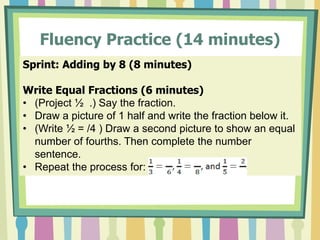
• (Project ½ .) Say the fraction.
• Draw a picture of 1 half and write the fraction below it.
• (Write ½ = /4 ) Draw a second picture to show an equal
number of fourths. Then complete the number
sentence.
• Repeat the process for:
Application Problem
(6 Minutes)
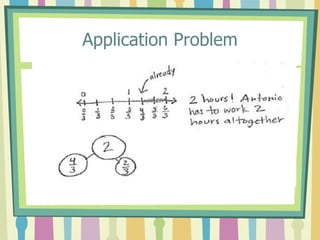
Antonio works on his project for 4 thirds of an
hour. His mom tells him that he must spend
another 2 thirds hour on it. Draw number bonds
and a number line with copies of thirds to show
how long Antonio worked altogether.
Application Problem
Concept Development
(30 minutes)
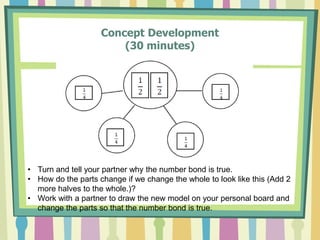
• Turn and tell your partner why the number bond is true.
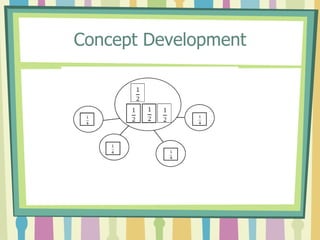
• How do the parts change if we change the whole to look like this (Add 2
more halves to the whole.)?
• Work with a partner to draw the new model on your personal board and
change the parts so that the number bond is true.
Concept Development
Concept Development
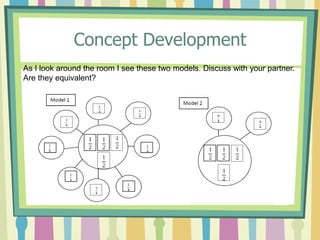
As I look around the room I see these two models. Discuss with your partner.
Are they equivalent?
Concept Development
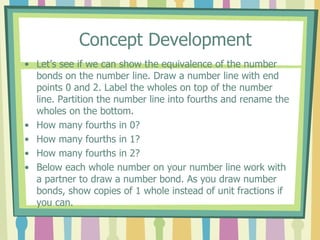
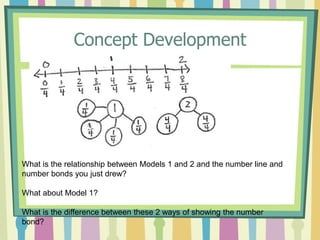
• Let’s see if we can show the equivalence of the number
bonds on the number line. Draw a number line with end
points 0 and 2. Label the wholes on top of the number
line. Partition the number line into fourths and rename the
wholes on the bottom.
• How many fourths in 0?
• How many fourths in 1?
• How many fourths in 2?
• Below each whole number on your number line work with
a partner to draw a number bond. As you draw number
bonds, show copies of 1 whole instead of unit fractions if
you can.
Concept Development
What is the relationship between Models 1 and 2 and the number line and
number bonds you just drew?
What about Model 1?
What is the difference between these 2 ways of showing the number
bond?
Problem Set (10 minutes)
You have 10 minutes to complete the problem set pages.
Debrief (8 minutes)
Let’s review your solutions for the problem set.
Exit Ticket
(3 minutes)
This is where you are going to show
us that you understand what we learned today!
We will learn if you are ready for the next lesson!
Homework
Lesson 26
Homework
Worksheet
Is Due Tomorrow!

Module 5, Lesson 26

  • 1.
    Fractions and Numberon the Number Line Module 5: Lesson 26 Objective: Decompose whole number fractions greater than 1 using whole number equivalence with various models.
  • 2.
    Fluency Practice (14minutes) Sprint: Adding by 8 (8 minutes) Write Equal Fractions (6 minutes) • (Project ½ .) Say the fraction. • Draw a picture of 1 half and write the fraction below it. • (Write ½ = /4 ) Draw a second picture to show an equal number of fourths. Then complete the number sentence. • Repeat the process for:
  • 3.
    Application Problem (6 Minutes) Antonioworks on his project for 4 thirds of an hour. His mom tells him that he must spend another 2 thirds hour on it. Draw number bonds and a number line with copies of thirds to show how long Antonio worked altogether.
  • 4.
  • 5.
    Concept Development (30 minutes) •Turn and tell your partner why the number bond is true. • How do the parts change if we change the whole to look like this (Add 2 more halves to the whole.)? • Work with a partner to draw the new model on your personal board and change the parts so that the number bond is true.
  • 6.
  • 7.
    Concept Development As Ilook around the room I see these two models. Discuss with your partner. Are they equivalent?
  • 8.
    Concept Development • Let’ssee if we can show the equivalence of the number bonds on the number line. Draw a number line with end points 0 and 2. Label the wholes on top of the number line. Partition the number line into fourths and rename the wholes on the bottom. • How many fourths in 0? • How many fourths in 1? • How many fourths in 2? • Below each whole number on your number line work with a partner to draw a number bond. As you draw number bonds, show copies of 1 whole instead of unit fractions if you can.
  • 9.
    Concept Development What isthe relationship between Models 1 and 2 and the number line and number bonds you just drew? What about Model 1? What is the difference between these 2 ways of showing the number bond?
  • 10.
    Problem Set (10minutes) You have 10 minutes to complete the problem set pages. Debrief (8 minutes) Let’s review your solutions for the problem set.
  • 11.
    Exit Ticket (3 minutes) Thisis where you are going to show us that you understand what we learned today! We will learn if you are ready for the next lesson!
  • 12.