Multiplication and Division with Units
of 0,1,6-9 & multiples of 10
Topic A: The Properties of Multiplication and Division
Module 3: Lesson 1
Objective: Study commutativity to find known facts
of 6, 7, 8, and 9.
Fluency Practice (15 minutes)
Sprint: Mixed Multiplication (9 minutes)
Sprint A: Do as many problems as you can!
Sprint B: Try to get one more right than you
did on Sprint A!
Fluency Practice
(11 minutes)
Group Counting
Count forward and backwards:
• Sixes to 60
• Sevens to 70
• Eight to 80
• Nines to 90
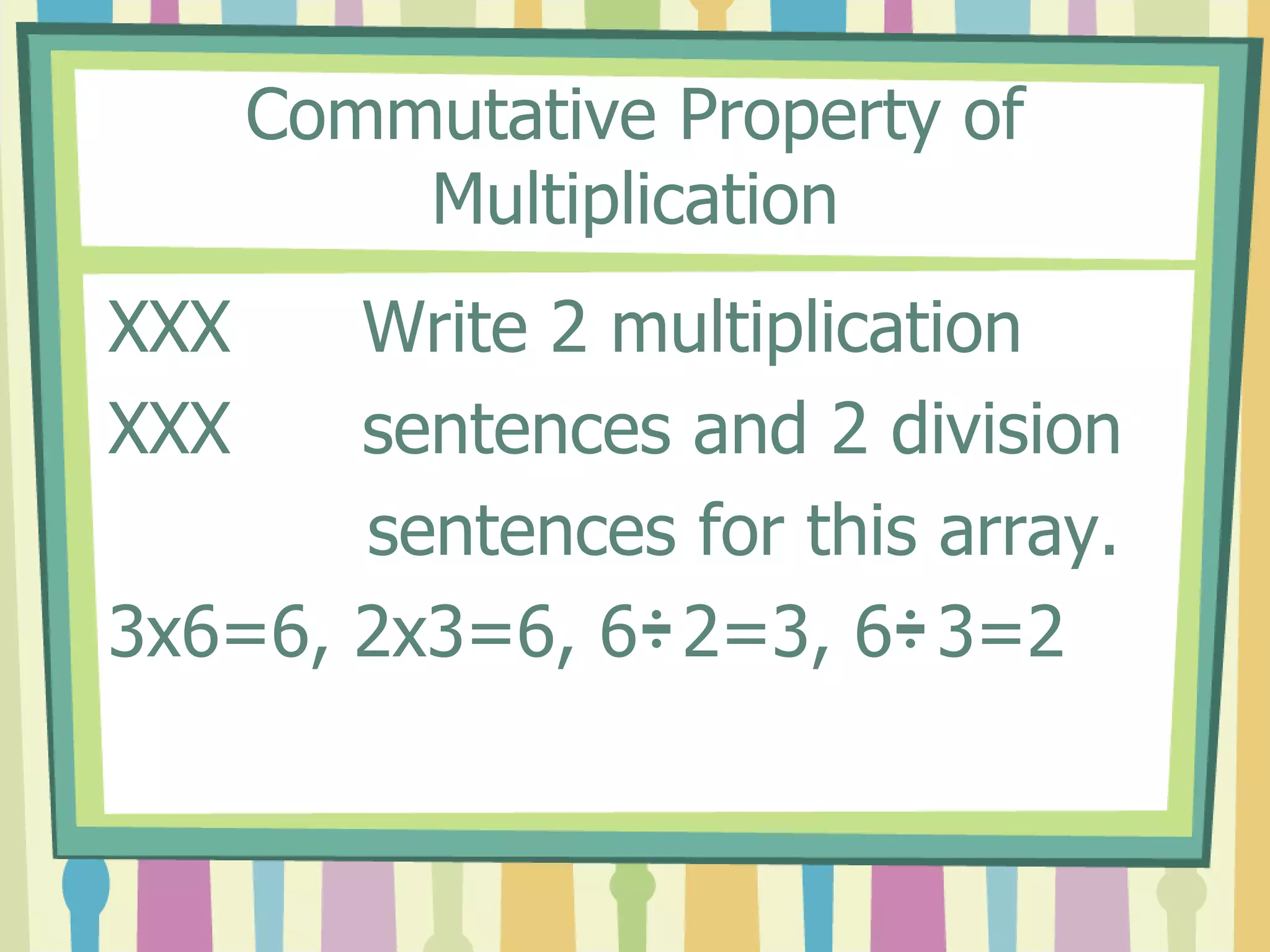
Commutative Property of
Multiplication
XXX Write 2 multiplication
XXX sentences and 2 division
sentences for this array.
3x6=6, 2x3=6, 6 2=3, 6 3=2
Commutative Property of
Multiplication
XX
XX
XX
XX
XX
XX
XX
XX
XX
XX
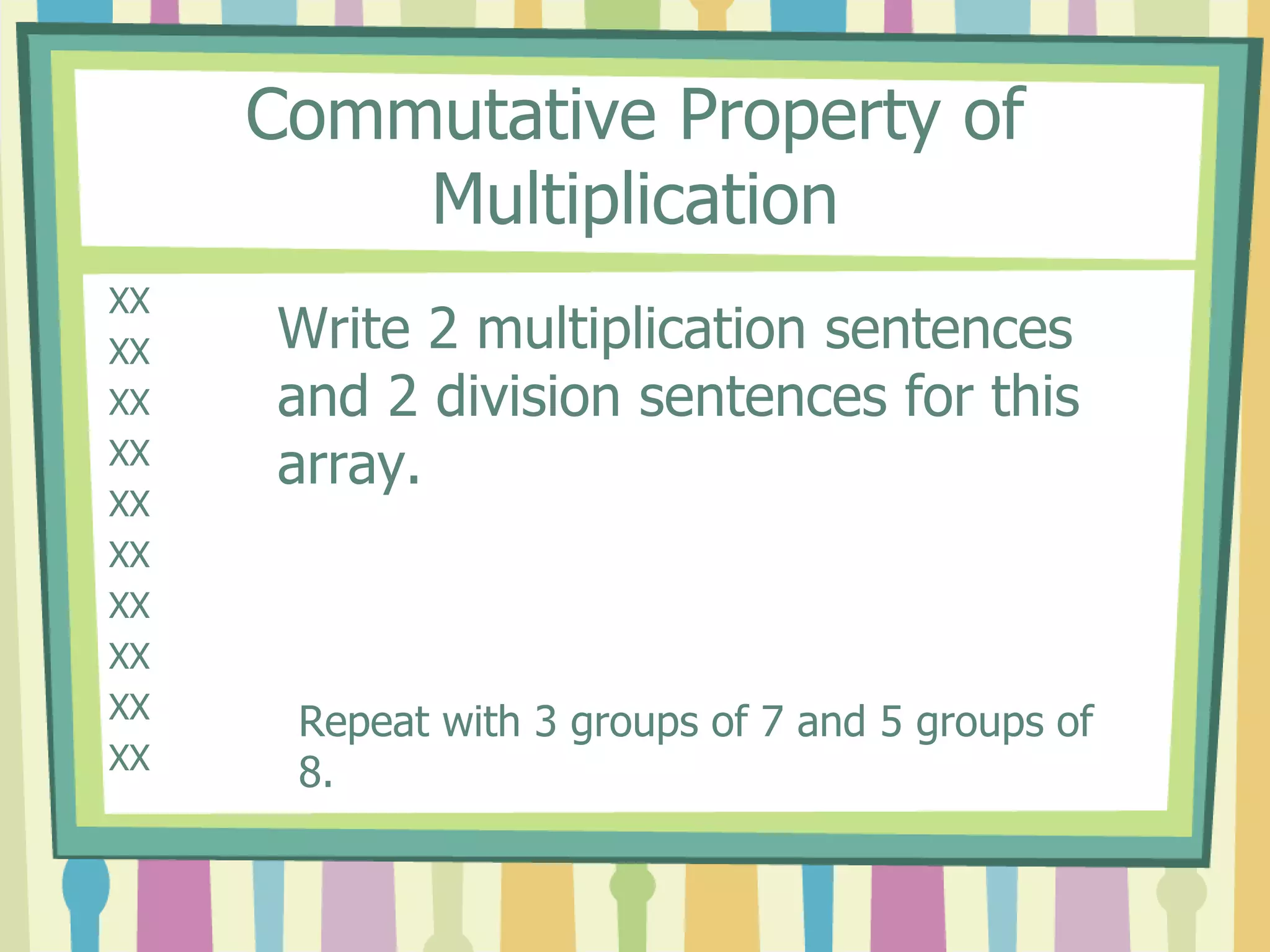
Write 2 multiplication sentences
and 2 division sentences for this
array.
Repeat with 3 groups of 7 and 5 groups of
8.
Application Problem
(5 minutes)
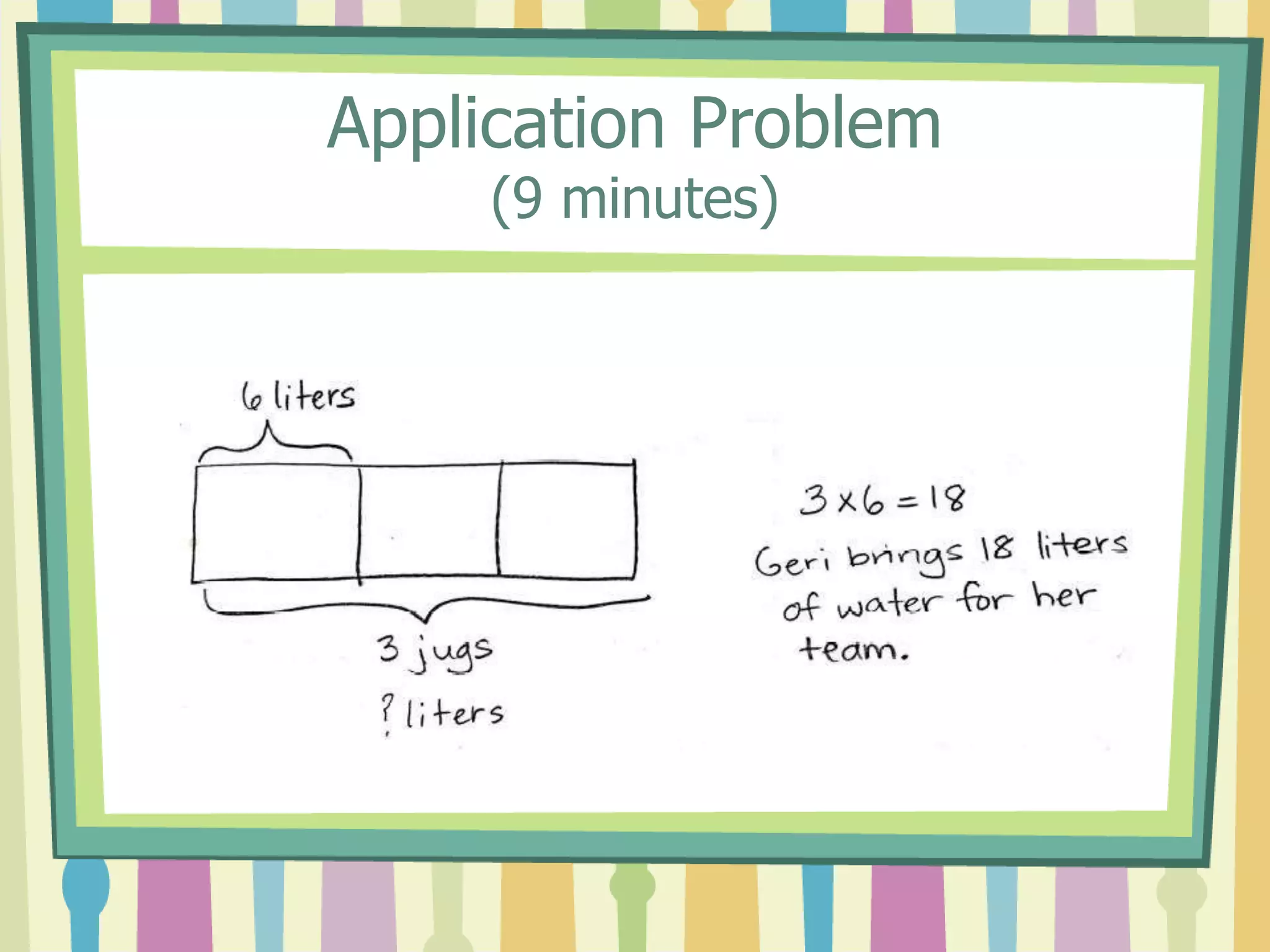
Geri brings 3 water jugs to her soccer
game to share with teammates. Each jug
contains 6 liters of water. How many liters
of water does Geri bring?
Draw a tape diagram to model this problem,
then solve using the RDW process.
Application Problem
(5 minutes)
Geri brings 3 water jugs to her soccer
game to share with teammates. Each jug
contains 6 liters of water. How many liters
of water does Geri bring?
Draw a tape diagram to model this problem,
then solve using the RDW process.
Application Problem
(9 minutes)
Concept Development (30 minutes)
Materials: (S) Personal White Boards, problem set
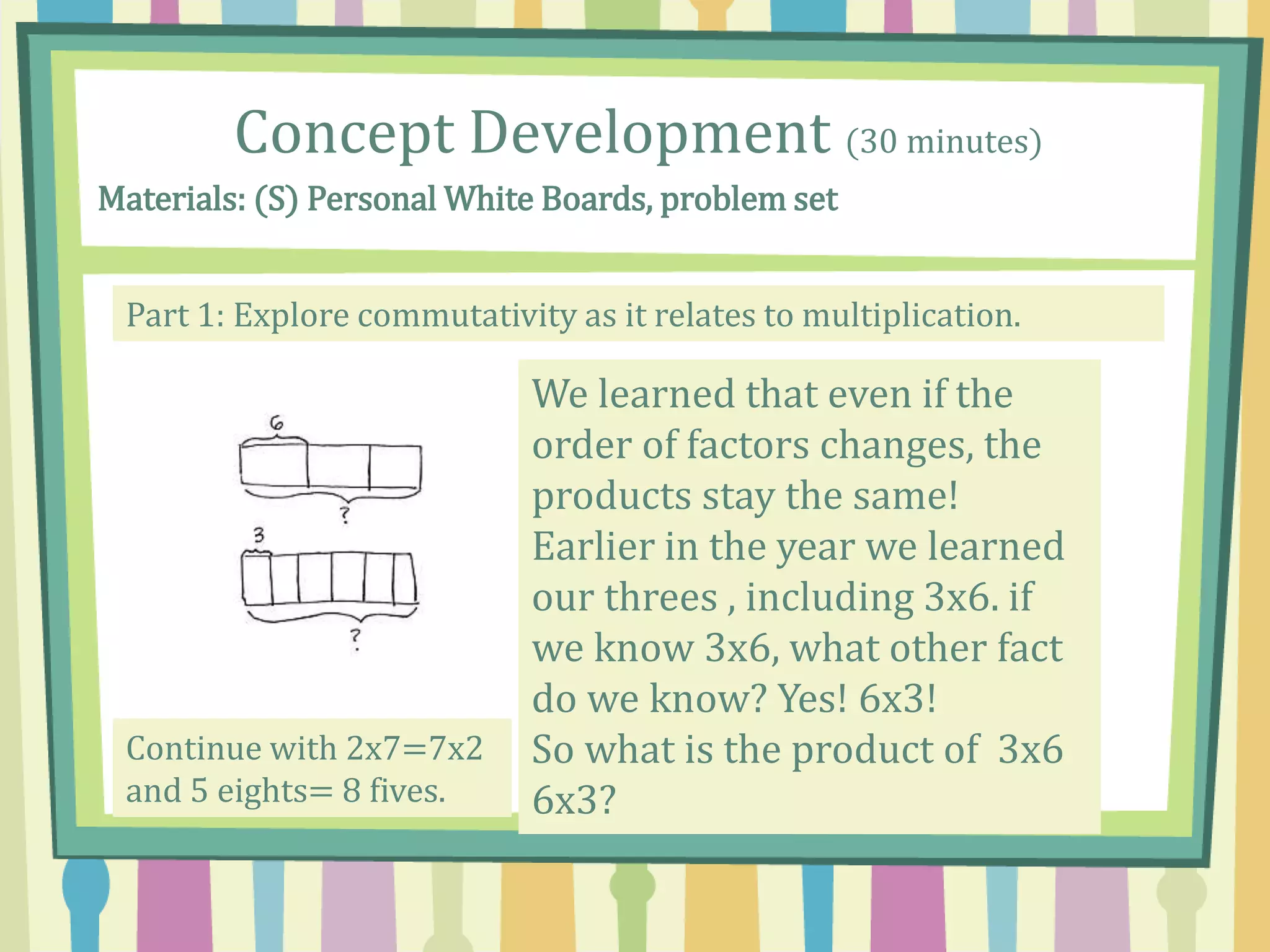
Part 1: Explore commutativity as it relates to multiplication.
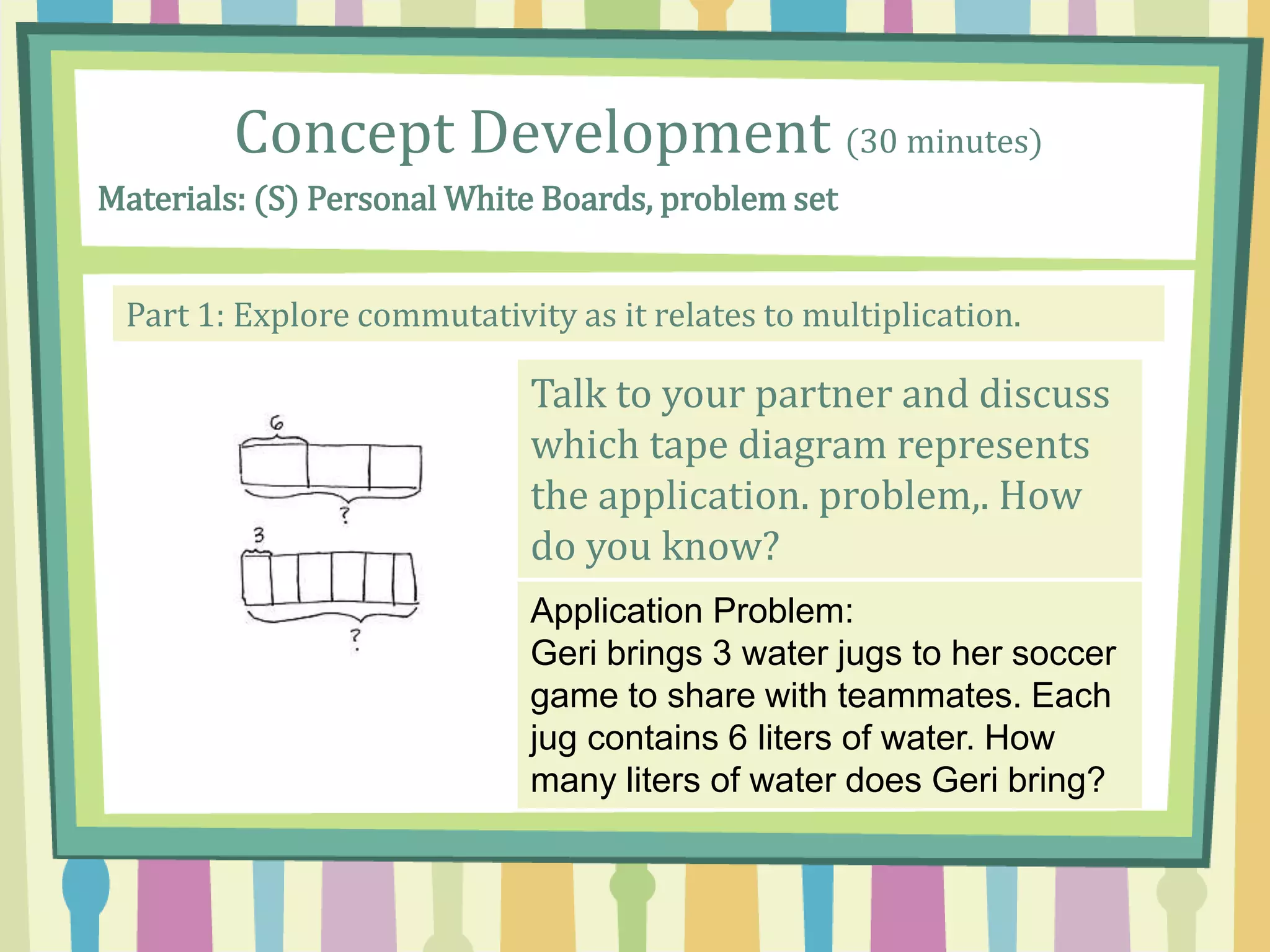
Talk to your partner and discuss
which tape diagram represents
the application. problem,. How
do you know?
Application Problem:
Geri brings 3 water jugs to her soccer
game to share with teammates. Each
jug contains 6 liters of water. How
many liters of water does Geri bring?
Concept Development (30 minutes)
Materials: (S) Personal White Boards, problem set
Part 1: Explore commutativity as it relates to multiplication.
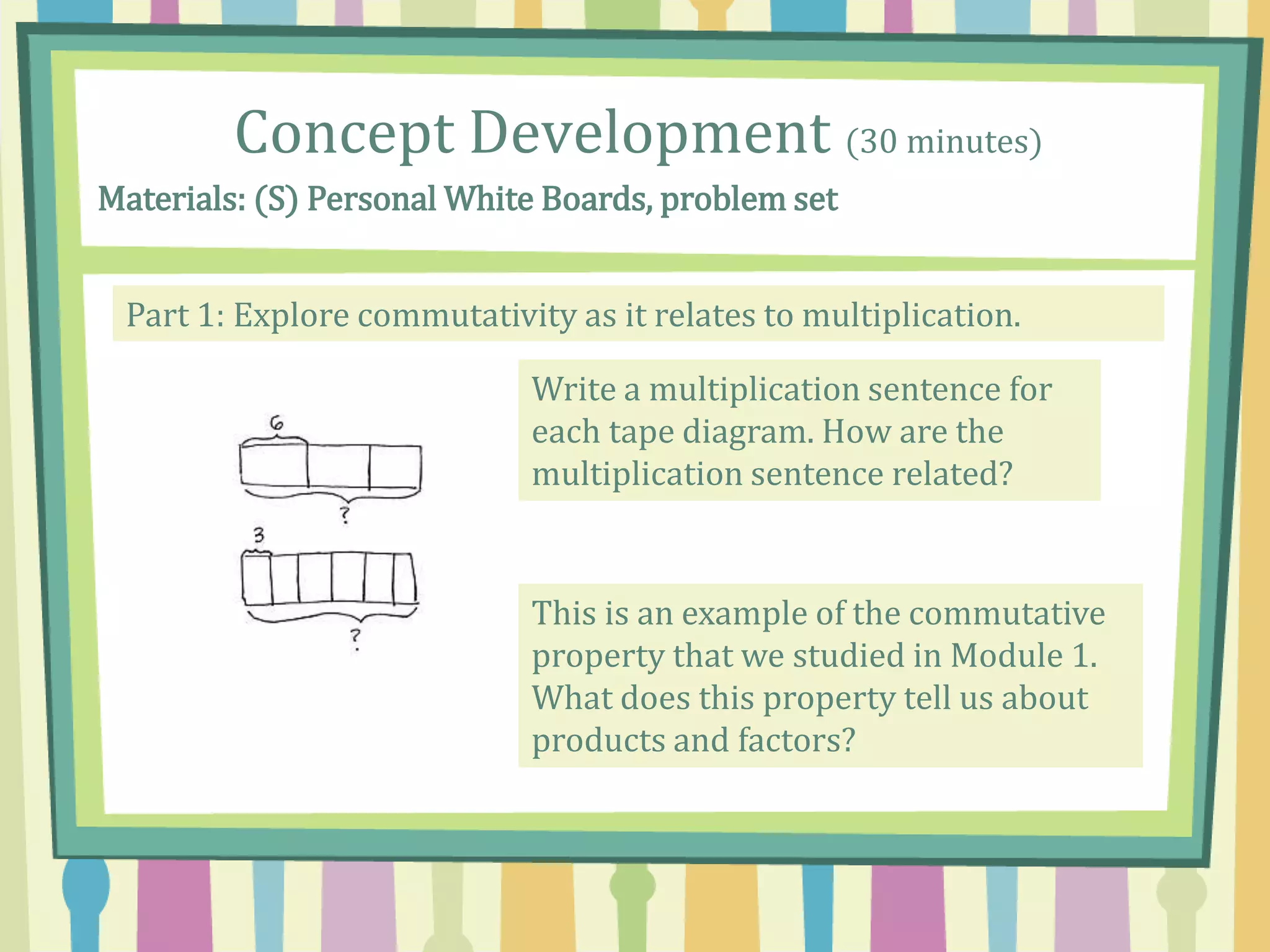
Write a multiplication sentence for
each tape diagram. How are the
multiplication sentence related?
This is an example of the commutative
property that we studied in Module 1.
What does this property tell us about
products and factors?
Concept Development (30 minutes)
Materials: (S) Personal White Boards, problem set
Part 1: Explore commutativity as it relates to multiplication.
We learned that even if the
order of factors changes, the
products stay the same!
Earlier in the year we learned
our threes , including 3x6. if
we know 3x6, what other fact
do we know? Yes! 6x3!
So what is the product of 3x6
6x3?
Continue with 2x7=7x2
and 5 eights= 8 fives.
Concept Development
(39 minutes)
Part 2: Use the multiplication chart to find the
known facts through commutativity.
Problem 1 on your problem set shows a multiplication
chart. The shaded numbers along the left column and
the top are factors. The numbers inside the chart are
products. Each un-shaded box represents the products
of 1 multiplication facts. Find the total number of facts
on your multiplication chart. How many facts are on the
chart?
Concept Development
(39 minutes)
Let’s use the chart to locate the product of 3 and 6. Put
your finger on Row 3 and slide it to the right until its
also in the 6 column. The number in the square where
the row and column meet is the product, which has
been done for you. What do you see in the chart is the
product of 3 and 6? Now let’s locate the product of 6
and 3. Find the square that where the row for 6 and
column for 3 meet. Use commutativity to write the
product of 6 and 3 in that square on your chart.
Concept Development
(30 minutes)
We can use commutativity to solve many new facts and fill in
the products on the chart. Write the products for all the facts
that we’ve already studied on the chart, then fill in those you
can solve using commutativity. (Allow time for students to
work.)
Shade in the facts you completed. (Allow time for students to
work.) How many are left to learn?
Look carefully at those 16 facts. Are there any that you will
be able to solve using the commutative property once you
know one? Really there are only 10 new facts to learn before
you know all the facts up to 10 × 10!
Problem Set (10 minutes)
You have 10 minutes to complete the problem set pages.
Debrief (10 minutes)
Let’s review your solutions for the problem set.
Exit Ticket
(3 minutes)
This is where you are going to show
us that you understand what we learned today!
We will learn if you are ready for the next lesson!
Homework
3-3 Lesson 1
Homework
Worksheet
Is Due Tomorrow!

Module 3 Lesson 1

  • 1.
    Multiplication and Divisionwith Units of 0,1,6-9 & multiples of 10 Topic A: The Properties of Multiplication and Division Module 3: Lesson 1 Objective: Study commutativity to find known facts of 6, 7, 8, and 9.
  • 2.
    Fluency Practice (15minutes) Sprint: Mixed Multiplication (9 minutes) Sprint A: Do as many problems as you can! Sprint B: Try to get one more right than you did on Sprint A!
  • 3.
    Fluency Practice (11 minutes) GroupCounting Count forward and backwards: • Sixes to 60 • Sevens to 70 • Eight to 80 • Nines to 90
  • 4.
    Commutative Property of Multiplication XXXWrite 2 multiplication XXX sentences and 2 division sentences for this array. 3x6=6, 2x3=6, 6 2=3, 6 3=2
  • 5.
    Commutative Property of Multiplication XX XX XX XX XX XX XX XX XX XX Write2 multiplication sentences and 2 division sentences for this array. Repeat with 3 groups of 7 and 5 groups of 8.
  • 6.
    Application Problem (5 minutes) Geribrings 3 water jugs to her soccer game to share with teammates. Each jug contains 6 liters of water. How many liters of water does Geri bring? Draw a tape diagram to model this problem, then solve using the RDW process.
  • 7.
    Application Problem (5 minutes) Geribrings 3 water jugs to her soccer game to share with teammates. Each jug contains 6 liters of water. How many liters of water does Geri bring? Draw a tape diagram to model this problem, then solve using the RDW process.
  • 8.
  • 9.
    Concept Development (30minutes) Materials: (S) Personal White Boards, problem set Part 1: Explore commutativity as it relates to multiplication. Talk to your partner and discuss which tape diagram represents the application. problem,. How do you know? Application Problem: Geri brings 3 water jugs to her soccer game to share with teammates. Each jug contains 6 liters of water. How many liters of water does Geri bring?
  • 10.
    Concept Development (30minutes) Materials: (S) Personal White Boards, problem set Part 1: Explore commutativity as it relates to multiplication. Write a multiplication sentence for each tape diagram. How are the multiplication sentence related? This is an example of the commutative property that we studied in Module 1. What does this property tell us about products and factors?
  • 11.
    Concept Development (30minutes) Materials: (S) Personal White Boards, problem set Part 1: Explore commutativity as it relates to multiplication. We learned that even if the order of factors changes, the products stay the same! Earlier in the year we learned our threes , including 3x6. if we know 3x6, what other fact do we know? Yes! 6x3! So what is the product of 3x6 6x3? Continue with 2x7=7x2 and 5 eights= 8 fives.
  • 12.
    Concept Development (39 minutes) Part2: Use the multiplication chart to find the known facts through commutativity. Problem 1 on your problem set shows a multiplication chart. The shaded numbers along the left column and the top are factors. The numbers inside the chart are products. Each un-shaded box represents the products of 1 multiplication facts. Find the total number of facts on your multiplication chart. How many facts are on the chart?
  • 13.
    Concept Development (39 minutes) Let’suse the chart to locate the product of 3 and 6. Put your finger on Row 3 and slide it to the right until its also in the 6 column. The number in the square where the row and column meet is the product, which has been done for you. What do you see in the chart is the product of 3 and 6? Now let’s locate the product of 6 and 3. Find the square that where the row for 6 and column for 3 meet. Use commutativity to write the product of 6 and 3 in that square on your chart.
  • 14.
    Concept Development (30 minutes) Wecan use commutativity to solve many new facts and fill in the products on the chart. Write the products for all the facts that we’ve already studied on the chart, then fill in those you can solve using commutativity. (Allow time for students to work.) Shade in the facts you completed. (Allow time for students to work.) How many are left to learn? Look carefully at those 16 facts. Are there any that you will be able to solve using the commutative property once you know one? Really there are only 10 new facts to learn before you know all the facts up to 10 × 10!
  • 15.
    Problem Set (10minutes) You have 10 minutes to complete the problem set pages. Debrief (10 minutes) Let’s review your solutions for the problem set.
  • 16.
    Exit Ticket (3 minutes) Thisis where you are going to show us that you understand what we learned today! We will learn if you are ready for the next lesson!
  • 17.