What is
WOODWORKING?
It is the art of
cutting, framing,
and joining timber
or wood.
CARPENTER
A skilled craftsperson
who performs carpentry.
Carpenters work with wood
to construct, install and
maintain buildings,
furniture, and other objects.
Types and Occupations
FINISH CARPENTER
- is one who does finish carpentry; that is, cabinetry, furniture
making, fine woodworking, model building, instrument making,
parquetry, joinery, or other carpentry where exact joints and minimal
margins of error are important.
TRIM CARPENTER
- specializes in molding and trim, such as door and window
casings, mantels, baseboard, and other types of ornamental work.
CABINETMAKER
- is a carpenter who does fine and detailed work, specializing
in the making of cabinets made from wood, wardrobes, dressers,
storage chests, and other furniture designed for storage.
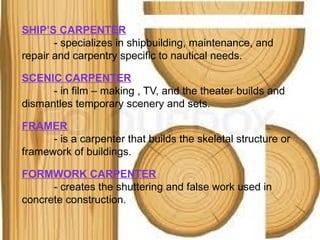
SHIP’S CARPENTER
- specializes in shipbuilding, maintenance, and
repair and carpentry specific to nautical needs.
SCENIC CARPENTER
- in film – making , TV, and the theater builds and
dismantles temporary scenery and sets.
FRAMER
- is a carpenter that builds the skeletal structure or
framework of buildings.
FORMWORK CARPENTER
- creates the shuttering and false work used in
concrete construction.
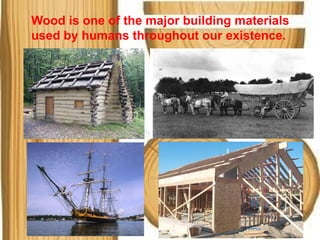
Wood is one of the major building materials
used by humans throughout our existence.
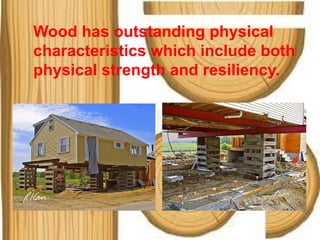
Wood has outstanding physical
characteristics which include both
physical strength and resiliency.
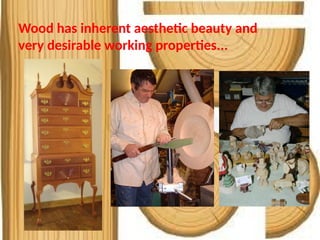
Wood has inherent aesthetic beauty and
very desirable working properties...
STRUCTURE
OF
WOOD
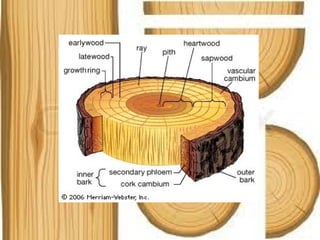
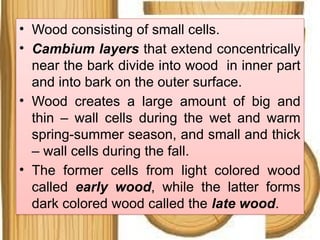
• Wood consisting of small cells.
• Cambium layers that extend concentrically
near the bark divide into wood in inner part
and into bark on the outer surface.
• Wood creates a large amount of big and
thin – wall cells during the wet and warm
spring-summer season, and small and thick
– wall cells during the fall.
• The former cells from light colored wood
called early wood, while the latter forms
dark colored wood called the late wood.
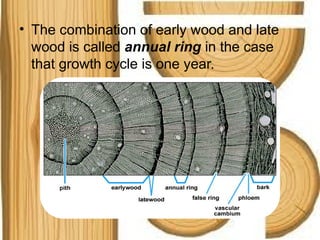
• The combination of early wood and late
wood is called annual ring in the case
that growth cycle is one year.
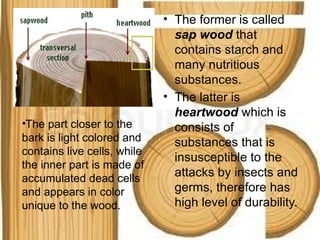
• The former is called
sap wood that
contains starch and
many nutritious
substances.
• The latter is
heartwood which is
consists of
substances that is
insusceptible to the
attacks by insects and
germs, therefore has
high level of durability.
•The part closer to the
bark is light colored and
contains live cells, while
the inner part is made of
accumulated dead cells
and appears in color
unique to the wood.
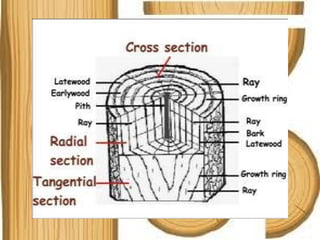
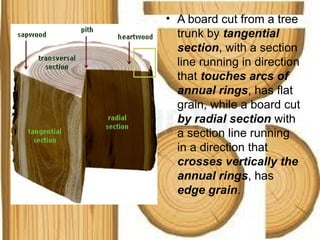
• A board cut from a tree
trunk by tangential
section, with a section
line running in direction
that touches arcs of
annual rings, has flat
grain, while a board cut
by radial section with
a section line running
in a direction that
crosses vertically the
annual rings, has
edge grain.
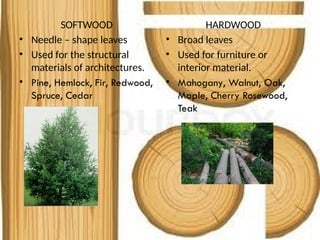
SOFTWOOD
• Needle – shape leaves
• Used for the structural
materials of architectures.
• Pine, Hemlock, Fir, Redwood,
Spruce, Cedar
HARDWOOD
• Broad leaves
• Used for furniture or
interior material.
• Mahogany, Walnut, Oak,
Maple, Cherry Rosewood,
Teak
PHYSICAL PROPERTY
OF
WOOD
• Wood shrinks when it discharges water and dries,
or swell when it absorbs water.
• This property relates to the amount of water
contained inside the cell wall of the wood, in other
words, the moisture content.
• Wood changes its shape in the drying process
according to place of origin and in the shape of the
wood.
• In order to avoid trouble, hardwood for home
furniture should be dried until the water content
becomes less than 6 – 12%, softwood for
architecture process should be dried until the
water content becomes less than 20%.
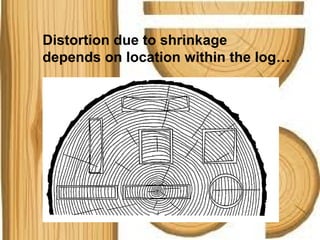
Distortion due to shrinkage
depends on location within the log…
MECHANICAL PROPERTY
OF
WOOD
Strength
• Strength posed on wood is received by its wall.
• Thickness of cell wall varies from species, and the
thicker the cell wall is, the higher specific gravity the
wood would possess.
• Therefore, wood with higher specific gravity has greater
strength and harder surface.
• The level of strength is significantly different within the
same wood, depending on the direction of the cell layout.
• Bending strength reaches to the highest level when
load is applied in a direction parallel to the fiber;
however, the strength is significantly reduced as the
angle of load direction against the fiber direction
becomes larger.
Distortion
• When wood is treated with heat by applying
hot steam, substances called lignin that
adhere each wood cell softened and create
gap between cells.
• This makes the wood easily distorted.
• If the wood is cooled and dried after it is
distorted, the distortion is fixed or permanent
and cannot be reversed to the original state.
• This property is used in making bent wood
products.
PREPARATION
OF
WOOD
Lumbering
Logging
Sawing
assembling
Methods and or manner of log sawing:
A. Plain or bastard sawing
- cutting the logs entirely through the
diameter a parallel cord tangential to the
annual rings.
B. Quarter or Rift Sawing
- divided into four methods; radial methods,
tangential method, quarter tangential, and
combined radial and tangential.
Seasoning of lumber
Natural or Air Seasoning
- considered as one of the best methods in
seasoning lumber although the period
involved is longer than the artificial method.
Artificial Seasoning
- method adopted for quick drying of the
wood such as forced air drying, kiln drying
and radio frequency dielectric drying.
Lumber and other related products:
1. Veneer and plywood
- are made of 3, 4, 7 or more veneer
slice that are laid upon the other with the
grain of each at right angle to those of the
sheets above or below.
a. Soft Plywood – most common for structural use.
b. Hardwood Plywood – used for paneling and finishing
where usually only one face is with hardwood finish.
c. Exterior or marine plywood – is made for external use.
2. Hardboard/Pressed wood or fiber board
- is made from woodchips which are exploded into
fibers with high pressure steam.
3. Particle Boards
- manufactured from wood chips, curls, fibers, flakes,
strands, shaving slivers which are bound together
and pressed into sheets and other molded shapes.
4. Laminated Wood
- processed by sawmilling and drying, knot and
cracks are removed, and the pieces are connected by
finger joints in fiber direction to create a wide and
long materials.
DEFECTS
OF
WOOD
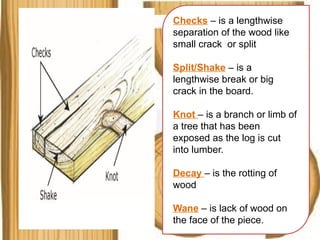
Checks – is a lengthwise
separation of the wood like
small crack or split
Split/Shake – is a
lengthwise break or big
crack in the board.
Knot – is a branch or limb of
a tree that has been
exposed as the log is cut
into lumber.
Decay – is the rotting of
wood
Wane – is lack of wood on
the face of the piece.
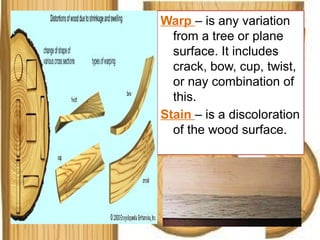
Warp – is any variation
from a tree or plane
surface. It includes
crack, bow, cup, twist,
or nay combination of
this.
Stain – is a discoloration
of the wood surface.
DIMENSIONING
OF
WOOD
Lumbers are sold according to
their dimensions where thickness
and width are measured in inches
and the length is measured in feet.
Prices of lumber sold are based on a
unit called BOARD FOOT which
means a piece of wood 12 inches
long, 12 inches wide and 1 inch
thick (12” x 12” x 1’)
To compute the total board feet in a
piece of lumber use the formula”
T”xW”xL’
12
Where: T” = thickness in inch
W” = width in inch
L’ = length in feet
12 = constant
Example:
Find the total board foot of 5 pieces of
2”x10”x14’ lumber.
Solution:
Bd. ft. = 7pcsx2x10x14
12
= 70 bd. ft.
* Lumber is sold either rough or
surfaced.
Prices of lumber ranges
according to the following:
1.Types of wood
2.Dimensions
3.Grades of lumber – either
sun dried, air dried, or kiln
dried
Woodworking Methods
1. Planning
a) Drawing and designing the project
b) Identify bill of materials
c) List the procedures
d) List tools and machines needed
2. Cutting – cutting wood to the right
size and shape can be done with a
variety of hand tools and machines.
3. Assembling – constructing the parts
of the project based on the planned
design.
4. Sanding and Finishing – sanding
removes tools marks and make wood
surface smooth for finishing. Sanding
should not begin until the wood has
been cut to its final size.
Sawing
• Different types of saws must be used
when you cut along the fiber direction
and when you cut across or
perpendicular or at an angle to the fiber
direction of the wood
• A rip saw is used to cut along the fiber
of the wood while cross cut saw is used
to cut across or perpendicular or at an
angle to the fiber of the wood.
• When sawing along the cutting lines,
make sure that your head is right above
or on the extension line from the saw
blade so that you can cut straight, with
the top surface and cutting surface of the
wood forms the right angle.
• When starting to cut, guide the saw blade
with your thumb and make a small chase.
• When finishing cutting, move the saw
slowly in the horizontal direction and
support the removing piece of wood at
the same time to avoid splitting.
Driving and Pulling Nails
• Hold the nail firmly near the pointed end with one
hand while grasping the hammer handle.
• Tap the nail lightly to start, then push down the nail
by hitting the head squarely.
• With some materials especially hardwood and
moldings, you’ll have to drill pilot holes before
driving the nails to avoid splitting.
• When removing or pulling deformed or bent nails,
place a block of wood under the hammer to prevent
or protect the wood surface from being scratched as
nails are pulled.
COMMON
CARPENTRY
TOOLS
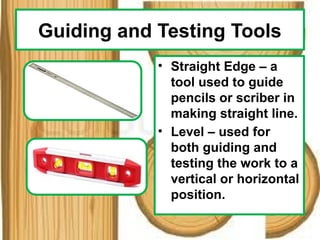
Guiding and Testing Tools
• Straight Edge – a
tool used to guide
pencils or scriber in
making straight line.
• Level – used for
both guiding and
testing the work to a
vertical or horizontal
position.
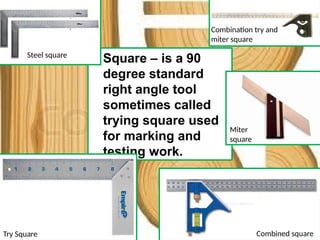
• Square – is a 90
degree standard
right angle tool
sometimes called
trying square used
for marking and
testing work.
Try Square
Miter
square
Combination try and
miter square
Combined square
Steel square
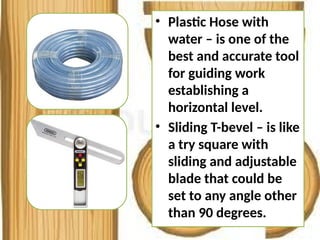
• Plastic Hose with
water – is one of the
best and accurate tool
for guiding work
establishing a
horizontal level.
• Sliding T-bevel – is like
a try square with
sliding and adjustable
blade that could be
set to any angle other
than 90 degrees.
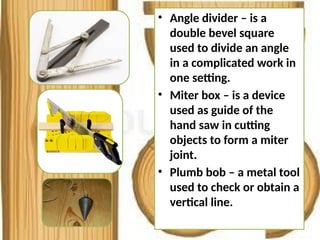
• Angle divider – is a
double bevel square
used to divide an angle
in a complicated work in
one setting.
• Miter box – is a device
used as guide of the
hand saw in cutting
objects to form a miter
joint.
• Plumb bob – a metal tool
used to check or obtain a
vertical line.
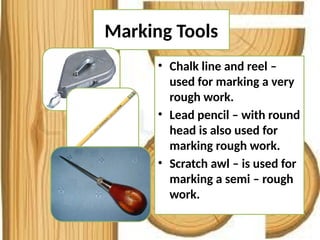
Marking Tools
• Chalk line and reel –
used for marking a very
rough work.
• Lead pencil – with round
head is also used for
marking rough work.
• Scratch awl – is used for
marking a semi – rough
work.
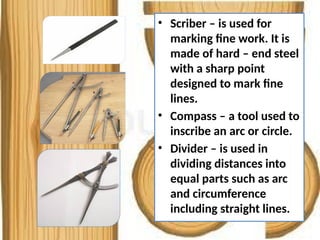
• Scriber – is used for
marking fine work. It is
made of hard – end steel
with a sharp point
designed to mark fine
lines.
• Compass – a tool used to
inscribe an arc or circle.
• Divider – is used in
dividing distances into
equal parts such as arc
and circumference
including straight lines.
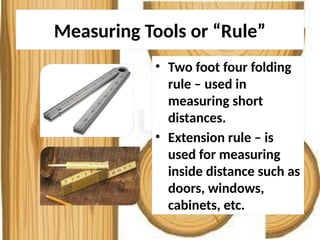
Measuring Tools or “Rule”
• Two foot four folding
rule – used in
measuring short
distances.
• Extension rule – is
used for measuring
inside distance such as
doors, windows,
cabinets, etc.
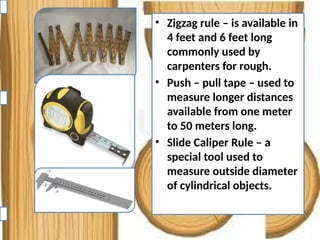
• Zigzag rule – is available in
4 feet and 6 feet long
commonly used by
carpenters for rough.
• Push – pull tape – used to
measure longer distances
available from one meter
to 50 meters long.
• Slide Caliper Rule – a
special tool used to
measure outside diameter
of cylindrical objects.
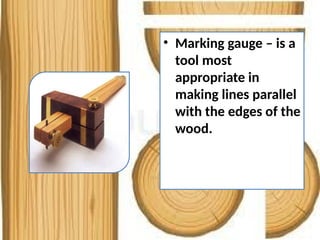
• Marking gauge – is a
tool most
appropriate in
making lines parallel
with the edges of the
wood.
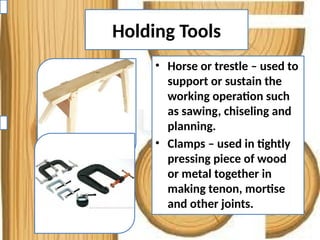
Holding Tools
• Horse or trestle – used to
support or sustain the
working operation such
as sawing, chiseling and
planning.
• Clamps – used in tightly
pressing piece of wood
or metal together in
making tenon, mortise
and other joints.
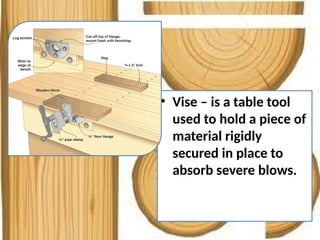
• Vise – is a table tool
used to hold a piece of
material rigidly
secured in place to
absorb severe blows.
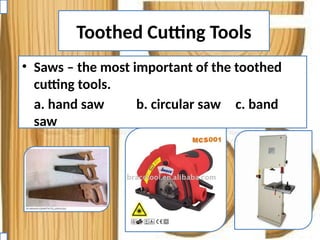
Toothed Cutting Tools
• Saws – the most important of the toothed
cutting tools.
a. hand saw b. circular saw c. band
saw
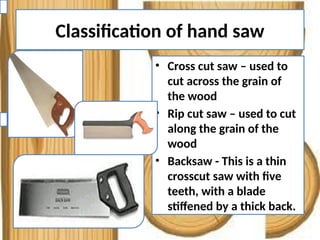
Classification of hand saw
• Cross cut saw – used to
cut across the grain of
the wood
• Rip cut saw – used to cut
along the grain of the
wood
• Backsaw - This is a thin
crosscut saw with five
teeth, with a blade
stiffened by a thick back.
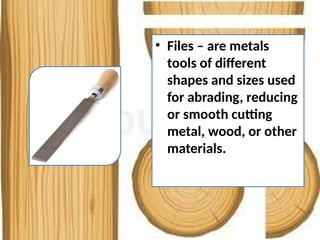
• Files – are metals
tools of different
shapes and sizes used
for abrading, reducing
or smooth cutting
metal, wood, or other
materials.
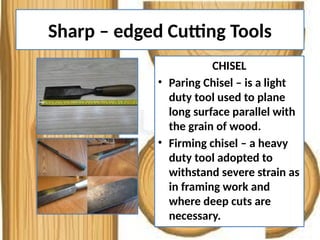
Sharp – edged Cutting Tools
CHISEL
• Paring Chisel – is a light
duty tool used to plane
long surface parallel with
the grain of wood.
• Firming chisel – a heavy
duty tool adopted to
withstand severe strain as
in framing work and
where deep cuts are
necessary.
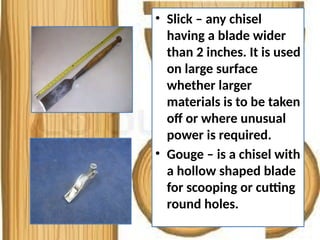
• Slick – any chisel
having a blade wider
than 2 inches. It is used
on large surface
whether larger
materials is to be taken
off or where unusual
power is required.
• Gouge – is a chisel with
a hollow shaped blade
for scooping or cutting
round holes.
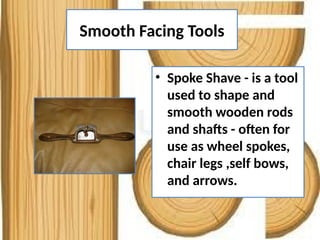
Smooth Facing Tools
• Spoke Shave - is a tool
used to shape and
smooth wooden rods
and shafts - often for
use as wheel spokes,
chair legs ,self bows,
and arrows.
PLANES
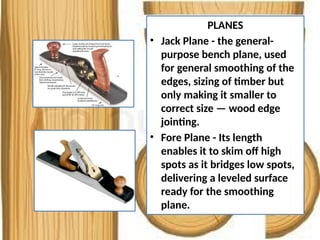
• Jack Plane - the general-
purpose bench plane, used
for general smoothing of the
edges, sizing of timber but
only making it smaller to
correct size — wood edge
jointing.
• Fore Plane - Its length
enables it to skim off high
spots as it bridges low spots,
delivering a leveled surface
ready for the smoothing
plane.
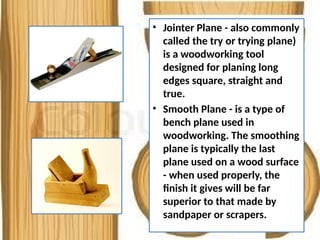
• Jointer Plane - also commonly
called the try or trying plane)
is a woodworking tool
designed for planing long
edges square, straight and
true.
• Smooth Plane - is a type of
bench plane used in
woodworking. The smoothing
plane is typically the last
plane used on a wood surface
- when used properly, the
finish it gives will be far
superior to that made by
sandpaper or scrapers.
Boring Tools
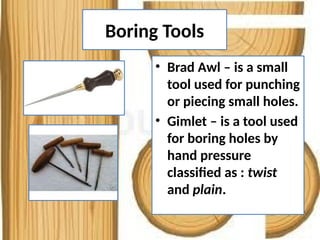
• Brad Awl – is a small
tool used for punching
or piecing small holes.
• Gimlet – is a tool used
for boring holes by
hand pressure
classified as : twist
and plain.
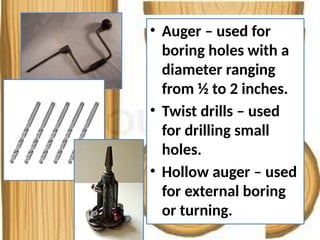
• Auger – used for
boring holes with a
diameter ranging
from ½ to 2 inches.
• Twist drills – used
for drilling small
holes.
• Hollow auger – used
for external boring
or turning.
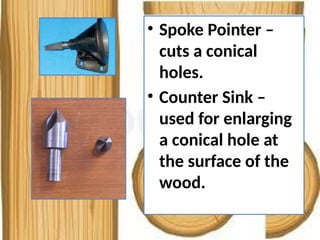
• Spoke Pointer –
cuts a conical
holes.
• Counter Sink –
used for enlarging
a conical hole at
the surface of the
wood.
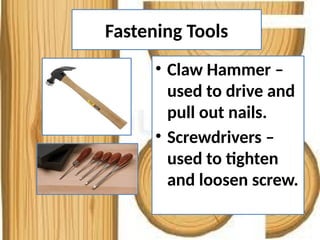
Fastening Tools
• Claw Hammer –
used to drive and
pull out nails.
• Screwdrivers –
used to tighten
and loosen screw.
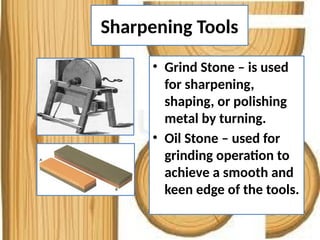
Sharpening Tools
• Grind Stone – is used
for sharpening,
shaping, or polishing
metal by turning.
• Oil Stone – used for
grinding operation to
achieve a smooth and
keen edge of the tools.
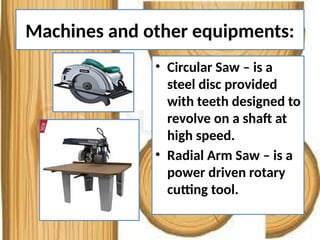
Machines and other equipments:
• Circular Saw – is a
steel disc provided
with teeth designed to
revolve on a shaft at
high speed.
• Radial Arm Saw – is a
power driven rotary
cutting tool.
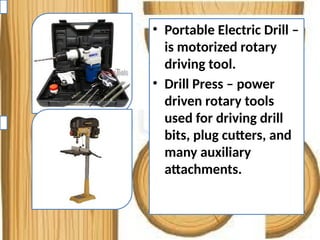
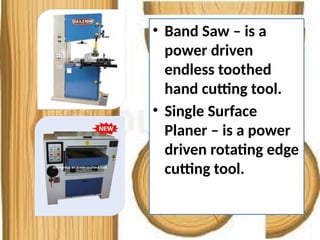
• Portable Electric Drill –
is motorized rotary
driving tool.
• Drill Press – power
driven rotary tools
used for driving drill
bits, plug cutters, and
many auxiliary
attachments.
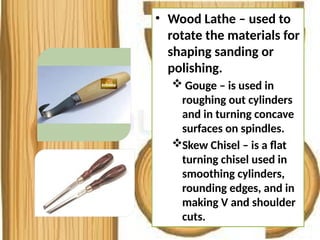
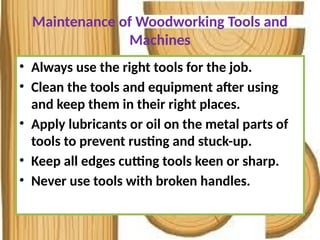
• Band Saw – is a
power driven
endless toothed
hand cutting tool.
• Single Surface
Planer – is a power
driven rotating edge
cutting tool.
• Wood Lathe – used to
rotate the materials for
shaping sanding or
polishing.
 Gouge – is used in
roughing out cylinders
and in turning concave
surfaces on spindles.
Skew Chisel – is a flat
turning chisel used in
smoothing cylinders,
rounding edges, and in
making V and shoulder
cuts.
Maintenance of Woodworking Tools and
Machines
• Always use the right tools for the job.
• Clean the tools and equipment after using
and keep them in their right places.
• Apply lubricants or oil on the metal parts of
tools to prevent rusting and stuck-up.
• Keep all edges cutting tools keen or sharp.
• Never use tools with broken handles.
THANK
YOU!!!

4th-Lesson-3-inserted-woodworking-G8.pptx

  • 2.
  • 3.
    It is theart of cutting, framing, and joining timber or wood.
  • 4.
    CARPENTER A skilled craftsperson whoperforms carpentry. Carpenters work with wood to construct, install and maintain buildings, furniture, and other objects.
  • 5.
    Types and Occupations FINISHCARPENTER - is one who does finish carpentry; that is, cabinetry, furniture making, fine woodworking, model building, instrument making, parquetry, joinery, or other carpentry where exact joints and minimal margins of error are important. TRIM CARPENTER - specializes in molding and trim, such as door and window casings, mantels, baseboard, and other types of ornamental work. CABINETMAKER - is a carpenter who does fine and detailed work, specializing in the making of cabinets made from wood, wardrobes, dressers, storage chests, and other furniture designed for storage.
  • 6.
    SHIP’S CARPENTER - specializesin shipbuilding, maintenance, and repair and carpentry specific to nautical needs. SCENIC CARPENTER - in film – making , TV, and the theater builds and dismantles temporary scenery and sets. FRAMER - is a carpenter that builds the skeletal structure or framework of buildings. FORMWORK CARPENTER - creates the shuttering and false work used in concrete construction.
  • 7.
    Wood is oneof the major building materials used by humans throughout our existence.
  • 8.
    Wood has outstandingphysical characteristics which include both physical strength and resiliency.
  • 9.
    Wood has inherentaesthetic beauty and very desirable working properties...
  • 10.
  • 13.
    • Wood consistingof small cells. • Cambium layers that extend concentrically near the bark divide into wood in inner part and into bark on the outer surface. • Wood creates a large amount of big and thin – wall cells during the wet and warm spring-summer season, and small and thick – wall cells during the fall. • The former cells from light colored wood called early wood, while the latter forms dark colored wood called the late wood.
  • 14.
    • The combinationof early wood and late wood is called annual ring in the case that growth cycle is one year.
  • 15.
    • The formeris called sap wood that contains starch and many nutritious substances. • The latter is heartwood which is consists of substances that is insusceptible to the attacks by insects and germs, therefore has high level of durability. •The part closer to the bark is light colored and contains live cells, while the inner part is made of accumulated dead cells and appears in color unique to the wood.
  • 16.
    • A boardcut from a tree trunk by tangential section, with a section line running in direction that touches arcs of annual rings, has flat grain, while a board cut by radial section with a section line running in a direction that crosses vertically the annual rings, has edge grain.
  • 17.
    SOFTWOOD • Needle –shape leaves • Used for the structural materials of architectures. • Pine, Hemlock, Fir, Redwood, Spruce, Cedar HARDWOOD • Broad leaves • Used for furniture or interior material. • Mahogany, Walnut, Oak, Maple, Cherry Rosewood, Teak
  • 18.
  • 19.
    • Wood shrinkswhen it discharges water and dries, or swell when it absorbs water. • This property relates to the amount of water contained inside the cell wall of the wood, in other words, the moisture content. • Wood changes its shape in the drying process according to place of origin and in the shape of the wood. • In order to avoid trouble, hardwood for home furniture should be dried until the water content becomes less than 6 – 12%, softwood for architecture process should be dried until the water content becomes less than 20%.
  • 20.
    Distortion due toshrinkage depends on location within the log…
  • 21.
  • 22.
    Strength • Strength posedon wood is received by its wall. • Thickness of cell wall varies from species, and the thicker the cell wall is, the higher specific gravity the wood would possess. • Therefore, wood with higher specific gravity has greater strength and harder surface. • The level of strength is significantly different within the same wood, depending on the direction of the cell layout. • Bending strength reaches to the highest level when load is applied in a direction parallel to the fiber; however, the strength is significantly reduced as the angle of load direction against the fiber direction becomes larger.
  • 23.
    Distortion • When woodis treated with heat by applying hot steam, substances called lignin that adhere each wood cell softened and create gap between cells. • This makes the wood easily distorted. • If the wood is cooled and dried after it is distorted, the distortion is fixed or permanent and cannot be reversed to the original state. • This property is used in making bent wood products.
  • 24.
  • 25.
  • 26.
    Methods and ormanner of log sawing: A. Plain or bastard sawing - cutting the logs entirely through the diameter a parallel cord tangential to the annual rings. B. Quarter or Rift Sawing - divided into four methods; radial methods, tangential method, quarter tangential, and combined radial and tangential.
  • 27.
    Seasoning of lumber Naturalor Air Seasoning - considered as one of the best methods in seasoning lumber although the period involved is longer than the artificial method. Artificial Seasoning - method adopted for quick drying of the wood such as forced air drying, kiln drying and radio frequency dielectric drying.
  • 28.
    Lumber and otherrelated products: 1. Veneer and plywood - are made of 3, 4, 7 or more veneer slice that are laid upon the other with the grain of each at right angle to those of the sheets above or below. a. Soft Plywood – most common for structural use. b. Hardwood Plywood – used for paneling and finishing where usually only one face is with hardwood finish. c. Exterior or marine plywood – is made for external use.
  • 29.
    2. Hardboard/Pressed woodor fiber board - is made from woodchips which are exploded into fibers with high pressure steam. 3. Particle Boards - manufactured from wood chips, curls, fibers, flakes, strands, shaving slivers which are bound together and pressed into sheets and other molded shapes. 4. Laminated Wood - processed by sawmilling and drying, knot and cracks are removed, and the pieces are connected by finger joints in fiber direction to create a wide and long materials.
  • 30.
  • 31.
    Checks – isa lengthwise separation of the wood like small crack or split Split/Shake – is a lengthwise break or big crack in the board. Knot – is a branch or limb of a tree that has been exposed as the log is cut into lumber. Decay – is the rotting of wood Wane – is lack of wood on the face of the piece.
  • 32.
    Warp – isany variation from a tree or plane surface. It includes crack, bow, cup, twist, or nay combination of this. Stain – is a discoloration of the wood surface.
  • 33.
  • 34.
    Lumbers are soldaccording to their dimensions where thickness and width are measured in inches and the length is measured in feet.
  • 35.
    Prices of lumbersold are based on a unit called BOARD FOOT which means a piece of wood 12 inches long, 12 inches wide and 1 inch thick (12” x 12” x 1’)
  • 36.
    To compute thetotal board feet in a piece of lumber use the formula” T”xW”xL’ 12 Where: T” = thickness in inch W” = width in inch L’ = length in feet 12 = constant
  • 37.
    Example: Find the totalboard foot of 5 pieces of 2”x10”x14’ lumber. Solution: Bd. ft. = 7pcsx2x10x14 12 = 70 bd. ft. * Lumber is sold either rough or surfaced.
  • 38.
    Prices of lumberranges according to the following: 1.Types of wood 2.Dimensions 3.Grades of lumber – either sun dried, air dried, or kiln dried
  • 39.
    Woodworking Methods 1. Planning a)Drawing and designing the project b) Identify bill of materials c) List the procedures d) List tools and machines needed 2. Cutting – cutting wood to the right size and shape can be done with a variety of hand tools and machines.
  • 40.
    3. Assembling –constructing the parts of the project based on the planned design. 4. Sanding and Finishing – sanding removes tools marks and make wood surface smooth for finishing. Sanding should not begin until the wood has been cut to its final size.
  • 41.
    Sawing • Different typesof saws must be used when you cut along the fiber direction and when you cut across or perpendicular or at an angle to the fiber direction of the wood • A rip saw is used to cut along the fiber of the wood while cross cut saw is used to cut across or perpendicular or at an angle to the fiber of the wood.
  • 42.
    • When sawingalong the cutting lines, make sure that your head is right above or on the extension line from the saw blade so that you can cut straight, with the top surface and cutting surface of the wood forms the right angle. • When starting to cut, guide the saw blade with your thumb and make a small chase. • When finishing cutting, move the saw slowly in the horizontal direction and support the removing piece of wood at the same time to avoid splitting.
  • 43.
    Driving and PullingNails • Hold the nail firmly near the pointed end with one hand while grasping the hammer handle. • Tap the nail lightly to start, then push down the nail by hitting the head squarely. • With some materials especially hardwood and moldings, you’ll have to drill pilot holes before driving the nails to avoid splitting. • When removing or pulling deformed or bent nails, place a block of wood under the hammer to prevent or protect the wood surface from being scratched as nails are pulled.
  • 44.
  • 45.
    Guiding and TestingTools • Straight Edge – a tool used to guide pencils or scriber in making straight line. • Level – used for both guiding and testing the work to a vertical or horizontal position.
  • 46.
    • Square –is a 90 degree standard right angle tool sometimes called trying square used for marking and testing work. Try Square Miter square Combination try and miter square Combined square Steel square
  • 47.
    • Plastic Hosewith water – is one of the best and accurate tool for guiding work establishing a horizontal level. • Sliding T-bevel – is like a try square with sliding and adjustable blade that could be set to any angle other than 90 degrees.
  • 48.
    • Angle divider– is a double bevel square used to divide an angle in a complicated work in one setting. • Miter box – is a device used as guide of the hand saw in cutting objects to form a miter joint. • Plumb bob – a metal tool used to check or obtain a vertical line.
  • 49.
    Marking Tools • Chalkline and reel – used for marking a very rough work. • Lead pencil – with round head is also used for marking rough work. • Scratch awl – is used for marking a semi – rough work.
  • 50.
    • Scriber –is used for marking fine work. It is made of hard – end steel with a sharp point designed to mark fine lines. • Compass – a tool used to inscribe an arc or circle. • Divider – is used in dividing distances into equal parts such as arc and circumference including straight lines.
  • 51.
    Measuring Tools or“Rule” • Two foot four folding rule – used in measuring short distances. • Extension rule – is used for measuring inside distance such as doors, windows, cabinets, etc.
  • 52.
    • Zigzag rule– is available in 4 feet and 6 feet long commonly used by carpenters for rough. • Push – pull tape – used to measure longer distances available from one meter to 50 meters long. • Slide Caliper Rule – a special tool used to measure outside diameter of cylindrical objects.
  • 53.
    • Marking gauge– is a tool most appropriate in making lines parallel with the edges of the wood.
  • 54.
    Holding Tools • Horseor trestle – used to support or sustain the working operation such as sawing, chiseling and planning. • Clamps – used in tightly pressing piece of wood or metal together in making tenon, mortise and other joints.
  • 55.
    • Vise –is a table tool used to hold a piece of material rigidly secured in place to absorb severe blows.
  • 56.
    Toothed Cutting Tools •Saws – the most important of the toothed cutting tools. a. hand saw b. circular saw c. band saw
  • 57.
    Classification of handsaw • Cross cut saw – used to cut across the grain of the wood • Rip cut saw – used to cut along the grain of the wood • Backsaw - This is a thin crosscut saw with five teeth, with a blade stiffened by a thick back.
  • 58.
    • Files –are metals tools of different shapes and sizes used for abrading, reducing or smooth cutting metal, wood, or other materials.
  • 59.
    Sharp – edgedCutting Tools CHISEL • Paring Chisel – is a light duty tool used to plane long surface parallel with the grain of wood. • Firming chisel – a heavy duty tool adopted to withstand severe strain as in framing work and where deep cuts are necessary.
  • 60.
    • Slick –any chisel having a blade wider than 2 inches. It is used on large surface whether larger materials is to be taken off or where unusual power is required. • Gouge – is a chisel with a hollow shaped blade for scooping or cutting round holes.
  • 61.
    Smooth Facing Tools •Spoke Shave - is a tool used to shape and smooth wooden rods and shafts - often for use as wheel spokes, chair legs ,self bows, and arrows.
  • 62.
    PLANES • Jack Plane- the general- purpose bench plane, used for general smoothing of the edges, sizing of timber but only making it smaller to correct size — wood edge jointing. • Fore Plane - Its length enables it to skim off high spots as it bridges low spots, delivering a leveled surface ready for the smoothing plane.
  • 63.
    • Jointer Plane- also commonly called the try or trying plane) is a woodworking tool designed for planing long edges square, straight and true. • Smooth Plane - is a type of bench plane used in woodworking. The smoothing plane is typically the last plane used on a wood surface - when used properly, the finish it gives will be far superior to that made by sandpaper or scrapers.
  • 64.
    Boring Tools • BradAwl – is a small tool used for punching or piecing small holes. • Gimlet – is a tool used for boring holes by hand pressure classified as : twist and plain.
  • 65.
    • Auger –used for boring holes with a diameter ranging from ½ to 2 inches. • Twist drills – used for drilling small holes. • Hollow auger – used for external boring or turning.
  • 66.
    • Spoke Pointer– cuts a conical holes. • Counter Sink – used for enlarging a conical hole at the surface of the wood.
  • 67.
    Fastening Tools • ClawHammer – used to drive and pull out nails. • Screwdrivers – used to tighten and loosen screw.
  • 68.
    Sharpening Tools • GrindStone – is used for sharpening, shaping, or polishing metal by turning. • Oil Stone – used for grinding operation to achieve a smooth and keen edge of the tools.
  • 69.
    Machines and otherequipments: • Circular Saw – is a steel disc provided with teeth designed to revolve on a shaft at high speed. • Radial Arm Saw – is a power driven rotary cutting tool.
  • 70.
    • Portable ElectricDrill – is motorized rotary driving tool. • Drill Press – power driven rotary tools used for driving drill bits, plug cutters, and many auxiliary attachments.
  • 71.
    • Band Saw– is a power driven endless toothed hand cutting tool. • Single Surface Planer – is a power driven rotating edge cutting tool.
  • 72.
    • Wood Lathe– used to rotate the materials for shaping sanding or polishing.  Gouge – is used in roughing out cylinders and in turning concave surfaces on spindles. Skew Chisel – is a flat turning chisel used in smoothing cylinders, rounding edges, and in making V and shoulder cuts.
  • 73.
    Maintenance of WoodworkingTools and Machines • Always use the right tools for the job. • Clean the tools and equipment after using and keep them in their right places. • Apply lubricants or oil on the metal parts of tools to prevent rusting and stuck-up. • Keep all edges cutting tools keen or sharp. • Never use tools with broken handles.

  • 74.