made by group 751
Materials  evaluation Materials  development Materials  adaptation
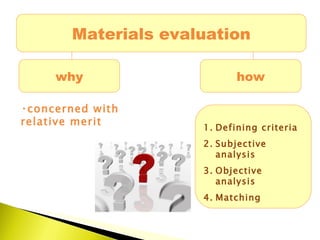
Materials evaluation why how concerned with relative merit Defining criteria Subjective analysis Objective analysis Matching
 
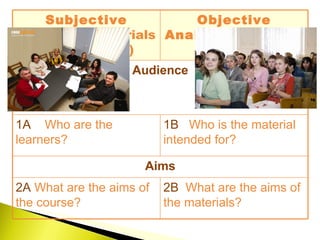
Subjective Analysis  (materials requirements) Objective Analysis  (materials evaluation) Audience 1A  Who are the learners? 1B   Who is the material intended for? Aims 2A  What are the aims of the course? 2B   What are the aims of the materials?
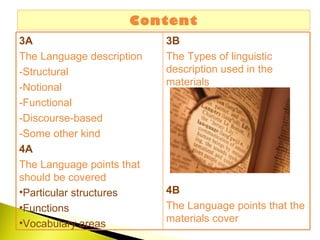
Content 3A   The Language description -Structural -Notional -Functional -Discourse-based -Some other kind 4A The Language points that should be covered Particular structures Functions Vocabulary areas 3B The Types of linguistic description used in the materials 4B The Language points that the materials cover
5A   The Proportion of work on each macro-skill (e.g. reading) Skill-integrated work 6A   The needed Micro-skills 5B   The Proportion of work on each skill Skill-integrated work 6B   The Micro-skills that are covered in the material
7A The text types that should be included -Manuals,Letters, Dialogues, Experimental Reports, Visual texts (pictures, diagrams, charts, graphs, cartoons etc.), Listening texts 7B The kinds of texts in the materials
 
8 A  What subject-matter area is required? What level of knowledge should be assumed? What topics are needed? What treatment should be the topics given? 8B What is the subject-matter areas, assumed level of knowledge and types of topics in the materials? What treatment are the topics given?
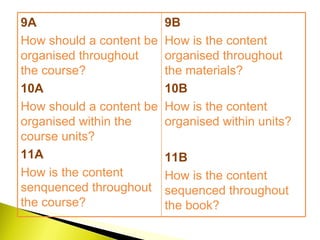
9A How should a content be organised throughout the course? 10A How should a content be organised within the course units? 11A How is the content senquenced throughout the course? 9B How is the content organised throughout the materials? 10B How is the content organised within units? 11B How is the content sequenced throughout the book?
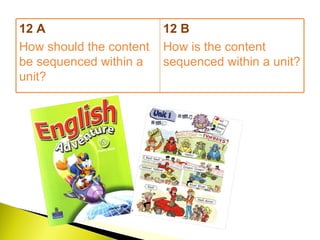
12 A How should the content be sequenced within a unit? 12 B How is the content sequenced within a unit?
Methodology 13 A What  theory of learning  should the course be based on?   14A   What aspects of the  learners' attitudes to learning English  should the course take into account?   13B What theory of learning are the materials are based on?  14B   What attitudes to learning English are the materials based on?
15A  What kinds of  exercises\tasks  are needed? (guided   free?) 16A  What  teaching-learning techniques  are to be used? 15B   What kinds of  exercises\tasks  are included in the materials? 16B  What teaching-learning techniques can be used with the materials?
17A   What aids are available for use?  18A   What guidance for teaching the course will be needed? 19A  How flexible do the materials need to be? 17B  What aids do the materials require?  18B  What guidance do the materials provide? 19B  In what ways are the materials flexible?
20A  What  price  range is necessary? 21A   When and in what quantities should the materials be available?   20B  What is the  price ? 21B   When and how readily can the materials be obtained?
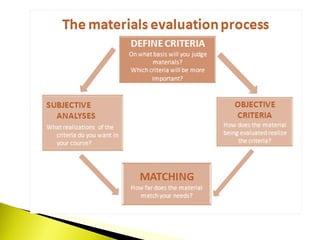
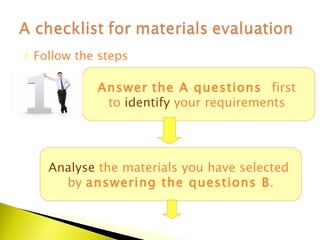
Follow the steps Answer   the A questions  first  to  identify  your requirements   Analyse  the materials you have selected  by  answering the questions B .
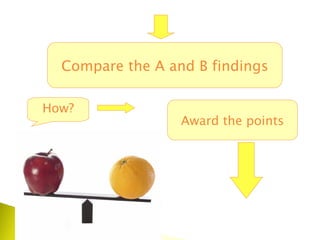
Compare the A and B findings How? Award the points
0 = does not match the desired features  1 = partly matches the desired features  2 = closely matches the desired features  Look for the widest spread of desired features  and concentrations in the areas  you consider most important
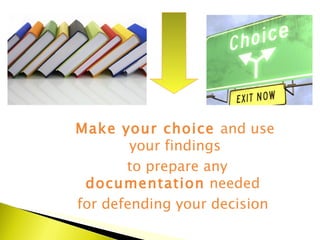
Make your choice  and use your findings to prepare any  documentation  needed  for defending your decision
Conclusion We observed the materials evaluation as one  way of exploiting a course design It can save a lot of duplication of effort by  possibly revealing materials  that can provide all or part of your materials needs The evaluation process should be  systematic  The evaluation process is best seen as a  matching exercise : matching your  analyzed needs  with  available solutions
for   your attention!

Materials evaluation

  • 1.
  • 2.
    Materials evaluationMaterials development Materials adaptation
  • 3.
    Materials evaluation whyhow concerned with relative merit Defining criteria Subjective analysis Objective analysis Matching
  • 4.
  • 5.
    Subjective Analysis (materials requirements) Objective Analysis (materials evaluation) Audience 1A Who are the learners? 1B Who is the material intended for? Aims 2A What are the aims of the course? 2B What are the aims of the materials?
  • 6.
    Content 3A The Language description -Structural -Notional -Functional -Discourse-based -Some other kind 4A The Language points that should be covered Particular structures Functions Vocabulary areas 3B The Types of linguistic description used in the materials 4B The Language points that the materials cover
  • 7.
    5A The Proportion of work on each macro-skill (e.g. reading) Skill-integrated work 6A The needed Micro-skills 5B The Proportion of work on each skill Skill-integrated work 6B The Micro-skills that are covered in the material
  • 8.
    7A The texttypes that should be included -Manuals,Letters, Dialogues, Experimental Reports, Visual texts (pictures, diagrams, charts, graphs, cartoons etc.), Listening texts 7B The kinds of texts in the materials
  • 9.
  • 10.
    8 A What subject-matter area is required? What level of knowledge should be assumed? What topics are needed? What treatment should be the topics given? 8B What is the subject-matter areas, assumed level of knowledge and types of topics in the materials? What treatment are the topics given?
  • 11.
    9A How shoulda content be organised throughout the course? 10A How should a content be organised within the course units? 11A How is the content senquenced throughout the course? 9B How is the content organised throughout the materials? 10B How is the content organised within units? 11B How is the content sequenced throughout the book?
  • 12.
    12 A Howshould the content be sequenced within a unit? 12 B How is the content sequenced within a unit?
  • 13.
    Methodology 13 AWhat theory of learning should the course be based on? 14A What aspects of the learners' attitudes to learning English should the course take into account? 13B What theory of learning are the materials are based on? 14B What attitudes to learning English are the materials based on?
  • 14.
    15A Whatkinds of exercises\tasks are needed? (guided  free?) 16A What teaching-learning techniques are to be used? 15B What kinds of exercises\tasks are included in the materials? 16B What teaching-learning techniques can be used with the materials?
  • 15.
    17A What aids are available for use? 18A What guidance for teaching the course will be needed? 19A How flexible do the materials need to be? 17B What aids do the materials require? 18B What guidance do the materials provide? 19B In what ways are the materials flexible?
  • 16.
    20A What price range is necessary? 21A When and in what quantities should the materials be available? 20B What is the price ? 21B When and how readily can the materials be obtained?
  • 17.
    Follow the stepsAnswer the A questions first to identify your requirements Analyse the materials you have selected by answering the questions B .
  • 18.
    Compare the Aand B findings How? Award the points
  • 19.
    0 = doesnot match the desired features 1 = partly matches the desired features 2 = closely matches the desired features Look for the widest spread of desired features and concentrations in the areas you consider most important
  • 20.
    Make your choice and use your findings to prepare any documentation needed for defending your decision
  • 21.
    Conclusion We observedthe materials evaluation as one way of exploiting a course design It can save a lot of duplication of effort by possibly revealing materials that can provide all or part of your materials needs The evaluation process should be systematic The evaluation process is best seen as a matching exercise : matching your analyzed needs with available solutions
  • 22.
    for your attention!