Material Semikonduktor
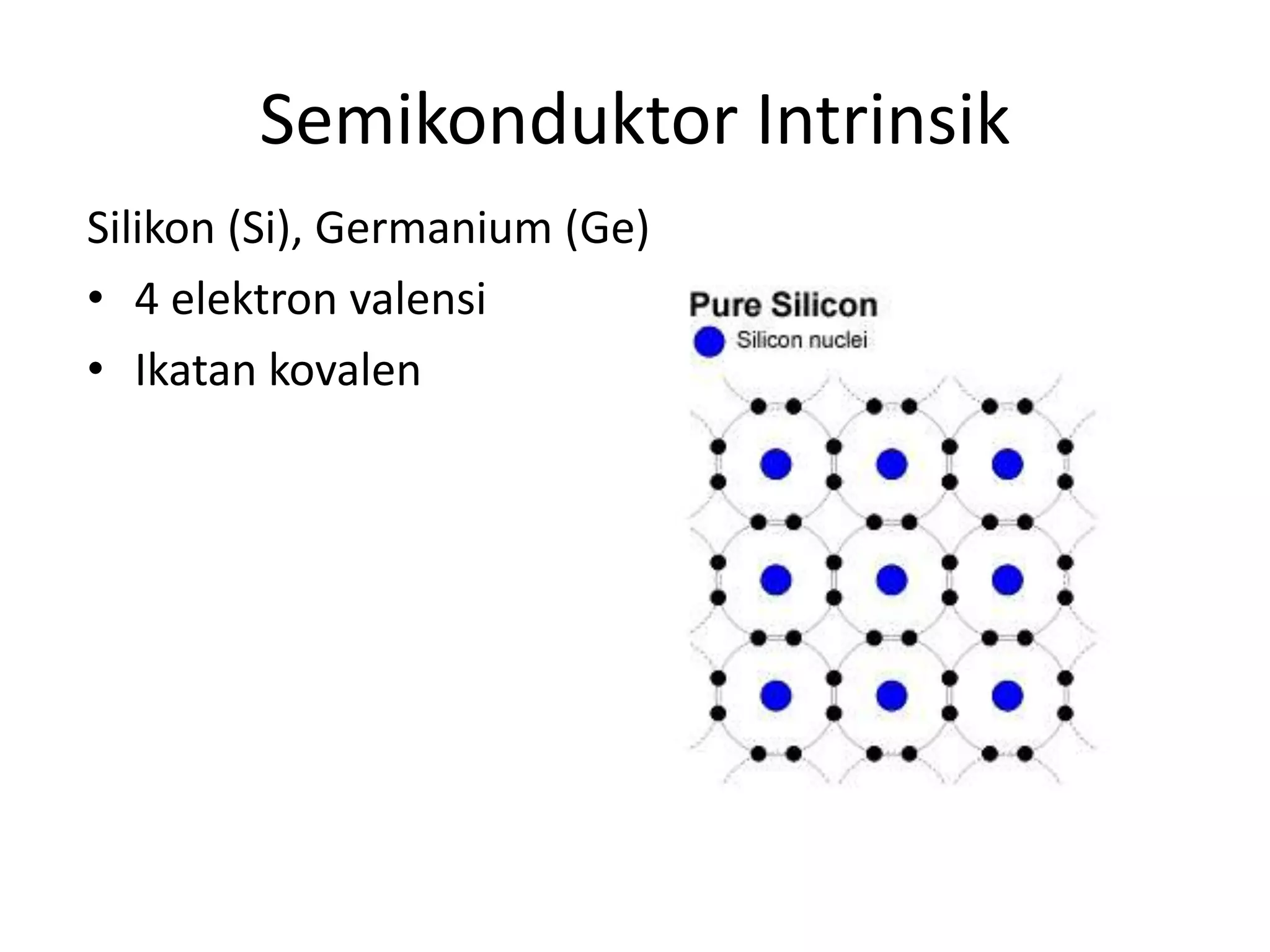
Semikonduktor Intrinsik
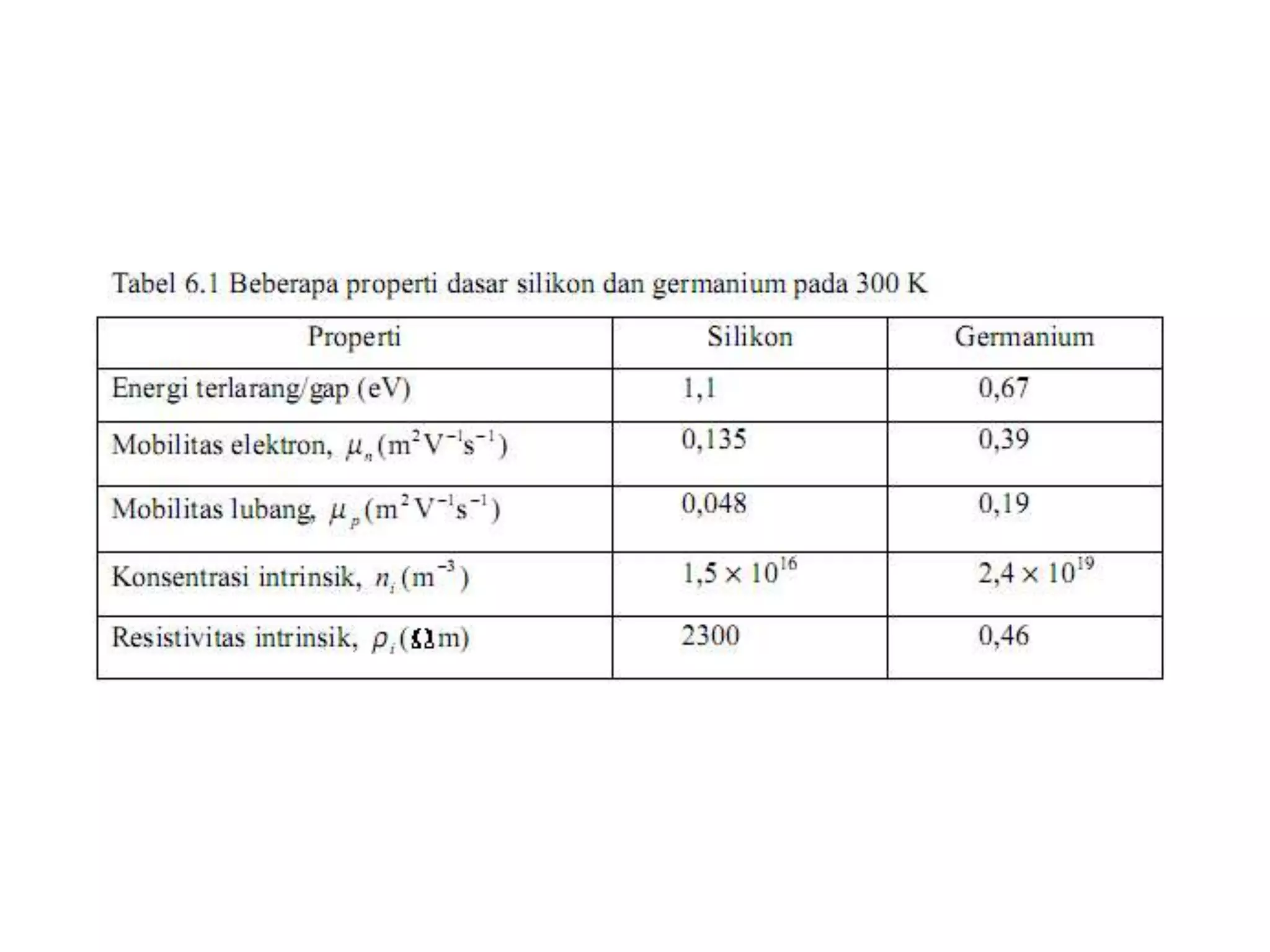
Silikon (Si), Germanium (Ge)
• 4 elektron valensi
• Ikatan kovalen
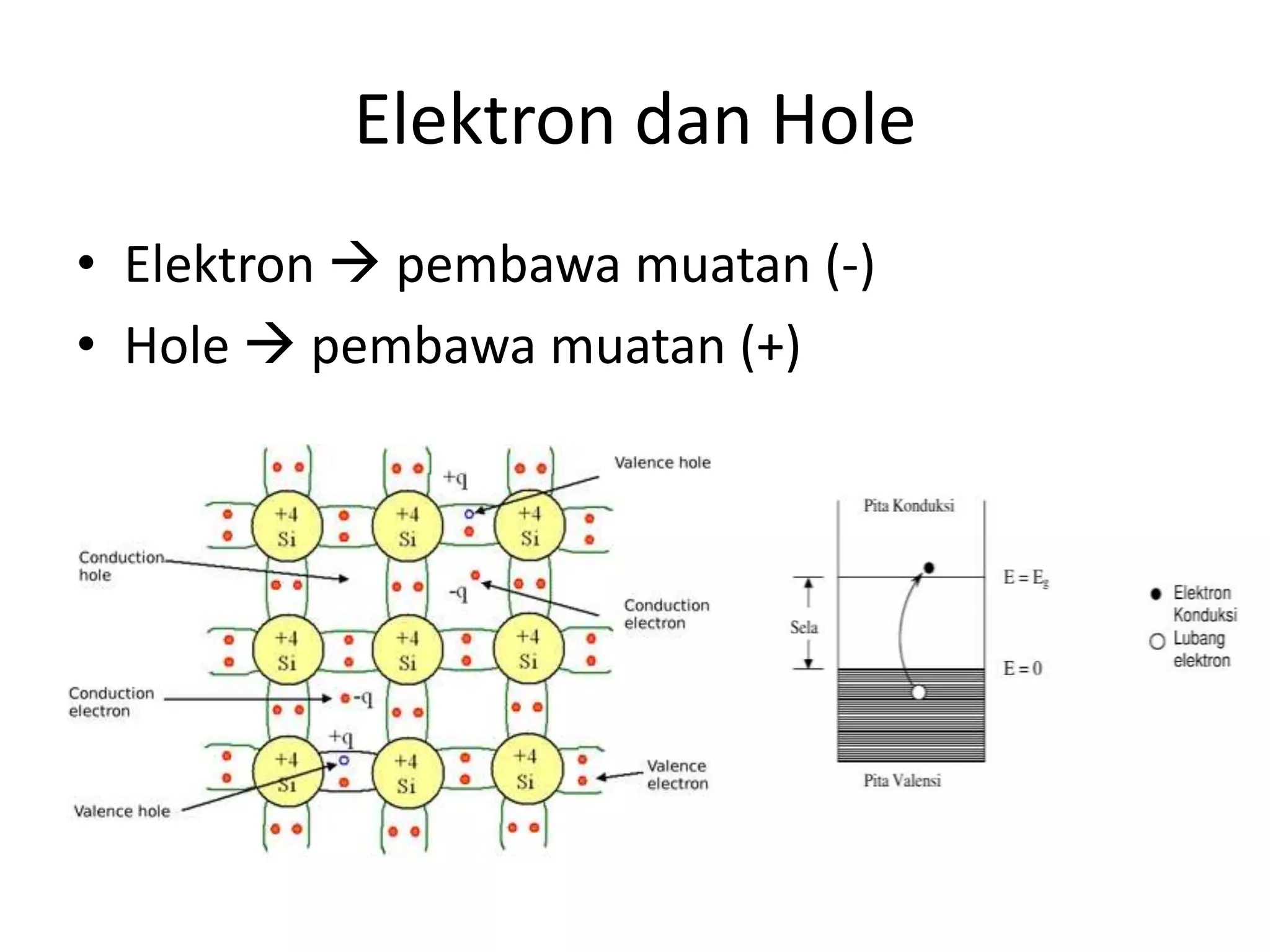
Elektron dan Hole
• Elektron  pembawa muatan (-)
• Hole  pembawa muatan (+)
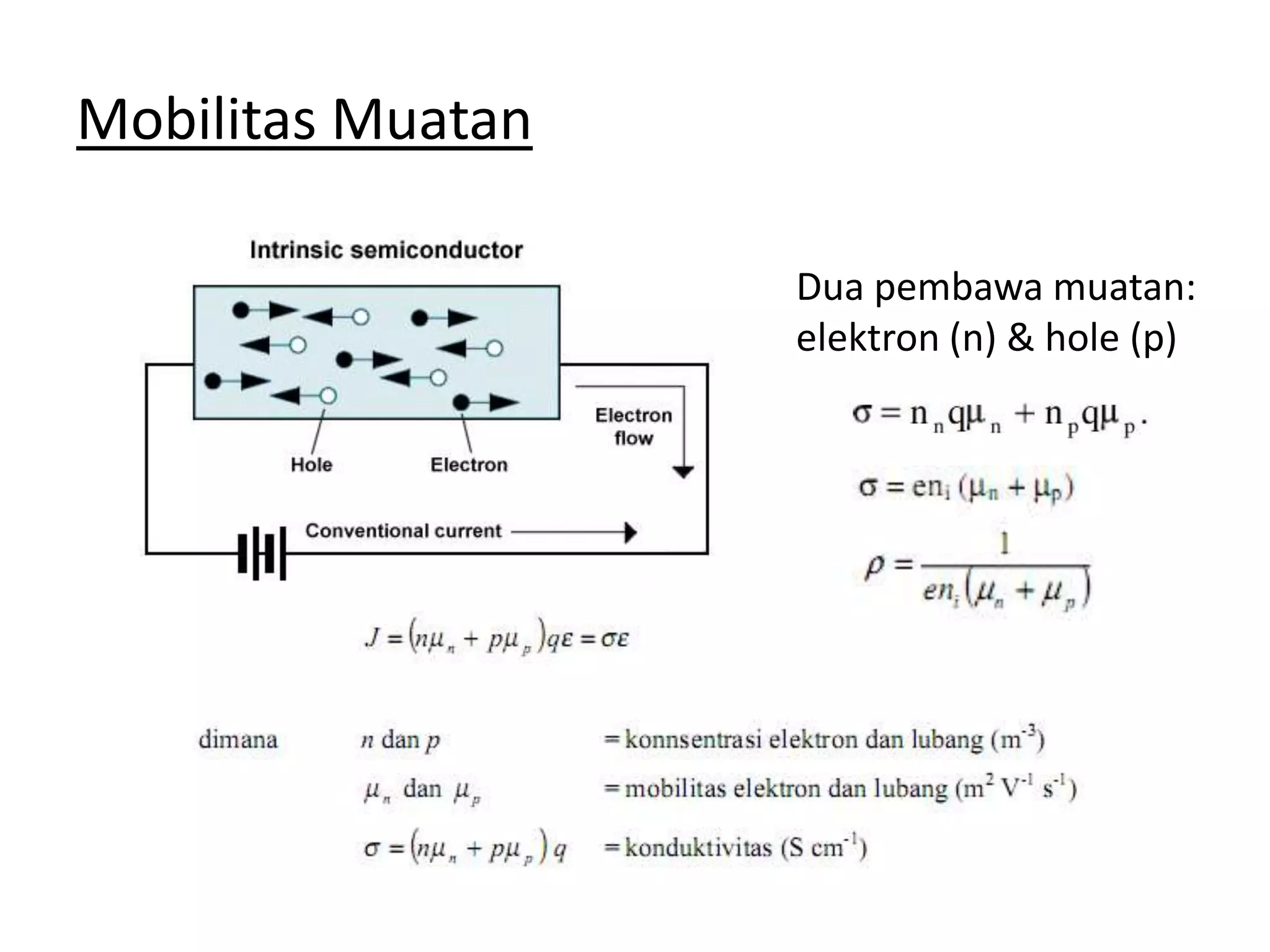
Mobilitas Muatan
Dua pembawa muatan:
elektron (n) & hole (p)
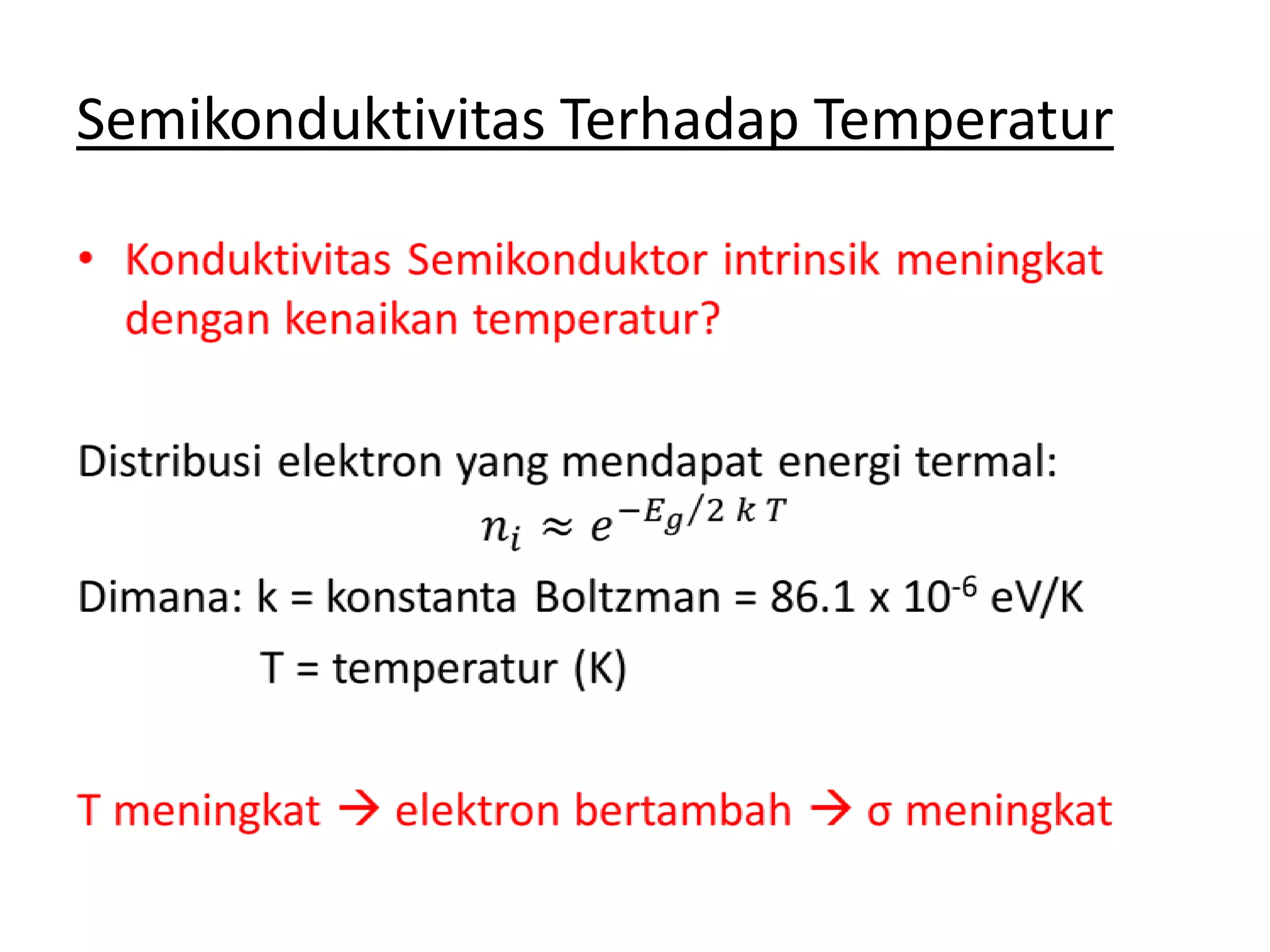
Semikonduktivitas Terhadap Temperatur
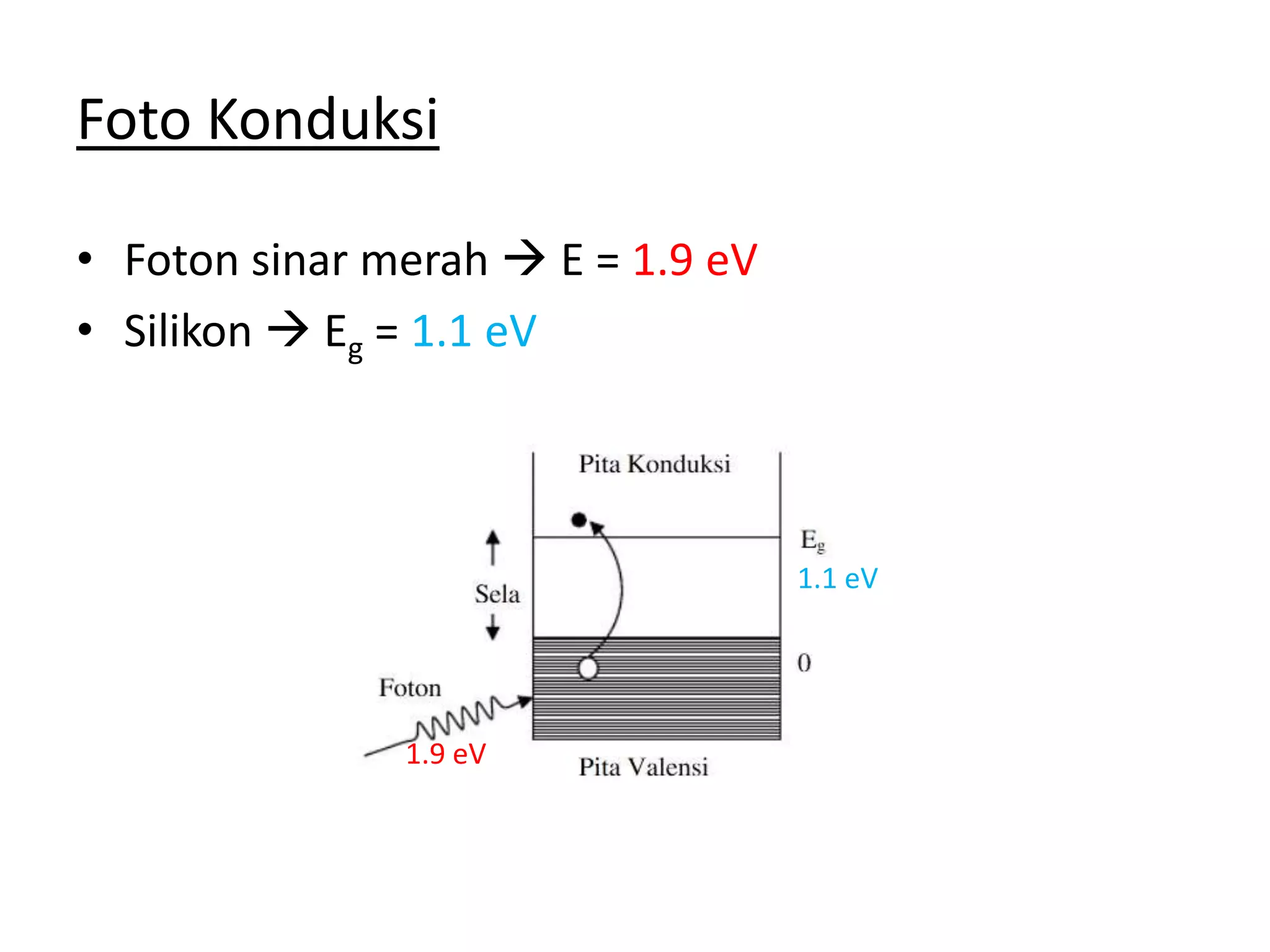
Foto Konduksi
• Foton sinar merah  E = 1.9 eV
• Silikon  Eg = 1.1 eV
1.9 eV
1.1 eV
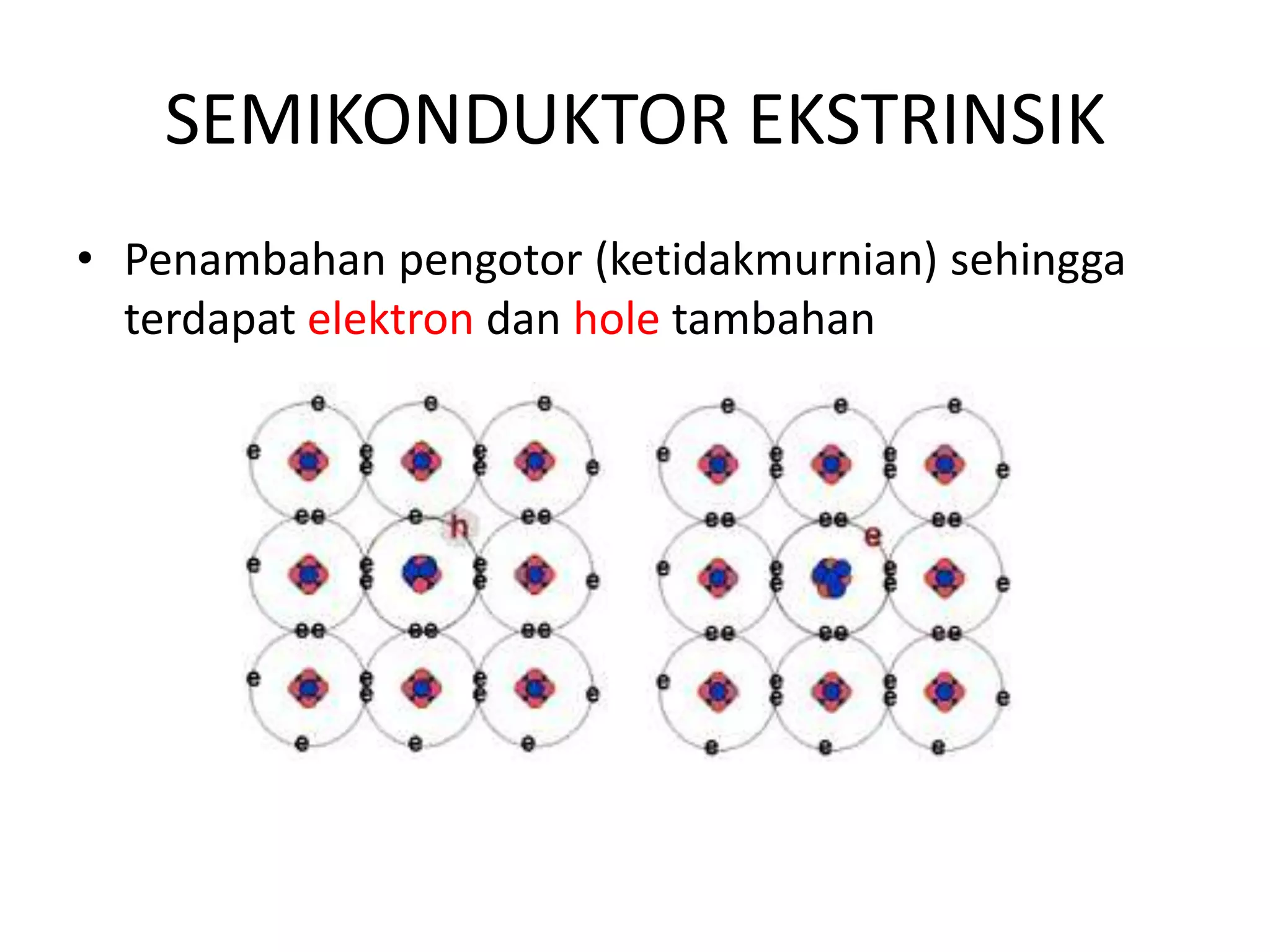
SEMIKONDUKTOR EKSTRINSIK
• Penambahan pengotor (ketidakmurnian) sehingga
terdapat elektron dan hole tambahan
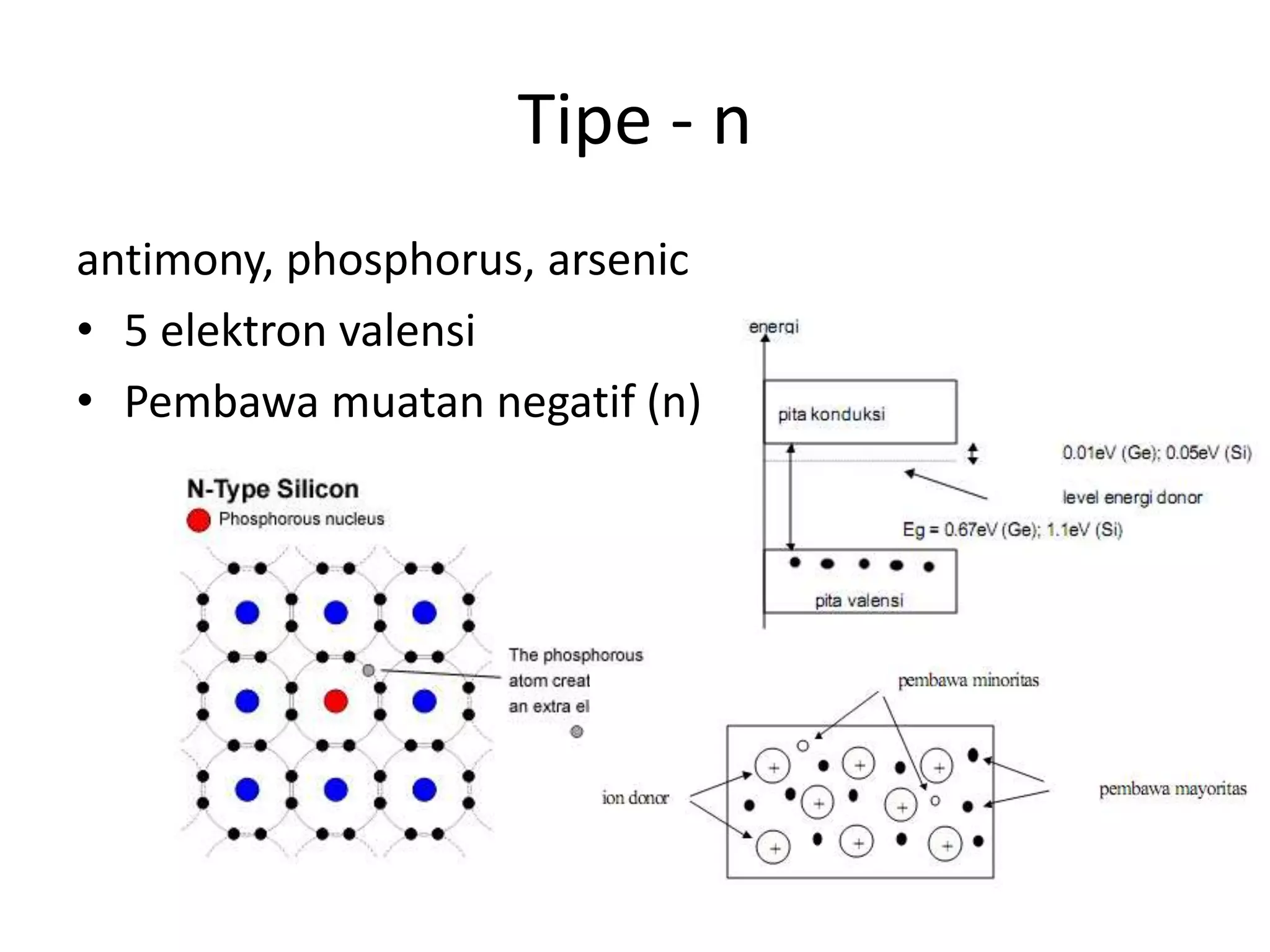
Tipe - n
antimony, phosphorus, arsenic
• 5 elektron valensi
• Pembawa muatan negatif (n)
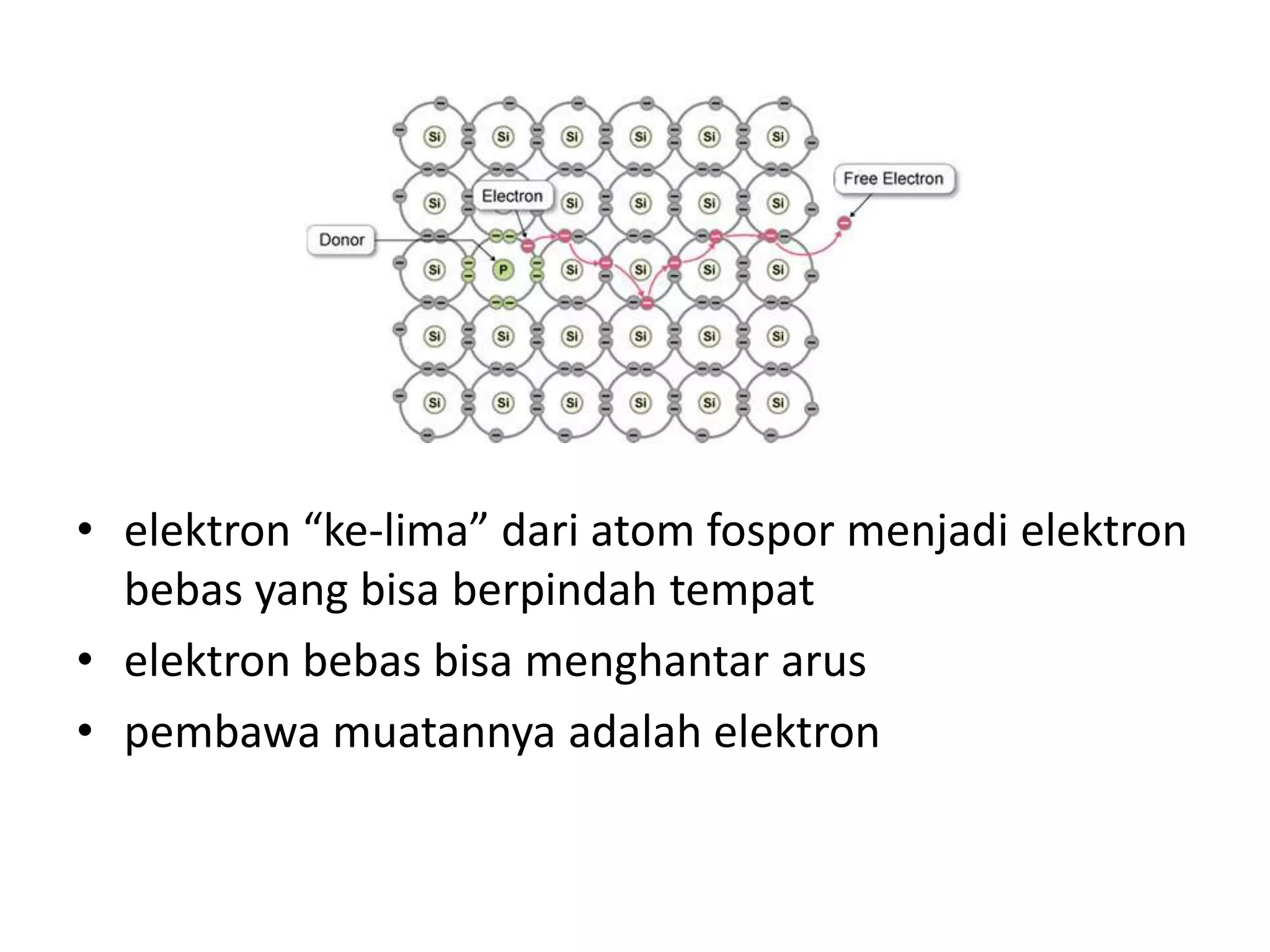
• elektron “ke-lima” dari atom fospor menjadi elektron
bebas yang bisa berpindah tempat
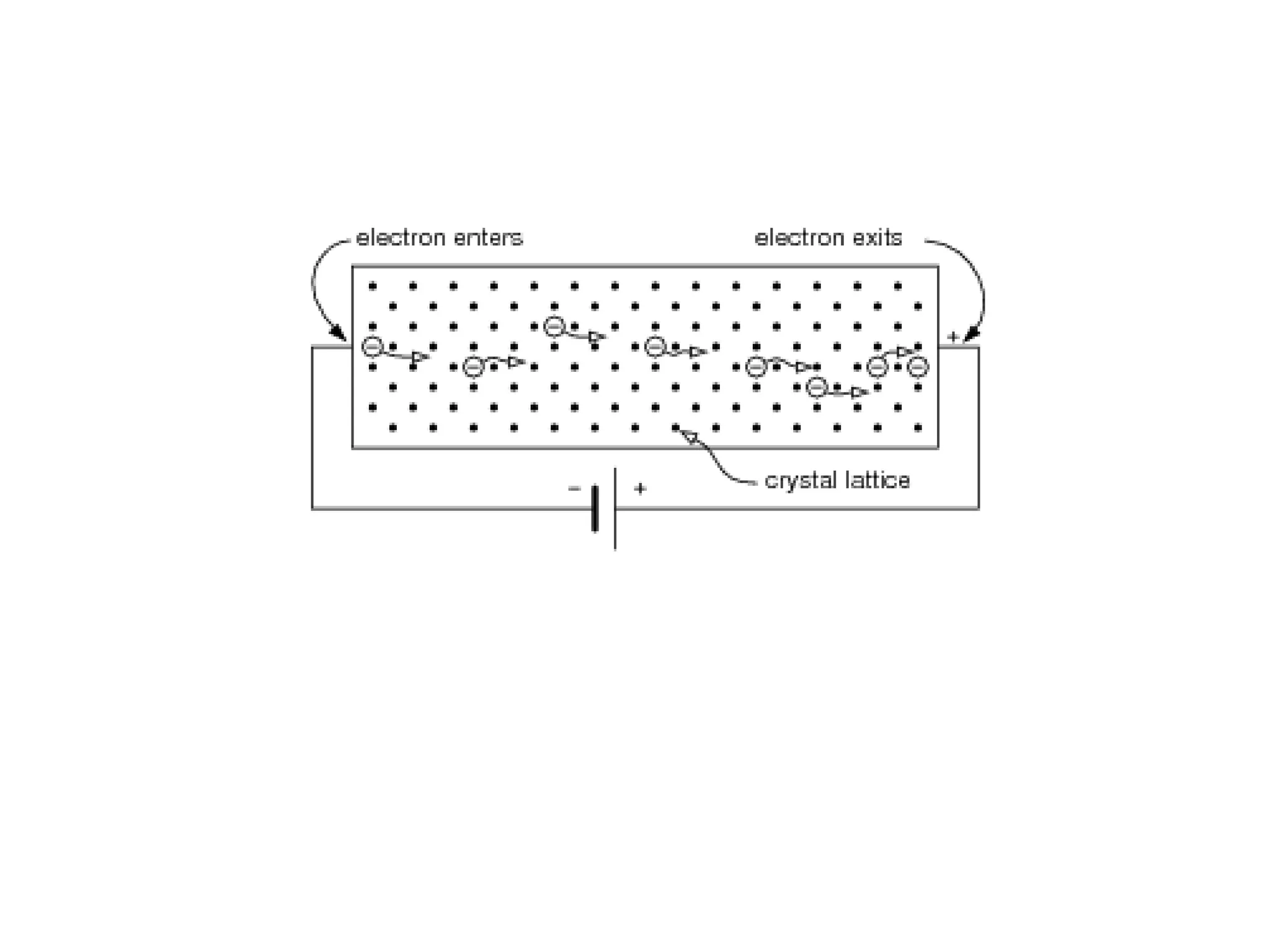
• elektron bebas bisa menghantar arus
• pembawa muatannya adalah elektron
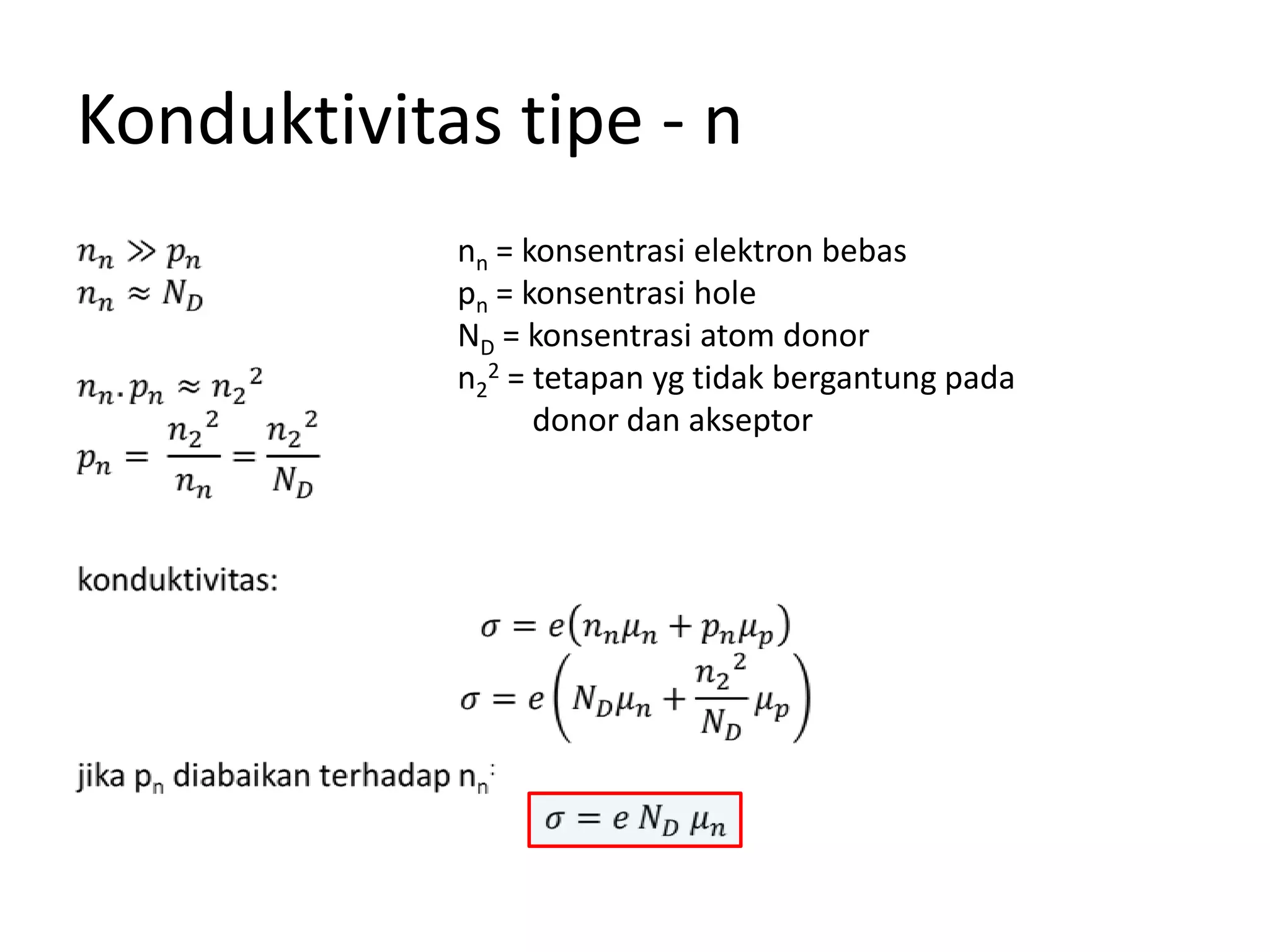
Konduktivitas tipe - n
nn = konsentrasi elektron bebas
pn = konsentrasi hole
ND = konsentrasi atom donor
n2
2 = tetapan yg tidak bergantung pada
donor dan akseptor
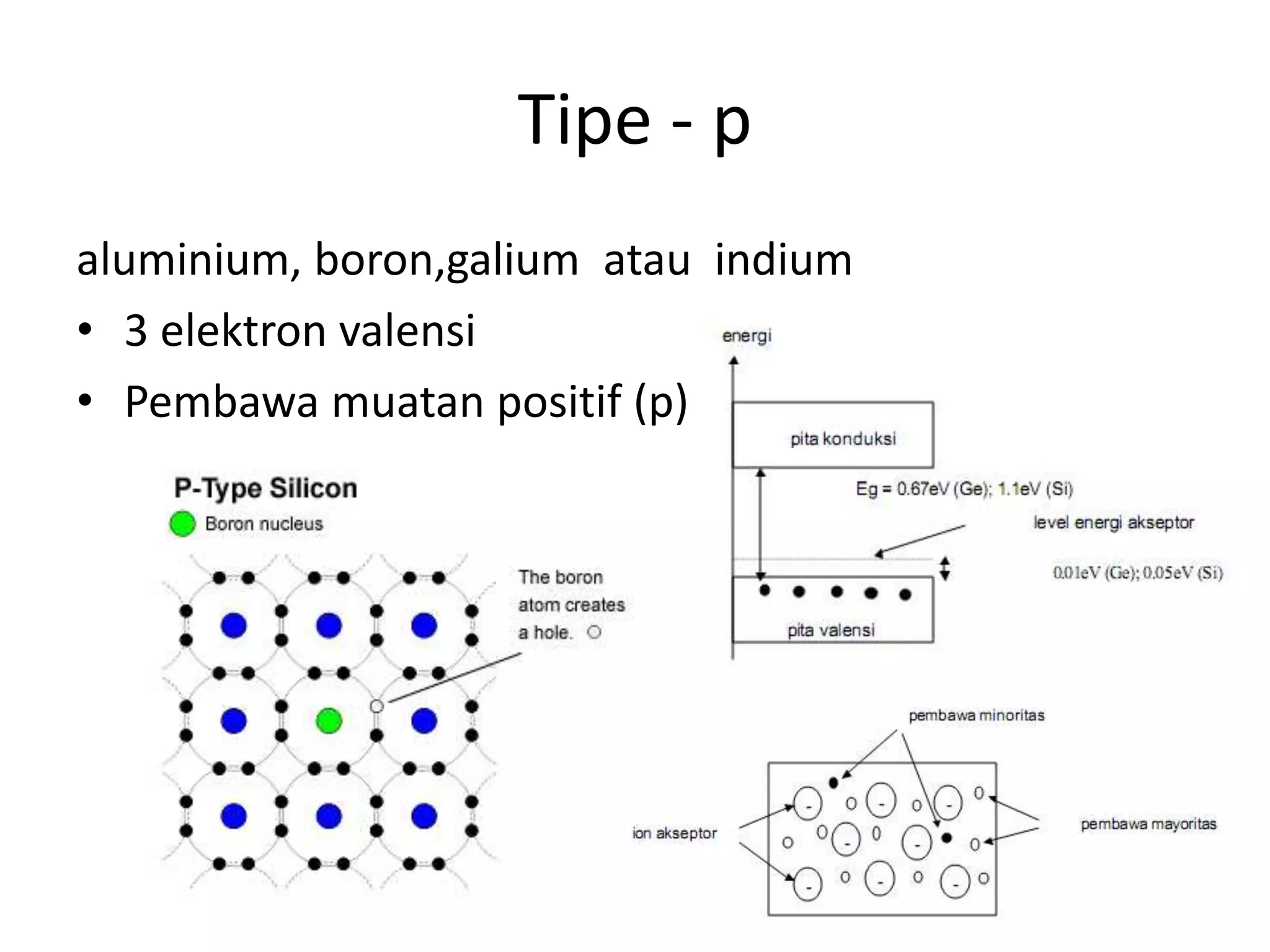
Tipe - p
aluminium, boron,galium atau indium
• 3 elektron valensi
• Pembawa muatan positif (p)
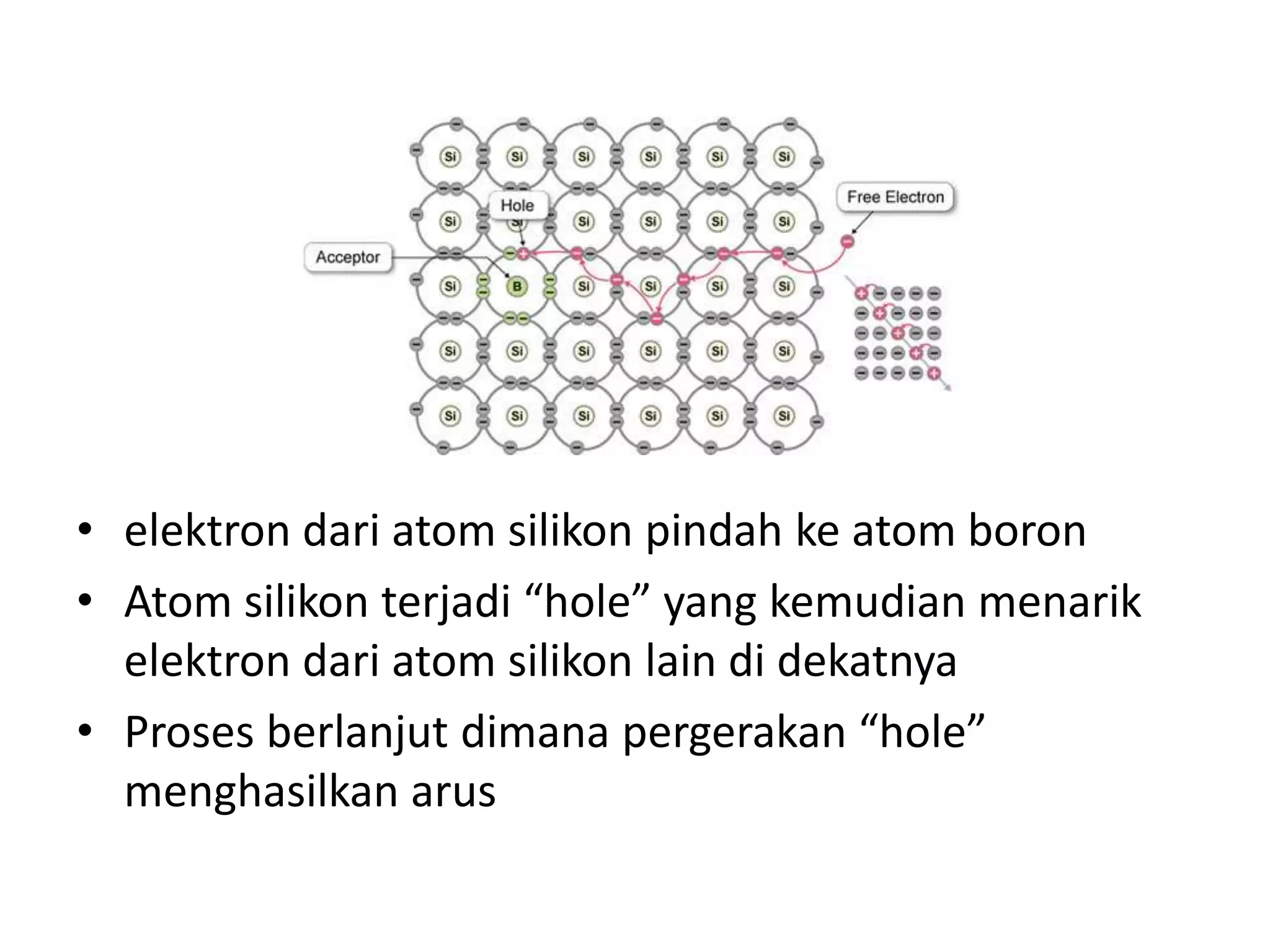
• elektron dari atom silikon pindah ke atom boron
• Atom silikon terjadi “hole” yang kemudian menarik
elektron dari atom silikon lain di dekatnya
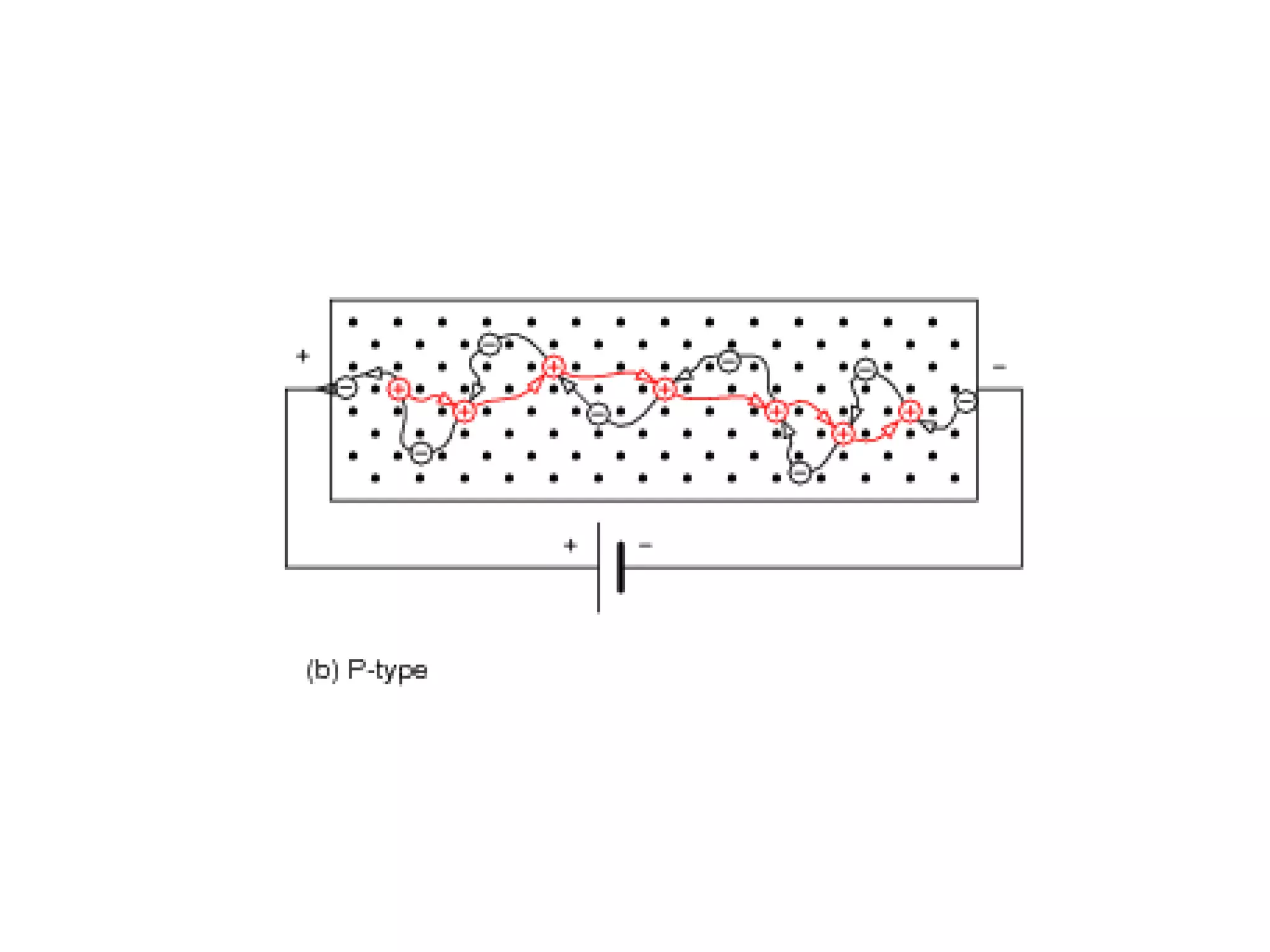
• Proses berlanjut dimana pergerakan “hole”
menghasilkan arus
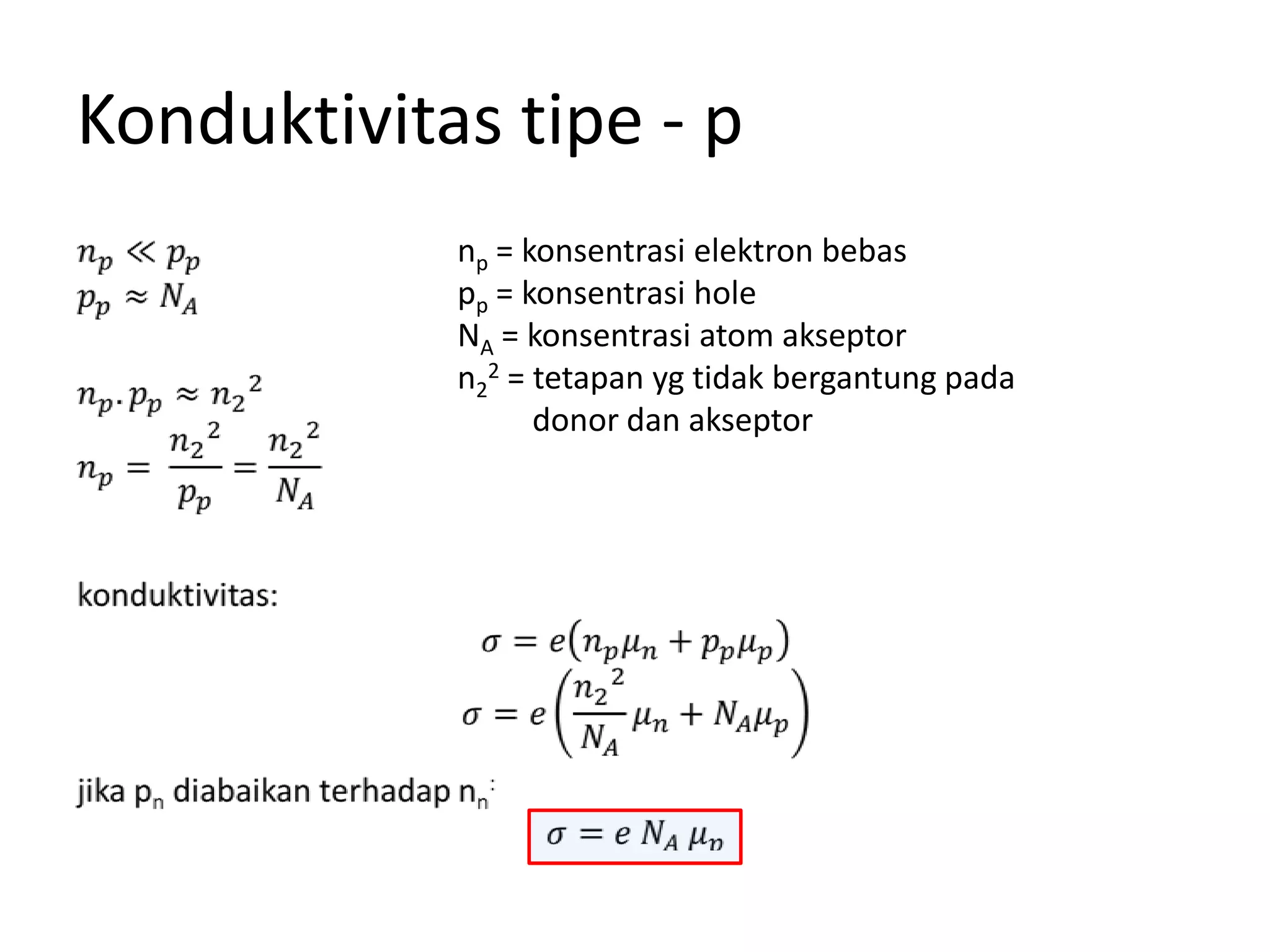
Konduktivitas tipe - p
np = konsentrasi elektron bebas
pp = konsentrasi hole
NA = konsentrasi atom akseptor
n2
2 = tetapan yg tidak bergantung pada
donor dan akseptor
Contoh Soal 1:
Konsentrasi atom Germanium (Ge) adalah 4.41 x 10²²
atom/cm3. Jika tiap 108 atom Ge dikotori 1 atom donor
dan μn = 3800 cm2/V.s, tentukan konduktivitas
semikonduktor tersebut?
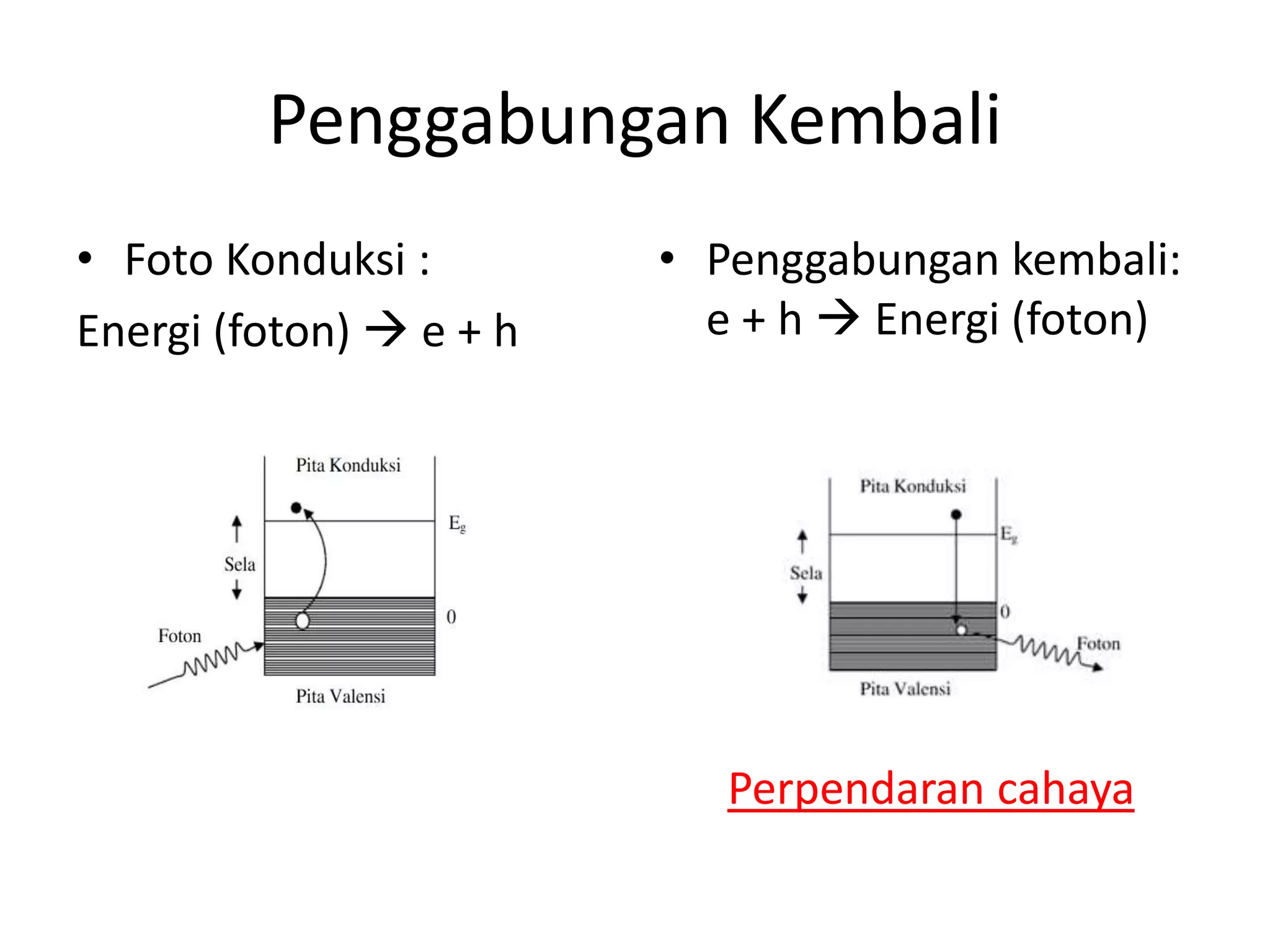
Penggabungan Kembali
• Foto Konduksi :
Energi (foton)  e + h
• Penggabungan kembali:
e + h  Energi (foton)
Perpendaran cahaya
PERANGKAT SEMIKONDUKTOR
• Penghantar
• Junction (dioda)
• Transistor
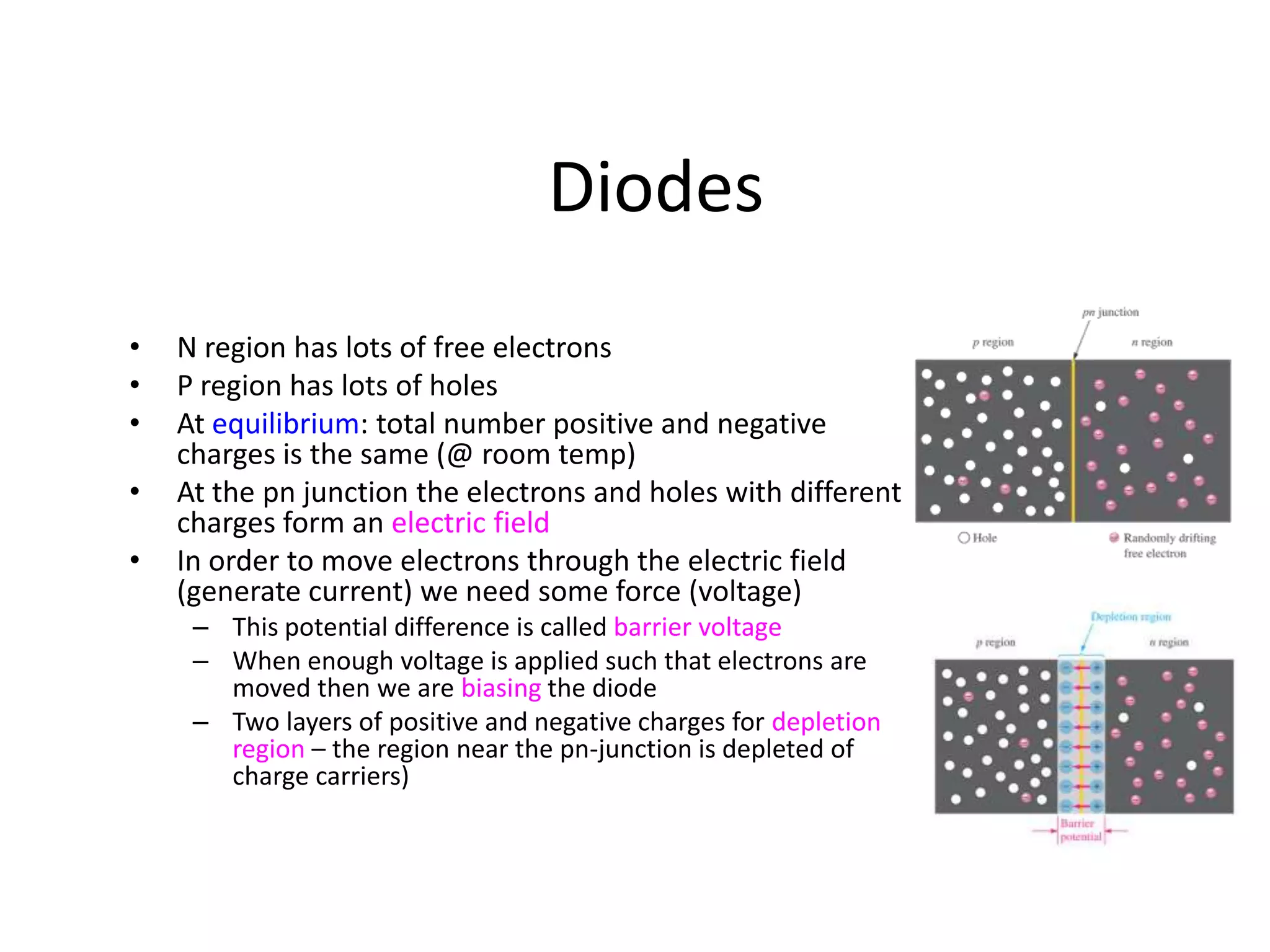
Diodes
• N region has lots of free electrons
• P region has lots of holes
• At equilibrium: total number positive and negative
charges is the same (@ room temp)
• At the pn junction the electrons and holes with different
charges form an electric field
• In order to move electrons through the electric field
(generate current) we need some force (voltage)
– This potential difference is called barrier voltage
– When enough voltage is applied such that electrons are
moved then we are biasing the diode
– Two layers of positive and negative charges for depletion
region – the region near the pn-junction is depleted of
charge carriers)
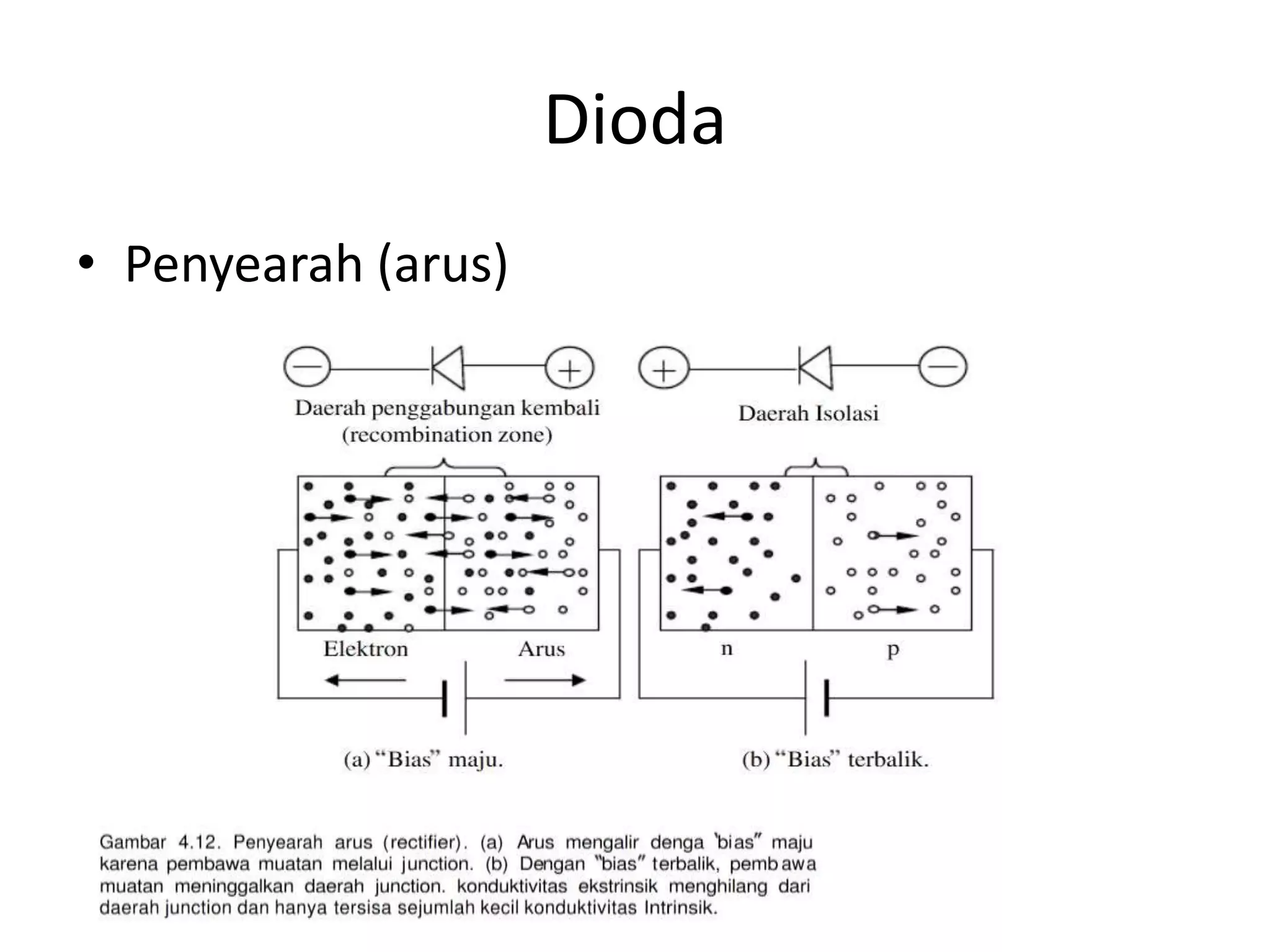
Dioda
• Penyearah (arus)
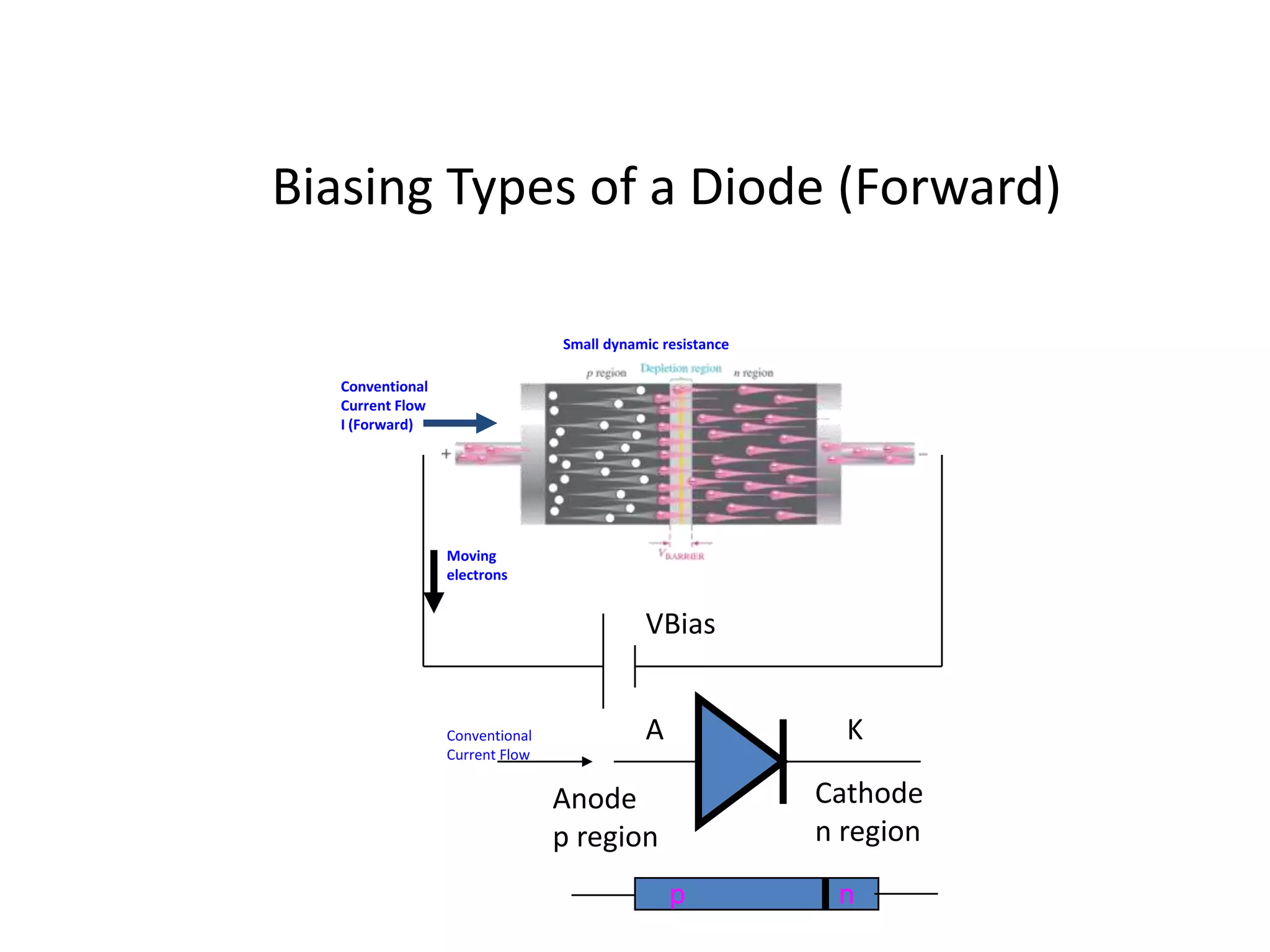
Biasing Types of a Diode (Forward)
Cathode
n region
Anode
p region
A K
Moving
electrons
Small dynamic resistance
VBias
np
Conventional
Current Flow
Conventional
Current Flow
I (Forward)
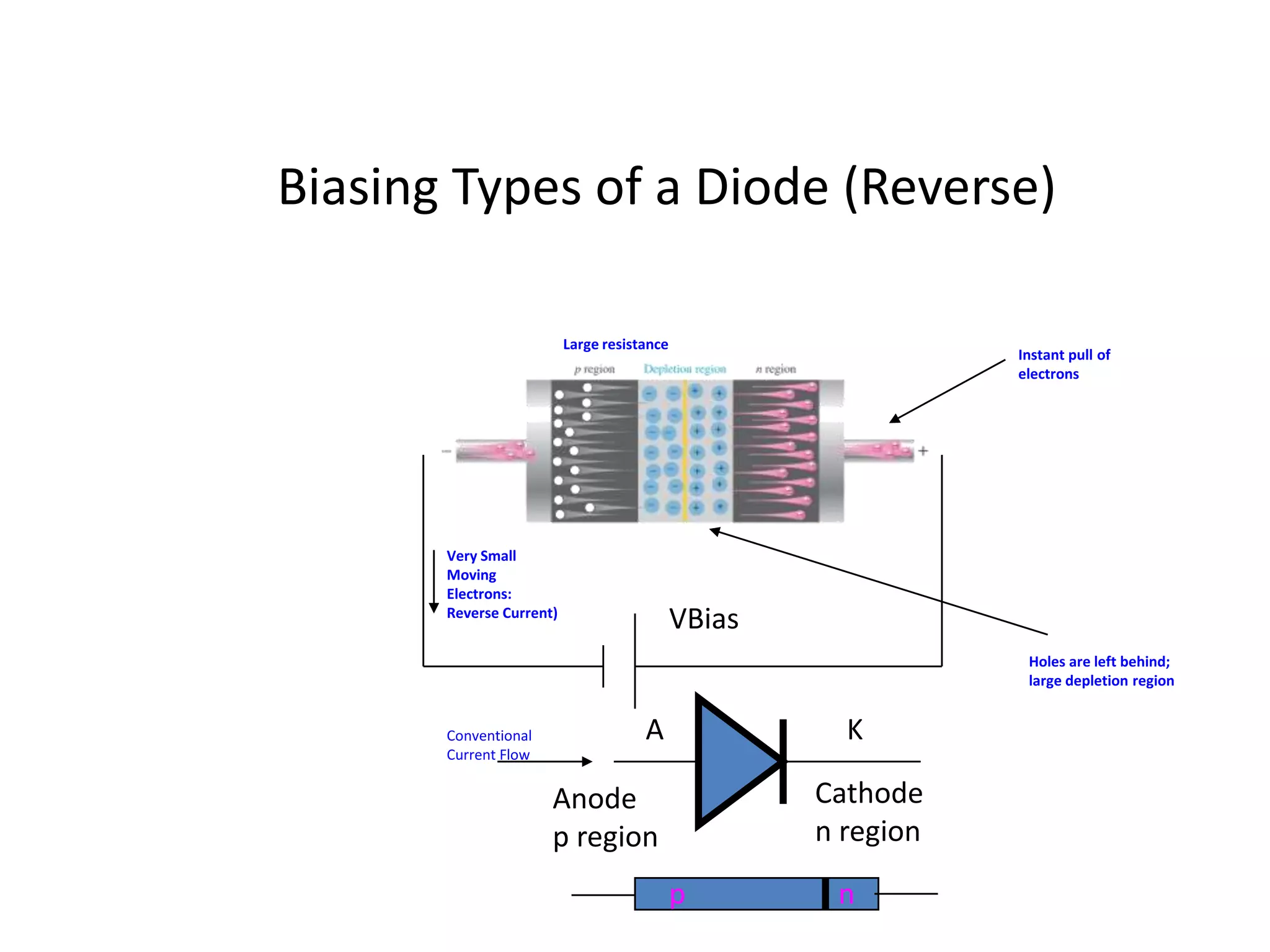
Very Small
Moving
Electrons:
Reverse Current)
Biasing Types of a Diode (Reverse)
Cathode
n region
Anode
p region
A K
Large resistance
VBias
np
Conventional
Current Flow
Holes are left behind;
large depletion region
Instant pull of
electrons
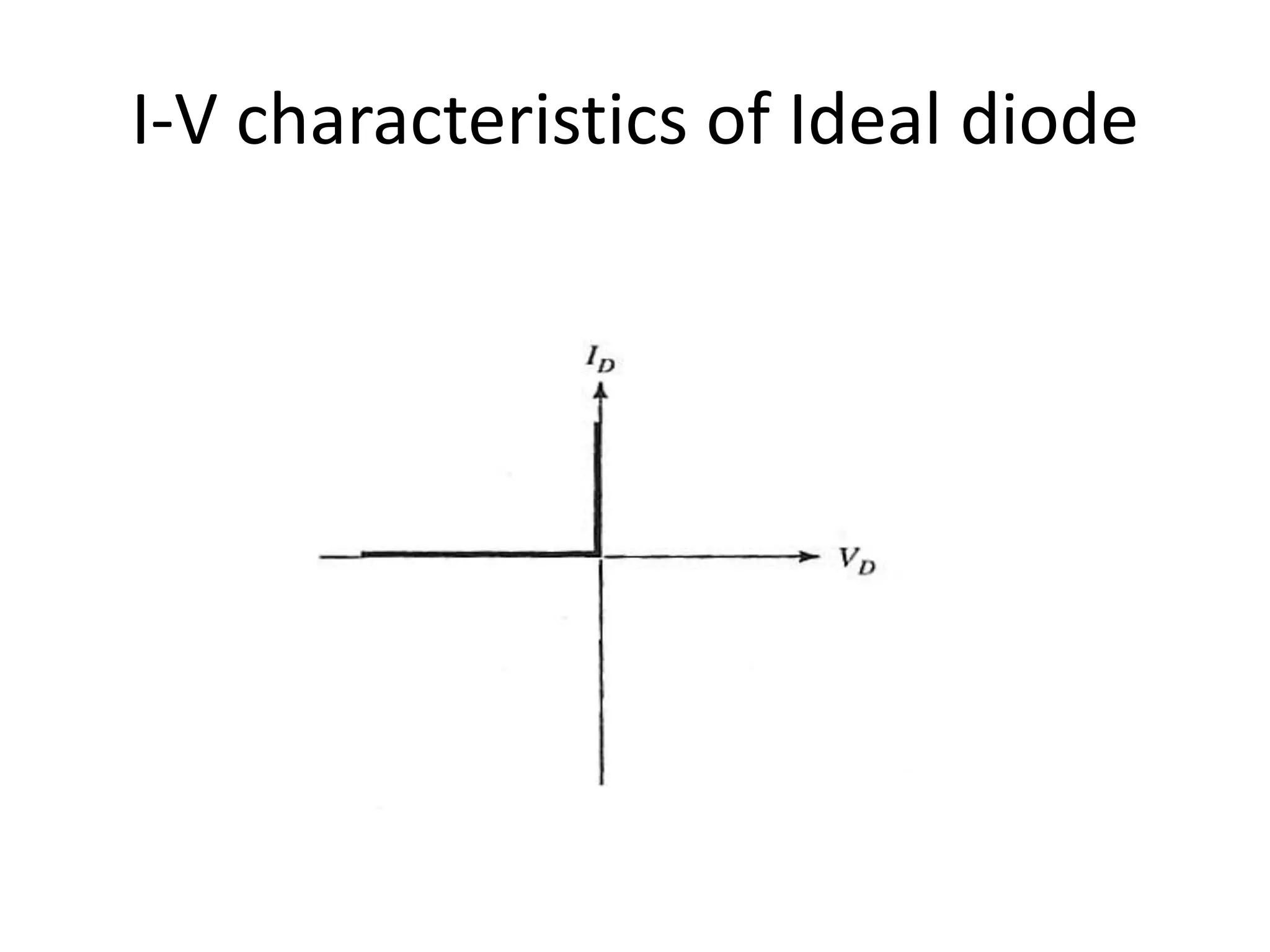
I-V characteristics of Ideal diode
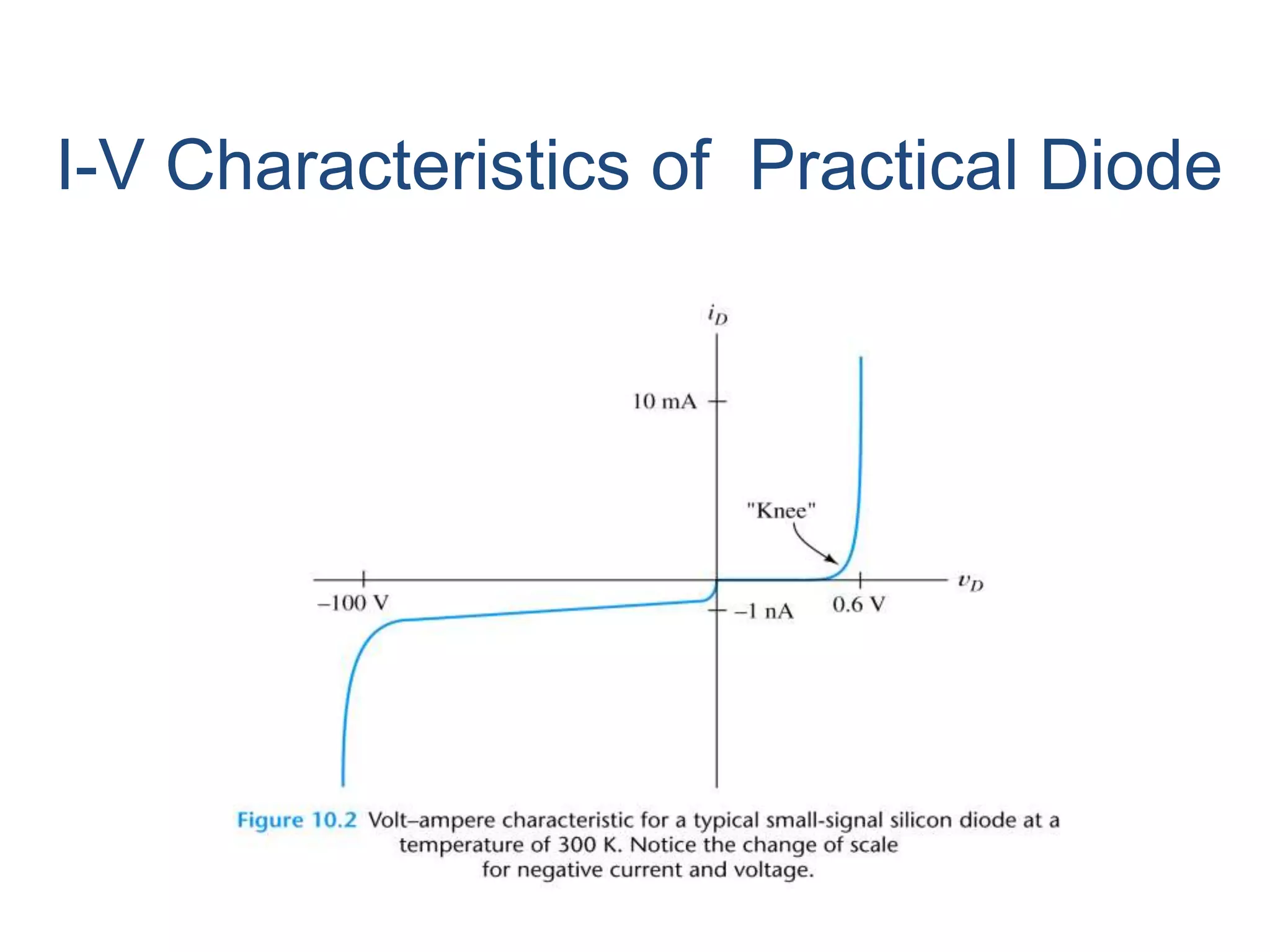
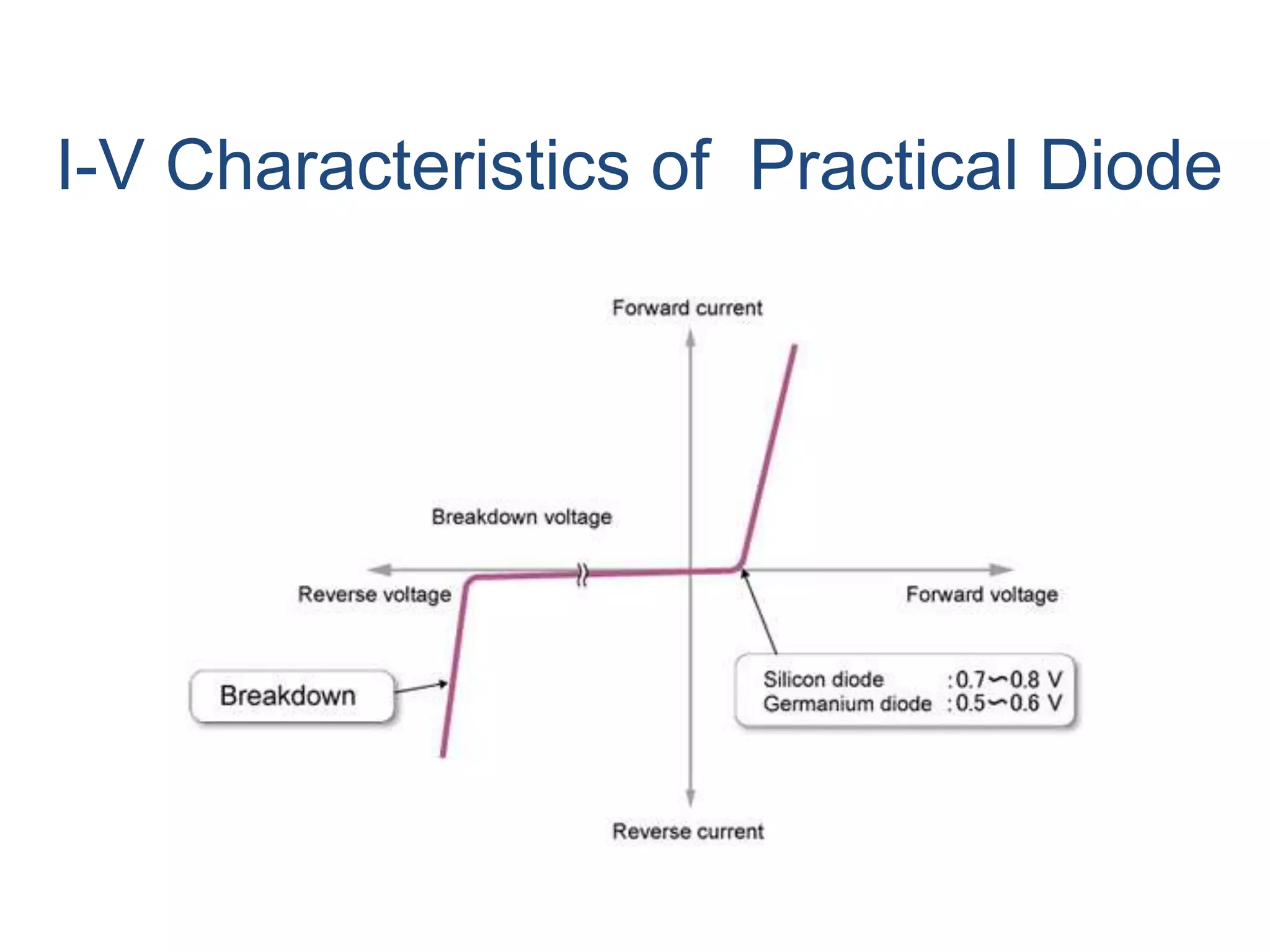
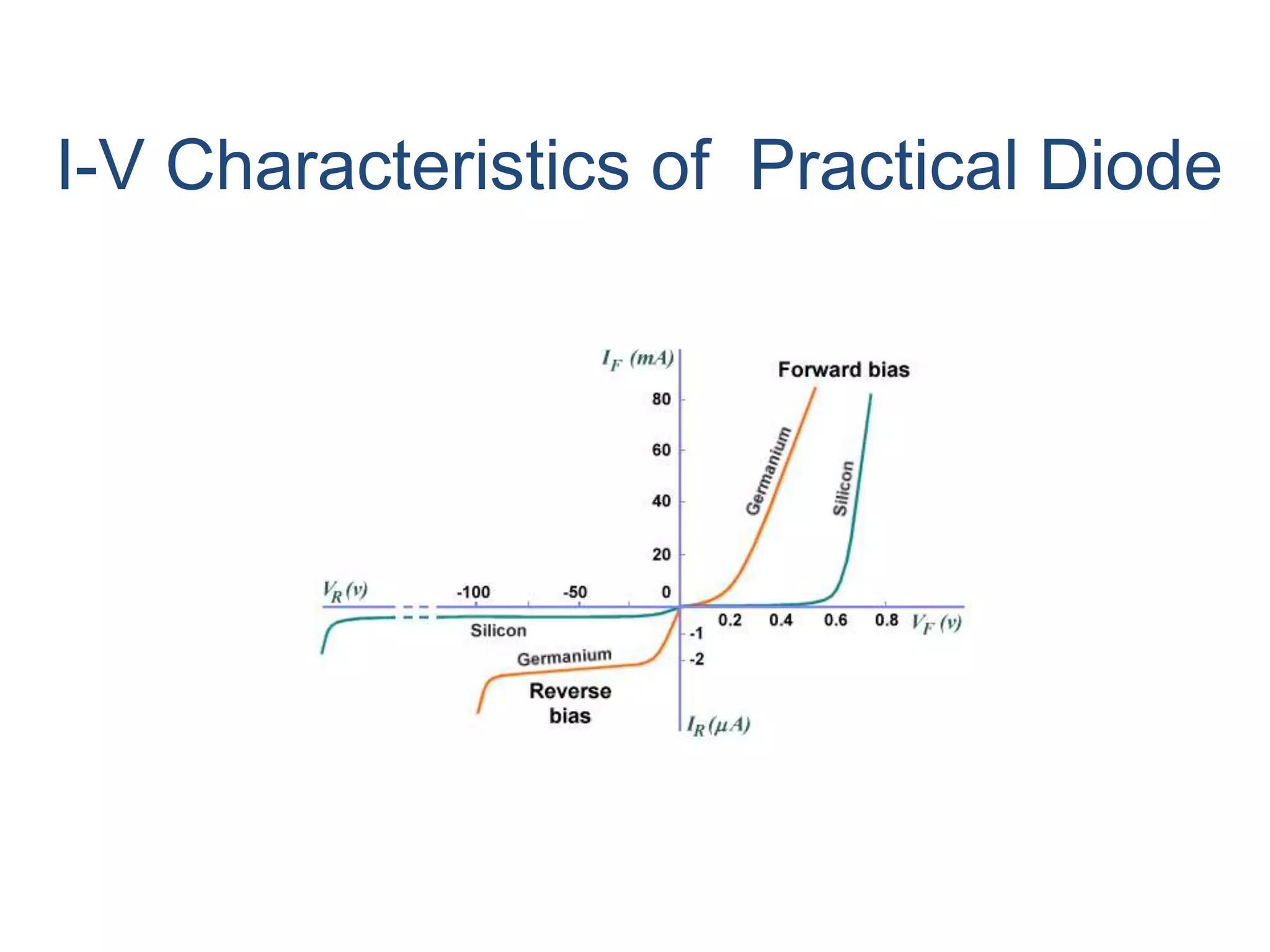
I-V Characteristics of Practical Diode
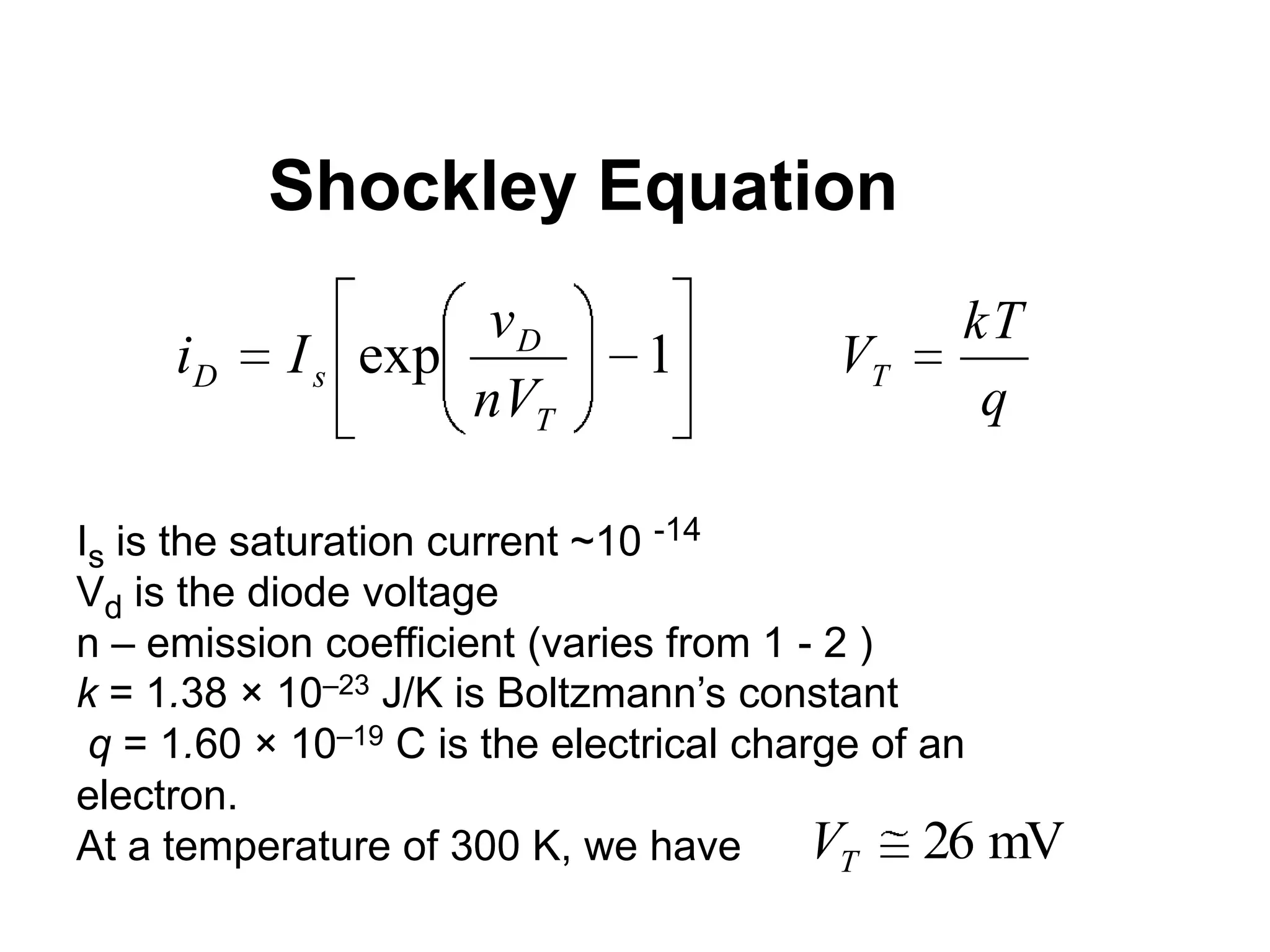
Shockley Equation
1exp
T
D
sD
nV
v
Ii
q
kT
VT
Is is the saturation current ~10 -14
Vd is the diode voltage
n – emission coefficient (varies from 1 - 2 )
k = 1.38 × 10⁻²³ J/K is Boltzmann’s constant
q = 1.60 × 10⁻¹⁹ C is the electrical charge of an
electron.
At a temperature of 300 K, we have mV26TV
Jenis Perangkat Junction p-n
• Diode
• LED
• Zener
• Varactor
• Varistor
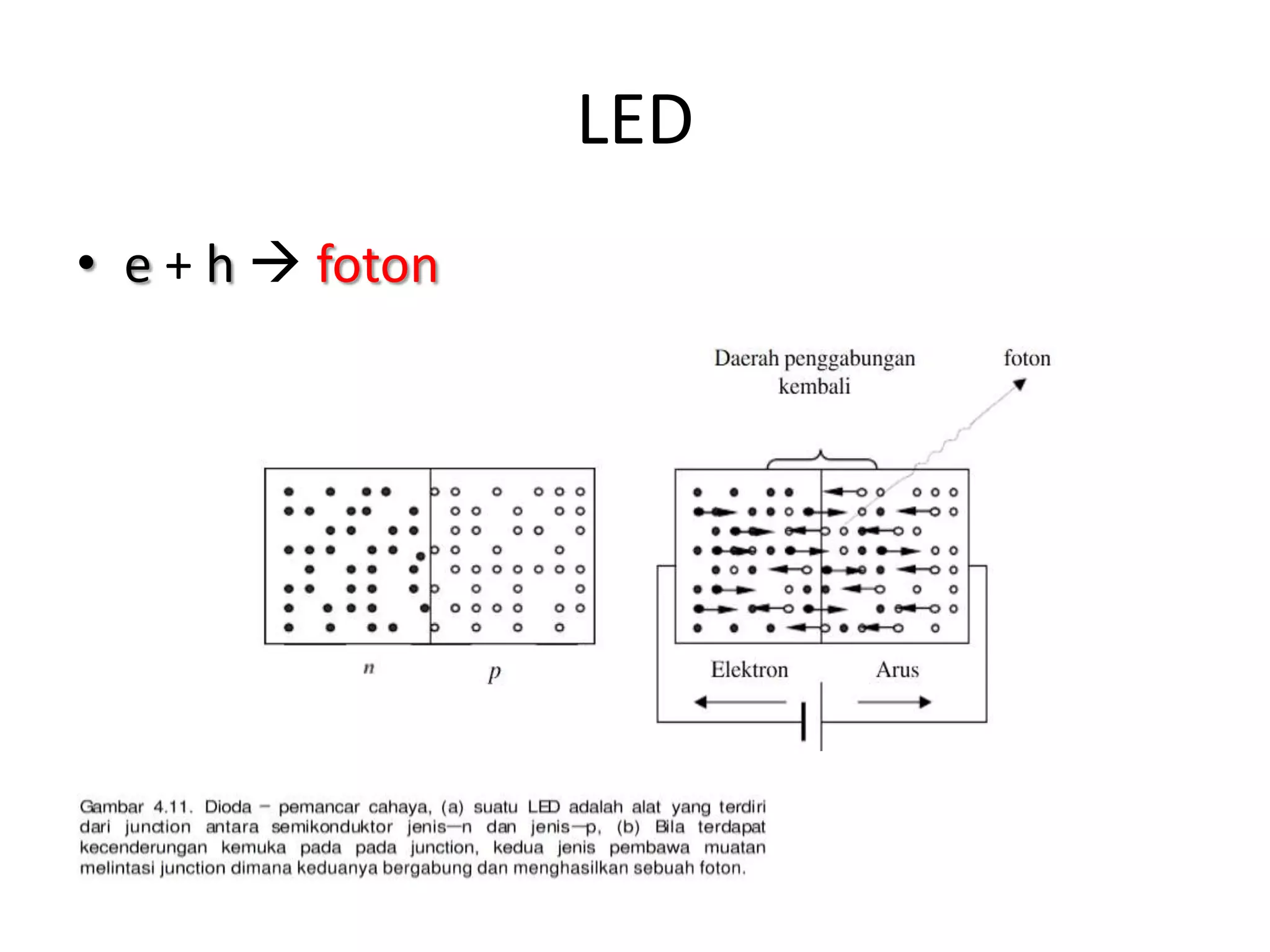
LED
• e + h  foton
Transistor
• Field Efect Transistor (FET)
• Bipolar Junction Transistor (BJT)
• Junction FET
• Metal Oxide Semiconductor FET
• Thyristor / Silicon Controlled Rectifier (SCR)
• Gate Turn Off Thyristor (GTO)
• Insulated Gate Bipolar Transistor (IGBT)
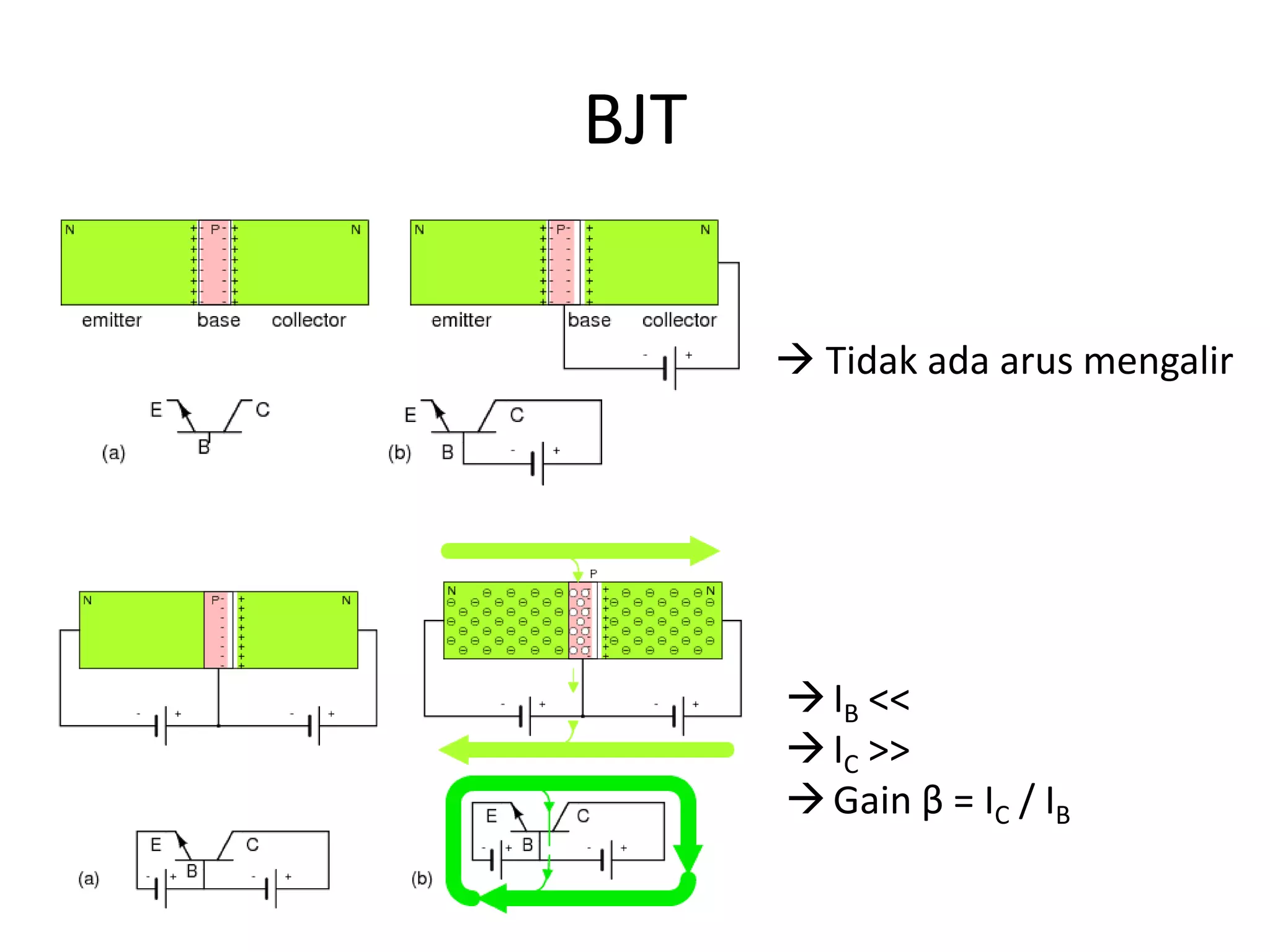
BJT
 Tidak ada arus mengalir
IB <<
IC >>
Gain β = IC / IB
Transistor
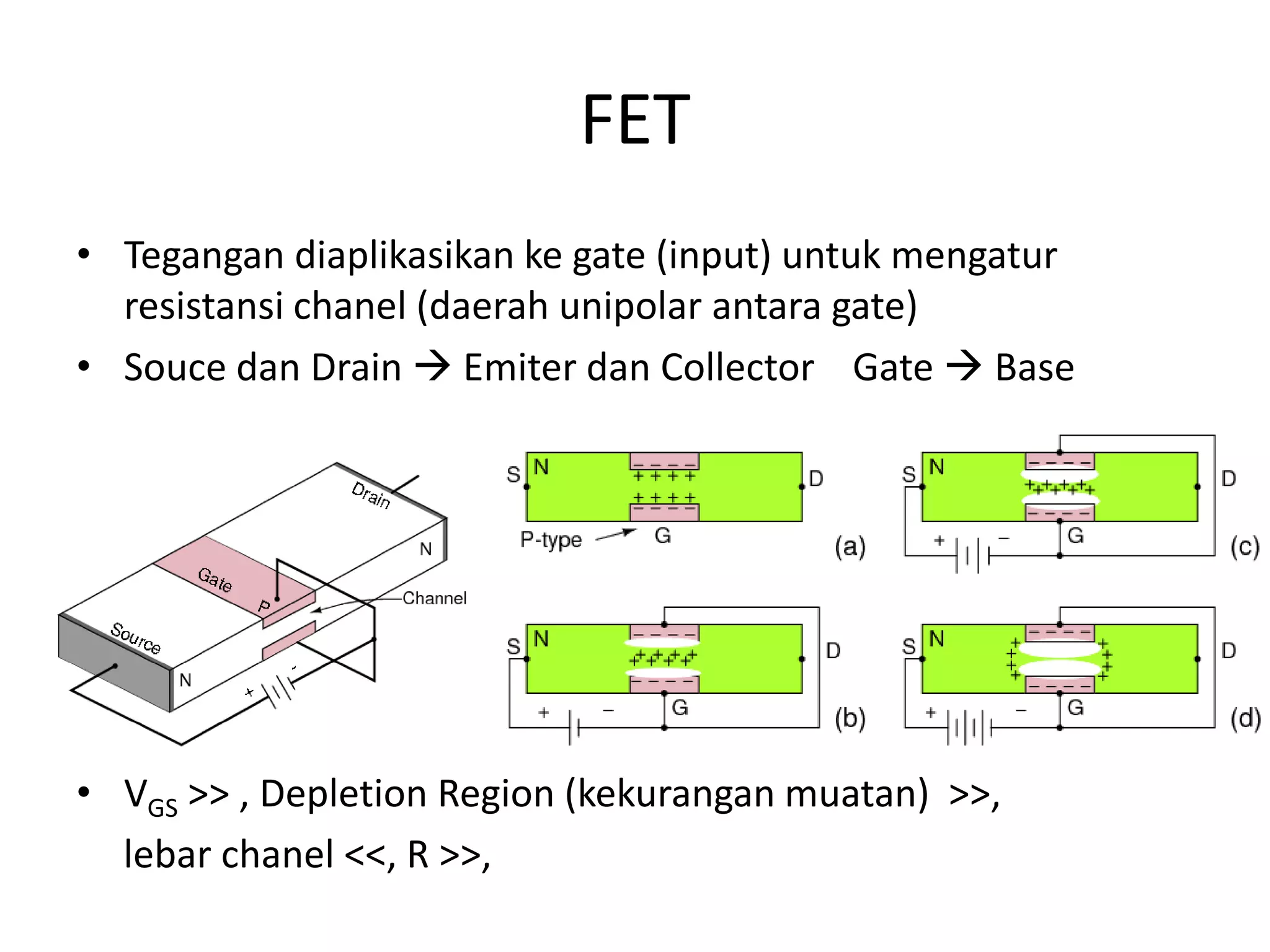
FET
• Tegangan diaplikasikan ke gate (input) untuk mengatur
resistansi chanel (daerah unipolar antara gate)
• Souce dan Drain  Emiter dan Collector Gate  Base
• VGS >> , Depletion Region (kekurangan muatan) >>,
lebar chanel <<, R >>,
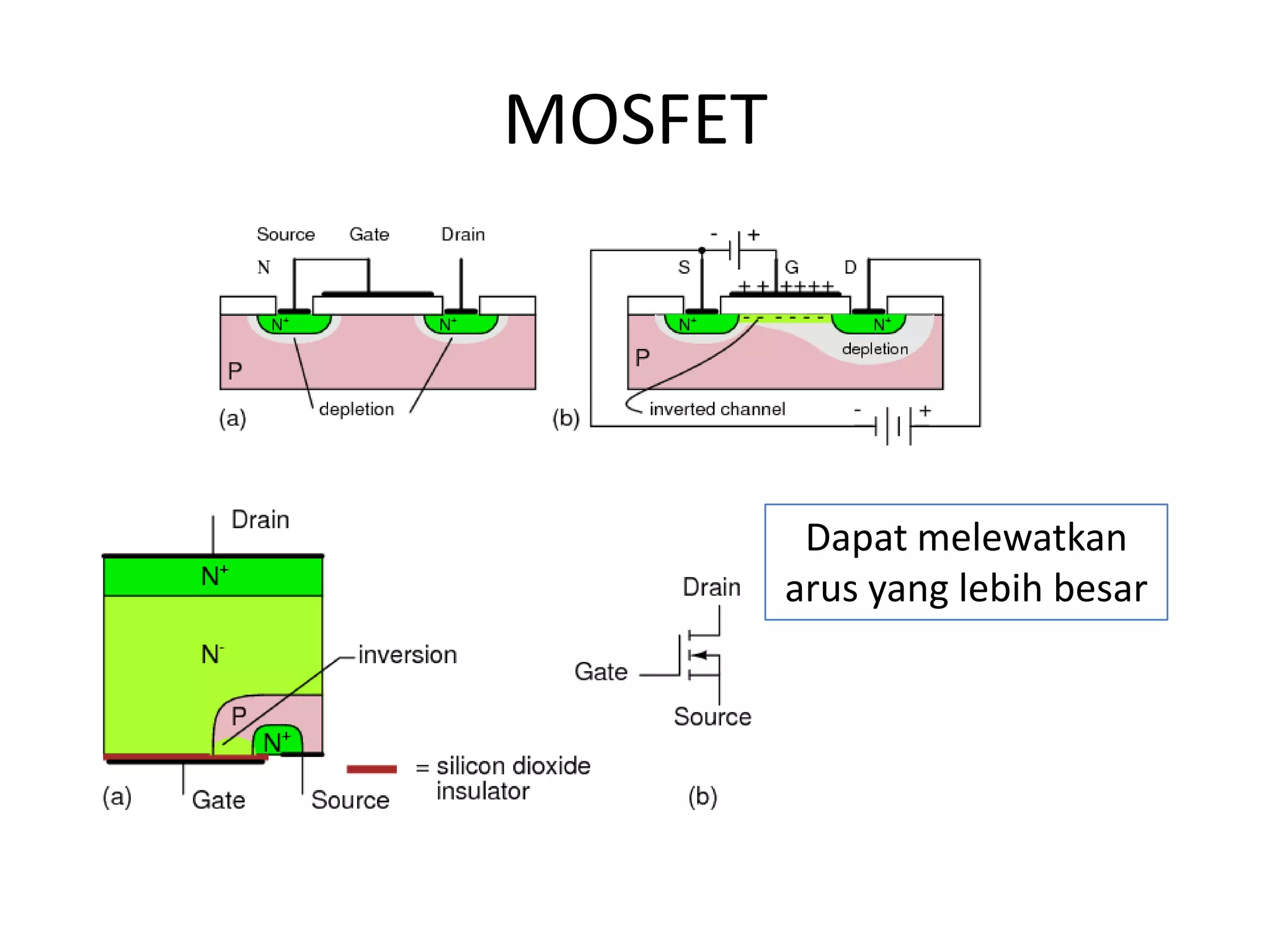
MOSFET
Dapat melewatkan
arus yang lebih besar
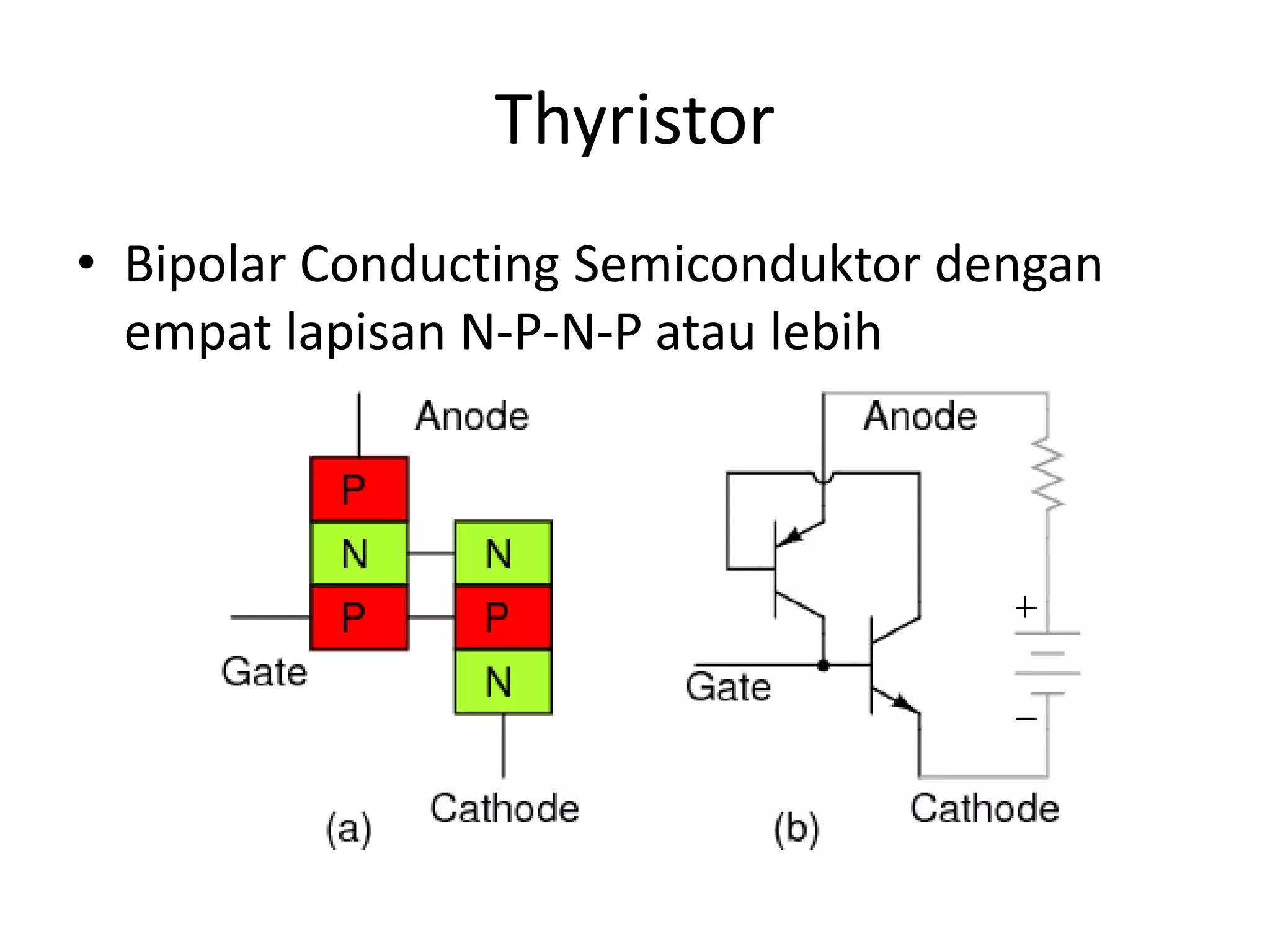
Thyristor
• Bipolar Conducting Semiconduktor dengan
empat lapisan N-P-N-P atau lebih
Contoh Soal 2
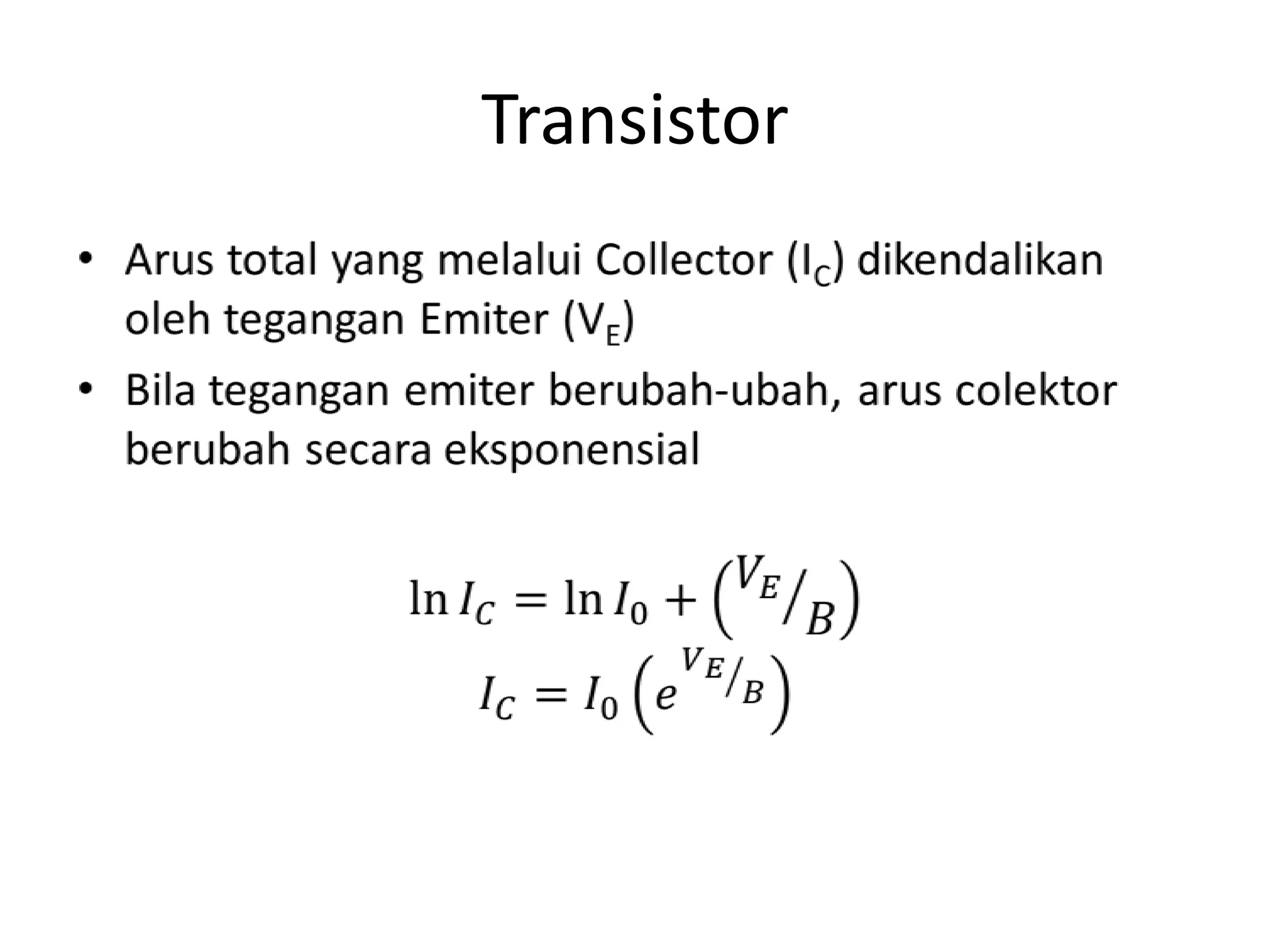
Suatu transistor mempunyai arus kolektor 4.7 mA jika
tegangan emiter 17 mV. Sedangkan pada tegangan
emiter 28 mV besar arus kolektor adalah 27.5 mA. Jika
transistor tersebut diberikan tegangan emiter sebesar
39 mV, berapakah arus kolektornya?

Material semikonduktor

  • 1.
  • 3.
    Semikonduktor Intrinsik Silikon (Si),Germanium (Ge) • 4 elektron valensi • Ikatan kovalen
  • 4.
    Elektron dan Hole •Elektron  pembawa muatan (-) • Hole  pembawa muatan (+)
  • 5.
    Mobilitas Muatan Dua pembawamuatan: elektron (n) & hole (p)
  • 6.
  • 8.
    Foto Konduksi • Fotonsinar merah  E = 1.9 eV • Silikon  Eg = 1.1 eV 1.9 eV 1.1 eV
  • 9.
    SEMIKONDUKTOR EKSTRINSIK • Penambahanpengotor (ketidakmurnian) sehingga terdapat elektron dan hole tambahan
  • 10.
    Tipe - n antimony,phosphorus, arsenic • 5 elektron valensi • Pembawa muatan negatif (n)
  • 11.
    • elektron “ke-lima”dari atom fospor menjadi elektron bebas yang bisa berpindah tempat • elektron bebas bisa menghantar arus • pembawa muatannya adalah elektron
  • 13.
    Konduktivitas tipe -n nn = konsentrasi elektron bebas pn = konsentrasi hole ND = konsentrasi atom donor n2 2 = tetapan yg tidak bergantung pada donor dan akseptor
  • 14.
    Tipe - p aluminium,boron,galium atau indium • 3 elektron valensi • Pembawa muatan positif (p)
  • 15.
    • elektron dariatom silikon pindah ke atom boron • Atom silikon terjadi “hole” yang kemudian menarik elektron dari atom silikon lain di dekatnya • Proses berlanjut dimana pergerakan “hole” menghasilkan arus
  • 17.
    Konduktivitas tipe -p np = konsentrasi elektron bebas pp = konsentrasi hole NA = konsentrasi atom akseptor n2 2 = tetapan yg tidak bergantung pada donor dan akseptor
  • 18.
    Contoh Soal 1: Konsentrasiatom Germanium (Ge) adalah 4.41 x 10²² atom/cm3. Jika tiap 108 atom Ge dikotori 1 atom donor dan μn = 3800 cm2/V.s, tentukan konduktivitas semikonduktor tersebut?
  • 19.
    Penggabungan Kembali • FotoKonduksi : Energi (foton)  e + h • Penggabungan kembali: e + h  Energi (foton) Perpendaran cahaya
  • 20.
    PERANGKAT SEMIKONDUKTOR • Penghantar •Junction (dioda) • Transistor
  • 21.
    Diodes • N regionhas lots of free electrons • P region has lots of holes • At equilibrium: total number positive and negative charges is the same (@ room temp) • At the pn junction the electrons and holes with different charges form an electric field • In order to move electrons through the electric field (generate current) we need some force (voltage) – This potential difference is called barrier voltage – When enough voltage is applied such that electrons are moved then we are biasing the diode – Two layers of positive and negative charges for depletion region – the region near the pn-junction is depleted of charge carriers)
  • 22.
  • 23.
    Biasing Types ofa Diode (Forward) Cathode n region Anode p region A K Moving electrons Small dynamic resistance VBias np Conventional Current Flow Conventional Current Flow I (Forward)
  • 24.
    Very Small Moving Electrons: Reverse Current) BiasingTypes of a Diode (Reverse) Cathode n region Anode p region A K Large resistance VBias np Conventional Current Flow Holes are left behind; large depletion region Instant pull of electrons
  • 25.
  • 26.
    I-V Characteristics ofPractical Diode
  • 27.
    I-V Characteristics ofPractical Diode
  • 28.
    I-V Characteristics ofPractical Diode
  • 29.
    Shockley Equation 1exp T D sD nV v Ii q kT VT Is isthe saturation current ~10 -14 Vd is the diode voltage n – emission coefficient (varies from 1 - 2 ) k = 1.38 × 10⁻²³ J/K is Boltzmann’s constant q = 1.60 × 10⁻¹⁹ C is the electrical charge of an electron. At a temperature of 300 K, we have mV26TV
  • 30.
    Jenis Perangkat Junctionp-n • Diode • LED • Zener • Varactor • Varistor
  • 31.
    LED • e +h  foton
  • 32.
    Transistor • Field EfectTransistor (FET) • Bipolar Junction Transistor (BJT) • Junction FET • Metal Oxide Semiconductor FET • Thyristor / Silicon Controlled Rectifier (SCR) • Gate Turn Off Thyristor (GTO) • Insulated Gate Bipolar Transistor (IGBT)
  • 33.
    BJT  Tidak adaarus mengalir IB << IC >> Gain β = IC / IB
  • 34.
  • 35.
    FET • Tegangan diaplikasikanke gate (input) untuk mengatur resistansi chanel (daerah unipolar antara gate) • Souce dan Drain  Emiter dan Collector Gate  Base • VGS >> , Depletion Region (kekurangan muatan) >>, lebar chanel <<, R >>,
  • 36.
  • 37.
    Thyristor • Bipolar ConductingSemiconduktor dengan empat lapisan N-P-N-P atau lebih
  • 38.
    Contoh Soal 2 Suatutransistor mempunyai arus kolektor 4.7 mA jika tegangan emiter 17 mV. Sedangkan pada tegangan emiter 28 mV besar arus kolektor adalah 27.5 mA. Jika transistor tersebut diberikan tegangan emiter sebesar 39 mV, berapakah arus kolektornya?

Editor's Notes

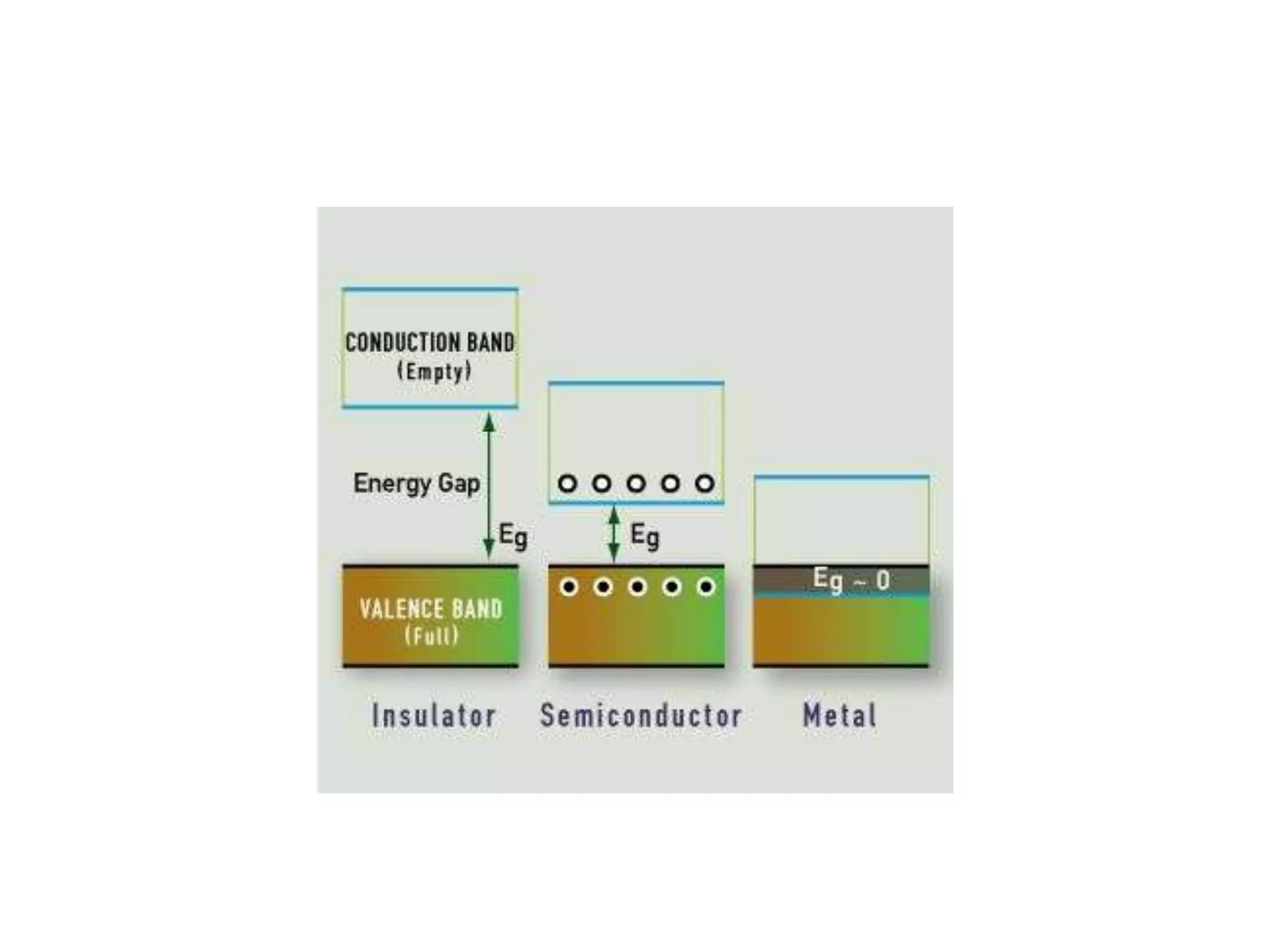
  • #4 Energi yang diperlukanuntukmemutussebuahikatankovalenadalahsebesar 1,1 eVuntuksilikondan 0,7 eVuntuk germanium. Padatemperaturruang (300K), sejumlahelektronmempunyaienergi yang cukupbesaruntukmelepaskandiridariikatan dan tereksitasi dari pita valensi ke pita konduksi menjadi elektron bebas
  • #5 Besaryaenergi yang diperlukanuntukmelepaskanelektrondari pita valensikepita konduksiinidisebutenergiterlarang (energy gap). Jikasebuahikatankovalenterputus, makaakanterjadikekosonganataulubang (hole). Padadaerahdimanaterjadikekosonganakanterdapatkelebihanmuatanpositif, dandaerah yang ditempatielektronbebasmempunyaikelebihanmuatannegatif. Keduamuataninilah yang memberikankontribusiadanyaaliranlistrikpadasemikonduktormurni. Jikaelektronvalensidariikatankovalen yang lain mengisilubangtersebut, makaakanterjadilubangbaru ditempat yang lain danseolah-olahsebuahmuatanpositifbergerakdarilubang yang lamakelubangbaru.
  • #7 Jumlahpembawamuatan (n) bertambahdenganjumlahmuatan (elektron) yang melompatiselaPada 0oKtidakadaelektron yang dapatmelompatiselaDengannaiknyatemperatur: elektronbertambah
  • #36 MemperkuatsinyalFET : transistor efekmedan: memanfaatkandaerah yang kekuranganpembawamuatanuntukmemperkuatkeluaran.Denganberubahnyasinyal, daerah yang kekuranganpembawamuatanberubah, dengandemikianmerubahresistivitasantarasumberdanpenerima.Sebaliknyaarus yang mengalirkeluarberubahsecaraterkendali.Sinyal yang lemahdapatmenyebabkanfluktuasiarus yang berarti.