MATERIAL MANAGEMENT
Ms. SAHELI C
LECTURER
IACN
INTRODUCTION
• Material management is the management and
control of goods, services and equipment
from the acquisition to distribution.
• It is concerned with providing the drugs,
supplies and equipments needed by health
personnel to deliver health services.
DEFINITION
➢ Material management is a scientific technique
comprising of planning, organizing & control of
materials from their initial purchase to their final
destination.
➢ Material is the essential resources to achieve the
objectives of health organization.
➢ About 40 % of the funds in the health care system
are used up for providing materials.
➢Material management integrates all material
functions. It includes:
• Planning for material.
• Purchasing.
• Incoming quality control.
• Demand estimation.
• Inventory management
• Warehousing and stores.
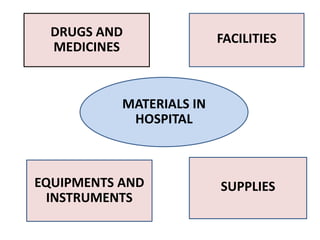
MATERIALS IN
HOSPITAL
DRUGS AND
MEDICINES
FACILITIES
EQUIPMENTS AND
INSTRUMENTS
SUPPLIES
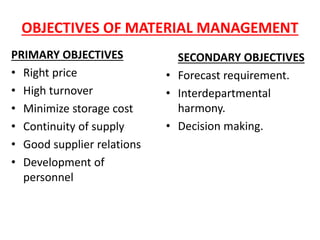
OBJECTIVES OF MATERIAL MANAGEMENT
PRIMARY OBJECTIVES
• Right price
• High turnover
• Minimize storage cost
• Continuity of supply
• Good supplier relations
• Development of
personnel
SECONDARY OBJECTIVES
• Forecast requirement.
• Interdepartmental
harmony.
• Decision making.
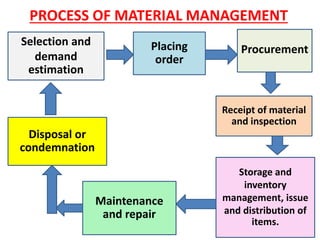
PROCESS OF MATERIAL MANAGEMENT
Selection and
demand
estimation
Placing
order
Receipt of material
and inspection
Storage and
inventory
management, issue
and distribution of
items.
Disposal or
condemnation
Maintenance
and repair
Procurement
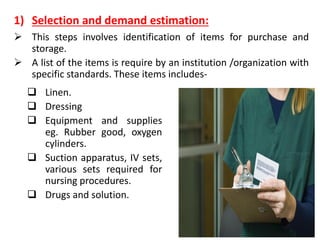
1) Selection and demand estimation:
➢ This steps involves identification of items for purchase and
storage.
➢ A list of the items is require by an institution /organization with
specific standards. These items includes-
❑ Linen.
❑ Dressing
❑ Equipment and supplies
eg. Rubber good, oxygen
cylinders.
❑ Suction apparatus, IV sets,
various sets required for
nursing procedures.
❑ Drugs and solution.
➢ For example in determining the quantity of the
bed sheets per patient ;the estimate will be:
❖ 1 top sheet + 1 bottom sheet = 2 sheets/
patient.
❖ Then 2 sheets/ patient is further needed as :
✓ 2 sheets/ patient in use.
✓ 2 sheets /patient in laundry.
✓ 2 sheets/ patient for emergency.
✓ Total = 6 sheets per patient
❖ So in a 24 bedded general ward the estimated
requirement of sheets will be 24X6 = 144
sheets.
❖ This implies at a given point of time this ward
need to have 144 bed sheets for patients
2) Placing order:
➢ This activity is
concerned with
estimation of the
expected demand of
an item for the
future.
➢ It is known as
casting and
forecasting that
usually made on the
basis of past
experience.
3) PROCUREMENT:
➢ It is an act of buying goods,
services or works from an
external source.
➢ Cost effectiveness, and cost
benefit analysis should be
ensured before buying the
goods.
➢ Standardization of items is
required.
➢ Group or bulk purchasing is
essential for cost
effectiveness.
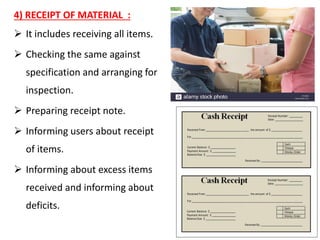
4) RECEIPT OF MATERIAL :
➢ It includes receiving all items.
➢ Checking the same against
specification and arranging for
inspection.
➢ Preparing receipt note.
➢ Informing users about receipt
of items.
➢ Informing about excess items
received and informing about
deficits.
5) Storage and inventory management:
➢ Material after being inspected received and stored into
store room till its consumption or distribution.
➢ Some material need to be stored at a specific temperature.
➢ Supplies are arranged on racks with both sides open and
issued or distributed from front side.
➢ Maintain the principle of First in First out (FIFO) which helps
in issuing those material first which are received first.
➢ Arrange group wise or alphabetically for easy identification.
➢ Monitor expiry date.
A) Use the method of two bin method: This method
separates the entire stock of each item into two bins or
boxes.
❑One box contains the main stock and second box contains
the enough stock to satisfy the demand during lead time.
B) Maintenance of buffer stock : A stock of additional
supplies is required to be maintained for meeting unusual
and emergency demands.
C) Lead time: Lead time refers to the interval between the
time; when the order placed of an item and the actual time
when the items have been replenished.
6) Maintenance and repair :
➢ This step includes the maintenance of all equipment’s
used for patient care services for protecting and
maintaining the life of these equipments.
➢ It is usually undertaken through services contracts.
➢ It is absolutely essential for effective material
management.
7) Disposal or condemnation:
• Over a period certain equipment either become
obsolete or beyond economic repair and
occupy precious space in the respective
departments or in the hospital on the whole.
• These equipment need to be condemned and
disposed off at regular intervals.
Material management converted

Material management converted

  • 1.
  • 2.
    INTRODUCTION • Material managementis the management and control of goods, services and equipment from the acquisition to distribution. • It is concerned with providing the drugs, supplies and equipments needed by health personnel to deliver health services.
  • 3.
    DEFINITION ➢ Material managementis a scientific technique comprising of planning, organizing & control of materials from their initial purchase to their final destination. ➢ Material is the essential resources to achieve the objectives of health organization. ➢ About 40 % of the funds in the health care system are used up for providing materials.
  • 4.
    ➢Material management integratesall material functions. It includes: • Planning for material. • Purchasing. • Incoming quality control. • Demand estimation. • Inventory management • Warehousing and stores.
  • 5.
  • 6.
    OBJECTIVES OF MATERIALMANAGEMENT PRIMARY OBJECTIVES • Right price • High turnover • Minimize storage cost • Continuity of supply • Good supplier relations • Development of personnel SECONDARY OBJECTIVES • Forecast requirement. • Interdepartmental harmony. • Decision making.
  • 7.
    PROCESS OF MATERIALMANAGEMENT Selection and demand estimation Placing order Receipt of material and inspection Storage and inventory management, issue and distribution of items. Disposal or condemnation Maintenance and repair Procurement
  • 8.
    1) Selection anddemand estimation: ➢ This steps involves identification of items for purchase and storage. ➢ A list of the items is require by an institution /organization with specific standards. These items includes- ❑ Linen. ❑ Dressing ❑ Equipment and supplies eg. Rubber good, oxygen cylinders. ❑ Suction apparatus, IV sets, various sets required for nursing procedures. ❑ Drugs and solution.
  • 9.
    ➢ For examplein determining the quantity of the bed sheets per patient ;the estimate will be: ❖ 1 top sheet + 1 bottom sheet = 2 sheets/ patient. ❖ Then 2 sheets/ patient is further needed as : ✓ 2 sheets/ patient in use. ✓ 2 sheets /patient in laundry. ✓ 2 sheets/ patient for emergency. ✓ Total = 6 sheets per patient ❖ So in a 24 bedded general ward the estimated requirement of sheets will be 24X6 = 144 sheets. ❖ This implies at a given point of time this ward need to have 144 bed sheets for patients 2) Placing order: ➢ This activity is concerned with estimation of the expected demand of an item for the future. ➢ It is known as casting and forecasting that usually made on the basis of past experience.
  • 10.
    3) PROCUREMENT: ➢ Itis an act of buying goods, services or works from an external source. ➢ Cost effectiveness, and cost benefit analysis should be ensured before buying the goods. ➢ Standardization of items is required. ➢ Group or bulk purchasing is essential for cost effectiveness.
  • 11.
    4) RECEIPT OFMATERIAL : ➢ It includes receiving all items. ➢ Checking the same against specification and arranging for inspection. ➢ Preparing receipt note. ➢ Informing users about receipt of items. ➢ Informing about excess items received and informing about deficits.
  • 12.
    5) Storage andinventory management: ➢ Material after being inspected received and stored into store room till its consumption or distribution. ➢ Some material need to be stored at a specific temperature. ➢ Supplies are arranged on racks with both sides open and issued or distributed from front side. ➢ Maintain the principle of First in First out (FIFO) which helps in issuing those material first which are received first. ➢ Arrange group wise or alphabetically for easy identification. ➢ Monitor expiry date.
  • 13.
    A) Use themethod of two bin method: This method separates the entire stock of each item into two bins or boxes. ❑One box contains the main stock and second box contains the enough stock to satisfy the demand during lead time. B) Maintenance of buffer stock : A stock of additional supplies is required to be maintained for meeting unusual and emergency demands. C) Lead time: Lead time refers to the interval between the time; when the order placed of an item and the actual time when the items have been replenished.
  • 14.
    6) Maintenance andrepair : ➢ This step includes the maintenance of all equipment’s used for patient care services for protecting and maintaining the life of these equipments. ➢ It is usually undertaken through services contracts. ➢ It is absolutely essential for effective material management.
  • 15.
    7) Disposal orcondemnation: • Over a period certain equipment either become obsolete or beyond economic repair and occupy precious space in the respective departments or in the hospital on the whole. • These equipment need to be condemned and disposed off at regular intervals.