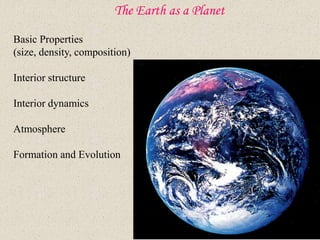
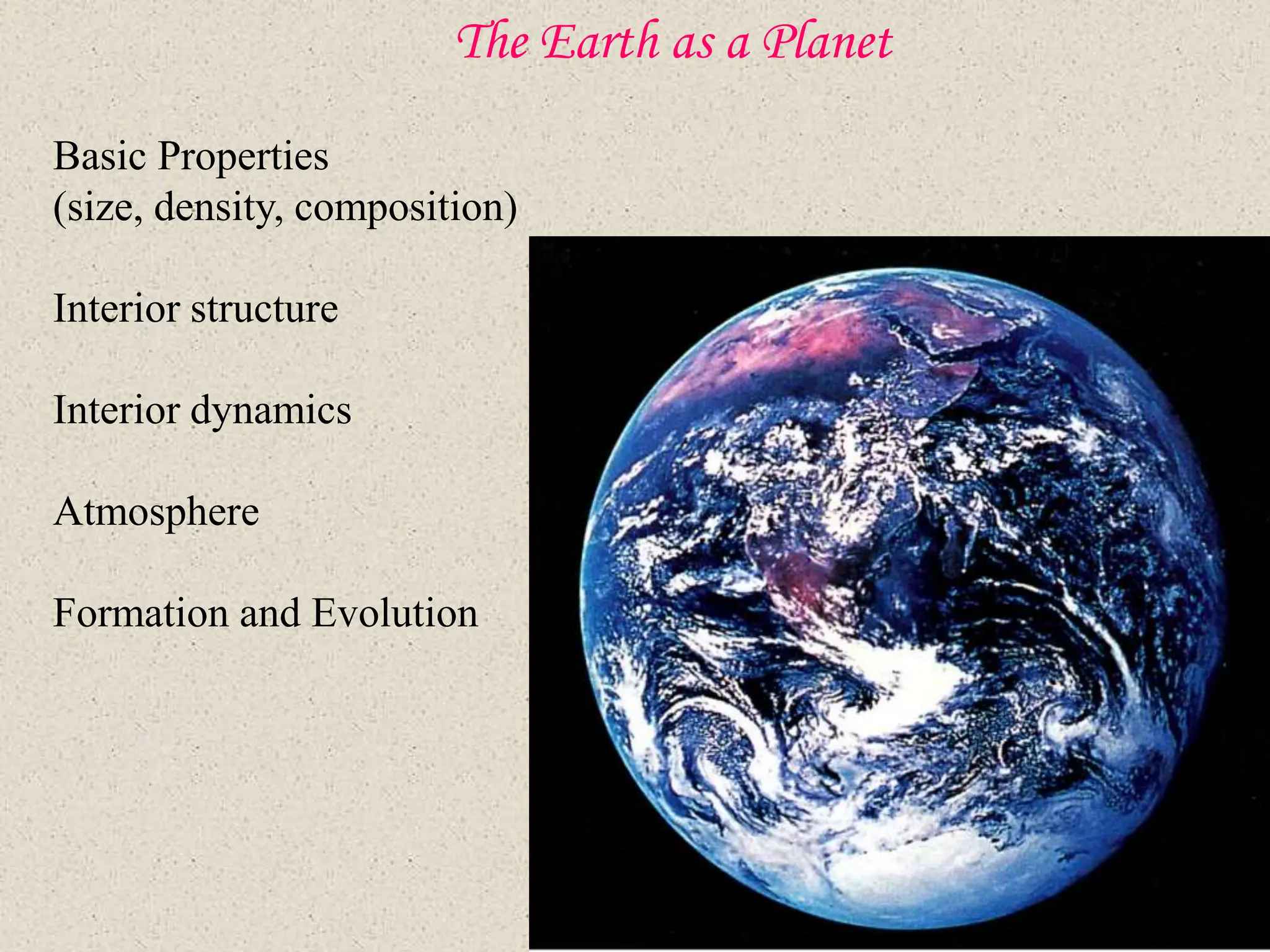
The Earth as a Planet
Basic Properties
(size, density, composition)
Interior structure
Interior dynamics
Atmosphere
Formation and Evolution
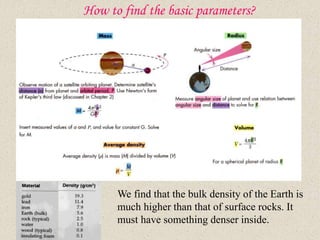
How to find the basic parameters?
We find that the bulk density of the Earth is
much higher than that of surface rocks. It
must have something denser inside.
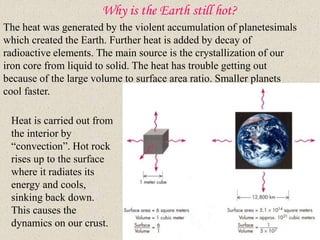
Why is the Earth still hot?
The heat was generated by the violent accumulation of planetesimals
which created the Earth. Further heat is added by decay of
radioactive elements. The main source is the crystallization of our
iron core from liquid to solid. The heat has trouble getting out
because of the large volume to surface area ratio. Smaller planets
cool faster.
Heat is carried out from
the interior by
“convection”. Hot rock
rises up to the surface
where it radiates its
energy and cools,
sinking back down.
This causes the
dynamics on our crust.
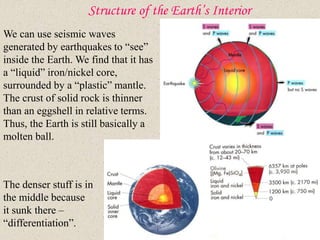
Structure of the Earth’s Interior
We can use seismic waves
generated by earthquakes to “see”
inside the Earth. We find that it has
a “liquid” iron/nickel core,
surrounded by a “plastic” mantle.
The crust of solid rock is thinner
than an eggshell in relative terms.
Thus, the Earth is still basically a
molten ball.
The denser stuff is in
the middle because
it sunk there –
“differentiation”.
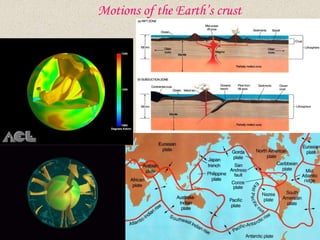
Motions of the Earth’s crust
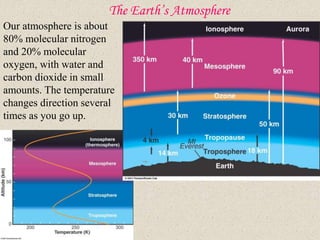
The Earth’s Atmosphere
Our atmosphere is about
80% molecular nitrogen
and 20% molecular
oxygen, with water and
carbon dioxide in small
amounts. The temperature
changes direction several
times as you go up.
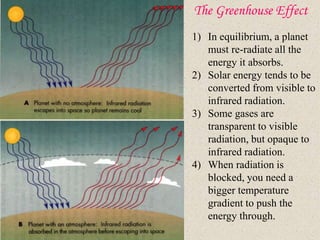
The Greenhouse Effect
1) In equilibrium, a planet
must re-radiate all the
energy it absorbs.
2) Solar energy tends to be
converted from visible to
infrared radiation.
3) Some gases are
transparent to visible
radiation, but opaque to
infrared radiation.
4) When radiation is
blocked, you need a
bigger temperature
gradient to push the
energy through.
Carbon Dioxide is a critical factor
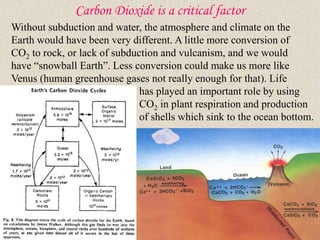
Without subduction and water, the atmosphere and climate on the
Earth would have been very different. A little more conversion of
CO2 to rock, or lack of subduction and vulcanism, and we would
have “snowball Earth”. Less conversion could make us more like
Venus (human greenhouse gases not really enough for that). Life
has played an important role by using
CO2 in plant respiration and production
of shells which sink to the ocean bottom.
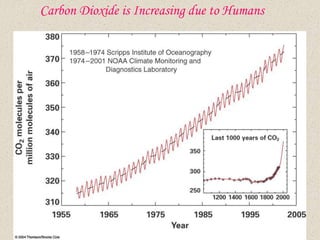
Carbon Dioxide is Increasing due to Humans
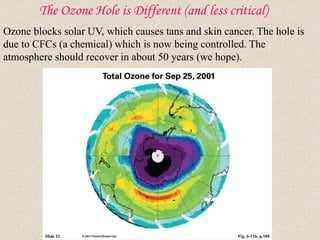
The Ozone Hole is Different (and less critical)
Slide 21 Fig. 6-11b, p.105
Ozone blocks solar UV, which causes tans and skin cancer. The hole is
due to CFCs (a chemical) which is now being controlled. The
atmosphere should recover in about 50 years (we hope).
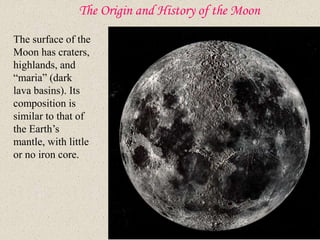
The Origin and History of the Moon
The surface of the
Moon has craters,
highlands, and
“maria” (dark
lava basins). Its
composition is
similar to that of
the Earth’s
mantle, with little
or no iron core.
Craters on the Moon
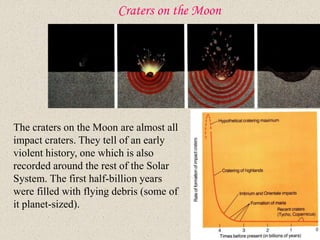
The craters on the Moon are almost all
impact craters. They tell of an early
violent history, one which is also
recorded around the rest of the Solar
System. The first half-billion years
were filled with flying debris (some of
it planet-sized).
Getting Ages from Half-lives
Start
1 half-life
2 half-lives
3 half-lives
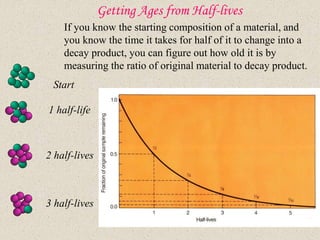
If you know the starting composition of a material, and
you know the time it takes for half of it to change into a
decay product, you can figure out how old it is by
measuring the ratio of original material to decay product.
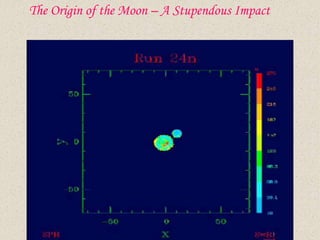
The Origin of the Moon – A Stupendous Impact
Tides
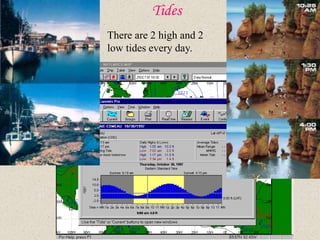
There are 2 high and 2
low tides every day.
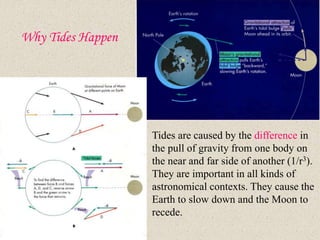
Why Tides Happen
Tides are caused by the difference in
the pull of gravity from one body on
the near and far side of another (1/r3).
They are important in all kinds of
astronomical contexts. They cause the
Earth to slow down and the Moon to
recede.
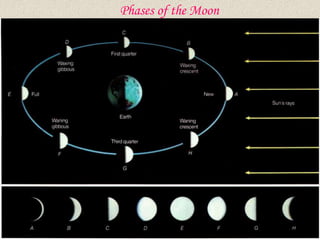
Phases of the Moon
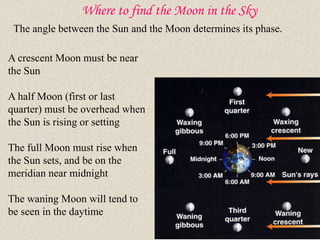
Where to find the Moon in the Sky
The angle between the Sun and the Moon determines its phase.
A crescent Moon must be near
the Sun
A half Moon (first or last
quarter) must be overhead when
the Sun is rising or setting
The full Moon must rise when
the Sun sets, and be on the
meridian near midnight
The waning Moon will tend to
be seen in the daytime
Phase Movie
Lunar Eclipses
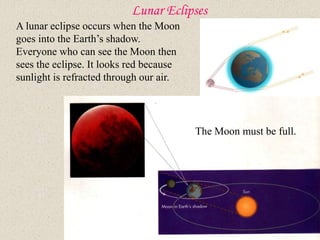
A lunar eclipse occurs when the Moon
goes into the Earth’s shadow.
Everyone who can see the Moon then
sees the eclipse. It looks red because
sunlight is refracted through our air.
The Moon must be full.
Solar Eclipses
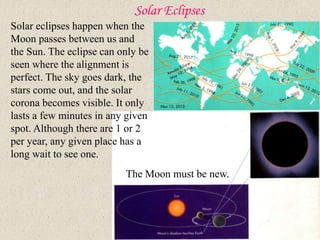
Solar eclipses happen when the
Moon passes between us and
the Sun. The eclipse can only be
seen where the alignment is
perfect. The sky goes dark, the
stars come out, and the solar
corona becomes visible. It only
lasts a few minutes in any given
spot. Although there are 1 or 2
per year, any given place has a
long wait to see one.
The Moon must be new.
ShadowDance
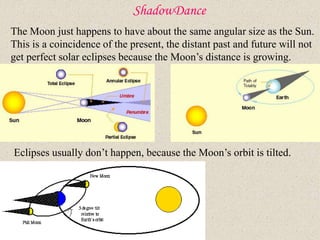
Eclipses usually don’t happen, because the Moon’s orbit is tilted.
The Moon just happens to have about the same angular size as the Sun.
This is a coincidence of the present, the distant past and future will not
get perfect solar eclipses because the Moon’s distance is growing.
Astro Quiz
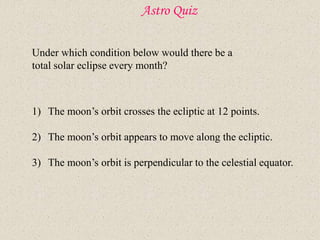
Under which condition below would there be a
total solar eclipse every month?
1) The moon’s orbit crosses the ecliptic at 12 points.
2) The moon’s orbit appears to move along the ecliptic.
3) The moon’s orbit is perpendicular to the celestial equator.

About earth.ppt

  • 1.
    The Earth asa Planet Basic Properties (size, density, composition) Interior structure Interior dynamics Atmosphere Formation and Evolution
  • 2.
    How to findthe basic parameters? We find that the bulk density of the Earth is much higher than that of surface rocks. It must have something denser inside.
  • 3.
    Why is theEarth still hot? The heat was generated by the violent accumulation of planetesimals which created the Earth. Further heat is added by decay of radioactive elements. The main source is the crystallization of our iron core from liquid to solid. The heat has trouble getting out because of the large volume to surface area ratio. Smaller planets cool faster. Heat is carried out from the interior by “convection”. Hot rock rises up to the surface where it radiates its energy and cools, sinking back down. This causes the dynamics on our crust.
  • 4.
    Structure of theEarth’s Interior We can use seismic waves generated by earthquakes to “see” inside the Earth. We find that it has a “liquid” iron/nickel core, surrounded by a “plastic” mantle. The crust of solid rock is thinner than an eggshell in relative terms. Thus, the Earth is still basically a molten ball. The denser stuff is in the middle because it sunk there – “differentiation”.
  • 5.
    Motions of theEarth’s crust
  • 6.
    The Earth’s Atmosphere Ouratmosphere is about 80% molecular nitrogen and 20% molecular oxygen, with water and carbon dioxide in small amounts. The temperature changes direction several times as you go up.
  • 7.
    The Greenhouse Effect 1)In equilibrium, a planet must re-radiate all the energy it absorbs. 2) Solar energy tends to be converted from visible to infrared radiation. 3) Some gases are transparent to visible radiation, but opaque to infrared radiation. 4) When radiation is blocked, you need a bigger temperature gradient to push the energy through.
  • 8.
    Carbon Dioxide isa critical factor Without subduction and water, the atmosphere and climate on the Earth would have been very different. A little more conversion of CO2 to rock, or lack of subduction and vulcanism, and we would have “snowball Earth”. Less conversion could make us more like Venus (human greenhouse gases not really enough for that). Life has played an important role by using CO2 in plant respiration and production of shells which sink to the ocean bottom.
  • 9.
    Carbon Dioxide isIncreasing due to Humans
  • 10.
    The Ozone Holeis Different (and less critical) Slide 21 Fig. 6-11b, p.105 Ozone blocks solar UV, which causes tans and skin cancer. The hole is due to CFCs (a chemical) which is now being controlled. The atmosphere should recover in about 50 years (we hope).
  • 11.
    The Origin andHistory of the Moon The surface of the Moon has craters, highlands, and “maria” (dark lava basins). Its composition is similar to that of the Earth’s mantle, with little or no iron core.
  • 12.
    Craters on theMoon The craters on the Moon are almost all impact craters. They tell of an early violent history, one which is also recorded around the rest of the Solar System. The first half-billion years were filled with flying debris (some of it planet-sized).
  • 13.
    Getting Ages fromHalf-lives Start 1 half-life 2 half-lives 3 half-lives If you know the starting composition of a material, and you know the time it takes for half of it to change into a decay product, you can figure out how old it is by measuring the ratio of original material to decay product.
  • 14.
    The Origin ofthe Moon – A Stupendous Impact
  • 15.
    Tides There are 2high and 2 low tides every day.
  • 16.
    Why Tides Happen Tidesare caused by the difference in the pull of gravity from one body on the near and far side of another (1/r3). They are important in all kinds of astronomical contexts. They cause the Earth to slow down and the Moon to recede.
  • 17.
  • 18.
    Where to findthe Moon in the Sky The angle between the Sun and the Moon determines its phase. A crescent Moon must be near the Sun A half Moon (first or last quarter) must be overhead when the Sun is rising or setting The full Moon must rise when the Sun sets, and be on the meridian near midnight The waning Moon will tend to be seen in the daytime
  • 19.
  • 20.
    Lunar Eclipses A lunareclipse occurs when the Moon goes into the Earth’s shadow. Everyone who can see the Moon then sees the eclipse. It looks red because sunlight is refracted through our air. The Moon must be full.
  • 21.
    Solar Eclipses Solar eclipseshappen when the Moon passes between us and the Sun. The eclipse can only be seen where the alignment is perfect. The sky goes dark, the stars come out, and the solar corona becomes visible. It only lasts a few minutes in any given spot. Although there are 1 or 2 per year, any given place has a long wait to see one. The Moon must be new.
  • 22.
    ShadowDance Eclipses usually don’thappen, because the Moon’s orbit is tilted. The Moon just happens to have about the same angular size as the Sun. This is a coincidence of the present, the distant past and future will not get perfect solar eclipses because the Moon’s distance is growing.
  • 23.
    Astro Quiz Under whichcondition below would there be a total solar eclipse every month? 1) The moon’s orbit crosses the ecliptic at 12 points. 2) The moon’s orbit appears to move along the ecliptic. 3) The moon’s orbit is perpendicular to the celestial equator.