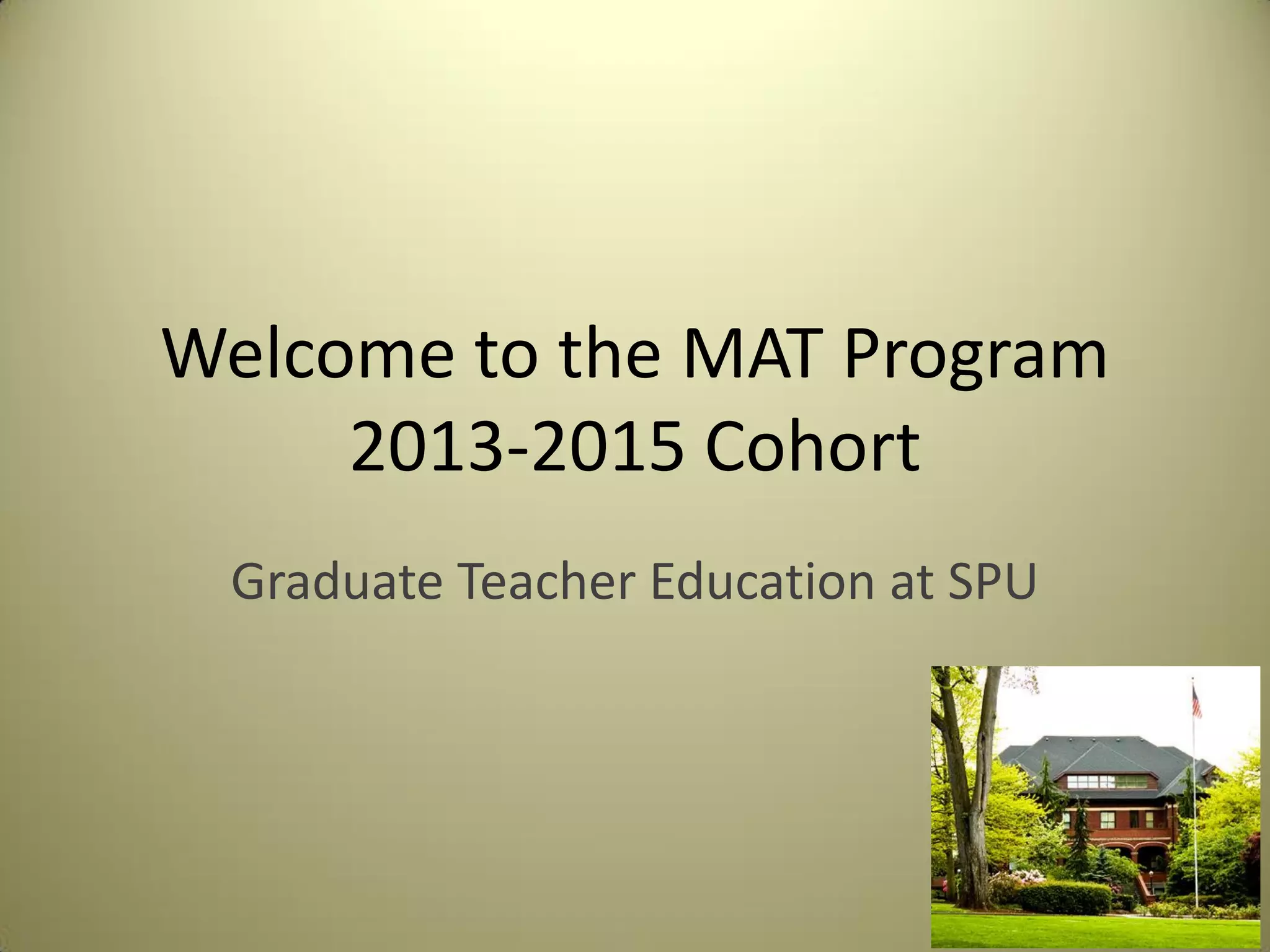
Welcome to the MAT Program
2013-2015 Cohort
Graduate Teacher Education at SPU
Agenda
First Half
Getting to Know You
About SPU and SOE
Standards & Accreditation
Certification Office ~3:15
Program Specifics
Academic Policies
Tuition and Fees
Second Half
UT for SS ~3:45
Opportunity at Big Picture HS
Campus Resources
Class Registration
Summer Quarter
bPortfolio
Between Now and Start
Contact and Support ~4:50
http://www.sputeachered.org/mat-candidate-orientation/
Learning Target
Get to know each other
Summarize features of the MAT program
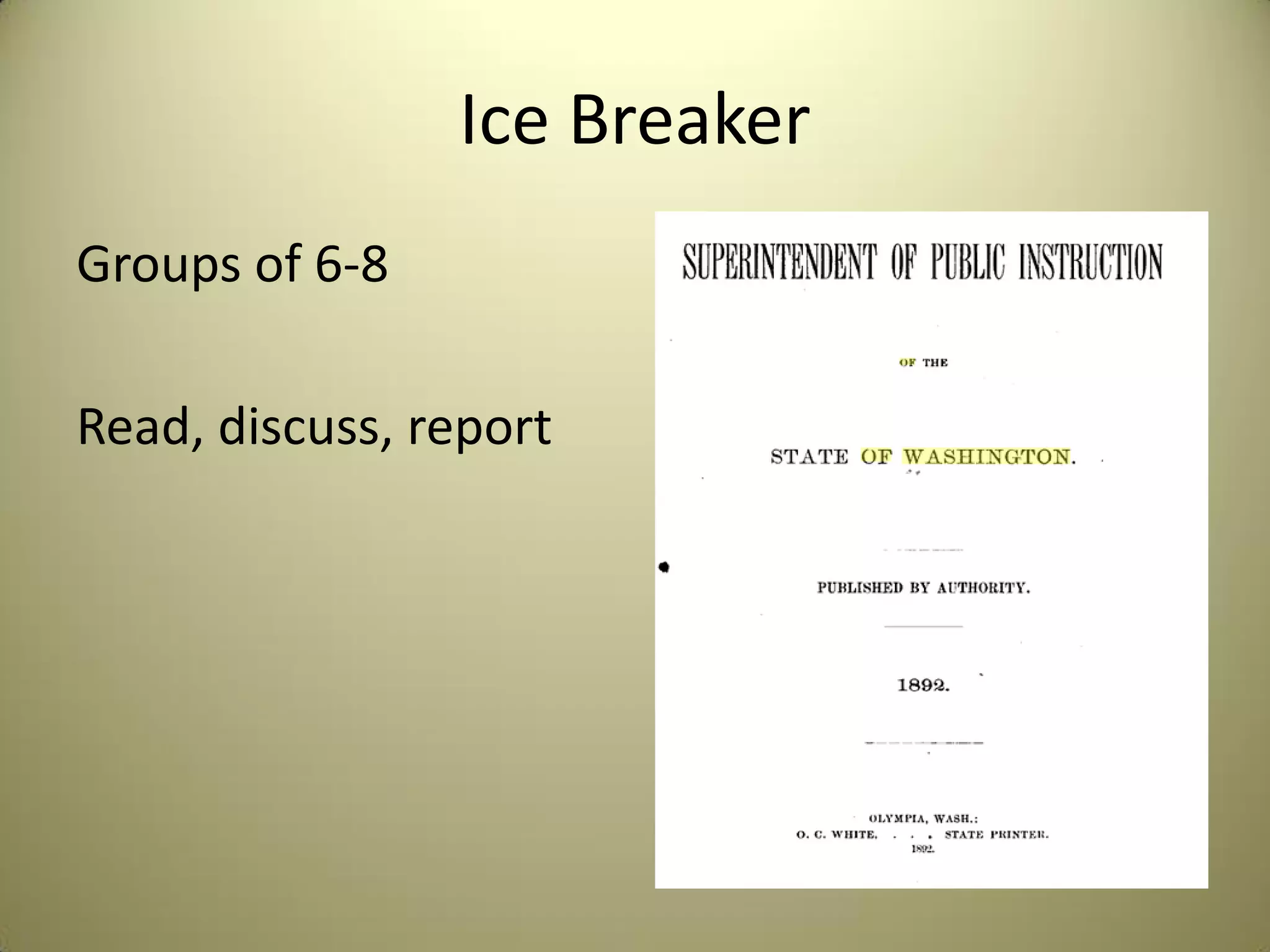
Ice Breaker
Groups of 6-8
Read, discuss, report
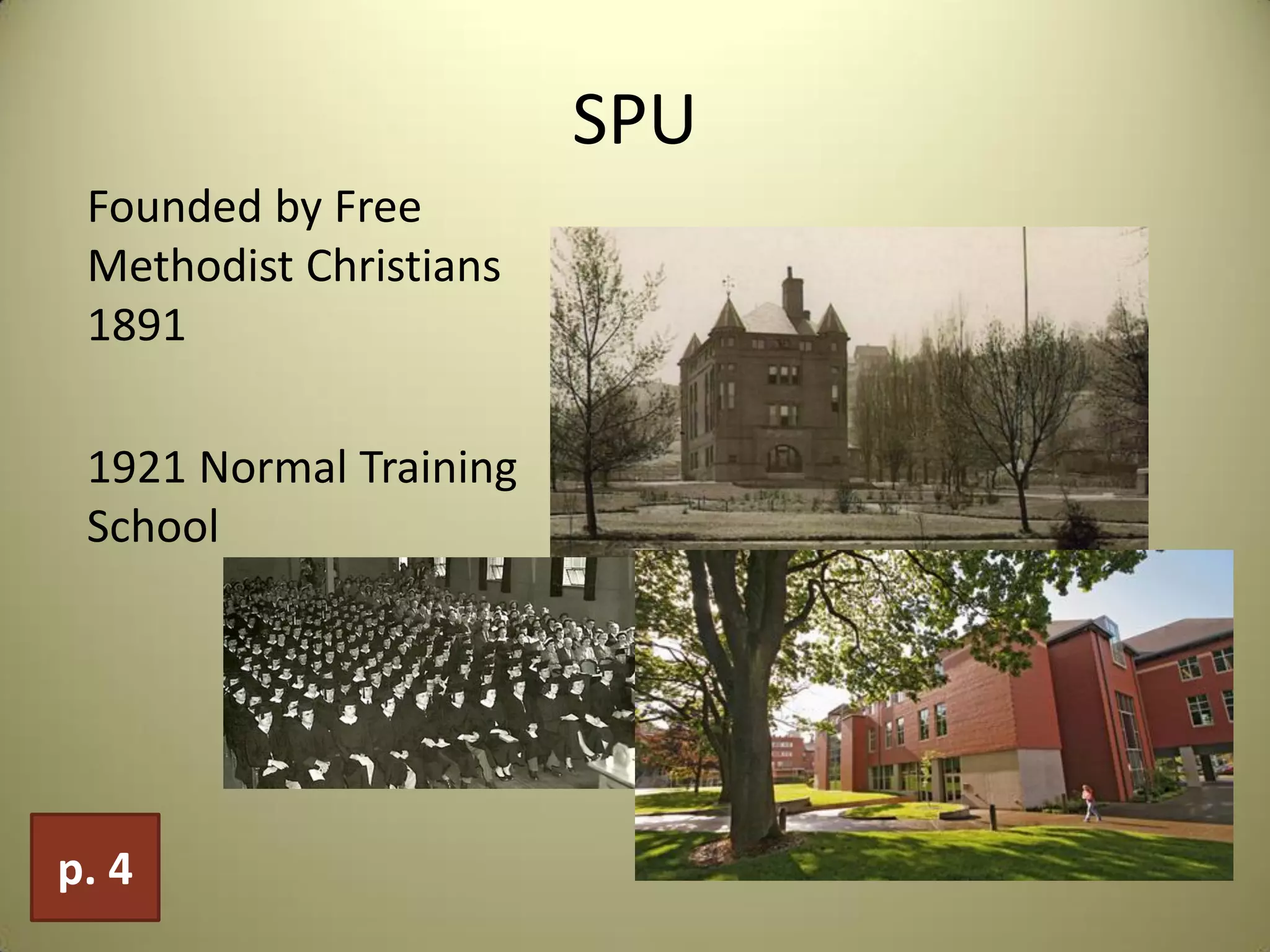
SPU
Founded by Free
Methodist Christians
1891
1921 Normal Training
School
p. 4
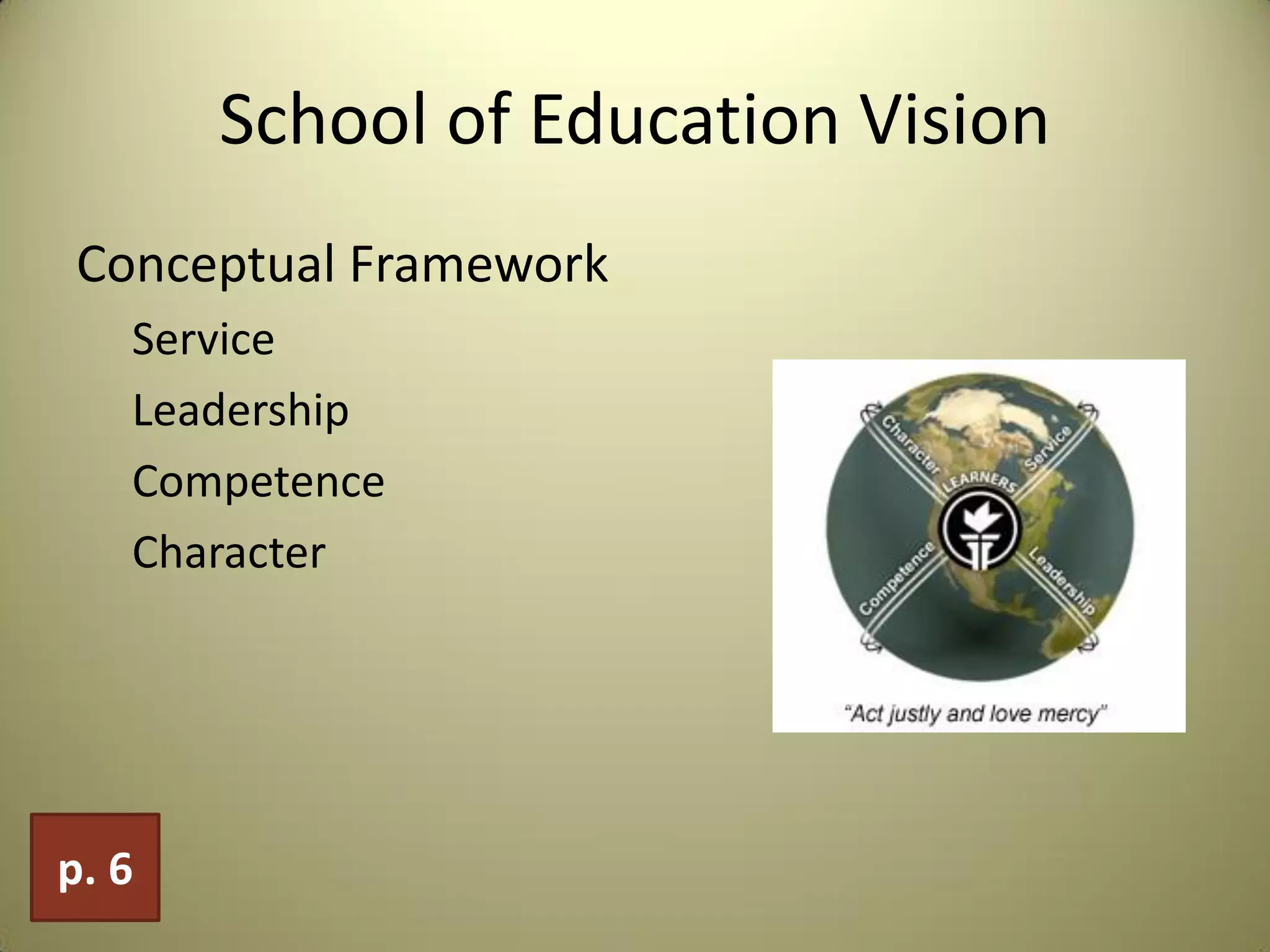
School of Education Vision
Conceptual Framework
Service
Leadership
Competence
Character
p. 6
MAT Program Standards
Principles of HOPE
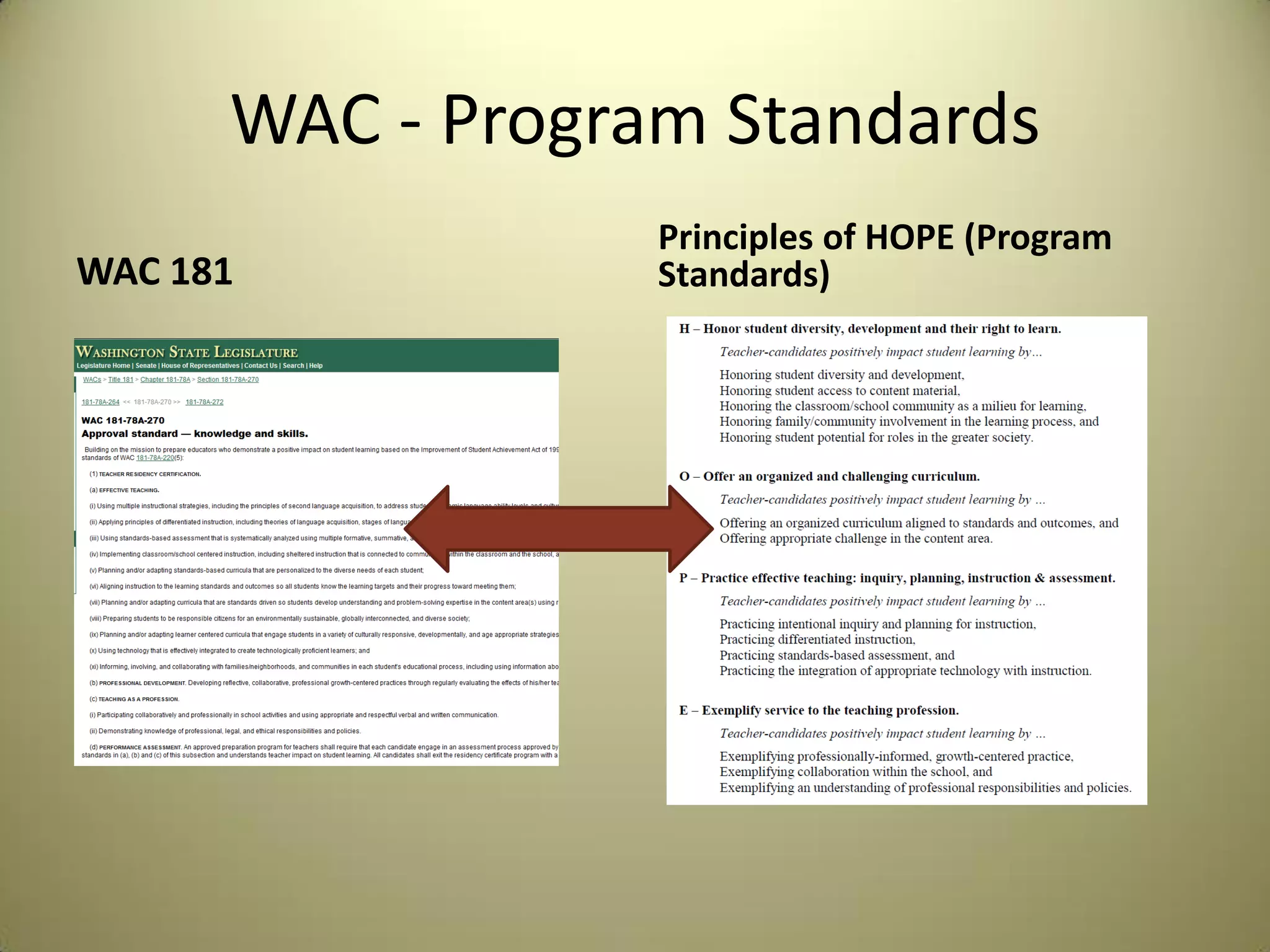
H – Honor student diversity, development and their right to
learn
O – Offer an organized and challenging curriculum
P – Practice effective teaching: inquiry, planning, instruction
and assessment
E – Exemplify service to the teaching profession
p. 7
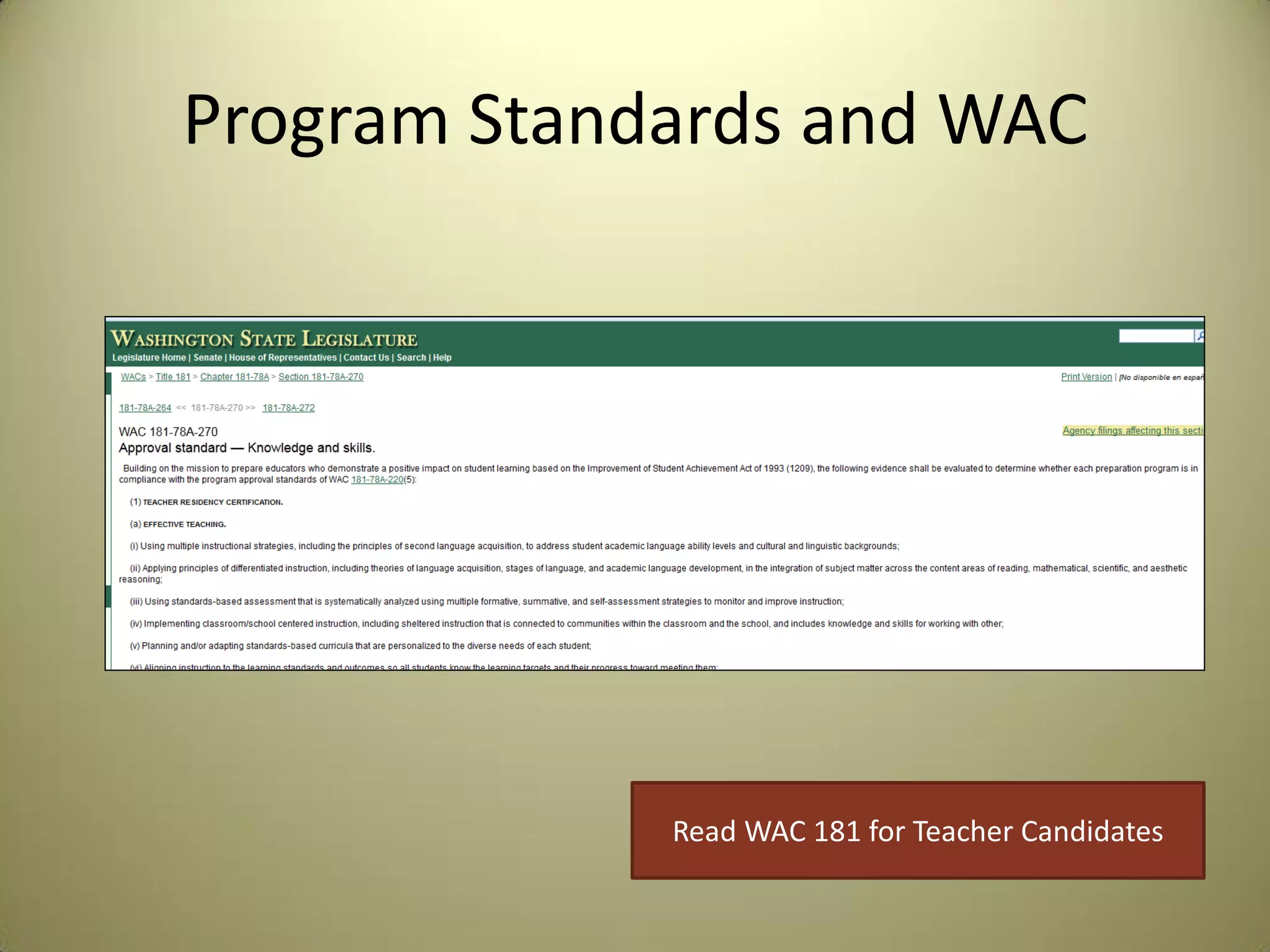
Program Standards and WAC
Read WAC 181 for Teacher Candidates
Graduate School Standards
• Foundational Knowledge and Skills
• Leadership
• Communication
• Analysis & Problem Solving
• Professionalism
• Impact on Student Learning
p. 9
Accreditation
• Professional Educator Standards Board
– Teacher Performance Assessment
– Draft Professional Development Plan
– WEST B and E
• National Council for Accreditation of Teacher
Education
– bPortfolio
– Disposition Assessment
MAT Program
MAT graduate degree + WA teaching certificate
Certificate (teaching license)
Approximately 50 credits (13 classes + two quarters of
internship)
MAT degree
15 credits (5 classes)
Variations according to endorsement and background
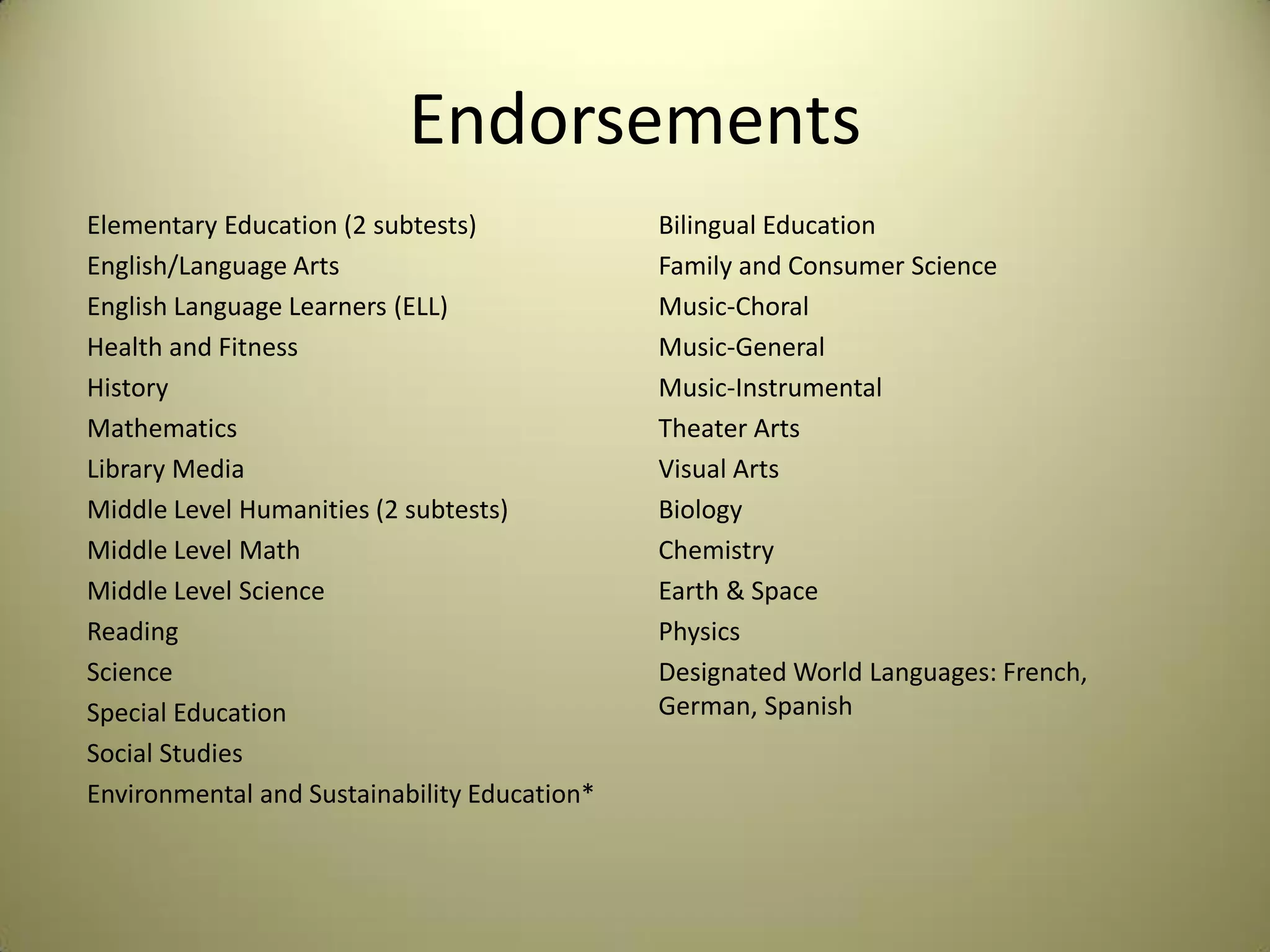
Endorsements
Elementary Education (2 subtests)
English/Language Arts
English Language Learners (ELL)
Health and Fitness
History
Mathematics
Library Media
Middle Level Humanities (2 subtests)
Middle Level Math
Middle Level Science
Reading
Science
Special Education
Social Studies
Environmental and Sustainability Education*
Bilingual Education
Family and Consumer Science
Music-Choral
Music-General
Music-Instrumental
Theater Arts
Visual Arts
Biology
Chemistry
Earth & Space
Physics
Designated World Languages: French,
German, Spanish
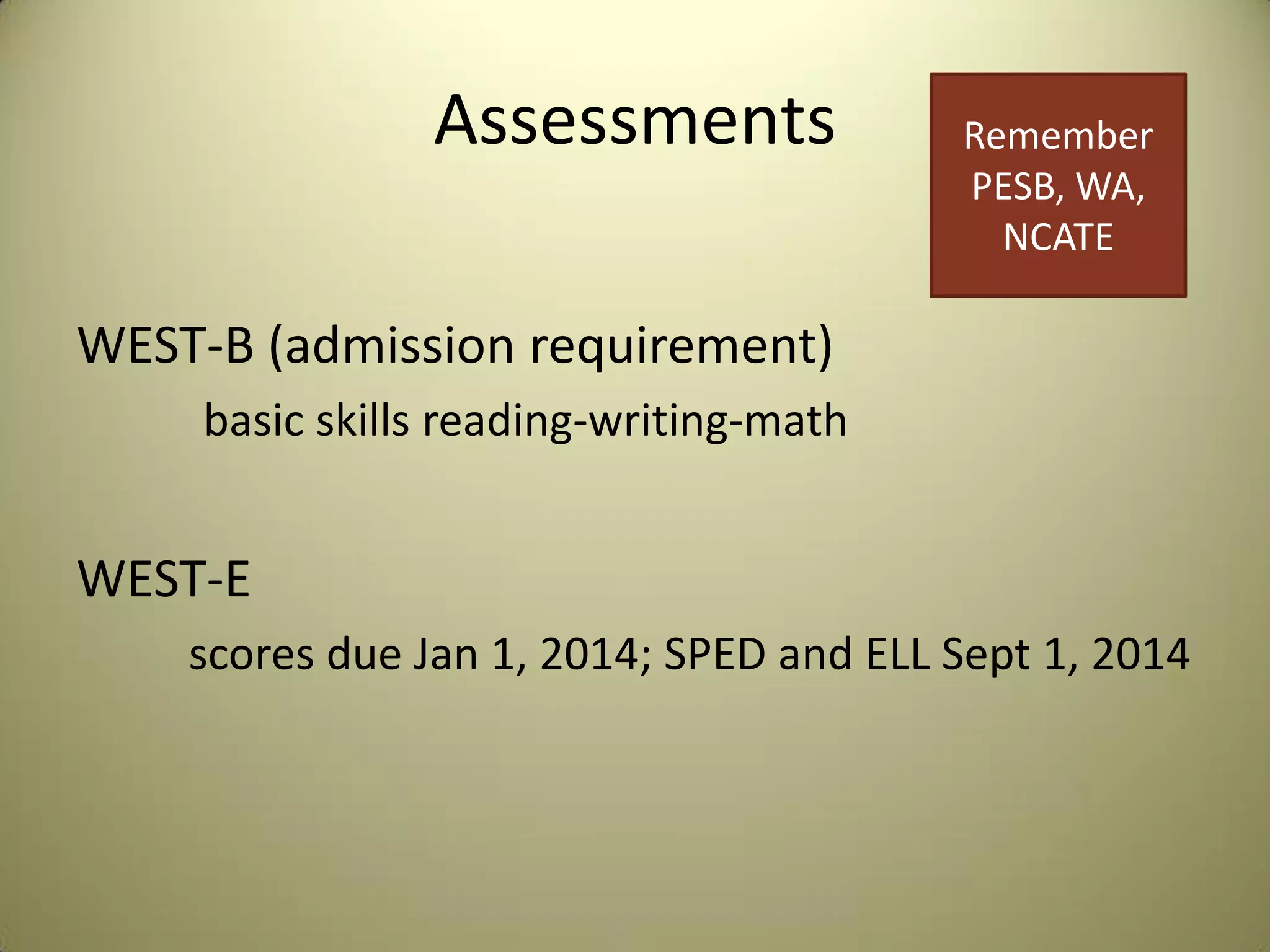
Assessments
WEST-B (admission requirement)
basic skills reading-writing-math
WEST-E
scores due Jan 1, 2014; SPED and ELL Sept 1, 2014
Remember
PESB, WA,
NCATE
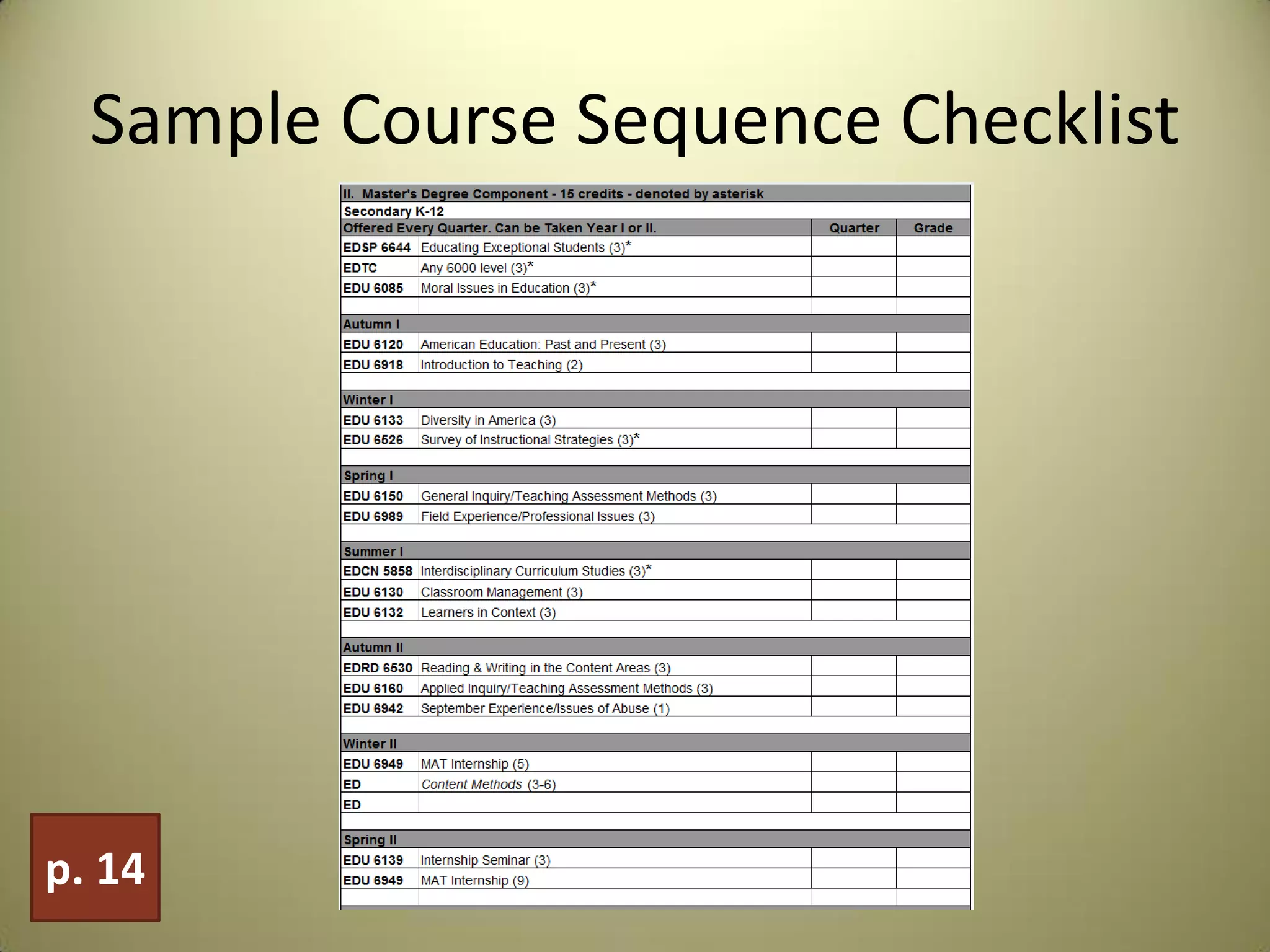
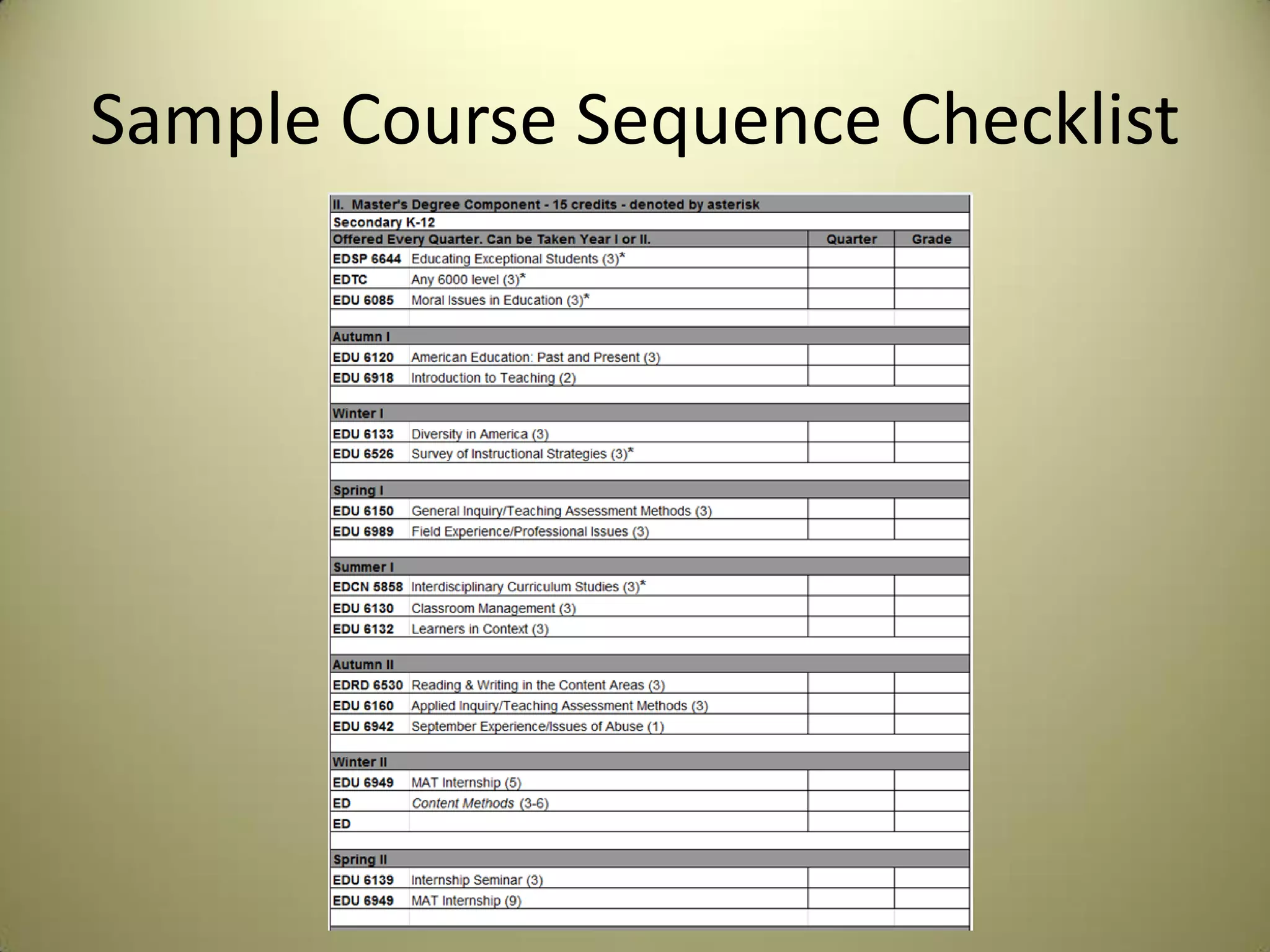
Sample Course Sequence Checklist
p. 14
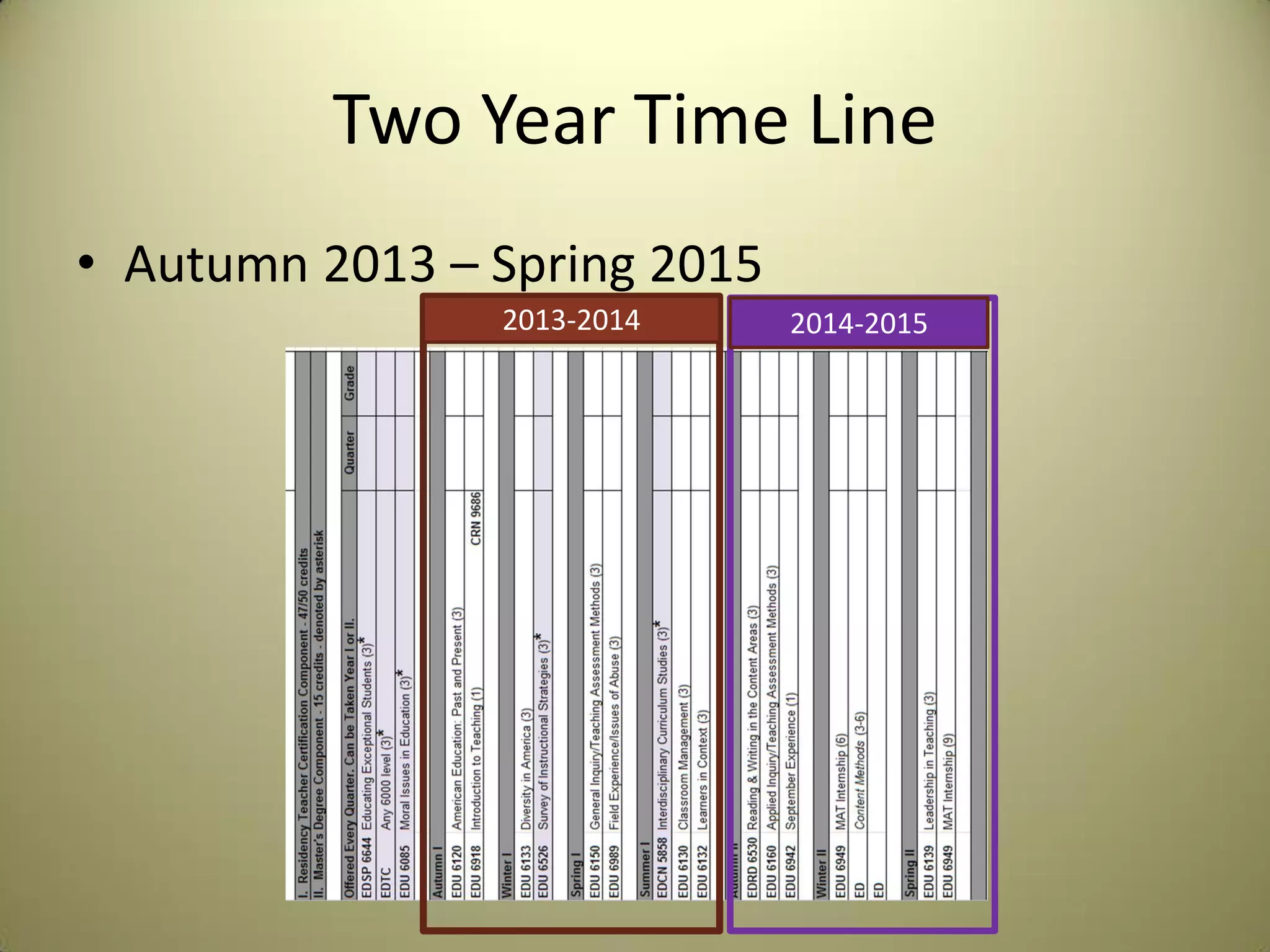
Two Year Time Line
• Autumn 2013 – Spring 2015
2013-2014 2014-2015
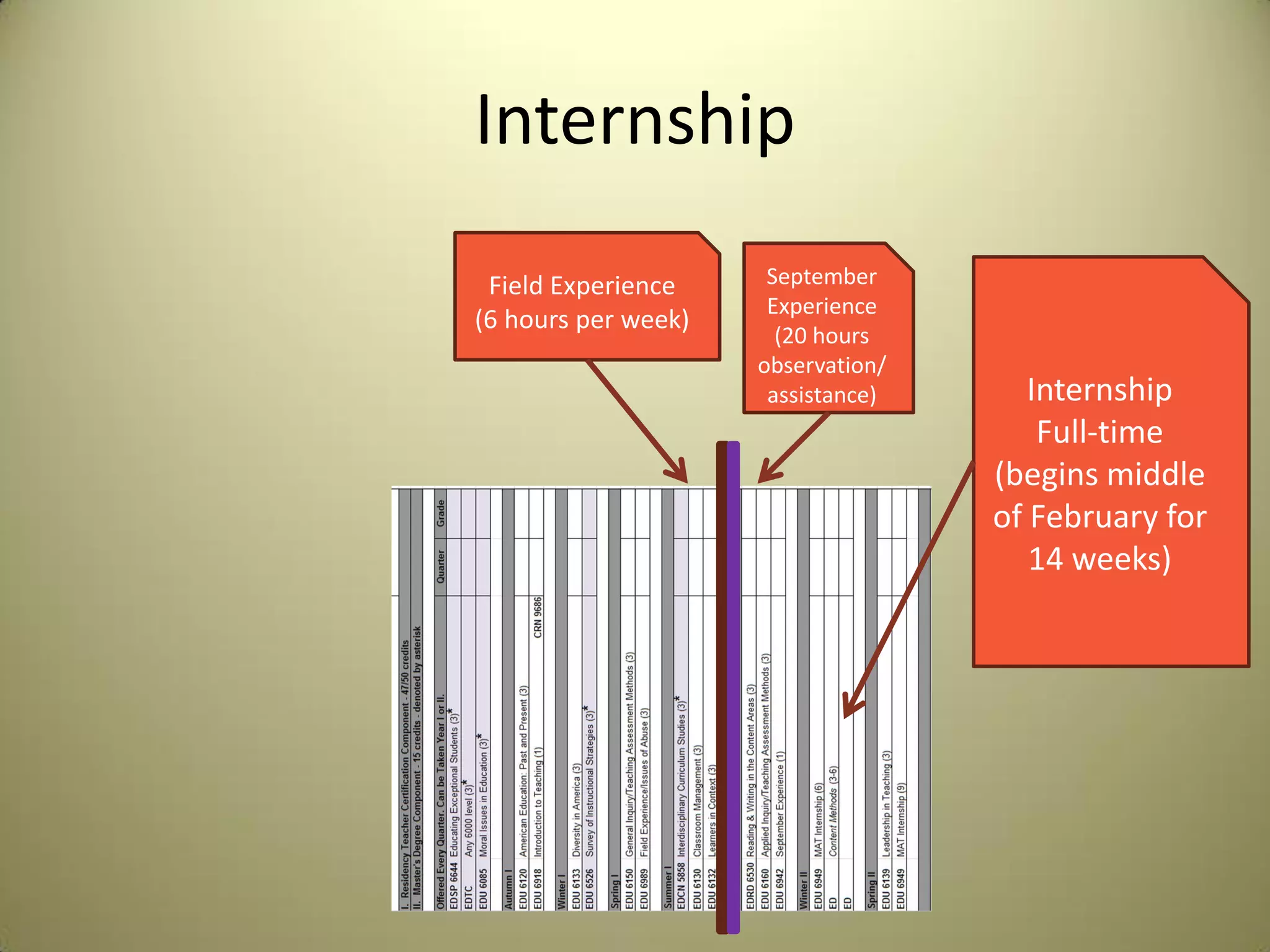
Internship
September
Experience
(20 hours
observation/
assistance) Internship
Full-time
(begins middle
of February for
14 weeks)
Field Experience
(6 hours per week)
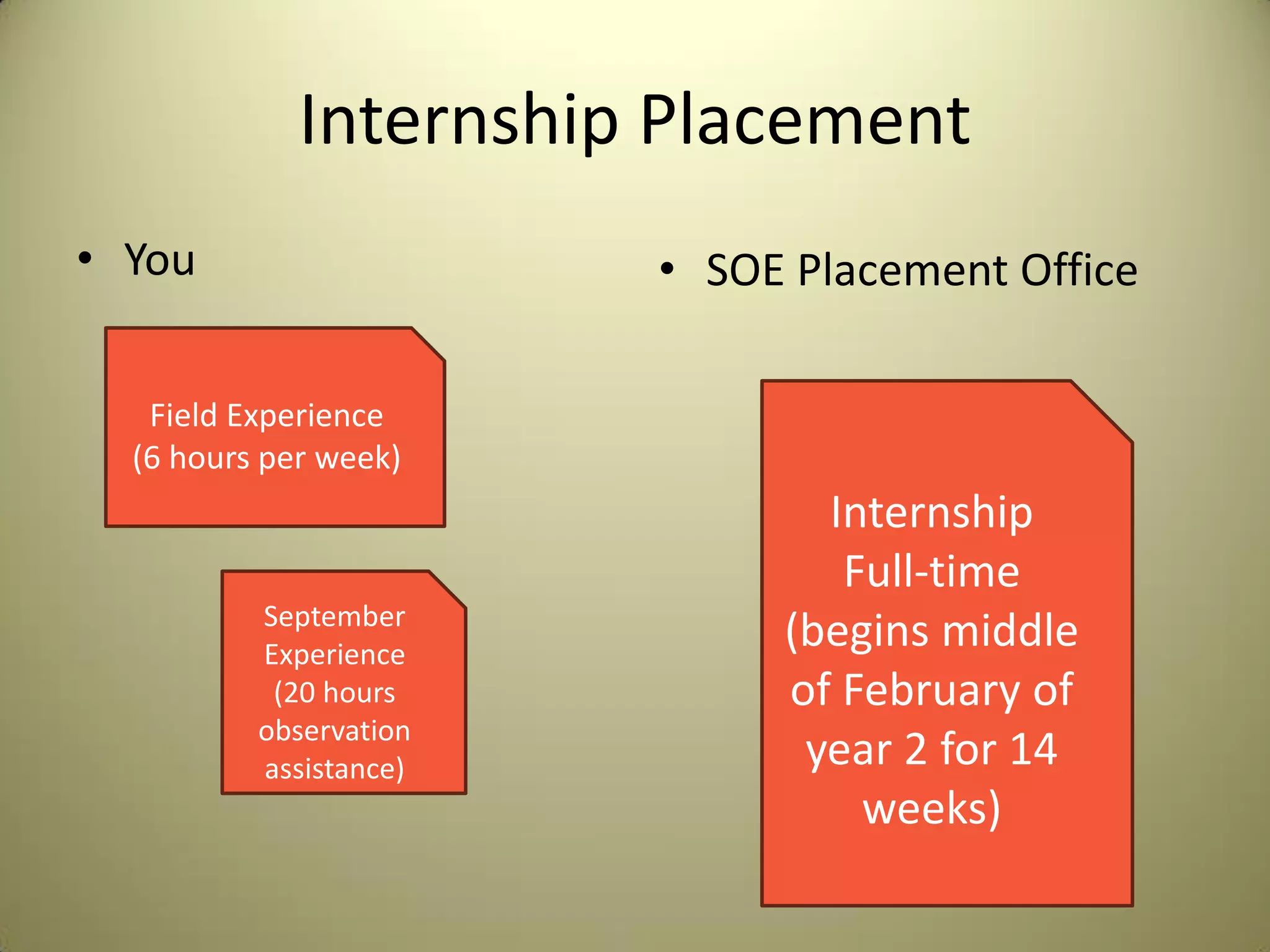
Internship Placement
• You • SOE Placement Office
September
Experience
(20 hours
observation
assistance)
Internship
Full-time
(begins middle
of February of
year 2 for 14
weeks)
Field Experience
(6 hours per week)
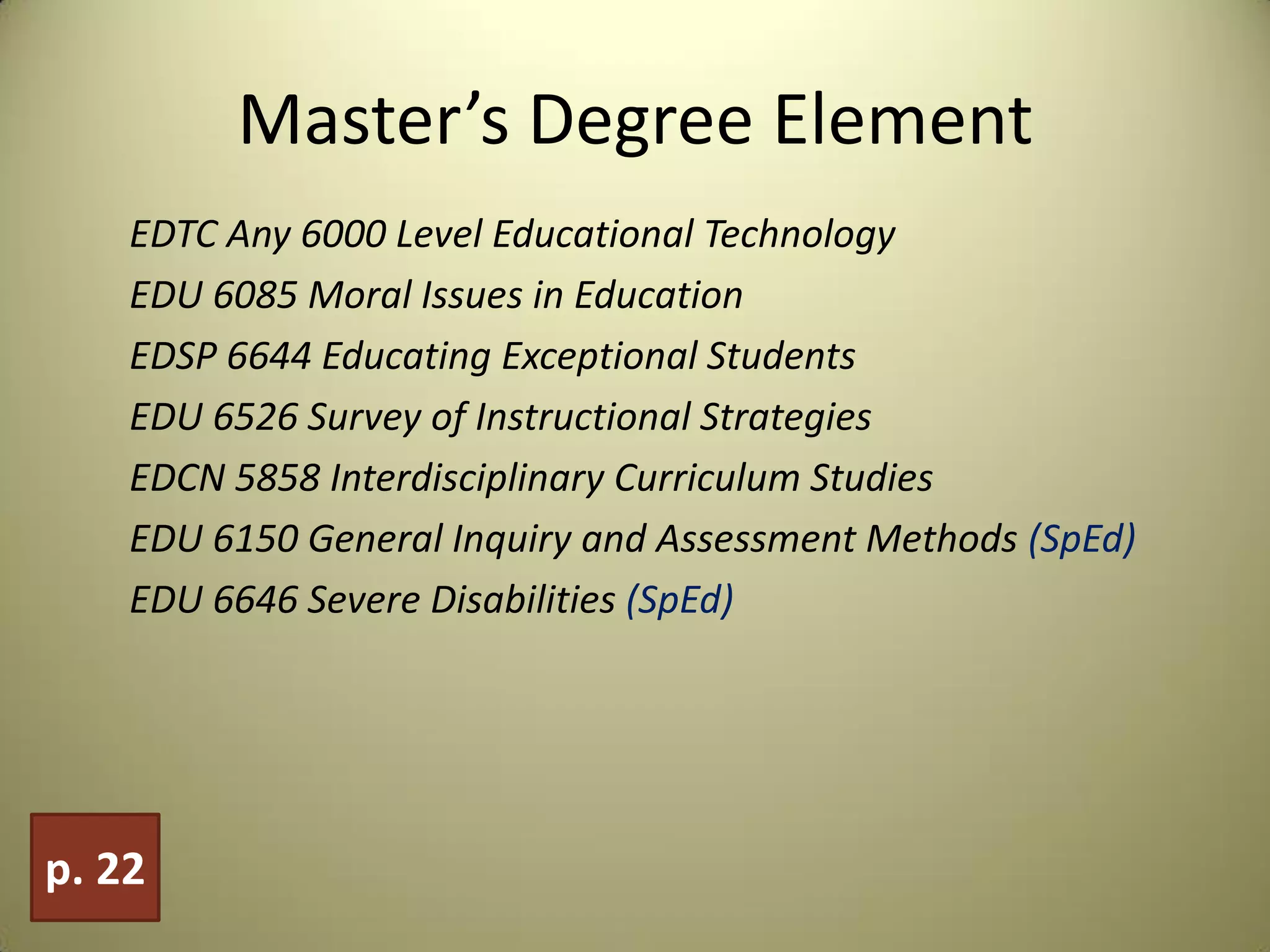
Master’s Degree Element
EDTC Any 6000 Level Educational Technology
EDU 6085 Moral Issues in Education
EDSP 6644 Educating Exceptional Students
EDU 6526 Survey of Instructional Strategies
EDCN 5858 Interdisciplinary Curriculum Studies
EDU 6150 General Inquiry and Assessment Methods (SpEd)
EDU 6646 Severe Disabilities (SpEd)
p. 22
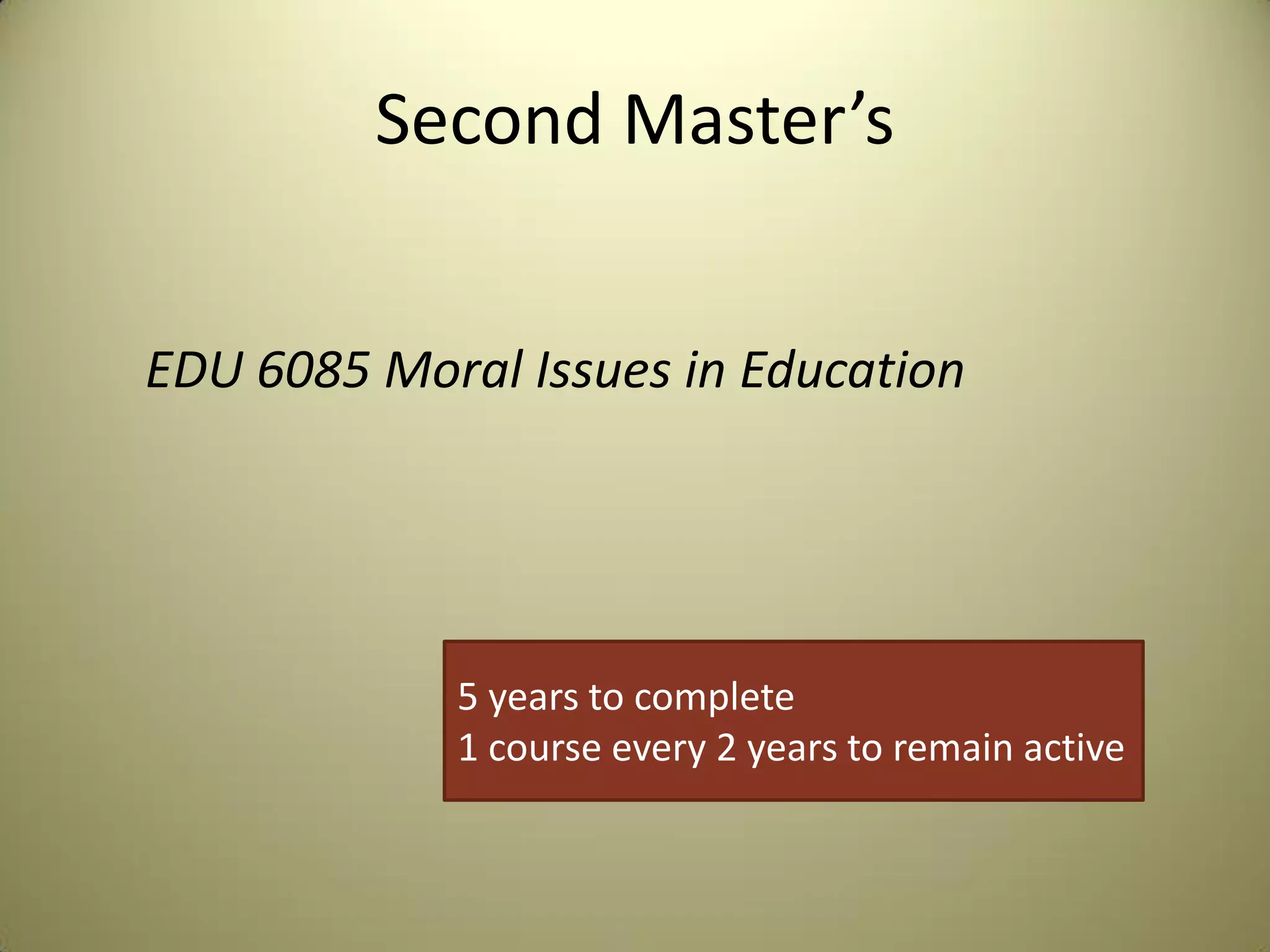
Second Master’s
EDU 6085 Moral Issues in Education
5 years to complete
1 course every 2 years to remain active
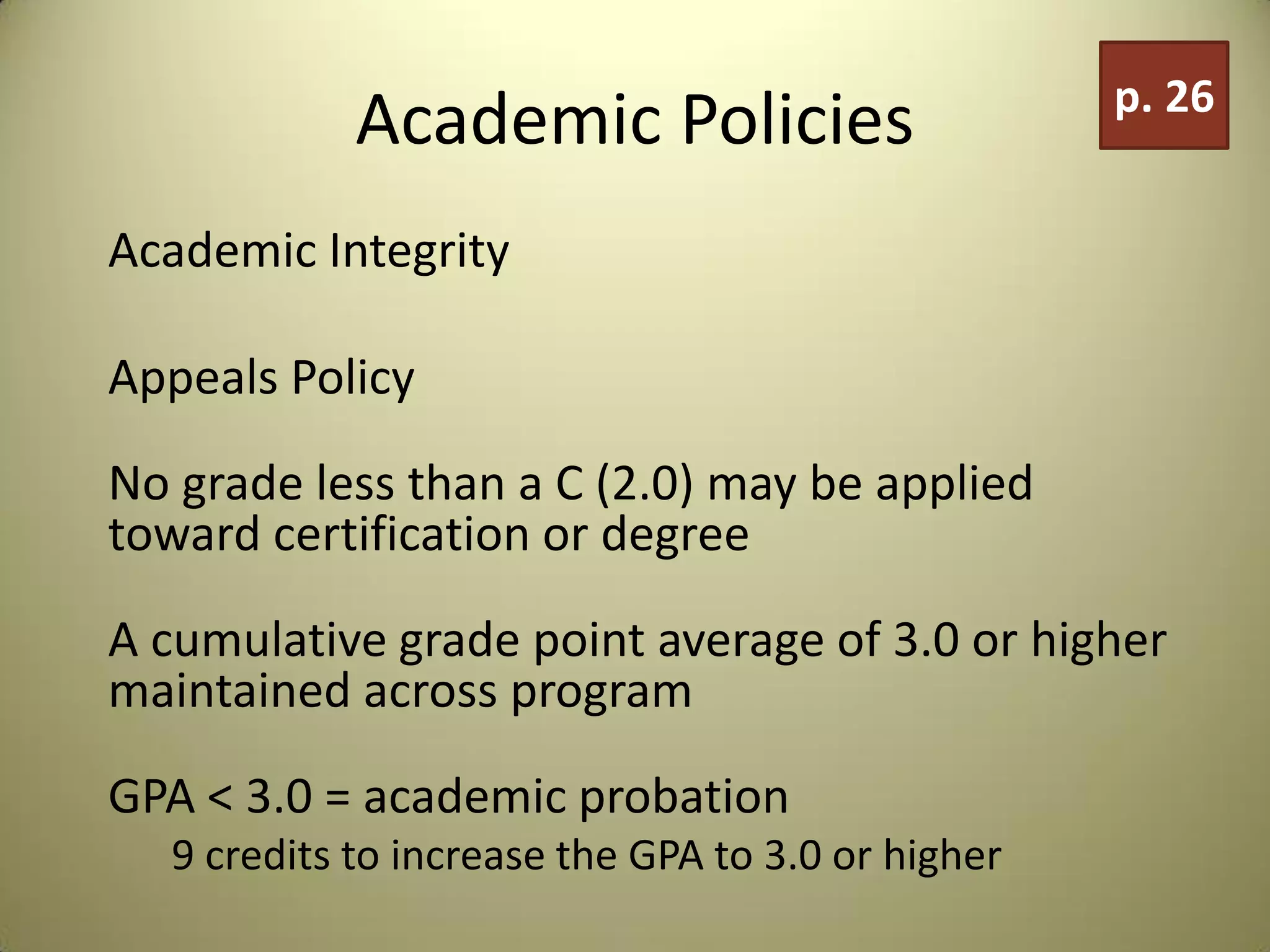
Academic Policies
Academic Integrity
Appeals Policy
No grade less than a C (2.0) may be applied
toward certification or degree
A cumulative grade point average of 3.0 or higher
maintained across program
GPA < 3.0 = academic probation
9 credits to increase the GPA to 3.0 or higher
p. 26
Welcome Back Kotter
MAT Tuition & Fees
$578 per credit for certification = $23,698 - $28,900
$578 per credit for Master’s (15) = $8,670
Internship $250 ($125w, $125s)
edTPA $300, State $55, Graduation $50
Books
p. 28
You can work for 17/21 months
Starting teacher salary with Master’s is $40,045
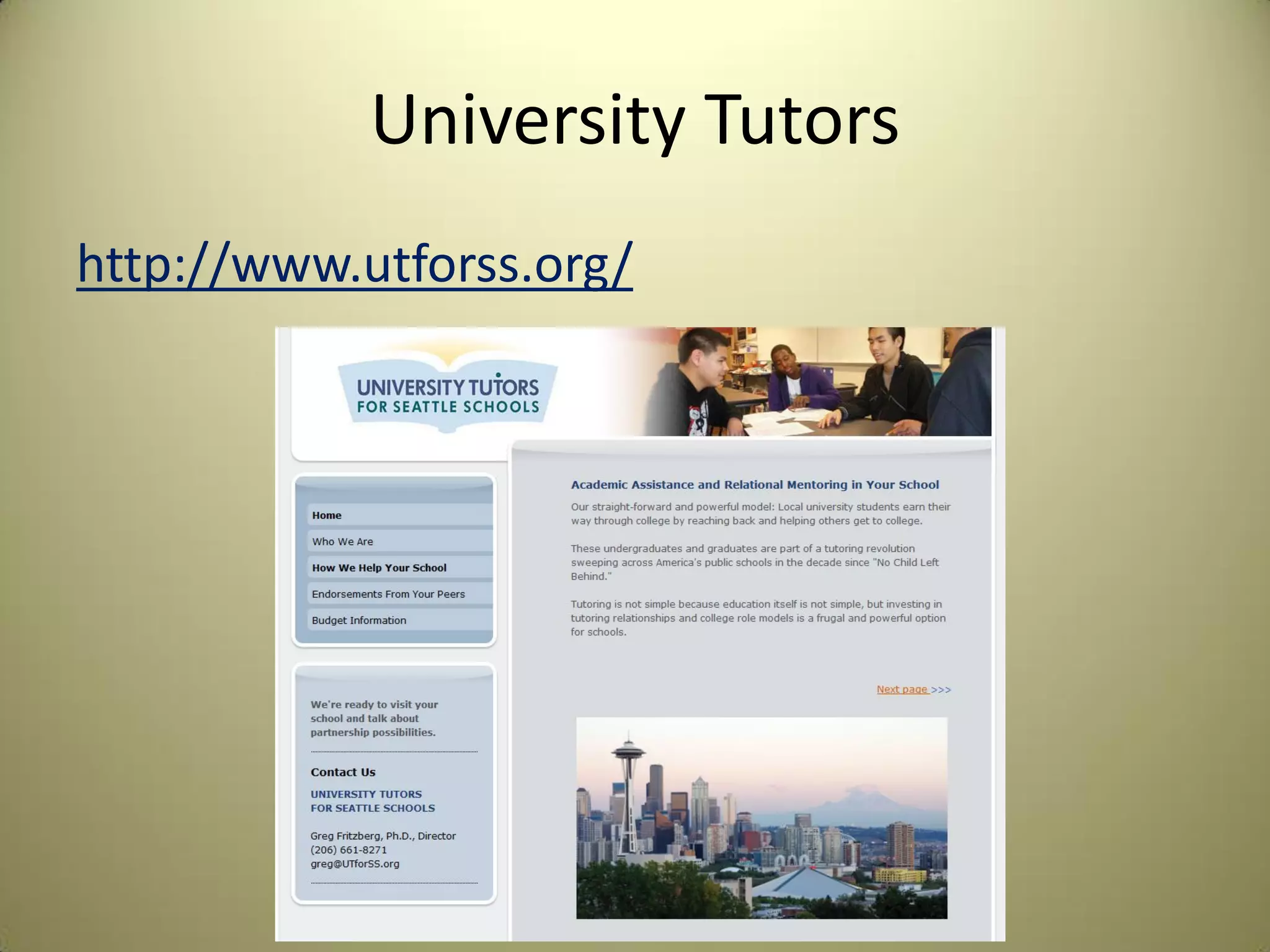
University Tutors
http://www.utforss.org/
University Tutors
University Tutors for Seattle Schools www.utforss.org
– Places university students with K-12 kids in
participating Seattle schools
– 2-5 hours per day, from September to June
– Paid positions, ~ $13
– Dr. Greg Fritzberg by email at gregf@spu.edu
Big Picture High School
Interest in volunteering
Highline School District
Stan.Harrison@highlineschools.org
Melissa.Brainerd@highlineschools.org
Campus Resources
ID Cards
Library
Software agreements (CIS)
Security
Bookstore
Parking
p. 34
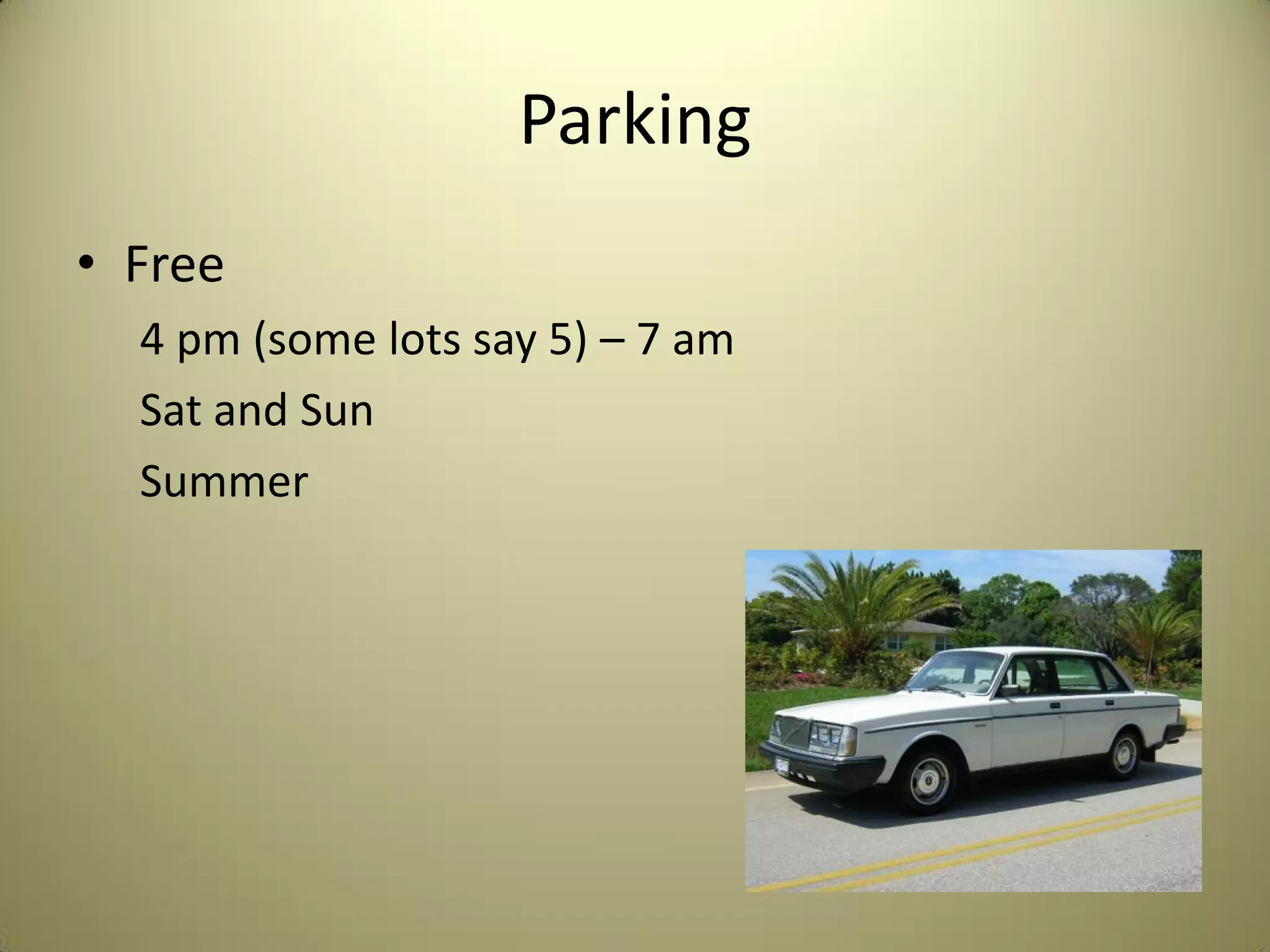
Parking
• Free
4 pm (some lots say 5) – 7 am
Sat and Sun
Summer
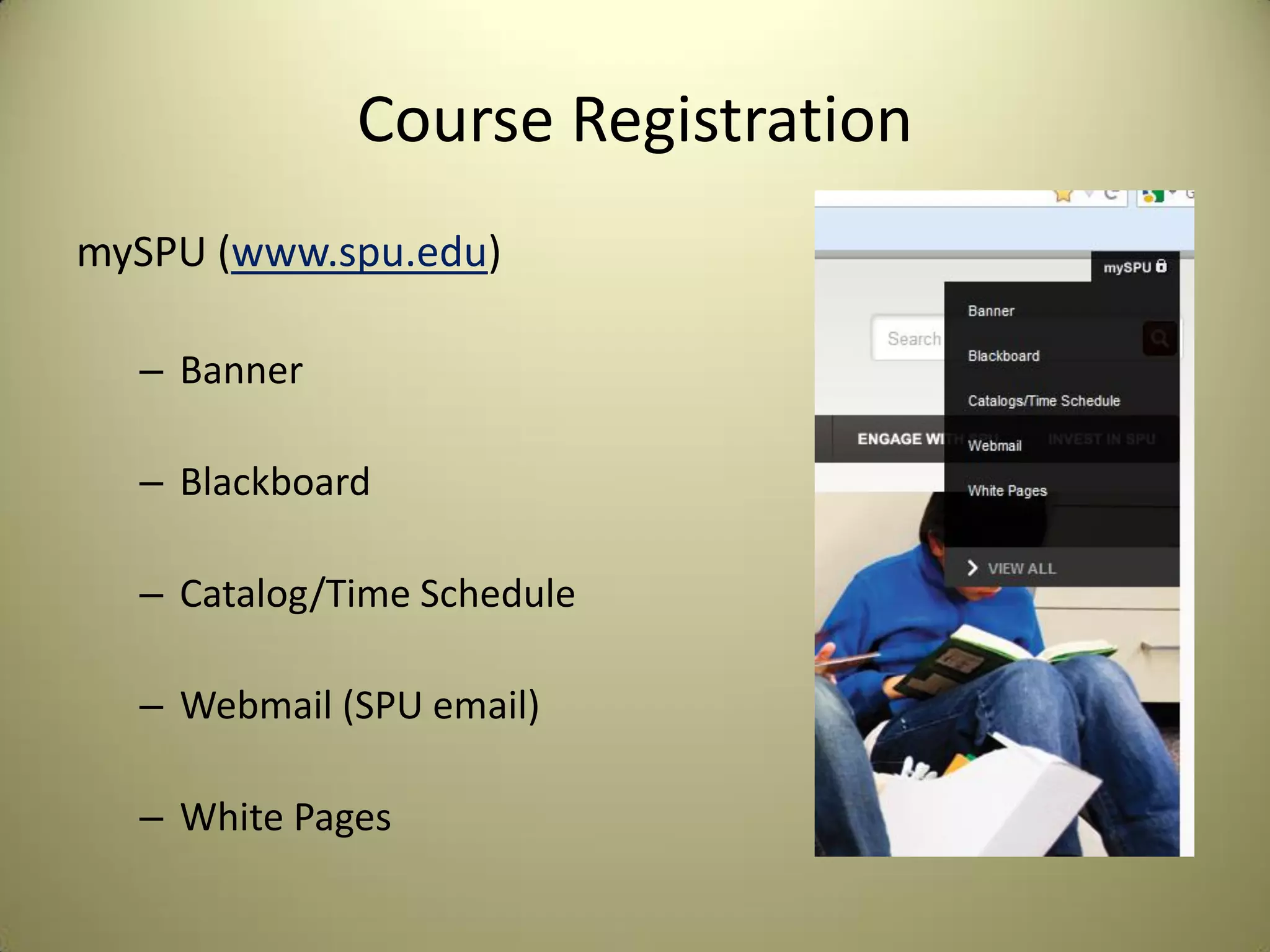
Course Registration
mySPU (www.spu.edu)
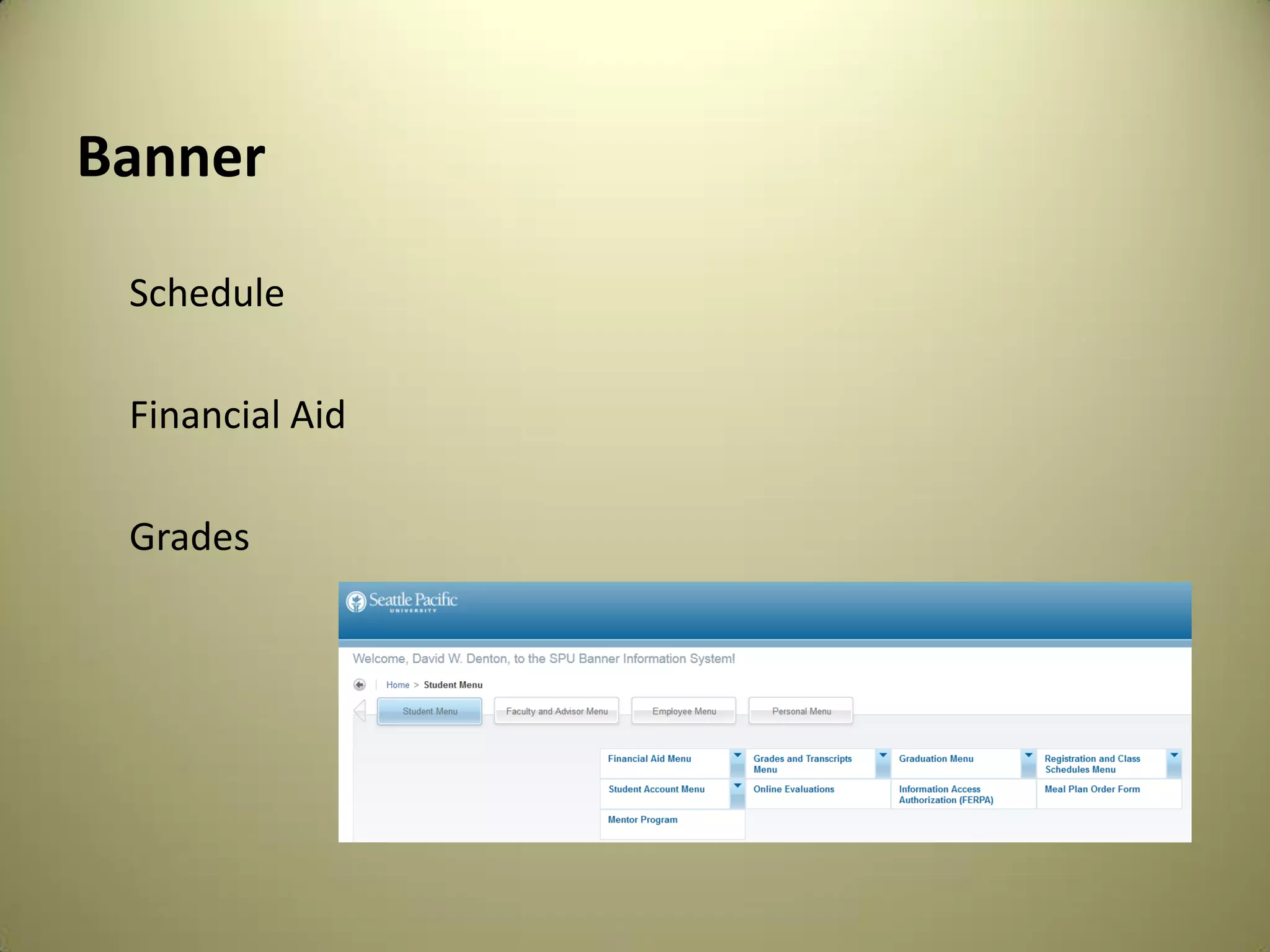
– Banner
– Blackboard
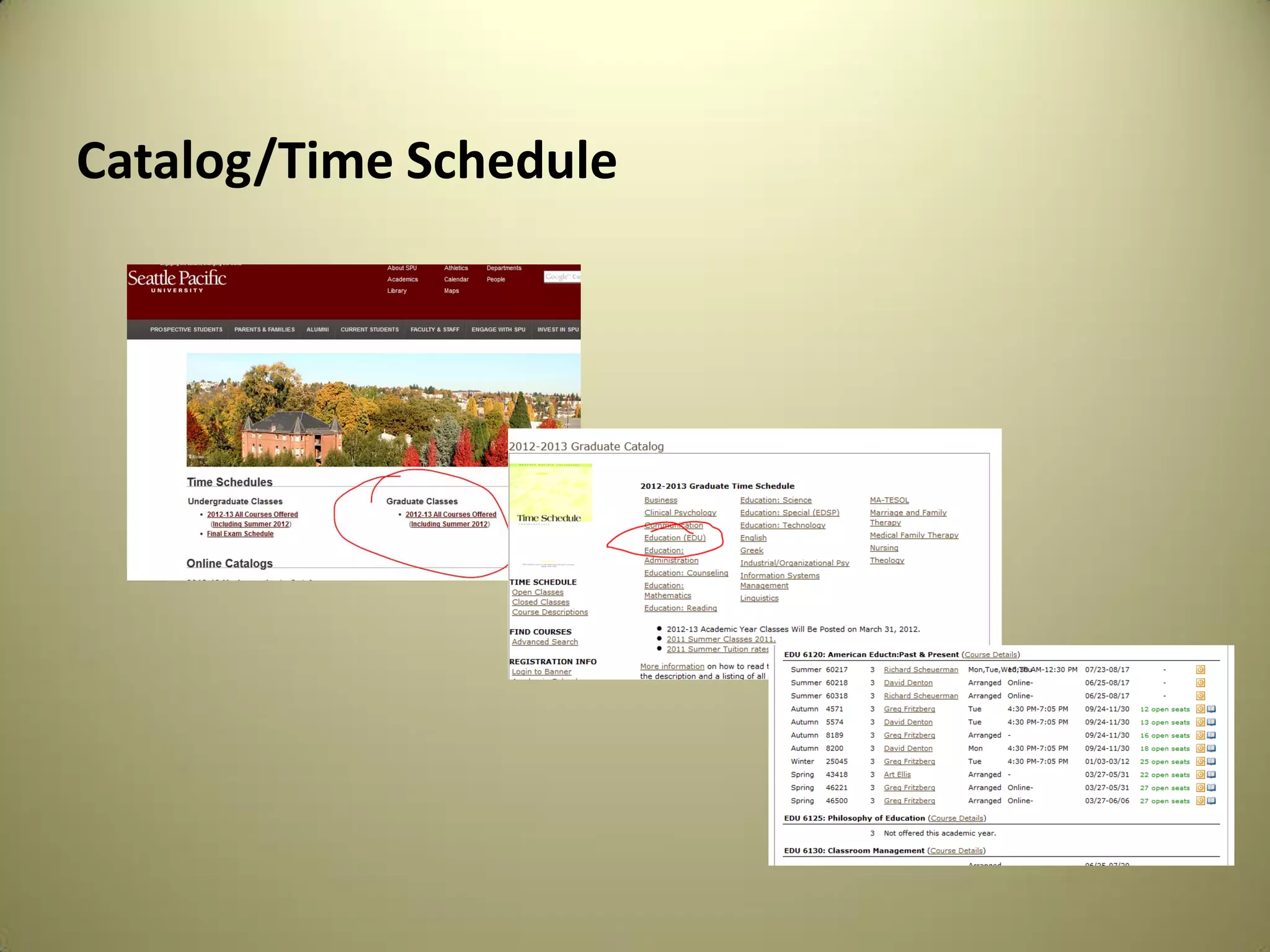
– Catalog/Time Schedule
– Webmail (SPU email)
– White Pages
Catalog/Time Schedule
Banner
Schedule
Financial Aid
Grades
Sample Course Sequence Checklist
Summer Quarter
Interested in early admission to complete
Master’s level class this summer?
Email Megan Hamshar, mego@spu.edu
EDSP 6644, EDU 6085, or EDTC 6000
Summer session begins June 24
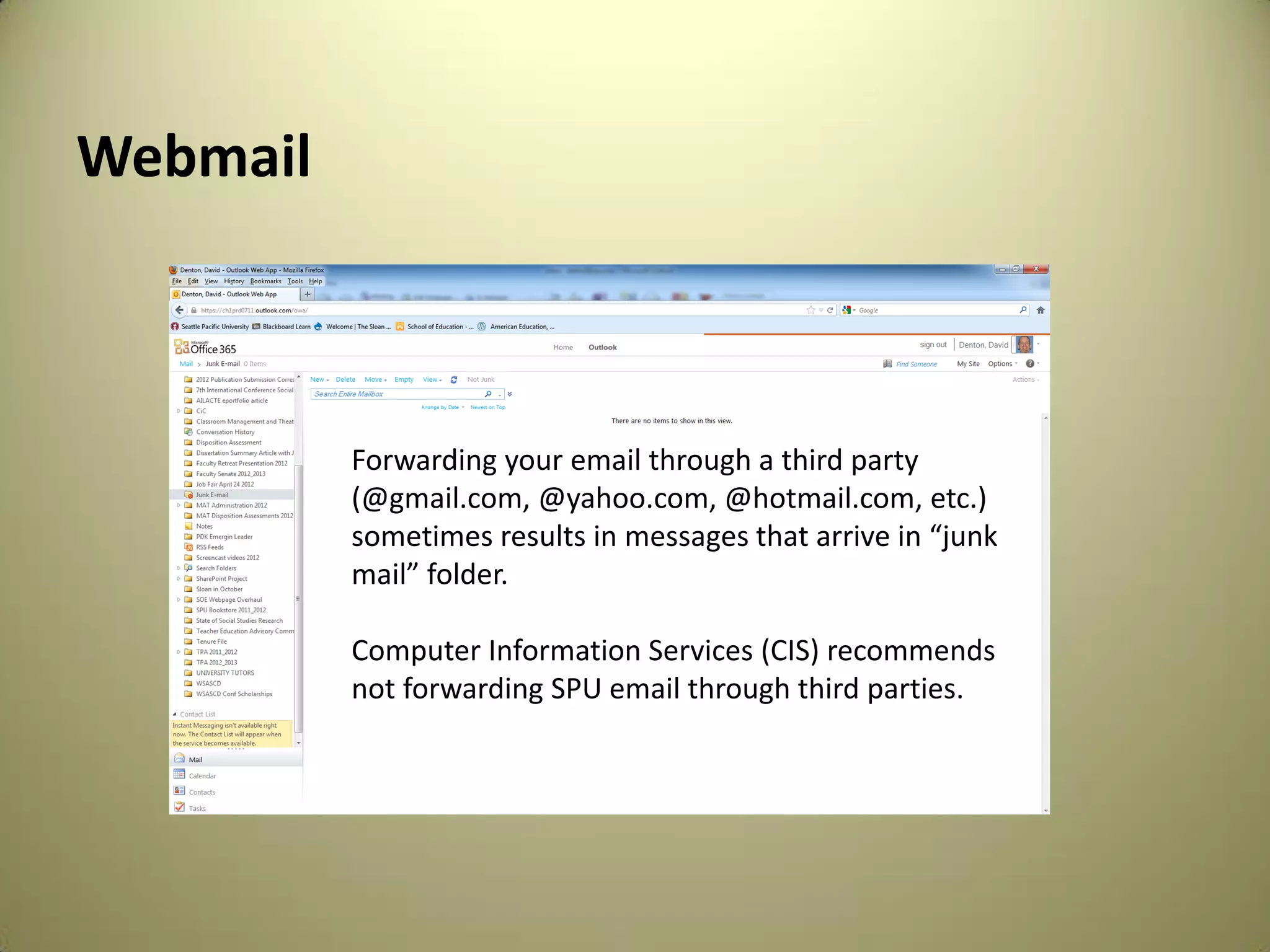
Webmail
Forwarding your email through a third party
(@gmail.com, @yahoo.com, @hotmail.com, etc.)
sometimes results in messages that arrive in “junk
mail” folder.
Computer Information Services (CIS) recommends
not forwarding SPU email through third parties.
Portfolio Assessment
Portfolio assessment involves the collection and
presentation of different types of student work
samples, gathered over time, to show depth and
breadth of learning. Work samples are collected
systematically to validate accomplishments relative
to specific instructional objectives. Portfolios
contain written entries, often accompanying work
samples, which are characterized by self-
assessment through reflection.
bPortfolio – Blog Portfolio –
shows portfolio contents in
an online container.
http://sputeacher.wordpress.com/
p. 30
WAC - Program Standards
WAC 181
Principles of HOPE (Program
Standards)
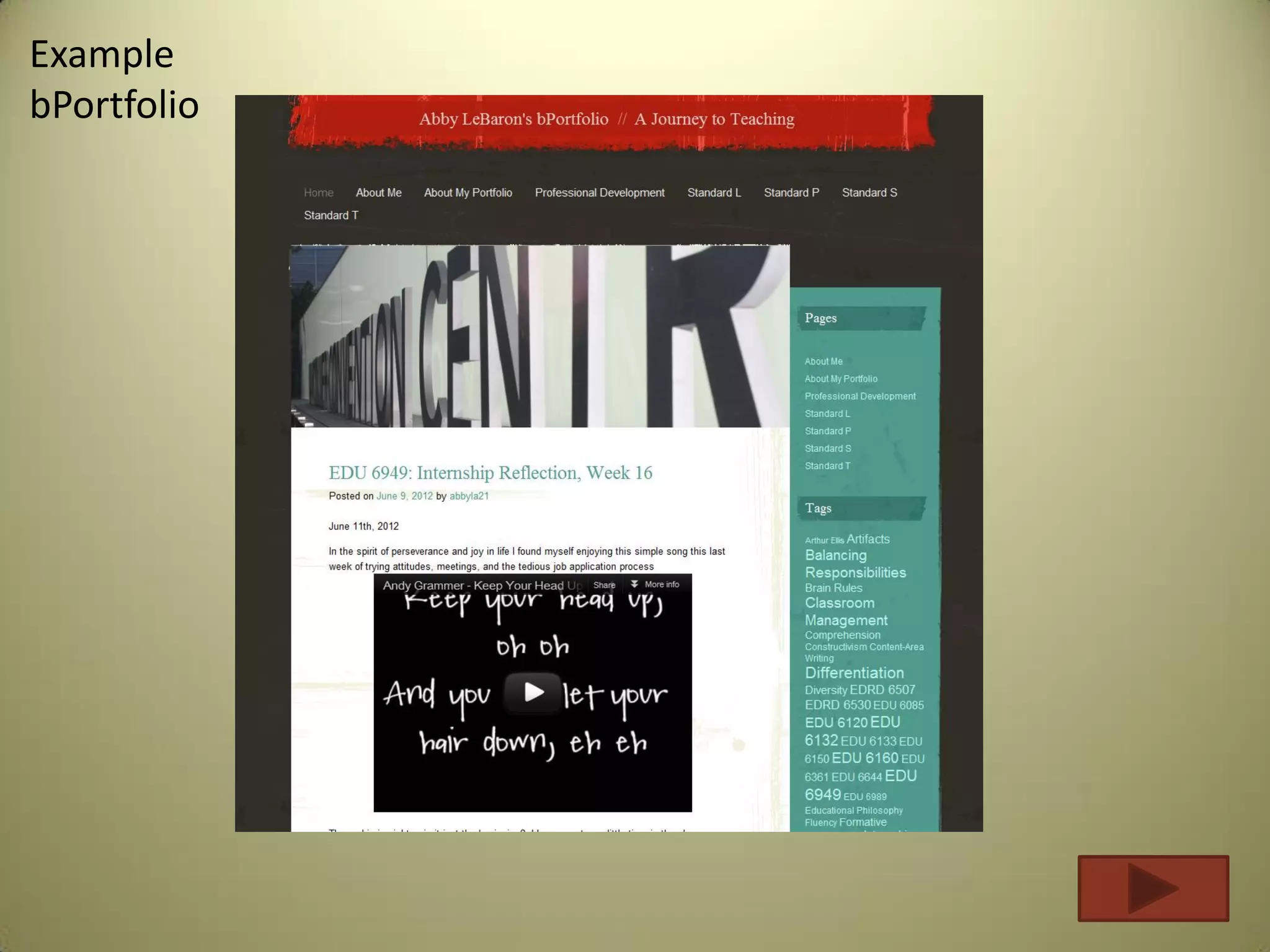
Example
bPortfolio
A task to complete by September 18
Module 1 – Develop your own bPortfolio site
according to the SPU template.
Module 2 – Post your first entry by answering
the following two questions:
What vision do you have of yourself as a
developing, effective teacher?
What do you think will make you a particularly
successful teacher?
p. 39
http://sputeacher.wordpress.com/
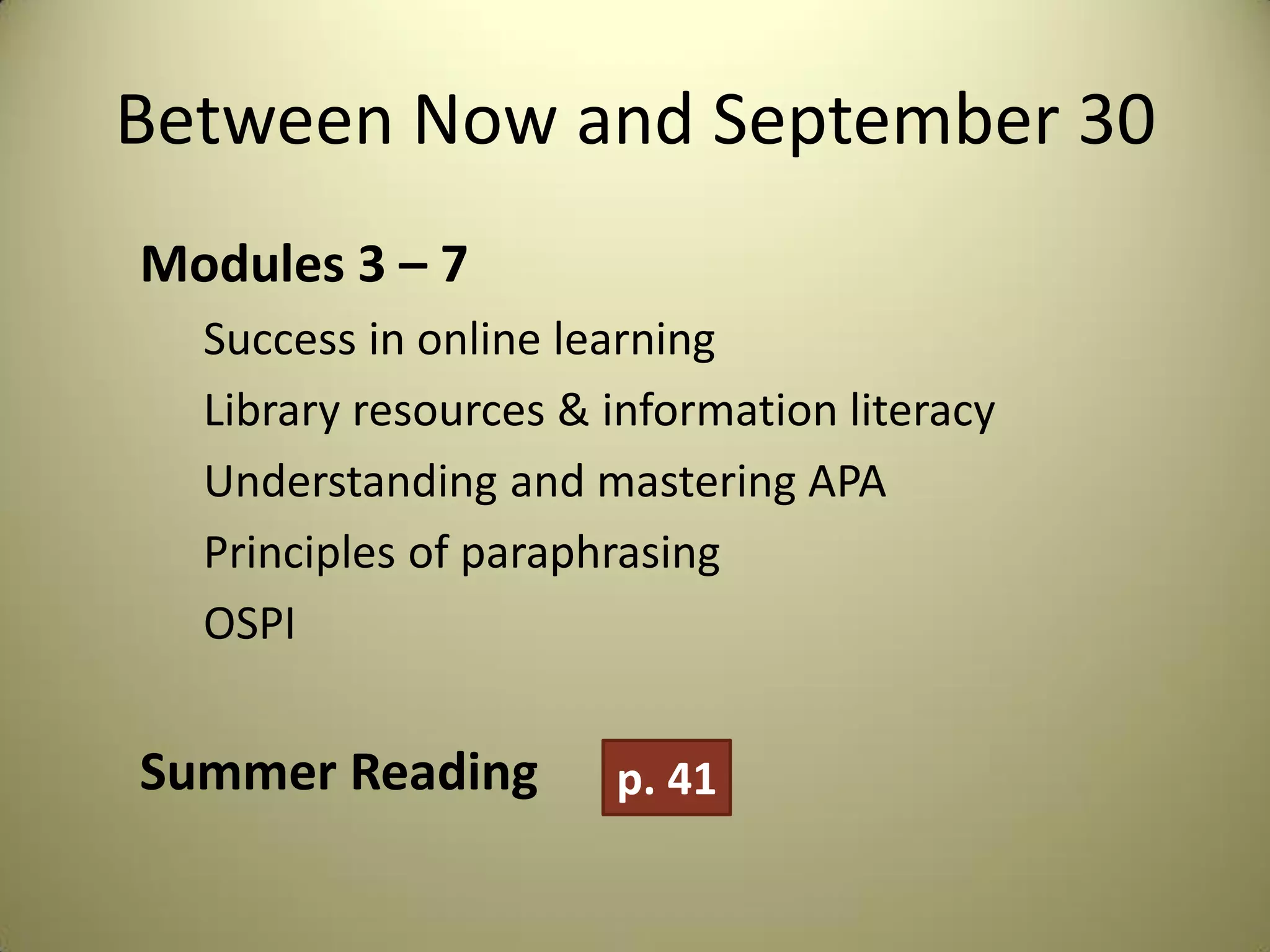
Between Now and September 30
Modules 3 – 7
Success in online learning
Library resources & information literacy
Understanding and mastering APA
Principles of paraphrasing
OSPI
Summer Reading p. 41
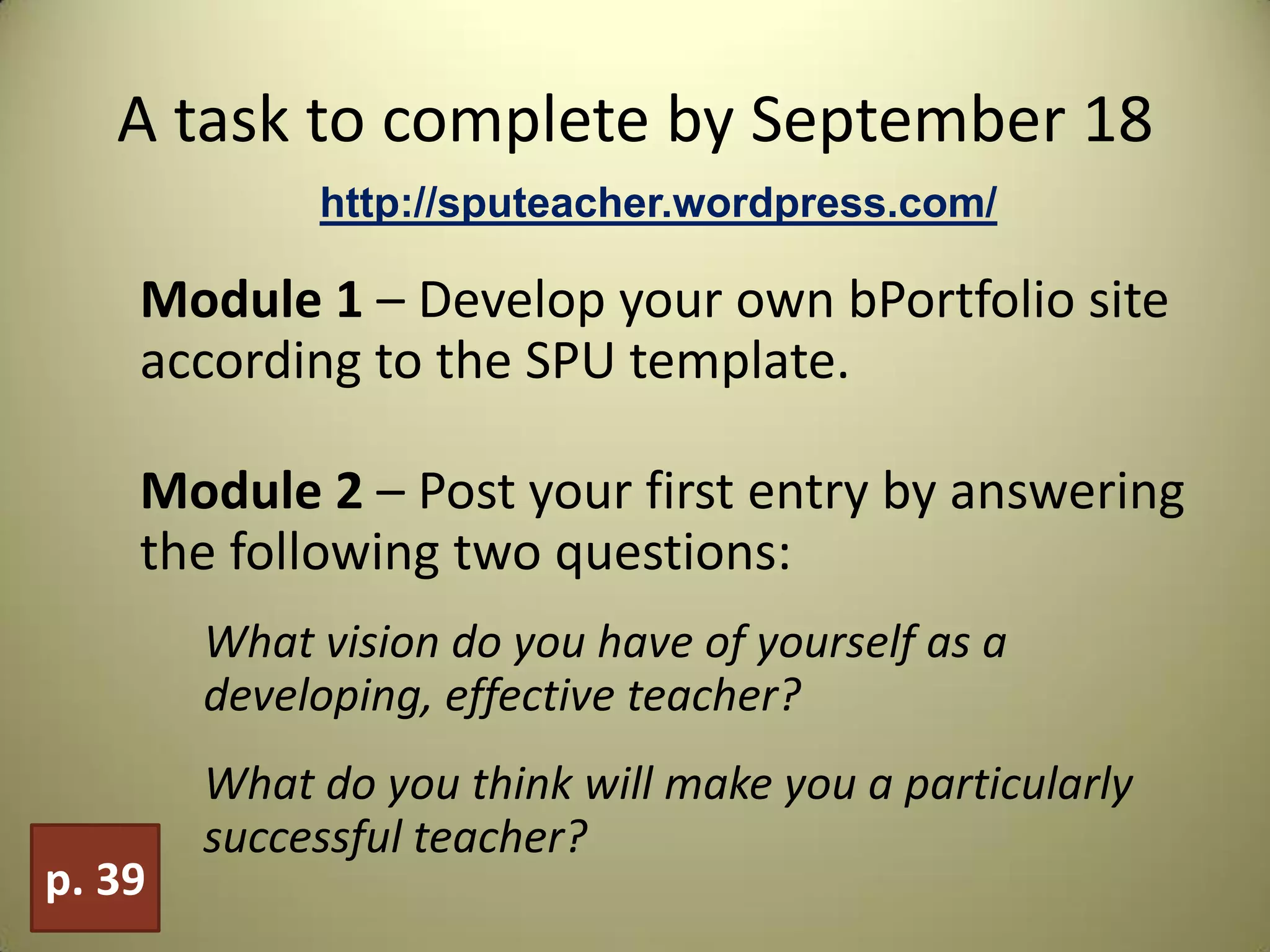
Contact and Support
Teacher Education
Program Admin
Internship Placement
Endorsement/Certification
p. 42
What’s next?
Approved Plan of Study Courses
Modules 1-7
Class registration
Webmail
Autumn registration (quarter starts September 30)
West-E
http://www.sputeachered.org/mat-candidate-orientation

MAT program orientation 2013

  • 1.
    Welcome to theMAT Program 2013-2015 Cohort Graduate Teacher Education at SPU
  • 2.
    Agenda First Half Getting toKnow You About SPU and SOE Standards & Accreditation Certification Office ~3:15 Program Specifics Academic Policies Tuition and Fees Second Half UT for SS ~3:45 Opportunity at Big Picture HS Campus Resources Class Registration Summer Quarter bPortfolio Between Now and Start Contact and Support ~4:50 http://www.sputeachered.org/mat-candidate-orientation/
  • 3.
    Learning Target Get toknow each other Summarize features of the MAT program
  • 4.
    Ice Breaker Groups of6-8 Read, discuss, report
  • 5.
    SPU Founded by Free MethodistChristians 1891 1921 Normal Training School p. 4
  • 6.
    School of EducationVision Conceptual Framework Service Leadership Competence Character p. 6
  • 7.
    MAT Program Standards Principlesof HOPE H – Honor student diversity, development and their right to learn O – Offer an organized and challenging curriculum P – Practice effective teaching: inquiry, planning, instruction and assessment E – Exemplify service to the teaching profession p. 7
  • 8.
    Program Standards andWAC Read WAC 181 for Teacher Candidates
  • 9.
    Graduate School Standards •Foundational Knowledge and Skills • Leadership • Communication • Analysis & Problem Solving • Professionalism • Impact on Student Learning p. 9
  • 10.
    Accreditation • Professional EducatorStandards Board – Teacher Performance Assessment – Draft Professional Development Plan – WEST B and E • National Council for Accreditation of Teacher Education – bPortfolio – Disposition Assessment
  • 11.
    MAT Program MAT graduatedegree + WA teaching certificate Certificate (teaching license) Approximately 50 credits (13 classes + two quarters of internship) MAT degree 15 credits (5 classes) Variations according to endorsement and background
  • 12.
    Endorsements Elementary Education (2subtests) English/Language Arts English Language Learners (ELL) Health and Fitness History Mathematics Library Media Middle Level Humanities (2 subtests) Middle Level Math Middle Level Science Reading Science Special Education Social Studies Environmental and Sustainability Education* Bilingual Education Family and Consumer Science Music-Choral Music-General Music-Instrumental Theater Arts Visual Arts Biology Chemistry Earth & Space Physics Designated World Languages: French, German, Spanish
  • 13.
    Assessments WEST-B (admission requirement) basicskills reading-writing-math WEST-E scores due Jan 1, 2014; SPED and ELL Sept 1, 2014 Remember PESB, WA, NCATE
  • 14.
    Sample Course SequenceChecklist p. 14
  • 15.
    Two Year TimeLine • Autumn 2013 – Spring 2015 2013-2014 2014-2015
  • 16.
    Internship September Experience (20 hours observation/ assistance) Internship Full-time (beginsmiddle of February for 14 weeks) Field Experience (6 hours per week)
  • 17.
    Internship Placement • You• SOE Placement Office September Experience (20 hours observation assistance) Internship Full-time (begins middle of February of year 2 for 14 weeks) Field Experience (6 hours per week)
  • 18.
    Master’s Degree Element EDTCAny 6000 Level Educational Technology EDU 6085 Moral Issues in Education EDSP 6644 Educating Exceptional Students EDU 6526 Survey of Instructional Strategies EDCN 5858 Interdisciplinary Curriculum Studies EDU 6150 General Inquiry and Assessment Methods (SpEd) EDU 6646 Severe Disabilities (SpEd) p. 22
  • 19.
    Second Master’s EDU 6085Moral Issues in Education 5 years to complete 1 course every 2 years to remain active
  • 20.
    Academic Policies Academic Integrity AppealsPolicy No grade less than a C (2.0) may be applied toward certification or degree A cumulative grade point average of 3.0 or higher maintained across program GPA < 3.0 = academic probation 9 credits to increase the GPA to 3.0 or higher p. 26
  • 21.
  • 22.
    MAT Tuition &Fees $578 per credit for certification = $23,698 - $28,900 $578 per credit for Master’s (15) = $8,670 Internship $250 ($125w, $125s) edTPA $300, State $55, Graduation $50 Books p. 28 You can work for 17/21 months Starting teacher salary with Master’s is $40,045
  • 23.
  • 24.
    University Tutors University Tutorsfor Seattle Schools www.utforss.org – Places university students with K-12 kids in participating Seattle schools – 2-5 hours per day, from September to June – Paid positions, ~ $13 – Dr. Greg Fritzberg by email at gregf@spu.edu
  • 25.
    Big Picture HighSchool Interest in volunteering Highline School District Stan.Harrison@highlineschools.org Melissa.Brainerd@highlineschools.org
  • 26.
    Campus Resources ID Cards Library Softwareagreements (CIS) Security Bookstore Parking p. 34
  • 27.
    Parking • Free 4 pm(some lots say 5) – 7 am Sat and Sun Summer
  • 28.
    Course Registration mySPU (www.spu.edu) –Banner – Blackboard – Catalog/Time Schedule – Webmail (SPU email) – White Pages
  • 29.
  • 30.
  • 31.
  • 32.
    Summer Quarter Interested inearly admission to complete Master’s level class this summer? Email Megan Hamshar, mego@spu.edu EDSP 6644, EDU 6085, or EDTC 6000 Summer session begins June 24
  • 33.
    Webmail Forwarding your emailthrough a third party (@gmail.com, @yahoo.com, @hotmail.com, etc.) sometimes results in messages that arrive in “junk mail” folder. Computer Information Services (CIS) recommends not forwarding SPU email through third parties.
  • 34.
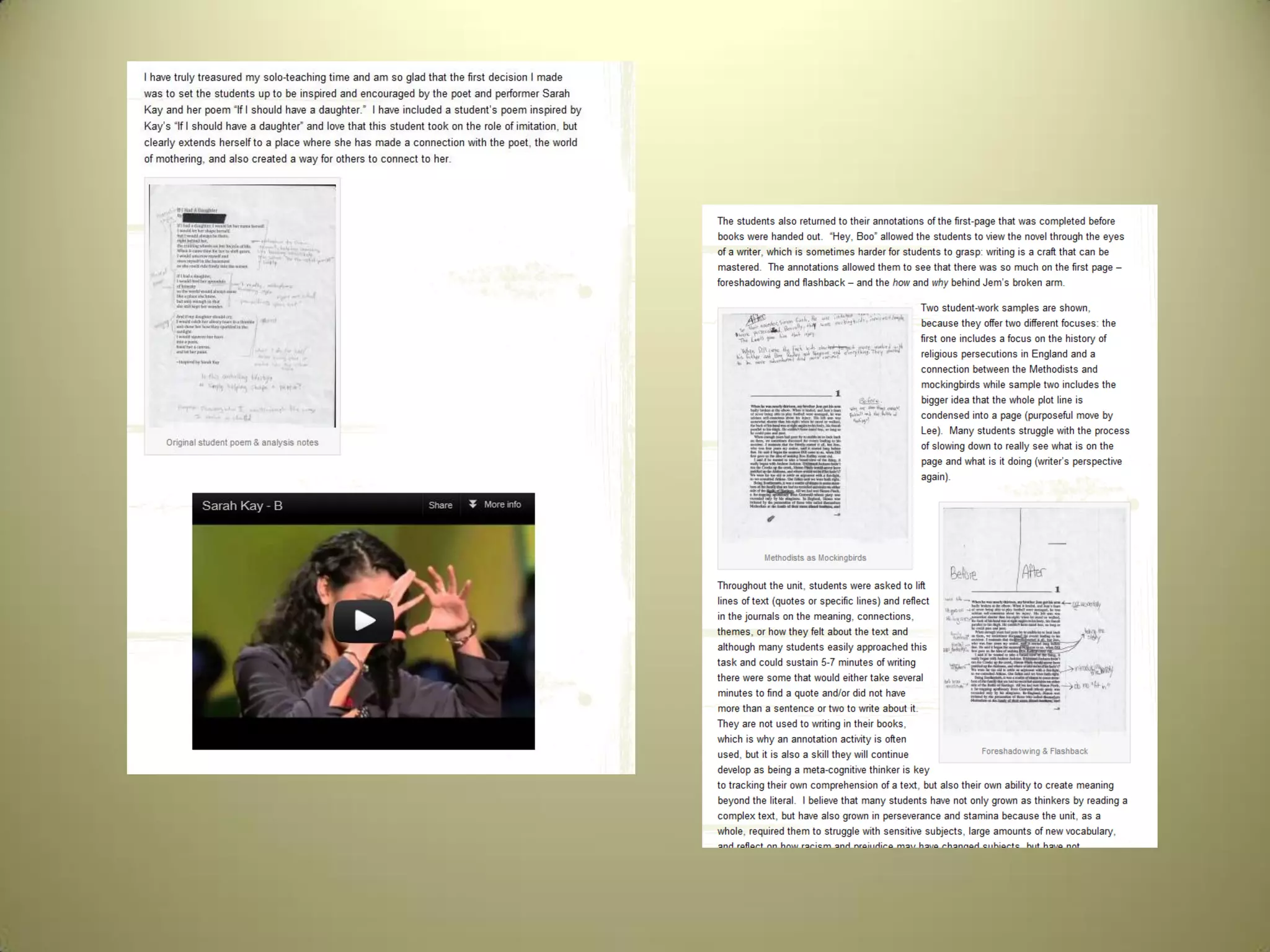
    Portfolio Assessment Portfolio assessmentinvolves the collection and presentation of different types of student work samples, gathered over time, to show depth and breadth of learning. Work samples are collected systematically to validate accomplishments relative to specific instructional objectives. Portfolios contain written entries, often accompanying work samples, which are characterized by self- assessment through reflection. bPortfolio – Blog Portfolio – shows portfolio contents in an online container. http://sputeacher.wordpress.com/ p. 30
  • 35.
    WAC - ProgramStandards WAC 181 Principles of HOPE (Program Standards)
  • 36.
  • 38.
    A task tocomplete by September 18 Module 1 – Develop your own bPortfolio site according to the SPU template. Module 2 – Post your first entry by answering the following two questions: What vision do you have of yourself as a developing, effective teacher? What do you think will make you a particularly successful teacher? p. 39 http://sputeacher.wordpress.com/
  • 39.
    Between Now andSeptember 30 Modules 3 – 7 Success in online learning Library resources & information literacy Understanding and mastering APA Principles of paraphrasing OSPI Summer Reading p. 41
  • 40.
    Contact and Support TeacherEducation Program Admin Internship Placement Endorsement/Certification p. 42
  • 41.
    What’s next? Approved Planof Study Courses Modules 1-7 Class registration Webmail Autumn registration (quarter starts September 30) West-E http://www.sputeachered.org/mat-candidate-orientation