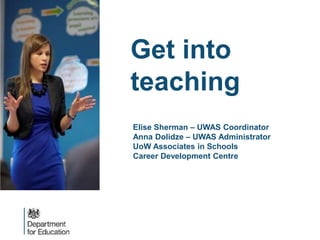
Get into
teaching
Elise Sherman – UWAS Coordinator
Anna Dolidze – UWAS Administrator
UoW Associates in Schools
Career Development Centre
What will we cover today?
 The rewards of teaching
 Qualifications and demand
 Routes into Teacher Training
 School experience
 UoW Career Development Centre Support
 Your teaching career
 Application advice
Why go into teaching?
 Teaching has changed. More people with a 2:1 or first degree than ever before
are training to be teachers.
 You could receive a substantial tax-free bursary while you train.
 Teacher training is better than ever before.
 Apply to train through School Direct, which is already attracting some of the top
graduates in the country.
 Starting salaries in teaching are higher than you think.
 Good teachers are in demand and there are excellent employment prospects.
 Teachers love teaching and stay in the career longer than other graduates.
 There are excellent opportunities for career progression.
 Primary teaching is as important as secondary teaching
 You will receive support from us throughout the application process.
What is the best thing about teaching?
 The relationships you build with the students, getting to know
your group and adapting your teaching to meet their needs.
 Seeing the reward of pupils learning and making progress.
 Knowing that through your teaching you have helped students
develop and enjoy your subject is a great feeling!
 And knowing that you’re actually making a difference to the lives
of the pupils is very rewarding!
The rewards of teaching
 Newly qualified teachers begin on an average starting salary of
£22,467, or £28,098 in inner London.
 Prospects of employment in teaching are better than most other
professions - 9 out of 10 new teachers, who want to teach, found
teaching jobs in the first 12 months. (Source: NQT Survey)
 Teachers are twice as likely to be in management positions 4 years into
their career, compared to fellow graduates (19 per cent teachers, 10
per cent science, 9 per cent accountants, 6 per cent legal). (Source:
HESA)
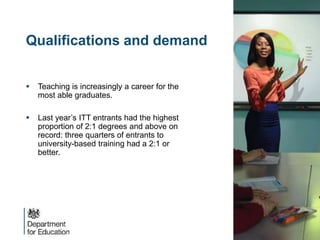
Qualifications and demand
 Teaching is increasingly a career for the
most able graduates.
 Last year’s ITT entrants had the highest
proportion of 2:1 degrees and above on
record: three quarters of entrants to
university-based training had a 2:1 or
better.
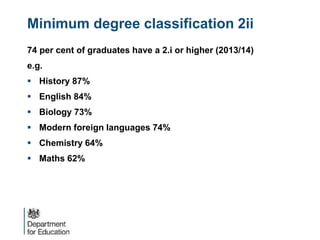
Minimum degree classification 2ii
74 per cent of graduates have a 2.i or higher (2013/14)
e.g.
 History 87%
 English 84%
 Biology 73%
 Modern foreign languages 74%
 Chemistry 64%
 Maths 62%
Minimum entry requirements
 UK undergraduate degree or a recognised equivalent
qualification.
 Standard equivalent to a grade C in GCSE English and
mathematics.
 Standard equivalent to a grade C in a science GCSE (primary
only).
 Most providers and schools will expect applicants to have some
form of “School Experience”
In demand subjects
 Some subjects such as history, English, PE, art & design, music and
Primary are extremely popular so applying early can make all the
difference in securing a training place.
 Teachers of maths, physics, chemistry, modern languages,
computing, geography and design and technology are particularly
in demand in schools at the moment.
 RE PGCE courses are often undersubscribed. Training providers may
consider those who have studied: Cultural Studies, Law, Psychology,
Sociology, History, Philosophy, Politics, Social Policy, Humanities, or
Criminology.
Funding
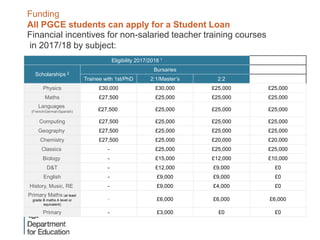
All PGCE students can apply for a Student Loan
Financial incentives for non-salaried teacher training courses
in 2017/18 by subject:
Eligibility 2017/2018 1
Scholarships 2
Bursaries
Trainee with 1st/PhD 2:1/Master’s 2:2
Physics £30,000 £30,000 £25,000 £25,000
Maths £27,500 £25,000 £25,000 £25,000
Languages
(French/German/Spanish) £27,500 £25,000 £25,000 £25,000
Computing £27,500 £25,000 £25,000 £25,000
Geography £27,500 £25,000 £25,000 £25,000
Chemistry £27,500 £25,000 £20,000 £20,000
Classics - £25,000 £25,000 £25,000
Biology - £15,000 £12,000 £10,000
D&T - £12,000 £9,000 £0
English - £9,000 £9,000 £0
History, Music, RE - £9,000 £4,000 £0
Primary Maths (at least
grade B maths A level or
equivalent)
- £6,000 £6,000 £6,000
Primary - £3,000 £0 £0
Funding options: - Student loan
 All subjects
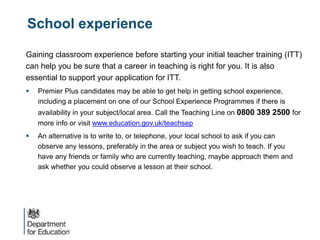
School experience
Gaining classroom experience before starting your initial teacher training (ITT)
can help you be sure that a career in teaching is right for you. It is also
essential to support your application for ITT.
 Premier Plus candidates may be able to get help in getting school experience,
including a placement on one of our School Experience Programmes if there is
availability in your subject/local area. Call the Teaching Line on 0800 389 2500 for
more info or visit www.education.gov.uk/teachsep
 An alternative is to write to, or telephone, your local school to ask if you can
observe any lessons, preferably in the area or subject you wish to teach. If you
have any friends or family who are currently teaching, maybe approach them and
ask whether you could observe a lesson at their school.
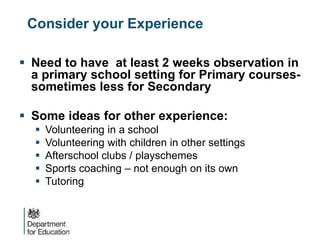
Consider your Experience
 Need to have at least 2 weeks observation in
a primary school setting for Primary courses-
sometimes less for Secondary
 Some ideas for other experience:
 Volunteering in a school
 Volunteering with children in other settings
 Afterschool clubs / playschemes
 Sports coaching – not enough on its own
 Tutoring
Associates in Schools (UWAS)
University of Westminster Associates
in Schools (UWAS) Scheme
 This is an exciting opportunity to gain valuable work
experience in a school classroom, where you will be
supporting the teacher while exploring a future career in
teaching.
 The scheme consists of a 15-day placement in a secondary
school. The placement can be completed in weekly blocks
or in instalments (eg one day per week), while continuing
your studies.
 For further information, please visit
the www.westminster.ac.uk/uwas
 Apply by 7th June for first intake 2017-18.
Your teacher training
There’s a range of great training options to choose from.
Whichever option you choose, whether school-led or university-led
teacher training, you can rest assured you’ll spend at least half of
your time in a school, giving you plenty of practical experience.
 All courses deliver over 1,000 hours of training.
 Behaviour management is compulsory.
 View and register at: https://getintoteaching.education.gov.uk/
University-led teacher training
 Postgraduate certificate in education (PGCE)
- For anyone who already has a degree
- Focuses on developing your teaching skills, rather than the subject you
intend to teach
School-led teacher training
 School Direct (QTS and in many cases PGCE)
- You’ll be selected by a school from day one, with a job in mind for you
- Training is full-time, school-based
 School-centred initial teacher training (SCITT)
- Designed and delivered by groups of neighbouring schools
- Taught by experienced, practising teachers, tailored to local needs
All school-led teacher training courses will lead to qualified teacher status
(QTS) and most will award a postgraduate certificate in education (PGCE).
(Please ask Schools you meet for the details of the courses they offer)
Other routes into teaching
 Teach First
- Employment-based route into teaching
- Initial six week intensive training programme followed by two years
teaching in a challenging school
- Postgraduate Certificate of Education (PGCE) awarded on successful
completion
- Applications are already filling up for 2018.
- See: www.teachfirst.org.uk
Application Preparation
 Research
 Attend the open events
 Apply for brochures
 Look at providers’ websites
 UCAS online application helper
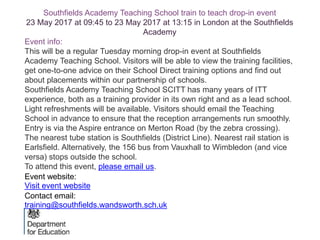
Southfields Academy Teaching School train to teach drop-in event
23 May 2017 at 09:45 to 23 May 2017 at 13:15 in London at the Southfields
Academy
Event info:
This will be a regular Tuesday morning drop-in event at Southfields
Academy Teaching School. Visitors will be able to view the training facilities,
get one-to-one advice on their School Direct training options and find out
about placements within our partnership of schools.
Southfields Academy Teaching School SCITT has many years of ITT
experience, both as a training provider in its own right and as a lead school.
Light refreshments will be available. Visitors should email the Teaching
School in advance to ensure that the reception arrangements run smoothly.
Entry is via the Aspire entrance on Merton Road (by the zebra crossing).
The nearest tube station is Southfields (District Line). Nearest rail station is
Earlsfield. Alternatively, the 156 bus from Vauxhall to Wimbledon (and vice
versa) stops outside the school.
To attend this event, please email us.
Event website:
Visit event website
Contact email:
training@southfields.wandsworth.sch.uk
 Ethos and Quality of provider
 Facilities
 Transport links
 Accommodation
 Finances
 Personal circumstances
Issues to consider
Subject knowledge enhancement
 Don’t hold back from applying because of your subject knowledge
confidence. If you are intending to teach maths, physics, chemistry, modern
languages, computing or design and technology, you could benefit from a
subject knowledge enhancement course.
 Each provider has a different entry requirement so talk to your chosen
provider about your own subject levels.
 If your provider feels that you would make a good teacher but you need to
undertake some additional study in the subject you want to teach before you
start training then your chosen provider can discuss a range of subject
knowledge enhancement (SKE) courses available to you.
Career Development Centre
 www.westminster.ac.uk/careers: - Jobs and events
 New database
 Meet with a careers advisor: - 20 minutes 'Quick Query' / 1
hour 'Consultation'.
 Book via Engage or phone Careers information team on 020
7911 5184
PGCE application
• Personal statement
• UoW Careers Advisor can check application form and help
prepare for interview
• Referees
• Principal referee (Academic – personal tutor)
• Second referee (character)
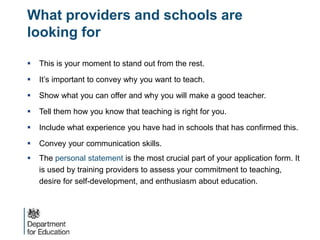
What providers and schools are
looking for
 This is your moment to stand out from the rest.
 It’s important to convey why you want to teach.
 Show what you can offer and why you will make a good teacher.
 Tell them how you know that teaching is right for you.
 Include what experience you have had in schools that has confirmed this.
 Convey your communication skills.
 The personal statement is the most crucial part of your application form. It
is used by training providers to assess your commitment to teaching,
desire for self-development, and enthusiasm about education.
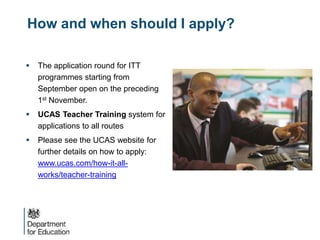
How and when should I apply?
 The application round for ITT
programmes starting from
September open on the preceding
1st November.
 UCAS Teacher Training system for
applications to all routes
 Please see the UCAS website for
further details on how to apply:
www.ucas.com/how-it-all-
works/teacher-training
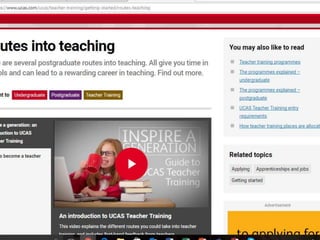
 One system – www.ucas.com
 Opens 1st November
 Check entry requirements of courses
 Apply 1: - 3 choices( November to September)
 Apply 2: - 1 choice at a time (January to September)
 Line up your 2 referees
 Last year, more than 81,000 new applications were submitted
between May and September.
How to Apply
Common Mistakes
 Grammar
 Spelling
 Not enough experience
 Not marketing your experience
 No reflection
 Qualification check
 Overview of course
 Writing task
 Tour of campus
 Group discussions
 Presentation
 1:1 interview
Examples of interview process
(St Mary’s)
 Keep up to date with educational issues via the internet
 Be prepared to ‘sell’ yourself
 Be reflective on your time in school
 Try the interactive interview and application assistant on the Get-Into-
Teaching website. Search “Interactive Interview” on the site
 Look at training providers’ websites.
 Prepare with a Careers Advisor
 Smart attire
 Documentation
Preparation for interview
 Health check
 Disclosure and Barring Service (DBS)
Fitness to Teach
 Energising Environment
 Career Structure and Job Security
 Making a difference
 Team and Autonomy
 Continued Learning
 No better feeling ?
Why Teaching ?
Skills tests
 All candidates wanting to start a teacher training course must have
passed the professional skills tests in numeracy and literacy before
beginning training.
 Training providers and schools will use skills tests results to inform
decisions during the application process.
 The skills tests registration system can be accessed via the skills tests
pages of the DfE website at www.education.gov.uk/teachskillstests
 The first attempt at taking your skills tests in each subject is provided
free of charge. 94% pass on first attempt.
 You can book up to two resits if required, but you will be expected to
pay for these yourself (£19.25 each). If you fail 2 resits (3 tests in total)
in either numeracy or literacy you won't be able to book any further
resits for 24 months from the date of the second resit.
Search “get into teaching” to visit DfE website
If you would like to speak to the DfE about teaching
or teacher training, please contact the Teaching
Line on Freephone 0800 389 2500. Alternatively,
you can talk to a Teaching Line adviser using
the online chat service between 8am and 8pm.
Further information and advice
Key links
 https://getintoteaching.education.gov.uk
 www.westminster.ac.uk/careers
 www.ucas.com/how-it-all-works/teacher-training
 www.westminster.ac.uk/uwas
 This Presentation: -
 www.slideshare.net/cdcwestminster

Getting into teaching (skills academy) 2017

  • 1.
    Get into teaching Elise Sherman– UWAS Coordinator Anna Dolidze – UWAS Administrator UoW Associates in Schools Career Development Centre
  • 2.
    What will wecover today?  The rewards of teaching  Qualifications and demand  Routes into Teacher Training  School experience  UoW Career Development Centre Support  Your teaching career  Application advice
  • 3.
    Why go intoteaching?  Teaching has changed. More people with a 2:1 or first degree than ever before are training to be teachers.  You could receive a substantial tax-free bursary while you train.  Teacher training is better than ever before.  Apply to train through School Direct, which is already attracting some of the top graduates in the country.  Starting salaries in teaching are higher than you think.  Good teachers are in demand and there are excellent employment prospects.  Teachers love teaching and stay in the career longer than other graduates.  There are excellent opportunities for career progression.  Primary teaching is as important as secondary teaching  You will receive support from us throughout the application process.
  • 4.
    What is thebest thing about teaching?  The relationships you build with the students, getting to know your group and adapting your teaching to meet their needs.  Seeing the reward of pupils learning and making progress.  Knowing that through your teaching you have helped students develop and enjoy your subject is a great feeling!  And knowing that you’re actually making a difference to the lives of the pupils is very rewarding!
  • 5.
    The rewards ofteaching  Newly qualified teachers begin on an average starting salary of £22,467, or £28,098 in inner London.  Prospects of employment in teaching are better than most other professions - 9 out of 10 new teachers, who want to teach, found teaching jobs in the first 12 months. (Source: NQT Survey)  Teachers are twice as likely to be in management positions 4 years into their career, compared to fellow graduates (19 per cent teachers, 10 per cent science, 9 per cent accountants, 6 per cent legal). (Source: HESA)
  • 6.
    Qualifications and demand Teaching is increasingly a career for the most able graduates.  Last year’s ITT entrants had the highest proportion of 2:1 degrees and above on record: three quarters of entrants to university-based training had a 2:1 or better.
  • 7.
    Minimum degree classification2ii 74 per cent of graduates have a 2.i or higher (2013/14) e.g.  History 87%  English 84%  Biology 73%  Modern foreign languages 74%  Chemistry 64%  Maths 62%
  • 8.
    Minimum entry requirements UK undergraduate degree or a recognised equivalent qualification.  Standard equivalent to a grade C in GCSE English and mathematics.  Standard equivalent to a grade C in a science GCSE (primary only).  Most providers and schools will expect applicants to have some form of “School Experience”
  • 9.
    In demand subjects Some subjects such as history, English, PE, art & design, music and Primary are extremely popular so applying early can make all the difference in securing a training place.  Teachers of maths, physics, chemistry, modern languages, computing, geography and design and technology are particularly in demand in schools at the moment.  RE PGCE courses are often undersubscribed. Training providers may consider those who have studied: Cultural Studies, Law, Psychology, Sociology, History, Philosophy, Politics, Social Policy, Humanities, or Criminology.
  • 10.
    Funding All PGCE studentscan apply for a Student Loan Financial incentives for non-salaried teacher training courses in 2017/18 by subject: Eligibility 2017/2018 1 Scholarships 2 Bursaries Trainee with 1st/PhD 2:1/Master’s 2:2 Physics £30,000 £30,000 £25,000 £25,000 Maths £27,500 £25,000 £25,000 £25,000 Languages (French/German/Spanish) £27,500 £25,000 £25,000 £25,000 Computing £27,500 £25,000 £25,000 £25,000 Geography £27,500 £25,000 £25,000 £25,000 Chemistry £27,500 £25,000 £20,000 £20,000 Classics - £25,000 £25,000 £25,000 Biology - £15,000 £12,000 £10,000 D&T - £12,000 £9,000 £0 English - £9,000 £9,000 £0 History, Music, RE - £9,000 £4,000 £0 Primary Maths (at least grade B maths A level or equivalent) - £6,000 £6,000 £6,000 Primary - £3,000 £0 £0
  • 11.
    Funding options: -Student loan  All subjects
  • 12.
    School experience Gaining classroomexperience before starting your initial teacher training (ITT) can help you be sure that a career in teaching is right for you. It is also essential to support your application for ITT.  Premier Plus candidates may be able to get help in getting school experience, including a placement on one of our School Experience Programmes if there is availability in your subject/local area. Call the Teaching Line on 0800 389 2500 for more info or visit www.education.gov.uk/teachsep  An alternative is to write to, or telephone, your local school to ask if you can observe any lessons, preferably in the area or subject you wish to teach. If you have any friends or family who are currently teaching, maybe approach them and ask whether you could observe a lesson at their school.
  • 13.
    Consider your Experience Need to have at least 2 weeks observation in a primary school setting for Primary courses- sometimes less for Secondary  Some ideas for other experience:  Volunteering in a school  Volunteering with children in other settings  Afterschool clubs / playschemes  Sports coaching – not enough on its own  Tutoring
  • 14.
  • 15.
    University of WestminsterAssociates in Schools (UWAS) Scheme  This is an exciting opportunity to gain valuable work experience in a school classroom, where you will be supporting the teacher while exploring a future career in teaching.  The scheme consists of a 15-day placement in a secondary school. The placement can be completed in weekly blocks or in instalments (eg one day per week), while continuing your studies.  For further information, please visit the www.westminster.ac.uk/uwas  Apply by 7th June for first intake 2017-18.
  • 16.
    Your teacher training There’sa range of great training options to choose from. Whichever option you choose, whether school-led or university-led teacher training, you can rest assured you’ll spend at least half of your time in a school, giving you plenty of practical experience.  All courses deliver over 1,000 hours of training.  Behaviour management is compulsory.  View and register at: https://getintoteaching.education.gov.uk/
  • 17.
    University-led teacher training Postgraduate certificate in education (PGCE) - For anyone who already has a degree - Focuses on developing your teaching skills, rather than the subject you intend to teach
  • 18.
    School-led teacher training School Direct (QTS and in many cases PGCE) - You’ll be selected by a school from day one, with a job in mind for you - Training is full-time, school-based  School-centred initial teacher training (SCITT) - Designed and delivered by groups of neighbouring schools - Taught by experienced, practising teachers, tailored to local needs All school-led teacher training courses will lead to qualified teacher status (QTS) and most will award a postgraduate certificate in education (PGCE). (Please ask Schools you meet for the details of the courses they offer)
  • 19.
    Other routes intoteaching  Teach First - Employment-based route into teaching - Initial six week intensive training programme followed by two years teaching in a challenging school - Postgraduate Certificate of Education (PGCE) awarded on successful completion - Applications are already filling up for 2018. - See: www.teachfirst.org.uk
  • 20.
    Application Preparation  Research Attend the open events  Apply for brochures  Look at providers’ websites  UCAS online application helper
  • 21.
    Southfields Academy TeachingSchool train to teach drop-in event 23 May 2017 at 09:45 to 23 May 2017 at 13:15 in London at the Southfields Academy Event info: This will be a regular Tuesday morning drop-in event at Southfields Academy Teaching School. Visitors will be able to view the training facilities, get one-to-one advice on their School Direct training options and find out about placements within our partnership of schools. Southfields Academy Teaching School SCITT has many years of ITT experience, both as a training provider in its own right and as a lead school. Light refreshments will be available. Visitors should email the Teaching School in advance to ensure that the reception arrangements run smoothly. Entry is via the Aspire entrance on Merton Road (by the zebra crossing). The nearest tube station is Southfields (District Line). Nearest rail station is Earlsfield. Alternatively, the 156 bus from Vauxhall to Wimbledon (and vice versa) stops outside the school. To attend this event, please email us. Event website: Visit event website Contact email: training@southfields.wandsworth.sch.uk
  • 22.
     Ethos andQuality of provider  Facilities  Transport links  Accommodation  Finances  Personal circumstances Issues to consider
  • 23.
    Subject knowledge enhancement Don’t hold back from applying because of your subject knowledge confidence. If you are intending to teach maths, physics, chemistry, modern languages, computing or design and technology, you could benefit from a subject knowledge enhancement course.  Each provider has a different entry requirement so talk to your chosen provider about your own subject levels.  If your provider feels that you would make a good teacher but you need to undertake some additional study in the subject you want to teach before you start training then your chosen provider can discuss a range of subject knowledge enhancement (SKE) courses available to you.
  • 24.
    Career Development Centre www.westminster.ac.uk/careers: - Jobs and events  New database  Meet with a careers advisor: - 20 minutes 'Quick Query' / 1 hour 'Consultation'.  Book via Engage or phone Careers information team on 020 7911 5184
  • 25.
    PGCE application • Personalstatement • UoW Careers Advisor can check application form and help prepare for interview • Referees • Principal referee (Academic – personal tutor) • Second referee (character)
  • 27.
    What providers andschools are looking for  This is your moment to stand out from the rest.  It’s important to convey why you want to teach.  Show what you can offer and why you will make a good teacher.  Tell them how you know that teaching is right for you.  Include what experience you have had in schools that has confirmed this.  Convey your communication skills.  The personal statement is the most crucial part of your application form. It is used by training providers to assess your commitment to teaching, desire for self-development, and enthusiasm about education.
  • 28.
    How and whenshould I apply?  The application round for ITT programmes starting from September open on the preceding 1st November.  UCAS Teacher Training system for applications to all routes  Please see the UCAS website for further details on how to apply: www.ucas.com/how-it-all- works/teacher-training
  • 29.
     One system– www.ucas.com  Opens 1st November  Check entry requirements of courses  Apply 1: - 3 choices( November to September)  Apply 2: - 1 choice at a time (January to September)  Line up your 2 referees  Last year, more than 81,000 new applications were submitted between May and September. How to Apply
  • 30.
    Common Mistakes  Grammar Spelling  Not enough experience  Not marketing your experience  No reflection
  • 31.
     Qualification check Overview of course  Writing task  Tour of campus  Group discussions  Presentation  1:1 interview Examples of interview process (St Mary’s)
  • 32.
     Keep upto date with educational issues via the internet  Be prepared to ‘sell’ yourself  Be reflective on your time in school  Try the interactive interview and application assistant on the Get-Into- Teaching website. Search “Interactive Interview” on the site  Look at training providers’ websites.  Prepare with a Careers Advisor  Smart attire  Documentation Preparation for interview
  • 33.
     Health check Disclosure and Barring Service (DBS) Fitness to Teach
  • 34.
     Energising Environment Career Structure and Job Security  Making a difference  Team and Autonomy  Continued Learning  No better feeling ? Why Teaching ?
  • 35.
    Skills tests  Allcandidates wanting to start a teacher training course must have passed the professional skills tests in numeracy and literacy before beginning training.  Training providers and schools will use skills tests results to inform decisions during the application process.  The skills tests registration system can be accessed via the skills tests pages of the DfE website at www.education.gov.uk/teachskillstests  The first attempt at taking your skills tests in each subject is provided free of charge. 94% pass on first attempt.  You can book up to two resits if required, but you will be expected to pay for these yourself (£19.25 each). If you fail 2 resits (3 tests in total) in either numeracy or literacy you won't be able to book any further resits for 24 months from the date of the second resit.
  • 36.
    Search “get intoteaching” to visit DfE website If you would like to speak to the DfE about teaching or teacher training, please contact the Teaching Line on Freephone 0800 389 2500. Alternatively, you can talk to a Teaching Line adviser using the online chat service between 8am and 8pm. Further information and advice
  • 37.
    Key links  https://getintoteaching.education.gov.uk www.westminster.ac.uk/careers  www.ucas.com/how-it-all-works/teacher-training  www.westminster.ac.uk/uwas  This Presentation: -  www.slideshare.net/cdcwestminster