Business Analysis
Skills &
Competencies
October
Community Event
2
Before we begin… housekeeping
In the event of an emergency, calmly follow
the instructions of staff.
Bathrooms are available off the hallway to
the right (facing the exit).
3
Thank you to our
Branch Sponsors!
4
About the IIBA
Uniting a community of professionals to
create better business outcomes.
• International Institute of Business Analysis (IIBA) is an
independent non-profit professional association serving the
growing field of business analysis.
• Promote professional standards and practices at the local level.
• Defines standards for business analysis through the Business
Analysis Body of Knowledge (BABOK)
5
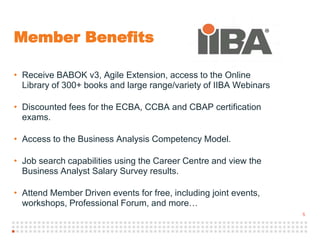
Member Benefits
• Receive BABOK v3, Agile Extension, access to the Online
Library of 300+ books and large range/variety of IIBA Webinars
• Discounted fees for the ECBA, CCBA and CBAP certification
exams.
• Access to the Business Analysis Competency Model.
• Job search capabilities using the Career Centre and view the
Business Analyst Salary Survey results.
• Attend Member Driven events for free, including joint events,
workshops, Professional Forum, and more…
6
What's On:
• New Chair and Deputy Chair!
• Thursday 8th of November: Hugh Peterken, IIBA Australia
President – Business Analysis The Profession of the Future
• Tuesday 11 December: Joint Event – End of Year Social Event
Business Analysis
Skills &
Competencies
Ken Fulmer
October , 2018
8
BABOK 3.0 - Competency Model v4
9
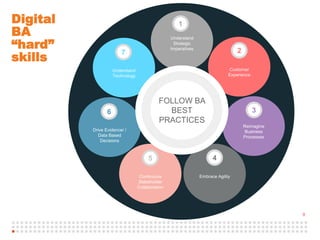
Digital
BA
“hard”
skills
Understand
Strategic
Imperatives
1
Customer
Experience
2
Reimagine
Business
Processes
3
Embrace Agility
4
Continuous
Stakeholder
Collaboration
5
Drive Evidence/ /
Data Based
Decisions
6
Understand
Technology
7
FOLLOW BA
BEST
PRACTICES
10
1 - Understand Strategic
Imperatives
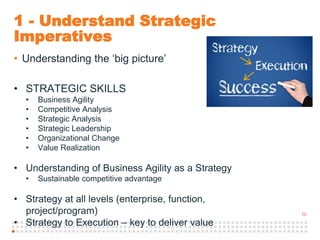
• Understanding the ‘big picture’
• STRATEGIC SKILLS
• Business Agility
• Competitive Analysis
• Strategic Analysis
• Strategic Leadership
• Organizational Change
• Value Realization
• Understanding of Business Agility as a Strategy
• Sustainable competitive advantage
• Strategy at all levels (enterprise, function,
project/program)
• Strategy to Execution – key to deliver value
11
2- Customer Experience
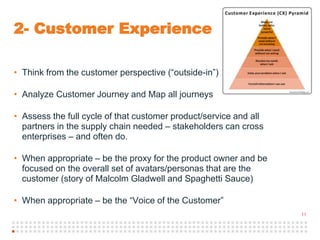
• Think from the customer perspective (“outside-in”)
• Analyze Customer Journey and Map all journeys
• Assess the full cycle of that customer product/service and all
partners in the supply chain needed – stakeholders can cross
enterprises – and often do.
• When appropriate – be the proxy for the product owner and be
focused on the overall set of avatars/personas that are the
customer (story of Malcolm Gladwell and Spaghetti Sauce)
• When appropriate – be the “Voice of the Customer”
12
3- Business Process
• Re-imagine the Business Process
• Front Office – tie to customer experience
• Mid and Back Office - Process integration
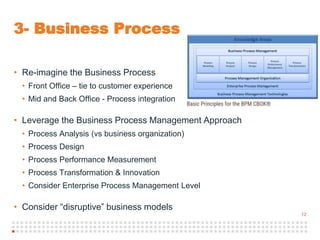
• Leverage the Business Process Management Approach
• Process Analysis (vs business organization)
• Process Design
• Process Performance Measurement
• Process Transformation & Innovation
• Consider Enterprise Process Management Level
• Consider “disruptive” business models
13
4- Embrace Agility
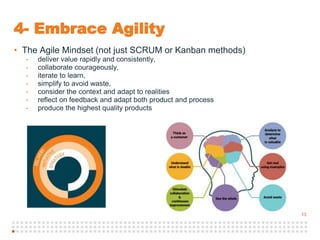
• The Agile Mindset (not just SCRUM or Kanban methods)
- deliver value rapidly and consistently,
- collaborate courageously,
- iterate to learn,
- simplify to avoid waste,
- consider the context and adapt to realities
- reflect on feedback and adapt both product and process
- produce the highest quality products
14
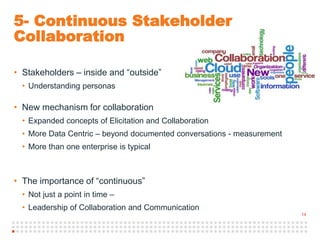
5- Continuous Stakeholder
Collaboration
• Stakeholders – inside and “outside”
• Understanding personas
• New mechanism for collaboration
• Expanded concepts of Elicitation and Collaboration
• More Data Centric – beyond documented conversations - measurement
• More than one enterprise is typical
• The importance of “continuous”
• Not just a point in time –
• Leadership of Collaboration and Communication
15
6 - DATA – Evidence Based
Decisions
• BA’s need to use data for analysis
• Elicitation – survey and experience based
• Customer Experience Data
• “Citizen Data Scientist” Level
• BA’s need to be able to use Data Tools
• BA’s need to be at the “power user” not developer level for big
data and business intelligence use by management
• BA’s need to be able to create and interpret VISUAL data
• BA’s need to interrogate data to find rules and requirement and
assist in developing algorithms for AI
• BA’s need to understand data structures and its business uses,
and how to exploit digital marketing data
16
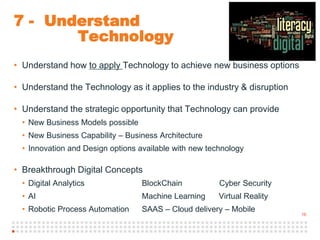
7 - Understand
Technology
• Understand how to apply Technology to achieve new business options
• Understand the Technology as it applies to the industry & disruption
• Understand the strategic opportunity that Technology can provide
• New Business Models possible
• New Business Capability – Business Architecture
• Innovation and Design options available with new technology
• Breakthrough Digital Concepts
• Digital Analytics BlockChain Cyber Security
• AI Machine Learning Virtual Reality
• Robotic Process Automation SAAS – Cloud delivery – Mobile
17
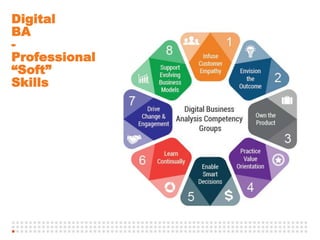
Digital
BA
-
Professional
“Soft”
Skills
18
S1- Infuse Customer Empathy
• Focus on the Customer
• Empathy – deep understanding of Customer Experience
• What the customer sees, thinks, and FEELS
• Experience across the full customer journey
• Human touch points – where and how does it impact the customer
• Minimize touch points with automation (AI)
• Think about the experience and not just the process!!
19
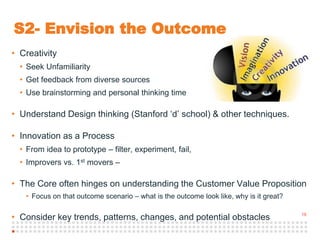
S2- Envision the Outcome
• Creativity
• Seek Unfamiliarity
• Get feedback from diverse sources
• Use brainstorming and personal thinking time
• Understand Design thinking (Stanford ‘d’ school) & other techniques.
• Innovation as a Process
• From idea to prototype – filter, experiment, fail,
• Improvers vs. 1st movers –
• The Core often hinges on understanding the Customer Value Proposition
• Focus on that outcome scenario – what is the outcome look like, why is it great?
• Consider key trends, patterns, changes, and potential obstacles
20
S3- Own the product and the
outcome
• Product vs. Project as a concept (initiative with no specific end)
• BA’s should own or lead the product & solution (not the project)
• In Agile this is a role in SCRUM – apply it more broadly to any method
• BA’s may act as a proxy for the business as owner (slippery approach)
• Accountability still needs to be with the business – BA is collaborator
• Outcome Focus
• MVP product approach from the Lean Thinking (minimally viable product)
• BUSINESS outcome, not project outcome (time, budget, scope)
• Experiment with the value of the OUTCOME
• Mindset of Leadership – ownership for the BA is critical to the profession
• Create & Seize Opportunities
21
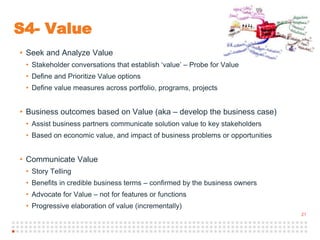
S4- Value
• Seek and Analyze Value
• Stakeholder conversations that establish ‘value’ – Probe for Value
• Define and Prioritize Value options
• Define value measures across portfolio, programs, projects
• Business outcomes based on Value (aka – develop the business case)
• Assist business partners communicate solution value to key stakeholders
• Based on economic value, and impact of business problems or opportunities
• Communicate Value
• Story Telling
• Benefits in credible business terms – confirmed by the business owners
• Advocate for Value – not for features or functions
• Progressive elaboration of value (incrementally)
22
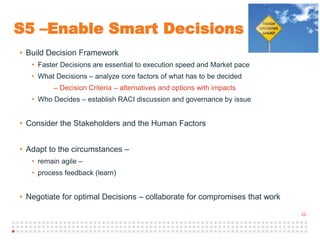
S5 –Enable Smart Decisions
• Build Decision Framework
• Faster Decisions are essential to execution speed and Market pace
• What Decisions – analyze core factors of what has to be decided
– Decision Criteria – alternatives and options with impacts
• Who Decides – establish RACI discussion and governance by issue
• Consider the Stakeholders and the Human Factors
• Adapt to the circumstances –
• remain agile –
• process feedback (learn)
• Negotiate for optimal Decisions – collaborate for compromises that work
23
S6 – LEARN Continuously
• Mindset of Lifetime Learning
• Many things we know are enduring – Foundational skills
• Other things we know are changing and are point in time skills
• Industries are changing, Technology is changing, Professional roles are changing
• Specialization of skills and breadth of skills are both aspects of future markets
• Be a Quick Learner
• Train you mind to learn quickly – accept and embrace change
• Be willing to be trainable – immerse yourself in new personal career growth
• Find ways to learn - just in time
• New learning processes take practice (like a sport)
• Look to multiple ways to find training and absorb it – multi-modal delivery
• Be market opportunity driven
24
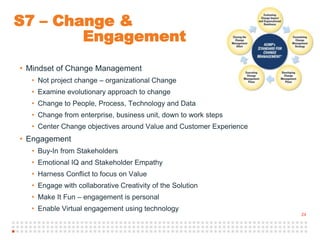
S7 – Change &
Engagement
• Mindset of Change Management
• Not project change – organizational Change
• Examine evolutionary approach to change
• Change to People, Process, Technology and Data
• Change from enterprise, business unit, down to work steps
• Center Change objectives around Value and Customer Experience
• Engagement
• Buy-In from Stakeholders
• Emotional IQ and Stakeholder Empathy
• Harness Conflict to focus on Value
• Engage with collaborative Creativity of the Solution
• Make It Fun – engagement is personal
• Enable Virtual engagement using technology
25
S8 – Culture & Business
Models
• Enterprise Culture
• Culture ties to Strategy Objectives – Efficiency & Transformation
• Focus on Market Awareness – Customer centricity
• Obsess over Outcomes – be purposeful but tie to that Value and Outcome orientation
• Enable Innovation
• New Approaches
• New Mindsets
• Support Social Networks
• Invent new Language where appropriate
• Streamline the Organization Structure – flatten where possible
• Business Model
• Transformation drives a new culture which values innovation over efficiency
• Customer Value Proposition is primary – understand horizontal segmentation & personas
• Systems Thinking Mindset – Find Opportunities and Seize the Opportunity
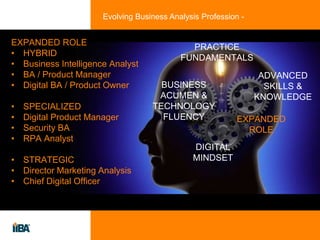
DIGITAL
MINDSET
BUSINESS
ACUMEN &
TECHNOLOGY
FLUENCY
PRACTICE
FUNDAMENTALS
ADVANCED
SKILLS &
KNOWLEDGE
EXPANDED
ROLE
EXPANDED ROLE
• HYBRID
• Business Intelligence Analyst
• BA / Product Manager
• Digital BA / Product Owner
• SPECIALIZED
• Digital Product Manager
• Security BA
• RPA Analyst
• STRATEGIC
• Director Marketing Analysis
• Chief Digital Officer
Evolving Business Analysis Profession -
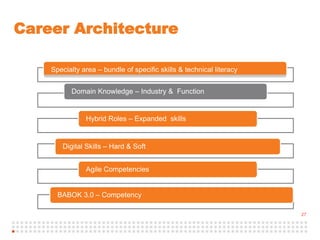
27
Career Architecture
Specialty area – bundle of specific skills & technical literacy
Domain Knowledge – Industry & Function
Hybrid Roles – Expanded skills
Digital Skills – Hard & Soft
Agile Competencies
BABOK 3.0 – Competency

BA Skills and Competency

  • 1.
  • 2.
    2 Before we begin…housekeeping In the event of an emergency, calmly follow the instructions of staff. Bathrooms are available off the hallway to the right (facing the exit).
  • 3.
    3 Thank you toour Branch Sponsors!
  • 4.
    4 About the IIBA Unitinga community of professionals to create better business outcomes. • International Institute of Business Analysis (IIBA) is an independent non-profit professional association serving the growing field of business analysis. • Promote professional standards and practices at the local level. • Defines standards for business analysis through the Business Analysis Body of Knowledge (BABOK)
  • 5.
    5 Member Benefits • ReceiveBABOK v3, Agile Extension, access to the Online Library of 300+ books and large range/variety of IIBA Webinars • Discounted fees for the ECBA, CCBA and CBAP certification exams. • Access to the Business Analysis Competency Model. • Job search capabilities using the Career Centre and view the Business Analyst Salary Survey results. • Attend Member Driven events for free, including joint events, workshops, Professional Forum, and more…
  • 6.
    6 What's On: • NewChair and Deputy Chair! • Thursday 8th of November: Hugh Peterken, IIBA Australia President – Business Analysis The Profession of the Future • Tuesday 11 December: Joint Event – End of Year Social Event
  • 7.
  • 8.
    8 BABOK 3.0 -Competency Model v4
  • 9.
  • 10.
    10 1 - UnderstandStrategic Imperatives • Understanding the ‘big picture’ • STRATEGIC SKILLS • Business Agility • Competitive Analysis • Strategic Analysis • Strategic Leadership • Organizational Change • Value Realization • Understanding of Business Agility as a Strategy • Sustainable competitive advantage • Strategy at all levels (enterprise, function, project/program) • Strategy to Execution – key to deliver value
  • 11.
    11 2- Customer Experience •Think from the customer perspective (“outside-in”) • Analyze Customer Journey and Map all journeys • Assess the full cycle of that customer product/service and all partners in the supply chain needed – stakeholders can cross enterprises – and often do. • When appropriate – be the proxy for the product owner and be focused on the overall set of avatars/personas that are the customer (story of Malcolm Gladwell and Spaghetti Sauce) • When appropriate – be the “Voice of the Customer”
  • 12.
    12 3- Business Process •Re-imagine the Business Process • Front Office – tie to customer experience • Mid and Back Office - Process integration • Leverage the Business Process Management Approach • Process Analysis (vs business organization) • Process Design • Process Performance Measurement • Process Transformation & Innovation • Consider Enterprise Process Management Level • Consider “disruptive” business models
  • 13.
    13 4- Embrace Agility •The Agile Mindset (not just SCRUM or Kanban methods) - deliver value rapidly and consistently, - collaborate courageously, - iterate to learn, - simplify to avoid waste, - consider the context and adapt to realities - reflect on feedback and adapt both product and process - produce the highest quality products
  • 14.
    14 5- Continuous Stakeholder Collaboration •Stakeholders – inside and “outside” • Understanding personas • New mechanism for collaboration • Expanded concepts of Elicitation and Collaboration • More Data Centric – beyond documented conversations - measurement • More than one enterprise is typical • The importance of “continuous” • Not just a point in time – • Leadership of Collaboration and Communication
  • 15.
    15 6 - DATA– Evidence Based Decisions • BA’s need to use data for analysis • Elicitation – survey and experience based • Customer Experience Data • “Citizen Data Scientist” Level • BA’s need to be able to use Data Tools • BA’s need to be at the “power user” not developer level for big data and business intelligence use by management • BA’s need to be able to create and interpret VISUAL data • BA’s need to interrogate data to find rules and requirement and assist in developing algorithms for AI • BA’s need to understand data structures and its business uses, and how to exploit digital marketing data
  • 16.
    16 7 - Understand Technology •Understand how to apply Technology to achieve new business options • Understand the Technology as it applies to the industry & disruption • Understand the strategic opportunity that Technology can provide • New Business Models possible • New Business Capability – Business Architecture • Innovation and Design options available with new technology • Breakthrough Digital Concepts • Digital Analytics BlockChain Cyber Security • AI Machine Learning Virtual Reality • Robotic Process Automation SAAS – Cloud delivery – Mobile
  • 17.
  • 18.
    18 S1- Infuse CustomerEmpathy • Focus on the Customer • Empathy – deep understanding of Customer Experience • What the customer sees, thinks, and FEELS • Experience across the full customer journey • Human touch points – where and how does it impact the customer • Minimize touch points with automation (AI) • Think about the experience and not just the process!!
  • 19.
    19 S2- Envision theOutcome • Creativity • Seek Unfamiliarity • Get feedback from diverse sources • Use brainstorming and personal thinking time • Understand Design thinking (Stanford ‘d’ school) & other techniques. • Innovation as a Process • From idea to prototype – filter, experiment, fail, • Improvers vs. 1st movers – • The Core often hinges on understanding the Customer Value Proposition • Focus on that outcome scenario – what is the outcome look like, why is it great? • Consider key trends, patterns, changes, and potential obstacles
  • 20.
    20 S3- Own theproduct and the outcome • Product vs. Project as a concept (initiative with no specific end) • BA’s should own or lead the product & solution (not the project) • In Agile this is a role in SCRUM – apply it more broadly to any method • BA’s may act as a proxy for the business as owner (slippery approach) • Accountability still needs to be with the business – BA is collaborator • Outcome Focus • MVP product approach from the Lean Thinking (minimally viable product) • BUSINESS outcome, not project outcome (time, budget, scope) • Experiment with the value of the OUTCOME • Mindset of Leadership – ownership for the BA is critical to the profession • Create & Seize Opportunities
  • 21.
    21 S4- Value • Seekand Analyze Value • Stakeholder conversations that establish ‘value’ – Probe for Value • Define and Prioritize Value options • Define value measures across portfolio, programs, projects • Business outcomes based on Value (aka – develop the business case) • Assist business partners communicate solution value to key stakeholders • Based on economic value, and impact of business problems or opportunities • Communicate Value • Story Telling • Benefits in credible business terms – confirmed by the business owners • Advocate for Value – not for features or functions • Progressive elaboration of value (incrementally)
  • 22.
    22 S5 –Enable SmartDecisions • Build Decision Framework • Faster Decisions are essential to execution speed and Market pace • What Decisions – analyze core factors of what has to be decided – Decision Criteria – alternatives and options with impacts • Who Decides – establish RACI discussion and governance by issue • Consider the Stakeholders and the Human Factors • Adapt to the circumstances – • remain agile – • process feedback (learn) • Negotiate for optimal Decisions – collaborate for compromises that work
  • 23.
    23 S6 – LEARNContinuously • Mindset of Lifetime Learning • Many things we know are enduring – Foundational skills • Other things we know are changing and are point in time skills • Industries are changing, Technology is changing, Professional roles are changing • Specialization of skills and breadth of skills are both aspects of future markets • Be a Quick Learner • Train you mind to learn quickly – accept and embrace change • Be willing to be trainable – immerse yourself in new personal career growth • Find ways to learn - just in time • New learning processes take practice (like a sport) • Look to multiple ways to find training and absorb it – multi-modal delivery • Be market opportunity driven
  • 24.
    24 S7 – Change& Engagement • Mindset of Change Management • Not project change – organizational Change • Examine evolutionary approach to change • Change to People, Process, Technology and Data • Change from enterprise, business unit, down to work steps • Center Change objectives around Value and Customer Experience • Engagement • Buy-In from Stakeholders • Emotional IQ and Stakeholder Empathy • Harness Conflict to focus on Value • Engage with collaborative Creativity of the Solution • Make It Fun – engagement is personal • Enable Virtual engagement using technology
  • 25.
    25 S8 – Culture& Business Models • Enterprise Culture • Culture ties to Strategy Objectives – Efficiency & Transformation • Focus on Market Awareness – Customer centricity • Obsess over Outcomes – be purposeful but tie to that Value and Outcome orientation • Enable Innovation • New Approaches • New Mindsets • Support Social Networks • Invent new Language where appropriate • Streamline the Organization Structure – flatten where possible • Business Model • Transformation drives a new culture which values innovation over efficiency • Customer Value Proposition is primary – understand horizontal segmentation & personas • Systems Thinking Mindset – Find Opportunities and Seize the Opportunity
  • 26.
    DIGITAL MINDSET BUSINESS ACUMEN & TECHNOLOGY FLUENCY PRACTICE FUNDAMENTALS ADVANCED SKILLS & KNOWLEDGE EXPANDED ROLE EXPANDEDROLE • HYBRID • Business Intelligence Analyst • BA / Product Manager • Digital BA / Product Owner • SPECIALIZED • Digital Product Manager • Security BA • RPA Analyst • STRATEGIC • Director Marketing Analysis • Chief Digital Officer Evolving Business Analysis Profession -
  • 27.
    27 Career Architecture Specialty area– bundle of specific skills & technical literacy Domain Knowledge – Industry & Function Hybrid Roles – Expanded skills Digital Skills – Hard & Soft Agile Competencies BABOK 3.0 – Competency

Editor's Notes