BA In Transformation
2020 and beyond:
BA as a Role or a Skill
David Mantica
SoftEd
www.softed.com
davidm@softed.com
• Enterprise Challenges
• High-level thought of BA as Catalyst to solve enterprise
challenges
• Current state of BA role
• What is it
• What governs it
• BA role disruption
• Agile
• PMI PBA
• Product Management
• Critical Skills (defining need)
• Modeling, Enterprise Analysis, Business Architecture
• Business Value Analysis
• Position Evolution
• Professional skills
• Being solution architect / trusted advisor
• Career path
Presentation Agenda
Speed
• Rapid pace of disruption and change
• Can handle change, lose and lose quickly
Productivity
• Key to profits in the face of contact change in need
Competitive Advantage
• Customer knowledge (internal and external)
Product Creation
• Three elements of product creation
• Competitive understanding, organizational capabilities, creating
value
Growing, Managing and Retaining Knowledge Workers
• Generation “Y” dilemma (Millennial)
Enterprise Challenges
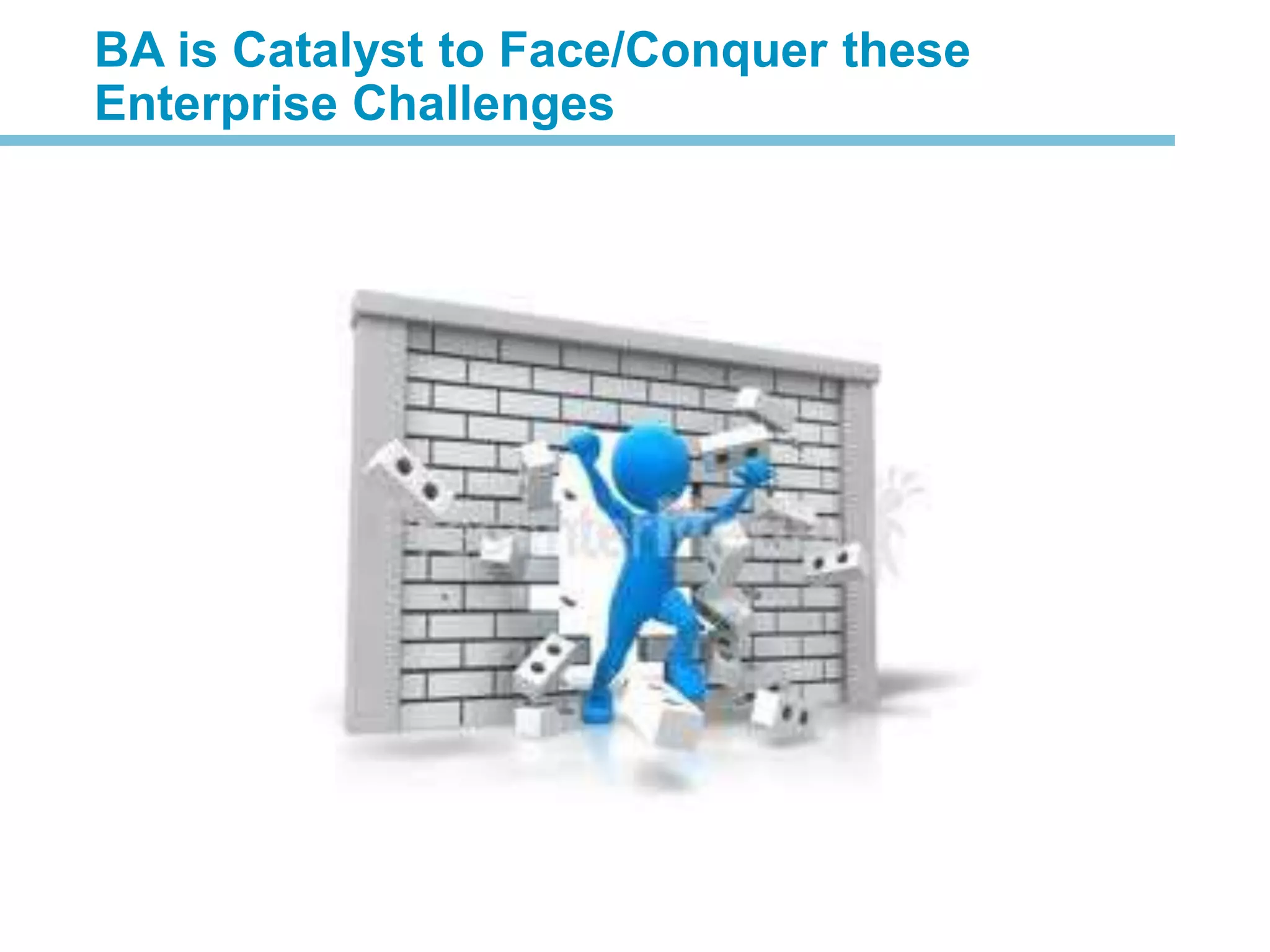
BA is Catalyst to Face/Conquer these
Enterprise Challenges
Position Overview
• Enterprise Analysis (business case)
• Project scope
• Process modeling
• Show how things work now and should work in the future
• Requirements Analysis, Elicitation, Management
• Converting from business (functional/non-functional)
requirements to technical (systems)
• Business Architecture / Business Rules
Position Profile
• Should act a lot like a Product Manager
• Should have solid user knowledge of system, power user
• Should be technical enough to “talk the talk”
• Much more concerned about outcome than budget or schedule
• Should have VERY strong domain knowledge
• Must be able to state/represent business case of system/software
What is a BA? (Industry perspective)
International Institute of Business Analysis (IIBA)
• www.iiba.org
• Started in Canada,
• 15 years old
• BA Body of Knowledge (BABOK)
• Current version 3.0
• Multiple certifications (2 core)
• Certified Business Analyst Professional (CBAP)
• Certification of Competency in Business Analysis (CCBA)
• New PMI-PBA certification potential impacts
Overall
• Still in infancy (took PMP 12+ years to reach tipping point)
• Doers know it and love it. Companies don’t know what it is or offers
• BA position means something slightly different to different organizations
• Adding extensions and connecting to hot things like cybersecurity and data
analysis
Who or What Governs the BA role?
Important Observation
VS.
Plan-driven
Development
Adaptive
Development
What is Agile??
The Mechanics of Scrum, where does BA fit??
• First off, Iterations are work-specific, not role-specific
• Work specific BA actions include:
• Chunk requirements into User Stories
• Provide input on need and prioritization of Stories
• Write non-functional test cases
• Perform non-function tests / acceptance tests
• Write specifics
• Write documentation / training
• Product Owner and BA not the same thing
• In Iteration, work focuses on only one aspect of the BA skill set.
• In Agile a lot of the role is in and around Iteration zero or the before iteration
planning work
BA Role In Iteration
• IIBA (International Institute of Business Analysis)
• Sees the BA (Business Analyst) as a role
• Specific function in defining what is going to be done
and how it is going to be done
• Agile (the way of working)
• Sees the BA (business analysis) as a skill
• Focused around writing and managing requirements and
testing output at user interface level
• Sometimes replace BA with Product Owner
• How does PMI see BA Work?
Is BA Work A Role or a Skill?
• Based on the make up of the PMI-PBA
designation PMI sees the BA as a skill
• It is something that can be added to a
professional’s set of skills and tools
• Anyone in the SDLC and beyond can gain
these skills based on their experience level
• The skills certified are tied to “in project” BA
work
• The skills are transfer to what is needed in an
agile production environment
PMI-PBA Demographics and Certification Vision
Where does software
development fit?
How do I get what I want from my efforts?
Why is this conversation
important
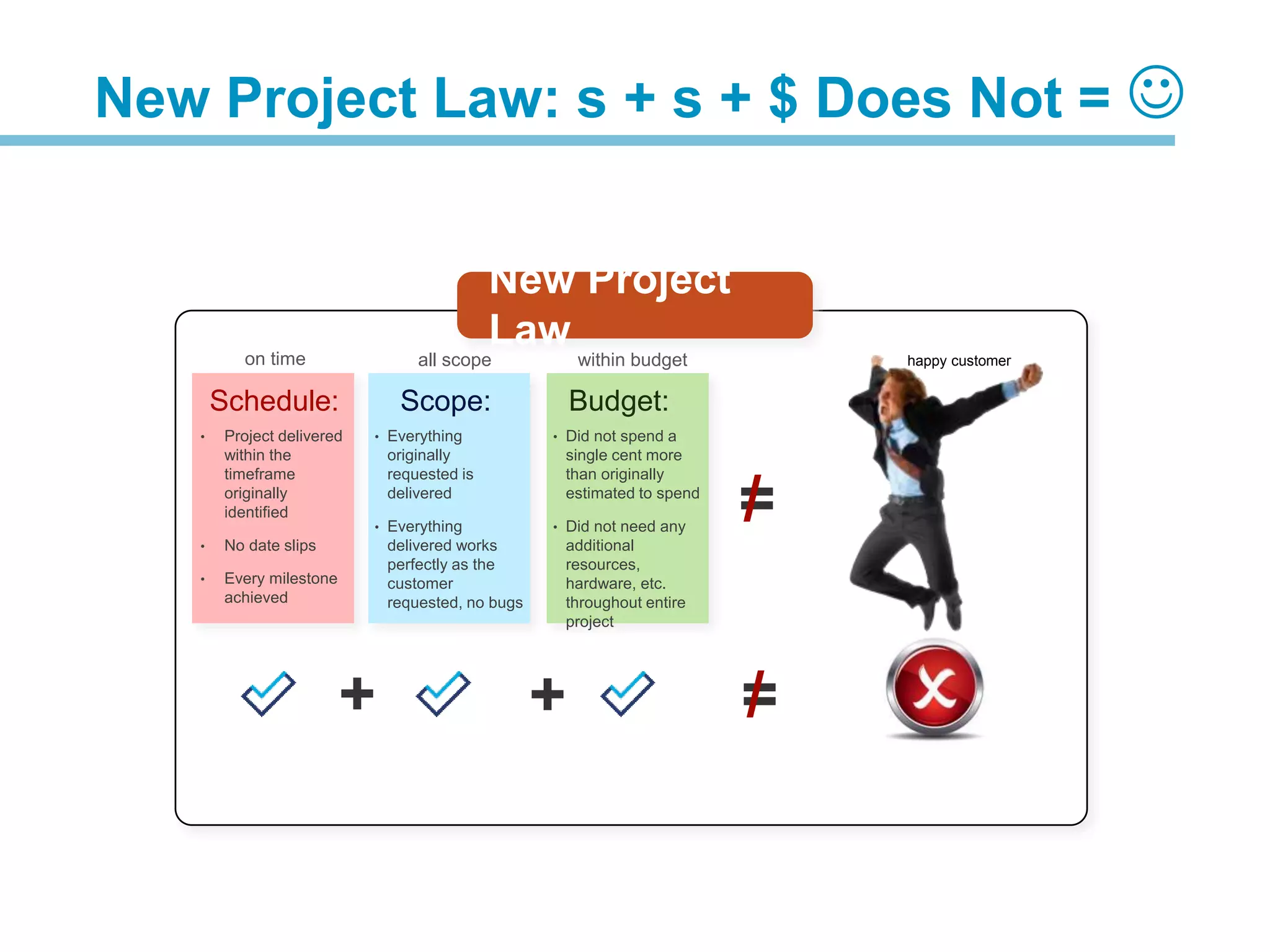
Schedule: Scope: Budget:
New Project
Law
• Project delivered
within the
timeframe
originally
identified
• No date slips
• Every milestone
achieved
• Everything
originally
requested is
delivered
• Everything
delivered works
perfectly as the
customer
requested, no bugs
• Did not spend a
single cent more
than originally
estimated to spend
• Did not need any
additional
resources,
hardware, etc.
throughout entire
project
on time all scope within budget
=
/
+ + =
/
happy customer
New Project Law: s + s + $ Does Not = 
• It seems the focus has been the measurable side of a BA’s responsibilities…
• ”if it can be measured, it can be monitored and if it can be monitored it
is important”
• Inside Agile – Way too much focus on requirement breakdown (Stories),
Testing and documentation
• Outside Agile – Way too much focus on requirements elicitation and
development
• Anecdotal: 95% of people in our classes focus just on the science side of role
• But missing the growth to becoming a TRUSTED ADVISOR. Enterprise
Analysis/Solution Architect/Management Consultant
• What is this??
BA Role Current Status:
Too Much Science Not Enough Art
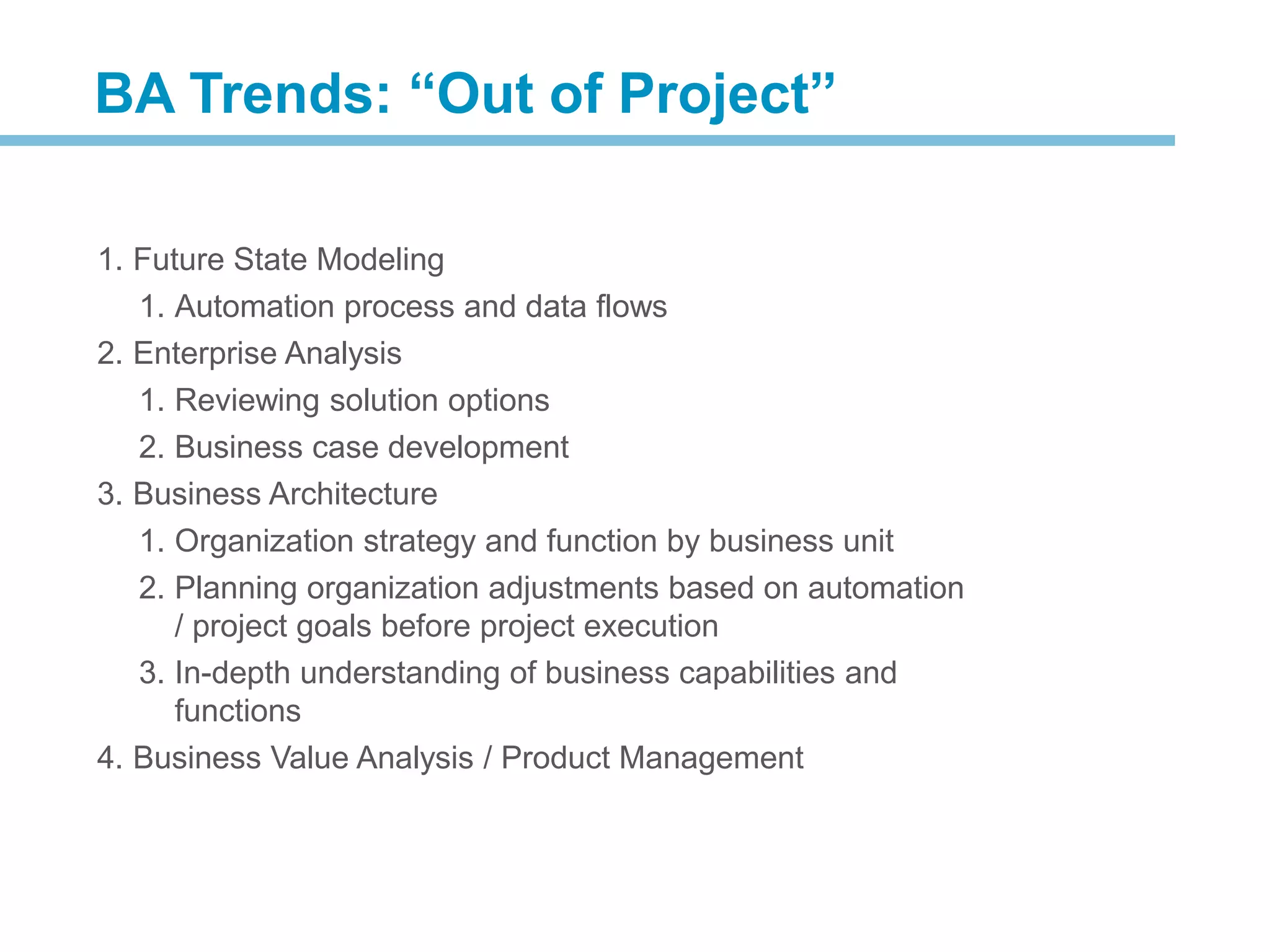
1. Future State Modeling
1. Automation process and data flows
2. Enterprise Analysis
1. Reviewing solution options
2. Business case development
3. Business Architecture
1. Organization strategy and function by business unit
2. Planning organization adjustments based on automation
/ project goals before project execution
3. In-depth understanding of business capabilities and
functions
4. Business Value Analysis / Product Management
BA Trends: “Out of Project”
A. Automation drives productivity and productivity drives profitability
B. But Automation screws up processes
C. Processes run companies—automate without process redefinition means
HUGE WASTE
What a BA must do:
1. Build future state, modeling both process and data flow
1. Does it work / will it work ?
2. Drive top / down agreement on new processes and data flow
3. Align requirements to new process
4. Push acceptance of new process flow
BA Trends: Models and Analysis
• Defining Need
• Are there other internal options
• Is there a return on investment and what is it
• Can the organization do what is requested
Basically building the business case
• Proper Enterprise Analysis drives Executive sponsor behavior
• Negotiate need using appropriate analysis techniques on the initial request
• Provide leadership to bring disparate executive stakeholders together for
informed project initiation
• Enterprise Analysis isn’t always part of BA’s responsibilities
• BA’s in those organizations are given the project initiate and goal and told
the model and the solutions and gather the necessary requirements
• Elements of Traditional Product Management
• ICAgile Product Management designation
https://www.icagile.com/Business-Agility/Operating-with-Agility/Product-
Management
BA Trends: Enterprise Analysis
• What is it?
• A “blueprint” of the enterprise that provides a common understanding of
the organization and is used to align strategic objectives and tactical
demands
• A bridge between your business model / strategy and how your
business functions
• What does a Business Architect work on?
• Supports the definition of business strategy and tactical goas that drive
organization operations
• Documents business capabilities and primary functions
• Develops root cause analysis to review enterprise business problems
• Captures an organization view and documents roles, responsibilities,
capabilities of business unites
• TOGAF (The Open Group Architecture Framework) is a community-based
standards effort to describe methods and tools used by architects
BA Trends: Business Architecture
• Distinct discipline
• Applies at many levels
• Crosses many initiatives
• May be embodied in many
roles
• Different aspects of value
Value
Delivery
Process
What is Value Management?
• Everyone responsible for value, so no
one is
• Responsibility gets diluted
• Lose sight of value of initiatives
• Not viewed as a distinct discipline
• Limited definition of “value”
The Need for Value Management
What is Value Management
Value Management Challenges
Business
Stewardship
• Single initiative,
project, team
focus
• Value-Based
Solutions
Delivery
• Key Agile
Practices
• Requirements,
Prioritization,
Roadmap
Business
Value
Analysis
• Portfolio
Focused
• Portfolio
Management
• Value
Management
Team
• Value
Management
and Program
Management
Expert-Value
Management
Customer Focused
Maximize Value
Establish Value Teams
Value-Based Approaches
Levels of Value Management
1.4.1
Value
Management
Right
Information
Right Level
Right Time
Right
Product
IIBA , Becoming a Business Analyst
Role, Not Job Title
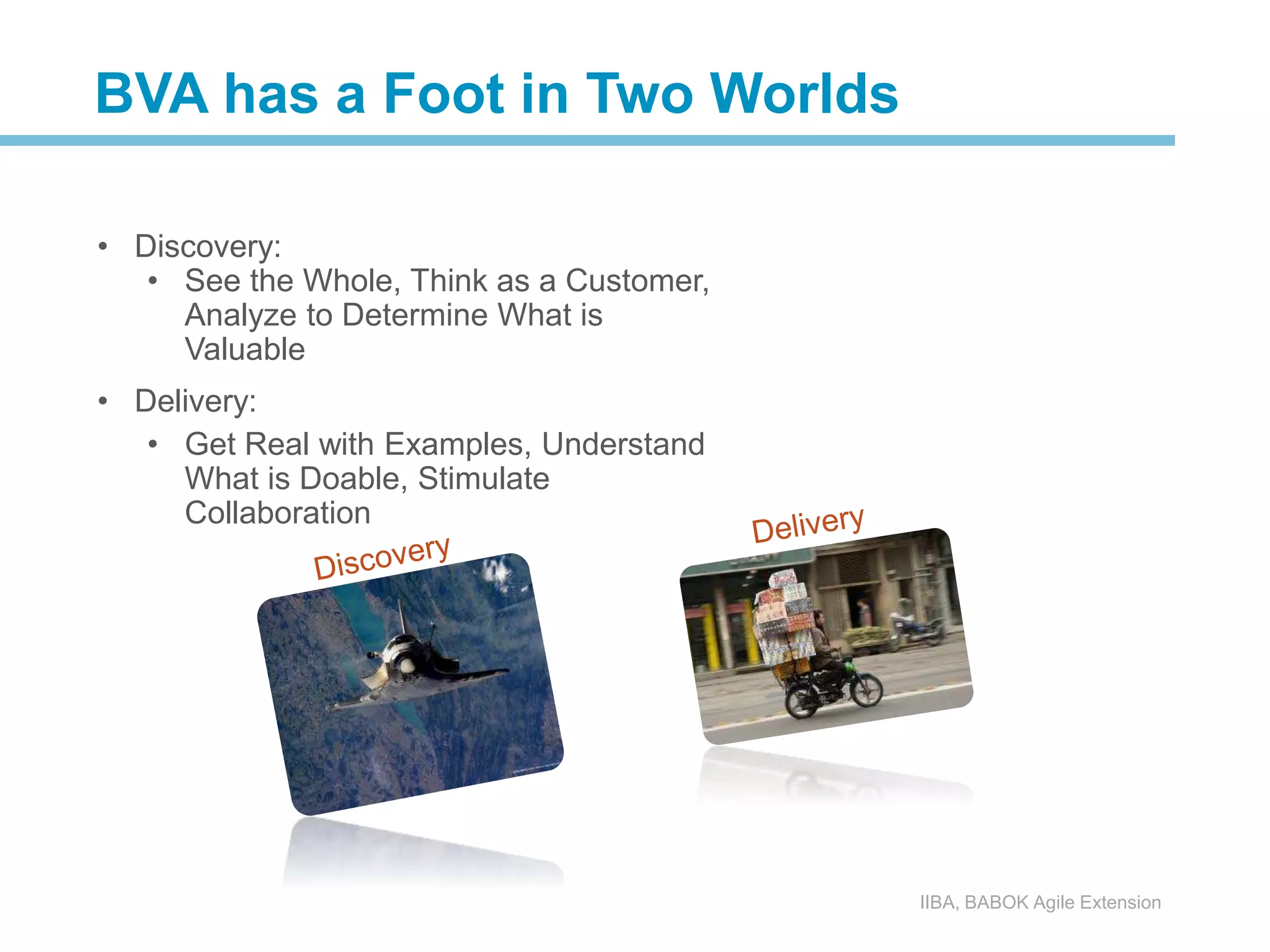
• Discovery:
• See the Whole, Think as a Customer,
Analyze to Determine What is
Valuable
• Delivery:
• Get Real with Examples, Understand
What is Doable, Stimulate
Collaboration
IIBA, BABOK Agile Extension
BVA has a Foot in Two Worlds
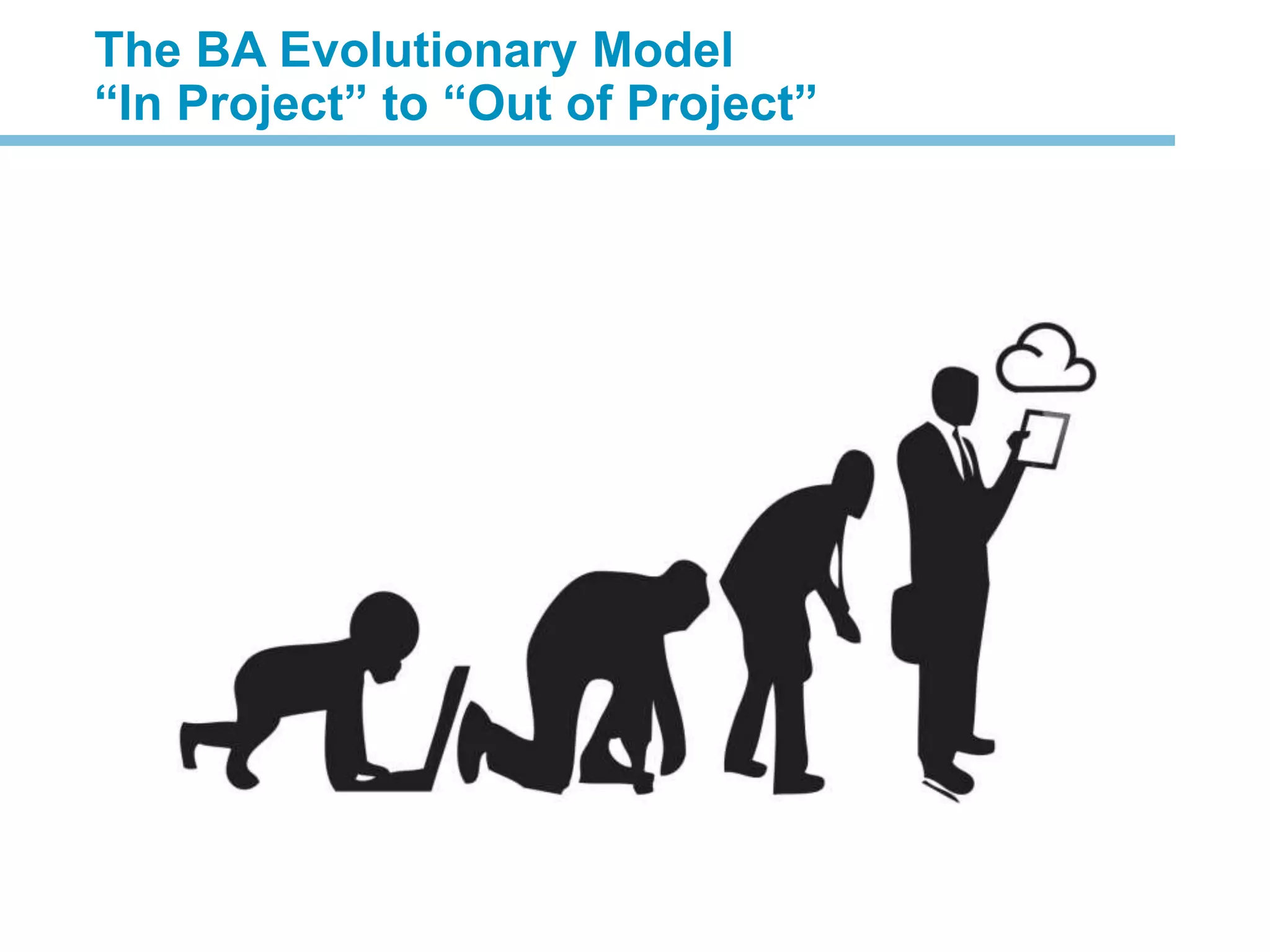
The BA Evolutionary Model
“In Project” to “Out of Project”
• Typical SDLC Professional Characteristics
• Detailed (accurate)
• Black / White (there is a right and wrong way)
• Professional not Management
• Don’t have distraction of staff
• No Authority
• Is seen as unbiased
Puts position at a disadvantage when moving to Trusted
Advisor / Mgmt. Consultant role / Product Management
Role
What Makes you Successful Can Also Hurt
You
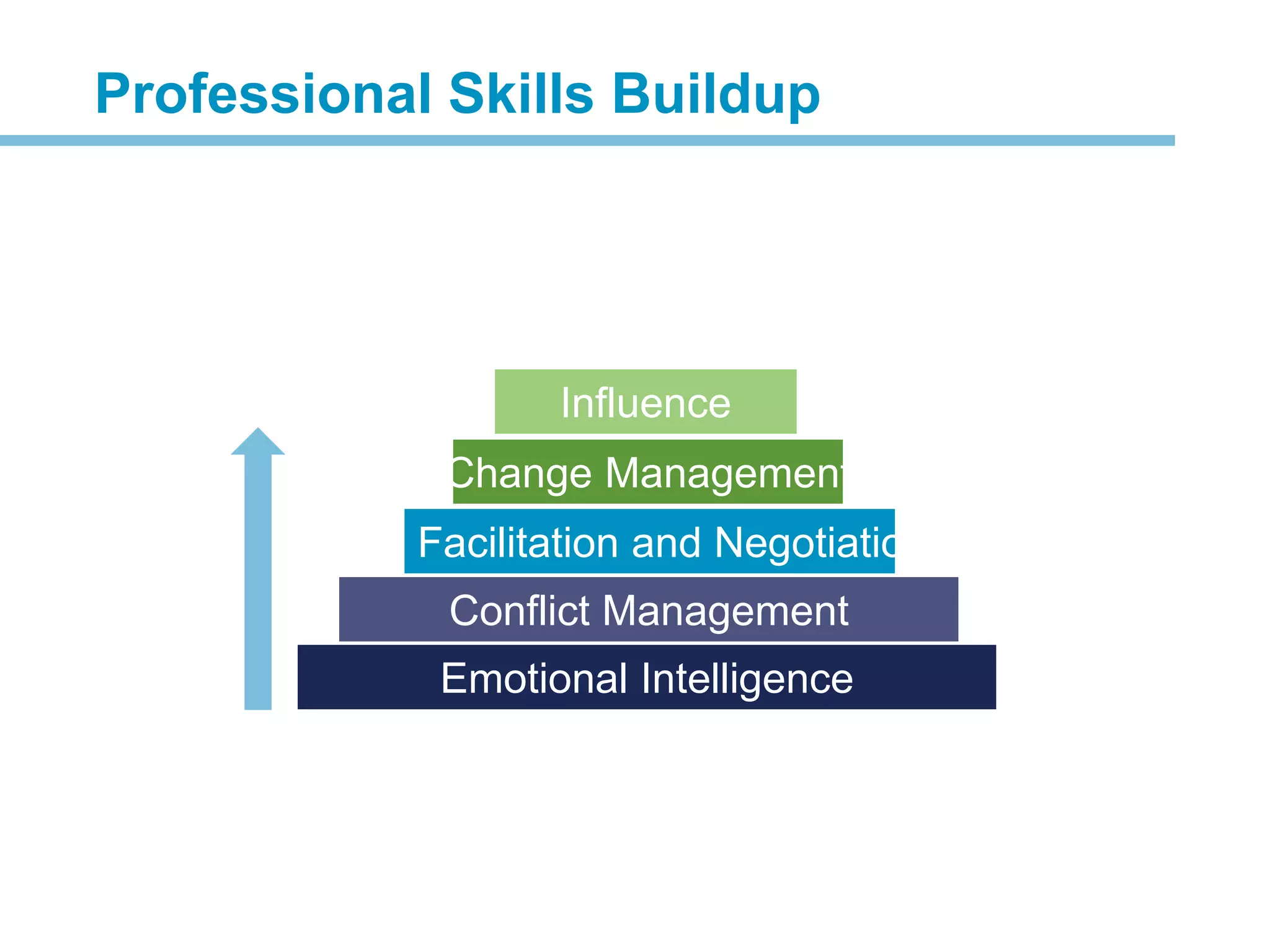
Emotional Intelligence
Conflict Management
Facilitation and Negotiation
Change Management
Influence
Professional Skills Buildup
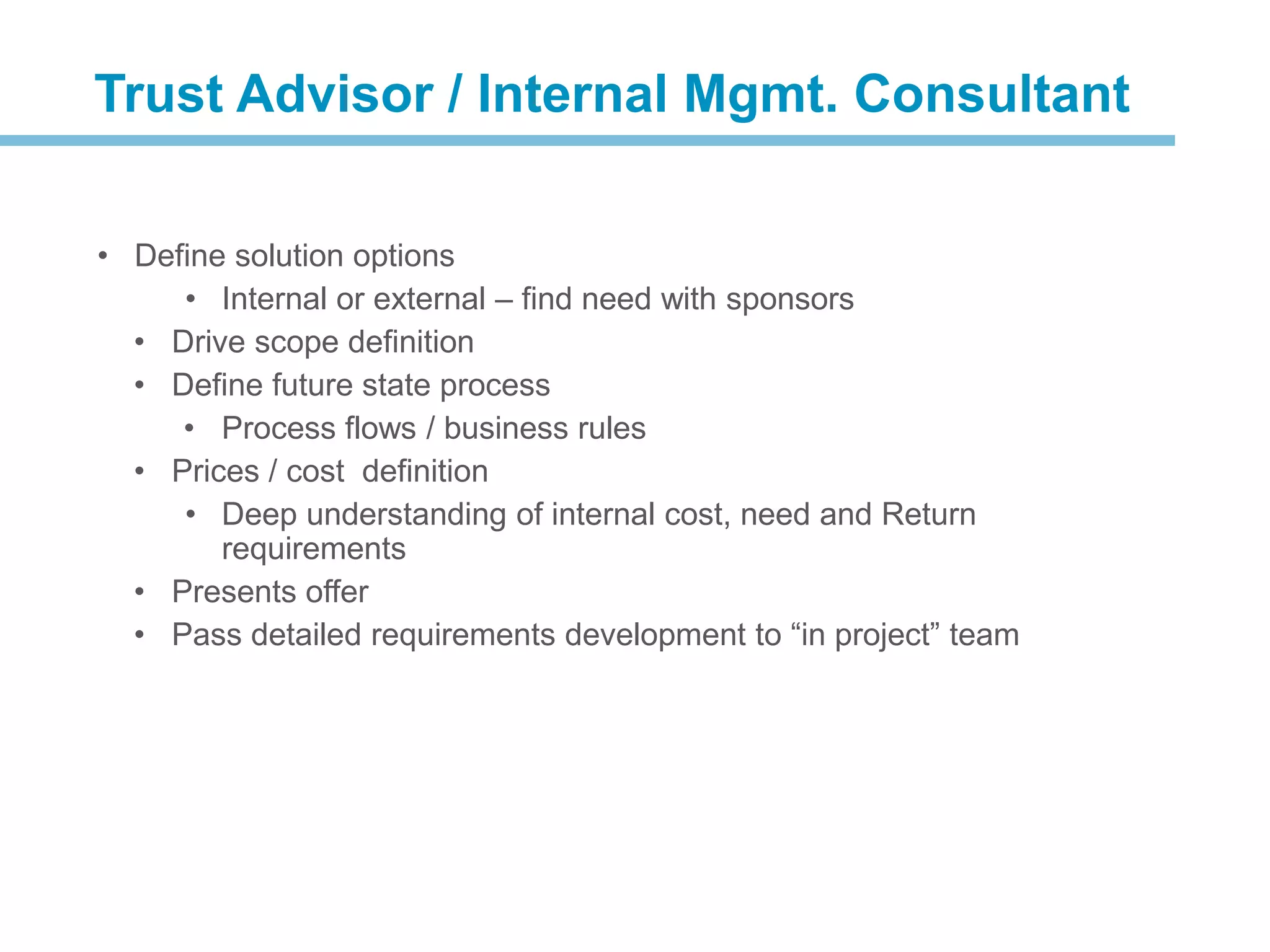
• Define solution options
• Internal or external – find need with sponsors
• Drive scope definition
• Define future state process
• Process flows / business rules
• Prices / cost definition
• Deep understanding of internal cost, need and Return
requirements
• Presents offer
• Pass detailed requirements development to “in project” team
Trust Advisor / Internal Mgmt. Consultant
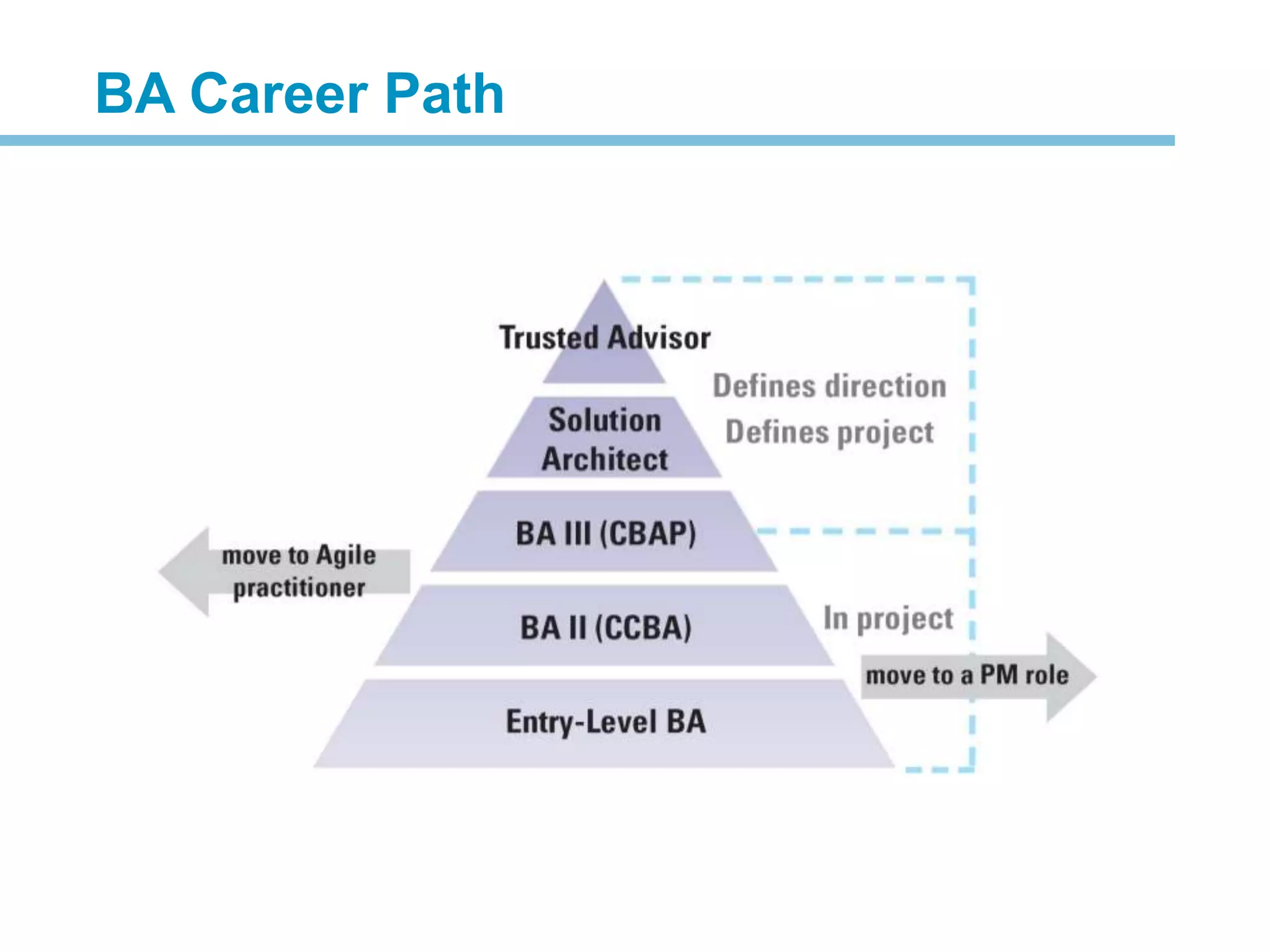
BA Career Path
Chapter sponsor/partner SoftEd is offering selected PMI chapters and
its membership 50% off discounts on its Live Online training for the rest
of the year.
SoftEd offers Business Analysis, Agile, DevOps and Software Testing
Training and it is the world’s largest provider of IC Agile training
courses. For more information about SoftEd’s public schedule go to:
https://www.softed.com/us/calendar/
You can register using the code DM0620.
Feel free to contact davidm@softed.com
Questions and

The BA In Transformation_2020_New.pptx

  • 1.
    BA In Transformation 2020and beyond: BA as a Role or a Skill David Mantica SoftEd www.softed.com davidm@softed.com
  • 2.
    • Enterprise Challenges •High-level thought of BA as Catalyst to solve enterprise challenges • Current state of BA role • What is it • What governs it • BA role disruption • Agile • PMI PBA • Product Management • Critical Skills (defining need) • Modeling, Enterprise Analysis, Business Architecture • Business Value Analysis • Position Evolution • Professional skills • Being solution architect / trusted advisor • Career path Presentation Agenda
  • 3.
    Speed • Rapid paceof disruption and change • Can handle change, lose and lose quickly Productivity • Key to profits in the face of contact change in need Competitive Advantage • Customer knowledge (internal and external) Product Creation • Three elements of product creation • Competitive understanding, organizational capabilities, creating value Growing, Managing and Retaining Knowledge Workers • Generation “Y” dilemma (Millennial) Enterprise Challenges
  • 4.
    BA is Catalystto Face/Conquer these Enterprise Challenges
  • 5.
    Position Overview • EnterpriseAnalysis (business case) • Project scope • Process modeling • Show how things work now and should work in the future • Requirements Analysis, Elicitation, Management • Converting from business (functional/non-functional) requirements to technical (systems) • Business Architecture / Business Rules Position Profile • Should act a lot like a Product Manager • Should have solid user knowledge of system, power user • Should be technical enough to “talk the talk” • Much more concerned about outcome than budget or schedule • Should have VERY strong domain knowledge • Must be able to state/represent business case of system/software What is a BA? (Industry perspective)
  • 6.
    International Institute ofBusiness Analysis (IIBA) • www.iiba.org • Started in Canada, • 15 years old • BA Body of Knowledge (BABOK) • Current version 3.0 • Multiple certifications (2 core) • Certified Business Analyst Professional (CBAP) • Certification of Competency in Business Analysis (CCBA) • New PMI-PBA certification potential impacts Overall • Still in infancy (took PMP 12+ years to reach tipping point) • Doers know it and love it. Companies don’t know what it is or offers • BA position means something slightly different to different organizations • Adding extensions and connecting to hot things like cybersecurity and data analysis Who or What Governs the BA role?
  • 7.
  • 8.
    The Mechanics ofScrum, where does BA fit??
  • 9.
    • First off,Iterations are work-specific, not role-specific • Work specific BA actions include: • Chunk requirements into User Stories • Provide input on need and prioritization of Stories • Write non-functional test cases • Perform non-function tests / acceptance tests • Write specifics • Write documentation / training • Product Owner and BA not the same thing • In Iteration, work focuses on only one aspect of the BA skill set. • In Agile a lot of the role is in and around Iteration zero or the before iteration planning work BA Role In Iteration
  • 10.
    • IIBA (InternationalInstitute of Business Analysis) • Sees the BA (Business Analyst) as a role • Specific function in defining what is going to be done and how it is going to be done • Agile (the way of working) • Sees the BA (business analysis) as a skill • Focused around writing and managing requirements and testing output at user interface level • Sometimes replace BA with Product Owner • How does PMI see BA Work? Is BA Work A Role or a Skill?
  • 11.
    • Based onthe make up of the PMI-PBA designation PMI sees the BA as a skill • It is something that can be added to a professional’s set of skills and tools • Anyone in the SDLC and beyond can gain these skills based on their experience level • The skills certified are tied to “in project” BA work • The skills are transfer to what is needed in an agile production environment PMI-PBA Demographics and Certification Vision
  • 12.
    Where does software developmentfit? How do I get what I want from my efforts? Why is this conversation important
  • 13.
    Schedule: Scope: Budget: NewProject Law • Project delivered within the timeframe originally identified • No date slips • Every milestone achieved • Everything originally requested is delivered • Everything delivered works perfectly as the customer requested, no bugs • Did not spend a single cent more than originally estimated to spend • Did not need any additional resources, hardware, etc. throughout entire project on time all scope within budget = / + + = / happy customer New Project Law: s + s + $ Does Not = 
  • 14.
    • It seemsthe focus has been the measurable side of a BA’s responsibilities… • ”if it can be measured, it can be monitored and if it can be monitored it is important” • Inside Agile – Way too much focus on requirement breakdown (Stories), Testing and documentation • Outside Agile – Way too much focus on requirements elicitation and development • Anecdotal: 95% of people in our classes focus just on the science side of role • But missing the growth to becoming a TRUSTED ADVISOR. Enterprise Analysis/Solution Architect/Management Consultant • What is this?? BA Role Current Status: Too Much Science Not Enough Art
  • 15.
    1. Future StateModeling 1. Automation process and data flows 2. Enterprise Analysis 1. Reviewing solution options 2. Business case development 3. Business Architecture 1. Organization strategy and function by business unit 2. Planning organization adjustments based on automation / project goals before project execution 3. In-depth understanding of business capabilities and functions 4. Business Value Analysis / Product Management BA Trends: “Out of Project”
  • 16.
    A. Automation drivesproductivity and productivity drives profitability B. But Automation screws up processes C. Processes run companies—automate without process redefinition means HUGE WASTE What a BA must do: 1. Build future state, modeling both process and data flow 1. Does it work / will it work ? 2. Drive top / down agreement on new processes and data flow 3. Align requirements to new process 4. Push acceptance of new process flow BA Trends: Models and Analysis
  • 17.
    • Defining Need •Are there other internal options • Is there a return on investment and what is it • Can the organization do what is requested Basically building the business case • Proper Enterprise Analysis drives Executive sponsor behavior • Negotiate need using appropriate analysis techniques on the initial request • Provide leadership to bring disparate executive stakeholders together for informed project initiation • Enterprise Analysis isn’t always part of BA’s responsibilities • BA’s in those organizations are given the project initiate and goal and told the model and the solutions and gather the necessary requirements • Elements of Traditional Product Management • ICAgile Product Management designation https://www.icagile.com/Business-Agility/Operating-with-Agility/Product- Management BA Trends: Enterprise Analysis
  • 18.
    • What isit? • A “blueprint” of the enterprise that provides a common understanding of the organization and is used to align strategic objectives and tactical demands • A bridge between your business model / strategy and how your business functions • What does a Business Architect work on? • Supports the definition of business strategy and tactical goas that drive organization operations • Documents business capabilities and primary functions • Develops root cause analysis to review enterprise business problems • Captures an organization view and documents roles, responsibilities, capabilities of business unites • TOGAF (The Open Group Architecture Framework) is a community-based standards effort to describe methods and tools used by architects BA Trends: Business Architecture
  • 19.
    • Distinct discipline •Applies at many levels • Crosses many initiatives • May be embodied in many roles • Different aspects of value Value Delivery Process What is Value Management?
  • 20.
    • Everyone responsiblefor value, so no one is • Responsibility gets diluted • Lose sight of value of initiatives • Not viewed as a distinct discipline • Limited definition of “value” The Need for Value Management What is Value Management Value Management Challenges
  • 21.
    Business Stewardship • Single initiative, project,team focus • Value-Based Solutions Delivery • Key Agile Practices • Requirements, Prioritization, Roadmap Business Value Analysis • Portfolio Focused • Portfolio Management • Value Management Team • Value Management and Program Management Expert-Value Management Customer Focused Maximize Value Establish Value Teams Value-Based Approaches Levels of Value Management
  • 22.
  • 23.
    • Discovery: • Seethe Whole, Think as a Customer, Analyze to Determine What is Valuable • Delivery: • Get Real with Examples, Understand What is Doable, Stimulate Collaboration IIBA, BABOK Agile Extension BVA has a Foot in Two Worlds
  • 24.
    The BA EvolutionaryModel “In Project” to “Out of Project”
  • 25.
    • Typical SDLCProfessional Characteristics • Detailed (accurate) • Black / White (there is a right and wrong way) • Professional not Management • Don’t have distraction of staff • No Authority • Is seen as unbiased Puts position at a disadvantage when moving to Trusted Advisor / Mgmt. Consultant role / Product Management Role What Makes you Successful Can Also Hurt You
  • 26.
    Emotional Intelligence Conflict Management Facilitationand Negotiation Change Management Influence Professional Skills Buildup
  • 27.
    • Define solutionoptions • Internal or external – find need with sponsors • Drive scope definition • Define future state process • Process flows / business rules • Prices / cost definition • Deep understanding of internal cost, need and Return requirements • Presents offer • Pass detailed requirements development to “in project” team Trust Advisor / Internal Mgmt. Consultant
  • 28.
  • 29.
    Chapter sponsor/partner SoftEdis offering selected PMI chapters and its membership 50% off discounts on its Live Online training for the rest of the year. SoftEd offers Business Analysis, Agile, DevOps and Software Testing Training and it is the world’s largest provider of IC Agile training courses. For more information about SoftEd’s public schedule go to: https://www.softed.com/us/calendar/ You can register using the code DM0620. Feel free to contact davidm@softed.com Questions and

Editor's Notes

  • #2 114 Edinburgh South Dr., Suite 104 l P.O. Box 5488 l Cary, NC 27511 Phone: 919.816.1750 l www.aspetech.com l Fax: 919.816.1710
  • #3 114 Edinburgh South Dr., Suite 104 l P.O. Box 5488 l Cary, NC 27511 Phone: 919.816.1750 l www.aspetech.com l Fax: 919.816.1710
  • #8 Agile is not a “one-size fits all approach”. The question to answer is “What approach most approximately fits the type of work we are doing here?” Large complex projects that represent a known problem but an unknown solution are the prime candidates for an adaptive development, Agile approach. Simple, low risk, straight forward projects that don’t require significant learning to complete are well suited to a plan driven approach. ________________________________________________________________________ ________________________________________________________________________ ________________________________________________________________________ ________________________________________________________________________ ________________________________________________________________________ ________________________________________________________________________ ________________________________________________________________________
  • #13 The Stacey Matrix is a model proposed by Ralph Douglas Stacey to determine the characteristics of work based on the degree of certainty and the level of agreement. People do the work, and they have to deal with requirements and technology. Requirements represent the “What” we want to do or deliver. Technology represents “How” or the delivery architecture. The delivery architecture is made up of processes and tools. These can be highly sophisticated or simple. By understanding the work characteristics we can understand the approach that best fits the work. Simple things can be accommodated by defined processes successfully, but as things get more complex, the way we approach the work needs to account for the need to learn. Agile is built for the need to learn. A helpful question: “Is it a widget or is it invention?” When it is a widget, that represents a known thing that we want to replicate. When it is invention, we don’t really know what it is, or what it needs to be. Invention requires learning to be successful. Invention also requires failing fast so that we don’t fail slow. Edison was reportedly asked how it feels to have failed over 10 thousand times inventing the light bulb. His answer was that he didn’t fail 10 thousand times, he found 10 thousand ways that didn’t work. If each failure was slow, like it took 9 months per failure, do the math, Edison would not have been the one to provide the light bulb. He wouldn’t have lived long enough. Invention requires fast failure or fast feedback cycles which create fast learning. ________________________________________________________________________ ________________________________________________________________________ ________________________________________________________________________ ________________________________________________________________________
  • #15 114 Edinburgh South Dr., Suite 104 l P.O. Box 5488 l Cary, NC 27511 Phone: 919.816.1750 l www.aspetech.com l Fax: 919.816.1710
  • #20 Notes: What is Value Management? We often focus on the Agile processes and the delivery of working software but there is a real discipline in managing the value that we derive from initiatives. In this course we will focus on the management of value, ensuring that we provide the right guidance to our teams so they can produce the right software and maximize customer value. As organizations, we often lose sight of what we really want to achieve with our initiatives – generate value. Learning Objectives: 1 Value Management as an Agile Discipline and Craft 0.5 1.1 The Need for Value Management 1.1.1 What is Value Management Many organizations lose sight of value in their initiatives. While there are a variety of roles who are in theory tasked with ensuring value is delivered often the responsibility ends up being diluted and not focused on. The purpose of this LO is to introduce the learner to the concept of value management as a distinct discipline which applies at many levels, crosses many initiatives and may be embodied in many roles. To be acceptable this LO should introduce the learner to the concepts of value management and the ideas of many different aspects of value. (Possibly through an interactive activity) Source: - Image: Microsoft clip art
  • #21 Notes: Managing Value Pitfalls There are many different pitfalls in managing value across organizations. Here’s a few: Learning Objectives: 1 Value Management as an Agile Discipline and Craft 0.5 1.1 The Need for Value Management 1.1.1 What is Value Management Many organizations lose sight of value in their initiatives. While there are a variety of roles who are in theory tasked with ensuring value is delivered often the responsibility ends up being diluted and not focused on. The purpose of this LO is to introduce the learner to the concept of value management as a distinct discipline which applies at many levels, crosses many initiatives and may be embodied in many roles. To be acceptable this LO should introduce the learner to the concepts of value management and the ideas of many different aspects of value. (Possibly through an interactive activity) Source: - Image: Microsoft clip art
  • #22 Notes: Business Stewardship: work done at the level of a single initiative/project/team Value Management: applies to a wider Portfolio level focus Learning Objectives: 1 Value Management as an Agile Discipline and Craft 0.5 1.1 The Need for Value Management 1.1.2 Levels of Value Management Value Management occurs at multiple levels. ICAgile uses the term Business Stewardship to refer to work done at the level of a single initiative/project/team and Value Management to apply to a wider Portfolio level focus The purpose of this LO is to introduce the learner to the two levels of value focus, the difference between organization wide portfolio focused To be acceptable this LO should clearly distinguish the difference between the role and responsibilities of Business Value Analysis vs. Business Value Stewardship
  • #23 Notes: Value Management ensures the right information is available to the development team at the right level of detail at the right time so they can build the right product. --- and that value is delivered to the customer at the right time and expectations ??? Value Management is a role, not a title like Business Analyst, Product Owner, Agile Analyst. It is a role that must be fulfilled to ensure value is delivered by ensures the right information is available to the development team at the right level of detail at the right time so they can build the right product and that value is delivered to the customer at the right time and expectations IIBA: Becoming a Business Analyst Agile Analyst In the agile world, software requirements are developed through continual exploration of the business need. Requirements are elicited and refined through an iterative process of planning, defining acceptance criteria, prioritizing, developing, and reviewing the results. Throughout the iterative planning and analysis of requirements, business analysis practitioners must constantly ensure that the features requested by the users align with the product's business goals, especially as the business goals evolve and change over time. Agile business analysis is about ensuring the right information is available to the development team in the right level of detail, at the right time, so they can build the right product. Irrespective of job titles, business analysis is about ensuring the project is able to deliver the maximum value for customers and adapting to the evolving business needs. When new to the Agile Analyst role, a business analyst looks for guidance from more senior Agile Analysts to ensure his/her work is complete. This role will assist in larger projects but only with supervision. Learning Objectives: 1 Value Management as an Agile Discipline and Craft 0.5 1.4 Role, Scope, and Diversity 0.5 1.4.1 Role, Not Job Title Value Management ensures the right information is available to the development team at the right level of detail at the right time so they can build the right product. --- and that value is delivered to the customer at the right time and expectations ??? The purpose of this LO is to understand that the scope of the role of VM&BA in an Agile organization is to identify the most valuable business needs. It includes learning to differentiate between the most valuable and the less valuable outcomes, and how to communicate valuable outcomes so that the team can deliver the right change. To be acceptable, this LO must provide learners with the opportunity to relate or contextualize the Business Value Steward role in their own work context. Source: https://www.iiba.org/Careers/Becoming-a-Business-Analyst/BaBA/Driving-Your-BA-Career-Roles.aspx Image: Microsoft clip art
  • #24 Notes: From IIBA BABOK: The principles that guide successful business analysis can be categorized into two distinct frameworks: the Discovery Framework and the Delivery Framework. The Discovery Framework deals with the whats and the whys of the product. Effective discovery is supported by three underlying principles: See The Whole, Think as a Customer, and Analyze to Determine What is Valuable. The Delivery Framework deals with the hows and the whens of the product. Effective delivery is supported by four underlying principles: Get Real Using Examples, Understand What is Doable, Stimulate Collaboration and Continuous Improvement, and Avoid Waste. Please note that these guiding principles are meant as a guide and not necessarily as hard and fast rules. For example, while Get Real Using Examples is included in the Delivery Framework, the techniques described in this principle can certainly prove effective within the Discovery Framework as well. Learning Objectives: 1 Value Management as an Agile Discipline and Craft 0.5 1.4 Role, Scope, and Diversity 0.5 1.4.5 Big Picture View Many roles in an Agile project consciously focus on the current iteration of work. The Business Value Analyst must take both long and short term perspectives. The purpose of this LO is to understand and apply techniques that enable an understanding of both the big picture view and how the current work aligns with the big picture. This includes communicating the big picture and alignment with the rest of the team. To be acceptable, this LO must provide learners with the opportunity to understand appropriate strategies to take a holistic view of the work and how this relates to their own work context. Source: Image: Microsoft clip art IIBA, BABOK Agile Extension