A Comprehensive Guide to Techniques, Applications, and Future Trends
Mastering Time Series
Forecasting
Introduction to Time Series Forecasting
Importance of Time Series Analysis
Components of Time Series Data
Types of Time Series Data
Applications of Time Series Forecasting
Understanding Stationarity
Steps to Achieve Stationarity
Autocorrelation and Partial Autocorrelation
Time Series Decomposition
Moving Average Method
Exponential Smoothing
01
02
03
04
05
06
07
08
09
10
11
Table of contents
ARIMA Model
Seasonal ARIMA (SARIMA)
Holt-Winters Method
Machine Learning in Time Series Forecasting
Neural Networks for Time Series
Long Short-Term Memory (LSTM) Networks
Prophet Model by Facebook
Evaluating Forecast Accuracy
Mean Absolute Error (MAE)
Root Mean Squared Error (RMSE)
Mean Absolute Percentage Error (MAPE)
12
13
14
15
16
17
18
19
20
21
22
Table of contents
Cross-Validation in Time Series
Handling Missing Data
Outlier Detection and Treatment
Feature Engineering for Time Series
Time Series Forecasting in Python
Libraries for Time Series Analysis
Case Study: Retail Sales Forecasting
Case Study: Stock Price Prediction
Case Study: Weather Forecasting
Challenges in Time Series Forecasting
Future Trends in Time Series Forecasting
23
24
25
26
27
28
29
30
31
32
33
Table of contents
Comparison: ARIMA vs. LSTM
Comparison: Traditional vs. Machine Learning Methods
Summary of Key Concepts
Conclusion and Future Directions
34
35
36
37
Table of contents
Mastering Time Series Forecasting
Understanding Time Series Forecasting
Definition: Time series forecasting is the process of predicting future values
based on previously observed values. It is widely used in various fields such as
finance, economics, and environmental science.
Importance: Accurate forecasting can lead to better decision-making, resource
allocation, and strategic planning. For instance, businesses can optimize
inventory levels and manage cash flow effectively.
Key Components of Time Series Data
Trend: The long-term movement in the data, indicating a general increase or
decrease over time. For example, a consistent rise in sales over several years.
Introduction to Time Series Forecasting
Introduction to Time Series
Forecasting
1
Mastering Time Series Forecasting
Understanding Trends and Patterns
Time series analysis allows for the
identification of underlying trends and
seasonal patterns in data over time.
This understanding is crucial for making
informed decisions in various fields such as
finance, economics, and environmental
science.
Forecasting Future Values
By analyzing historical data, time series
models can predict future values with a degree
of accuracy.
Businesses can forecast sales, stock prices, or
demand for products, enabling better resource
allocation and strategic planning.
Evaluating Impact of External Factors
Time series analysis helps in assessing how
external events (like economic shifts or policy
changes) influence data trends.
This evaluation is essential for organizations
to adapt their strategies in response to
changing conditions, ensuring resilience and
competitiveness.
Importance of Time Series Analysis
2
01 02
04
03
Mastering Time Series Forecasting
Also known as noise, these are random
variations that cannot be attributed to trend,
seasonality, or cycles.
Irregular components can arise from
unforeseen events (e.g., natural disasters,
economic shocks) and are essential to
consider for accurate forecasting.
Irregular Components
Fluctuations that occur over longer periods,
typically influenced by economic or business
cycles.
Unlike seasonality, cycles do not have a fixed
period and can vary in duration, making them
more challenging to identify and predict.
Cyclic Patterns
Regular, predictable patterns that occur at
specific intervals, such as daily, monthly, or
yearly.
For example, retail sales often increase during
the holiday season, reflecting seasonal effects
that can significantly impact forecasting.
Seasonality
Trend
The long-term movement in the data, indicating
a general direction (upward, downward, or
stable) over time.
Trends can span years or decades and are
crucial for understanding the overall behavior
of the series.
Components of Time Series Data
3
Mastering Time Series Forecasting
Univariate Time Series
Definition: A time series that consists of
observations of a single variable over time.
Examples: Daily stock prices, monthly sales
figures, or annual temperature records. This
type is often used for simple forecasting
models.
Multivariate Time Series
Definition: A time series that includes multiple
variables, allowing for the analysis of
relationships between them over time.
Examples: Economic indicators like GDP,
unemployment rates, and inflation rates
analyzed together. This type is useful for
understanding complex interactions and
improving forecasting accuracy.
Seasonal Time Series
Definition: A time series that exhibits regular
patterns or fluctuations at specific intervals,
often due to seasonal factors.
Examples: Retail sales that peak during holiday
seasons or electricity consumption that varies
with temperature changes. Recognizing
seasonality is crucial for effective forecasting
and planning.
Types of Time Series Data
4
01 02 03
04 05
Mastering Time Series Forecasting
Energy Consumption Forecasting
Utility companies leverage time series data to
forecast energy demand.
This aids in grid management, ensuring a
balance between supply and demand, and
facilitating the integration of renewable energy
sources.
Healthcare Analytics
In healthcare, time series forecasting is used to
predict patient admissions, disease outbreaks,
and resource utilization.
Accurate forecasts can enhance patient care
and optimize hospital operations.
Weather and Climate Prediction
Meteorologists apply time series forecasting to
analyze weather patterns and predict future
climatic conditions.
This is crucial for disaster management,
agriculture planning, and resource allocation.
Sales and Demand Forecasting
Businesses utilize time series models to
predict future sales and customer demand.
This helps in inventory management,
optimizing supply chains, and planning
marketing strategies, ultimately leading to
improved operational efficiency.
Financial Market Analysis
Time series forecasting is extensively used in
predicting stock prices, interest rates, and
market trends.
By analyzing historical data, investors can
make informed decisions, potentially
increasing returns on investments.
Applications of Time Series Forecasting
5
Mastering Time Series Forecasting
Predictive Modeling: Stationarity is crucial for
many forecasting models, including ARIMA, as
these models assume that the underlying data-
generating process does not change over time.
Non-stationary data can lead to unreliable and
misleading forecasts.
Transformation Techniques: To achieve
stationarity, various techniques can be applied,
such as differencing, detrending, or applying
logarithmic transformations. Identifying the
appropriate method is essential for effective
time series analysis and accurate predictions.
Importance in Time Series
Forecasting
02
Definition of Stationarity
A time series is considered stationary if its
statistical properties, such as mean, variance,
and autocorrelation, remain constant over time.
This implies that the series does not exhibit
trends or seasonal effects that can distort
analysis.
01
Understanding Stationarity
6
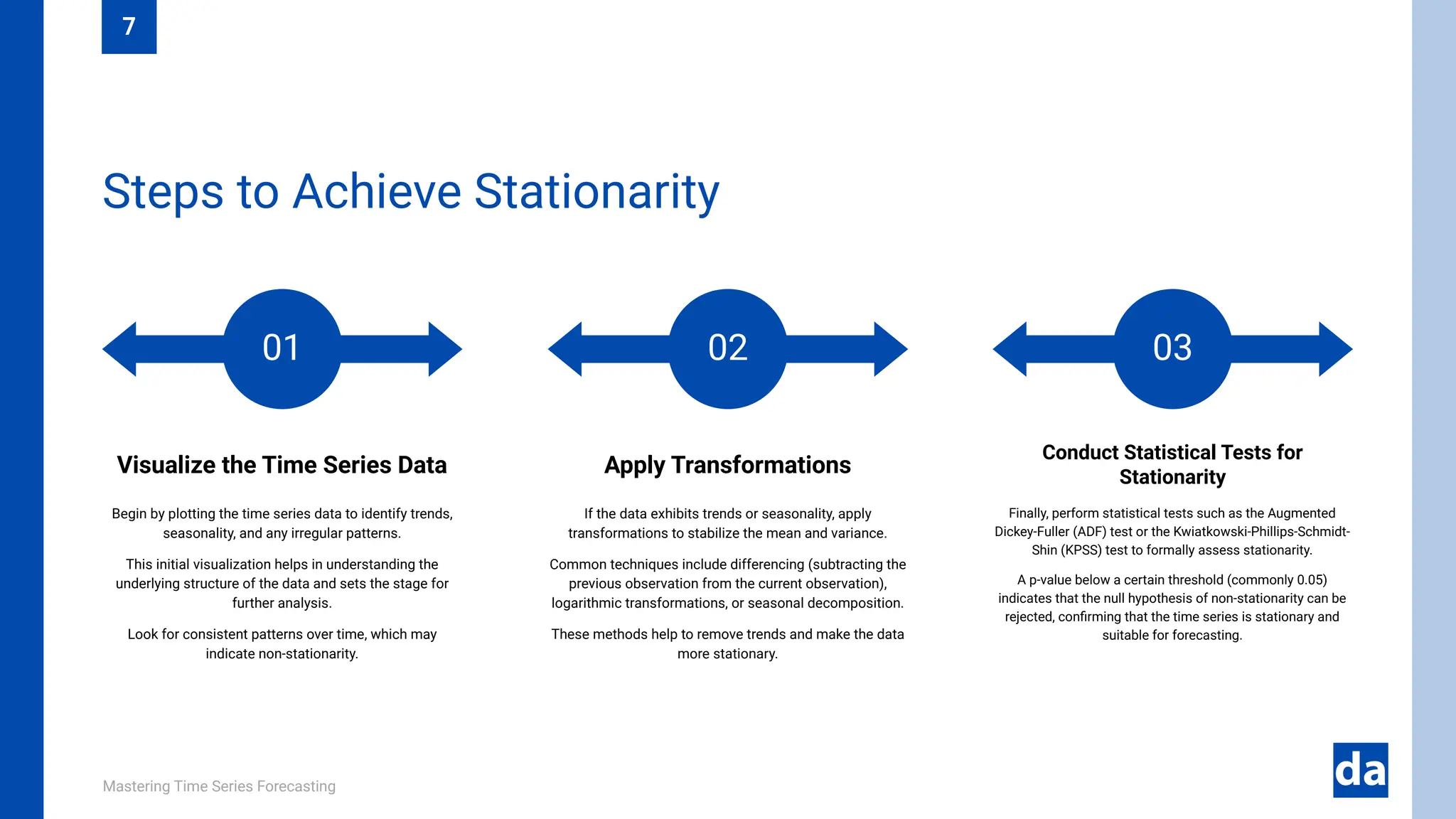
01 02 03
Mastering Time Series Forecasting
Finally, perform statistical tests such as the Augmented
Dickey-Fuller (ADF) test or the Kwiatkowski-Phillips-Schmidt-
Shin (KPSS) test to formally assess stationarity.
A p-value below a certain threshold (commonly 0.05)
indicates that the null hypothesis of non-stationarity can be
rejected, confirming that the time series is stationary and
suitable for forecasting.
Conduct Statistical Tests for
Stationarity
If the data exhibits trends or seasonality, apply
transformations to stabilize the mean and variance.
Common techniques include differencing (subtracting the
previous observation from the current observation),
logarithmic transformations, or seasonal decomposition.
These methods help to remove trends and make the data
more stationary.
Apply Transformations
Begin by plotting the time series data to identify trends,
seasonality, and any irregular patterns.
This initial visualization helps in understanding the
underlying structure of the data and sets the stage for
further analysis.
Look for consistent patterns over time, which may
indicate non-stationarity.
Visualize the Time Series Data
Steps to Achieve Stationarity
7
Mastering Time Series Forecasting
Understanding Autocorrelation
Definition: Autocorrelation measures the
correlation of a time series with its own past
values. It helps identify patterns and trends
over time.
Importance: High autocorrelation at lagged
values indicates that past values significantly
influence future values, which is crucial for
effective forecasting.
Exploring Partial Autocorrelation
Definition: Partial autocorrelation quantifies the
correlation between a time series and its
lagged values, while controlling for the values
of intervening lags.
Usage: It is particularly useful in identifying the
appropriate number of lags to include in
autoregressive models, aiding in model
selection and improving forecasting accuracy.
Autocorrelation and Partial
Autocorrelation
8
03
02
01
Mastering Time Series Forecasting
Decomposed time series can enhance
forecasting models by allowing analysts to
separately model each component.
This approach leads to more accurate
predictions, as it accounts for both predictable
patterns (trend and seasonality) and
unpredictable variations (residuals).
Applications in Forecasting
Trend: The long-term movement in the data,
indicating the general direction (upward or
downward) over time.
Seasonality: Regular, periodic fluctuations that occur
at specific intervals, such as daily, monthly, or yearly.
Residuals: The random noise or irregularities in the
data that cannot be attributed to trend or seasonality.
Components of Time Series
Time Series Decomposition
Time series decomposition is a statistical
technique used to break down a time series
into its constituent components: trend,
seasonality, and residuals.
This process helps in understanding underlying
patterns and improving forecasting accuracy.
Time Series Decomposition
9
Mastering Time Series Forecasting
Definition and Purpose
The Moving Average (MA) method is a
statistical technique used to analyze time
series data by creating averages of different
subsets of the complete dataset.
Its primary purpose is to smooth out short-
term fluctuations and highlight longer-term
trends or cycles, making it easier to identify
patterns in the data.
Types of Moving Averages
Simple Moving Average (SMA): Calculated by
taking the arithmetic mean of a fixed number
of past observations. For example, a 5-day
SMA averages the values of the last five days.
Weighted Moving Average (WMA): Assigns
different weights to past observations, giving
more importance to recent data. This method
is useful when more recent data is believed to
be more indicative of future trends.
Exponential Moving Average (EMA): Similar to
WMA but applies an exponential decay factor,
allowing the average to react more significantly
to recent price changes. This is particularly
useful in financial markets for trend analysis.
Moving Average Method
10
03
02
01
Mastering Time Series Forecasting
Widely used in various fields such as finance,
inventory management, and demand
forecasting.
Provides a simple yet effective method for
generating short-term forecasts.
Adaptable to different types of data patterns,
making it a versatile tool in time series
analysis.
Applications and Benefits
Simple Exponential Smoothing: Best for data without trends
or seasonality. Uses a single smoothing constant (α) to
adjust the weight of the most recent observation.
Holt’s Linear Trend Model: Extends simple exponential
smoothing to capture linear trends. Incorporates two
smoothing constants: one for the level and one for the trend.
Holt-Winters Seasonal Model: Suitable for data with both
trend and seasonality. Utilizes three smoothing constants:
level, trend, and seasonal components.
Types of Exponential Smoothing
Overview of Exponential Smoothing
A forecasting technique that applies
decreasing weights to past observations.
More recent data points have a greater
influence on the forecast than older data.
Exponential Smoothing
11
Mastering Time Series Forecasting
Overview of ARIMA
ARIMA stands for AutoRegressive Integrated
Moving Average.
It is a popular statistical method used for time
series forecasting, particularly effective for
non-stationary data.
Components of ARIMA
AutoRegressive (AR) Part: This component
captures the relationship between an
observation and a number of lagged
observations (previous time points).
Integrated (I) Part: This involves differencing
the data to make it stationary, which is crucial
for accurate forecasting.
Moving Average (MA) Part: This component
models the relationship between an
observation and a residual error from a moving
average model applied to lagged observations.
Model Selection and Evaluation
Parameter Selection: The parameters p (AR
terms), d (differencing), and q (MA terms) are
determined using techniques like the ACF
(Autocorrelation Function) and PACF (Partial
Autocorrelation Function) plots.
Model Evaluation: Common metrics for
evaluating ARIMA models include AIC (Akaike
Information Criterion) and BIC (Bayesian
Information Criterion), which help in selecting
the best model by balancing goodness of fit
and model complexity.
ARIMA Model
12
03
02
01
Mastering Time Series Forecasting
Commonly used in various fields such as
finance, retail, and meteorology, where
seasonal fluctuations are prevalent.
Examples include forecasting sales during
holiday seasons, predicting temperature
variations throughout the year, and analyzing
monthly economic indicators.
Applications and Use Cases
SARIMA effectively captures both trend and
seasonality in data, allowing for more accurate
forecasts.
Seasonal differencing (D) is used to remove
seasonal trends, while seasonal autoregressive
(P) and moving average (Q) terms account for
seasonal correlations.
Modeling Seasonal Patterns
Overview of SARIMA
SARIMA extends the ARIMA model by incorporating
seasonal components, making it suitable for time series
data with seasonal patterns.
It is defined by the parameters (p, d, q)(P, D, Q, s), where:
p: number of autoregressive terms
d: number of non-seasonal differences
q: number of lagged forecast errors
Seasonal ARIMA (SARIMA)
13
Mastering Time Series Forecasting
Overview of the Holt-Winters Method
A forecasting technique that extends
exponential smoothing to capture seasonality
in time series data.
Utilizes three components: level, trend, and
seasonal factors, making it suitable for data
with trends and seasonal patterns.
Components of the Model
Level (α): Represents the smoothed value of
the series at the current time.
Trend (β): Captures the direction and rate of
change in the data over time.
Seasonality (γ): Accounts for repeating
patterns or cycles in the data, adjusted for
seasonal fluctuations.
Applications and Use Cases
Widely used in various industries such as retail,
finance, and supply chain management for
demand forecasting.
Effective for predicting future values based on
historical data, especially when seasonal
variations are significant, improving accuracy
in decision-making processes.
Holt-Winters Method
14
01 02
04
03
Mastering Time Series Forecasting
Common metrics include Mean Absolute Error
(MAE), Root Mean Squared Error (RMSE), and
Mean Absolute Percentage Error (MAPE).
These metrics help assess the accuracy of
predictions and guide model selection and
tuning.
Evaluation Metrics for Forecasting
Models
Effective forecasting requires careful data
preprocessing, including handling missing
values and outliers.
Feature engineering, such as creating lagged
variables and seasonal indicators, is crucial for
improving model performance.
Data Preparation and Feature
Engineering
Machine learning algorithms, such as ARIMA,
LSTM, and Prophet, enhance traditional
forecasting methods.
These techniques can capture complex
patterns and relationships in data that linear
models may miss.
Role of Machine Learning
Techniques
Introduction to Time Series
Forecasting
Time series forecasting involves predicting
future values based on previously observed
values.
It is widely used in various fields such as
finance, economics, and environmental
science.
Machine Learning in Time Series
Forecasting
15
Mastering Time Series Forecasting
Introduction to Neural Networks in
Time Series
Neural networks are powerful tools for
modeling complex patterns in time series data.
They can capture non-linear relationships and
interactions that traditional statistical methods
may overlook.
Types of Neural Networks for Time
Series Forecasting
Recurrent Neural Networks (RNNs): Designed
to handle sequential data, RNNs maintain a
memory of previous inputs, making them
suitable for time-dependent tasks.
Long Short-Term Memory (LSTM) Networks: A
specialized type of RNN that addresses the
vanishing gradient problem, allowing for the
learning of long-term dependencies in time
series data.
Convolutional Neural Networks (CNNs): While
primarily used for image data, CNNs can also
be adapted for time series by treating the data
as a one-dimensional image, effectively
capturing local patterns.
Applications and Benefits
Neural networks can be applied in various
domains such as finance (stock price
prediction), healthcare (patient monitoring),
and energy (demand forecasting).
Their ability to learn from large datasets and
improve accuracy over time makes them a
valuable asset in time series forecasting.
Neural Networks for Time Series
16
03
02
01
Mastering Time Series Forecasting
LSTMs are widely used in various domains such as
finance (stock price prediction), weather
forecasting, and resource consumption forecasting.
Their ability to handle non-linear relationships and
complex patterns makes them superior to
traditional forecasting methods, achieving accuracy
improvements of up to 20-30% in certain
applications.
Applications in Time Series
Forecasting
Cell State: The memory of the network that
carries information across time steps, allowing
it to retain relevant data over long periods.
Gates: LSTMs utilize three gates (input, forget,
and output) to control the flow of information,
enabling the model to decide what to
remember and what to discard.
Key Components of LSTM
Introduction to LSTM Networks
LSTM networks are a type of recurrent neural
network (RNN) designed to model sequential
data.
They are particularly effective for time series
forecasting due to their ability to learn long-
term dependencies.
Long Short-Term Memory (LSTM)
Networks
17
Mastering Time Series Forecasting
Overview of the Prophet Model
Designed for forecasting time series data that
may have missing values and outliers.
Utilizes an additive model that incorporates
seasonal effects, holidays, and trend changes.
Key Features and Benefits
User-Friendly Interface: Allows users with
minimal statistical knowledge to generate
forecasts.
Robustness: Handles various types of time
series data, making it suitable for business
applications across different industries.
Automatic Seasonality Detection: Identifies
and adjusts for seasonal patterns without
extensive manual input, enhancing forecasting
accuracy.
Prophet Model by Facebook
18
03
02
01
Mastering Time Series Forecasting
Cross-Validation: This technique involves partitioning the
data into subsets, training the model on some subsets
while validating it on others. It helps in assessing how the
results of a statistical analysis will generalize to an
independent dataset.
Benchmarking Against Naive Models: Comparing the
performance of complex forecasting models against
simpler naive models (like using the last observed value
as the forecast) can provide insights into the added value
of more sophisticated approaches.
Model Comparison Techniques
Forecast vs. Actual Plots: Graphical representation
of predicted values against actual outcomes helps
in visually assessing the accuracy of forecasts.
Patterns, trends, and discrepancies can be easily
identified.
Residual Analysis: Examining the residuals (the
differences between predicted and actual values)
can reveal whether the forecasting model is
capturing the underlying data patterns effectively.
Visualizing Forecast Performance
Key Metrics for Assessment
Mean Absolute Error (MAE): Measures the average
magnitude of errors in a set of forecasts, without
considering their direction. It provides a clear
indication of how far off predictions are from actual
values.
Root Mean Square Error (RMSE): This metric squares
the errors before averaging, giving higher weight to
larger errors. It is particularly useful when large
errors are undesirable, as it penalizes them more
heavily.
Evaluating Forecast Accuracy
19
Mastering Time Series Forecasting
A Mean Absolute Error (MAE) of 0.5 indicates a highly accurate forecasting model,
where the average absolute difference between predicted and actual values is minimal.
This level of precision is crucial for effective decision-making in time series analysis.
MAE Value for Ideal Forecasts
0.5
20
Mean Absolute Error (MAE)
Mastering Time Series Forecasting
In many practical applications of time series forecasting, an RMSE value between 0.5 and
1.0 is considered acceptable. This range indicates that the model's predictions are
reasonably close to the actual values, allowing for effective decision-making based on the
forecasts.
Typical RMSE Range for Time Series Models
0.5 - 1.0
21
Root Mean Squared Error (RMSE)
Mastering Time Series Forecasting
MAPE is a widely used metric for measuring the accuracy of forecasting models.
A MAPE of 12% indicates that, on average, the forecasted values deviate from
the actual values by 12%, which is considered acceptable in many industries.
Mean Absolute Percentage Error (MAPE)
12%
22
Mean Absolute Percentage Error (MAPE)
Mastering Time Series Forecasting
Importance of Cross-Validation
Ensures model robustness: Cross-validation
helps assess how the results of a statistical
analysis will generalize to an independent
dataset. This is crucial in time series
forecasting, where overfitting can lead to poor
predictive performance.
Mitigates temporal dependencies: Unlike
traditional cross-validation, time series data
has inherent temporal dependencies. Proper
cross-validation techniques account for these
dependencies to avoid data leakage.
Techniques for Time Series Cross-
Validation
Rolling Forecast Origin: This method involves
training the model on a fixed-size window of
past observations and then testing it on the
next observation. The window rolls forward,
allowing for multiple training/testing splits.
Benefits: It mimics real-world forecasting
scenarios and provides a more realistic
evaluation of model performance.
Time Series Split: This technique divides the
dataset into training and testing sets based on
time, ensuring that the training set always
precedes the testing set. Benefits: It preserves
the temporal order of observations, which is
essential for accurate forecasting.
Cross-Validation in Time Series
23
03
02
01
Mastering Time Series Forecasting
Assess how missing data affects model
performance by comparing forecasts
generated with and without imputed values.
Utilize metrics such as Mean Absolute Error
(MAE) and Root Mean Squared Error (RMSE) to
quantify the impact and ensure robust
forecasting.
Evaluating the Impact of Missing
Data
Imputation Methods: Use statistical techniques like
mean, median, or mode imputation to fill in missing
values. More advanced methods include interpolation
and time series-specific techniques like Seasonal
Decomposition of Time Series (STL).
Deletion Methods: In some cases, it may be appropriate
to remove records with missing values. This can be
done through listwise deletion (removing entire records)
or pairwise deletion (using available data for analysis).
Techniques for Handling Missing
Data
Understanding Missing Data in Time
Series
Missing data can occur due to various reasons
such as sensor malfunctions, data entry errors,
or system outages.
In time series forecasting, it is crucial to
identify the pattern and extent of missing data
to mitigate its impact on model accuracy.
Handling Missing Data
24
Mastering Time Series Forecasting
Understanding Outliers in Time Series
Outliers are data points that deviate
significantly from the overall pattern of the
data.
They can arise from various sources, including
measurement errors, data entry mistakes, or
genuine anomalies in the underlying process.
Methods for Outlier Detection
Statistical Techniques: Utilize methods such as
Z-scores or the Interquartile Range (IQR) to
identify outliers based on statistical
thresholds.
Machine Learning Approaches: Implement
algorithms like Isolation Forest or DBSCAN
that can automatically detect anomalies in
complex datasets.
Strategies for Outlier Treatment
Removal: Exclude outliers from the dataset if
they are determined to be errors or irrelevant to
the analysis.
Imputation: Replace outliers with estimated
values based on surrounding data points to
maintain dataset integrity.
Transformation: Apply techniques such as log
transformation to reduce the impact of outliers
on the overall analysis and forecasting
accuracy.
Outlier Detection and Treatment
25
01 02
04
03
Mastering Time Series Forecasting
Extract useful components from timestamps
(e.g., year, month, day, hour).
Enables the model to learn from specific time-
related patterns, enhancing predictive power.
Date and Time Decomposition
Calculate rolling means, sums, or standard
deviations over specified windows.
Provides insights into the data's behavior over
time and smooths out noise.
Rolling Statistics
Generate features based on previous time
steps (e.g., lagged values).
Helps capture the temporal dependencies and
improve model accuracy.
Creating Lag Features
Understanding Temporal Patterns
Identify and analyze trends, seasonality, and
cyclic behavior in the data.
Use techniques like decomposition to separate
these components for better forecasting.
Feature Engineering for Time Series
26
Mastering Time Series Forecasting
Introduction to Time Series Forecasting
Time series forecasting involves predicting
future values based on previously observed
values. It is widely used in various fields such
as finance, economics, and environmental
science.
Key components include trend, seasonality,
and noise, which help in understanding the
underlying patterns in the data.
Popular Python Libraries for Time
Series Analysis
Pandas: Essential for data manipulation and
analysis, providing powerful data structures
like DataFrames to handle time series data
efficiently.
Statsmodels: Offers a range of statistical
models, including ARIMA and seasonal
decomposition, which are crucial for time
series forecasting.
Prophet: Developed by Facebook, this library is
designed for forecasting time series data that
exhibit strong seasonal effects and several
seasons of historical data.
Steps in Time Series Forecasting
Data Preparation: Clean and preprocess the
data, ensuring it is in a suitable format for
analysis. This includes handling missing values
and converting timestamps.
Model Selection and Training: Choose an
appropriate forecasting model based on the
data characteristics. Train the model using
historical data to learn the patterns.
Evaluation and Prediction: Assess the model's
performance using metrics like Mean Absolute
Error (MAE) or Root Mean Squared Error
(RMSE). Use the model to make future
predictions and visualize the results for better
interpretation.
Time Series Forecasting in Python
27
03
02
01
Mastering Time Series Forecasting
Overview: Developed by Facebook, Prophet is a
forecasting tool that is particularly effective for time
series with strong seasonal effects.
Key Features:
User-friendly interface that allows for easy handling of
missing data and outliers.
Automatic detection of seasonal trends and holidays,
making it suitable for business forecasting.
Prophet
Overview: This library is designed for statistical
modeling and provides tools specifically for time series
analysis.
Key Features:
Implementation of ARIMA, SARIMA, and other time
series models.
Comprehensive statistical tests and diagnostics for
model evaluation.
Statsmodels
Pandas
Overview: A powerful data manipulation library in
Python, Pandas provides extensive capabilities for
handling time series data.
Key Features:
Time-based indexing for easy data selection and
slicing.
Built-in functions for resampling, shifting, and rolling
window calculations.
Libraries for Time Series Analysis
28
Mastering Time Series Forecasting
Overview of Retail Sales Forecasting
Retail sales forecasting involves predicting
future sales based on historical data, seasonal
trends, and market conditions.
Accurate forecasting is crucial for inventory
management, staffing, and financial planning.
Data Collection and Preparation
Historical sales data is collected from various
sources, including point-of-sale systems and
online transactions.
Data cleaning and preprocessing are essential
to remove anomalies and ensure consistency,
which can include handling missing values and
outliers.
Model Selection and Implementation
Common forecasting models include ARIMA
(AutoRegressive Integrated Moving Average),
Exponential Smoothing, and Machine Learning
approaches.
The choice of model depends on the data
characteristics, such as seasonality and trend.
ARIMA is effective for univariate time series
data, while machine learning models can
capture complex patterns.
Evaluation and Adjustment
Forecast accuracy is evaluated using metrics
like Mean Absolute Error (MAE) and Root Mean
Squared Error (RMSE).
Continuous monitoring and adjustment of the
model are necessary to improve accuracy,
especially in response to changing market
conditions or consumer behavior.
Regular updates can lead to a 10-15%
improvement in forecast accuracy.
Case Study: Retail Sales
Forecasting
29
01 02
04
03
Mastering Time Series Forecasting
Presentation of prediction accuracy: Example
results show an RMSE of 2.5% on test data.
Discussion of market trends identified through
predictions, including potential investment
strategies based on forecasted price
movements.
Results and Insights
Comparison of various forecasting models:
ARIMA (AutoRegressive Integrated Moving Average):
Effective for linear trends and seasonality.
LSTM (Long Short-Term Memory networks): Suitable
for capturing complex patterns in non-linear data.
Evaluation of model performance using metrics such
as RMSE (Root Mean Square Error) and MAE (Mean
Absolute Error).
Model Selection and
Implementation
Utilization of historical stock price data,
typically spanning 5-10 years.
Key preprocessing steps include handling
missing values, normalization, and feature
engineering (e.g., moving averages, volatility
indicators).
Data Collection and
Preprocessing
Introduction to Stock Price Prediction
Overview of stock price prediction as a critical
application of time series forecasting.
Importance of accurate predictions for
investors and financial analysts.
Case Study: Stock Price Prediction
30
Mastering Time Series Forecasting
Overview of Weather Forecasting
Weather forecasting involves predicting
atmospheric conditions at a specific location
over a given time period.
It utilizes historical weather data, satellite
imagery, and advanced computational models
to generate forecasts.
Data Collection Techniques
Meteorological Stations: Ground-based
stations collect real-time data on temperature,
humidity, wind speed, and precipitation.
Remote Sensing: Satellites provide
comprehensive data on cloud cover, sea
surface temperatures, and atmospheric
pressure, enhancing the accuracy of forecasts.
Time Series Analysis Methods
ARIMA Models: Autoregressive Integrated
Moving Average (ARIMA) models are
commonly used for short-term forecasting,
capturing trends and seasonality in historical
data.
Machine Learning Approaches: Techniques
such as Random Forest and Neural Networks
are increasingly applied to improve prediction
accuracy by learning complex patterns in large
datasets.
Impact of Accurate Forecasting
Economic Benefits: Accurate weather
forecasts can save industries like agriculture
and transportation millions of dollars by
optimizing operations and reducing losses.
Public Safety: Timely and precise weather
predictions are crucial for disaster
preparedness, helping to mitigate the impact
of severe weather events on communities.
Case Study: Weather Forecasting
31
03
02
01
Mastering Time Series Forecasting
Identifying and accurately modeling seasonal
patterns is essential for effective forecasting.
Trends may change over time, requiring
continuous monitoring and model adjustments
to maintain forecast accuracy.
Seasonality and Trend Detection
Choosing the right forecasting model is crucial;
options range from simple linear regression to
complex machine learning algorithms.
Overfitting can occur when models are too
complex, capturing noise instead of the
underlying trend, leading to poor generalization
on unseen data.
Model Selection and Complexity
Data Quality and Availability
Incomplete or missing data can significantly
impact the accuracy of forecasts.
Noise and outliers in the data can distort
patterns, making it difficult to identify trends
and seasonality.
Challenges in Time Series
Forecasting
32
Mastering Time Series Forecasting
Integration of Machine Learning
Techniques
Enhanced Predictive Accuracy: The adoption of
advanced machine learning algorithms, such
as deep learning and ensemble methods, is
expected to significantly improve the accuracy
of time series forecasts. Techniques like Long
Short-Term Memory (LSTM) networks are
particularly effective in capturing complex
patterns in sequential data.
Automated Feature Engineering: Future models
will increasingly leverage automated feature
extraction methods, allowing for the
identification of relevant predictors without
extensive manual intervention, thus
streamlining the forecasting process.
Real-Time Data Processing
Increased Demand for Instant Insights: As
businesses seek to make data-driven decisions
faster, the ability to process and analyze time
series data in real-time will become crucial.
This trend will drive the development of more
sophisticated streaming analytics platforms.
IoT and Sensor Data Utilization: The
proliferation of Internet of Things (IoT) devices
will provide a wealth of real-time data, enabling
more dynamic and responsive forecasting
models that can adapt to changing conditions
on-the-fly.
Focus on Explainability and
Transparency
Regulatory Compliance: As organizations face
increasing scrutiny regarding the use of AI and
machine learning, there will be a growing
emphasis on the explainability of forecasting
models. Stakeholders will demand clear
insights into how predictions are made,
particularly in regulated industries.
User-Friendly Interfaces: The development of
intuitive visualization tools will help non-
technical users understand and trust
forecasting models, facilitating broader
adoption across various sectors.
Future Trends in Time Series
Forecasting
33
Mastering Time Series Forecasting
Comparison: ARIMA vs. LSTM
34
• Model Type: Advanced Neural Network
• LSTM is a type of recurrent neural network (RNN) designed to
learn long-term dependencies in sequential data. It excels in
capturing complex, non-linear relationships and is particularly
useful for multivariate time series forecasting. LSTM networks
can automatically learn features from raw data, making them
adaptable to various forecasting scenarios without extensive
feature engineering.
• Data Requirements: High Flexibility with Data
• LSTM models can handle large volumes of data and are capable
of learning from both short-term and long-term patterns. They
require more computational resources and training time
compared to ARIMA, but they can outperform traditional models
in scenarios with intricate patterns, such as those found in
financial markets or sensor data.
LSTM (Long Short-Term Memory)
• Model Type: Traditional Statistical Model
• ARIMA is a linear model that combines autoregression,
differencing, and moving averages to capture temporal
dependencies in time series data. It is particularly effective
for univariate time series forecasting where the data is
stationary or can be made stationary through differencing.
ARIMA requires careful parameter tuning (p, d, q) and is best
suited for datasets with clear trends and seasonality.
• Data Requirements: Limited to Linear Relationships
• ARIMA assumes that the underlying data follows a linear
pattern, which can limit its effectiveness in capturing
complex, non-linear relationships. It also requires a
significant amount of historical data to accurately estimate
parameters and may struggle with large datasets or high-
dimensional data.
ARIMA (AutoRegressive Integrated Moving
Average)
Mastering Time Series Forecasting
Comparison: Traditional vs. Machine Learning Methods
35
• Approach: Machine learning methods, including algorithms
like LSTM (Long Short-Term Memory) networks and Random
Forests, leverage large datasets and can automatically learn
complex patterns without the need for explicit feature
engineering. These models can handle non-linear
relationships and adapt to changes in data trends more
effectively.
• Performance: Machine learning methods often outperform
traditional techniques in terms of accuracy, especially in
large and complex datasets. They can capture intricate
patterns and interactions, leading to improved forecasting
accuracy. However, they require more computational
resources and may necessitate a larger amount of historical
data for training.
Machine Learning Methods
• Approach: Traditional time series forecasting methods, such
as ARIMA (AutoRegressive Integrated Moving Average) and
Exponential Smoothing, rely on statistical techniques that
assume linear relationships and stationary data. These
methods often require extensive pre-processing and
parameter tuning to achieve optimal results.
• Performance: While effective for simpler datasets,
traditional methods may struggle with complex patterns,
seasonality, and non-linear relationships. They typically
perform well when the underlying data is stable, but their
accuracy can diminish significantly in the presence of
outliers or sudden changes in trends.
Traditional Methods
Mastering Time Series Forecasting
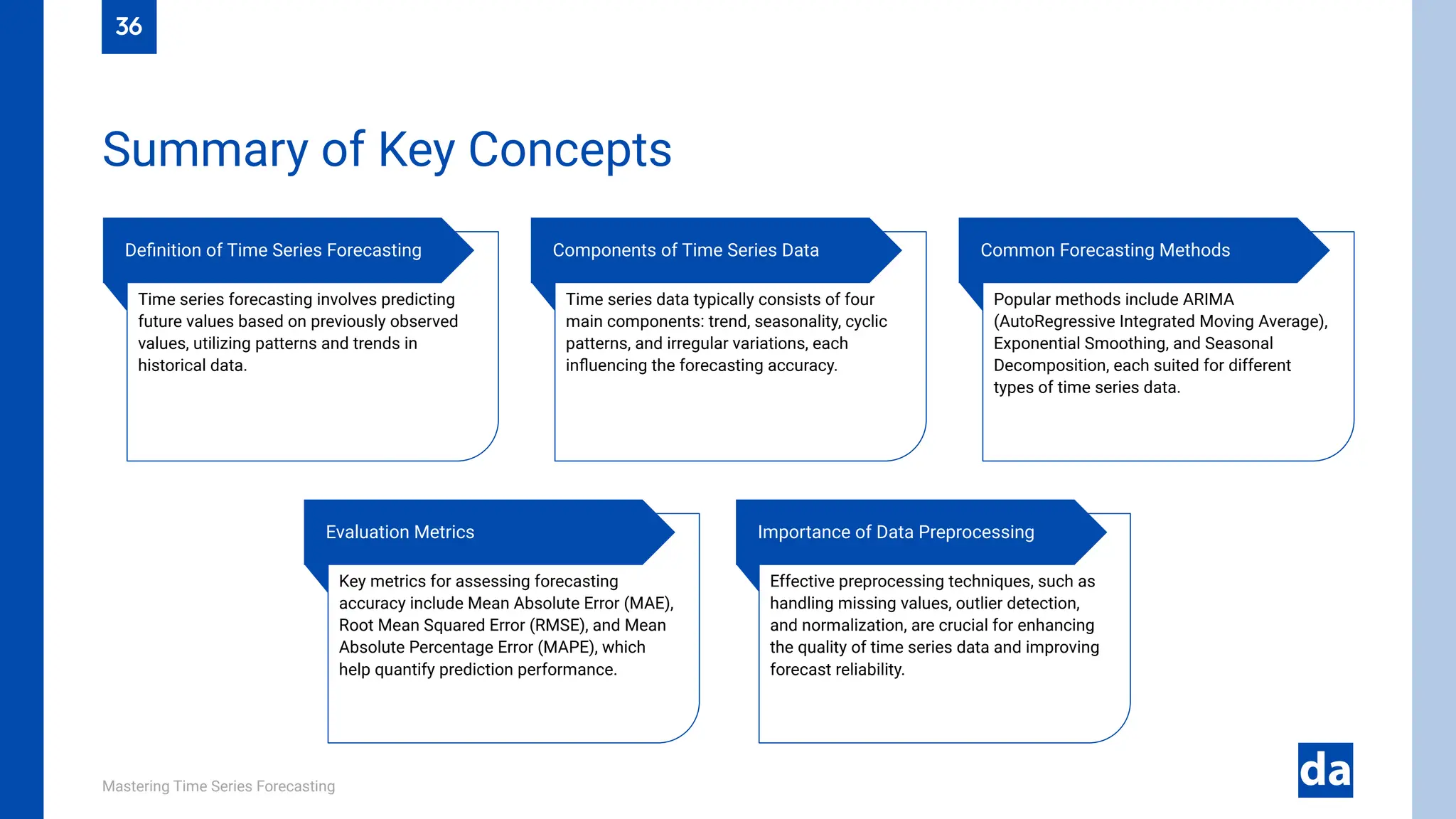
Summary of Key Concepts
36
Effective preprocessing techniques, such as
handling missing values, outlier detection,
and normalization, are crucial for enhancing
the quality of time series data and improving
forecast reliability.
Importance of Data Preprocessing
Key metrics for assessing forecasting
accuracy include Mean Absolute Error (MAE),
Root Mean Squared Error (RMSE), and Mean
Absolute Percentage Error (MAPE), which
help quantify prediction performance.
Evaluation Metrics
Popular methods include ARIMA
(AutoRegressive Integrated Moving Average),
Exponential Smoothing, and Seasonal
Decomposition, each suited for different
types of time series data.
Common Forecasting Methods
Time series data typically consists of four
main components: trend, seasonality, cyclic
patterns, and irregular variations, each
influencing the forecasting accuracy.
Components of Time Series Data
Time series forecasting involves predicting
future values based on previously observed
values, utilizing patterns and trends in
historical data.
Definition of Time Series Forecasting
Mastering Time Series Forecasting
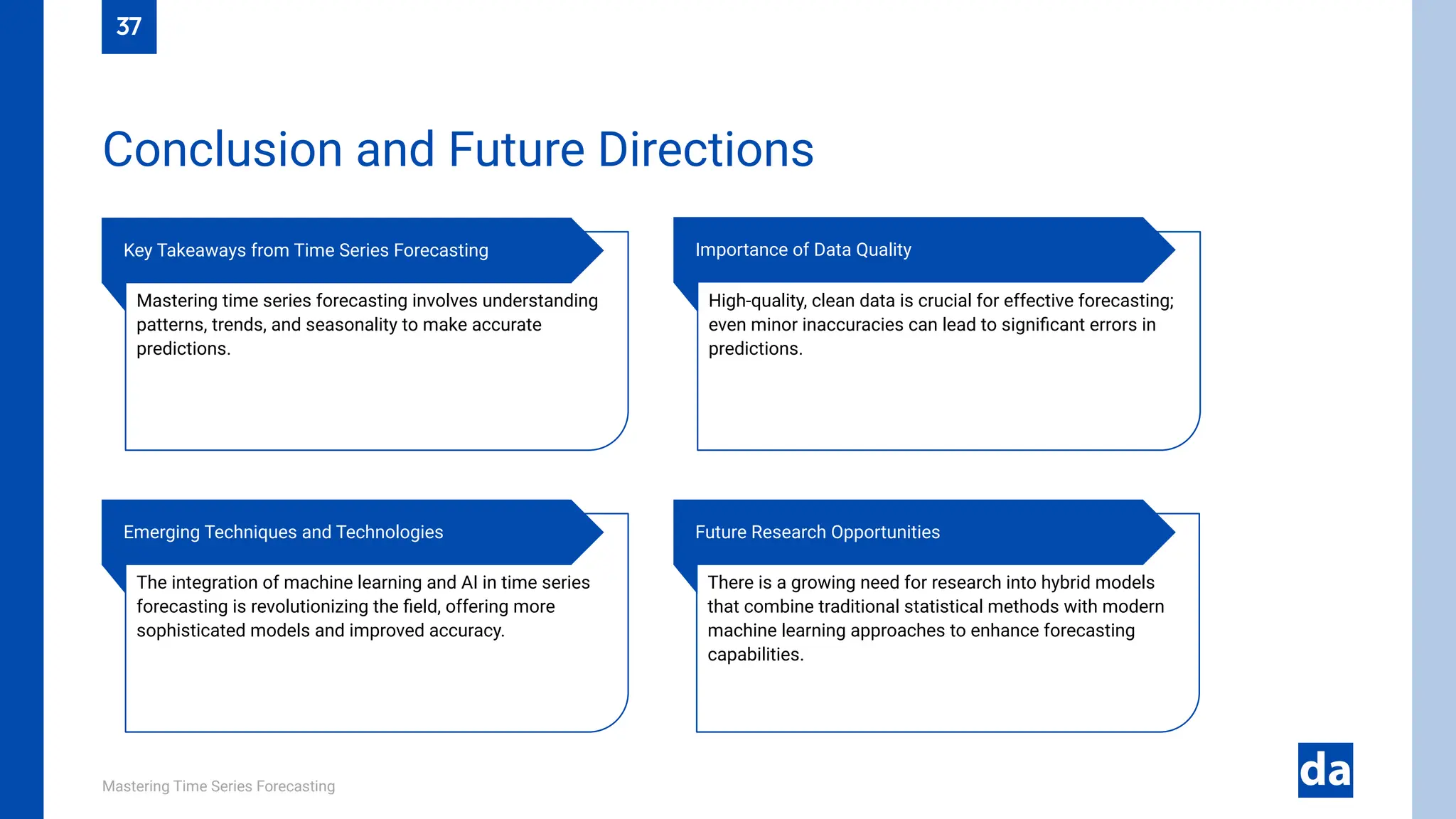
Conclusion and Future Directions
37
There is a growing need for research into hybrid models
that combine traditional statistical methods with modern
machine learning approaches to enhance forecasting
capabilities.
Future Research Opportunities
The integration of machine learning and AI in time series
forecasting is revolutionizing the field, offering more
sophisticated models and improved accuracy.
Emerging Techniques and Technologies
High-quality, clean data is crucial for effective forecasting;
even minor inaccuracies can lead to significant errors in
predictions.
Importance of Data Quality
Mastering time series forecasting involves understanding
patterns, trends, and seasonality to make accurate
predictions.
Key Takeaways from Time Series Forecasting

Mastering Time Series Forecasting - Guide to Techniques, Applications, and Future Trends

  • 1.
    A Comprehensive Guideto Techniques, Applications, and Future Trends Mastering Time Series Forecasting
  • 2.
    Introduction to TimeSeries Forecasting Importance of Time Series Analysis Components of Time Series Data Types of Time Series Data Applications of Time Series Forecasting Understanding Stationarity Steps to Achieve Stationarity Autocorrelation and Partial Autocorrelation Time Series Decomposition Moving Average Method Exponential Smoothing 01 02 03 04 05 06 07 08 09 10 11 Table of contents
  • 3.
    ARIMA Model Seasonal ARIMA(SARIMA) Holt-Winters Method Machine Learning in Time Series Forecasting Neural Networks for Time Series Long Short-Term Memory (LSTM) Networks Prophet Model by Facebook Evaluating Forecast Accuracy Mean Absolute Error (MAE) Root Mean Squared Error (RMSE) Mean Absolute Percentage Error (MAPE) 12 13 14 15 16 17 18 19 20 21 22 Table of contents
  • 4.
    Cross-Validation in TimeSeries Handling Missing Data Outlier Detection and Treatment Feature Engineering for Time Series Time Series Forecasting in Python Libraries for Time Series Analysis Case Study: Retail Sales Forecasting Case Study: Stock Price Prediction Case Study: Weather Forecasting Challenges in Time Series Forecasting Future Trends in Time Series Forecasting 23 24 25 26 27 28 29 30 31 32 33 Table of contents
  • 5.
    Comparison: ARIMA vs.LSTM Comparison: Traditional vs. Machine Learning Methods Summary of Key Concepts Conclusion and Future Directions 34 35 36 37 Table of contents
  • 6.
    Mastering Time SeriesForecasting Understanding Time Series Forecasting Definition: Time series forecasting is the process of predicting future values based on previously observed values. It is widely used in various fields such as finance, economics, and environmental science. Importance: Accurate forecasting can lead to better decision-making, resource allocation, and strategic planning. For instance, businesses can optimize inventory levels and manage cash flow effectively. Key Components of Time Series Data Trend: The long-term movement in the data, indicating a general increase or decrease over time. For example, a consistent rise in sales over several years. Introduction to Time Series Forecasting Introduction to Time Series Forecasting 1
  • 7.
    Mastering Time SeriesForecasting Understanding Trends and Patterns Time series analysis allows for the identification of underlying trends and seasonal patterns in data over time. This understanding is crucial for making informed decisions in various fields such as finance, economics, and environmental science. Forecasting Future Values By analyzing historical data, time series models can predict future values with a degree of accuracy. Businesses can forecast sales, stock prices, or demand for products, enabling better resource allocation and strategic planning. Evaluating Impact of External Factors Time series analysis helps in assessing how external events (like economic shifts or policy changes) influence data trends. This evaluation is essential for organizations to adapt their strategies in response to changing conditions, ensuring resilience and competitiveness. Importance of Time Series Analysis 2
  • 8.
    01 02 04 03 Mastering TimeSeries Forecasting Also known as noise, these are random variations that cannot be attributed to trend, seasonality, or cycles. Irregular components can arise from unforeseen events (e.g., natural disasters, economic shocks) and are essential to consider for accurate forecasting. Irregular Components Fluctuations that occur over longer periods, typically influenced by economic or business cycles. Unlike seasonality, cycles do not have a fixed period and can vary in duration, making them more challenging to identify and predict. Cyclic Patterns Regular, predictable patterns that occur at specific intervals, such as daily, monthly, or yearly. For example, retail sales often increase during the holiday season, reflecting seasonal effects that can significantly impact forecasting. Seasonality Trend The long-term movement in the data, indicating a general direction (upward, downward, or stable) over time. Trends can span years or decades and are crucial for understanding the overall behavior of the series. Components of Time Series Data 3
  • 9.
    Mastering Time SeriesForecasting Univariate Time Series Definition: A time series that consists of observations of a single variable over time. Examples: Daily stock prices, monthly sales figures, or annual temperature records. This type is often used for simple forecasting models. Multivariate Time Series Definition: A time series that includes multiple variables, allowing for the analysis of relationships between them over time. Examples: Economic indicators like GDP, unemployment rates, and inflation rates analyzed together. This type is useful for understanding complex interactions and improving forecasting accuracy. Seasonal Time Series Definition: A time series that exhibits regular patterns or fluctuations at specific intervals, often due to seasonal factors. Examples: Retail sales that peak during holiday seasons or electricity consumption that varies with temperature changes. Recognizing seasonality is crucial for effective forecasting and planning. Types of Time Series Data 4
  • 10.
    01 02 03 0405 Mastering Time Series Forecasting Energy Consumption Forecasting Utility companies leverage time series data to forecast energy demand. This aids in grid management, ensuring a balance between supply and demand, and facilitating the integration of renewable energy sources. Healthcare Analytics In healthcare, time series forecasting is used to predict patient admissions, disease outbreaks, and resource utilization. Accurate forecasts can enhance patient care and optimize hospital operations. Weather and Climate Prediction Meteorologists apply time series forecasting to analyze weather patterns and predict future climatic conditions. This is crucial for disaster management, agriculture planning, and resource allocation. Sales and Demand Forecasting Businesses utilize time series models to predict future sales and customer demand. This helps in inventory management, optimizing supply chains, and planning marketing strategies, ultimately leading to improved operational efficiency. Financial Market Analysis Time series forecasting is extensively used in predicting stock prices, interest rates, and market trends. By analyzing historical data, investors can make informed decisions, potentially increasing returns on investments. Applications of Time Series Forecasting 5
  • 11.
    Mastering Time SeriesForecasting Predictive Modeling: Stationarity is crucial for many forecasting models, including ARIMA, as these models assume that the underlying data- generating process does not change over time. Non-stationary data can lead to unreliable and misleading forecasts. Transformation Techniques: To achieve stationarity, various techniques can be applied, such as differencing, detrending, or applying logarithmic transformations. Identifying the appropriate method is essential for effective time series analysis and accurate predictions. Importance in Time Series Forecasting 02 Definition of Stationarity A time series is considered stationary if its statistical properties, such as mean, variance, and autocorrelation, remain constant over time. This implies that the series does not exhibit trends or seasonal effects that can distort analysis. 01 Understanding Stationarity 6
  • 12.
    01 02 03 MasteringTime Series Forecasting Finally, perform statistical tests such as the Augmented Dickey-Fuller (ADF) test or the Kwiatkowski-Phillips-Schmidt- Shin (KPSS) test to formally assess stationarity. A p-value below a certain threshold (commonly 0.05) indicates that the null hypothesis of non-stationarity can be rejected, confirming that the time series is stationary and suitable for forecasting. Conduct Statistical Tests for Stationarity If the data exhibits trends or seasonality, apply transformations to stabilize the mean and variance. Common techniques include differencing (subtracting the previous observation from the current observation), logarithmic transformations, or seasonal decomposition. These methods help to remove trends and make the data more stationary. Apply Transformations Begin by plotting the time series data to identify trends, seasonality, and any irregular patterns. This initial visualization helps in understanding the underlying structure of the data and sets the stage for further analysis. Look for consistent patterns over time, which may indicate non-stationarity. Visualize the Time Series Data Steps to Achieve Stationarity 7
  • 13.
    Mastering Time SeriesForecasting Understanding Autocorrelation Definition: Autocorrelation measures the correlation of a time series with its own past values. It helps identify patterns and trends over time. Importance: High autocorrelation at lagged values indicates that past values significantly influence future values, which is crucial for effective forecasting. Exploring Partial Autocorrelation Definition: Partial autocorrelation quantifies the correlation between a time series and its lagged values, while controlling for the values of intervening lags. Usage: It is particularly useful in identifying the appropriate number of lags to include in autoregressive models, aiding in model selection and improving forecasting accuracy. Autocorrelation and Partial Autocorrelation 8
  • 14.
    03 02 01 Mastering Time SeriesForecasting Decomposed time series can enhance forecasting models by allowing analysts to separately model each component. This approach leads to more accurate predictions, as it accounts for both predictable patterns (trend and seasonality) and unpredictable variations (residuals). Applications in Forecasting Trend: The long-term movement in the data, indicating the general direction (upward or downward) over time. Seasonality: Regular, periodic fluctuations that occur at specific intervals, such as daily, monthly, or yearly. Residuals: The random noise or irregularities in the data that cannot be attributed to trend or seasonality. Components of Time Series Time Series Decomposition Time series decomposition is a statistical technique used to break down a time series into its constituent components: trend, seasonality, and residuals. This process helps in understanding underlying patterns and improving forecasting accuracy. Time Series Decomposition 9
  • 15.
    Mastering Time SeriesForecasting Definition and Purpose The Moving Average (MA) method is a statistical technique used to analyze time series data by creating averages of different subsets of the complete dataset. Its primary purpose is to smooth out short- term fluctuations and highlight longer-term trends or cycles, making it easier to identify patterns in the data. Types of Moving Averages Simple Moving Average (SMA): Calculated by taking the arithmetic mean of a fixed number of past observations. For example, a 5-day SMA averages the values of the last five days. Weighted Moving Average (WMA): Assigns different weights to past observations, giving more importance to recent data. This method is useful when more recent data is believed to be more indicative of future trends. Exponential Moving Average (EMA): Similar to WMA but applies an exponential decay factor, allowing the average to react more significantly to recent price changes. This is particularly useful in financial markets for trend analysis. Moving Average Method 10
  • 16.
    03 02 01 Mastering Time SeriesForecasting Widely used in various fields such as finance, inventory management, and demand forecasting. Provides a simple yet effective method for generating short-term forecasts. Adaptable to different types of data patterns, making it a versatile tool in time series analysis. Applications and Benefits Simple Exponential Smoothing: Best for data without trends or seasonality. Uses a single smoothing constant (α) to adjust the weight of the most recent observation. Holt’s Linear Trend Model: Extends simple exponential smoothing to capture linear trends. Incorporates two smoothing constants: one for the level and one for the trend. Holt-Winters Seasonal Model: Suitable for data with both trend and seasonality. Utilizes three smoothing constants: level, trend, and seasonal components. Types of Exponential Smoothing Overview of Exponential Smoothing A forecasting technique that applies decreasing weights to past observations. More recent data points have a greater influence on the forecast than older data. Exponential Smoothing 11
  • 17.
    Mastering Time SeriesForecasting Overview of ARIMA ARIMA stands for AutoRegressive Integrated Moving Average. It is a popular statistical method used for time series forecasting, particularly effective for non-stationary data. Components of ARIMA AutoRegressive (AR) Part: This component captures the relationship between an observation and a number of lagged observations (previous time points). Integrated (I) Part: This involves differencing the data to make it stationary, which is crucial for accurate forecasting. Moving Average (MA) Part: This component models the relationship between an observation and a residual error from a moving average model applied to lagged observations. Model Selection and Evaluation Parameter Selection: The parameters p (AR terms), d (differencing), and q (MA terms) are determined using techniques like the ACF (Autocorrelation Function) and PACF (Partial Autocorrelation Function) plots. Model Evaluation: Common metrics for evaluating ARIMA models include AIC (Akaike Information Criterion) and BIC (Bayesian Information Criterion), which help in selecting the best model by balancing goodness of fit and model complexity. ARIMA Model 12
  • 18.
    03 02 01 Mastering Time SeriesForecasting Commonly used in various fields such as finance, retail, and meteorology, where seasonal fluctuations are prevalent. Examples include forecasting sales during holiday seasons, predicting temperature variations throughout the year, and analyzing monthly economic indicators. Applications and Use Cases SARIMA effectively captures both trend and seasonality in data, allowing for more accurate forecasts. Seasonal differencing (D) is used to remove seasonal trends, while seasonal autoregressive (P) and moving average (Q) terms account for seasonal correlations. Modeling Seasonal Patterns Overview of SARIMA SARIMA extends the ARIMA model by incorporating seasonal components, making it suitable for time series data with seasonal patterns. It is defined by the parameters (p, d, q)(P, D, Q, s), where: p: number of autoregressive terms d: number of non-seasonal differences q: number of lagged forecast errors Seasonal ARIMA (SARIMA) 13
  • 19.
    Mastering Time SeriesForecasting Overview of the Holt-Winters Method A forecasting technique that extends exponential smoothing to capture seasonality in time series data. Utilizes three components: level, trend, and seasonal factors, making it suitable for data with trends and seasonal patterns. Components of the Model Level (α): Represents the smoothed value of the series at the current time. Trend (β): Captures the direction and rate of change in the data over time. Seasonality (γ): Accounts for repeating patterns or cycles in the data, adjusted for seasonal fluctuations. Applications and Use Cases Widely used in various industries such as retail, finance, and supply chain management for demand forecasting. Effective for predicting future values based on historical data, especially when seasonal variations are significant, improving accuracy in decision-making processes. Holt-Winters Method 14
  • 20.
    01 02 04 03 Mastering TimeSeries Forecasting Common metrics include Mean Absolute Error (MAE), Root Mean Squared Error (RMSE), and Mean Absolute Percentage Error (MAPE). These metrics help assess the accuracy of predictions and guide model selection and tuning. Evaluation Metrics for Forecasting Models Effective forecasting requires careful data preprocessing, including handling missing values and outliers. Feature engineering, such as creating lagged variables and seasonal indicators, is crucial for improving model performance. Data Preparation and Feature Engineering Machine learning algorithms, such as ARIMA, LSTM, and Prophet, enhance traditional forecasting methods. These techniques can capture complex patterns and relationships in data that linear models may miss. Role of Machine Learning Techniques Introduction to Time Series Forecasting Time series forecasting involves predicting future values based on previously observed values. It is widely used in various fields such as finance, economics, and environmental science. Machine Learning in Time Series Forecasting 15
  • 21.
    Mastering Time SeriesForecasting Introduction to Neural Networks in Time Series Neural networks are powerful tools for modeling complex patterns in time series data. They can capture non-linear relationships and interactions that traditional statistical methods may overlook. Types of Neural Networks for Time Series Forecasting Recurrent Neural Networks (RNNs): Designed to handle sequential data, RNNs maintain a memory of previous inputs, making them suitable for time-dependent tasks. Long Short-Term Memory (LSTM) Networks: A specialized type of RNN that addresses the vanishing gradient problem, allowing for the learning of long-term dependencies in time series data. Convolutional Neural Networks (CNNs): While primarily used for image data, CNNs can also be adapted for time series by treating the data as a one-dimensional image, effectively capturing local patterns. Applications and Benefits Neural networks can be applied in various domains such as finance (stock price prediction), healthcare (patient monitoring), and energy (demand forecasting). Their ability to learn from large datasets and improve accuracy over time makes them a valuable asset in time series forecasting. Neural Networks for Time Series 16
  • 22.
    03 02 01 Mastering Time SeriesForecasting LSTMs are widely used in various domains such as finance (stock price prediction), weather forecasting, and resource consumption forecasting. Their ability to handle non-linear relationships and complex patterns makes them superior to traditional forecasting methods, achieving accuracy improvements of up to 20-30% in certain applications. Applications in Time Series Forecasting Cell State: The memory of the network that carries information across time steps, allowing it to retain relevant data over long periods. Gates: LSTMs utilize three gates (input, forget, and output) to control the flow of information, enabling the model to decide what to remember and what to discard. Key Components of LSTM Introduction to LSTM Networks LSTM networks are a type of recurrent neural network (RNN) designed to model sequential data. They are particularly effective for time series forecasting due to their ability to learn long- term dependencies. Long Short-Term Memory (LSTM) Networks 17
  • 23.
    Mastering Time SeriesForecasting Overview of the Prophet Model Designed for forecasting time series data that may have missing values and outliers. Utilizes an additive model that incorporates seasonal effects, holidays, and trend changes. Key Features and Benefits User-Friendly Interface: Allows users with minimal statistical knowledge to generate forecasts. Robustness: Handles various types of time series data, making it suitable for business applications across different industries. Automatic Seasonality Detection: Identifies and adjusts for seasonal patterns without extensive manual input, enhancing forecasting accuracy. Prophet Model by Facebook 18
  • 24.
    03 02 01 Mastering Time SeriesForecasting Cross-Validation: This technique involves partitioning the data into subsets, training the model on some subsets while validating it on others. It helps in assessing how the results of a statistical analysis will generalize to an independent dataset. Benchmarking Against Naive Models: Comparing the performance of complex forecasting models against simpler naive models (like using the last observed value as the forecast) can provide insights into the added value of more sophisticated approaches. Model Comparison Techniques Forecast vs. Actual Plots: Graphical representation of predicted values against actual outcomes helps in visually assessing the accuracy of forecasts. Patterns, trends, and discrepancies can be easily identified. Residual Analysis: Examining the residuals (the differences between predicted and actual values) can reveal whether the forecasting model is capturing the underlying data patterns effectively. Visualizing Forecast Performance Key Metrics for Assessment Mean Absolute Error (MAE): Measures the average magnitude of errors in a set of forecasts, without considering their direction. It provides a clear indication of how far off predictions are from actual values. Root Mean Square Error (RMSE): This metric squares the errors before averaging, giving higher weight to larger errors. It is particularly useful when large errors are undesirable, as it penalizes them more heavily. Evaluating Forecast Accuracy 19
  • 25.
    Mastering Time SeriesForecasting A Mean Absolute Error (MAE) of 0.5 indicates a highly accurate forecasting model, where the average absolute difference between predicted and actual values is minimal. This level of precision is crucial for effective decision-making in time series analysis. MAE Value for Ideal Forecasts 0.5 20 Mean Absolute Error (MAE)
  • 26.
    Mastering Time SeriesForecasting In many practical applications of time series forecasting, an RMSE value between 0.5 and 1.0 is considered acceptable. This range indicates that the model's predictions are reasonably close to the actual values, allowing for effective decision-making based on the forecasts. Typical RMSE Range for Time Series Models 0.5 - 1.0 21 Root Mean Squared Error (RMSE)
  • 27.
    Mastering Time SeriesForecasting MAPE is a widely used metric for measuring the accuracy of forecasting models. A MAPE of 12% indicates that, on average, the forecasted values deviate from the actual values by 12%, which is considered acceptable in many industries. Mean Absolute Percentage Error (MAPE) 12% 22 Mean Absolute Percentage Error (MAPE)
  • 28.
    Mastering Time SeriesForecasting Importance of Cross-Validation Ensures model robustness: Cross-validation helps assess how the results of a statistical analysis will generalize to an independent dataset. This is crucial in time series forecasting, where overfitting can lead to poor predictive performance. Mitigates temporal dependencies: Unlike traditional cross-validation, time series data has inherent temporal dependencies. Proper cross-validation techniques account for these dependencies to avoid data leakage. Techniques for Time Series Cross- Validation Rolling Forecast Origin: This method involves training the model on a fixed-size window of past observations and then testing it on the next observation. The window rolls forward, allowing for multiple training/testing splits. Benefits: It mimics real-world forecasting scenarios and provides a more realistic evaluation of model performance. Time Series Split: This technique divides the dataset into training and testing sets based on time, ensuring that the training set always precedes the testing set. Benefits: It preserves the temporal order of observations, which is essential for accurate forecasting. Cross-Validation in Time Series 23
  • 29.
    03 02 01 Mastering Time SeriesForecasting Assess how missing data affects model performance by comparing forecasts generated with and without imputed values. Utilize metrics such as Mean Absolute Error (MAE) and Root Mean Squared Error (RMSE) to quantify the impact and ensure robust forecasting. Evaluating the Impact of Missing Data Imputation Methods: Use statistical techniques like mean, median, or mode imputation to fill in missing values. More advanced methods include interpolation and time series-specific techniques like Seasonal Decomposition of Time Series (STL). Deletion Methods: In some cases, it may be appropriate to remove records with missing values. This can be done through listwise deletion (removing entire records) or pairwise deletion (using available data for analysis). Techniques for Handling Missing Data Understanding Missing Data in Time Series Missing data can occur due to various reasons such as sensor malfunctions, data entry errors, or system outages. In time series forecasting, it is crucial to identify the pattern and extent of missing data to mitigate its impact on model accuracy. Handling Missing Data 24
  • 30.
    Mastering Time SeriesForecasting Understanding Outliers in Time Series Outliers are data points that deviate significantly from the overall pattern of the data. They can arise from various sources, including measurement errors, data entry mistakes, or genuine anomalies in the underlying process. Methods for Outlier Detection Statistical Techniques: Utilize methods such as Z-scores or the Interquartile Range (IQR) to identify outliers based on statistical thresholds. Machine Learning Approaches: Implement algorithms like Isolation Forest or DBSCAN that can automatically detect anomalies in complex datasets. Strategies for Outlier Treatment Removal: Exclude outliers from the dataset if they are determined to be errors or irrelevant to the analysis. Imputation: Replace outliers with estimated values based on surrounding data points to maintain dataset integrity. Transformation: Apply techniques such as log transformation to reduce the impact of outliers on the overall analysis and forecasting accuracy. Outlier Detection and Treatment 25
  • 31.
    01 02 04 03 Mastering TimeSeries Forecasting Extract useful components from timestamps (e.g., year, month, day, hour). Enables the model to learn from specific time- related patterns, enhancing predictive power. Date and Time Decomposition Calculate rolling means, sums, or standard deviations over specified windows. Provides insights into the data's behavior over time and smooths out noise. Rolling Statistics Generate features based on previous time steps (e.g., lagged values). Helps capture the temporal dependencies and improve model accuracy. Creating Lag Features Understanding Temporal Patterns Identify and analyze trends, seasonality, and cyclic behavior in the data. Use techniques like decomposition to separate these components for better forecasting. Feature Engineering for Time Series 26
  • 32.
    Mastering Time SeriesForecasting Introduction to Time Series Forecasting Time series forecasting involves predicting future values based on previously observed values. It is widely used in various fields such as finance, economics, and environmental science. Key components include trend, seasonality, and noise, which help in understanding the underlying patterns in the data. Popular Python Libraries for Time Series Analysis Pandas: Essential for data manipulation and analysis, providing powerful data structures like DataFrames to handle time series data efficiently. Statsmodels: Offers a range of statistical models, including ARIMA and seasonal decomposition, which are crucial for time series forecasting. Prophet: Developed by Facebook, this library is designed for forecasting time series data that exhibit strong seasonal effects and several seasons of historical data. Steps in Time Series Forecasting Data Preparation: Clean and preprocess the data, ensuring it is in a suitable format for analysis. This includes handling missing values and converting timestamps. Model Selection and Training: Choose an appropriate forecasting model based on the data characteristics. Train the model using historical data to learn the patterns. Evaluation and Prediction: Assess the model's performance using metrics like Mean Absolute Error (MAE) or Root Mean Squared Error (RMSE). Use the model to make future predictions and visualize the results for better interpretation. Time Series Forecasting in Python 27
  • 33.
    03 02 01 Mastering Time SeriesForecasting Overview: Developed by Facebook, Prophet is a forecasting tool that is particularly effective for time series with strong seasonal effects. Key Features: User-friendly interface that allows for easy handling of missing data and outliers. Automatic detection of seasonal trends and holidays, making it suitable for business forecasting. Prophet Overview: This library is designed for statistical modeling and provides tools specifically for time series analysis. Key Features: Implementation of ARIMA, SARIMA, and other time series models. Comprehensive statistical tests and diagnostics for model evaluation. Statsmodels Pandas Overview: A powerful data manipulation library in Python, Pandas provides extensive capabilities for handling time series data. Key Features: Time-based indexing for easy data selection and slicing. Built-in functions for resampling, shifting, and rolling window calculations. Libraries for Time Series Analysis 28
  • 34.
    Mastering Time SeriesForecasting Overview of Retail Sales Forecasting Retail sales forecasting involves predicting future sales based on historical data, seasonal trends, and market conditions. Accurate forecasting is crucial for inventory management, staffing, and financial planning. Data Collection and Preparation Historical sales data is collected from various sources, including point-of-sale systems and online transactions. Data cleaning and preprocessing are essential to remove anomalies and ensure consistency, which can include handling missing values and outliers. Model Selection and Implementation Common forecasting models include ARIMA (AutoRegressive Integrated Moving Average), Exponential Smoothing, and Machine Learning approaches. The choice of model depends on the data characteristics, such as seasonality and trend. ARIMA is effective for univariate time series data, while machine learning models can capture complex patterns. Evaluation and Adjustment Forecast accuracy is evaluated using metrics like Mean Absolute Error (MAE) and Root Mean Squared Error (RMSE). Continuous monitoring and adjustment of the model are necessary to improve accuracy, especially in response to changing market conditions or consumer behavior. Regular updates can lead to a 10-15% improvement in forecast accuracy. Case Study: Retail Sales Forecasting 29
  • 35.
    01 02 04 03 Mastering TimeSeries Forecasting Presentation of prediction accuracy: Example results show an RMSE of 2.5% on test data. Discussion of market trends identified through predictions, including potential investment strategies based on forecasted price movements. Results and Insights Comparison of various forecasting models: ARIMA (AutoRegressive Integrated Moving Average): Effective for linear trends and seasonality. LSTM (Long Short-Term Memory networks): Suitable for capturing complex patterns in non-linear data. Evaluation of model performance using metrics such as RMSE (Root Mean Square Error) and MAE (Mean Absolute Error). Model Selection and Implementation Utilization of historical stock price data, typically spanning 5-10 years. Key preprocessing steps include handling missing values, normalization, and feature engineering (e.g., moving averages, volatility indicators). Data Collection and Preprocessing Introduction to Stock Price Prediction Overview of stock price prediction as a critical application of time series forecasting. Importance of accurate predictions for investors and financial analysts. Case Study: Stock Price Prediction 30
  • 36.
    Mastering Time SeriesForecasting Overview of Weather Forecasting Weather forecasting involves predicting atmospheric conditions at a specific location over a given time period. It utilizes historical weather data, satellite imagery, and advanced computational models to generate forecasts. Data Collection Techniques Meteorological Stations: Ground-based stations collect real-time data on temperature, humidity, wind speed, and precipitation. Remote Sensing: Satellites provide comprehensive data on cloud cover, sea surface temperatures, and atmospheric pressure, enhancing the accuracy of forecasts. Time Series Analysis Methods ARIMA Models: Autoregressive Integrated Moving Average (ARIMA) models are commonly used for short-term forecasting, capturing trends and seasonality in historical data. Machine Learning Approaches: Techniques such as Random Forest and Neural Networks are increasingly applied to improve prediction accuracy by learning complex patterns in large datasets. Impact of Accurate Forecasting Economic Benefits: Accurate weather forecasts can save industries like agriculture and transportation millions of dollars by optimizing operations and reducing losses. Public Safety: Timely and precise weather predictions are crucial for disaster preparedness, helping to mitigate the impact of severe weather events on communities. Case Study: Weather Forecasting 31
  • 37.
    03 02 01 Mastering Time SeriesForecasting Identifying and accurately modeling seasonal patterns is essential for effective forecasting. Trends may change over time, requiring continuous monitoring and model adjustments to maintain forecast accuracy. Seasonality and Trend Detection Choosing the right forecasting model is crucial; options range from simple linear regression to complex machine learning algorithms. Overfitting can occur when models are too complex, capturing noise instead of the underlying trend, leading to poor generalization on unseen data. Model Selection and Complexity Data Quality and Availability Incomplete or missing data can significantly impact the accuracy of forecasts. Noise and outliers in the data can distort patterns, making it difficult to identify trends and seasonality. Challenges in Time Series Forecasting 32
  • 38.
    Mastering Time SeriesForecasting Integration of Machine Learning Techniques Enhanced Predictive Accuracy: The adoption of advanced machine learning algorithms, such as deep learning and ensemble methods, is expected to significantly improve the accuracy of time series forecasts. Techniques like Long Short-Term Memory (LSTM) networks are particularly effective in capturing complex patterns in sequential data. Automated Feature Engineering: Future models will increasingly leverage automated feature extraction methods, allowing for the identification of relevant predictors without extensive manual intervention, thus streamlining the forecasting process. Real-Time Data Processing Increased Demand for Instant Insights: As businesses seek to make data-driven decisions faster, the ability to process and analyze time series data in real-time will become crucial. This trend will drive the development of more sophisticated streaming analytics platforms. IoT and Sensor Data Utilization: The proliferation of Internet of Things (IoT) devices will provide a wealth of real-time data, enabling more dynamic and responsive forecasting models that can adapt to changing conditions on-the-fly. Focus on Explainability and Transparency Regulatory Compliance: As organizations face increasing scrutiny regarding the use of AI and machine learning, there will be a growing emphasis on the explainability of forecasting models. Stakeholders will demand clear insights into how predictions are made, particularly in regulated industries. User-Friendly Interfaces: The development of intuitive visualization tools will help non- technical users understand and trust forecasting models, facilitating broader adoption across various sectors. Future Trends in Time Series Forecasting 33
  • 39.
    Mastering Time SeriesForecasting Comparison: ARIMA vs. LSTM 34 • Model Type: Advanced Neural Network • LSTM is a type of recurrent neural network (RNN) designed to learn long-term dependencies in sequential data. It excels in capturing complex, non-linear relationships and is particularly useful for multivariate time series forecasting. LSTM networks can automatically learn features from raw data, making them adaptable to various forecasting scenarios without extensive feature engineering. • Data Requirements: High Flexibility with Data • LSTM models can handle large volumes of data and are capable of learning from both short-term and long-term patterns. They require more computational resources and training time compared to ARIMA, but they can outperform traditional models in scenarios with intricate patterns, such as those found in financial markets or sensor data. LSTM (Long Short-Term Memory) • Model Type: Traditional Statistical Model • ARIMA is a linear model that combines autoregression, differencing, and moving averages to capture temporal dependencies in time series data. It is particularly effective for univariate time series forecasting where the data is stationary or can be made stationary through differencing. ARIMA requires careful parameter tuning (p, d, q) and is best suited for datasets with clear trends and seasonality. • Data Requirements: Limited to Linear Relationships • ARIMA assumes that the underlying data follows a linear pattern, which can limit its effectiveness in capturing complex, non-linear relationships. It also requires a significant amount of historical data to accurately estimate parameters and may struggle with large datasets or high- dimensional data. ARIMA (AutoRegressive Integrated Moving Average)
  • 40.
    Mastering Time SeriesForecasting Comparison: Traditional vs. Machine Learning Methods 35 • Approach: Machine learning methods, including algorithms like LSTM (Long Short-Term Memory) networks and Random Forests, leverage large datasets and can automatically learn complex patterns without the need for explicit feature engineering. These models can handle non-linear relationships and adapt to changes in data trends more effectively. • Performance: Machine learning methods often outperform traditional techniques in terms of accuracy, especially in large and complex datasets. They can capture intricate patterns and interactions, leading to improved forecasting accuracy. However, they require more computational resources and may necessitate a larger amount of historical data for training. Machine Learning Methods • Approach: Traditional time series forecasting methods, such as ARIMA (AutoRegressive Integrated Moving Average) and Exponential Smoothing, rely on statistical techniques that assume linear relationships and stationary data. These methods often require extensive pre-processing and parameter tuning to achieve optimal results. • Performance: While effective for simpler datasets, traditional methods may struggle with complex patterns, seasonality, and non-linear relationships. They typically perform well when the underlying data is stable, but their accuracy can diminish significantly in the presence of outliers or sudden changes in trends. Traditional Methods
  • 41.
    Mastering Time SeriesForecasting Summary of Key Concepts 36 Effective preprocessing techniques, such as handling missing values, outlier detection, and normalization, are crucial for enhancing the quality of time series data and improving forecast reliability. Importance of Data Preprocessing Key metrics for assessing forecasting accuracy include Mean Absolute Error (MAE), Root Mean Squared Error (RMSE), and Mean Absolute Percentage Error (MAPE), which help quantify prediction performance. Evaluation Metrics Popular methods include ARIMA (AutoRegressive Integrated Moving Average), Exponential Smoothing, and Seasonal Decomposition, each suited for different types of time series data. Common Forecasting Methods Time series data typically consists of four main components: trend, seasonality, cyclic patterns, and irregular variations, each influencing the forecasting accuracy. Components of Time Series Data Time series forecasting involves predicting future values based on previously observed values, utilizing patterns and trends in historical data. Definition of Time Series Forecasting
  • 42.
    Mastering Time SeriesForecasting Conclusion and Future Directions 37 There is a growing need for research into hybrid models that combine traditional statistical methods with modern machine learning approaches to enhance forecasting capabilities. Future Research Opportunities The integration of machine learning and AI in time series forecasting is revolutionizing the field, offering more sophisticated models and improved accuracy. Emerging Techniques and Technologies High-quality, clean data is crucial for effective forecasting; even minor inaccuracies can lead to significant errors in predictions. Importance of Data Quality Mastering time series forecasting involves understanding patterns, trends, and seasonality to make accurate predictions. Key Takeaways from Time Series Forecasting