
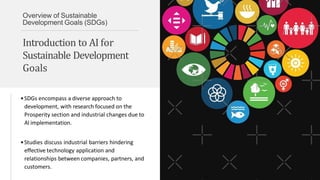
•SDGs encompass a diverse approach to
development, with research focused on the
Prosperity section and industrial changes due to
AI implementation.
•Studies discuss industrial barriers hindering
effective technology application and
relationships between companies, partners, and
customers.
Overview of Sustainable
Development Goals (SDGs)
Introduction to AI for
Sustainable Development
Goals
Overview of Sustainable Development Goals (SDGs)
Introduction to AI for Sustainable Development Goals
Technical aspect explores algorithms
addressing global challenges like
healthcare, knowledge, and humanity.
Research suggests AI's potential positive
impact on achieving SDGs across various
sectors, including society, economy, and
environment.
•AI has the potential to positively impact the achievement of SDGs, but there are
potential negative impacts such as increased inequalities and biases in decision-
making.
•Gaps in understanding the specific impacts of AI on different targets within the SDGs
have been identified, particularly in societal biases, economic disparities, and
environmental sustainability.
•Further research is needed to address these gaps and develop tailored analyses and
tools to better understand the role of AI in achieving the SDGs.
Role of AI in addressing SDGs
Introduction to AI for Sustainable Development Goals
•Challenges include the potential for AI to exacerbate inequalities, increase energy
consumption, and lack transparency and ethical oversight.
•AI presents opportunities to enable the achievement of many SDGs, particularly in the
areas of society, economy, and environment.
•It can support the provision of essential services, promote low-carbon systems, and
contribute to sustainable development.
Challenges and opportunities in using AI for SDGs
Introduction to AI for Sustainable Development Goals
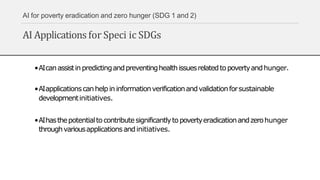
•AIcanassistinpredictingandpreventinghealthissuesrelatedtopovertyandhunger.
•AIapplicationscanhelpininformationverificationandvalidationforsustainable
developmentinitiatives.
•AIhasthepotentialtocontributesignificantlytopovertyeradicationandzerohunger
throughvariousapplicationsandinitiatives.
AI for poverty eradication and zero hunger (SDG 1 and 2)
AI Applicationsfor Speci ic SDGs
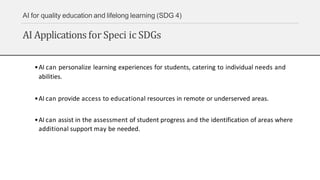
•AI can personalize learning experiences for students, catering to individual needs and
abilities.
•AI can provide access to educational resources in remote or underserved areas.
•AI can assist in the assessment of student progress and the identification of areas where
additional support may be needed.
AI for quality education and lifelong learning (SDG 4)
AI Applicationsfor Speci ic SDGs
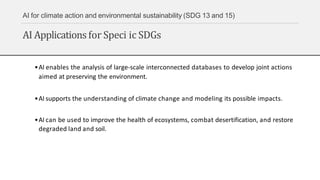
•AI enables the analysis of large-scale interconnected databases to develop joint actions
aimed at preserving the environment.
•AI supports the understanding of climate change and modeling its possible impacts.
•AI can be used to improve the health of ecosystems, combat desertification, and restore
degraded land and soil.
AI for climate action and environmental sustainability (SDG 13 and 15)
AI Applicationsfor Speci ic SDGs
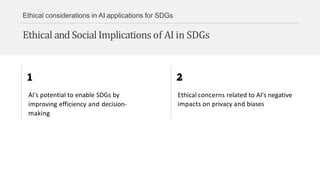
Ethical considerations in AI applications for SDGs
Ethical and Social Implications of AI in SDGs
AI's potential to enable SDGs by
improving efficiency and decision-
making
Ethical concerns related to AI's negative
impacts on privacy and biases
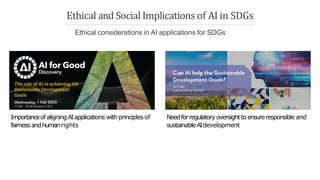
ImportanceofaligningAIapplications withprinciplesof
fairness andhumanrights
Needforregulatory oversighttoensureresponsible and
sustainableAIdevelopment
Ethical and Social Implications of AI in SDGs
Ethical considerations in AI applications for SDGs
Social impact and inclusivity in AI-driven solutions
Ethical and Social Implications of AI in SDGs
Influenceofhumanfactorssuchas
cultureandcognitivebiasesonAI
adoption
LeveragingAItodrivepositivesocial,
environmental,andeconomic
outcomes
Social impact and inclusivity in AI-driven solutions
Ethical and Social Implications of AI in SDGs
ExploringimpactofAIon job
displacementandcreatingnewjob
opportunities
Understanding culturaldimensionsand
biasesforinclusive AI-drivensolutions
Balancing technological advancement with human welfare
Ethical and Social Implications of AI in SDGs
Potentialoftechnologicaladvancement
toimprovehumanwelfareandprovide
newopportunities
Creating regulations and guidelines to
ensure beneficial use o
f technological
advancements
•Consideringpotentialimpactsofnewtechnologiesondifferentgroupswithinsociety
•Harnessingtechnologicaladvancementto improvehumanwelfarewhilebeingmindful
ofpotentialrisks
Balancing technological advancement with human welfare
Ethical and Social Implications of AI in SDGs
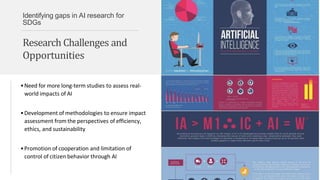
•Need for more long-term studies to assess real-
world impacts of AI
•Development of methodologies to ensure impact
assessment from the perspectives of efficiency,
ethics, and sustainability
•Promotion of cooperation and limitation of
control of citizen behavior through AI
Identifying gaps in AI research for
SDGs
Research Challenges and
Opportunities
•MoreresearchontheimpactofAIoninstitutions andlegislationregardingtransparency
andaccountability ofAI
•Adoption ofdecentralizedAIapproaches formoreequitabledevelopment
Identifying gaps in AI research for SDGs
Research Challenges and Opportunities
•Forminginterdisciplinary research teams
•Creatinginterdisciplinary research centersorinstitutes
•Establishing interdisciplinaryresearch networks
Collaborative approaches for interdisciplinary research
Research Challenges and Opportunities
•Varietyofsourcesincludinggovernmentgrants,privateinvestments,corporate
sponsorships,andnon-profitorganizations
•Fundingfrominternationalbodiesandinstitutions supportingsustainable development
initiatives
Funding and resource allocation for AI-driven sustainable development projects
Research Challenges and Opportunities
•Carefulplanningandconsideration ofspecific needsandgoalsofeachinitiative
•Partnershipsandcollaborationsbetweendifferentstakeholdersto leverageresources
andexpertise
Funding and resource allocation for AI-driven sustainable development projects
Research Challenges and Opportunities
•UseofAIinsmartfarmingandprecisionagriculture
•Application ofAIinsmarthealthandprecisionmedicine
•Potentialtoimprovecropmanagement,resourceuse,andpersonalizedhealthcare
Emerging trends in AI for SDGs
Future Outlook and Conclusion
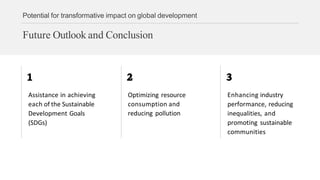
Potential for transformative impact on global development
Future Outlook and Conclusion
Assistance in achieving
each of the Sustainable
Development Goals
(SDGs)
Optimizing resource
consumption and
reducing pollution
Enhancing industry
performance, reducing
inequalities, and
promoting sustainable
communities
•FocusontheethicalandresponsibleuseofAI
•Addressglobalchallengessuchasclimatechangeandinequality
•Developinnovativesolutions thatpromote social,environmental,andeconomic well-
being
Call to action for researchers to contribute to AI-driven sustainable development
Future Outlook and Conclusion