Levels of Measurement
Additional
Support
Statistics Solutions is a full-service dissertation consulting company
providing graduate students timely, editorial support for their
dissertations and scholarly projects
For information about our services, receive a complementary 30-min
consultation available Mon-Fri 9-5 ET:
https://app.hubspot.com/meetings/jeanine/dissertation-consultation
info@StatisticsSolutions.com
Phone: 877-437-8622
Overview
Why are levels of measurement important?
Basic levels of measurement
• Ratio and Interval
• Ordinal
• Nominal
How to determine appropriate analysis based on levels of
measurement
Questions
Need help with your dissertation? Call 727-442-4290
Why are levels
of
measurement
important?
Levels of measurement are the properties of
values/categories that appear in data
Levels of measurement help determine the most
appropriate ways to describe, analyze, and interpret data
Four basic levels: ratio, interval, ordinal, and nominal
Other classifications exist, and data may need
consideration beyond the four basic levels
Need help with your dissertation? Call 727-442-4290
Ratio and
Interval
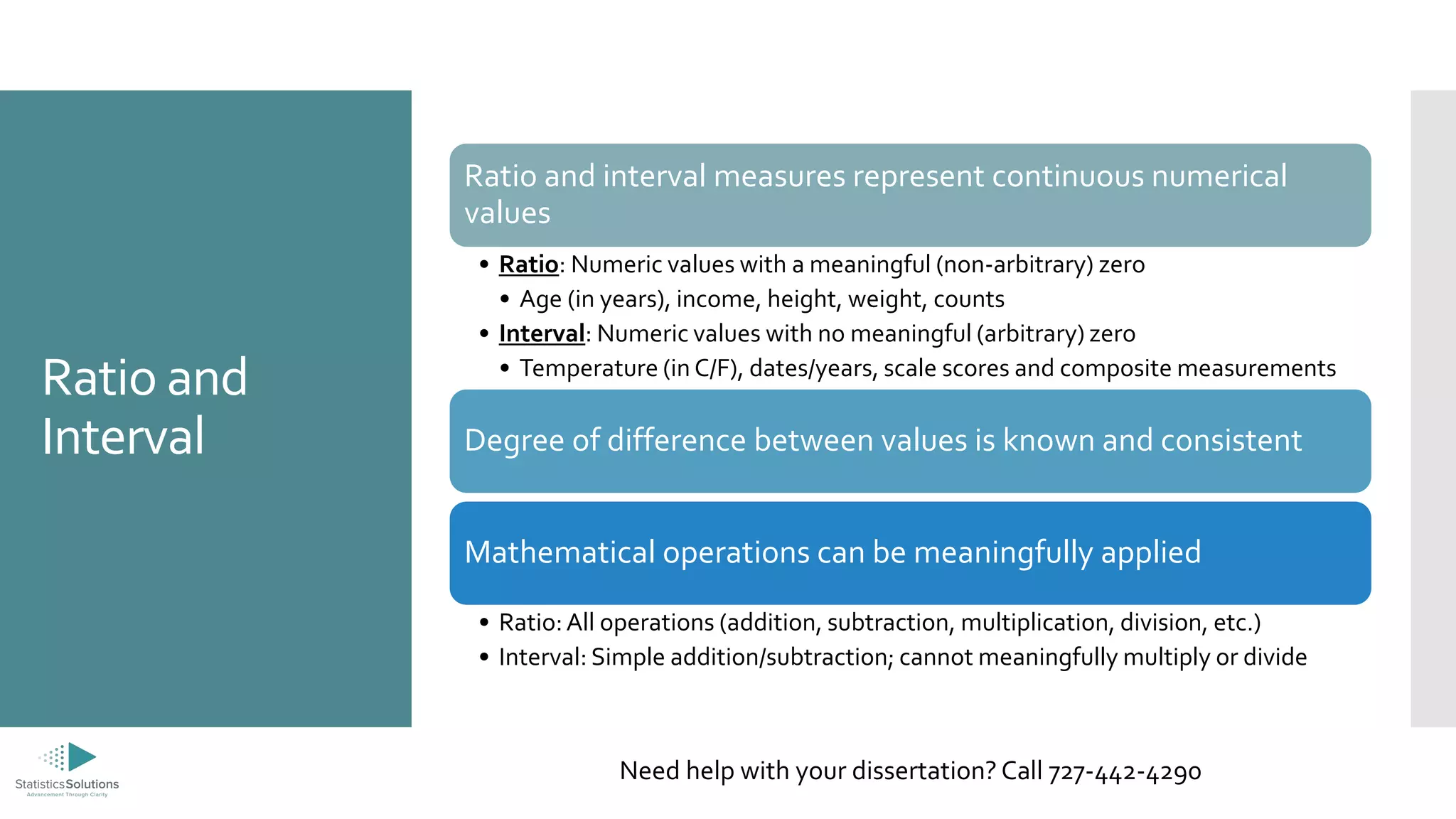
Ratio and interval measures represent continuous numerical
values
• Ratio: Numeric values with a meaningful (non-arbitrary) zero
• Age (in years), income, height, weight, counts
• Interval: Numeric values with no meaningful (arbitrary) zero
• Temperature (in C/F), dates/years, scale scores and composite measurements
Degree of difference between values is known and consistent
Mathematical operations can be meaningfully applied
• Ratio:All operations (addition, subtraction, multiplication, division, etc.)
• Interval: Simple addition/subtraction; cannot meaningfully multiply or divide
Need help with your dissertation? Call 727-442-4290
Ordinal
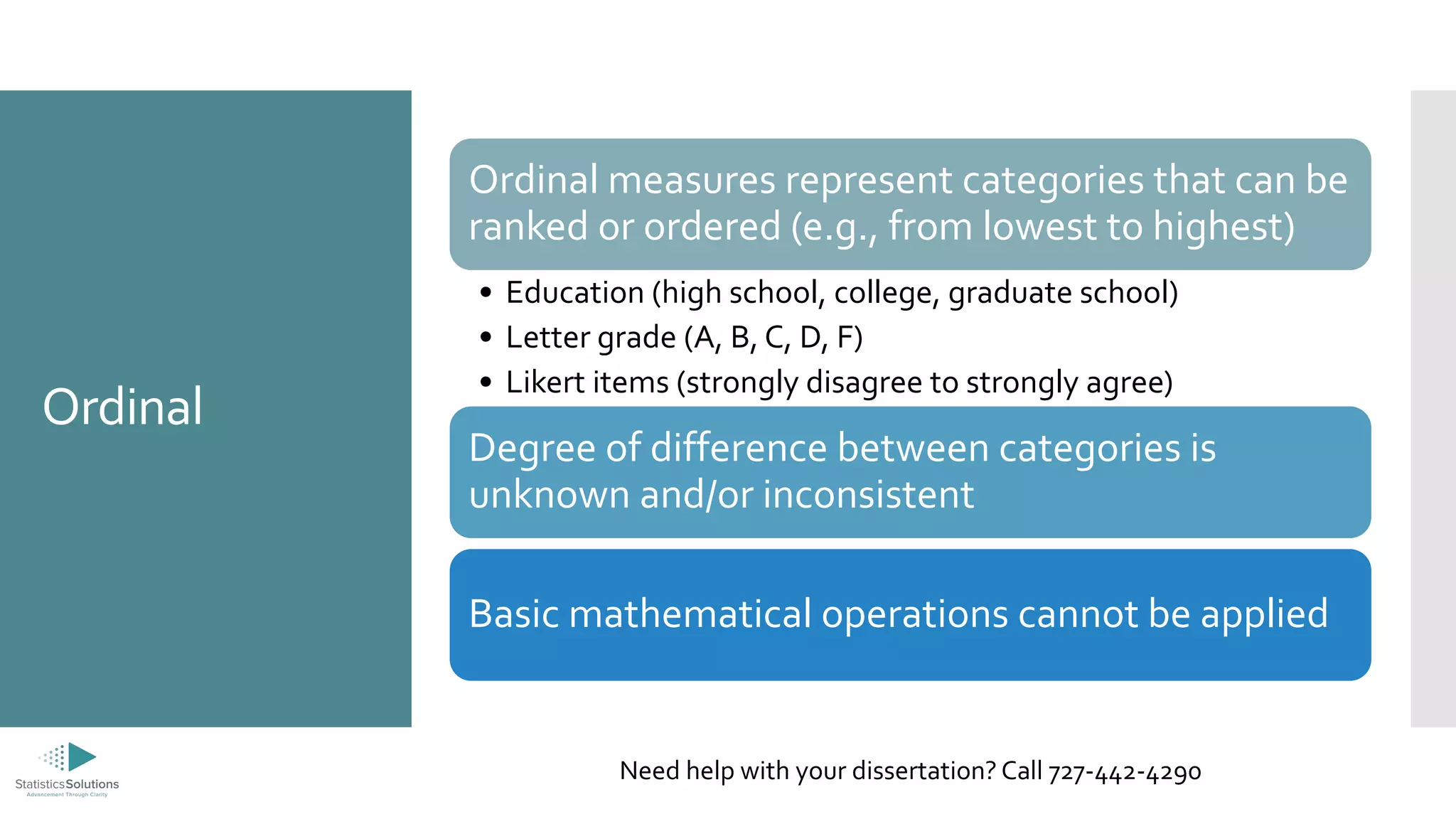
Ordinal measures represent categories that can be
ranked or ordered (e.g., from lowest to highest)
• Education (high school, college, graduate school)
• Letter grade (A, B, C, D, F)
• Likert items (strongly disagree to strongly agree)
Degree of difference between categories is
unknown and/or inconsistent
Basic mathematical operations cannot be applied
Need help with your dissertation? Call 727-442-4290
Nominal
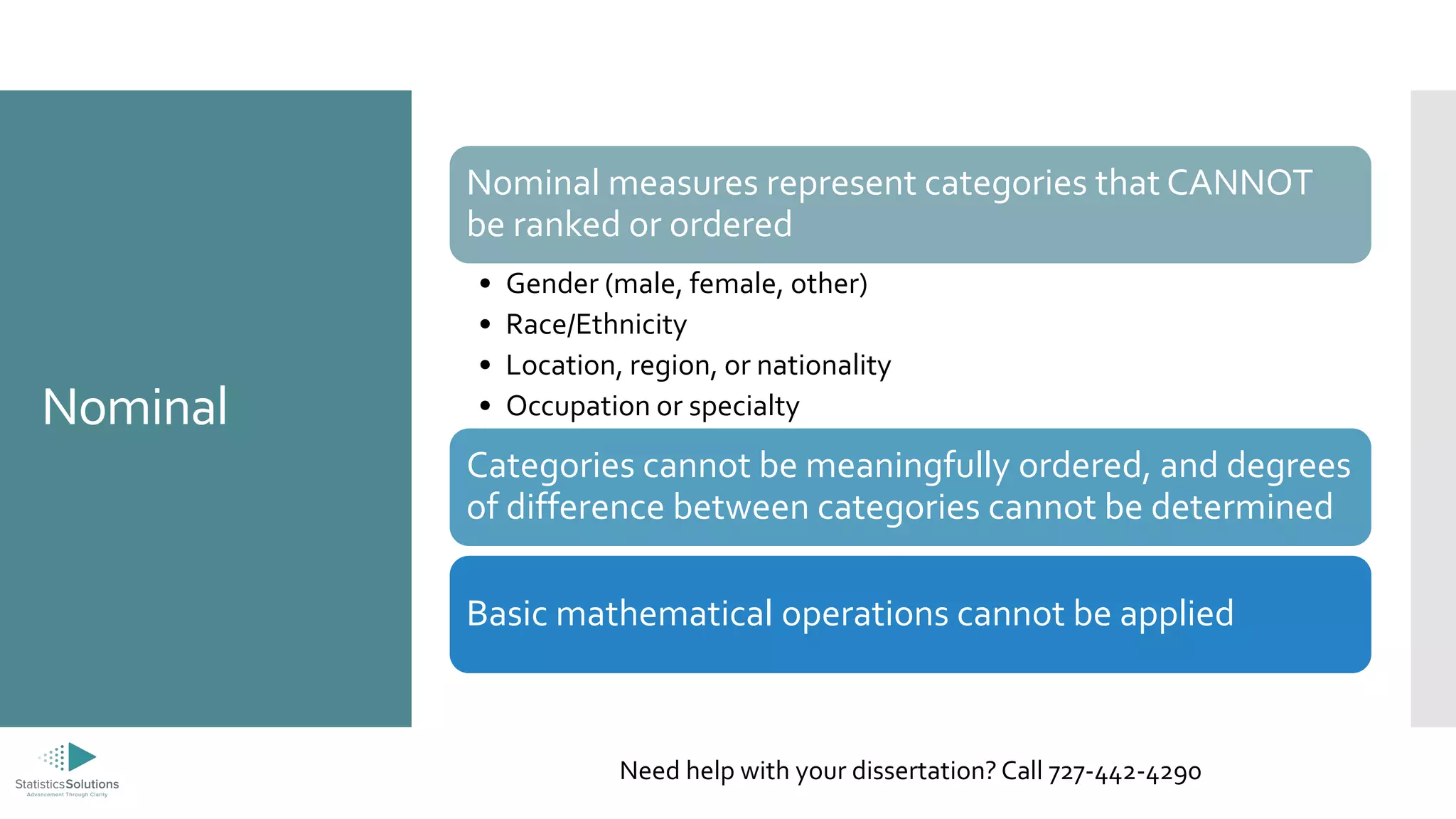
Nominal measures represent categories that CANNOT
be ranked or ordered
• Gender (male, female, other)
• Race/Ethnicity
• Location, region, or nationality
• Occupation or specialty
Categories cannot be meaningfully ordered, and degrees
of difference between categories cannot be determined
Basic mathematical operations cannot be applied
Need help with your dissertation? Call 727-442-4290
Instruments
with Likert
Responses
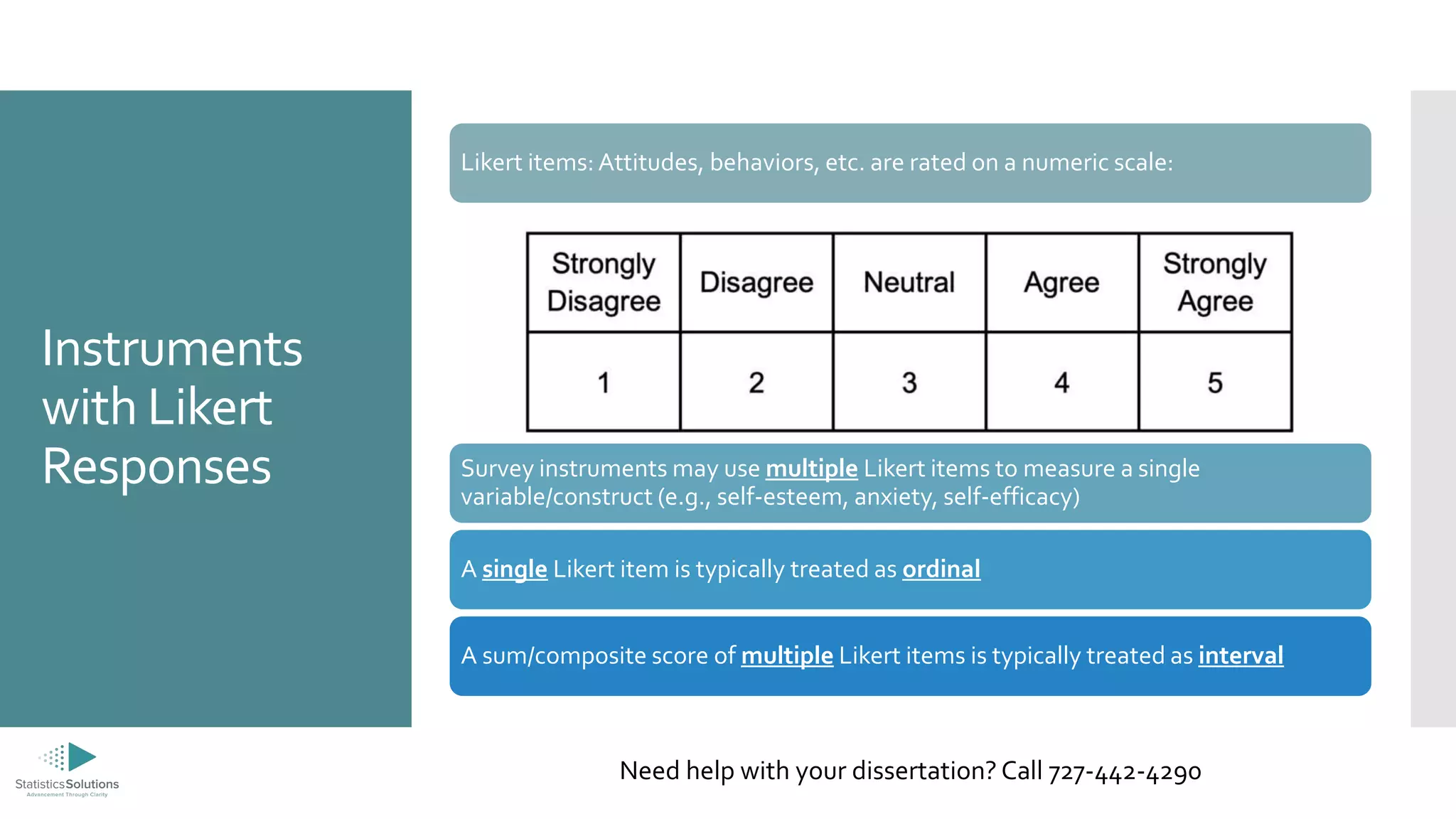
Likert items: Attitudes, behaviors, etc. are rated on a numeric scale:
Survey instruments may use multiple Likert items to measure a single
variable/construct (e.g., self-esteem, anxiety, self-efficacy)
A single Likert item is typically treated as ordinal
A sum/composite score of multiple Likert items is typically treated as interval
Need help with your dissertation? Call 727-442-4290
Choosing
Appropriate
Analyses
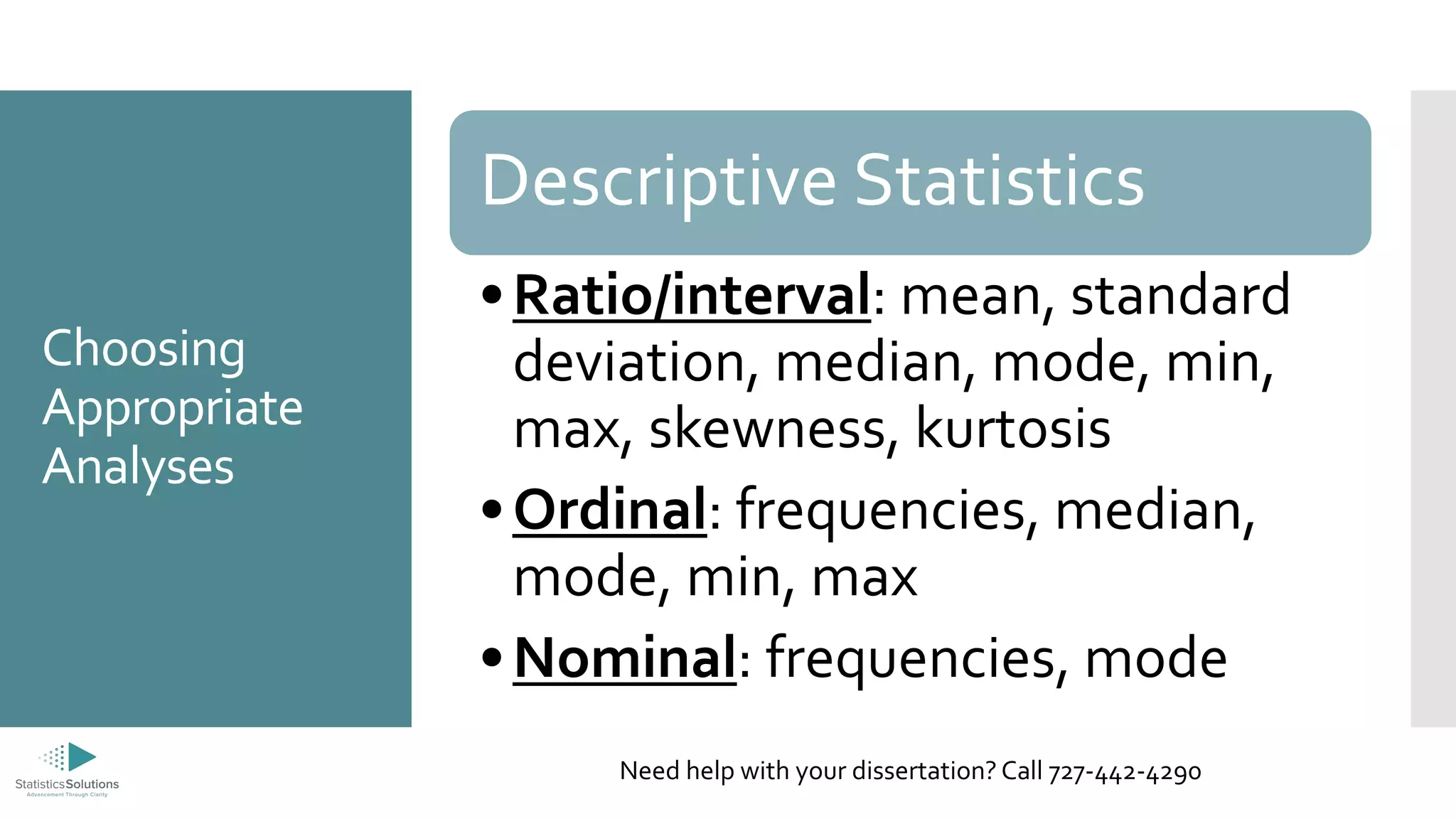
Descriptive Statistics
•Ratio/interval: mean, standard
deviation, median, mode, min,
max, skewness, kurtosis
•Ordinal: frequencies, median,
mode, min, max
•Nominal: frequencies, mode
Need help with your dissertation? Call 727-442-4290
Choosing
Appropriate
Analyses
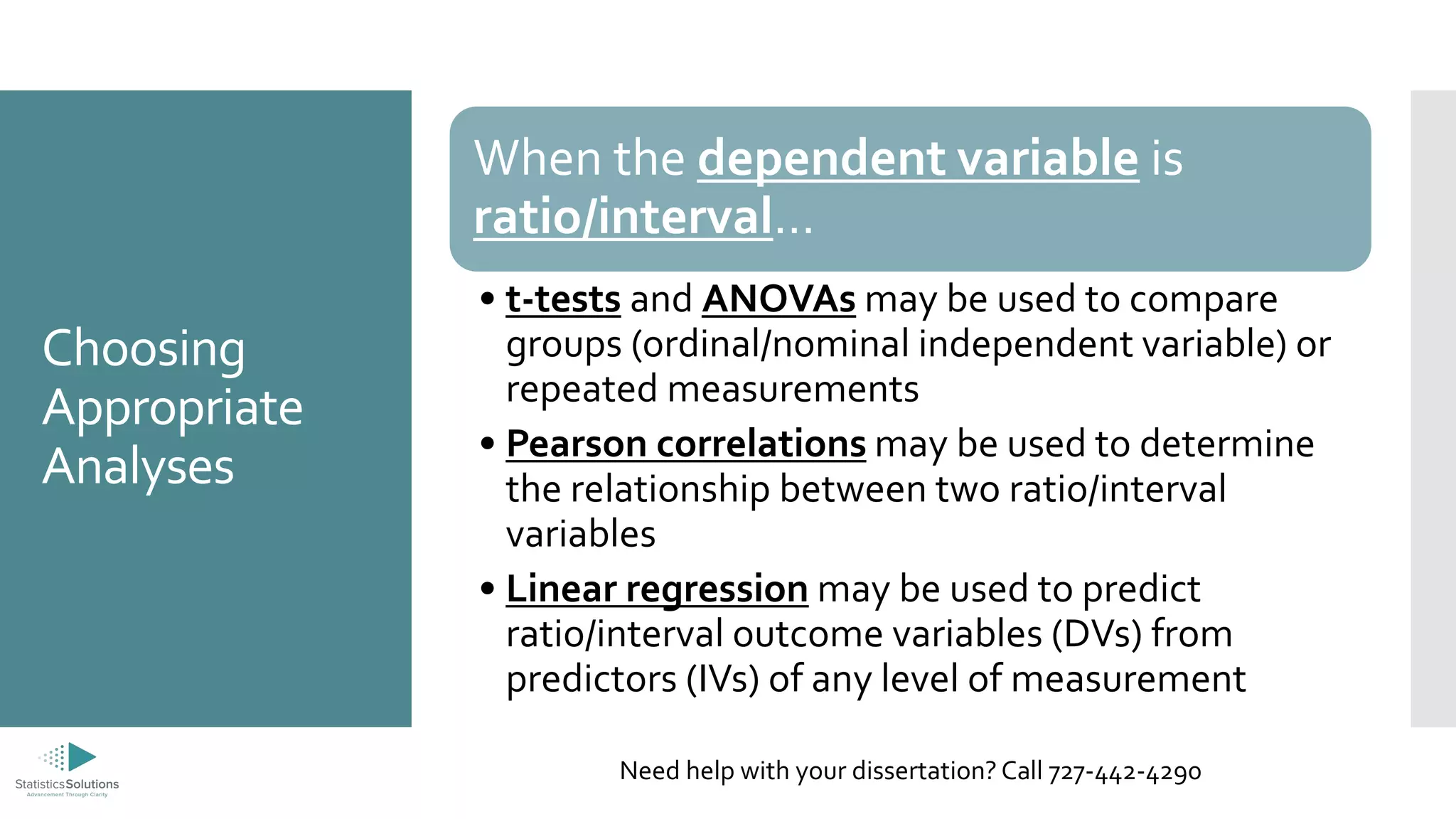
When the dependent variable is
ratio/interval…
• t-tests and ANOVAs may be used to compare
groups (ordinal/nominal independent variable) or
repeated measurements
• Pearson correlations may be used to determine
the relationship between two ratio/interval
variables
• Linear regression may be used to predict
ratio/interval outcome variables (DVs) from
predictors (IVs) of any level of measurement
Need help with your dissertation? Call 727-442-4290
Choosing
Appropriate
Analyses
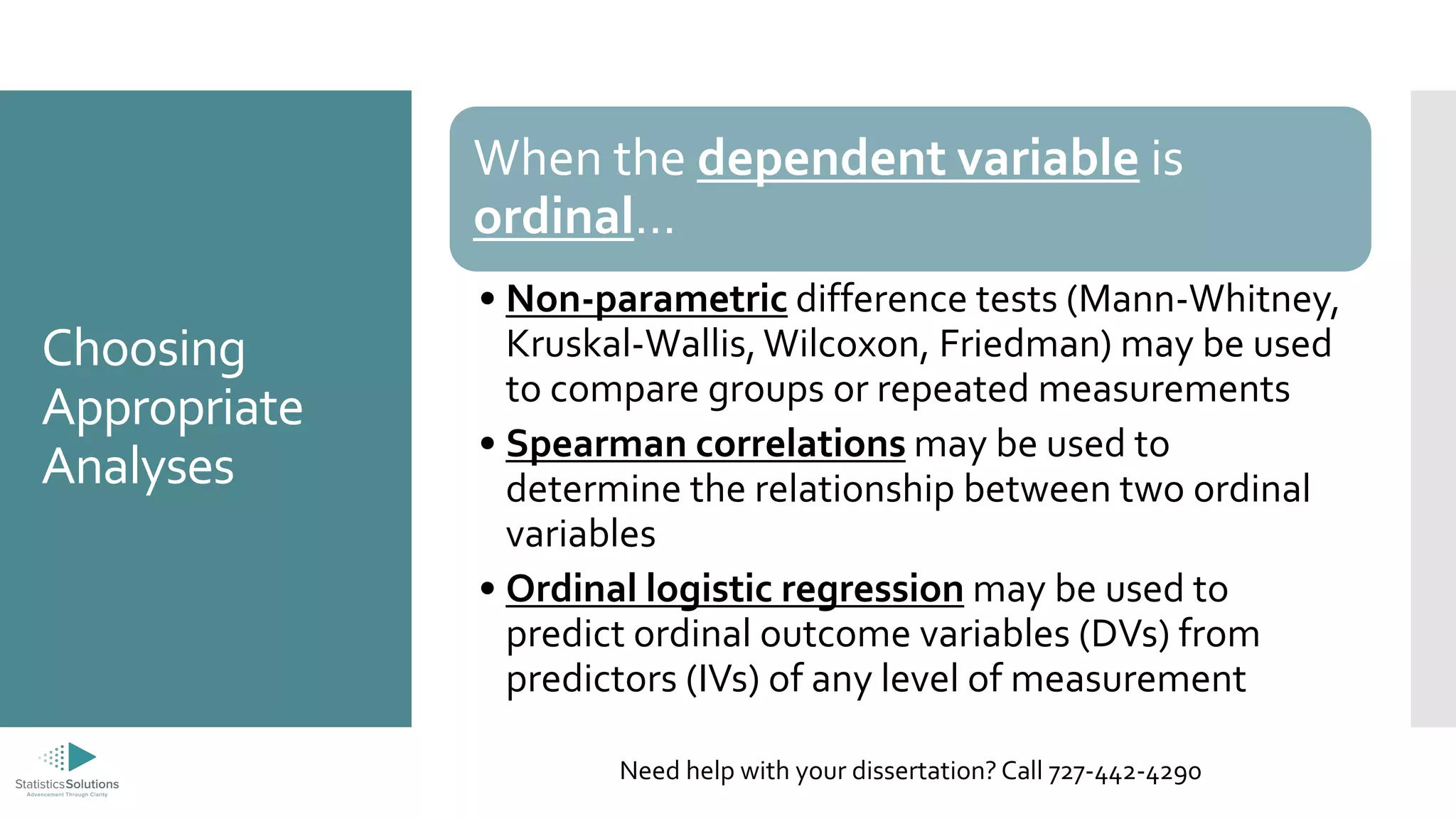
When the dependent variable is
ordinal…
• Non-parametric difference tests (Mann-Whitney,
Kruskal-Wallis, Wilcoxon, Friedman) may be used
to compare groups or repeated measurements
• Spearman correlations may be used to
determine the relationship between two ordinal
variables
• Ordinal logistic regression may be used to
predict ordinal outcome variables (DVs) from
predictors (IVs) of any level of measurement
Need help with your dissertation? Call 727-442-4290
Choosing
Appropriate
Analyses
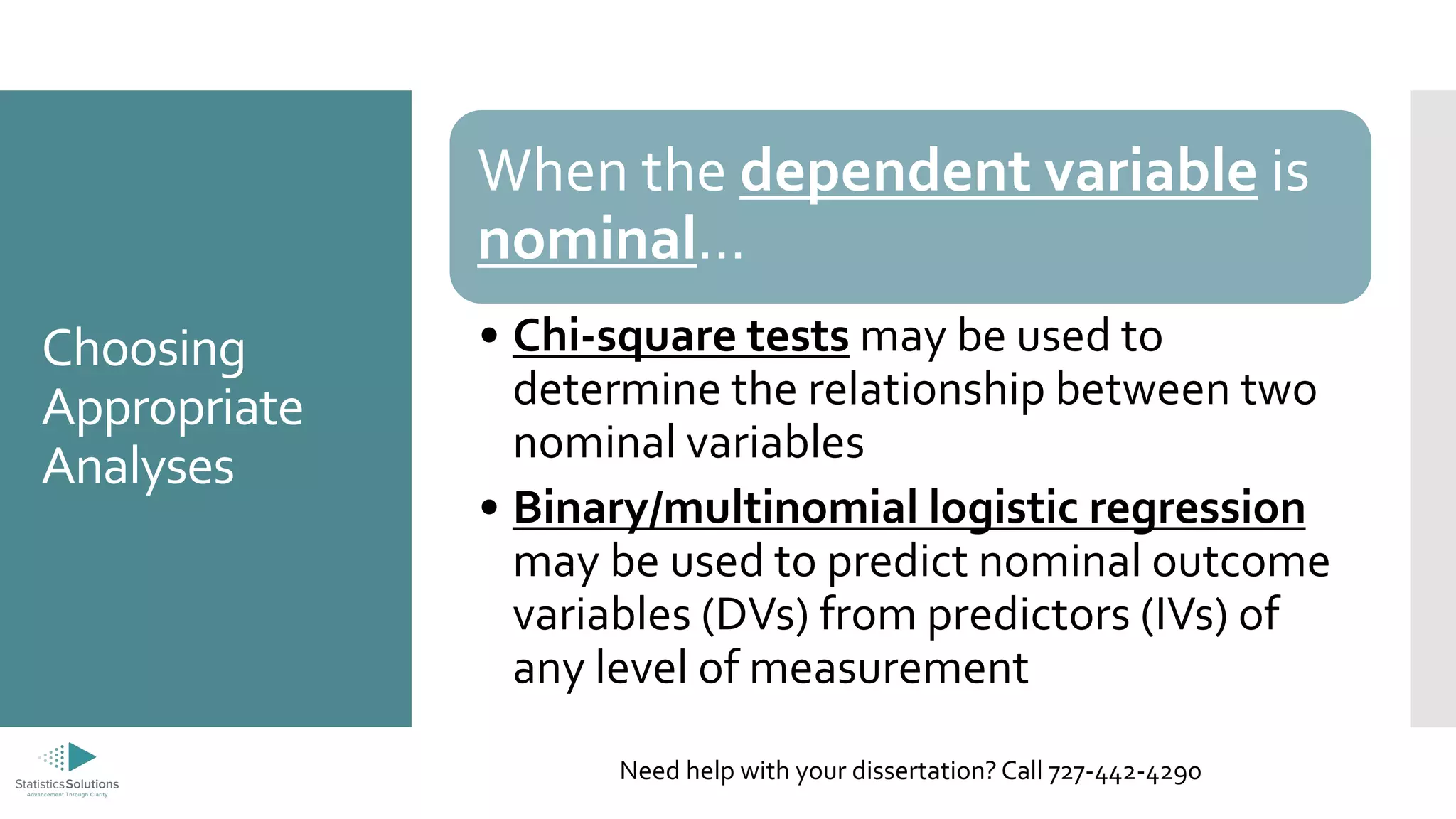
When the dependent variable is
nominal…
• Chi-square tests may be used to
determine the relationship between two
nominal variables
• Binary/multinomial logistic regression
may be used to predict nominal outcome
variables (DVs) from predictors (IVs) of
any level of measurement
Need help with your dissertation? Call 727-442-4290
Additional
Support
Statistics Solutions is a full-service dissertation consulting company
providing graduate students timely, editorial support for their
dissertations and scholarly projects
For information about our services, receive a complementary 30-min
consultation available Mon-Fri 9-5 ET:
https://app.hubspot.com/meetings/jeanine/dissertation-consultation
info@StatisticsSolutions.com
Phone: 877-437-8622

Mastering Levels of Measurement

  • 1.
  • 2.
    Additional Support Statistics Solutions isa full-service dissertation consulting company providing graduate students timely, editorial support for their dissertations and scholarly projects For information about our services, receive a complementary 30-min consultation available Mon-Fri 9-5 ET: https://app.hubspot.com/meetings/jeanine/dissertation-consultation info@StatisticsSolutions.com Phone: 877-437-8622
  • 3.
    Overview Why are levelsof measurement important? Basic levels of measurement • Ratio and Interval • Ordinal • Nominal How to determine appropriate analysis based on levels of measurement Questions Need help with your dissertation? Call 727-442-4290
  • 4.
    Why are levels of measurement important? Levelsof measurement are the properties of values/categories that appear in data Levels of measurement help determine the most appropriate ways to describe, analyze, and interpret data Four basic levels: ratio, interval, ordinal, and nominal Other classifications exist, and data may need consideration beyond the four basic levels Need help with your dissertation? Call 727-442-4290
  • 5.
    Ratio and Interval Ratio andinterval measures represent continuous numerical values • Ratio: Numeric values with a meaningful (non-arbitrary) zero • Age (in years), income, height, weight, counts • Interval: Numeric values with no meaningful (arbitrary) zero • Temperature (in C/F), dates/years, scale scores and composite measurements Degree of difference between values is known and consistent Mathematical operations can be meaningfully applied • Ratio:All operations (addition, subtraction, multiplication, division, etc.) • Interval: Simple addition/subtraction; cannot meaningfully multiply or divide Need help with your dissertation? Call 727-442-4290
  • 6.
    Ordinal Ordinal measures representcategories that can be ranked or ordered (e.g., from lowest to highest) • Education (high school, college, graduate school) • Letter grade (A, B, C, D, F) • Likert items (strongly disagree to strongly agree) Degree of difference between categories is unknown and/or inconsistent Basic mathematical operations cannot be applied Need help with your dissertation? Call 727-442-4290
  • 7.
    Nominal Nominal measures representcategories that CANNOT be ranked or ordered • Gender (male, female, other) • Race/Ethnicity • Location, region, or nationality • Occupation or specialty Categories cannot be meaningfully ordered, and degrees of difference between categories cannot be determined Basic mathematical operations cannot be applied Need help with your dissertation? Call 727-442-4290
  • 8.
    Instruments with Likert Responses Likert items:Attitudes, behaviors, etc. are rated on a numeric scale: Survey instruments may use multiple Likert items to measure a single variable/construct (e.g., self-esteem, anxiety, self-efficacy) A single Likert item is typically treated as ordinal A sum/composite score of multiple Likert items is typically treated as interval Need help with your dissertation? Call 727-442-4290
  • 9.
    Choosing Appropriate Analyses Descriptive Statistics •Ratio/interval: mean,standard deviation, median, mode, min, max, skewness, kurtosis •Ordinal: frequencies, median, mode, min, max •Nominal: frequencies, mode Need help with your dissertation? Call 727-442-4290
  • 10.
    Choosing Appropriate Analyses When the dependentvariable is ratio/interval… • t-tests and ANOVAs may be used to compare groups (ordinal/nominal independent variable) or repeated measurements • Pearson correlations may be used to determine the relationship between two ratio/interval variables • Linear regression may be used to predict ratio/interval outcome variables (DVs) from predictors (IVs) of any level of measurement Need help with your dissertation? Call 727-442-4290
  • 11.
    Choosing Appropriate Analyses When the dependentvariable is ordinal… • Non-parametric difference tests (Mann-Whitney, Kruskal-Wallis, Wilcoxon, Friedman) may be used to compare groups or repeated measurements • Spearman correlations may be used to determine the relationship between two ordinal variables • Ordinal logistic regression may be used to predict ordinal outcome variables (DVs) from predictors (IVs) of any level of measurement Need help with your dissertation? Call 727-442-4290
  • 12.
    Choosing Appropriate Analyses When the dependentvariable is nominal… • Chi-square tests may be used to determine the relationship between two nominal variables • Binary/multinomial logistic regression may be used to predict nominal outcome variables (DVs) from predictors (IVs) of any level of measurement Need help with your dissertation? Call 727-442-4290
  • 13.
    Additional Support Statistics Solutions isa full-service dissertation consulting company providing graduate students timely, editorial support for their dissertations and scholarly projects For information about our services, receive a complementary 30-min consultation available Mon-Fri 9-5 ET: https://app.hubspot.com/meetings/jeanine/dissertation-consultation info@StatisticsSolutions.com Phone: 877-437-8622