
Click Here to Agree:
Managing Intellectual
Property when
Crowdsourcing
Solutions
In the journal:
Business Horizons
Download the article here
“The legal cornerstone of any
crowdsourcing initiative is a carefully
considered set of contractual terms and
conditions” (de Beer et al 2017: 209)
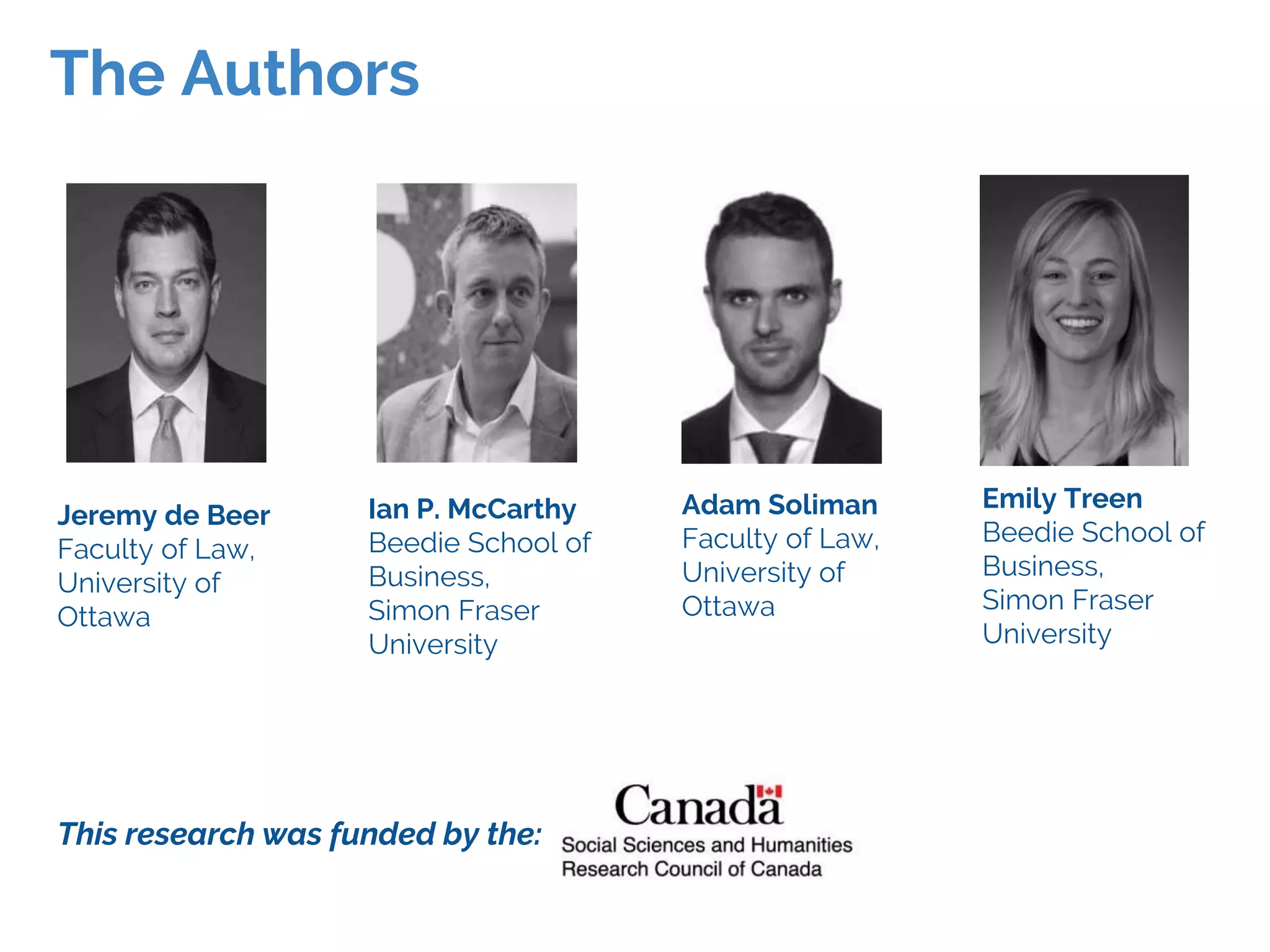
The Authors
Jeremy de Beer
Faculty of Law,
University of
Ottawa
Ian P. McCarthy
Beedie School of
Business,
Simon Fraser
University
Adam Soliman
Faculty of Law,
University of
Ottawa
Emily Treen
Beedie School of
Business,
Simon Fraser
University
This research was funded by the:
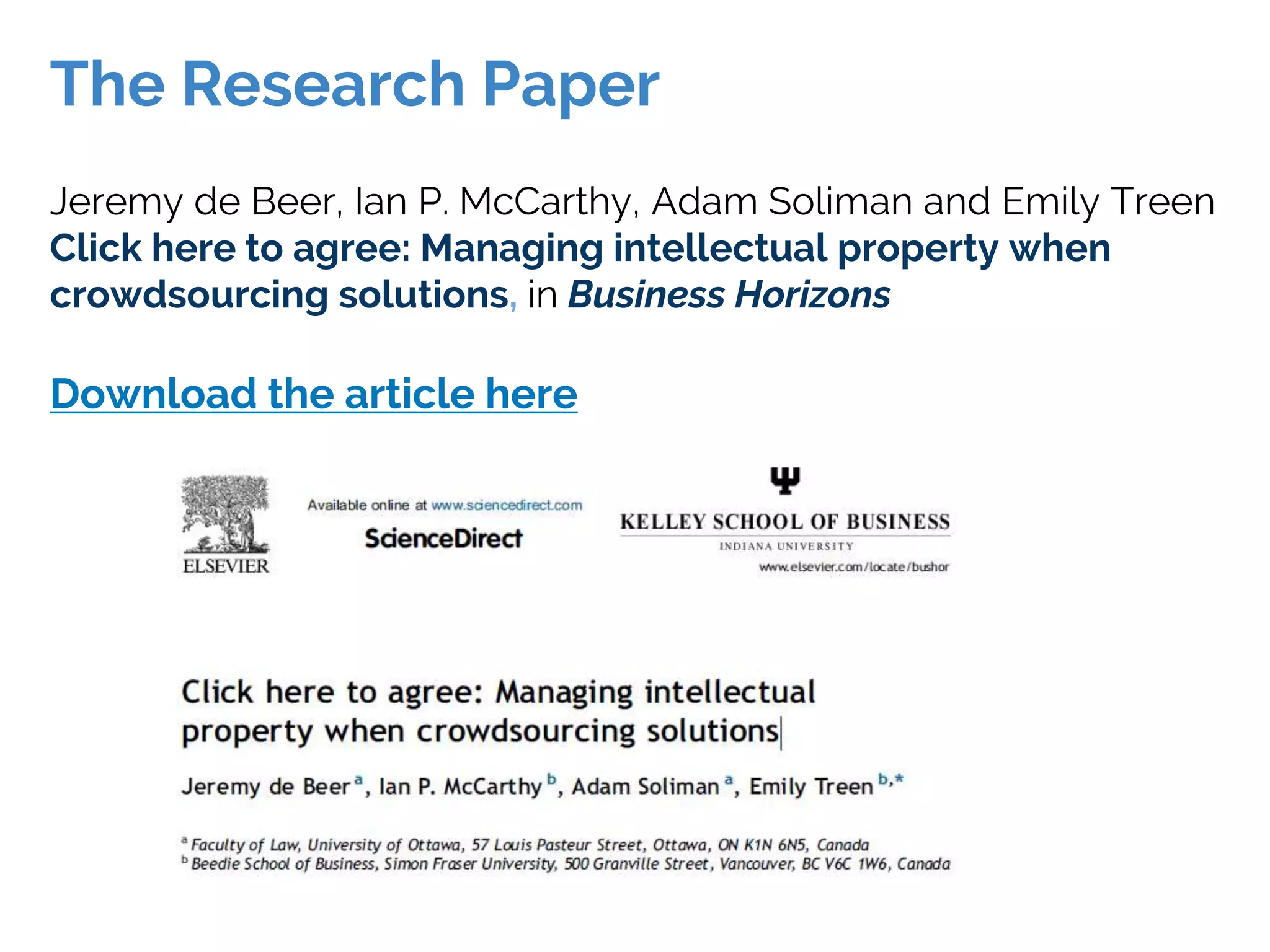
Jeremy de Beer, Ian P. McCarthy, Adam Soliman and Emily Treen
Click here to agree: Managing intellectual property when
crowdsourcing solutions, in Business Horizons
Download the article here
The Research Paper
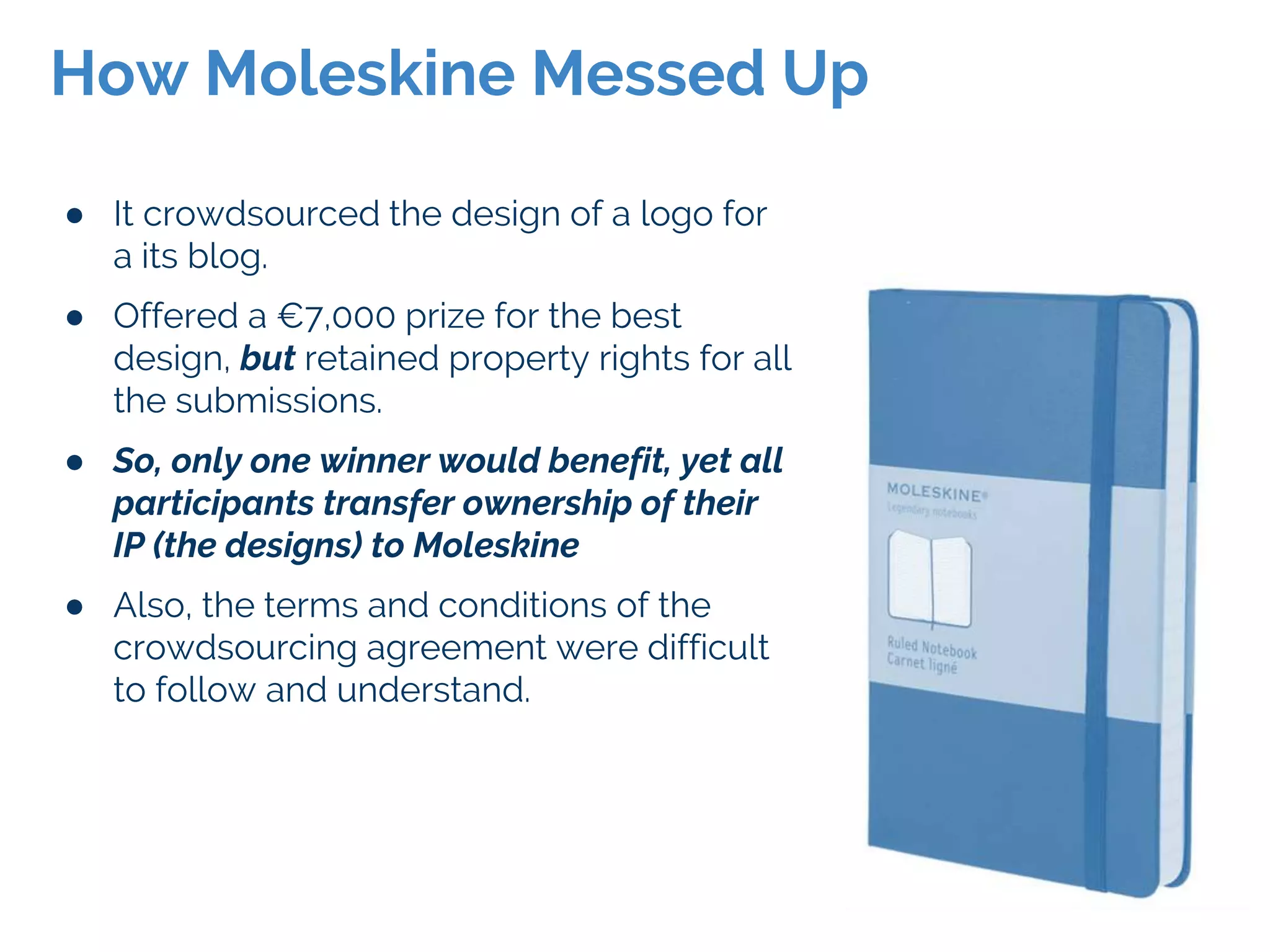
● It crowdsourced the design of a logo for
a its blog.
● Offered a €7,000 prize for the best
design, but retained property rights for all
the submissions.
● So, only one winner would benefit, yet all
participants transfer ownership of their
IP (the designs) to Moleskine
● Also, the terms and conditions of the
crowdsourcing agreement were difficult
to follow and understand.
How Moleskine Messed Up
● The design community lashed out at
Moleskine for what was perceived as
profiteering and free riding on the IP
of consumers.
● Moleskine argued:
○ that people didn’t have to
participate in the contest; and
○ that many organizations use this
approach to crowdsource IP
● This response prompted further
backlash from the community and,
eventually, an apology from
Moleskine.
How Moleskine Messed Up
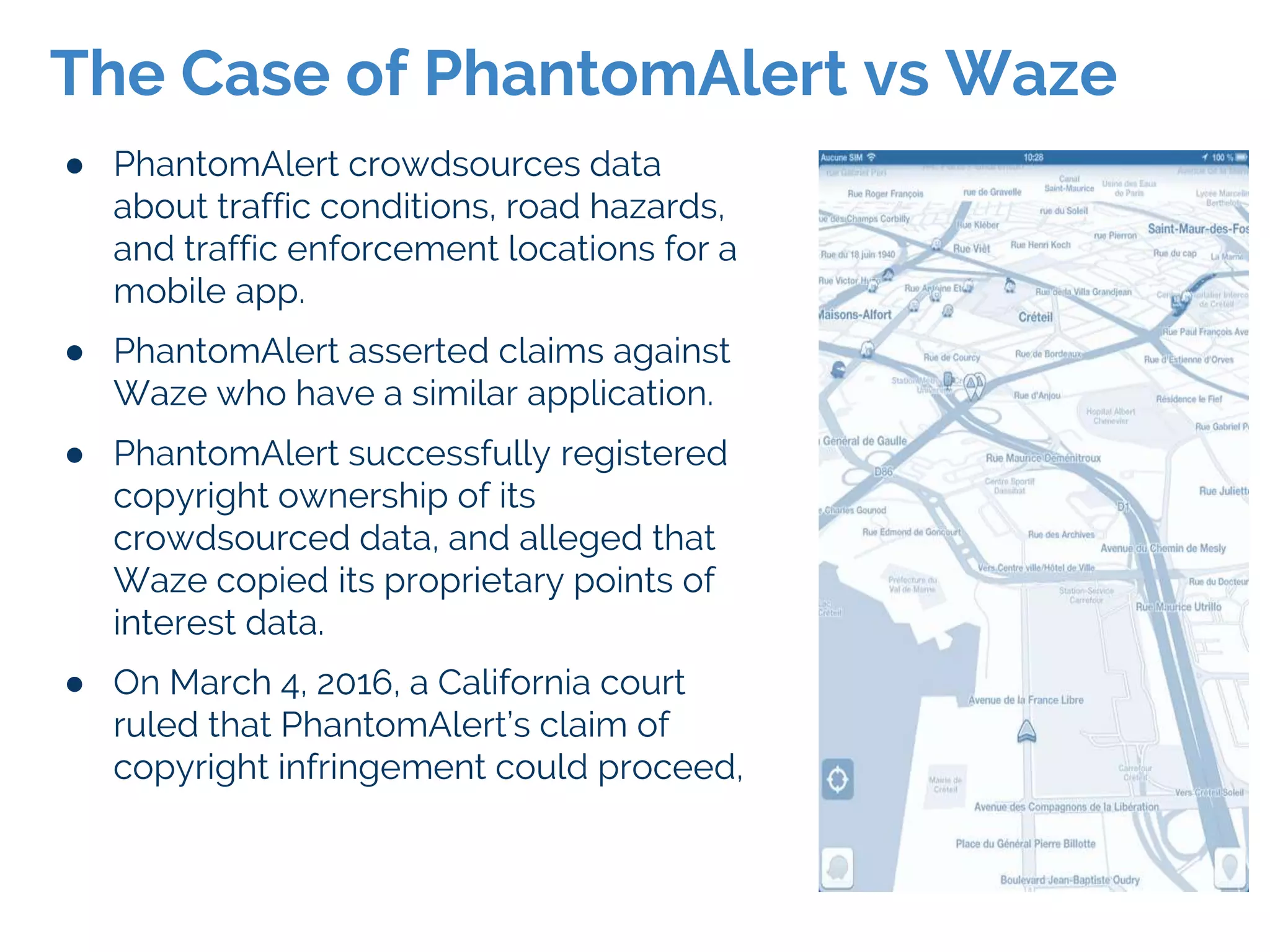
● PhantomAlert crowdsources data
about traffic conditions, road hazards,
and traffic enforcement locations for a
mobile app.
● PhantomAlert asserted claims against
Waze who have a similar application.
● PhantomAlert successfully registered
copyright ownership of its
crowdsourced data, and alleged that
Waze copied its proprietary points of
interest data.
● On March 4, 2016, a California court
ruled that PhantomAlert’s claim of
copyright infringement could proceed,
The Case of PhantomAlert vs Waze
Together these two examples demonstrate that
organizations need to consider intellectual property
related risks when sourcing solutions from a crowd.
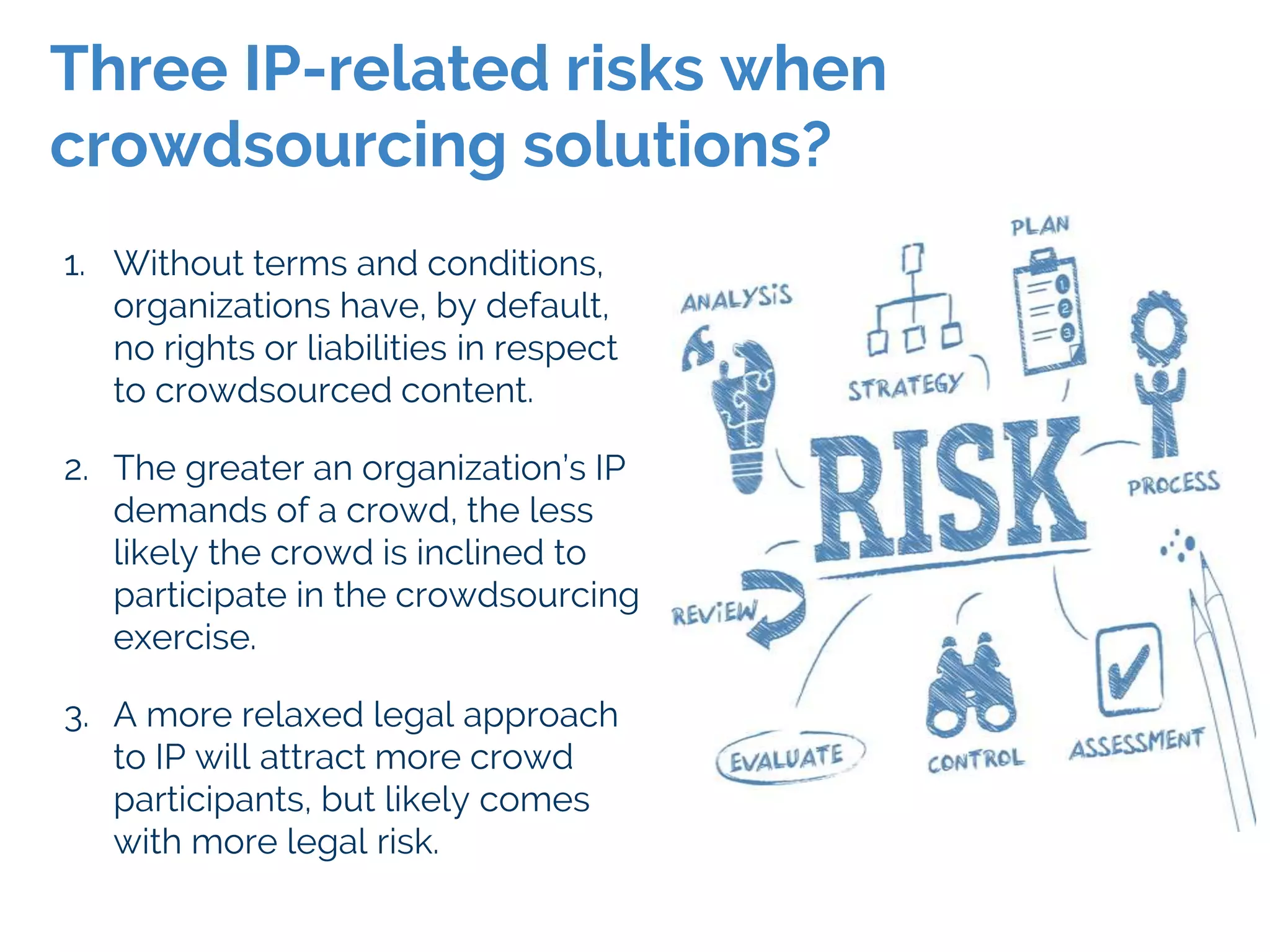
1. Without terms and conditions,
organizations have, by default,
no rights or liabilities in respect
to crowdsourced content.
2. The greater an organization’s IP
demands of a crowd, the less
likely the crowd is inclined to
participate in the crowdsourcing
exercise.
3. A more relaxed legal approach
to IP will attract more crowd
participants, but likely comes
with more legal risk.
Three IP-related risks when
crowdsourcing solutions?
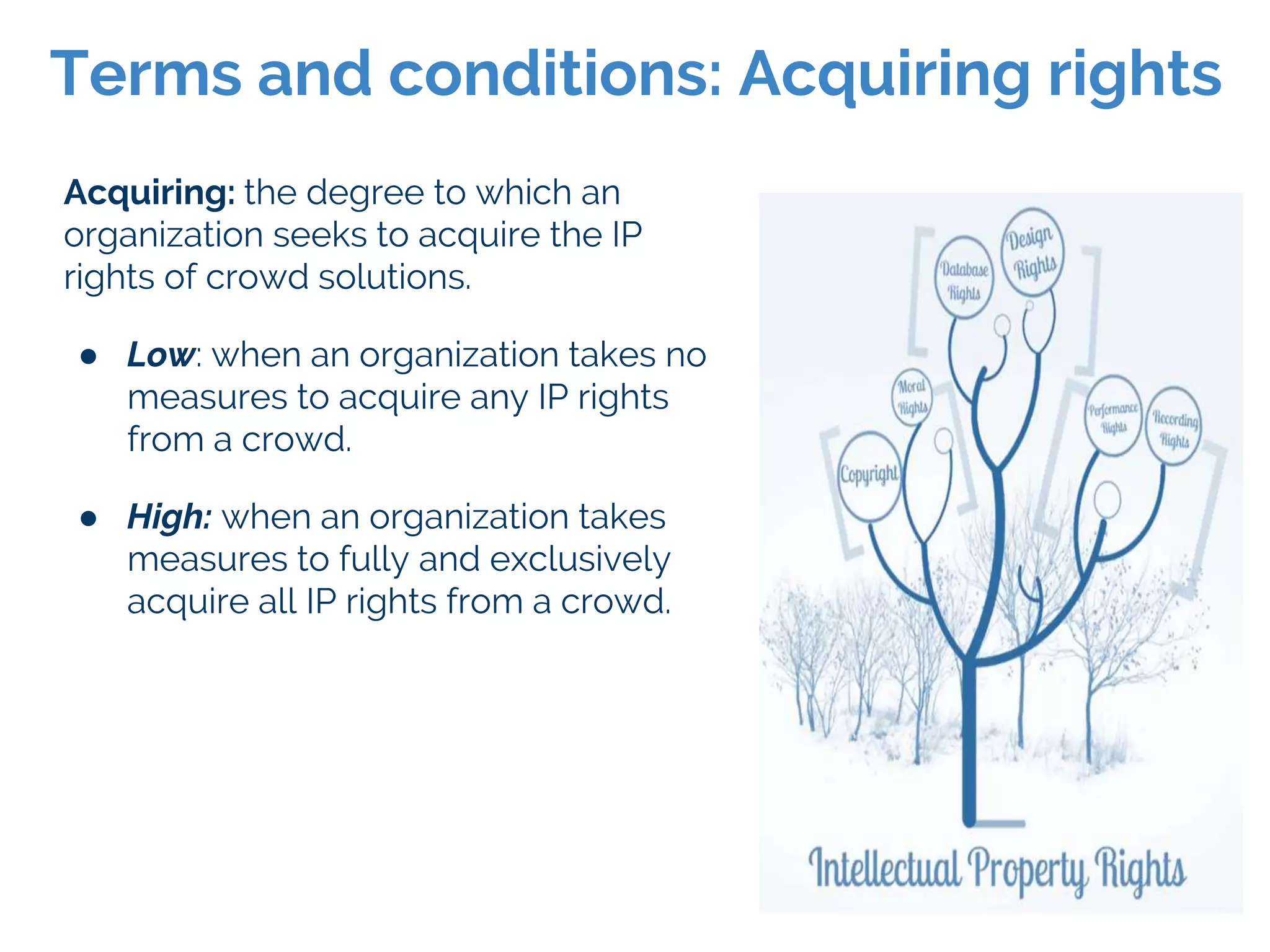
Acquiring: the degree to which an
organization seeks to acquire the IP
rights of crowd solutions.
● Low: when an organization takes no
measures to acquire any IP rights
from a crowd.
● High: when an organization takes
measures to fully and exclusively
acquire all IP rights from a crowd.
Terms and conditions: Acquiring rights
● Crowd participants may include
content in their submissions that
they themselves did not create or
have used without appropriate
authorization.
● This is known as: intellectual
property contamination.
Why limit your liabilities when crowdsourcing?
Limiting liabilities: the degree to
which organizations seek to
safeguard themselves from
potential liabilities associated with
crowdsourced solutions.
● Low: the organization takes no
legal measures to limit its
liabilities regarding
contamination.
● High: the organization takes
extensive measures to protect
itself from any contamination
risks that could accompany
crowdsourcing solutions.
Limiting liabilities
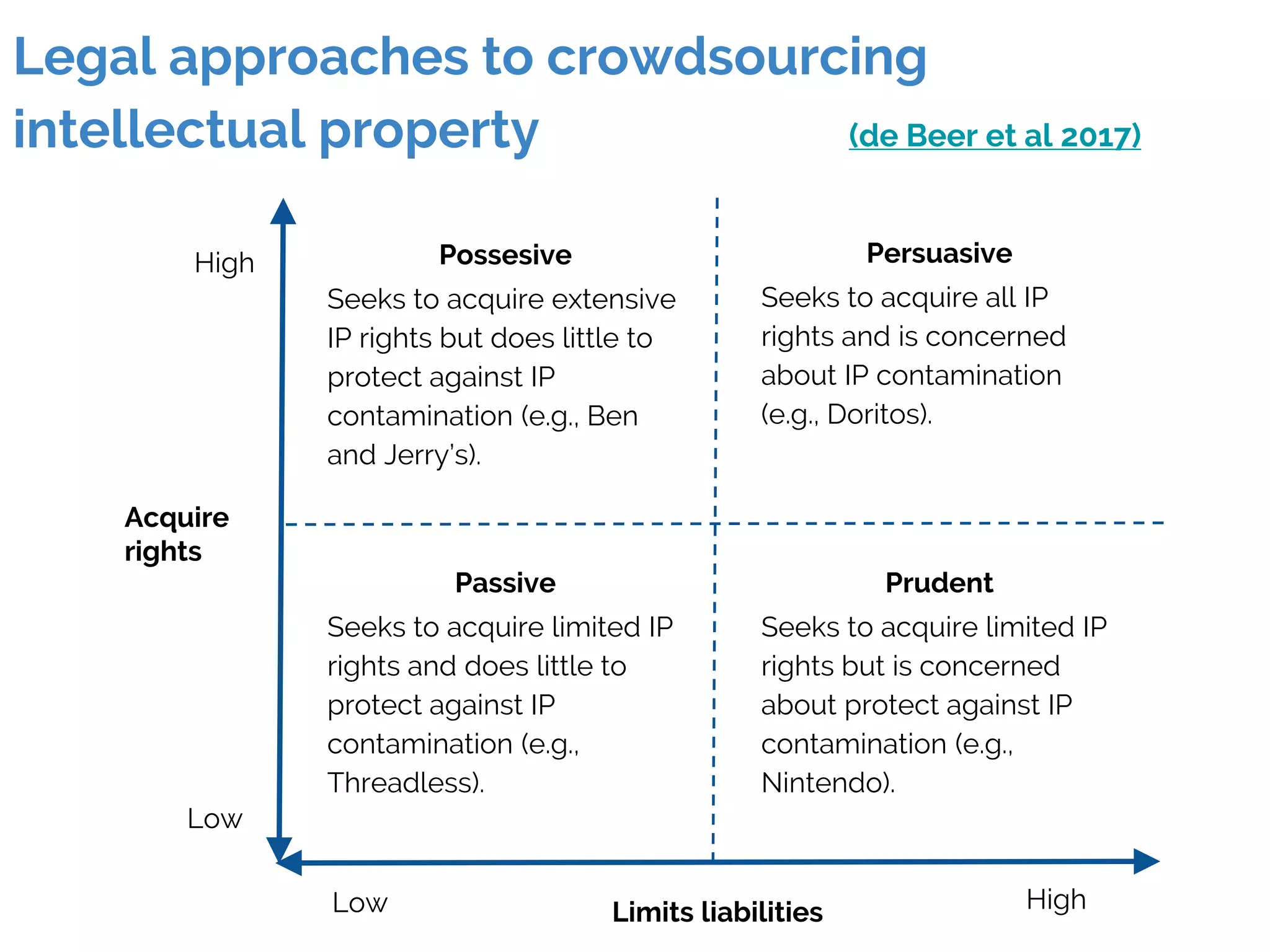
Limits liabilitiesLow High
High
Low
Acquire
rights
Possesive
Seeks to acquire extensive
IP rights but does little to
protect against IP
contamination (e.g., Ben
and Jerry’s).
Persuasive
Seeks to acquire all IP
rights and is concerned
about IP contamination
(e.g., Doritos).
Passive
Seeks to acquire limited IP
rights and does little to
protect against IP
contamination (e.g.,
Threadless).
Prudent
Seeks to acquire limited IP
rights but is concerned
about protect against IP
contamination (e.g.,
Nintendo).
Legal approaches to crowdsourcing
intellectual property (de Beer et al 2017)
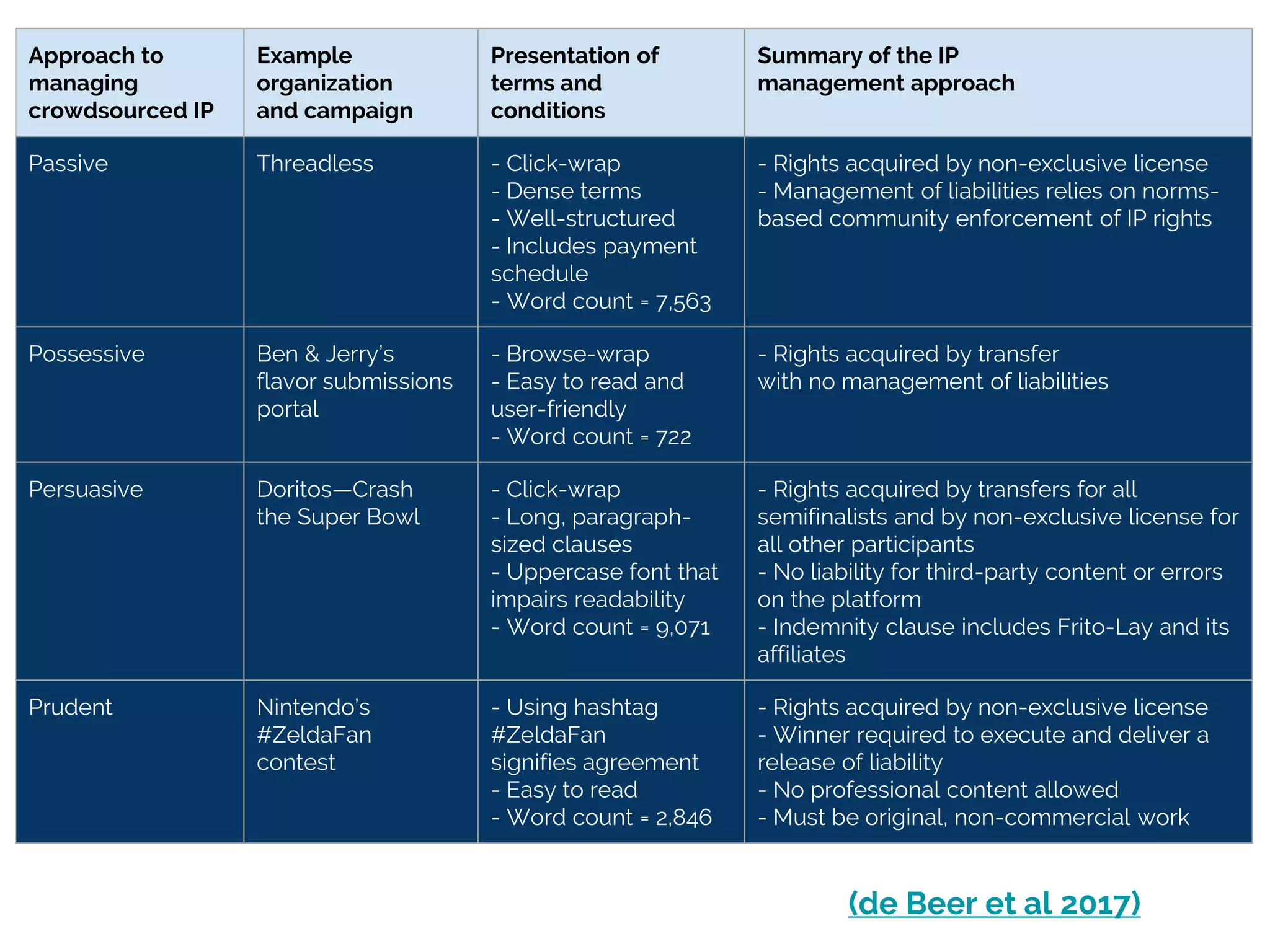
Approach to
managing
crowdsourced IP
Example
organization
and campaign
Presentation of
terms and
conditions
Summary of the IP
management approach
Passive Threadless - Click-wrap
- Dense terms
- Well-structured
- Includes payment
schedule
- Word count = 7,563
- Rights acquired by non-exclusive license
- Management of liabilities relies on norms-
based community enforcement of IP rights
Possessive Ben & Jerry’s
flavor submissions
portal
- Browse-wrap
- Easy to read and
user-friendly
- Word count = 722
- Rights acquired by transfer
with no management of liabilities
Persuasive Doritos—Crash
the Super Bowl
- Click-wrap
- Long, paragraph-
sized clauses
- Uppercase font that
impairs readability
- Word count = 9,071
- Rights acquired by transfers for all
semifinalists and by non-exclusive license for
all other participants
- No liability for third-party content or errors
on the platform
- Indemnity clause includes Frito-Lay and its
affiliates
Prudent Nintendo’s
#ZeldaFan
contest
- Using hashtag
#ZeldaFan
signifies agreement
- Easy to read
- Word count = 2,846
- Rights acquired by non-exclusive license
- Winner required to execute and deliver a
release of liability
- No professional content allowed
- Must be original, non-commercial work
(de Beer et al 2017)
The takeaways
Aligning motivations and rewards
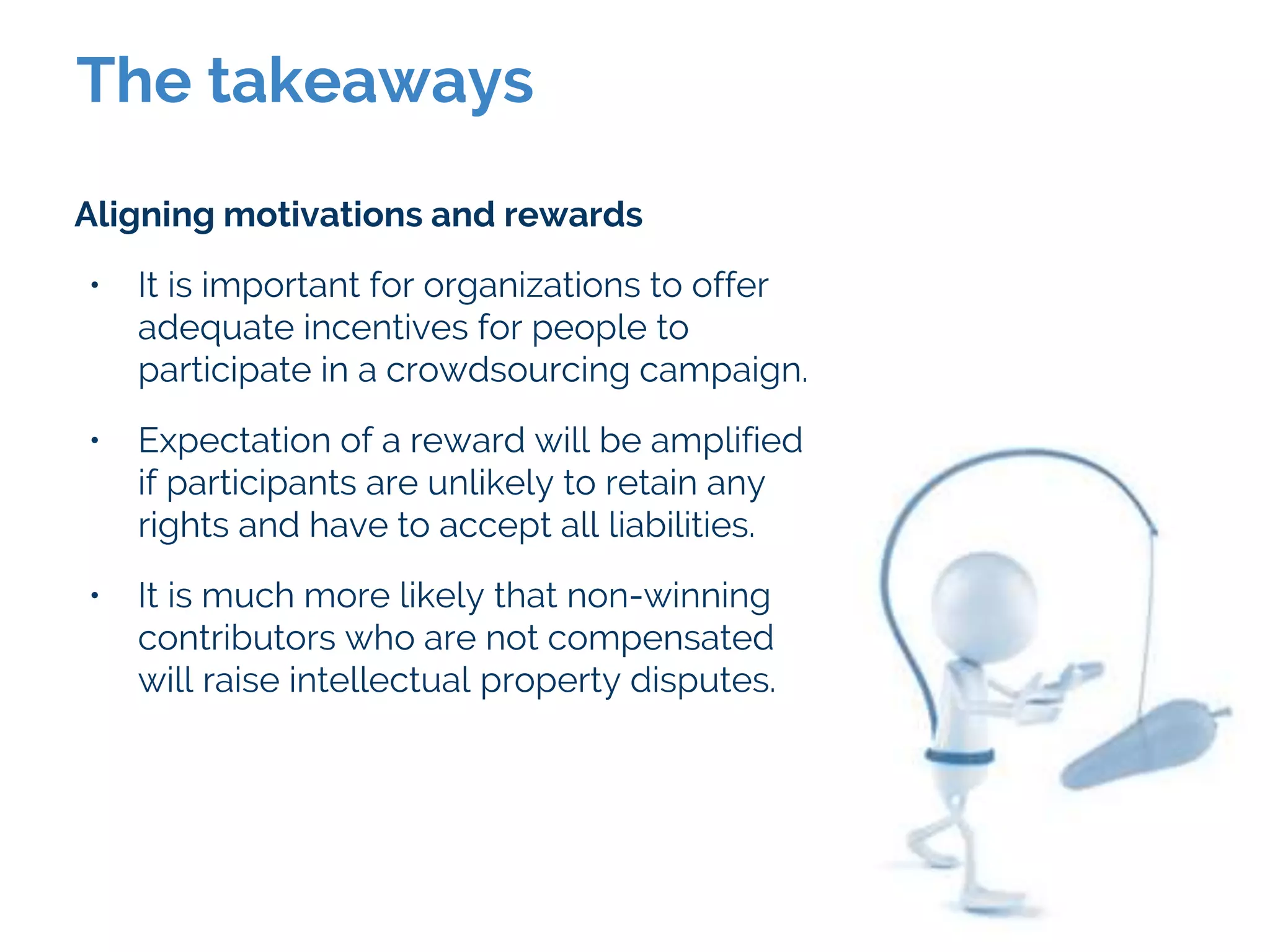
• It is important for organizations to offer
adequate incentives for people to
participate in a crowdsourcing campaign.
• Expectation of a reward will be amplified
if participants are unlikely to retain any
rights and have to accept all liabilities.
• It is much more likely that non-winning
contributors who are not compensated
will raise intellectual property disputes.
The takeaways
Let’s be clear
• Be as transparent as possible and use language
that can be understood by the crowd, without
sacrificing the legal protection afforded to legally-
sound terms and conditions.
• The ramifications of not being clear and
transparent and hiding behind a wall of legal
jargon can prove detrimental to a brand.
The takeaways
Consider an intermediary or existing platform
• Crowdsourcing service providers can
assume responsibility for the strategic,
logistical, and legal issues connected with a
crowdsourcing initiative.
• Specialized crowdsourcing providers
include: InnoCentive, NineSigma, eYeka,
and Topcoder.
Our framework illustrates the legal approaches
that organizations can use to manage the value,
risks, and effectiveness of crowdsourcing.
In the end, a reciprocating relationship emerges.
The legal approach to managing crowdsourced
intellectual property shapes the crowdsourcing
campaign while, at the same time, the campaign
shapes the legal approach.
Dr. Ian McCarthy
@toffeemen68
Professor, Technology and
Operations Management
Beedie School of Business
Simon Fraser University
Ian McCarthy
It Depends Blog
Slides produced by:

Click here to agree managing intellectual property when crowdsourcing solutions

  • 1.
    Click Here toAgree: Managing Intellectual Property when Crowdsourcing Solutions In the journal: Business Horizons Download the article here
  • 2.
    “The legal cornerstoneof any crowdsourcing initiative is a carefully considered set of contractual terms and conditions” (de Beer et al 2017: 209)
  • 3.
    The Authors Jeremy deBeer Faculty of Law, University of Ottawa Ian P. McCarthy Beedie School of Business, Simon Fraser University Adam Soliman Faculty of Law, University of Ottawa Emily Treen Beedie School of Business, Simon Fraser University This research was funded by the:
  • 4.
    Jeremy de Beer,Ian P. McCarthy, Adam Soliman and Emily Treen Click here to agree: Managing intellectual property when crowdsourcing solutions, in Business Horizons Download the article here The Research Paper
  • 5.
    ● It crowdsourcedthe design of a logo for a its blog. ● Offered a €7,000 prize for the best design, but retained property rights for all the submissions. ● So, only one winner would benefit, yet all participants transfer ownership of their IP (the designs) to Moleskine ● Also, the terms and conditions of the crowdsourcing agreement were difficult to follow and understand. How Moleskine Messed Up
  • 6.
    ● The designcommunity lashed out at Moleskine for what was perceived as profiteering and free riding on the IP of consumers. ● Moleskine argued: ○ that people didn’t have to participate in the contest; and ○ that many organizations use this approach to crowdsource IP ● This response prompted further backlash from the community and, eventually, an apology from Moleskine. How Moleskine Messed Up
  • 7.
    ● PhantomAlert crowdsourcesdata about traffic conditions, road hazards, and traffic enforcement locations for a mobile app. ● PhantomAlert asserted claims against Waze who have a similar application. ● PhantomAlert successfully registered copyright ownership of its crowdsourced data, and alleged that Waze copied its proprietary points of interest data. ● On March 4, 2016, a California court ruled that PhantomAlert’s claim of copyright infringement could proceed, The Case of PhantomAlert vs Waze
  • 8.
    Together these twoexamples demonstrate that organizations need to consider intellectual property related risks when sourcing solutions from a crowd.
  • 9.
    1. Without termsand conditions, organizations have, by default, no rights or liabilities in respect to crowdsourced content. 2. The greater an organization’s IP demands of a crowd, the less likely the crowd is inclined to participate in the crowdsourcing exercise. 3. A more relaxed legal approach to IP will attract more crowd participants, but likely comes with more legal risk. Three IP-related risks when crowdsourcing solutions?
  • 10.
    Acquiring: the degreeto which an organization seeks to acquire the IP rights of crowd solutions. ● Low: when an organization takes no measures to acquire any IP rights from a crowd. ● High: when an organization takes measures to fully and exclusively acquire all IP rights from a crowd. Terms and conditions: Acquiring rights
  • 11.
    ● Crowd participantsmay include content in their submissions that they themselves did not create or have used without appropriate authorization. ● This is known as: intellectual property contamination. Why limit your liabilities when crowdsourcing?
  • 12.
    Limiting liabilities: thedegree to which organizations seek to safeguard themselves from potential liabilities associated with crowdsourced solutions. ● Low: the organization takes no legal measures to limit its liabilities regarding contamination. ● High: the organization takes extensive measures to protect itself from any contamination risks that could accompany crowdsourcing solutions. Limiting liabilities
  • 13.
    Limits liabilitiesLow High High Low Acquire rights Possesive Seeksto acquire extensive IP rights but does little to protect against IP contamination (e.g., Ben and Jerry’s). Persuasive Seeks to acquire all IP rights and is concerned about IP contamination (e.g., Doritos). Passive Seeks to acquire limited IP rights and does little to protect against IP contamination (e.g., Threadless). Prudent Seeks to acquire limited IP rights but is concerned about protect against IP contamination (e.g., Nintendo). Legal approaches to crowdsourcing intellectual property (de Beer et al 2017)
  • 14.
    Approach to managing crowdsourced IP Example organization andcampaign Presentation of terms and conditions Summary of the IP management approach Passive Threadless - Click-wrap - Dense terms - Well-structured - Includes payment schedule - Word count = 7,563 - Rights acquired by non-exclusive license - Management of liabilities relies on norms- based community enforcement of IP rights Possessive Ben & Jerry’s flavor submissions portal - Browse-wrap - Easy to read and user-friendly - Word count = 722 - Rights acquired by transfer with no management of liabilities Persuasive Doritos—Crash the Super Bowl - Click-wrap - Long, paragraph- sized clauses - Uppercase font that impairs readability - Word count = 9,071 - Rights acquired by transfers for all semifinalists and by non-exclusive license for all other participants - No liability for third-party content or errors on the platform - Indemnity clause includes Frito-Lay and its affiliates Prudent Nintendo’s #ZeldaFan contest - Using hashtag #ZeldaFan signifies agreement - Easy to read - Word count = 2,846 - Rights acquired by non-exclusive license - Winner required to execute and deliver a release of liability - No professional content allowed - Must be original, non-commercial work (de Beer et al 2017)
  • 15.
    The takeaways Aligning motivationsand rewards • It is important for organizations to offer adequate incentives for people to participate in a crowdsourcing campaign. • Expectation of a reward will be amplified if participants are unlikely to retain any rights and have to accept all liabilities. • It is much more likely that non-winning contributors who are not compensated will raise intellectual property disputes.
  • 16.
    The takeaways Let’s beclear • Be as transparent as possible and use language that can be understood by the crowd, without sacrificing the legal protection afforded to legally- sound terms and conditions. • The ramifications of not being clear and transparent and hiding behind a wall of legal jargon can prove detrimental to a brand.
  • 17.
    The takeaways Consider anintermediary or existing platform • Crowdsourcing service providers can assume responsibility for the strategic, logistical, and legal issues connected with a crowdsourcing initiative. • Specialized crowdsourcing providers include: InnoCentive, NineSigma, eYeka, and Topcoder.
  • 18.
    Our framework illustratesthe legal approaches that organizations can use to manage the value, risks, and effectiveness of crowdsourcing. In the end, a reciprocating relationship emerges. The legal approach to managing crowdsourced intellectual property shapes the crowdsourcing campaign while, at the same time, the campaign shapes the legal approach.
  • 19.
    Dr. Ian McCarthy @toffeemen68 Professor,Technology and Operations Management Beedie School of Business Simon Fraser University Ian McCarthy It Depends Blog Slides produced by: