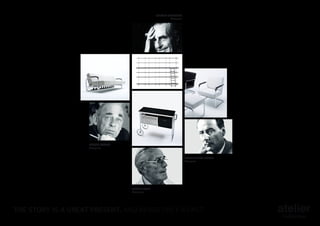
IGNAZIO GARDELLA
Designer

ALVAR AALTO
Designer

WERNER MAX MOSER
Designer

ALFRED ROTH
Designer

The story is a great present, and never only a past.
Master designers icon pieces
Atelier is part of Misuraemme Group and
it was created from a mental concept, a
particular vision of what furniture means,
not originated from a traditional craftmans’
or cabinet-makers’ workshop, but it was
created as an editor of very special design
collections.

The story is a great
present, and never
only a past.
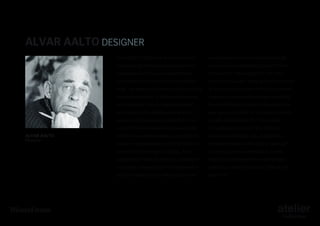
Alvar Aalto DESIGNER
From 1927 to 1935 Alvar Aalto worked on
two buildings which were to become the

this point on, his biography is rich with

contribute to his fame on an international

events and success, ranging from the design

level: the Municipal Library of Viipuri and the

of a simple sauna stool in birch to urbanistic

Paimio Sanatorium. In these constructions

projects such as the Säynätsalo Island and

of rationalistic imprint, Aalto succeeded

the reconstruction plans for Rovaniemi. He

in introducing the defining character of

was also responsible for numerous projects

organic architecture as exemplified in the

abroad, including the M.I.T. dormitory

use of form and material which eventually
Designer

new techniques developed by Aalto. From

masterpieces of his juvenile period and

ALVAR AALTO

warped wood furniture achieved through

in Cambridge, MA (USA) and the Riola

led to a new understanding of architecture.

Church near Bologna, Italy. Outside his

Based on the experience with the furniture

homeland, however, the organic approach

designed for these two buildings, Aalto

to architecture was intended as a pure

together with both his wife Aino and Maire

relationship between man-made projects

Gullichsen, founded the Artek trademark in

and nature. Alvar Aalto died in 1976 at the

1935 that specialized in the production of

age of 78.
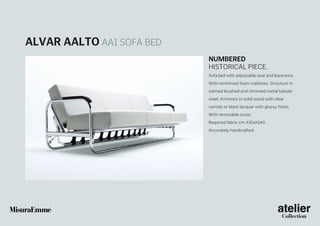
Alvar Aalto AA1 sofa bed
Numbered
historical piece.
Sofa bed with adjustable seat and backrests.
With reinforced foam mattress. Structure in
satined brushed and chromed metal tubular
steel. Armrests in solid wood with clear
varnish or black lacquer with glossy finish.
With removable cover.
Required fabric cm 430xh140.
Accurately handcrafted.
AA1 sofa bed CURIOSITY
Alvar Aalto’s sofa bed
is a mostly unknown
part in the biography of
the finish master.
In fact, before becoming internationally
famous, towards the end of the 1920’ies
Aalto adhered to the Germanic influenced
Functionalist Movement and in 1924
took part in the CIAM congress about the
“Exhistenzminimum” at Francfort where he
got in contact witch Gropius, Moholy-Nagy
and Giedion. In the same year he participated
in a competition organized by Thonet
Mundus for the design of chairs and furniture
with structure in bent steel tubing. It was
also Siegfried Giedion who called on him

for a collection he realized for Wohnbedarf
and then put in production a chair as well
as the adjustable sofabed which, in fact,
reflects perfectly the principles of economy,
simplicity of use and “lightness” in the
figurative sense recommended at Frankfurt.
The sofa, slightly modified on Giedion’s

was presented at
Stoccarda in 1932 and
on the occasion of the
Universal Exposition at
Bruxelles in 1935.
advice,
Alfred Roth DESIGNER
Was born in Wangen, Switzerland May 21st

on architecture. Many of his publications

1903 and studied architecture in Zürich

focused on his liaisons with the most

with Karl Moser. He worked in the studio

famous exponents of modern architecture,

of Le Corbusier and Pierre Jeanneret, for

such as Le Corbusier, Loos, Hoffmann,

whom he designed the two houses of the

Perret, Van De Velde, and Piet Mondrian.

International Exposition in Stuttgart. In 1931
he opened his own atelier and carried out
important projects in Switzerland, Sweden,
the United States, and in the Middle East.
In collaboration with Marcel Breuer he

ALFRED ROTH
Designer

constructed the “Doldertal” houses in Zürich.
In addition to serving as guest professor
at the Universities of Harvard and Saint
Louis as well as at the Polytechnic High
School in Zürich, he published several books
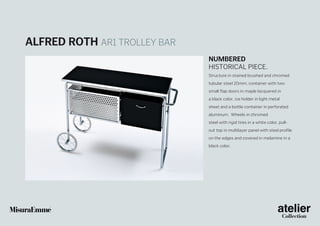
Alfred Roth AR1 trolley bar
Numbered
historical piece.
Structure in stained brushed and chromed
tubular steel 20mm, container with two
small flap doors in maple lacquered in
a black color, ice holder in light metal
sheet and a bottle container in perforated
aluminum. Wheels in chromed
steel with rigid tires in a white color, pullout top in multilayer panel with steel profile
on the edges and covered in melamine in a
black color.
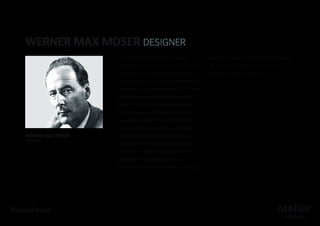
Werner Max Moser DESIGNER
Born in 1896 in Karlsruhe (D), studied

and Rudolf Graber, founded the Wohnbedarf

architecture both in Zürich with his father

AG Zurich–the collection for which he

Karl Moser and at Stuttgart with Bonatz,

designed numerous models.

Abel and Fiechter. He worked with different
architects in Holland and in the USA, where
he spent two years at Frank Lloyd Wright’s
atelier. He carried out important projects
in Switzerland and Germany, such as the
Budge-Heim house in Frankfurt and the
Neubühl Siedlung in Zürich, constructed

Werner Max Moser
Designer

with the collaboration of Mart Stam and
Ferdinand Kramer. After lecturing at Harvard
University, he became professor at the
Polytechnic High School of Zürich.
In 1931 Moser, along with Siegfried Giedon
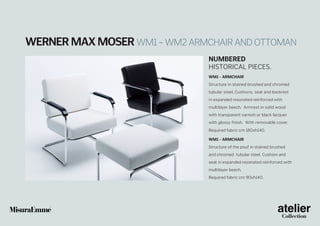
Werner Max Moser WM1 – WM2 armchair and ottoman
Numbered
historical pieceS.
WM1 - Armchair
Structure in stained brushed and chromed
tubular steel. Cushions, seat and backrest
in expanded resonated reinforced with
multilayer beech. Armrest in solid wood
with transparent varnish or black lacquer
with glossy finish. With removable cover.
Required fabric cm 180xh140.
WM1 - Armchair
Structure of the pouf in stained brushed
and chromed tubular steel. Cushion and
seat in expanded resonated reinforced with
multilayer beech.
Required fabric cm 90xh140.
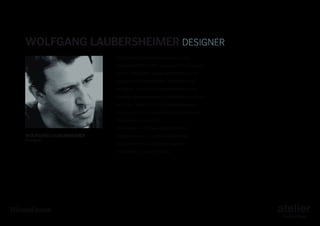
Wolfgang Laubersheimer DESIGNER
Wolfgang Laubersheimer: born in Bad
Kreuznach (D) in 1955, is one of the founders
of the “Pentagon” group which had a great
success on the exhibition “Documenta 8”
at Kassel. Furniture of simple forms using
durable materials which contrast on one side
with the “Gute Form” of postwar Bauhaus
traditions and on the other the post-modern
tendencies of the 80’s.
The intention of these young German

Wolfgang Laubersheimer
Designer

designers was to create independent
projects which radically change the
traditional concept of living.
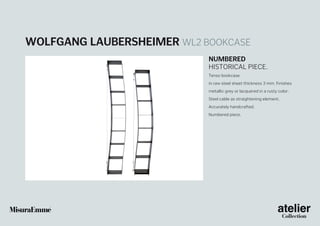
Wolfgang Laubersheimer WL2 bookcase
Numbered
historical piece.
Tenso bookcase
in raw steel sheet thickness 3 mm. Finishes
metallic grey or lacquered in a rusty color.
Steel cable as straightening element.
Accurately handcrafted.
Numbered piece.
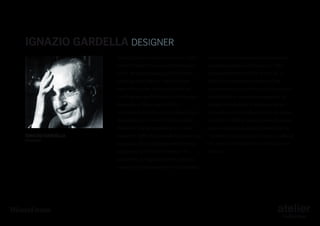
Ignazio Gardella DESIGNER
Ignazio Gardella was born in Milan in 1905
where he lived all his life and had his own

he travelled to the USA for the E.C.A., in

office Gardella-Martini, continuing the

1956 he accompanied students of the

work of his father. He received his first

architecture school of Venice to Greece and

Civil Engineering PhD from the Polytechnic

participated in international meetings of

University of Milan and his PhD in

Modern Architecture in Bergamo, Aix-en-

Architecture from the Istituto Universitario

Provence, La Sarraz after the war. He began

di Architettura of Venice. From the early

teaching in 1940 at various universities and

thirties he started expanding his travels
Designer

regarding modern architecture, in 1950

office. He started working in 1929 at the

IGNAZIO GARDELLA

in numerous congresses and discussions

was eventually appointed professor of the

abroad for both study and work, for example

“Elements of Composition” course in 1962 at

his stay in 1931 in Germany where he met

the Istituto Universitario of Architettura of

a groupe of architects in Frankfurt, his

Venice.

trip with Arch. Pagano in 1939 to Finland,
Sweden and Norway where he participated
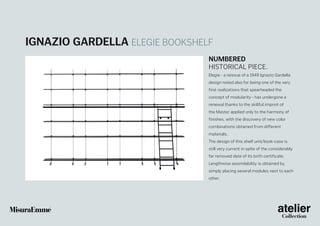
Ignazio Gardella Elegie bookshelf
Numbered
historical piece.
Elegie - a reissue of a 1949 Ignazio Gardella
design noted also for being one of the very
first realizations that spearheaded the
concept of modularity - has undergone a
renewal thanks to the skillful imprint of
the Master applied only to the harmony of
finishes, with the discovery of new color
combinations obtained from different
materials.
The design of this shelf unit/book-case is
still very current in spite of the considerably
far removed date of its birth certificate.
Lengthwise assimilability is obtained by
simply placing several modules next to each
other.
to be continued

Master Designers - Iconic Pieces - Atelier collection

  • 2.
    IGNAZIO GARDELLA Designer ALVAR AALTO Designer WERNERMAX MOSER Designer ALFRED ROTH Designer The story is a great present, and never only a past.
  • 3.
    Master designers iconpieces Atelier is part of Misuraemme Group and it was created from a mental concept, a particular vision of what furniture means, not originated from a traditional craftmans’ or cabinet-makers’ workshop, but it was created as an editor of very special design collections. The story is a great present, and never only a past.
  • 4.
    Alvar Aalto DESIGNER From1927 to 1935 Alvar Aalto worked on two buildings which were to become the this point on, his biography is rich with contribute to his fame on an international events and success, ranging from the design level: the Municipal Library of Viipuri and the of a simple sauna stool in birch to urbanistic Paimio Sanatorium. In these constructions projects such as the Säynätsalo Island and of rationalistic imprint, Aalto succeeded the reconstruction plans for Rovaniemi. He in introducing the defining character of was also responsible for numerous projects organic architecture as exemplified in the abroad, including the M.I.T. dormitory use of form and material which eventually Designer new techniques developed by Aalto. From masterpieces of his juvenile period and ALVAR AALTO warped wood furniture achieved through in Cambridge, MA (USA) and the Riola led to a new understanding of architecture. Church near Bologna, Italy. Outside his Based on the experience with the furniture homeland, however, the organic approach designed for these two buildings, Aalto to architecture was intended as a pure together with both his wife Aino and Maire relationship between man-made projects Gullichsen, founded the Artek trademark in and nature. Alvar Aalto died in 1976 at the 1935 that specialized in the production of age of 78.
  • 5.
    Alvar Aalto AA1sofa bed Numbered historical piece. Sofa bed with adjustable seat and backrests. With reinforced foam mattress. Structure in satined brushed and chromed metal tubular steel. Armrests in solid wood with clear varnish or black lacquer with glossy finish. With removable cover. Required fabric cm 430xh140. Accurately handcrafted.
  • 6.
    AA1 sofa bedCURIOSITY Alvar Aalto’s sofa bed is a mostly unknown part in the biography of the finish master. In fact, before becoming internationally famous, towards the end of the 1920’ies Aalto adhered to the Germanic influenced Functionalist Movement and in 1924 took part in the CIAM congress about the “Exhistenzminimum” at Francfort where he got in contact witch Gropius, Moholy-Nagy and Giedion. In the same year he participated in a competition organized by Thonet Mundus for the design of chairs and furniture with structure in bent steel tubing. It was also Siegfried Giedion who called on him for a collection he realized for Wohnbedarf and then put in production a chair as well as the adjustable sofabed which, in fact, reflects perfectly the principles of economy, simplicity of use and “lightness” in the figurative sense recommended at Frankfurt. The sofa, slightly modified on Giedion’s was presented at Stoccarda in 1932 and on the occasion of the Universal Exposition at Bruxelles in 1935. advice,
  • 7.
    Alfred Roth DESIGNER Wasborn in Wangen, Switzerland May 21st on architecture. Many of his publications 1903 and studied architecture in Zürich focused on his liaisons with the most with Karl Moser. He worked in the studio famous exponents of modern architecture, of Le Corbusier and Pierre Jeanneret, for such as Le Corbusier, Loos, Hoffmann, whom he designed the two houses of the Perret, Van De Velde, and Piet Mondrian. International Exposition in Stuttgart. In 1931 he opened his own atelier and carried out important projects in Switzerland, Sweden, the United States, and in the Middle East. In collaboration with Marcel Breuer he ALFRED ROTH Designer constructed the “Doldertal” houses in Zürich. In addition to serving as guest professor at the Universities of Harvard and Saint Louis as well as at the Polytechnic High School in Zürich, he published several books
  • 8.
    Alfred Roth AR1trolley bar Numbered historical piece. Structure in stained brushed and chromed tubular steel 20mm, container with two small flap doors in maple lacquered in a black color, ice holder in light metal sheet and a bottle container in perforated aluminum. Wheels in chromed steel with rigid tires in a white color, pullout top in multilayer panel with steel profile on the edges and covered in melamine in a black color.
  • 9.
    Werner Max MoserDESIGNER Born in 1896 in Karlsruhe (D), studied and Rudolf Graber, founded the Wohnbedarf architecture both in Zürich with his father AG Zurich–the collection for which he Karl Moser and at Stuttgart with Bonatz, designed numerous models. Abel and Fiechter. He worked with different architects in Holland and in the USA, where he spent two years at Frank Lloyd Wright’s atelier. He carried out important projects in Switzerland and Germany, such as the Budge-Heim house in Frankfurt and the Neubühl Siedlung in Zürich, constructed Werner Max Moser Designer with the collaboration of Mart Stam and Ferdinand Kramer. After lecturing at Harvard University, he became professor at the Polytechnic High School of Zürich. In 1931 Moser, along with Siegfried Giedon
  • 10.
    Werner Max MoserWM1 – WM2 armchair and ottoman Numbered historical pieceS. WM1 - Armchair Structure in stained brushed and chromed tubular steel. Cushions, seat and backrest in expanded resonated reinforced with multilayer beech. Armrest in solid wood with transparent varnish or black lacquer with glossy finish. With removable cover. Required fabric cm 180xh140. WM1 - Armchair Structure of the pouf in stained brushed and chromed tubular steel. Cushion and seat in expanded resonated reinforced with multilayer beech. Required fabric cm 90xh140.
  • 11.
    Wolfgang Laubersheimer DESIGNER WolfgangLaubersheimer: born in Bad Kreuznach (D) in 1955, is one of the founders of the “Pentagon” group which had a great success on the exhibition “Documenta 8” at Kassel. Furniture of simple forms using durable materials which contrast on one side with the “Gute Form” of postwar Bauhaus traditions and on the other the post-modern tendencies of the 80’s. The intention of these young German Wolfgang Laubersheimer Designer designers was to create independent projects which radically change the traditional concept of living.
  • 12.
    Wolfgang Laubersheimer WL2bookcase Numbered historical piece. Tenso bookcase in raw steel sheet thickness 3 mm. Finishes metallic grey or lacquered in a rusty color. Steel cable as straightening element. Accurately handcrafted. Numbered piece.
  • 13.
    Ignazio Gardella DESIGNER IgnazioGardella was born in Milan in 1905 where he lived all his life and had his own he travelled to the USA for the E.C.A., in office Gardella-Martini, continuing the 1956 he accompanied students of the work of his father. He received his first architecture school of Venice to Greece and Civil Engineering PhD from the Polytechnic participated in international meetings of University of Milan and his PhD in Modern Architecture in Bergamo, Aix-en- Architecture from the Istituto Universitario Provence, La Sarraz after the war. He began di Architettura of Venice. From the early teaching in 1940 at various universities and thirties he started expanding his travels Designer regarding modern architecture, in 1950 office. He started working in 1929 at the IGNAZIO GARDELLA in numerous congresses and discussions was eventually appointed professor of the abroad for both study and work, for example “Elements of Composition” course in 1962 at his stay in 1931 in Germany where he met the Istituto Universitario of Architettura of a groupe of architects in Frankfurt, his Venice. trip with Arch. Pagano in 1939 to Finland, Sweden and Norway where he participated
  • 14.
    Ignazio Gardella Elegiebookshelf Numbered historical piece. Elegie - a reissue of a 1949 Ignazio Gardella design noted also for being one of the very first realizations that spearheaded the concept of modularity - has undergone a renewal thanks to the skillful imprint of the Master applied only to the harmony of finishes, with the discovery of new color combinations obtained from different materials. The design of this shelf unit/book-case is still very current in spite of the considerably far removed date of its birth certificate. Lengthwise assimilability is obtained by simply placing several modules next to each other.
  • 15.