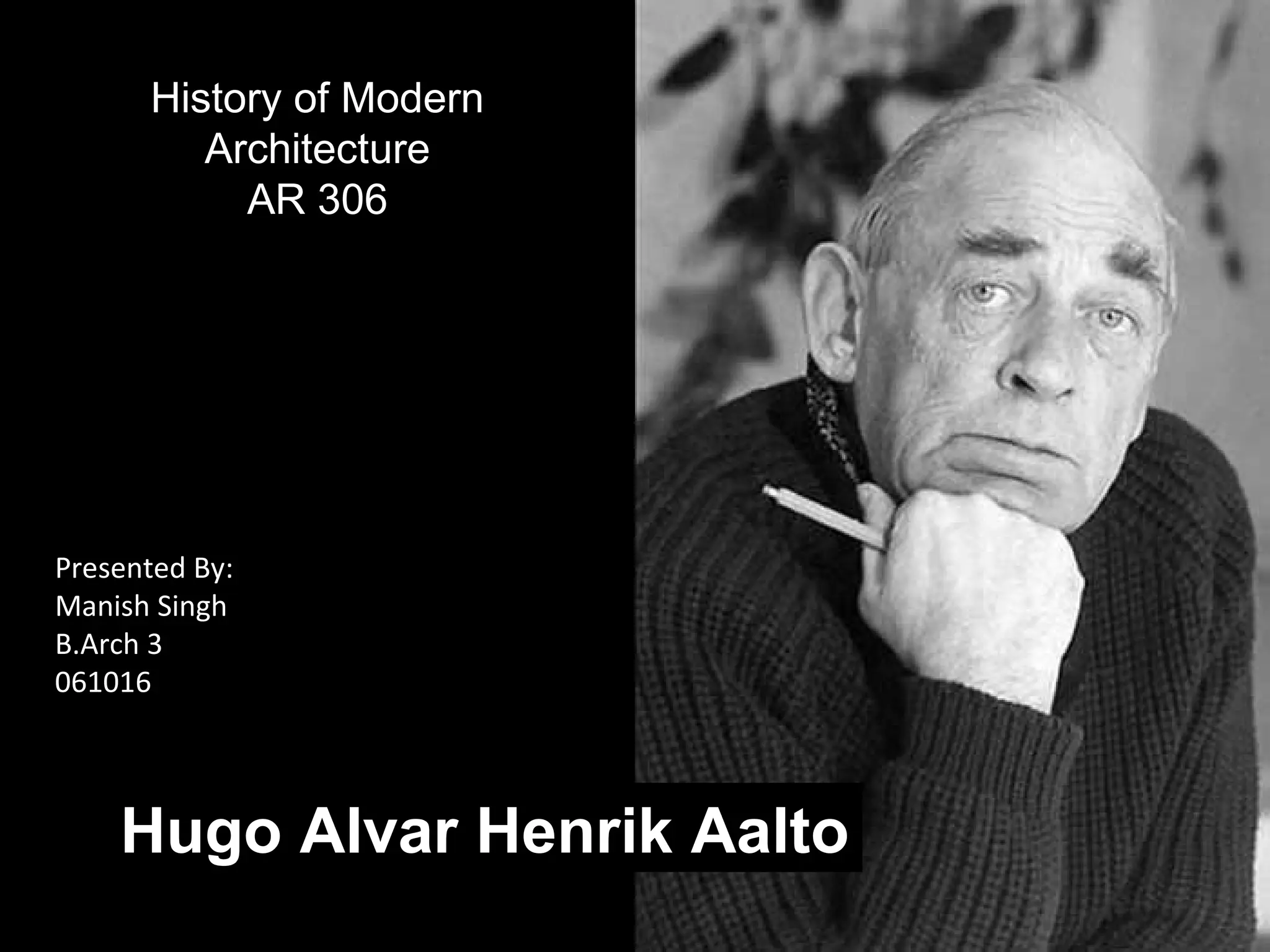
Hugo Alvar Henrik Aalto
Presented By:
Manish Singh
B.Arch 3
061016
History of Modern
Architecture
AR 306
February 3, 1898 — May 11, 1976
Introduction
Finnish architect and designer
"Father of Modernism" in the Scandinavian countries
Work includes architecture, furniture, textiles and
glassware
born in Kuortane, Finland
His father, Johan Henrik Aalto, was a Finnish-speaking land-
surveyor
married architect Aino Marsio, who became Aino Alto
In 1952 Aalto married architect Elissa Mäkiniemi
Nordic modernism
Humanistic Modernism
Functionalism
Bio Architecture
Philosophy:
Embodied Rationalism
Philosophy:
Nordic modernism
•First and most influential architects of
Nordic modernism.
•Nordic countries architects were practicing
so-called Nordic Classicism style - a style
that had been a reaction to the previous
dominant style of National Romanticism -
before moving, in the late 1920s
•Aalto's career spans the changes in style
from (Nordic Classicism) to purist
International Style Modernism to a more
personal, synthetic and idiosyncratic
Modernism
Humanistic Modernism
• Viewed the machine age as dehumanizing and believed it harmed
social relationships and human worth
• Humanistic design
• Clear message: Aesthetics and functionality belong to all
Functionalism
Usage dictates the outward form, without
regard to such traditional conceptions of
symmetry, proportions, etc
•Strongly influenced by the nature : Finnish forests and
lakes
•Bio-climatic solutions
•There is a particular care in the use of natural
materials, in the insertion of the building in the natural
environment, in the best sunshine conditions and
natural lighting.
Bio Architecture
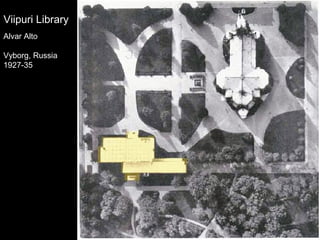
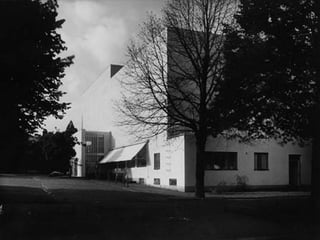
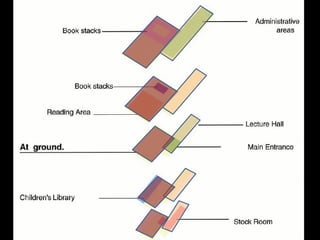
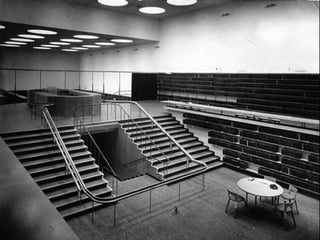
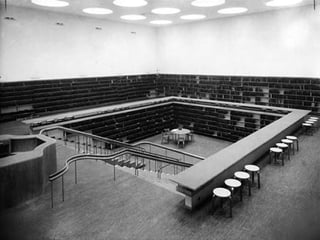
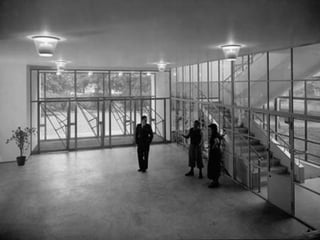
Viipuri Library
Alvar Alto
Vyborg, Russia
1927-35
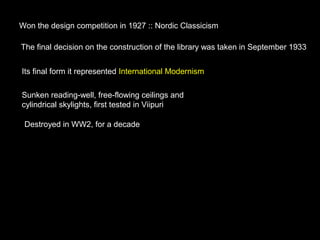
Won the design competition in 1927 :: Nordic Classicism
The final decision on the construction of the library was taken in September 1933
Its final form it represented International Modernism
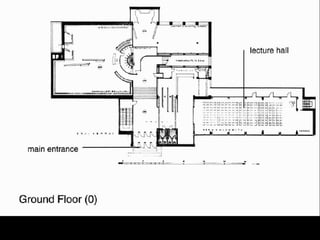
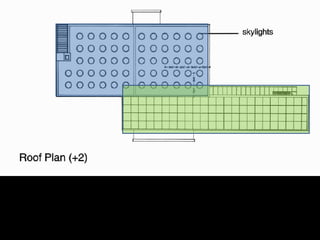
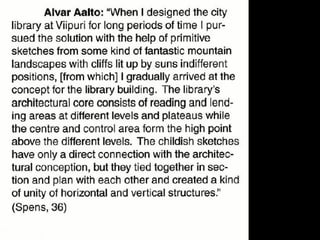
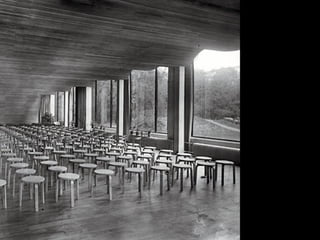
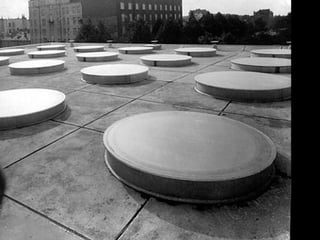
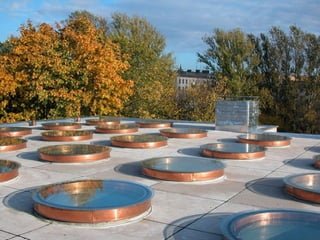
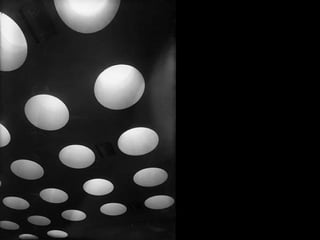
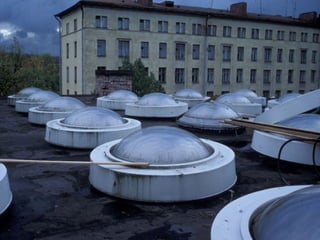
Sunken reading-well, free-flowing ceilings and
cylindrical skylights, first tested in Viipuri
Destroyed in WW2, for a decade
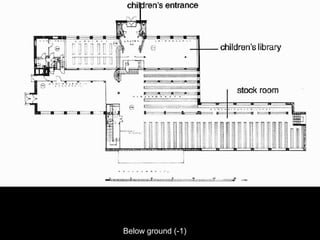
Below ground (-1)
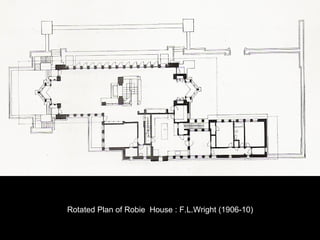
Rotated Plan of Robie House : F.L.Wright (1906-10)
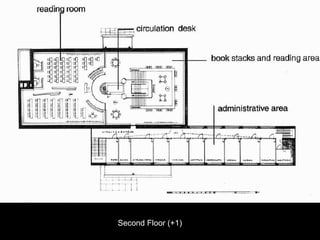
Second Floor (+1)
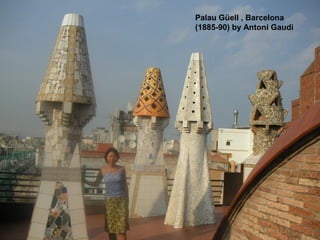
Palau Güell , Barcelona
(1885-90) by Antoni Gaudi
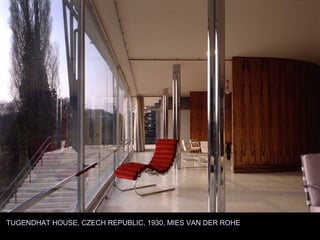
LUDWIG MIES VAN DER ROHE
TUGENDHAT HOUSE, CZECH REPUBLIC, 1930, MIES VAN DER ROHE
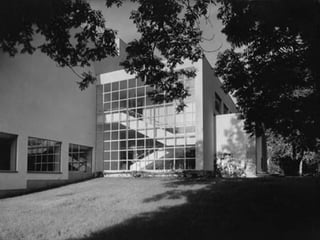
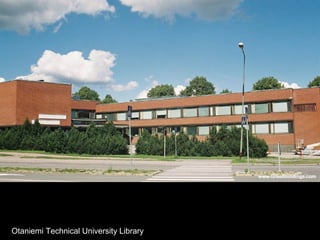
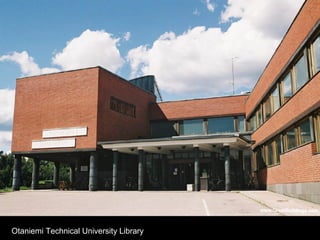
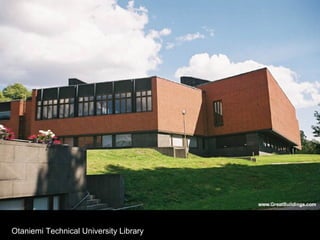
Otaniemi Technical University Library
Alvar Alto ,Otaniemi, Finland,1964-69
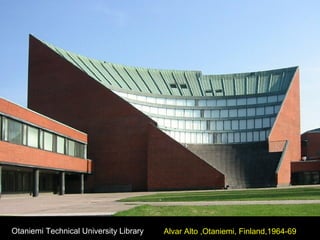
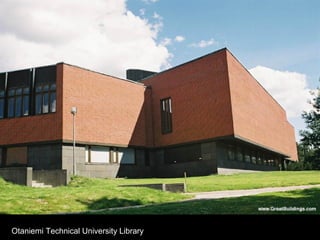
Otaniemi Technical University Library Alvar Alto ,Otaniemi, Finland,1964-69
•Red brick, black granite, and copper
•University include the main building, the
library, the shopping centre, and the water
tower, with a crescent-shaped auditorium
at the center
•International Style
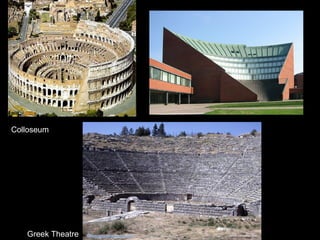
•Campus buildings pivot around landmark
form of main auditorium, reminiscent of a
Greek Theater
Colloseum
Greek Theatre
Otaniemi Technical University Library
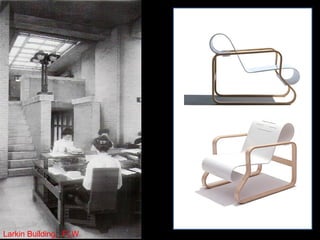
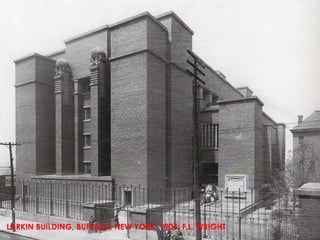
LARKIN BUILDING, BUFFALO, NEW YORK, 1904; F.L. WRIGHT
Otaniemi Technical University Library
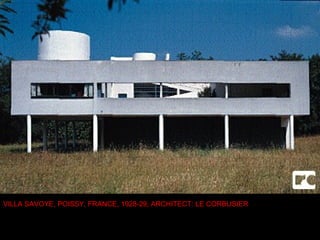
VILLA SAVOYE, POISSY, FRANCE, 1928-29; ARCHITECT: LE CORBUSIER
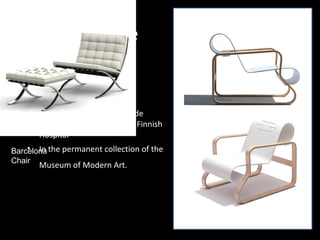
Furniture
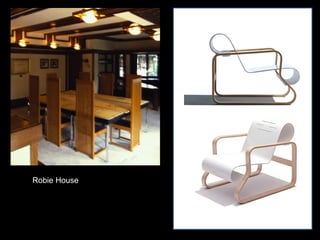
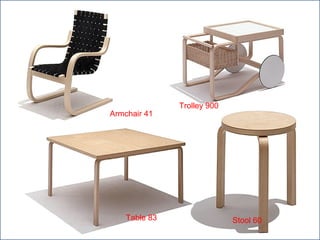
• Armchair 41
• Designed originally to exude
warmth and humanity in a Finnish
Hospital
• In the permanent collection of the
Museum of Modern Art.
Barcelona
Chair
Larkin Building , FLW
Robie House
Armchair 41
Trolley 900
Stool 60Table 83
Glassware
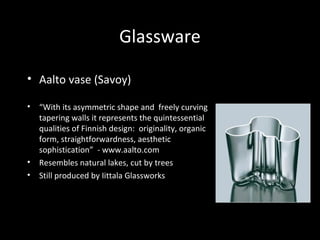
• Aalto vase (Savoy)
• “With its asymmetric shape and freely curving
tapering walls it represents the quintessential
qualities of Finnish design: originality, organic
form, straightforwardness, aesthetic
sophistication” - www.aalto.com
• Resembles natural lakes, cut by trees
• Still produced by Iittala Glassworks
Embodied Rationalism
Alvar Aalto is often treated as the most important
early Modernist
who doesn’t fit
The mainstream, nearly filmic
narrative begins with the work of Frank Lloyd Wright, and then,
in a series of cuts, presents a central cast of characters in which
Le Corbusier, Ludwig Mies van der Rohe,
and Walter Gropius play leading roles
Many of his design methods contravene
the precepts by which Modernism is
typically conceived
If Modernism was concerned with mass production, Aalto
almost defiantly celebrated the irregularities and idiosyncracies
of handicraft.
If Modernism aspired to universalism, Aalto—
putatively, at least—practiced particularism. If Modernists
embraced structural rationalism, or at least the pretense of it,
Aalto exhibited an only occasional interest in exhibiting the
structure of his buildings.
Aalto refused to integrate structure with form and masked hybrid
structural solutions freely: load-bearing masonry here, steel beams, or
poured concrete there.
If Modernism insisted upon the symbolic
importance and pragmatic superiority of new materials, Aalto
liberally mixed old with new—wood; stucco; reinforced, poured,
and prefabricated concrete; steel; brick.
If Modernism suffered a
deep ambivalence toward typology and historic precedent, Aalto
freely drew from Eric Gunnar Asplund’s Stockholm Public Library,
Le Corbusier’s Villa Savoye, the Vesnin Brothers’ project for
Pravda, Italian Renaissance palazzi, Finnish country churches,
Karelian courtyard farmhouses, Roman amphitheaters, and more.
Source ::
Ultraviolet: Alvar Aalto’s
Embodied Rationalism
Howard Design Magazine
(2008)
If Modernism mandated a functional approach to planning and
consequently a formal abstraction, Aalto’s buildings pulsate with
figuration and symbols.
If Modernism redefined architecture as
space, Aalto celebrated objectness. If Modernism whispered
or shouted transparency, Aalto’s buildings revel in their long
passages of opacity
Source ::
Ultraviolet: Alvar Aalto’s
Embodied Rationalism
Howard Design Magazine (2008)
For Aalto, rationalism and humanism intermeshed so much
that the concepts were practically coterminous.
Aalto’s rationalism better describes the cognitive realities of
human experience than did the multifarious rationalisms
advanced by his contemporaneous Modernist colleagues.
Aalto’s conception of rationalism and place it within these longstanding
intellectual traditions. Only then can the alternative
notion of rationalism, which I call embodied rationalism.
Conclusion
Embodied Rationalism : Alvar Alto
Thank You

Alvar Aalto

  • 1.
    Hugo Alvar HenrikAalto Presented By: Manish Singh B.Arch 3 061016 History of Modern Architecture AR 306
  • 2.
    February 3, 1898— May 11, 1976 Introduction Finnish architect and designer "Father of Modernism" in the Scandinavian countries Work includes architecture, furniture, textiles and glassware born in Kuortane, Finland His father, Johan Henrik Aalto, was a Finnish-speaking land- surveyor married architect Aino Marsio, who became Aino Alto In 1952 Aalto married architect Elissa Mäkiniemi
  • 3.
    Nordic modernism Humanistic Modernism Functionalism BioArchitecture Philosophy: Embodied Rationalism
  • 4.
    Philosophy: Nordic modernism •First andmost influential architects of Nordic modernism. •Nordic countries architects were practicing so-called Nordic Classicism style - a style that had been a reaction to the previous dominant style of National Romanticism - before moving, in the late 1920s •Aalto's career spans the changes in style from (Nordic Classicism) to purist International Style Modernism to a more personal, synthetic and idiosyncratic Modernism
  • 5.
    Humanistic Modernism • Viewedthe machine age as dehumanizing and believed it harmed social relationships and human worth • Humanistic design • Clear message: Aesthetics and functionality belong to all
  • 6.
    Functionalism Usage dictates theoutward form, without regard to such traditional conceptions of symmetry, proportions, etc
  • 7.
    •Strongly influenced bythe nature : Finnish forests and lakes •Bio-climatic solutions •There is a particular care in the use of natural materials, in the insertion of the building in the natural environment, in the best sunshine conditions and natural lighting. Bio Architecture
  • 8.
  • 10.
    Won the designcompetition in 1927 :: Nordic Classicism The final decision on the construction of the library was taken in September 1933 Its final form it represented International Modernism Sunken reading-well, free-flowing ceilings and cylindrical skylights, first tested in Viipuri Destroyed in WW2, for a decade
  • 11.
  • 13.
    Rotated Plan ofRobie House : F.L.Wright (1906-10)
  • 14.
  • 28.
    Palau Güell ,Barcelona (1885-90) by Antoni Gaudi
  • 30.
    LUDWIG MIES VANDER ROHE TUGENDHAT HOUSE, CZECH REPUBLIC, 1930, MIES VAN DER ROHE
  • 31.
    Otaniemi Technical UniversityLibrary Alvar Alto ,Otaniemi, Finland,1964-69
  • 32.
    Otaniemi Technical UniversityLibrary Alvar Alto ,Otaniemi, Finland,1964-69
  • 33.
    •Red brick, blackgranite, and copper •University include the main building, the library, the shopping centre, and the water tower, with a crescent-shaped auditorium at the center •International Style •Campus buildings pivot around landmark form of main auditorium, reminiscent of a Greek Theater
  • 34.
  • 35.
  • 36.
  • 37.
    LARKIN BUILDING, BUFFALO,NEW YORK, 1904; F.L. WRIGHT
  • 38.
  • 39.
  • 40.
    VILLA SAVOYE, POISSY,FRANCE, 1928-29; ARCHITECT: LE CORBUSIER
  • 41.
    Furniture • Armchair 41 •Designed originally to exude warmth and humanity in a Finnish Hospital • In the permanent collection of the Museum of Modern Art. Barcelona Chair
  • 42.
  • 43.
  • 44.
  • 46.
    Glassware • Aalto vase(Savoy) • “With its asymmetric shape and freely curving tapering walls it represents the quintessential qualities of Finnish design: originality, organic form, straightforwardness, aesthetic sophistication” - www.aalto.com • Resembles natural lakes, cut by trees • Still produced by Iittala Glassworks
  • 47.
    Embodied Rationalism Alvar Aaltois often treated as the most important early Modernist who doesn’t fit The mainstream, nearly filmic narrative begins with the work of Frank Lloyd Wright, and then, in a series of cuts, presents a central cast of characters in which Le Corbusier, Ludwig Mies van der Rohe, and Walter Gropius play leading roles Many of his design methods contravene the precepts by which Modernism is typically conceived
  • 48.
    If Modernism wasconcerned with mass production, Aalto almost defiantly celebrated the irregularities and idiosyncracies of handicraft. If Modernism aspired to universalism, Aalto— putatively, at least—practiced particularism. If Modernists embraced structural rationalism, or at least the pretense of it, Aalto exhibited an only occasional interest in exhibiting the structure of his buildings. Aalto refused to integrate structure with form and masked hybrid structural solutions freely: load-bearing masonry here, steel beams, or poured concrete there. If Modernism insisted upon the symbolic importance and pragmatic superiority of new materials, Aalto liberally mixed old with new—wood; stucco; reinforced, poured, and prefabricated concrete; steel; brick. If Modernism suffered a deep ambivalence toward typology and historic precedent, Aalto freely drew from Eric Gunnar Asplund’s Stockholm Public Library, Le Corbusier’s Villa Savoye, the Vesnin Brothers’ project for Pravda, Italian Renaissance palazzi, Finnish country churches, Karelian courtyard farmhouses, Roman amphitheaters, and more. Source :: Ultraviolet: Alvar Aalto’s Embodied Rationalism Howard Design Magazine (2008)
  • 49.
    If Modernism mandateda functional approach to planning and consequently a formal abstraction, Aalto’s buildings pulsate with figuration and symbols. If Modernism redefined architecture as space, Aalto celebrated objectness. If Modernism whispered or shouted transparency, Aalto’s buildings revel in their long passages of opacity Source :: Ultraviolet: Alvar Aalto’s Embodied Rationalism Howard Design Magazine (2008)
  • 50.
    For Aalto, rationalismand humanism intermeshed so much that the concepts were practically coterminous. Aalto’s rationalism better describes the cognitive realities of human experience than did the multifarious rationalisms advanced by his contemporaneous Modernist colleagues. Aalto’s conception of rationalism and place it within these longstanding intellectual traditions. Only then can the alternative notion of rationalism, which I call embodied rationalism. Conclusion Embodied Rationalism : Alvar Alto
  • 51.