Master Databricks with AccentFuture – Online Training
Boost your data expertise with AccentFuture’s Databricks online training. Learn data engineering, analytics, and machine learning through hands-on projects and expert-led sessions.
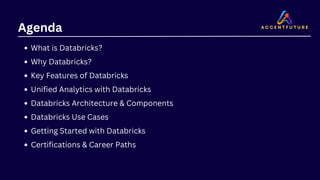
Agenda
What is Databricks?
WhyDatabricks?
Key Features of Databricks
Unified Analytics with Databricks
Databricks Architecture & Components
Databricks Use Cases
Getting Started with Databricks
Certifications & Career Paths
3.
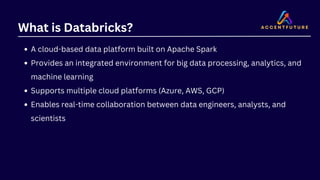
What is Databricks?
Acloud-based data platform built on Apache Spark
Provides an integrated environment for big data processing, analytics, and
machine learning
Supports multiple cloud platforms (Azure, AWS, GCP)
Enables real-time collaboration between data engineers, analysts, and
scientists
4.
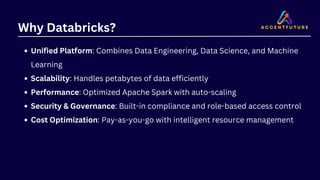
Why Databricks?
Unified Platform:Combines Data Engineering, Data Science, and Machine
Learning
Scalability: Handles petabytes of data efficiently
Performance: Optimized Apache Spark with auto-scaling
Security & Governance: Built-in compliance and role-based access control
Cost Optimization: Pay-as-you-go with intelligent resource management
5.
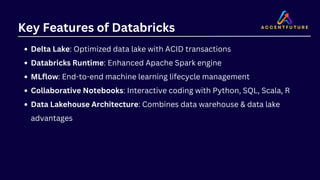
Key Features ofDatabricks
Delta Lake: Optimized data lake with ACID transactions
Databricks Runtime: Enhanced Apache Spark engine
MLflow: End-to-end machine learning lifecycle management
Collaborative Notebooks: Interactive coding with Python, SQL, Scala, R
Data Lakehouse Architecture: Combines data warehouse & data lake
advantages
6.
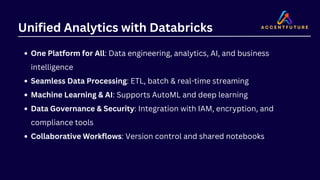
Unified Analytics withDatabricks
One Platform for All: Data engineering, analytics, AI, and business
intelligence
Seamless Data Processing: ETL, batch & real-time streaming
Machine Learning & AI: Supports AutoML and deep learning
Data Governance & Security: Integration with IAM, encryption, and
compliance tools
Collaborative Workflows: Version control and shared notebooks
7.
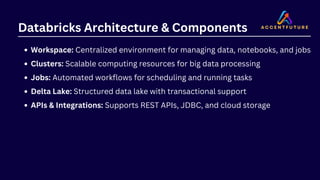
Databricks Architecture &Components
Workspace: Centralized environment for managing data, notebooks, and jobs
Clusters: Scalable computing resources for big data processing
Jobs: Automated workflows for scheduling and running tasks
Delta Lake: Structured data lake with transactional support
APIs & Integrations: Supports REST APIs, JDBC, and cloud storage
8.
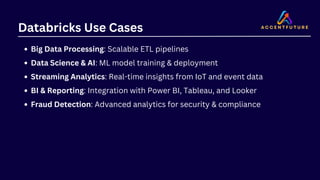
Databricks Use Cases
BigData Processing: Scalable ETL pipelines
Data Science & AI: ML model training & deployment
Streaming Analytics: Real-time insights from IoT and event data
BI & Reporting: Integration with Power BI, Tableau, and Looker
Fraud Detection: Advanced analytics for security & compliance
9.
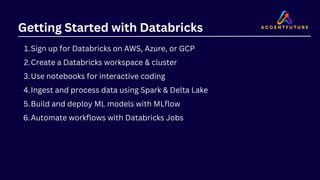
Getting Started withDatabricks
Sign up for Databricks on AWS, Azure, or GCP
1.
Create a Databricks workspace & cluster
2.
Use notebooks for interactive coding
3.
Ingest and process data using Spark & Delta Lake
4.
Build and deploy ML models with MLflow
5.
Automate workflows with Databricks Jobs
6.
10.
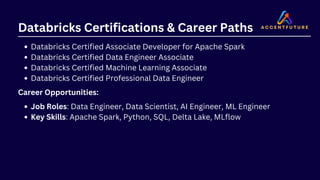
Databricks Certifications &Career Paths
Databricks Certified Associate Developer for Apache Spark
Databricks Certified Data Engineer Associate
Databricks Certified Machine Learning Associate
Databricks Certified Professional Data Engineer
Career Opportunities:
Job Roles: Data Engineer, Data Scientist, AI Engineer, ML Engineer
Key Skills: Apache Spark, Python, SQL, Delta Lake, MLflow
11.
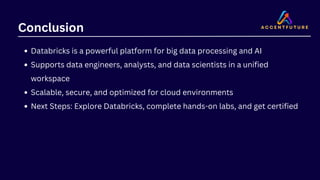
Conclusion
Databricks is apowerful platform for big data processing and AI
Supports data engineers, analysts, and data scientists in a unified
workspace
Scalable, secure, and optimized for cloud environments
Next Steps: Explore Databricks, complete hands-on labs, and get certified