SPARK
PERFORMANCE
TUNING
Optimize Your PySpark Applications with Confidence
AccentFuture – Best PySpark & Databricks Online Training
+91-96400 01789
contact@accentfuture.com
W H Y S PA R K P E R F O R M A N C E
T U N I N G M AT T E R S
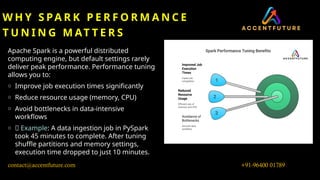
Apache Spark is a powerful distributed
computing engine, but default settings rarely
deliver peak performance. Performance tuning
allows you to:
o Improve job execution times significantly
o Reduce resource usage (memory, CPU)
o Avoid bottlenecks in data-intensive
workflows
o 🎯 Example: A data ingestion job in PySpark
took 45 minutes to complete. After tuning
shuffle partitions and memory settings,
execution time dropped to just 10 minutes.
+91-96400 01789
contact@accentfuture.com
U N D E R S T A N D I N G T H E S P A R K E X E C U T I O N M O D E L
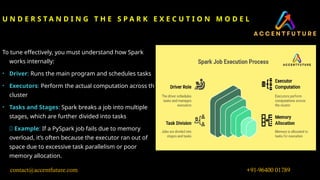
To tune effectively, you must understand how Spark
works internally:
• Driver: Runs the main program and schedules tasks
• Executors: Perform the actual computation across the
cluster
• Tasks and Stages: Spark breaks a job into multiple
stages, which are further divided into tasks
📘 Example: If a PySpark job fails due to memory
overload, it’s often because the executor ran out of
space due to excessive task parallelism or poor
memory allocation.
contact@accentfuture.com +91-96400 01789
M E M O R Y M A N A G E M E N T – G E T T I N G I T
R I G H T
Memory tuning is critical for Spark performance. The main settings include:
o spark.executor.memory: Total memory allocated per executor
o spark.memory.fraction: Controls how much memory is for storage vs execution
o spark.driver.memory: Memory available to the driver
💡 Example: Increasing executor.memory from 4GB to 8GB helped reduce garbage
collection overhead in a machine learning pipeline using PySpark on Databricks.
+91-96400 01789
contact@accentfuture.com
S H U F F L E O P T I M I Z A T I O N – T H E H I D D E N
P E R F O R M A N C E K I L L E R
Shuffles happen when Spark moves data between partitions, often due to operations
like groupBy, join, or distinct.
Tuning Tips:
• Replace groupByKey() with reduceByKey()
• Use broadcast joins when one dataset is small
• Set spark.sql.shuffle.partitions to match your data size and cluster
🧪 Example: A PySpark join on two large DataFrames caused a huge shuffle stage.
By using a broadcast join on the smaller table, shuffle size dropped by 80%, and
runtime improved by 3x.
+91-96400 01789
contact@accentfuture.com
P A R T I T I O N I N G S T R AT E G Y –
B A L A N C I N G T H E L O A D
Spark parallelizes operations by partitioning data.
Poor partitioning leads to:
• Skewed load across executors
• Underutilization of cluster resources
• Memory errors or slow tasks
Best Practices:
• Use repartition() for full reshuffling
• Use coalesce() to reduce partitions efficiently
• Target partition sizes around 100–200MB
🧪 Example: In a 2TB retail dataset, repartitioning
from 100 to 800 improved query performance
and reduced spill to disk.
+91-96400 01789
contact@accentfuture.com
0
7
/
0
4
/
2
0
2
5
7
C A C H I N G A N D P E R S I S T E N C E
– A V O I D R E C O M P U T I N G
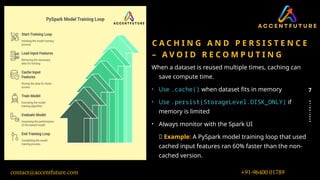
When a dataset is reused multiple times, caching can
save compute time.
• Use .cache() when dataset fits in memory
• Use .persist(StorageLevel.DISK_ONLY) if
memory is limited
• Always monitor with the Spark UI
💡 Example: A PySpark model training loop that used
cached input features ran 60% faster than the non-
cached version.
+91-96400 01789
contact@accentfuture.com
0
7
/
0
4
/
2
0
2
5
8
S E R I A L I Z AT I O N & R E S O U R C E
S E T T I N G S
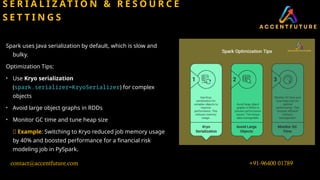
Spark uses Java serialization by default, which is slow and
bulky.
Optimization Tips:
• Use Kryo serialization
(spark.serializer=KryoSerializer) for complex
objects
• Avoid large object graphs in RDDs
• Monitor GC time and tune heap size
🧪 Example: Switching to Kryo reduced job memory usage
by 40% and boosted performance for a financial risk
modeling job in PySpark.
+91-96400 01789
contact@accentfuture.com
0
7
/
0
4
/
2
0
2
5
9
S U M M A R Y & L E A R N I N G P AT H W I T H
A C C E N T F U T U R E
Key Takeaways:
• Understand the execution model
• Tune memory, partitions, and shuffles
• Use caching and smart joins
• Monitor jobs using Spark UI
🎓 Ready to Master Spark?
Explore our expert-led programs:
✅ Apache PySpark training
✅ Best PySpark course for real-time data pipelines
✅ Databricks online course for enterprise-ready skills
🔗 Start your learning at: www.accentfuture.com
+91-96400 01789
contact@accentfuture.com

0
7
/
0
4
/
2
0
2
5
10
CO NTACT DE TA ILS
• 📧 contact@accentfuture.com
• 🌐 AccentFuture
• 📞 +91-96400 01789
contact@accentfuture.com +91-96400 01789

Spark Performance Tuning | Best PySpark & Databricks Online Training

  • 1.
    SPARK PERFORMANCE TUNING Optimize Your PySparkApplications with Confidence AccentFuture – Best PySpark & Databricks Online Training +91-96400 01789 contact@accentfuture.com
  • 2.
    W H YS PA R K P E R F O R M A N C E T U N I N G M AT T E R S Apache Spark is a powerful distributed computing engine, but default settings rarely deliver peak performance. Performance tuning allows you to: o Improve job execution times significantly o Reduce resource usage (memory, CPU) o Avoid bottlenecks in data-intensive workflows o 🎯 Example: A data ingestion job in PySpark took 45 minutes to complete. After tuning shuffle partitions and memory settings, execution time dropped to just 10 minutes. +91-96400 01789 contact@accentfuture.com
  • 3.
    U N DE R S T A N D I N G T H E S P A R K E X E C U T I O N M O D E L To tune effectively, you must understand how Spark works internally: • Driver: Runs the main program and schedules tasks • Executors: Perform the actual computation across the cluster • Tasks and Stages: Spark breaks a job into multiple stages, which are further divided into tasks 📘 Example: If a PySpark job fails due to memory overload, it’s often because the executor ran out of space due to excessive task parallelism or poor memory allocation. contact@accentfuture.com +91-96400 01789
  • 4.
    M E MO R Y M A N A G E M E N T – G E T T I N G I T R I G H T Memory tuning is critical for Spark performance. The main settings include: o spark.executor.memory: Total memory allocated per executor o spark.memory.fraction: Controls how much memory is for storage vs execution o spark.driver.memory: Memory available to the driver 💡 Example: Increasing executor.memory from 4GB to 8GB helped reduce garbage collection overhead in a machine learning pipeline using PySpark on Databricks. +91-96400 01789 contact@accentfuture.com
  • 5.
    S H UF F L E O P T I M I Z A T I O N – T H E H I D D E N P E R F O R M A N C E K I L L E R Shuffles happen when Spark moves data between partitions, often due to operations like groupBy, join, or distinct. Tuning Tips: • Replace groupByKey() with reduceByKey() • Use broadcast joins when one dataset is small • Set spark.sql.shuffle.partitions to match your data size and cluster 🧪 Example: A PySpark join on two large DataFrames caused a huge shuffle stage. By using a broadcast join on the smaller table, shuffle size dropped by 80%, and runtime improved by 3x. +91-96400 01789 contact@accentfuture.com
  • 6.
    P A RT I T I O N I N G S T R AT E G Y – B A L A N C I N G T H E L O A D Spark parallelizes operations by partitioning data. Poor partitioning leads to: • Skewed load across executors • Underutilization of cluster resources • Memory errors or slow tasks Best Practices: • Use repartition() for full reshuffling • Use coalesce() to reduce partitions efficiently • Target partition sizes around 100–200MB 🧪 Example: In a 2TB retail dataset, repartitioning from 100 to 800 improved query performance and reduced spill to disk. +91-96400 01789 contact@accentfuture.com
  • 7.
    0 7 / 0 4 / 2 0 2 5 7 C A CH I N G A N D P E R S I S T E N C E – A V O I D R E C O M P U T I N G When a dataset is reused multiple times, caching can save compute time. • Use .cache() when dataset fits in memory • Use .persist(StorageLevel.DISK_ONLY) if memory is limited • Always monitor with the Spark UI 💡 Example: A PySpark model training loop that used cached input features ran 60% faster than the non- cached version. +91-96400 01789 contact@accentfuture.com
  • 8.
    0 7 / 0 4 / 2 0 2 5 8 S E RI A L I Z AT I O N & R E S O U R C E S E T T I N G S Spark uses Java serialization by default, which is slow and bulky. Optimization Tips: • Use Kryo serialization (spark.serializer=KryoSerializer) for complex objects • Avoid large object graphs in RDDs • Monitor GC time and tune heap size 🧪 Example: Switching to Kryo reduced job memory usage by 40% and boosted performance for a financial risk modeling job in PySpark. +91-96400 01789 contact@accentfuture.com
  • 9.
    0 7 / 0 4 / 2 0 2 5 9 S U MM A R Y & L E A R N I N G P AT H W I T H A C C E N T F U T U R E Key Takeaways: • Understand the execution model • Tune memory, partitions, and shuffles • Use caching and smart joins • Monitor jobs using Spark UI 🎓 Ready to Master Spark? Explore our expert-led programs: ✅ Apache PySpark training ✅ Best PySpark course for real-time data pipelines ✅ Databricks online course for enterprise-ready skills 🔗 Start your learning at: www.accentfuture.com +91-96400 01789 contact@accentfuture.com

  • 10.
    0 7 / 0 4 / 2 0 2 5 10 CO NTACT DETA ILS • 📧 contact@accentfuture.com • 🌐 AccentFuture • 📞 +91-96400 01789 contact@accentfuture.com +91-96400 01789