1
Women helping women
in entrepreneurship:
Funding Sources	
  
July 24, 2013
MassChallenge
Participants:
Sheryl Schultz
Angel Investor, Tech Marketer and Mentor,
Golden Seeds, Launchpad, TCN Board
Beth Marcus
CEO of Playrific, Serial Entrepreneur,
Mentor
Heatherjean MacNeil
Program Director, The Center for Women’s
Entrepreneurial Leadership, Babson College
2
Funding the CompanyBefore you can get funded,
you have to know
where to look
Before you know where to look,
you need to understand
what you are
3
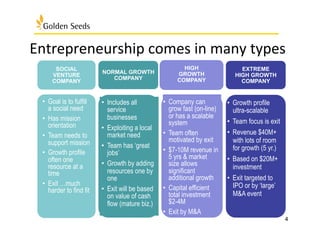
Entrepreneurship	
  comes	
  in	
  many	
  types	


NORMAL GROWTH
COMPANY
HIGH
GROWTH
COMPANY
EXTREME
HIGH GROWTH
COMPANY
SOCIAL
VENTURE
COMPANY
•  Includes all
service
businesses
•  Exploiting a local
market need
•  Team has ‘great
jobs’
•  Growth by adding
resources one by
one
•  Exit will be based
on value of cash
flow (mature biz.)
•  Growth profile
ultra-scalable
•  Team focus is exit
•  Revenue $40M+
with lots of room
for growth (5 yr.)
•  Based on $20M+
investment
•  Exit targeted to
IPO or by ‘large’
M&A event
•  Goal is to fulfill
a social need
•  Has mission
orientation
•  Team needs to
support mission
•  Growth profile
often one
resource at a
time
•  Exit …much
harder to find fit
•  Company can
grow fast (on-line)
or has a scalable
system
•  Team often
motivated by exit
•  $7-10M revenue in
5 yrs & market
size allows
significant
additional growth
•  Capital efficient
total investment
$2-4M
•  Exit by M&A
4
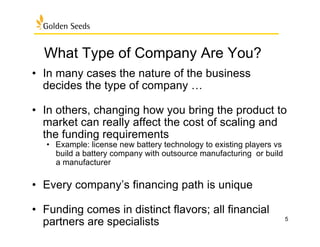
What Type of Company Are You?
•  In many cases the nature of the business
decides the type of company …
•  In others, changing how you bring the product to
market can really affect the cost of scaling and
the funding requirements
•  Example: license new battery technology to existing players vs
build a battery company with outsource manufacturing or build
a manufacturer
•  Every company’s financing path is unique
•  Funding comes in distinct flavors; all financial
partners are specialists 5
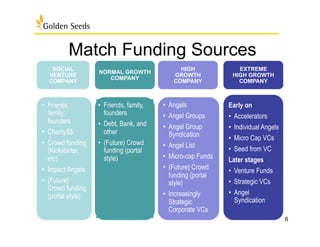
Match Funding Sources
NORMAL GROWTH
COMPANY
HIGH
GROWTH
COMPANY
EXTREME
HIGH GROWTH
COMPANY
SOCIAL
VENTURE
COMPANY
•  Friends, family,
founders
•  Debt, Bank, and
other
•  (Future) Crowd
funding (portal
style)
Early on
•  Accelerators
•  Individual Angels
•  Micro Cap VCs
•  Seed from VC
Later stages
•  Venture Funds
•  Strategic VCs
•  Angel
Syndication
•  Friends
family,
founders
•  Charity$$
•  Crowd funding
(Kickstarter,
etc)
•  Impact Angels
•  (Future)
Crowd funding
(portal style)
•  Angels
•  Angel Groups
•  Angel Group
Syndication
•  Angel List
•  Micro-cap Funds
•  (Future) Crowd
funding (portal
style)
•  Increasingly
Strategic
Corporate VCs
6
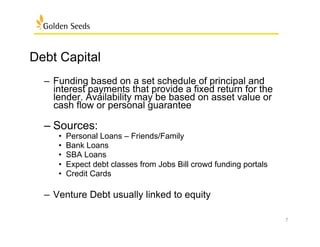
Debt Capital: Repayment
Debt Capital
–  Funding based on a set schedule of principal and
interest payments that provide a fixed return for the
lender. Availability may be based on asset value or
cash flow or personal guarantee
– Sources:
•  Personal Loans – Friends/Family
•  Bank Loans
•  SBA Loans
•  Expect debt classes from Jobs Bill crowd funding portals
•  Credit Cards
–  Venture Debt usually linked to equity
7
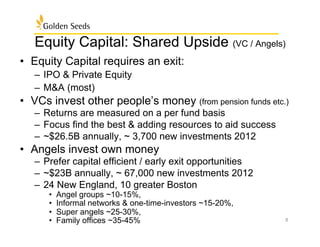
Equity Capital: Shared Upside (VC / Angels)
•  Equity Capital requires an exit:
–  IPO & Private Equity
–  M&A (most)
•  VCs invest other people’s money (from pension funds etc.)
–  Returns are measured on a per fund basis
–  Focus find the best & adding resources to aid success
–  ~$26.5B annually, ~ 3,700 new investments 2012
•  Angels invest own money
–  Prefer capital efficient / early exit opportunities
–  ~$23B annually, ~ 67,000 new investments 2012
–  24 New England, 10 greater Boston
•  Angel groups ~10-15%,
•  Informal networks & one-time-investors ~15-20%,
•  Super angels ~25-30%,
•  Family offices ~35-45% 8
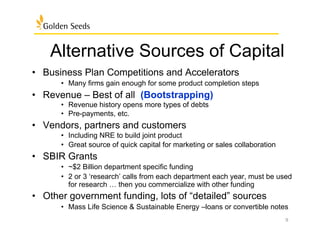
Alternative Sources of Capital
•  Business Plan Competitions and Accelerators
•  Many firms gain enough for some product completion steps
•  Revenue – Best of all (Bootstrapping)
•  Revenue history opens more types of debts
•  Pre-payments, etc.
•  Vendors, partners and customers
•  Including NRE to build joint product
•  Great source of quick capital for marketing or sales collaboration
•  SBIR Grants
•  ~$2 Billion department specific funding
•  2 or 3 ‘research’ calls from each department each year, must be used
for research … then you commercialize with other funding
•  Other government funding, lots of “detailed” sources
•  Mass Life Science & Sustainable Energy –loans or convertible notes
9
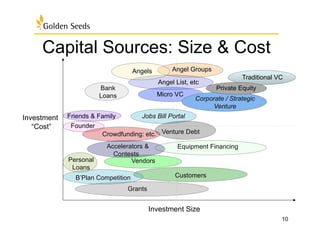
Capital Sources: Size & Cost
Investment Size
Investment
“Cost”
Traditional VC
Micro VC
Equipment Financing
Angel GroupsAngels
Angel List, etc
Corporate / Strategic
Venture
Customers
Jobs Bill Portal
Vendors
Founder
Friends & Family
Crowdfunding: etc.
Grants
Venture Debt
Bank
Loans
Personal
Loans
Private Equity
B’Plan Competition
Accelerators &
Contests
10
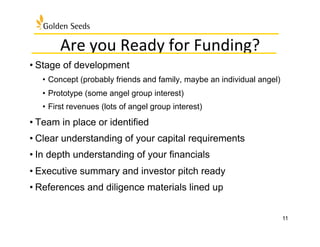
Are	
  you	
  Ready	
  for	
  Funding?	
  
• Stage of development
•  Concept (probably friends and family, maybe an individual angel)
•  Prototype (some angel group interest)
•  First revenues (lots of angel group interest)
• Team in place or identified
• Clear understanding of your capital requirements
• In depth understanding of your financials
• Executive summary and investor pitch ready
• References and diligence materials lined up
11
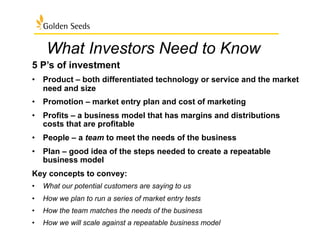
What Investors Need to Know
5 P’s of investment
•  Product – both differentiated technology or service and the market
need and size
•  Promotion – market entry plan and cost of marketing
•  Profits – a business model that has margins and distributions
costs that are profitable
•  People – a team to meet the needs of the business
•  Plan – good idea of the steps needed to create a repeatable
business model
Key concepts to convey:
•  What our potential customers are saying to us
•  How we plan to run a series of market entry tests
•  How the team matches the needs of the business
•  How we will scale against a repeatable business model
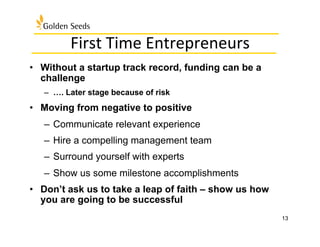
First	
  Time	
  Entrepreneurs	
  
•  Without a startup track record, funding can be a
challenge
–  …. Later stage because of risk
•  Moving from negative to positive
–  Communicate relevant experience
–  Hire a compelling management team
–  Surround yourself with experts
–  Show us some milestone accomplishments
•  Don’t ask us to take a leap of faith – show us how
you are going to be successful
13
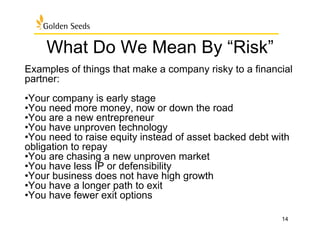
What Do We Mean By “Risk”
Examples of things that make a company risky to a financial
partner:
• Your company is early stage
• You need more money, now or down the road
• You are a new entrepreneur
• You have unproven technology
• You need to raise equity instead of asset backed debt with
obligation to repay
• You are chasing a new unproven market
• You have less IP or defensibility
• Your business does not have high growth
• You have a longer path to exit
• You have fewer exit options
14
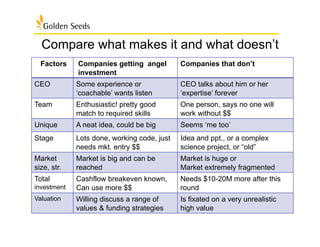
Compare what makes it and what doesn’t
Factors Companies getting angel
investment
Companies that don’t
CEO Some experience or
‘coachable’ wants listen
CEO talks about him or her
‘expertise’ forever
Team Enthusiastic! pretty good
match to required skills
One person, says no one will
work without $$
Unique A neat idea, could be big Seems ‘me too’
Stage Lots done, working code, just
needs mkt. entry $$
Idea and ppt., or a complex
science project, or “old”
Market
size, str.
Market is big and can be
reached
Market is huge or
Market extremely fragmented
Total
investment
Cashflow breakeven known,
Can use more $$
Needs $10-20M more after this
round
Valuation Willing discuss a range of
values & funding strategies
Is fixated on a very unrealistic
high value
There is no Justice …
•  What doesn’t work
•  Deals that can’t develop an exit should bootstrap, get debt, etc
•  Companies at too early of stage – risk set large
•  Entrepreneurs expecting too high a valuations
•  Asking for the wrong amount of money
•  And .. The odds are bad … may have a “hard presentation slot”
• Find a champion (before you apply if possible) !!!!
What are the Deal Marketing Materials
• Business Summary -2-5 pages with financial summary
• 12-20 slide pitch deck with a backup side for every
serious question
• 5-8 page market (size and structure) summary
• Integrated financial model
• 30 second elevator pitch
• 1-2 minute tell me more / meeting request pitch
(write a business plan for yourself)
Crea:ng	
  an	
  Effec:ve	
  Presenta:on	
  
•  Elevator pitch – who are you and what do you do and why?
•  Market opportunity
–  What is the problem you are solving
–  How big is the market
•  Product or service (intellectual property)
•  Target clients and business model
•  Go to market strategy
•  Competitive landscape and advantage
–  Barriers to entry
•  The management team
–  Hiring plan
•  Financial summary, including last year’s P & L and 3 year projections
•  Funding needs for this round & use of funds
–  history of funding to date
–  pre-money valuation
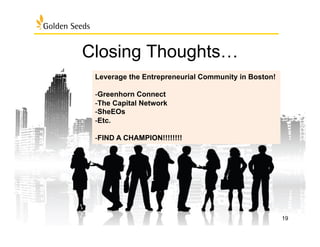
Closing Thoughts…
19
Leverage the Entrepreneurial Community in Boston!
- Greenhorn Connect
- The Capital Network
- SheEOs
- Etc.
- FIND A CHAMPION!!!!!!!!

Women Helping Women in Entrepreneurship at MassChallenge

  • 1.
    1 Women helping women inentrepreneurship: Funding Sources   July 24, 2013 MassChallenge
  • 2.
    Participants: Sheryl Schultz Angel Investor,Tech Marketer and Mentor, Golden Seeds, Launchpad, TCN Board Beth Marcus CEO of Playrific, Serial Entrepreneur, Mentor Heatherjean MacNeil Program Director, The Center for Women’s Entrepreneurial Leadership, Babson College 2
  • 3.
    Funding the CompanyBeforeyou can get funded, you have to know where to look Before you know where to look, you need to understand what you are 3
  • 4.
    Entrepreneurship  comes  in  many  types       NORMAL GROWTH COMPANY HIGH GROWTH COMPANY EXTREME HIGH GROWTH COMPANY SOCIAL VENTURE COMPANY •  Includes all service businesses •  Exploiting a local market need •  Team has ‘great jobs’ •  Growth by adding resources one by one •  Exit will be based on value of cash flow (mature biz.) •  Growth profile ultra-scalable •  Team focus is exit •  Revenue $40M+ with lots of room for growth (5 yr.) •  Based on $20M+ investment •  Exit targeted to IPO or by ‘large’ M&A event •  Goal is to fulfill a social need •  Has mission orientation •  Team needs to support mission •  Growth profile often one resource at a time •  Exit …much harder to find fit •  Company can grow fast (on-line) or has a scalable system •  Team often motivated by exit •  $7-10M revenue in 5 yrs & market size allows significant additional growth •  Capital efficient total investment $2-4M •  Exit by M&A 4
  • 5.
    What Type ofCompany Are You? •  In many cases the nature of the business decides the type of company … •  In others, changing how you bring the product to market can really affect the cost of scaling and the funding requirements •  Example: license new battery technology to existing players vs build a battery company with outsource manufacturing or build a manufacturer •  Every company’s financing path is unique •  Funding comes in distinct flavors; all financial partners are specialists 5
  • 6.
    Match Funding Sources NORMALGROWTH COMPANY HIGH GROWTH COMPANY EXTREME HIGH GROWTH COMPANY SOCIAL VENTURE COMPANY •  Friends, family, founders •  Debt, Bank, and other •  (Future) Crowd funding (portal style) Early on •  Accelerators •  Individual Angels •  Micro Cap VCs •  Seed from VC Later stages •  Venture Funds •  Strategic VCs •  Angel Syndication •  Friends family, founders •  Charity$$ •  Crowd funding (Kickstarter, etc) •  Impact Angels •  (Future) Crowd funding (portal style) •  Angels •  Angel Groups •  Angel Group Syndication •  Angel List •  Micro-cap Funds •  (Future) Crowd funding (portal style) •  Increasingly Strategic Corporate VCs 6
  • 7.
    Debt Capital: Repayment DebtCapital –  Funding based on a set schedule of principal and interest payments that provide a fixed return for the lender. Availability may be based on asset value or cash flow or personal guarantee – Sources: •  Personal Loans – Friends/Family •  Bank Loans •  SBA Loans •  Expect debt classes from Jobs Bill crowd funding portals •  Credit Cards –  Venture Debt usually linked to equity 7
  • 8.
    Equity Capital: SharedUpside (VC / Angels) •  Equity Capital requires an exit: –  IPO & Private Equity –  M&A (most) •  VCs invest other people’s money (from pension funds etc.) –  Returns are measured on a per fund basis –  Focus find the best & adding resources to aid success –  ~$26.5B annually, ~ 3,700 new investments 2012 •  Angels invest own money –  Prefer capital efficient / early exit opportunities –  ~$23B annually, ~ 67,000 new investments 2012 –  24 New England, 10 greater Boston •  Angel groups ~10-15%, •  Informal networks & one-time-investors ~15-20%, •  Super angels ~25-30%, •  Family offices ~35-45% 8
  • 9.
    Alternative Sources ofCapital •  Business Plan Competitions and Accelerators •  Many firms gain enough for some product completion steps •  Revenue – Best of all (Bootstrapping) •  Revenue history opens more types of debts •  Pre-payments, etc. •  Vendors, partners and customers •  Including NRE to build joint product •  Great source of quick capital for marketing or sales collaboration •  SBIR Grants •  ~$2 Billion department specific funding •  2 or 3 ‘research’ calls from each department each year, must be used for research … then you commercialize with other funding •  Other government funding, lots of “detailed” sources •  Mass Life Science & Sustainable Energy –loans or convertible notes 9
  • 10.
    Capital Sources: Size& Cost Investment Size Investment “Cost” Traditional VC Micro VC Equipment Financing Angel GroupsAngels Angel List, etc Corporate / Strategic Venture Customers Jobs Bill Portal Vendors Founder Friends & Family Crowdfunding: etc. Grants Venture Debt Bank Loans Personal Loans Private Equity B’Plan Competition Accelerators & Contests 10
  • 11.
    Are  you  Ready  for  Funding?   • Stage of development •  Concept (probably friends and family, maybe an individual angel) •  Prototype (some angel group interest) •  First revenues (lots of angel group interest) • Team in place or identified • Clear understanding of your capital requirements • In depth understanding of your financials • Executive summary and investor pitch ready • References and diligence materials lined up 11
  • 12.
    What Investors Needto Know 5 P’s of investment •  Product – both differentiated technology or service and the market need and size •  Promotion – market entry plan and cost of marketing •  Profits – a business model that has margins and distributions costs that are profitable •  People – a team to meet the needs of the business •  Plan – good idea of the steps needed to create a repeatable business model Key concepts to convey: •  What our potential customers are saying to us •  How we plan to run a series of market entry tests •  How the team matches the needs of the business •  How we will scale against a repeatable business model
  • 13.
    First  Time  Entrepreneurs   •  Without a startup track record, funding can be a challenge –  …. Later stage because of risk •  Moving from negative to positive –  Communicate relevant experience –  Hire a compelling management team –  Surround yourself with experts –  Show us some milestone accomplishments •  Don’t ask us to take a leap of faith – show us how you are going to be successful 13
  • 14.
    What Do WeMean By “Risk” Examples of things that make a company risky to a financial partner: • Your company is early stage • You need more money, now or down the road • You are a new entrepreneur • You have unproven technology • You need to raise equity instead of asset backed debt with obligation to repay • You are chasing a new unproven market • You have less IP or defensibility • Your business does not have high growth • You have a longer path to exit • You have fewer exit options 14
  • 15.
    Compare what makesit and what doesn’t Factors Companies getting angel investment Companies that don’t CEO Some experience or ‘coachable’ wants listen CEO talks about him or her ‘expertise’ forever Team Enthusiastic! pretty good match to required skills One person, says no one will work without $$ Unique A neat idea, could be big Seems ‘me too’ Stage Lots done, working code, just needs mkt. entry $$ Idea and ppt., or a complex science project, or “old” Market size, str. Market is big and can be reached Market is huge or Market extremely fragmented Total investment Cashflow breakeven known, Can use more $$ Needs $10-20M more after this round Valuation Willing discuss a range of values & funding strategies Is fixated on a very unrealistic high value
  • 16.
    There is noJustice … •  What doesn’t work •  Deals that can’t develop an exit should bootstrap, get debt, etc •  Companies at too early of stage – risk set large •  Entrepreneurs expecting too high a valuations •  Asking for the wrong amount of money •  And .. The odds are bad … may have a “hard presentation slot” • Find a champion (before you apply if possible) !!!!
  • 17.
    What are theDeal Marketing Materials • Business Summary -2-5 pages with financial summary • 12-20 slide pitch deck with a backup side for every serious question • 5-8 page market (size and structure) summary • Integrated financial model • 30 second elevator pitch • 1-2 minute tell me more / meeting request pitch (write a business plan for yourself)
  • 18.
    Crea:ng  an  Effec:ve  Presenta:on   •  Elevator pitch – who are you and what do you do and why? •  Market opportunity –  What is the problem you are solving –  How big is the market •  Product or service (intellectual property) •  Target clients and business model •  Go to market strategy •  Competitive landscape and advantage –  Barriers to entry •  The management team –  Hiring plan •  Financial summary, including last year’s P & L and 3 year projections •  Funding needs for this round & use of funds –  history of funding to date –  pre-money valuation
  • 19.
    Closing Thoughts… 19 Leverage theEntrepreneurial Community in Boston! - Greenhorn Connect - The Capital Network - SheEOs - Etc. - FIND A CHAMPION!!!!!!!!