GOOD MORNING GRADE 8!
JESUS LOVES YOU <3
MOST ESSENTIAL LEARNING COMPETENCY
Investigate the relationship
between the amount of force
applied and the mass of the
object to the amount of
change in the object’s motion
What is the Exact
Relation Between
FORCE AND MOTION?
VERSUS
Aristotle Galileo
“The natural State of a body is to remain at rest and
a force has to act on a body for it to move and to
keep it moving.”
“The natural tendency of a moving object is to
continue moving and no force is required to keep it
moving.”
Newton’s
Three Laws of
Motion
Science 8
1. Law of Inertia
MASS AS A MEASURE OF INERTIA
Mass and Weight
 On Earth, Mass and Weight is
directly proportional to each other. If
the mass is high, its weight is also
big. If the mass is halved, the weight
is also halved. But, this does not
mean that mass and weight are the
same.
Mass and Weight
For an instance, the
gravitational pull of earth acts
on an object that has mass,
then the combined quantity is
called weight.
Weight (w) = mass (m) x gravity (g)
w = mg
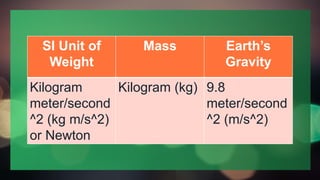
SI Unit of
Weight
Mass Earth’s
Gravity
Kilogram
meter/second
^2 (kg m/s^2)
or Newton
Kilogram (kg) 9.8
meter/second
^2 (m/s^2)
Sample Problem:
SUMMARY OF THE FIRST LAW
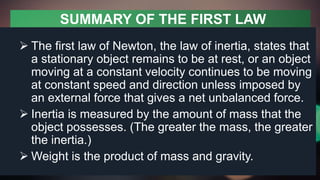
 The first law of Newton, the law of inertia, states that
a stationary object remains to be at rest, or an object
moving at a constant velocity continues to be moving
at constant speed and direction unless imposed by
an external force that gives a net unbalanced force.
 Inertia is measured by the amount of mass that the
object possesses. (The greater the mass, the greater
the inertia.)
 Weight is the product of mass and gravity.
Practice Exercise.
A 1.0 kg object is brought to planet Mercury
where the acceleration due to gravity is 0.38
times its value on Earth.
a.) What is the weight of the object on Earth?
b.) What is the mass of the object on
mercury?
c.) What is its weight on Mercury?
LAW OF ACCELERATION
FORCES of varying types,
when they are imposed and
caused an unbalanced state
to an object, always results in
ACCELERATION.
LAW OF ACCELERATION
 Investigates the relationship
of force and mass in the
object’s acceleration.
ACCELERATION
Directly related
with net force
Inversely related
with net force
Unbalanced forced result in a Net
Force that leads to
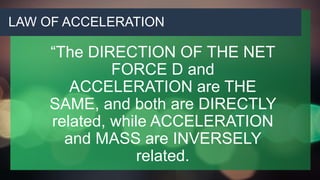
“The DIRECTION OF THE NET
FORCE D and
ACCELERATION are THE
SAME, and both are DIRECTLY
related, while ACCELERATION
and MASS are INVERSELY
related.
LAW OF ACCELERATION
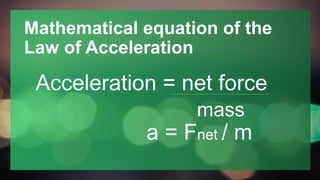
Mathematical equation of the
Law of Acceleration
Acceleration = net force
mass
a = Fnet / m
Often rearranged as:
Fnet = ma
Sample Problem:
Suppose a ball of mass
0.60 kg is hits with a force
of 12 kg m/𝑠2
. What will
be its acceleration?
Practice Exercise
If a bowling ball with a force
of 15.0 kg m/𝑠2
acts on a
bowling pin with 5.0 kg
mass, what will be the
acceleration?
LAW OF ACTION & REACTION
An object of
Weight 30 N
rests on a table.
(a) What are the
forces acting on
the object? (b)
What are the
reactions to
these forces?
Practice Exercise
A ball hangs from the
ceiling by means of a
thread of negligible weight.
Enumerate all the action-
reaction forces.
Q1_W1_Newtons-Law-of-Motion.pptx

Q1_W1_Newtons-Law-of-Motion.pptx

  • 1.
    GOOD MORNING GRADE8! JESUS LOVES YOU <3
  • 2.
    MOST ESSENTIAL LEARNINGCOMPETENCY Investigate the relationship between the amount of force applied and the mass of the object to the amount of change in the object’s motion
  • 3.
    What is theExact Relation Between FORCE AND MOTION?
  • 4.
    VERSUS Aristotle Galileo “The naturalState of a body is to remain at rest and a force has to act on a body for it to move and to keep it moving.” “The natural tendency of a moving object is to continue moving and no force is required to keep it moving.”
  • 5.
  • 6.
    1. Law ofInertia
  • 7.
    MASS AS AMEASURE OF INERTIA
  • 11.
    Mass and Weight On Earth, Mass and Weight is directly proportional to each other. If the mass is high, its weight is also big. If the mass is halved, the weight is also halved. But, this does not mean that mass and weight are the same.
  • 12.
    Mass and Weight Foran instance, the gravitational pull of earth acts on an object that has mass, then the combined quantity is called weight.
  • 13.
    Weight (w) =mass (m) x gravity (g) w = mg
  • 14.
    SI Unit of Weight MassEarth’s Gravity Kilogram meter/second ^2 (kg m/s^2) or Newton Kilogram (kg) 9.8 meter/second ^2 (m/s^2)
  • 15.
  • 16.
    SUMMARY OF THEFIRST LAW  The first law of Newton, the law of inertia, states that a stationary object remains to be at rest, or an object moving at a constant velocity continues to be moving at constant speed and direction unless imposed by an external force that gives a net unbalanced force.  Inertia is measured by the amount of mass that the object possesses. (The greater the mass, the greater the inertia.)  Weight is the product of mass and gravity.
  • 17.
    Practice Exercise. A 1.0kg object is brought to planet Mercury where the acceleration due to gravity is 0.38 times its value on Earth. a.) What is the weight of the object on Earth? b.) What is the mass of the object on mercury? c.) What is its weight on Mercury?
  • 18.
  • 19.
    FORCES of varyingtypes, when they are imposed and caused an unbalanced state to an object, always results in ACCELERATION.
  • 20.
    LAW OF ACCELERATION Investigates the relationship of force and mass in the object’s acceleration. ACCELERATION Directly related with net force Inversely related with net force Unbalanced forced result in a Net Force that leads to
  • 21.
    “The DIRECTION OFTHE NET FORCE D and ACCELERATION are THE SAME, and both are DIRECTLY related, while ACCELERATION and MASS are INVERSELY related. LAW OF ACCELERATION
  • 22.
    Mathematical equation ofthe Law of Acceleration Acceleration = net force mass a = Fnet / m
  • 23.
  • 24.
    Sample Problem: Suppose aball of mass 0.60 kg is hits with a force of 12 kg m/𝑠2 . What will be its acceleration?
  • 25.
    Practice Exercise If abowling ball with a force of 15.0 kg m/𝑠2 acts on a bowling pin with 5.0 kg mass, what will be the acceleration?
  • 26.
    LAW OF ACTION& REACTION
  • 29.
    An object of Weight30 N rests on a table. (a) What are the forces acting on the object? (b) What are the reactions to these forces?
  • 30.
    Practice Exercise A ballhangs from the ceiling by means of a thread of negligible weight. Enumerate all the action- reaction forces.

Editor's Notes

  • #4 FORCE is a push or pull exerted by one body on another body. The effect of which is to tend to change or change the state of motion of the body which it acts.
  • #7 OR the ability of a body to resist any change in motion.
  • #8 Inertia is a property that is possessed by any material that has mass. MASS is a measure of inertia.
  • #25 Sol: a=fnet/m a=12 kg m/s^2 / 0.60 kg a= 20 m/s^2
  • #27 If object A exerts a force on object B, object B also exerts an equal and opposite force on object A. In other words, forces result from interactions.
  • #30 Solution: The forces acting on the object are its weight and the upward force by the table. Weight is downward pull of the earth on the object. Weight is 30 N. The reaction to this force is an upward force of 30 N exerted by the object on the Earth.