Glossary
• Molecular ion- The ion obtained by the loss of one
electron from the molecule (m+
)
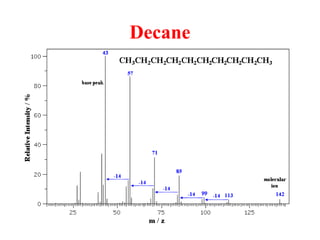
• Base peak - The most intense peak in the MS,
assigned 100% intensity
• Radical cation - positively charged species with an
odd number of electrons
• Fragment ions - Lighter cations (and radical cations)
formed by the decomposition of the molecular ion.
These often correspond to stable carbcations.
• m/z - mass to charge ratio
Isotopes
• Mass spectrometersare capable of separating and detecting
individual ions even those that only differ by a single atomic
mass unit.
• As a result molecules containing different isotopes can be
distinguished.
• This is most apparent when atoms such as bromine or chlorine
are present (79
Br : 81
Br, intensity 1:1 and 35
Cl : 37
Cl, intensity 3:1)
where peaks at "M" and "M+2" are obtained.
• The intensity ratios in the isotope patterns are due to the natural
abundance of the isotopes.
• "M+1" peaks are seen due the the presence of 13
C in the sample.
McLafferty Rearrangement
link toSDBS
H
O
H
m+ = 86
+
.
O
H
H
.
+
O
H
H
.
+
m/z = 44
+
H transfer from
carbon
results in loss of a neutral alkene
32.
McLafferty Rearrangements in
AlkylBenzenes
CH2
CH2
CHCH3
H
m+ 134
loss of CH3CH=CH2
.
+
CH2
H
H
+
.
m/e 92
CH2
+
m/e 91
- propyl
.
High Resolution MassSpectrometry
Determination of Molecular Formula
CO
N2
C2H4
CH2N
all show m+ at 28
CO 27.9949
N2 28.0062
C2H4 28.0312
CH2N 28.0187
exact mass
42.
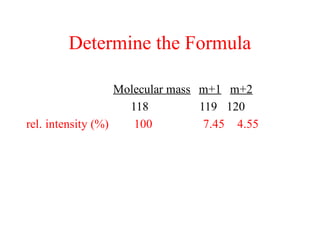
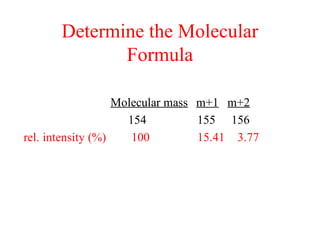
Isotope Ratios CanHelp to
Determine Molecular Formula
Relative intensities
(%)
MF MW M M+1 M+2
CO 28.0 100 1.12 0.2
N2 28.0 100 0.76 ----
C2H4 28.0 100 2.23 0.01
43.
Comparisons of MolecularWeights
and Precise Masses
MF MW exact mass
C3H8O 60.1 60.05754
C2H8N2 60.1 60.06884
C2H4O2 60.1 60.02112
CH4N2O 60.1 60.03242
45.
Determine the Formula
fragmentfinder
Molecular mass m+1 m+2
110 111 112
rel. intensity (%) 100 6.96 0.60
exact mass = 110.0376