STRONGER
Strategies
for success
2015 Partner Conference
together
Creative DB Plan
Designs and Case
Studies
Maryann Geary, EVP, BPAS Plan
Administration & Recordkeeping
Vince Spina, President, Harbridge
Consulting Group, a BPAS Company
2015 Partner ConferenceStronger Together
Agenda
• Why Save in a Tax-Qualified Plan?
• Basic Cash Balance Plan
• BPAS WRAP Design
(“Worker Retirement Accumulation Plan”)
• The Future of DB/DC Combo Plans
2015 Partner ConferenceStronger Together
Why Save in a Tax-Qualified Plan?
The “on-the street” question……why
not just save outside a plan where there
is favorable capital gains treatment?
2015 Partner ConferenceStronger Together
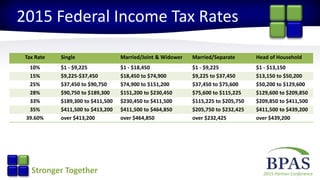
2015 Federal Income Tax Rates
Tax Rate Single Married/Joint & Widower Married/Separate Head of Household
10% $1 - $9,225 $1 - $18,450 $1 - $9,225 $1 - $13,150
15% $9,225-$37,450 $18,450 to $74,900 $9,225 to $37,450 $13,150 to $50,200
25% $37,450 to $90,750 $74,900 to $151,200 $37,450 to $75,600 $50,200 to $129,600
28% $90,750 to $189,300 $151,200 to $230,450 $75,600 to $115,225 $129,600 to $209,850
33% $189,300 to $411,500 $230,450 to $411,500 $115,225 to $205,750 $209,850 to $411,500
35% $411,500 to $413,200 $411,500 to $464,850 $205,750 to $232,425 $411,500 to $439,200
39.60% over $413,200 over $464,850 over $232,425 over $439,200
2015 Partner ConferenceStronger Together
Why Save in a Tax-Qualified Plan?
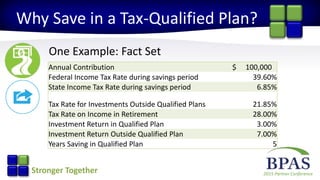
One Example: Fact Set
Annual Contribution $ 100,000
Federal Income Tax Rate during savings period 39.60%
State Income Tax Rate during savings period 6.85%
Tax Rate for Investments Outside Qualified Plans 21.85%
Tax Rate on Income in Retirement 28.00%
Investment Return in Qualified Plan 3.00%
Investment Return Outside Qualified Plan 7.00%
Years Saving in Qualified Plan 5
2015 Partner ConferenceStronger Together
Why Save in a Tax-Qualified Plan?
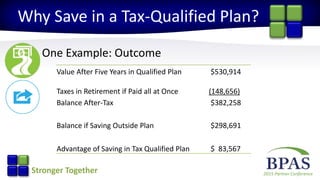
One Example: Outcome
Value After Five Years in Qualified Plan $530,914
Taxes in Retirement if Paid all at Once (148,656)
Balance After-Tax $382,258
Balance if Saving Outside Plan $298,691
Advantage of Saving in Tax Qualified Plan $ 83,567
2015 Partner ConferenceStronger Together
Why Save in a Tax-Qualified Plan?
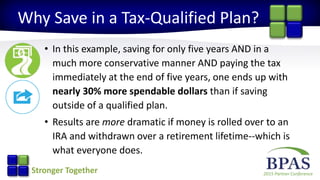
• In this example, saving for only five years AND in a
much more conservative manner AND paying the tax
immediately at the end of five years, one ends up with
nearly 30% more spendable dollars than if saving
outside of a qualified plan.
• Results are more dramatic if money is rolled over to an
IRA and withdrawn over a retirement lifetime--which is
what everyone does.
2015 Partner ConferenceStronger Together
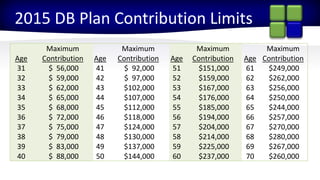
2015 DB Plan Contribution Limits
Maximum Maximum Maximum Maximum
Age Contribution Age Contribution Age Contribution Age Contribution
31 $ 56,000 41 $ 92,000 51 $151,000 61 $249,000
32 $ 59,000 42 $ 97,000 52 $159,000 62 $262,000
33 $ 62,000 43 $102,000 53 $167,000 63 $256,000
34 $ 65,000 44 $107,000 54 $176,000 64 $250,000
35 $ 68,000 45 $112,000 55 $185,000 65 $244,000
36 $ 72,000 46 $118,000 56 $194,000 66 $257,000
37 $ 75,000 47 $124,000 57 $204,000 67 $270,000
38 $ 79,000 48 $130,000 58 $214,000 68 $280,000
39 $ 83,000 49 $137,000 59 $225,000 69 $267,000
40 $ 88,000 50 $144,000 60 $237,000 70 $260,000
2015 Partner ConferenceStronger Together
Cash Balance Plans
Participants have notional account balances
• Service Credits (e.g., 2.5% of pay or a flat amount such as $100,000)
and Interest Credits
— A fixed amount (e.g., 3%)
— Tied to an index (e.g., 5- or 10-year Treasury yields) that changes year to
year, or
— The actual return on plan assets
— If the actual return on plan assets is used, there is a minimum floor of 0%
return over a participant’s career (but can have a negative return for a
particular year)
2015 Partner ConferenceStronger Together
Cash Balance Plans
• What makes a Cash Balance Plan a Defined Benefit
Plan?
— “Defined” interest credits
— Ability to annuitize account balances at retirement
within the plan
— As a result, DB plan limits apply (i.e. not the
$53,000 DC plan limit)
• Plan assets don’t need to equal the sum of account
balances
2015 Partner ConferenceStronger Together
Cash Balance Plans
• Need to satisfy non-discrimination rules
— Generally need to provide rank and file a contribution
of 7.5% of pay between the 401(k) Plan and Cash
Balance Plan
• Assets are in a pooled account
— Participants do NOT have individual direction of
account balance
— All participants get the same investment return
2015 Partner ConferenceStronger Together
Cash Balance Plans
• Cash Balance looks a lot like a Balance Forward DC
plan except with much higher contribution limits
• Sponsor usually has both CB and 401(k) Plan
2015 Partner ConferenceStronger Together
Cash Balance Plans
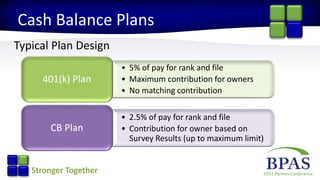
Typical Plan Design
• 5% of pay for rank and file
• Maximum contribution for owners
• No matching contribution
401(k) Plan
• 2.5% of pay for rank and file
• Contribution for owner based on
Survey Results (up to maximum limit)
CB Plan
2015 Partner ConferenceStronger Together
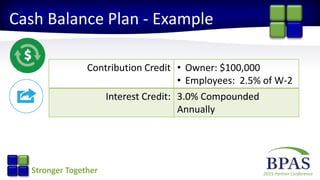
Cash Balance Plan - Example
Contribution Credit • Owner: $100,000
• Employees: 2.5% of W-2
Interest Credit: 3.0% Compounded
Annually
2015 Partner ConferenceStronger Together
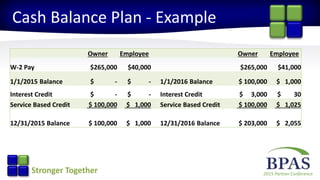
Cash Balance Plan - Example
Owner Employee Owner Employee
W-2 Pay $265,000 $40,000 $265,000 $41,000
1/1/2015 Balance $ - $ - 1/1/2016 Balance $ 100,000 $ 1,000
Interest Credit $ - $ - Interest Credit $ 3,000 $ 30
Service Based Credit $ 100,000 $ 1,000 Service Based Credit $ 100,000 $ 1,025
12/31/2015 Balance $ 100,000 $ 1,000 12/31/2016 Balance $ 203,000 $ 2,055
2015 Partner ConferenceStronger Together
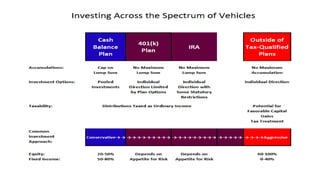
Cash Balance Plans – Investments
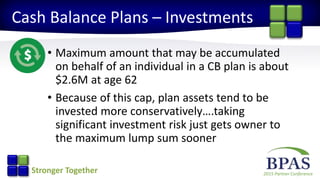
• Maximum amount that may be accumulated
on behalf of an individual in a CB plan is about
$2.6M at age 62
• Because of this cap, plan assets tend to be
invested more conservatively….taking
significant investment risk just gets owner to
the maximum lump sum sooner
2015 Partner ConferenceStronger Together
Cash Balance Plans – Investments
2015 Partner ConferenceStronger Together
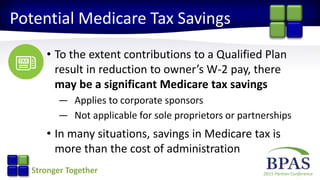
Potential Medicare Tax Savings
• To the extent contributions to a Qualified Plan
result in reduction to owner’s W-2 pay, there
may be a significant Medicare tax savings
— Applies to corporate sponsors
— Not applicable for sole proprietors or partnerships
• In many situations, savings in Medicare tax is
more than the cost of administration
2015 Partner ConferenceStronger Together
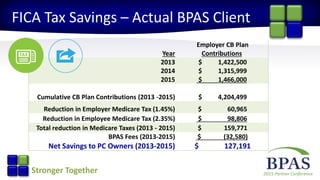
FICA Tax Savings – Actual BPAS Client
Employer CB Plan
Year Contributions
2013 $ 1,422,500
2014 $ 1,315,999
2015 $ 1,466,000
Cumulative CB Plan Contributions (2013 -2015) $ 4,204,499
Reduction in Employer Medicare Tax (1.45%) $ 60,965
Reduction in Employee Medicare Tax (2.35%) $ 98,806
Total reduction in Medicare Taxes (2013 - 2015) $ 159,771
BPAS Fees (2013-2015) $ (32,580)
Net Savings to PC Owners (2013-2015) $ 127,191
2015 Partner ConferenceStronger Together
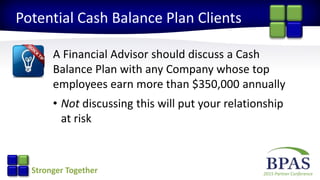
Potential Cash Balance Plan Clients
A Financial Advisor should discuss a Cash
Balance Plan with any Company whose top
employees earn more than $350,000 annually
• Not discussing this will put your relationship
at risk
2015 Partner ConferenceStronger Together
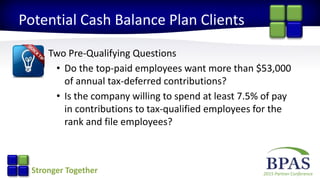
Potential Cash Balance Plan Clients
Two Pre-Qualifying Questions
• Do the top-paid employees want more than $53,000
of annual tax-deferred contributions?
• Is the company willing to spend at least 7.5% of pay
in contributions to tax-qualified employees for the
rank and file employees?
2015 Partner ConferenceStronger Together
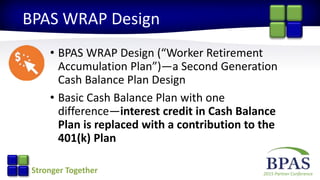
BPAS WRAP Design
• BPAS WRAP Design (“Worker Retirement
Accumulation Plan”)—a Second Generation
Cash Balance Plan Design
• Basic Cash Balance Plan with one
difference—interest credit in Cash Balance
Plan is replaced with a contribution to the
401(k) Plan
2015 Partner ConferenceStronger Together
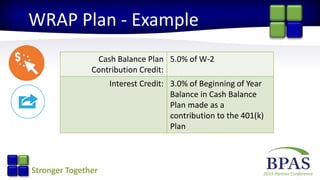
WRAP Plan - Example
Cash Balance Plan
Contribution Credit:
5.0% of W-2
Interest Credit: 3.0% of Beginning of Year
Balance in Cash Balance
Plan made as a
contribution to the 401(k)
Plan
2015 Partner ConferenceStronger Together
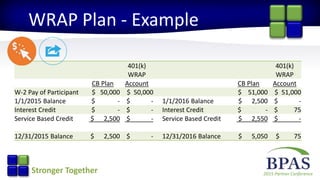
WRAP Plan - Example
401(k) 401(k)
WRAP WRAP
CB Plan Account CB Plan Account
W-2 Pay of Participant $ 50,000 $ 50,000 $ 51,000 $ 51,000
1/1/2015 Balance $ - $ - 1/1/2016 Balance $ 2,500 $ -
Interest Credit $ - $ - Interest Credit $ - $ 75
Service Based Credit $ 2,500 $ - Service Based Credit $ 2,550 $ -
12/31/2015 Balance $ 2,500 $ - 12/31/2016 Balance $ 5,050 $ 75
2015 Partner ConferenceStronger Together
BPAS WRAP Design – Why?
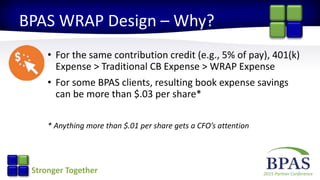
• For the same contribution credit (e.g., 5% of pay), 401(k)
Expense > Traditional CB Expense > WRAP Expense
• For some BPAS clients, resulting book expense savings
can be more than $.03 per share*
* Anything more than $.01 per share gets a CFO’s attention
2015 Partner ConferenceStronger Together
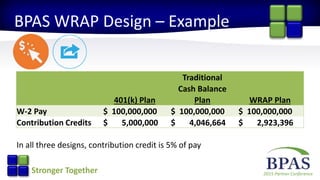
BPAS WRAP Design – Example
Traditional
Cash Balance
401(k) Plan Plan WRAP Plan
W-2 Pay $ 100,000,000 $ 100,000,000 $ 100,000,000
Contribution Credits $ 5,000,000 $ 4,046,664 $ 2,923,396
In all three designs, contribution credit is 5% of pay
2015 Partner ConferenceStronger Together
BPAS WRAP Design – Who?
Who would be interested in a WRAP Plan Design?
• Public companies where book expense is a primary
issue
• Any sponsor of a DB plan that was already
converted into a Cash Balance Plan
2015 Partner ConferenceStronger Together
DB/DC Combo Plans
• What is the Current State of these plans?
• Generally at Retirement:
• DC Plan, take rollover distribution to IRA
• DC industry has been focused on “catching the rollover”
• DB Plan, make one time election of an annuity
from plan
2015 Partner ConferenceStronger Together
DB/DC Combo Plans
Suppose someone earning $50,000 has done
everything right and accumulated $500,000
(i.e., 10 x pay) at age 65
• What do they do? Rollover to IRA and draw
down over their retirement?
• Does this maximize their lifestyle in
retirement?
• What about a guaranteed life annuity?
2015 Partner ConferenceStronger Together
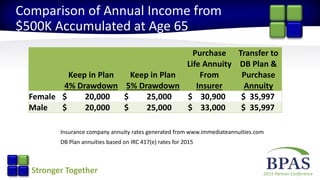
Comparison of Annual Income from
$500K Accumulated at Age 65
Purchase Transfer to
Life Annuity DB Plan &
Keep in Plan Keep in Plan From Purchase
4% Drawdown 5% Drawdown Insurer Annuity
Female $ 20,000 $ 25,000 $ 30,900 $ 35,997
Male $ 20,000 $ 25,000 $ 33,000 $ 35,997
Insurance company annuity rates generated from www.immediateannuities.com
DB Plan annuities based on IRC 417(e) rates for 2015
2015 Partner ConferenceStronger Together
The Future of DB/DC Combo Plans
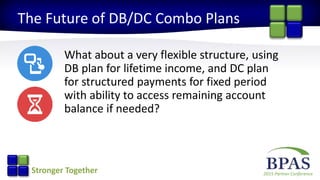
What about a very flexible structure, using
DB plan for lifetime income, and DC plan
for structured payments for fixed period
with ability to access remaining account
balance if needed?
2015 Partner ConferenceStronger Together
The Future of DB/DC Combo Plans
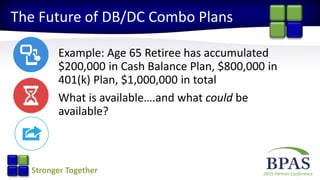
Example: Age 65 Retiree has accumulated
$200,000 in Cash Balance Plan, $800,000 in
401(k) Plan, $1,000,000 in total
What is available….and what could be
available?
2015 Partner ConferenceStronger Together
The Future of DB/DC Combo Plans
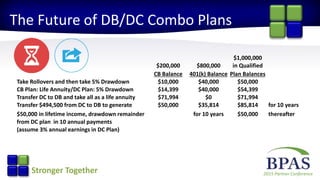
$1,000,000
$200,000 $800,000 in Qualified
CB Balance 401(k) Balance Plan Balances
Take Rollovers and then take 5% Drawdown $10,000 $40,000 $50,000
CB Plan: Life Annuity/DC Plan: 5% Drawdown $14,399 $40,000 $54,399
Transfer DC to DB and take all as a life annuity $71,994 $0 $71,994
Transfer $494,500 from DC to DB to generate $50,000 $35,814 $85,814 for 10 years
$50,000 in lifetime income, drawdown remainder for 10 years $50,000 thereafter
from DC plan in 10 annual payments
(assume 3% annual earnings in DC Plan)
2015 Partner ConferenceStronger Together
The Future of DB/DC Combo Plans
Historic DB/DC combo plans have had
distribution options that have been too rigid;
technology will make the type of options
illustrated easily accessible
2015 Partner ConferenceStronger Together
Questions
Thank you
2015 Partner ConferenceStronger Together
BPAS DB Plan Contacts
Vince Spina vspina@bpas.com (315) 703-8999
Ken Prell kprell@bpas.com (315) 703-8993
Jason Disco jdisco@bpas.com (315) 703-8916
STRONGER
Strategies
for success
2015 Partner Conference
together
Creative DC/DB
Plan Design & Case
Studies
Maryann Geary, EVP, BPAS
Plan Administration &
Recordkeeping
Vince Spina, President,
Harbridge Consulting Group,
a BPAS Company
2015 Partner ConferenceStronger Together
Things to Consider
• Plan Sponsor’s Needs
—Flexibility
—Desired Contributions
—Administrative Complexity and Expenses
• Employer and Employee Demographics
—Entity Type
—Employee Demographics
—Plan Features
2015 Partner ConferenceStronger Together
Traditional 401(k)
Advantages
• Elective Deferrals
• Catch-up contributions
• Discretionary employer
contributions
• Employer contributions can be
subject to vesting schedule
• Employees working less than
1,000 hours can be excluded as
well as employees under 21 or
who have been employed less than
one year
• Loans and hardships can be offered
2015 Partner ConferenceStronger Together
Traditional 401(k)
Disadvantages
• ADP/ACP test can limit HCE contributions
• Fiduciary responsibilities
• Adds an administrative burden with payroll complexity,
frequent plan deposits, testing and reporting costs
2015 Partner ConferenceStronger Together
Traditional 401(k)
Best for companies that:
• Don’t want to commit to employer contributions
• Have HCEs that are willing to accept contribution
limitations
• Expect good NHCE participation
• Have payroll systems in place to handle withholding
and are able to provide data in a timely manner
2015 Partner ConferenceStronger Together
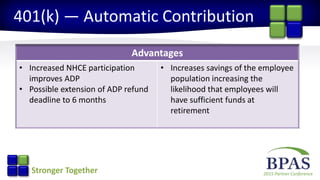
401(k) — Automatic Contribution
Advantages
• Increased NHCE participation
improves ADP
• Possible extension of ADP refund
deadline to 6 months
• Increases savings of the employee
population increasing the
likelihood that employees will
have sufficient funds at
retirement
2015 Partner ConferenceStronger Together
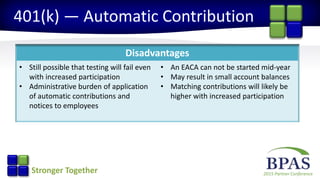
401(k) — Automatic Contribution
Disadvantages
• Still possible that testing will fail even
with increased participation
• Administrative burden of application
of automatic contributions and
notices to employees
• An EACA can not be started mid-year
• May result in small account balances
• Matching contributions will likely be
higher with increased participation
2015 Partner ConferenceStronger Together
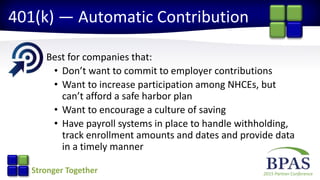
401(k) — Automatic Contribution
Best for companies that:
• Don’t want to commit to employer contributions
• Want to increase participation among NHCEs, but
can’t afford a safe harbor plan
• Want to encourage a culture of saving
• Have payroll systems in place to handle withholding,
track enrollment amounts and dates and provide data
in a timely manner
2015 Partner ConferenceStronger Together
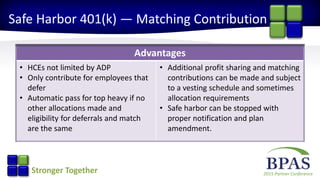
Safe Harbor 401(k) — Matching Contribution
Advantages
• HCEs not limited by ADP
• Only contribute for employees that
defer
• Automatic pass for top heavy if no
other allocations made and
eligibility for deferrals and match
are the same
• Additional profit sharing and matching
contributions can be made and subject
to a vesting schedule and sometimes
allocation requirements
• Safe harbor can be stopped with
proper notification and plan
amendment.
2015 Partner ConferenceStronger Together
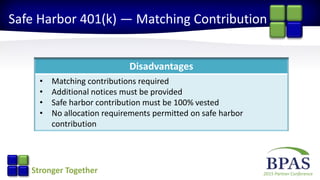
Safe Harbor 401(k) — Matching Contribution
Disadvantages
• Matching contributions required
• Additional notices must be provided
• Safe harbor contribution must be 100% vested
• No allocation requirements permitted on safe harbor
contribution
2015 Partner ConferenceStronger Together
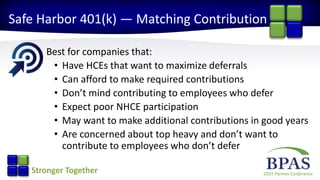
Best for companies that:
• Have HCEs that want to maximize deferrals
• Can afford to make required contributions
• Don’t mind contributing to employees who defer
• Expect poor NHCE participation
• May want to make additional contributions in good years
• Are concerned about top heavy and don’t want to
contribute to employees who don’t defer
Safe Harbor 401(k) — Matching Contribution
2015 Partner ConferenceStronger Together
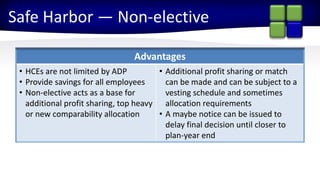
Safe Harbor — Non-elective
Advantages
• HCEs are not limited by ADP
• Provide savings for all employees
• Non-elective acts as a base for
additional profit sharing, top heavy
or new comparability allocation
• Additional profit sharing or match
can be made and can be subject to a
vesting schedule and sometimes
allocation requirements
• A maybe notice can be issued to
delay final decision until closer to
plan-year end
2015 Partner ConferenceStronger Together
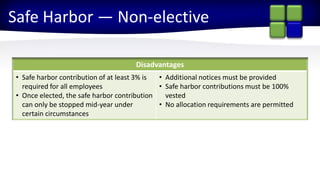
Safe Harbor — Non-elective
Disadvantages
• Safe harbor contribution of at least 3% is
required for all employees
• Once elected, the safe harbor contribution
can only be stopped mid-year under
certain circumstances
• Additional notices must be provided
• Safe harbor contributions must be 100%
vested
• No allocation requirements are permitted
2015 Partner ConferenceStronger Together
Safe Harbor — Non-elective
Best for companies that:
• Have HCEs that want to maximize deferrals
• Can afford to make the required contribution
• Want to contribute something for each employee
• Expect poor employee participation
• Do not have high turnover after one year or service
• Likely to make additional contributions in good years
2015 Partner ConferenceStronger Together
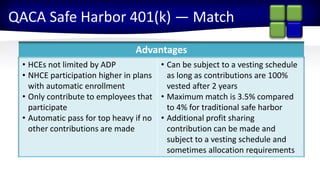
QACA Safe Harbor 401(k) — Match
Advantages
• HCEs not limited by ADP
• NHCE participation higher in plans
with automatic enrollment
• Only contribute to employees that
participate
• Automatic pass for top heavy if no
other contributions are made
• Can be subject to a vesting schedule
as long as contributions are 100%
vested after 2 years
• Maximum match is 3.5% compared
to 4% for traditional safe harbor
• Additional profit sharing
contribution can be made and
subject to a vesting schedule and
sometimes allocation requirements
2015 Partner ConferenceStronger Together
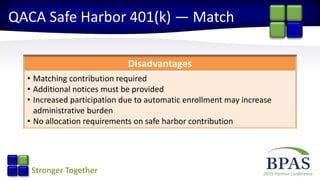
QACA Safe Harbor 401(k) — Match
Disadvantages
• Matching contribution required
• Additional notices must be provided
• Increased participation due to automatic enrollment may increase
administrative burden
• No allocation requirements on safe harbor contribution
2015 Partner ConferenceStronger Together
QACA Safe Harbor 401(k) — Match
Best for companies that:
• Have HCEs that want to maximize deferrals
• Can afford to make required contributions
• Don’t mind contributing to employees who defer
• Want to encourage saving by their employees
• May want to make additional contributions in good years
• Are concerned about top heavy and don’t want to
contribute for employees that don't defer
2015 Partner ConferenceStronger Together
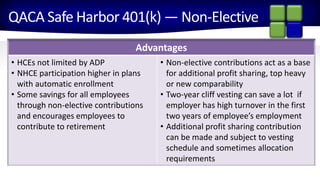
QACA Safe Harbor 401(k) — Non-Elective
Advantages
• HCEs not limited by ADP
• NHCE participation higher in plans
with automatic enrollment
• Some savings for all employees
through non-elective contributions
and encourages employees to
contribute to retirement
• Non-elective contributions act as a base
for additional profit sharing, top heavy
or new comparability
• Two-year cliff vesting can save a lot if
employer has high turnover in the first
two years of employee’s employment
• Additional profit sharing contribution
can be made and subject to vesting
schedule and sometimes allocation
requirements
2015 Partner ConferenceStronger Together
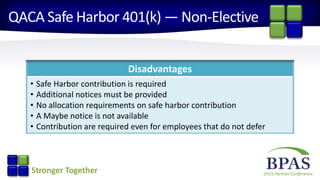
QACA Safe Harbor 401(k) — Non-Elective
Disadvantages
• Safe Harbor contribution is required
• Additional notices must be provided
• No allocation requirements on safe harbor contribution
• A Maybe notice is not available
• Contribution are required even for employees that do not defer
2015 Partner ConferenceStronger Together
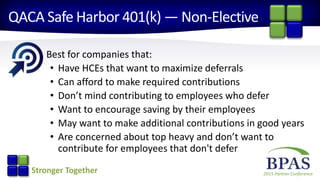
QACA Safe Harbor 401(k) — Non-Elective
Best for companies that:
• Have HCEs that want to maximize deferrals
• Can afford to make required contributions
• Don’t mind contributing to employees who defer
• Want to encourage saving by their employees
• May want to make additional contributions in good years
• Are concerned about top heavy and don’t want to
contribute for employees that don't defer
2015 Partner ConferenceStronger Together
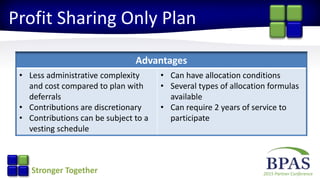
Profit Sharing Only Plan
Advantages
• Less administrative complexity
and cost compared to plan with
deferrals
• Contributions are discretionary
• Contributions can be subject to a
vesting schedule
• Can have allocation conditions
• Several types of allocation formulas
available
• Can require 2 years of service to
participate
2015 Partner ConferenceStronger Together
Profit Sharing Only Plan
Disadvantages
• Depending on demographics, it might be significantly more expensive
to maximize the HCES
• Employees aren’t able to contribute to their own retirement
2015 Partner ConferenceStronger Together
Pro Rata Allocation
Best for companies that:
• Want to keep the plan simple
• Are okay with contributing the same percentage of
compensation to HCEs as to NHCEs
2015 Partner ConferenceStronger Together
Integrated Allocation
Best for companies that:
• Want to provide a greater benefit to employees with
higher compensation without additional testing
• Have HCE compensation that is quite a bit higher than
NHCE compensation
• Have owners with high compensation that are younger
than some or most of the NHCEs
2015 Partner ConferenceStronger Together
New Comparability Allocation
Best for companies that:
• Have HCEs who are older than at least a few of the NHCEs
• Have a fairly stable workforce demographic
• Have HCEs that want to receive the maximum contribution
while contributing as little as possible to the NHCEs
• Don’t mind making the gateway contribution of the lesser of 5%
or 1/3 of the highest HCE contribution percentage
• Want flexibility to provide different contribution levels to
different employees
2015 Partner ConferenceStronger Together
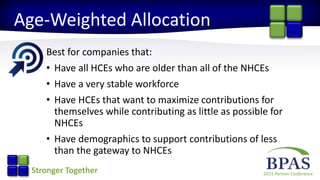
Age-Weighted Allocation
Best for companies that:
• Have all HCEs who are older than all of the NHCEs
• Have a very stable workforce
• Have HCEs that want to maximize contributions for
themselves while contributing as little as possible for
NHCEs
• Have demographics to support contributions of less
than the gateway to NHCEs
2015 Partner ConferenceStronger Together
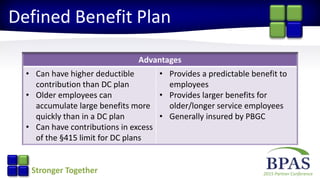
Defined Benefit Plan
Advantages
• Can have higher deductible
contribution than DC plan
• Older employees can
accumulate large benefits more
quickly than in a DC plan
• Can have contributions in excess
of the §415 limit for DC plans
• Provides a predictable benefit to
employees
• Provides larger benefits for
older/longer service employees
• Generally insured by PBGC
2015 Partner ConferenceStronger Together
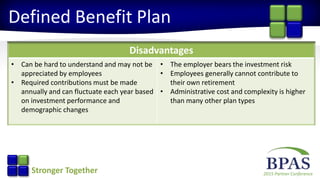
Defined Benefit Plan
Disadvantages
• Can be hard to understand and may not be
appreciated by employees
• Required contributions must be made
annually and can fluctuate each year based
on investment performance and
demographic changes
• The employer bears the investment risk
• Employees generally cannot contribute to
their own retirement
• Administrative cost and complexity is higher
than many other plan types
2015 Partner ConferenceStronger Together
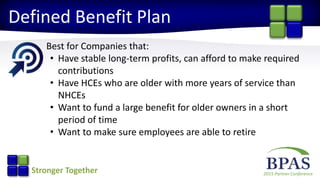
Defined Benefit Plan
Best for Companies that:
• Have stable long-term profits, can afford to make required
contributions
• Have HCEs who are older with more years of service than
NHCEs
• Want to fund a large benefit for older owners in a short
period of time
• Want to make sure employees are able to retire
2015 Partner ConferenceStronger Together
Defined Benefit Plan
Best for Companies that:
• Want to make deductible contributions in excess of 25%
of eligible compensation
• Want to contribute more than the maximum contribution
available under a DC plan for some employees
2015 Partner ConferenceStronger Together
Employee Stock Ownership Plan
Advantages
• Provides ownership mentality for
employees
• Possible business succession tool
• Can provide tax advantages to the
selling owner
• Can be leveraged
• Creates a market for the stock of a
closely held corporation
• Interest and dividends in excess of
the 25% of compensation limitation
may be deductible
2015 Partner ConferenceStronger Together
Employee Stock Ownership Plan
Disadvantages
• Complicated with high start up and
administrative costs
• Loan payments for leveraged ESOP
create an annual contribution
requirement
• Owner must adjust to sharing
ownership with employees or
completely transferring ownership
to employees
• Pro rata is only allocation method
permitted
• Increased fiduciary liability associated
with having stock in the plan
• External valuation of stock is required
and adds cost to the plan
• If company goes bankrupt, ESOP
accounts may become worthless
2015 Partner ConferenceStronger Together
Employee Stock Ownership Plan
Best for companies that:
• Have stable long-term profits
• Want to transfer ownership to employees
• Want to create a market for shares of a closely held
company
• Want to deduct more than 25% of eligible
compensation
2015 Partner ConferenceStronger Together
Case Study #1
• Dr. Jalil contacts you about a retirement plan. He and his partner want
to start saving $50,000 each per year for retirement. Dr. Jalil’s wife acts
as the office manager and comes into the office bi-weekly to process
payroll.
• Dr. Jalil wants flexibility in contributions as he and his partner have
children entering college and they may need cash. He does not want to
add an administrative burden for his wife. His staff is older than he and
his partner. He does not object to making contributions for his staff as
long as he can subject them to a vesting schedule. He anticipates that
his staff will remain at the current level for at least three years.
2015 Partner ConferenceStronger Together
Case Study #2
In a conversation with Jewel, owner of the gym you
frequent, she mentions that she would like to purchase
some new gym equipment. However, the equipment is
expensive and the financing would require increased net
profits after paying corporate taxes. Jewel is also
interested in establishing a retirement plan and wants to
know if there is a plan type that can help her achieve
both goals.
2015 Partner ConferenceStronger Together
Case Study #3
Jeffrey owns a fitness company and wants to encourage
employees to increase productivity and decrease
expenses. He is also looking for a higher return on his
investments and would like to save taxes and corporate
cash flow. His key executives would like ownership in the
company. Many of his employees have significant
longevity and he would like to reward them with a piece
of the profitability they helped to create.
2015 Partner ConferenceStronger Together
Case Study #4
• Erin, a retired teacher, calls you about establishing a
retirement plan. Erin provides consulting to several
educational organizations and anticipates income from this
practice will be approximately $120,000 (after taxes). Erin did
some part-time consulting over the last 3 years and earned
$72,000 each year.
• Erin does not anticipate hiring any employees. She 60 years
old and is collecting a pension from her prior employer’s
plan. She plans to continue her consulting services for
another 5 years
2015 Partner ConferenceStronger Together
Case Study #5
• You meet Dr. Baker, sole owner of Lakeside Dental. Her husband works
at Lakeside Dental as the Office Manager and processes payroll in
QuickBooks.
• Dr. Baker wants flexibility in contributions because she plans to buy
equipment in the next few years.
• She wants to minimize administration for her husband.
• She has two employees in addition to her husband and herself – a
hygienist and a receptionist.
• Most of her staff is older than she and she’d like to make a contribution
for them. She does want to retain her current staff and does not
anticipate any new hires for the next five years
2015 Partner ConferenceStronger Together
Case Study #6
• During a round of golf, your friend, Jim, tells you he wants to begin saving
for retirement. Jim has a small business and his mother works for him as
an assistant doing payroll and HR.
• Jim would like flexibility in contributions and he is concerned about the
administrative burden on his mother; payroll takes her away from her
other duties.
• Jim has one staff member, Jack, who is younger than he. Jim wants to
provide Jack with a substantial benefit. He would also like to maximize the
benefit to his mother. He would like to subject the contributions to a
vesting schedule. One of his goals is to retain Jack as an employee.
• He does not anticipate any staff increases in the foreseeable future
2015 Partner ConferenceStronger Together
Case Study #7
Kevin is the sole owner of Dermagraphix Corporation. He received two
offers from third parties interested in acquiring his company. Kevin tells
you, over coffee, that he feels that both offers are unacceptable. The first
offer is too low, and while the second offer is acceptable from a price
standpoint, the buyer plans to move the company out of state. Kevin has
one son working for the company but he is young and relatively
inexperienced and is not ready to assume responsibility for corporate
ownership. Kevin also tells you that two of his Senior Executives are
capable and interested in taking over the company but they don’t have
ready cash to buy Kevin out. Kevin asks you if he should accept one of the
offers or if you have another option that he should consider
2015 Partner ConferenceStronger Together
Case Study #8
A few years later, you get another call from Kevin. The ESOP that you
helped him establish is working very well. However, Kevin is
concerned he won’t have enough money saved for retirement. He has
25 employees now, including himself and his wife. Everyone is under
the age of 30, except Kevin and his wife. Kevin uses an outside payroll
vendor and has an office manager that is extremely computer savvy.
Kevin suspects that many of his employees are not saving for their
retirement outside of the ESOP and he wants to help them achieve a
comfortable retirement. He also wants to make the maximum
contribution for himself and his wife, which he has determined to be
$50,000+ per year
2015 Partner ConferenceStronger Together
Case Study #9
You meet Ben at a cocktail party. He tells you that for the past 18
months, he has owned a sports training facility. He is comfortable with
the revenue and growth of the business and would like to expand his
employee benefits to include a retirement plan. Ben doesn’t feel that
he has the time or expertise to administer the plan. He has 15 fulltime
employees and 5 part-time. He cannot afford to make any employer
contributions right now but hopes to be able to do so in the near
future. Ben is 50 and would like to save as much for retirement for
himself as possible. He is the only HCE. He currently uses an outside
payroll vendor that also provides a platform for their health benefits.
2015 Partner ConferenceStronger Together
Case Study #10
• You get a call from Ryan who is interested in establishing a
retirement plan. He heard about a plan that allows him to
accumulate substantial dollars for his retirement while providing
modest benefits for his employees. He tells you that he is a dentist
with 8 employees. He wants to start saving for retirement and wants
his contributions to be pre-tax.
• Ryan purchased the practice 20 years ago after having worked for
the prior owner for several years. The practice is now incorporated
and has elected Sub-chapter S status. 7 employees have worked with
Ryan for more that 2 years. The practice has a solid client base and
income is fairly steady.
2015 Partner ConferenceStronger Together
Case Study #10
• Ryan would like to see proposals that would provide him with a
contribution of $150,000 while keeping contributions to employees
in the 5-10% of compensation range. Ryan does not want to provide
different contribution percentages for different employees as he
fears this may lead to personnel problems.
• Ryan currently sponsors a safe harbor 401(k) plan with a new
comparability formula.
• There are several employees the same age or older than Ryan.
2015 Partner ConferenceStronger Together
Case Study #11
• During 2014, you get a call from George who is interested in establishing
a retirement plan. George is an independent insurance agent with no
employees and no plans to ever hire another person. He is 50 years old
and has not really made any plans for retirement other than annual
contributions to a traditional IRA. He would like to retire at age 62 and
wants to be able to continue his current standard of living. He is also very
interested in reducing his tax burden.
• George explains that he has built up a substantial group of clients that are
very loyal to him. His income has grown over the last 20 years at an
annual rate of 7%-10% and he foresees this continuing into the future. His
net Schedule C was $350,000 and he has a high 3-year average of over
$255,000.
2015 Partner ConferenceStronger Together
Questions
Maryann Geary, SVP, Plan
Administration and Recordkeeping
Services, BPAS
Vince Spina, President, Harbridge
Consulting Group, a BPAS Company
Thank you

Creative DC/DB Plan Design & Case Studies

  • 1.
    STRONGER Strategies for success 2015 PartnerConference together Creative DB Plan Designs and Case Studies Maryann Geary, EVP, BPAS Plan Administration & Recordkeeping Vince Spina, President, Harbridge Consulting Group, a BPAS Company
  • 2.
    2015 Partner ConferenceStrongerTogether Agenda • Why Save in a Tax-Qualified Plan? • Basic Cash Balance Plan • BPAS WRAP Design (“Worker Retirement Accumulation Plan”) • The Future of DB/DC Combo Plans
  • 3.
    2015 Partner ConferenceStrongerTogether Why Save in a Tax-Qualified Plan? The “on-the street” question……why not just save outside a plan where there is favorable capital gains treatment?
  • 4.
    2015 Partner ConferenceStrongerTogether 2015 Federal Income Tax Rates Tax Rate Single Married/Joint & Widower Married/Separate Head of Household 10% $1 - $9,225 $1 - $18,450 $1 - $9,225 $1 - $13,150 15% $9,225-$37,450 $18,450 to $74,900 $9,225 to $37,450 $13,150 to $50,200 25% $37,450 to $90,750 $74,900 to $151,200 $37,450 to $75,600 $50,200 to $129,600 28% $90,750 to $189,300 $151,200 to $230,450 $75,600 to $115,225 $129,600 to $209,850 33% $189,300 to $411,500 $230,450 to $411,500 $115,225 to $205,750 $209,850 to $411,500 35% $411,500 to $413,200 $411,500 to $464,850 $205,750 to $232,425 $411,500 to $439,200 39.60% over $413,200 over $464,850 over $232,425 over $439,200
  • 5.
    2015 Partner ConferenceStrongerTogether Why Save in a Tax-Qualified Plan? One Example: Fact Set Annual Contribution $ 100,000 Federal Income Tax Rate during savings period 39.60% State Income Tax Rate during savings period 6.85% Tax Rate for Investments Outside Qualified Plans 21.85% Tax Rate on Income in Retirement 28.00% Investment Return in Qualified Plan 3.00% Investment Return Outside Qualified Plan 7.00% Years Saving in Qualified Plan 5
  • 6.
    2015 Partner ConferenceStrongerTogether Why Save in a Tax-Qualified Plan? One Example: Outcome Value After Five Years in Qualified Plan $530,914 Taxes in Retirement if Paid all at Once (148,656) Balance After-Tax $382,258 Balance if Saving Outside Plan $298,691 Advantage of Saving in Tax Qualified Plan $ 83,567
  • 7.
    2015 Partner ConferenceStrongerTogether Why Save in a Tax-Qualified Plan? • In this example, saving for only five years AND in a much more conservative manner AND paying the tax immediately at the end of five years, one ends up with nearly 30% more spendable dollars than if saving outside of a qualified plan. • Results are more dramatic if money is rolled over to an IRA and withdrawn over a retirement lifetime--which is what everyone does.
  • 8.
    2015 Partner ConferenceStrongerTogether 2015 DB Plan Contribution Limits Maximum Maximum Maximum Maximum Age Contribution Age Contribution Age Contribution Age Contribution 31 $ 56,000 41 $ 92,000 51 $151,000 61 $249,000 32 $ 59,000 42 $ 97,000 52 $159,000 62 $262,000 33 $ 62,000 43 $102,000 53 $167,000 63 $256,000 34 $ 65,000 44 $107,000 54 $176,000 64 $250,000 35 $ 68,000 45 $112,000 55 $185,000 65 $244,000 36 $ 72,000 46 $118,000 56 $194,000 66 $257,000 37 $ 75,000 47 $124,000 57 $204,000 67 $270,000 38 $ 79,000 48 $130,000 58 $214,000 68 $280,000 39 $ 83,000 49 $137,000 59 $225,000 69 $267,000 40 $ 88,000 50 $144,000 60 $237,000 70 $260,000
  • 9.
    2015 Partner ConferenceStrongerTogether Cash Balance Plans Participants have notional account balances • Service Credits (e.g., 2.5% of pay or a flat amount such as $100,000) and Interest Credits — A fixed amount (e.g., 3%) — Tied to an index (e.g., 5- or 10-year Treasury yields) that changes year to year, or — The actual return on plan assets — If the actual return on plan assets is used, there is a minimum floor of 0% return over a participant’s career (but can have a negative return for a particular year)
  • 10.
    2015 Partner ConferenceStrongerTogether Cash Balance Plans • What makes a Cash Balance Plan a Defined Benefit Plan? — “Defined” interest credits — Ability to annuitize account balances at retirement within the plan — As a result, DB plan limits apply (i.e. not the $53,000 DC plan limit) • Plan assets don’t need to equal the sum of account balances
  • 11.
    2015 Partner ConferenceStrongerTogether Cash Balance Plans • Need to satisfy non-discrimination rules — Generally need to provide rank and file a contribution of 7.5% of pay between the 401(k) Plan and Cash Balance Plan • Assets are in a pooled account — Participants do NOT have individual direction of account balance — All participants get the same investment return
  • 12.
    2015 Partner ConferenceStrongerTogether Cash Balance Plans • Cash Balance looks a lot like a Balance Forward DC plan except with much higher contribution limits • Sponsor usually has both CB and 401(k) Plan
  • 13.
    2015 Partner ConferenceStrongerTogether Cash Balance Plans Typical Plan Design • 5% of pay for rank and file • Maximum contribution for owners • No matching contribution 401(k) Plan • 2.5% of pay for rank and file • Contribution for owner based on Survey Results (up to maximum limit) CB Plan
  • 14.
    2015 Partner ConferenceStrongerTogether Cash Balance Plan - Example Contribution Credit • Owner: $100,000 • Employees: 2.5% of W-2 Interest Credit: 3.0% Compounded Annually
  • 15.
    2015 Partner ConferenceStrongerTogether Cash Balance Plan - Example Owner Employee Owner Employee W-2 Pay $265,000 $40,000 $265,000 $41,000 1/1/2015 Balance $ - $ - 1/1/2016 Balance $ 100,000 $ 1,000 Interest Credit $ - $ - Interest Credit $ 3,000 $ 30 Service Based Credit $ 100,000 $ 1,000 Service Based Credit $ 100,000 $ 1,025 12/31/2015 Balance $ 100,000 $ 1,000 12/31/2016 Balance $ 203,000 $ 2,055
  • 16.
    2015 Partner ConferenceStrongerTogether Cash Balance Plans – Investments • Maximum amount that may be accumulated on behalf of an individual in a CB plan is about $2.6M at age 62 • Because of this cap, plan assets tend to be invested more conservatively….taking significant investment risk just gets owner to the maximum lump sum sooner
  • 17.
    2015 Partner ConferenceStrongerTogether Cash Balance Plans – Investments
  • 18.
    2015 Partner ConferenceStrongerTogether Potential Medicare Tax Savings • To the extent contributions to a Qualified Plan result in reduction to owner’s W-2 pay, there may be a significant Medicare tax savings — Applies to corporate sponsors — Not applicable for sole proprietors or partnerships • In many situations, savings in Medicare tax is more than the cost of administration
  • 19.
    2015 Partner ConferenceStrongerTogether FICA Tax Savings – Actual BPAS Client Employer CB Plan Year Contributions 2013 $ 1,422,500 2014 $ 1,315,999 2015 $ 1,466,000 Cumulative CB Plan Contributions (2013 -2015) $ 4,204,499 Reduction in Employer Medicare Tax (1.45%) $ 60,965 Reduction in Employee Medicare Tax (2.35%) $ 98,806 Total reduction in Medicare Taxes (2013 - 2015) $ 159,771 BPAS Fees (2013-2015) $ (32,580) Net Savings to PC Owners (2013-2015) $ 127,191
  • 20.
    2015 Partner ConferenceStrongerTogether Potential Cash Balance Plan Clients A Financial Advisor should discuss a Cash Balance Plan with any Company whose top employees earn more than $350,000 annually • Not discussing this will put your relationship at risk
  • 21.
    2015 Partner ConferenceStrongerTogether Potential Cash Balance Plan Clients Two Pre-Qualifying Questions • Do the top-paid employees want more than $53,000 of annual tax-deferred contributions? • Is the company willing to spend at least 7.5% of pay in contributions to tax-qualified employees for the rank and file employees?
  • 22.
    2015 Partner ConferenceStrongerTogether BPAS WRAP Design • BPAS WRAP Design (“Worker Retirement Accumulation Plan”)—a Second Generation Cash Balance Plan Design • Basic Cash Balance Plan with one difference—interest credit in Cash Balance Plan is replaced with a contribution to the 401(k) Plan
  • 23.
    2015 Partner ConferenceStrongerTogether WRAP Plan - Example Cash Balance Plan Contribution Credit: 5.0% of W-2 Interest Credit: 3.0% of Beginning of Year Balance in Cash Balance Plan made as a contribution to the 401(k) Plan
  • 24.
    2015 Partner ConferenceStrongerTogether WRAP Plan - Example 401(k) 401(k) WRAP WRAP CB Plan Account CB Plan Account W-2 Pay of Participant $ 50,000 $ 50,000 $ 51,000 $ 51,000 1/1/2015 Balance $ - $ - 1/1/2016 Balance $ 2,500 $ - Interest Credit $ - $ - Interest Credit $ - $ 75 Service Based Credit $ 2,500 $ - Service Based Credit $ 2,550 $ - 12/31/2015 Balance $ 2,500 $ - 12/31/2016 Balance $ 5,050 $ 75
  • 25.
    2015 Partner ConferenceStrongerTogether BPAS WRAP Design – Why? • For the same contribution credit (e.g., 5% of pay), 401(k) Expense > Traditional CB Expense > WRAP Expense • For some BPAS clients, resulting book expense savings can be more than $.03 per share* * Anything more than $.01 per share gets a CFO’s attention
  • 26.
    2015 Partner ConferenceStrongerTogether BPAS WRAP Design – Example Traditional Cash Balance 401(k) Plan Plan WRAP Plan W-2 Pay $ 100,000,000 $ 100,000,000 $ 100,000,000 Contribution Credits $ 5,000,000 $ 4,046,664 $ 2,923,396 In all three designs, contribution credit is 5% of pay
  • 27.
    2015 Partner ConferenceStrongerTogether BPAS WRAP Design – Who? Who would be interested in a WRAP Plan Design? • Public companies where book expense is a primary issue • Any sponsor of a DB plan that was already converted into a Cash Balance Plan
  • 28.
    2015 Partner ConferenceStrongerTogether DB/DC Combo Plans • What is the Current State of these plans? • Generally at Retirement: • DC Plan, take rollover distribution to IRA • DC industry has been focused on “catching the rollover” • DB Plan, make one time election of an annuity from plan
  • 29.
    2015 Partner ConferenceStrongerTogether DB/DC Combo Plans Suppose someone earning $50,000 has done everything right and accumulated $500,000 (i.e., 10 x pay) at age 65 • What do they do? Rollover to IRA and draw down over their retirement? • Does this maximize their lifestyle in retirement? • What about a guaranteed life annuity?
  • 30.
    2015 Partner ConferenceStrongerTogether Comparison of Annual Income from $500K Accumulated at Age 65 Purchase Transfer to Life Annuity DB Plan & Keep in Plan Keep in Plan From Purchase 4% Drawdown 5% Drawdown Insurer Annuity Female $ 20,000 $ 25,000 $ 30,900 $ 35,997 Male $ 20,000 $ 25,000 $ 33,000 $ 35,997 Insurance company annuity rates generated from www.immediateannuities.com DB Plan annuities based on IRC 417(e) rates for 2015
  • 31.
    2015 Partner ConferenceStrongerTogether The Future of DB/DC Combo Plans What about a very flexible structure, using DB plan for lifetime income, and DC plan for structured payments for fixed period with ability to access remaining account balance if needed?
  • 32.
    2015 Partner ConferenceStrongerTogether The Future of DB/DC Combo Plans Example: Age 65 Retiree has accumulated $200,000 in Cash Balance Plan, $800,000 in 401(k) Plan, $1,000,000 in total What is available….and what could be available?
  • 33.
    2015 Partner ConferenceStrongerTogether The Future of DB/DC Combo Plans $1,000,000 $200,000 $800,000 in Qualified CB Balance 401(k) Balance Plan Balances Take Rollovers and then take 5% Drawdown $10,000 $40,000 $50,000 CB Plan: Life Annuity/DC Plan: 5% Drawdown $14,399 $40,000 $54,399 Transfer DC to DB and take all as a life annuity $71,994 $0 $71,994 Transfer $494,500 from DC to DB to generate $50,000 $35,814 $85,814 for 10 years $50,000 in lifetime income, drawdown remainder for 10 years $50,000 thereafter from DC plan in 10 annual payments (assume 3% annual earnings in DC Plan)
  • 34.
    2015 Partner ConferenceStrongerTogether The Future of DB/DC Combo Plans Historic DB/DC combo plans have had distribution options that have been too rigid; technology will make the type of options illustrated easily accessible
  • 35.
    2015 Partner ConferenceStrongerTogether Questions Thank you
  • 36.
    2015 Partner ConferenceStrongerTogether BPAS DB Plan Contacts Vince Spina vspina@bpas.com (315) 703-8999 Ken Prell kprell@bpas.com (315) 703-8993 Jason Disco jdisco@bpas.com (315) 703-8916
  • 37.
    STRONGER Strategies for success 2015 PartnerConference together Creative DC/DB Plan Design & Case Studies Maryann Geary, EVP, BPAS Plan Administration & Recordkeeping Vince Spina, President, Harbridge Consulting Group, a BPAS Company
  • 38.
    2015 Partner ConferenceStrongerTogether Things to Consider • Plan Sponsor’s Needs —Flexibility —Desired Contributions —Administrative Complexity and Expenses • Employer and Employee Demographics —Entity Type —Employee Demographics —Plan Features
  • 39.
    2015 Partner ConferenceStrongerTogether Traditional 401(k) Advantages • Elective Deferrals • Catch-up contributions • Discretionary employer contributions • Employer contributions can be subject to vesting schedule • Employees working less than 1,000 hours can be excluded as well as employees under 21 or who have been employed less than one year • Loans and hardships can be offered
  • 40.
    2015 Partner ConferenceStrongerTogether Traditional 401(k) Disadvantages • ADP/ACP test can limit HCE contributions • Fiduciary responsibilities • Adds an administrative burden with payroll complexity, frequent plan deposits, testing and reporting costs
  • 41.
    2015 Partner ConferenceStrongerTogether Traditional 401(k) Best for companies that: • Don’t want to commit to employer contributions • Have HCEs that are willing to accept contribution limitations • Expect good NHCE participation • Have payroll systems in place to handle withholding and are able to provide data in a timely manner
  • 42.
    2015 Partner ConferenceStrongerTogether 401(k) — Automatic Contribution Advantages • Increased NHCE participation improves ADP • Possible extension of ADP refund deadline to 6 months • Increases savings of the employee population increasing the likelihood that employees will have sufficient funds at retirement
  • 43.
    2015 Partner ConferenceStrongerTogether 401(k) — Automatic Contribution Disadvantages • Still possible that testing will fail even with increased participation • Administrative burden of application of automatic contributions and notices to employees • An EACA can not be started mid-year • May result in small account balances • Matching contributions will likely be higher with increased participation
  • 44.
    2015 Partner ConferenceStrongerTogether 401(k) — Automatic Contribution Best for companies that: • Don’t want to commit to employer contributions • Want to increase participation among NHCEs, but can’t afford a safe harbor plan • Want to encourage a culture of saving • Have payroll systems in place to handle withholding, track enrollment amounts and dates and provide data in a timely manner
  • 45.
    2015 Partner ConferenceStrongerTogether Safe Harbor 401(k) — Matching Contribution Advantages • HCEs not limited by ADP • Only contribute for employees that defer • Automatic pass for top heavy if no other allocations made and eligibility for deferrals and match are the same • Additional profit sharing and matching contributions can be made and subject to a vesting schedule and sometimes allocation requirements • Safe harbor can be stopped with proper notification and plan amendment.
  • 46.
    2015 Partner ConferenceStrongerTogether Safe Harbor 401(k) — Matching Contribution Disadvantages • Matching contributions required • Additional notices must be provided • Safe harbor contribution must be 100% vested • No allocation requirements permitted on safe harbor contribution
  • 47.
    2015 Partner ConferenceStrongerTogether Best for companies that: • Have HCEs that want to maximize deferrals • Can afford to make required contributions • Don’t mind contributing to employees who defer • Expect poor NHCE participation • May want to make additional contributions in good years • Are concerned about top heavy and don’t want to contribute to employees who don’t defer Safe Harbor 401(k) — Matching Contribution
  • 48.
    2015 Partner ConferenceStrongerTogether Safe Harbor — Non-elective Advantages • HCEs are not limited by ADP • Provide savings for all employees • Non-elective acts as a base for additional profit sharing, top heavy or new comparability allocation • Additional profit sharing or match can be made and can be subject to a vesting schedule and sometimes allocation requirements • A maybe notice can be issued to delay final decision until closer to plan-year end
  • 49.
    2015 Partner ConferenceStrongerTogether Safe Harbor — Non-elective Disadvantages • Safe harbor contribution of at least 3% is required for all employees • Once elected, the safe harbor contribution can only be stopped mid-year under certain circumstances • Additional notices must be provided • Safe harbor contributions must be 100% vested • No allocation requirements are permitted
  • 50.
    2015 Partner ConferenceStrongerTogether Safe Harbor — Non-elective Best for companies that: • Have HCEs that want to maximize deferrals • Can afford to make the required contribution • Want to contribute something for each employee • Expect poor employee participation • Do not have high turnover after one year or service • Likely to make additional contributions in good years
  • 51.
    2015 Partner ConferenceStrongerTogether QACA Safe Harbor 401(k) — Match Advantages • HCEs not limited by ADP • NHCE participation higher in plans with automatic enrollment • Only contribute to employees that participate • Automatic pass for top heavy if no other contributions are made • Can be subject to a vesting schedule as long as contributions are 100% vested after 2 years • Maximum match is 3.5% compared to 4% for traditional safe harbor • Additional profit sharing contribution can be made and subject to a vesting schedule and sometimes allocation requirements
  • 52.
    2015 Partner ConferenceStrongerTogether QACA Safe Harbor 401(k) — Match Disadvantages • Matching contribution required • Additional notices must be provided • Increased participation due to automatic enrollment may increase administrative burden • No allocation requirements on safe harbor contribution
  • 53.
    2015 Partner ConferenceStrongerTogether QACA Safe Harbor 401(k) — Match Best for companies that: • Have HCEs that want to maximize deferrals • Can afford to make required contributions • Don’t mind contributing to employees who defer • Want to encourage saving by their employees • May want to make additional contributions in good years • Are concerned about top heavy and don’t want to contribute for employees that don't defer
  • 54.
    2015 Partner ConferenceStrongerTogether QACA Safe Harbor 401(k) — Non-Elective Advantages • HCEs not limited by ADP • NHCE participation higher in plans with automatic enrollment • Some savings for all employees through non-elective contributions and encourages employees to contribute to retirement • Non-elective contributions act as a base for additional profit sharing, top heavy or new comparability • Two-year cliff vesting can save a lot if employer has high turnover in the first two years of employee’s employment • Additional profit sharing contribution can be made and subject to vesting schedule and sometimes allocation requirements
  • 55.
    2015 Partner ConferenceStrongerTogether QACA Safe Harbor 401(k) — Non-Elective Disadvantages • Safe Harbor contribution is required • Additional notices must be provided • No allocation requirements on safe harbor contribution • A Maybe notice is not available • Contribution are required even for employees that do not defer
  • 56.
    2015 Partner ConferenceStrongerTogether QACA Safe Harbor 401(k) — Non-Elective Best for companies that: • Have HCEs that want to maximize deferrals • Can afford to make required contributions • Don’t mind contributing to employees who defer • Want to encourage saving by their employees • May want to make additional contributions in good years • Are concerned about top heavy and don’t want to contribute for employees that don't defer
  • 57.
    2015 Partner ConferenceStrongerTogether Profit Sharing Only Plan Advantages • Less administrative complexity and cost compared to plan with deferrals • Contributions are discretionary • Contributions can be subject to a vesting schedule • Can have allocation conditions • Several types of allocation formulas available • Can require 2 years of service to participate
  • 58.
    2015 Partner ConferenceStrongerTogether Profit Sharing Only Plan Disadvantages • Depending on demographics, it might be significantly more expensive to maximize the HCES • Employees aren’t able to contribute to their own retirement
  • 59.
    2015 Partner ConferenceStrongerTogether Pro Rata Allocation Best for companies that: • Want to keep the plan simple • Are okay with contributing the same percentage of compensation to HCEs as to NHCEs
  • 60.
    2015 Partner ConferenceStrongerTogether Integrated Allocation Best for companies that: • Want to provide a greater benefit to employees with higher compensation without additional testing • Have HCE compensation that is quite a bit higher than NHCE compensation • Have owners with high compensation that are younger than some or most of the NHCEs
  • 61.
    2015 Partner ConferenceStrongerTogether New Comparability Allocation Best for companies that: • Have HCEs who are older than at least a few of the NHCEs • Have a fairly stable workforce demographic • Have HCEs that want to receive the maximum contribution while contributing as little as possible to the NHCEs • Don’t mind making the gateway contribution of the lesser of 5% or 1/3 of the highest HCE contribution percentage • Want flexibility to provide different contribution levels to different employees
  • 62.
    2015 Partner ConferenceStrongerTogether Age-Weighted Allocation Best for companies that: • Have all HCEs who are older than all of the NHCEs • Have a very stable workforce • Have HCEs that want to maximize contributions for themselves while contributing as little as possible for NHCEs • Have demographics to support contributions of less than the gateway to NHCEs
  • 63.
    2015 Partner ConferenceStrongerTogether Defined Benefit Plan Advantages • Can have higher deductible contribution than DC plan • Older employees can accumulate large benefits more quickly than in a DC plan • Can have contributions in excess of the §415 limit for DC plans • Provides a predictable benefit to employees • Provides larger benefits for older/longer service employees • Generally insured by PBGC
  • 64.
    2015 Partner ConferenceStrongerTogether Defined Benefit Plan Disadvantages • Can be hard to understand and may not be appreciated by employees • Required contributions must be made annually and can fluctuate each year based on investment performance and demographic changes • The employer bears the investment risk • Employees generally cannot contribute to their own retirement • Administrative cost and complexity is higher than many other plan types
  • 65.
    2015 Partner ConferenceStrongerTogether Defined Benefit Plan Best for Companies that: • Have stable long-term profits, can afford to make required contributions • Have HCEs who are older with more years of service than NHCEs • Want to fund a large benefit for older owners in a short period of time • Want to make sure employees are able to retire
  • 66.
    2015 Partner ConferenceStrongerTogether Defined Benefit Plan Best for Companies that: • Want to make deductible contributions in excess of 25% of eligible compensation • Want to contribute more than the maximum contribution available under a DC plan for some employees
  • 67.
    2015 Partner ConferenceStrongerTogether Employee Stock Ownership Plan Advantages • Provides ownership mentality for employees • Possible business succession tool • Can provide tax advantages to the selling owner • Can be leveraged • Creates a market for the stock of a closely held corporation • Interest and dividends in excess of the 25% of compensation limitation may be deductible
  • 68.
    2015 Partner ConferenceStrongerTogether Employee Stock Ownership Plan Disadvantages • Complicated with high start up and administrative costs • Loan payments for leveraged ESOP create an annual contribution requirement • Owner must adjust to sharing ownership with employees or completely transferring ownership to employees • Pro rata is only allocation method permitted • Increased fiduciary liability associated with having stock in the plan • External valuation of stock is required and adds cost to the plan • If company goes bankrupt, ESOP accounts may become worthless
  • 69.
    2015 Partner ConferenceStrongerTogether Employee Stock Ownership Plan Best for companies that: • Have stable long-term profits • Want to transfer ownership to employees • Want to create a market for shares of a closely held company • Want to deduct more than 25% of eligible compensation
  • 70.
    2015 Partner ConferenceStrongerTogether Case Study #1 • Dr. Jalil contacts you about a retirement plan. He and his partner want to start saving $50,000 each per year for retirement. Dr. Jalil’s wife acts as the office manager and comes into the office bi-weekly to process payroll. • Dr. Jalil wants flexibility in contributions as he and his partner have children entering college and they may need cash. He does not want to add an administrative burden for his wife. His staff is older than he and his partner. He does not object to making contributions for his staff as long as he can subject them to a vesting schedule. He anticipates that his staff will remain at the current level for at least three years.
  • 71.
    2015 Partner ConferenceStrongerTogether Case Study #2 In a conversation with Jewel, owner of the gym you frequent, she mentions that she would like to purchase some new gym equipment. However, the equipment is expensive and the financing would require increased net profits after paying corporate taxes. Jewel is also interested in establishing a retirement plan and wants to know if there is a plan type that can help her achieve both goals.
  • 72.
    2015 Partner ConferenceStrongerTogether Case Study #3 Jeffrey owns a fitness company and wants to encourage employees to increase productivity and decrease expenses. He is also looking for a higher return on his investments and would like to save taxes and corporate cash flow. His key executives would like ownership in the company. Many of his employees have significant longevity and he would like to reward them with a piece of the profitability they helped to create.
  • 73.
    2015 Partner ConferenceStrongerTogether Case Study #4 • Erin, a retired teacher, calls you about establishing a retirement plan. Erin provides consulting to several educational organizations and anticipates income from this practice will be approximately $120,000 (after taxes). Erin did some part-time consulting over the last 3 years and earned $72,000 each year. • Erin does not anticipate hiring any employees. She 60 years old and is collecting a pension from her prior employer’s plan. She plans to continue her consulting services for another 5 years
  • 74.
    2015 Partner ConferenceStrongerTogether Case Study #5 • You meet Dr. Baker, sole owner of Lakeside Dental. Her husband works at Lakeside Dental as the Office Manager and processes payroll in QuickBooks. • Dr. Baker wants flexibility in contributions because she plans to buy equipment in the next few years. • She wants to minimize administration for her husband. • She has two employees in addition to her husband and herself – a hygienist and a receptionist. • Most of her staff is older than she and she’d like to make a contribution for them. She does want to retain her current staff and does not anticipate any new hires for the next five years
  • 75.
    2015 Partner ConferenceStrongerTogether Case Study #6 • During a round of golf, your friend, Jim, tells you he wants to begin saving for retirement. Jim has a small business and his mother works for him as an assistant doing payroll and HR. • Jim would like flexibility in contributions and he is concerned about the administrative burden on his mother; payroll takes her away from her other duties. • Jim has one staff member, Jack, who is younger than he. Jim wants to provide Jack with a substantial benefit. He would also like to maximize the benefit to his mother. He would like to subject the contributions to a vesting schedule. One of his goals is to retain Jack as an employee. • He does not anticipate any staff increases in the foreseeable future
  • 76.
    2015 Partner ConferenceStrongerTogether Case Study #7 Kevin is the sole owner of Dermagraphix Corporation. He received two offers from third parties interested in acquiring his company. Kevin tells you, over coffee, that he feels that both offers are unacceptable. The first offer is too low, and while the second offer is acceptable from a price standpoint, the buyer plans to move the company out of state. Kevin has one son working for the company but he is young and relatively inexperienced and is not ready to assume responsibility for corporate ownership. Kevin also tells you that two of his Senior Executives are capable and interested in taking over the company but they don’t have ready cash to buy Kevin out. Kevin asks you if he should accept one of the offers or if you have another option that he should consider
  • 77.
    2015 Partner ConferenceStrongerTogether Case Study #8 A few years later, you get another call from Kevin. The ESOP that you helped him establish is working very well. However, Kevin is concerned he won’t have enough money saved for retirement. He has 25 employees now, including himself and his wife. Everyone is under the age of 30, except Kevin and his wife. Kevin uses an outside payroll vendor and has an office manager that is extremely computer savvy. Kevin suspects that many of his employees are not saving for their retirement outside of the ESOP and he wants to help them achieve a comfortable retirement. He also wants to make the maximum contribution for himself and his wife, which he has determined to be $50,000+ per year
  • 78.
    2015 Partner ConferenceStrongerTogether Case Study #9 You meet Ben at a cocktail party. He tells you that for the past 18 months, he has owned a sports training facility. He is comfortable with the revenue and growth of the business and would like to expand his employee benefits to include a retirement plan. Ben doesn’t feel that he has the time or expertise to administer the plan. He has 15 fulltime employees and 5 part-time. He cannot afford to make any employer contributions right now but hopes to be able to do so in the near future. Ben is 50 and would like to save as much for retirement for himself as possible. He is the only HCE. He currently uses an outside payroll vendor that also provides a platform for their health benefits.
  • 79.
    2015 Partner ConferenceStrongerTogether Case Study #10 • You get a call from Ryan who is interested in establishing a retirement plan. He heard about a plan that allows him to accumulate substantial dollars for his retirement while providing modest benefits for his employees. He tells you that he is a dentist with 8 employees. He wants to start saving for retirement and wants his contributions to be pre-tax. • Ryan purchased the practice 20 years ago after having worked for the prior owner for several years. The practice is now incorporated and has elected Sub-chapter S status. 7 employees have worked with Ryan for more that 2 years. The practice has a solid client base and income is fairly steady.
  • 80.
    2015 Partner ConferenceStrongerTogether Case Study #10 • Ryan would like to see proposals that would provide him with a contribution of $150,000 while keeping contributions to employees in the 5-10% of compensation range. Ryan does not want to provide different contribution percentages for different employees as he fears this may lead to personnel problems. • Ryan currently sponsors a safe harbor 401(k) plan with a new comparability formula. • There are several employees the same age or older than Ryan.
  • 81.
    2015 Partner ConferenceStrongerTogether Case Study #11 • During 2014, you get a call from George who is interested in establishing a retirement plan. George is an independent insurance agent with no employees and no plans to ever hire another person. He is 50 years old and has not really made any plans for retirement other than annual contributions to a traditional IRA. He would like to retire at age 62 and wants to be able to continue his current standard of living. He is also very interested in reducing his tax burden. • George explains that he has built up a substantial group of clients that are very loyal to him. His income has grown over the last 20 years at an annual rate of 7%-10% and he foresees this continuing into the future. His net Schedule C was $350,000 and he has a high 3-year average of over $255,000.
  • 82.
    2015 Partner ConferenceStrongerTogether Questions Maryann Geary, SVP, Plan Administration and Recordkeeping Services, BPAS Vince Spina, President, Harbridge Consulting Group, a BPAS Company Thank you