The Science of Aging
Where we are and where we could go
Martin Borch Jensen
Fifty Years HQ
November 18, 2019
Kia Winslow
Thank you
According to NIH grant review panels:
Experience:
Who am I?
Nanobiotechnology
M.Sc Ph.D.
DNA repair
Accelerated aging
Mitochondria
Inflammation/signaling
K99
Aging as a problem
Defining ‘aging’
Mechanisms of aging
Landscape & challenges
c
c
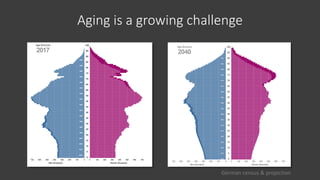
Aging is a growing challenge
c
c
German census & projection
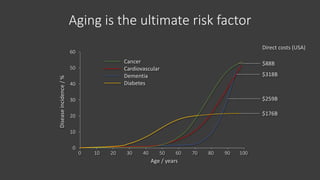
Aging is the ultimate risk factor
10 200 30 40 50 60 70 80 90 100
0
10
20
30
40
50
60
Age / years
Diseaseincidence/% Cancer
Cardiovascular
Dementia
Diabetes
$88B
$318B
$259B
$176B
Direct costs (USA)
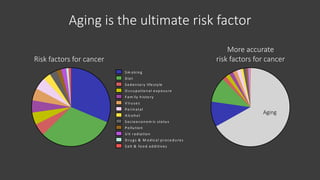
S m o kin g
D iet
S ed entary lifestyle
O ccu p atio n al exp o su re
F a m ily h isto ry
V iru se s
Perin atal
A lco h o l
S o cio eco n o m ic statu s
Po llu tio n
U V radiatio n
D ru gs & M ed ical p ro ce d u res
S alt & fo o d ad d itives
Risk factors for cancer
Aging is the ultimate risk factor
More accurate
risk factors for cancer
Aging
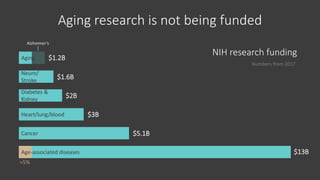
NIH research funding
Cancer
Heart/lung/blood
$5.1B
$3B
Diabetes &
Kidney
$2B
Neuro/
Stroke
$1.6B
Aging $1.2B
Alzheimer’s
$13BAge-associated diseases
≈5%
Aging research is not being funded
Numbers from 2017
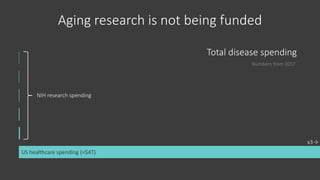
US healthcare spending (≈$4T)
NIH research spending
Total disease spending
Aging research is not being funded
x3→
Numbers from 2017
Early investments haven’t paid off
Why isn’t aging research funded?
Is anything different now?
Why isn’t aging research funded?
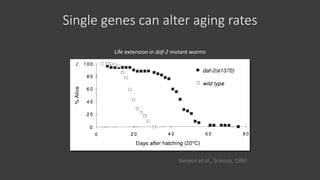
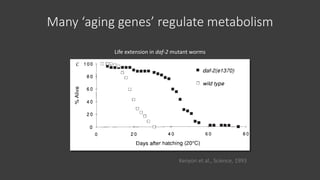
Life extension in daf-2 mutant worms
Kenyon et al., Science, 1993
Single genes can alter aging rates
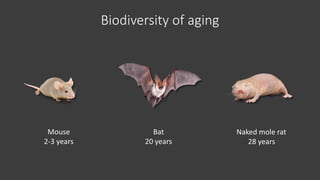
Mouse
2-3 years
Bat
20 years
Naked mole rat
28 years
Biodiversity of aging
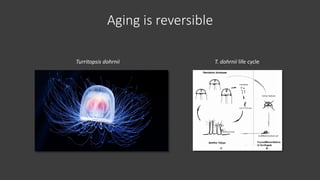
Turritopsis dohrnii T. dohrnii life cycle
Aging is reversible
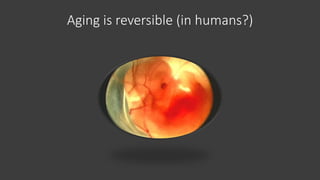
Aging is reversible (in humans?)
Aging as a problem
Defining ‘aging’
Mechanisms of aging
Landscape & challenges
How to think about “aging”
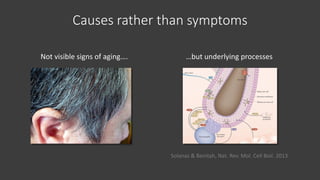
Solanas & Benitah, Nat. Rev. Mol. Cell Biol. 2013
Not visible signs of aging…. …but underlying processes
Causes rather than symptoms
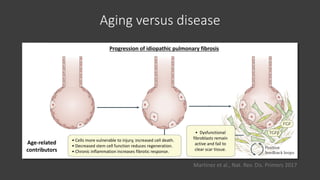
Aging versus disease
Martinez et al., Nat. Rev. Dis. Primers 2017
Various types of injury
(smoke, infection, …)
kills epithelial cells
Aberrant attempts at
repair cause fibrosis
• Cells more vulnerable to injury, increased cell death.
• Decreased stem cell function reduces regeneration.
• Chronic inflammation increases fibrotic response.
• Dysfunctional
fibroblasts remain
active and fail to
clear scar tissue.
Age-related
contributors
Progression of idiopathic pulmonary fibrosis
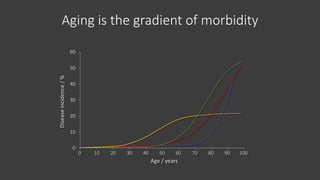
Aging is the gradient of morbidity
10 200 30 40 50 60 70 80 90 100
0
10
20
30
40
50
60
Age / years
Diseaseincidence/%
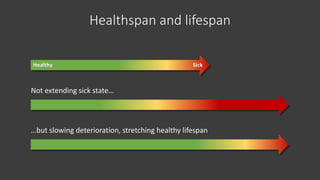
Not extending sick state…
…but slowing deterioration, stretching healthy lifespan
SickHealthy
Healthspan and lifespan
Defining “Aging”
Systemic & progressive decline
in ability to preserve physiological function
in the face of genetic and environmental challenges.
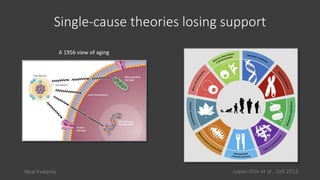
Single-cause theories losing support
Lopez-Otin et al., Cell 2013Neal Fedarko
A 1956 view of aging
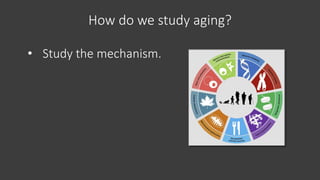
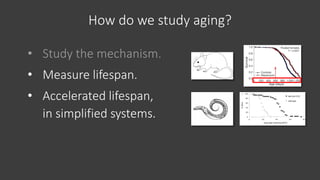
How do we study aging?
• Study the mechanism.
• Measure lifespan.
• Accelerated lifespan,
in simplified systems.
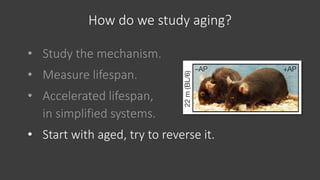
• Start with aged, try to reverse it.
How do we study aging?
• Study the mechanism.
• Measure lifespan.
• Accelerated lifespan,
in simplified systems.
• Start with aged, try to reverse it.
How do we study aging?
• Study the mechanism.
• Measure lifespan.
• Accelerated lifespan,
in simplified systems.
• Start with aged, try to reverse it.
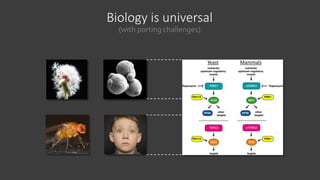
Biology is universal
(with porting challenges)
Yeast Mammals
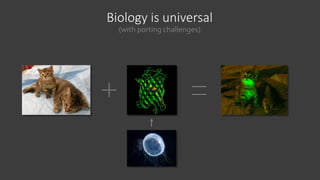
Biology is universal
(with porting challenges)
[Intermission]
Aging as a problem
Defining ‘aging’
Mechanisms of aging
Landscape & challenges
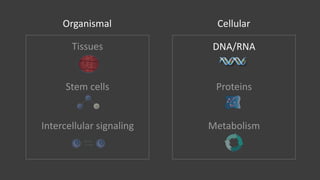
Organismal Cellular
DNA/RNA
Proteins
Metabolism
Tissues
Stem cells
Intercellular signaling
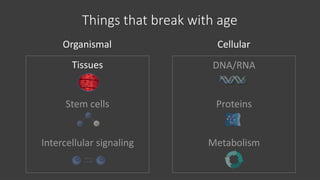
Things that break with age
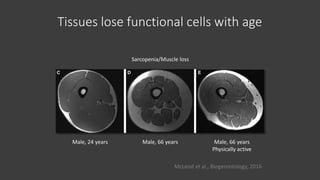
McLeod et al., Biogerontology, 2016
Male, 24 years Male, 66 years Male, 66 years
Physically active
Sarcopenia/Muscle loss
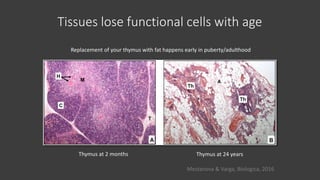
Tissues lose functional cells with age
Replacement of your thymus with fat happens early in puberty/adulthood
Thymus at 2 months Thymus at 24 years
Mestanova & Varga, Biologica, 2016
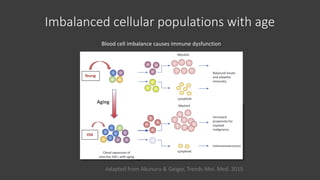
Adapted from Akunuru & Geiger, Trends Mol. Med. 2015
Imbalanced cellular populations with age
Blood cell imbalance causes immune dysfunction
Aging
Organismal Cellular
DNA/RNA
Proteins
Metabolism
Tissues
Stem cells
Intercellular signaling
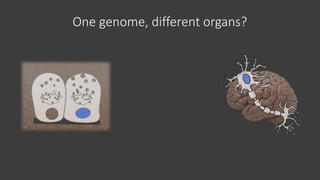
One genome, different organs?
moderate high very low
Gene 1
2
3
…
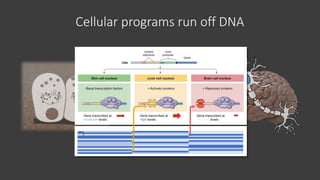
Cellular programs run off DNA
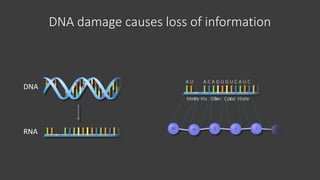
DNA
RNA
DNA damage causes loss of information
A U G C A C A G U G U C A U C
Ile Gln Cys HisMet His Ser Val Ile
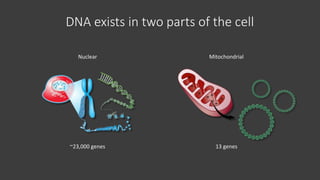
~23,000 genes 13 genes
Nuclear Mitochondrial
DNA exists in two parts of the cell
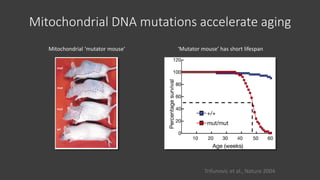
Trifunovic et al., Nature 2004
Mitochondrial DNA mutations accelerate aging
Mitochondrial ‘mutator mouse’ ‘Mutator mouse’ has short lifespan
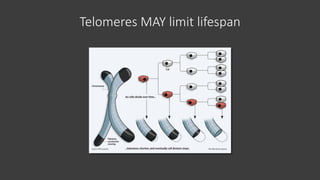
Telomeres MAY limit lifespan
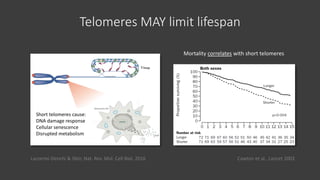
Mortality correlates with short telomeres
Cawton et al., Lancet 2003
Telomeres MAY limit lifespan
Short telomeres cause:
DNA damage response
Cellular senescence
Disrupted metabolism
Lazzerini-Denchi & Sfeir, Nat. Rev. Mol. Cell Biol. 2016
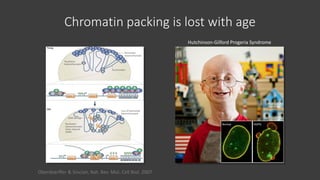
Chromatin packing is lost with age
Oberdoerffer & Sinclair, Nat. Rev. Mol. Cell Biol. 2007
Hutchinson-Gilford Progeria Syndrome
Organismal Cellular
DNA/RNA
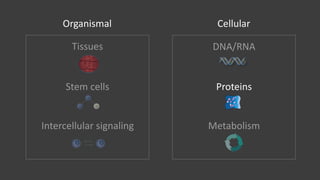
Proteins
Metabolism
Tissues
Stem cells
Intercellular signaling
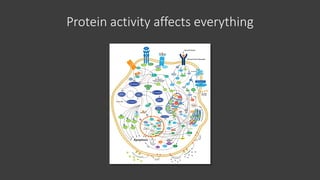
Protein activity affects everything
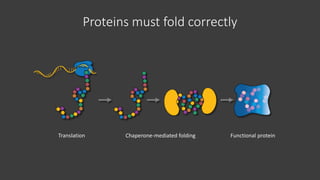
Proteins must fold correctly
Translation Chaperone-mediated folding Functional protein
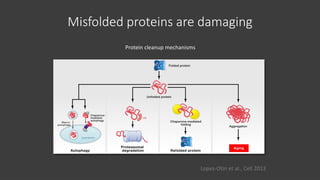
Lopez-Otin et al., Cell 2013
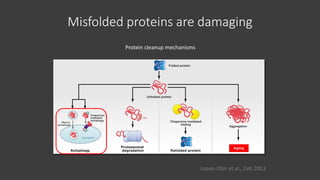
Misfolded proteins are damaging
Protein cleanup mechanisms
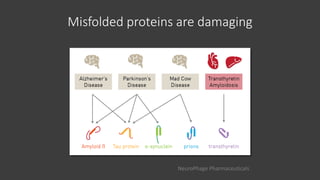
NeuroPhage Pharmaceuticals
Misfolded proteins are damaging
Lopez-Otin et al., Cell 2013
Misfolded proteins are damaging
Protein cleanup mechanisms
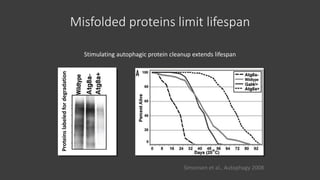
Simonsen et al., Autophagy 2008
Misfolded proteins limit lifespan
Stimulating autophagic protein cleanup extends lifespan
Wildtype Wildtype
Proteinslabeledfordegradation
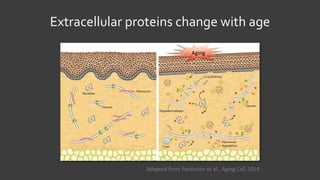
Adapted from Parkinson et al., Aging Cell 2014
Extracellular proteins change with age
Aging
Organismal Cellular
DNA/RNA
Proteins
Metabolism
Tissues
Stem cells
Intercellular signaling
Life extension in daf-2 mutant worms
Kenyon et al., Science, 1993
Many ‘aging genes’ regulate metabolism
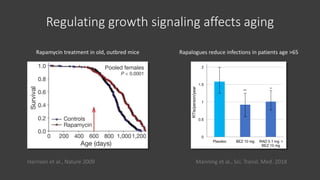
Harrison et al., Nature 2009 Manning et al., Sci. Transl. Med. 2018
Regulating growth signaling affects aging
Rapamycin treatment in old, outbred mice Rapalogues reduce infections in patients age >65
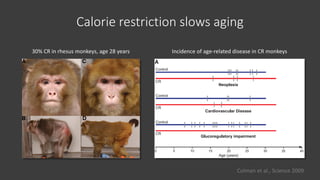
Colman et al., Science 2009
Calorie restriction slows aging
30% CR in rhesus monkeys, age 28 years Incidence of age-related disease in CR monkeys
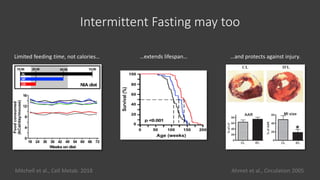
Intermittent Fasting may too
Mitchell et al., Cell Metab. 2018 Ahmet et al., Circulation 2005
Limited feeding time, not calories… …extends lifespan… …and protects against injury.
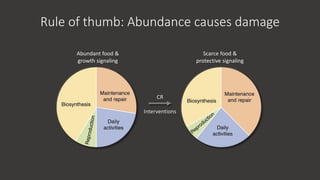
Rule of thumb: Abundance causes damage
Abundant food &
growth signaling
Scarce food &
protective signaling
CR
Interventions
Organismal Cellular
DNA/RNA
Proteins
Metabolism
Tissues
Stem cells
Intercellular signaling
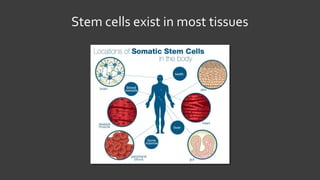
Stem cells exist in most tissues
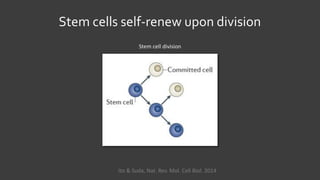
Stem cells self-renew upon division
Stem cell division
Ito & Suda, Nat. Rev. Mol. Cell Biol. 2014
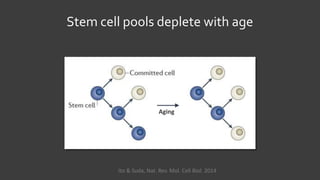
Stem cell pools deplete with age
Aging
Ito & Suda, Nat. Rev. Mol. Cell Biol. 2014
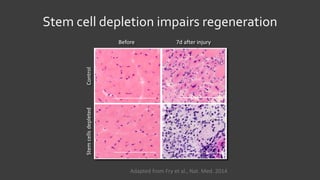
100 µm
Adapted from Fry et al., Nat. Med. 2014
StemcellsdepletedControl
Before 7d after injury
Stem cell depletion impairs regeneration
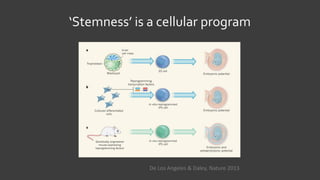
De Los Angeles & Daley, Nature 2013
‘Stemness’ is a cellular program
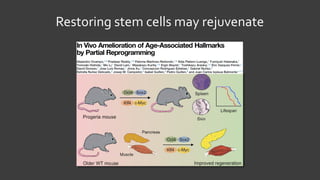
Restoring stem cells may rejuvenate
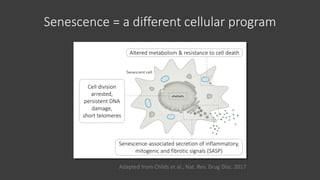
Adapted from Childs et al., Nat. Rev. Drug Disc. 2017
Senescence = a different cellular program
Senescence-associated secretion of inflammatory,
mitogenic and fibrotic signals (SASP)
Altered metabolism & resistance to cell death
Cell division
arrested,
persistent DNA
damage,
short telomeres
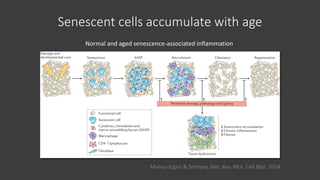
Munoz-Espin & Serrano, Nat. Rev. Mol. Cell Biol. 2014
Senescent cells accumulate with age
Normal and aged senescence-associated inflammation
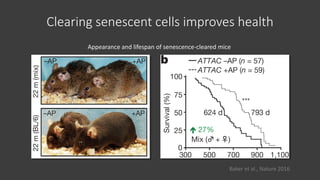
Baker et al., Nature 2016
Clearing senescent cells improves health
Appearance and lifespan of senescence-cleared mice
Organismal Cellular
DNA/RNA
Proteins
Metabolism
Tissues
Stem cells
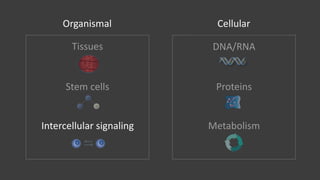
Intercellular signaling
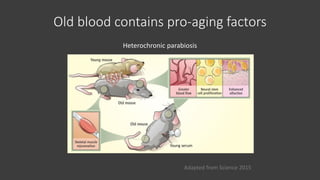
Old blood contains pro-aging factors
Young serum
Adapted from Science 2015
Heterochronic parabiosis
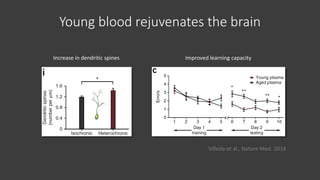
Villeda et al., Nature Med. 2014
Young blood rejuvenates the brain
Increase in dendritic spines Improved learning capacity
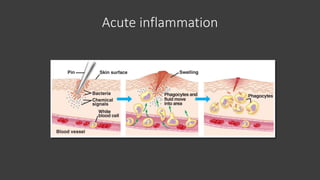
Acute inflammation
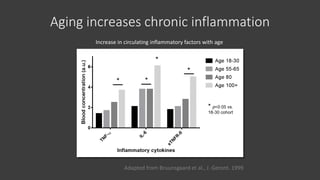
Adapted from Bruunsgaard et al., J. Geront. 1999
Aging increases chronic inflammation
Increase in circulating inflammatory factors with age
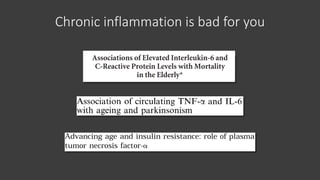
Chronic inflammation is bad for you
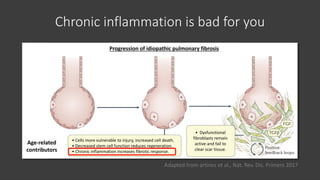
Adapted from artinez et al., Nat. Rev. Dis. Primers 2017
Various types of injury
(smoke, infection, …)
kills epithelial cells
Aberrant attempts at
repair cause fibrosis
• Cells more vulnerable to injury, increased cell death.
• Decreased stem cell function reduces regeneration.
• Chronic inflammation increases fibrotic response.
• Dysfunctional
fibroblasts remain
active and fail to
clear scar tissue.
Age-related
contributors
Progression of idiopathic pulmonary fibrosis
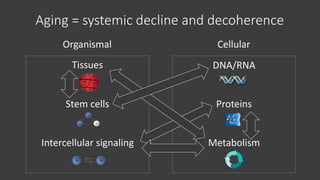
Organismal Cellular
DNA/RNA
Proteins
Metabolism
Tissues
Stem cells
Intercellular signaling
Aging = systemic decline and decoherence
[Intermission]
Aging as a problem
Defining ‘aging’
Mechanisms of aging
Landscape & challenges
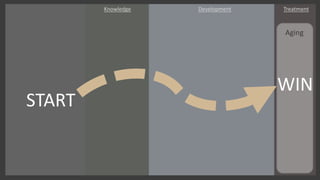
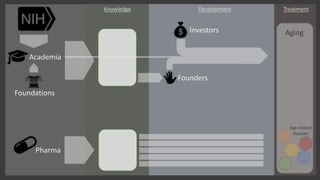
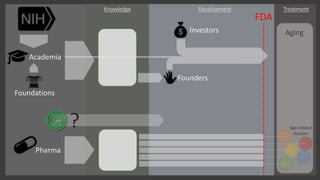
Knowledge Development Treatment
START
WIN
Aging
Knowledge Development Treatment
Age-related
diseases
Academia
Investors
Pharma
Founders
Foundations
Aging
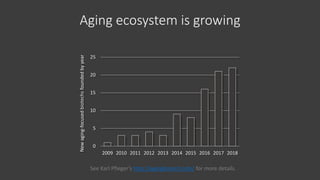
Aging ecosystem is growing
0
5
10
15
20
25
2009 2010 2011 2012 2013 2014 2015 2016 2017 2018
See Karl Pfleger’s http://agingbiotech.info/ for more details.
Newaging-focusedbiotechsfoundedbyyear
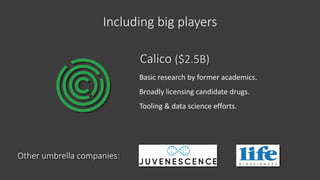
Calico ($2.5B)
Basic research by former academics.
Broadly licensing candidate drugs.
Tooling & data science efforts.
Including big players
Other umbrella companies:
1. Hard to capture value
2. Aging takes a lifetime
3. Optimizing a complex system
What are the major challenges?
FDA
Knowledge Development Treatment
Age-related
diseases
Academia
Investors
Pharma
Founders
Foundations
?
Aging
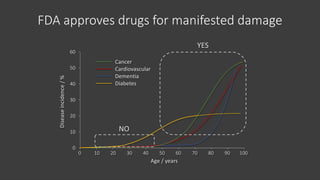
FDA approves drugs for manifested damage
10 200 30 40 50 60 70 80 90 100
0
10
20
30
40
50
60
Age / years
Diseaseincidence/% Cancer
Cardiovascular
Dementia
Diabetes
YES
NO
& others
Senescent cell clearance:
Who is developing aging therapeutics?
& others
Stem cells & regenerative:
Who is developing aging therapeutics?
& others
mTOR pathway (growth signaling):
Who is developing aging therapeutics?
Factors in young blood:
Who is developing aging therapeutics?
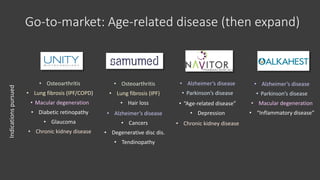
• Osteoarthritis
• Lung fibrosis (IPF)
• Hair loss
• Alzheimer’s disease
• Cancers
• Degenerative disc dis.
• Tendinopathy
Go-to-market: Age-related disease (then expand)
• Osteoarthritis
• Lung fibrosis (IPF/COPD)
• Macular degeneration
• Diabetic retinopathy
• Glaucoma
• Chronic kidney disease
Indicationspursued
• Alzheimer’s disease
• Parkinson’s disease
• “Age-related disease”
• Depression
• Chronic kidney disease
• Alzheimer’s disease
• Parkinson’s disease
• Macular degeneration
• “Inflammatory disease”
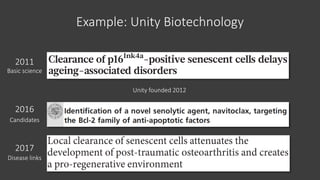
Example: Unity Biotechnology
2011
Unity founded 2012
2017
2016
Basic science
Candidates
Disease links
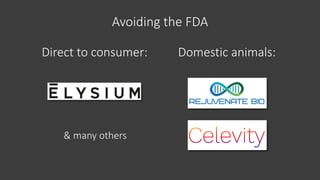
& many others
Direct to consumer: Domestic animals:
Avoiding the FDA
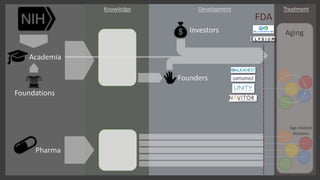
Knowledge Development Treatment
Age-related
diseases
Academia
FDA
Investors
Pharma
Founders
Aging
Foundations
1. Hard to capture value
2. Aging takes a lifetime
3. Optimizing a complex system
What are the major challenges?
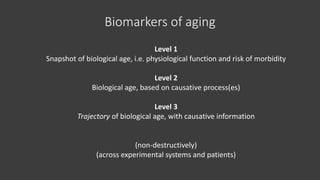
Measuring biological age
Level 1
Snapshot of biological age, i.e. physiological function and risk of morbidity
Level 2
Biological age, based on causative process(es)
Level 3
Trajectory of biological age, with causative information
(non-destructively)
(across experimental systems and patients)
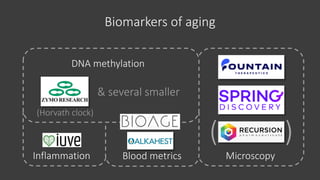
Biomarkers of aging
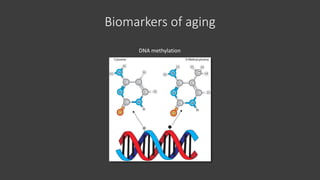
Biomarkers of aging
DNA methylation
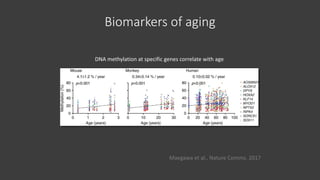
Biomarkers of aging
Maegawa et al., Nature Comms. 2017
DNA methylation at specific genes correlate with age
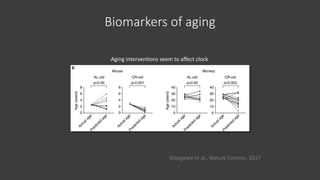
Biomarkers of aging
Maegawa et al., Nature Comms. 2017
Aging interventions seem to affect clock
Biomarkers of aging
DNA methylation
MicroscopyBlood metricsInflammation
& several smaller
(Horvath clock)
( )