Strategies for Taking
 Standardized Tests
      GRADE 2
‘Twas the Night Before
         Testing
• Go to bed on time.


•Solve family/friend problems before
the testing date.
•Talk to your parents about any
concerns that you might have about the
test.
The Morning of Testing
• Start your day as you always
  do.
• Eat a good breakfast.
• Think of what you will do to
  relax after you get home from
  school.
• Think Positive!
Multiple Choice Questions

• If you do not understand the
  directions, ask for help.
• Read the question and all
  answer choices before
  marking anything.
Pace Yourself
• Don’t spend too much time on
  any one question. Do your best
  and then move on.
• Answers the easiest questions
  first, but be sure to go back to
  those questions you skipped.
Multiple Choice Questions
• Do not change your answers
  unless you are very uncertain
  about your first answer choice.
• Answer every question. Make
  the most intelligent guess you
  can.
Multiple Choice Questions
• An answer that has “all of the
  above” is usually the correct
  answer.
• None of the above" is usually an
  incorrect response,
• "Funny" responses are usually
  wrong
The Process of Elimination
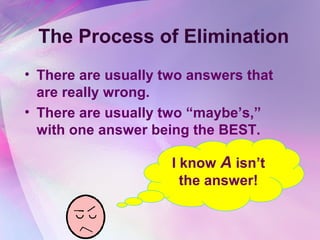
• There are usually two answers that
  are really wrong.
• There are usually two “maybe’s,”
  with one answer being the BEST.

                     I know A isn’t
                       the answer!
The Process of Elimination
• If all else fails, choose the
  second (b) bubble or third
  bubble (c). The first (a) bubble
  is usually least likely to be the
  correct one.
Answering Questions
• Go back to the passage and
  reread!
• Is it right there? Think &
  Search? Author & Me?
Skip, Return, Check
• If you finish early, check to
  make sure you have
  answered all questions.
Reading Passages
• The test requires you to read
  passages and then answer
  questions about what you read,
  so read the questions first.
•By doing this, you will know what
you are looking for as you read.
This also helps you go faster on
the test.
Reading Passages
• When there are several
  questions about a reading
  passage or chart, look for
  clues in other questions that
  will help you with those items
  about which you are unsure.
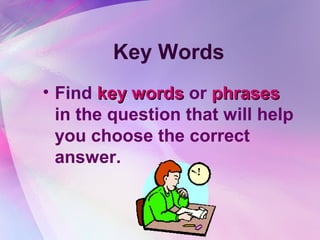
Key Words
• Find key words or phrases
  in the question that will help
  you choose the correct
  answer.
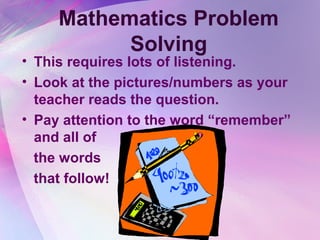
Mathematics Problem
           Solving
• This requires lots of listening.
• Look at the pictures/numbers as your
  teacher reads the question.
• Pay attention to the word “remember”
  and all of
  the words
  that follow!
Mathematics Problem
           Solving
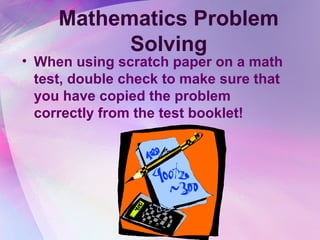
• When using scratch paper on a math
  test, double check to make sure that
  you have copied the problem
  correctly from the test booklet!
Math Computation
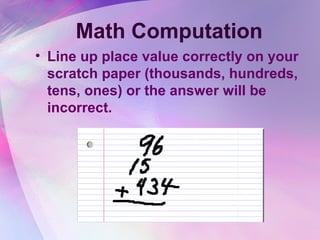
• Line up place value correctly on your
  scratch paper (thousands, hundreds,
  tens, ones) or the answer will be
  incorrect.
Math Computation
• If your answer does not match one
  of the choices, reread the problem,
  recopy the numbers, and try
  solving it again.
Mathematics Problem
           Solving
• Look at the answers, there will be at
  least one or two that is really WRONG!
• NH- stands for Not Here (check this
  bubble if you’ve worked out the
  problem and
  you know
  your answer
  is correct.
A Matter of Time
• If any time remains, spend it on
  those questions about which you
  know nothing or almost nothing.
• As you go back through, do not
  change all answers.
• Remember: Your first
  guess is usually right.
Final Tips
• Fill in bubbles fully, write neatly,
  and erase stray marks.
The Death Grip
• If your arm tires during testing it
  is probably due to the grip that
  you have on your pencil.
• Relax the grip and give those
  muscles a break.
• Do not do arm exercises during
  testing as this disturbs others.
Thank you, Mr. Know-it-all!
• Remember it's okay not to
  know everything — unlike
  class tests, these tests will
  have some questions designed
  to challenge the limits of your
  knowledge at a grade level
  above your current grade.
FOR TEACHERS
Struggling Readers-
    Teach Explicitly during
    Small Group Instruction
•   First read the questions as best as you can.
•   Skip words you don’t know and fill in with a word that
    makes sense.
•   Look for numbers, underlined, or words with Capital
    Letters.
•   If you see a word with a capital letter in the middle of a
    sentence then that word is a name of a person or place
    most likely.
•   If you can’t read a name just call the first letter or
    whatever. However, be sure to call it the same thing
    every time
•   If a question is asking what an underlined word means,
    look for words around that word that are in the answers.
Increase STAMINA

-During  familiar reading or another time,
  begin having students read for 10
  minutes.
-Gradually, increase time by 5 minutes
  until they can sustain their reading for
  30 minutes.
Types of Text
•   How-To
•   Informational
•   Realistic Fiction
•   Signs/Practical Text
•   Fantasy
•   Poetry

2nd grade test taking strategies

  • 1.
    Strategies for Taking Standardized Tests GRADE 2
  • 2.
    ‘Twas the NightBefore Testing • Go to bed on time. •Solve family/friend problems before the testing date. •Talk to your parents about any concerns that you might have about the test.
  • 3.
    The Morning ofTesting • Start your day as you always do. • Eat a good breakfast. • Think of what you will do to relax after you get home from school. • Think Positive!
  • 4.
    Multiple Choice Questions •If you do not understand the directions, ask for help. • Read the question and all answer choices before marking anything.
  • 5.
    Pace Yourself • Don’tspend too much time on any one question. Do your best and then move on. • Answers the easiest questions first, but be sure to go back to those questions you skipped.
  • 6.
    Multiple Choice Questions •Do not change your answers unless you are very uncertain about your first answer choice. • Answer every question. Make the most intelligent guess you can.
  • 7.
    Multiple Choice Questions •An answer that has “all of the above” is usually the correct answer. • None of the above" is usually an incorrect response, • "Funny" responses are usually wrong
  • 8.
    The Process ofElimination • There are usually two answers that are really wrong. • There are usually two “maybe’s,” with one answer being the BEST. I know A isn’t the answer!
  • 9.
    The Process ofElimination • If all else fails, choose the second (b) bubble or third bubble (c). The first (a) bubble is usually least likely to be the correct one.
  • 10.
    Answering Questions • Goback to the passage and reread! • Is it right there? Think & Search? Author & Me?
  • 11.
    Skip, Return, Check •If you finish early, check to make sure you have answered all questions.
  • 12.
    Reading Passages • Thetest requires you to read passages and then answer questions about what you read, so read the questions first. •By doing this, you will know what you are looking for as you read. This also helps you go faster on the test.
  • 13.
    Reading Passages • Whenthere are several questions about a reading passage or chart, look for clues in other questions that will help you with those items about which you are unsure.
  • 14.
    Key Words • Findkey words or phrases in the question that will help you choose the correct answer.
  • 15.
    Mathematics Problem Solving • This requires lots of listening. • Look at the pictures/numbers as your teacher reads the question. • Pay attention to the word “remember” and all of the words that follow!
  • 16.
    Mathematics Problem Solving • When using scratch paper on a math test, double check to make sure that you have copied the problem correctly from the test booklet!
  • 17.
    Math Computation • Lineup place value correctly on your scratch paper (thousands, hundreds, tens, ones) or the answer will be incorrect.
  • 18.
    Math Computation • Ifyour answer does not match one of the choices, reread the problem, recopy the numbers, and try solving it again.
  • 19.
    Mathematics Problem Solving • Look at the answers, there will be at least one or two that is really WRONG! • NH- stands for Not Here (check this bubble if you’ve worked out the problem and you know your answer is correct.
  • 20.
    A Matter ofTime • If any time remains, spend it on those questions about which you know nothing or almost nothing. • As you go back through, do not change all answers. • Remember: Your first guess is usually right.
  • 21.
    Final Tips • Fillin bubbles fully, write neatly, and erase stray marks.
  • 22.
    The Death Grip •If your arm tires during testing it is probably due to the grip that you have on your pencil. • Relax the grip and give those muscles a break. • Do not do arm exercises during testing as this disturbs others.
  • 23.
    Thank you, Mr.Know-it-all! • Remember it's okay not to know everything — unlike class tests, these tests will have some questions designed to challenge the limits of your knowledge at a grade level above your current grade.
  • 24.
  • 25.
    Struggling Readers- Teach Explicitly during Small Group Instruction • First read the questions as best as you can. • Skip words you don’t know and fill in with a word that makes sense. • Look for numbers, underlined, or words with Capital Letters. • If you see a word with a capital letter in the middle of a sentence then that word is a name of a person or place most likely. • If you can’t read a name just call the first letter or whatever. However, be sure to call it the same thing every time • If a question is asking what an underlined word means, look for words around that word that are in the answers.
  • 26.
    Increase STAMINA -During familiar reading or another time, begin having students read for 10 minutes. -Gradually, increase time by 5 minutes until they can sustain their reading for 30 minutes.
  • 27.
    Types of Text • How-To • Informational • Realistic Fiction • Signs/Practical Text • Fantasy • Poetry

Editor's Notes

  • #2 jc-schools.net/tutorials/test-strategies.ppt MATERIALS I NEED: Example passages from Primary 2 Complete Battery Stanford 10 Teacher’s Manual Examples of Passages from other resources Comprehension Strategy from Benchmark Need to find….How-To’s/Poems
  • #3 This is a power point you could use to do with your children to explain important things that will help them do well on the test.
  • #8 Looking at the practice booklet, there aren’t any “all of the above” etc.
  • #12 In second grade, they get as much time as they need.
  • #13 Sets that purpose just like in Quick Reads
  • #16 Ten ducks were swimming in a pond. Two of the ducks waddled out to eat some bread crumbs. How many ducks were still in the pond? Remember, there were ten and three waddled out. Mark your answer. What can we do to foster good listening skills?
  • #27 Once or twice a week- this is not boot camp-get a packet together/ Use grade level passages and questions or books of choice from classroom library Grade level text: This is what you are going to see; we want you to be prepared.
  • #28 Use resources from comprehension strategy booklet (HOLLY BRING TO SHOW) How-To: students will have bulleted items, or numbered items -main idea -details -sequence -What kind of how to? How to build a bird house, make an airplane, -refer back to steps Informational -main idea/mostly about -details -vocabulary definitions -author’s purpose Realistic Fiction -reading lots of dialogue -Use strategies from your minilessons on answering questions: Right There, Think and Search, Author and Me…Who, What, -what type of story is this? Use pictures to help Signs -Number 4 says -look for key words Look for numbers! Capital Letters! Fantasy -have to know paragraphs…block style -In paragraph 3… -question that asks what you do if you don’t know what a word means—think about the sentence (not going to use the words Context Clues) Poetry -mood -first part of poem.. -second part of poem.. -rhymes