Teaching Pupils with Autistic
Spectrum Disorder
Some information and advice from the Communication Support Base
Definition of Autism
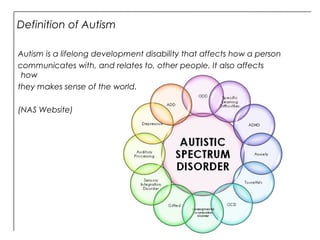
Autism is a lifelong development disability that affects how a person
communicates with, and relates to, other people. It also affects
how
they makes sense of the world.
(NAS Website)
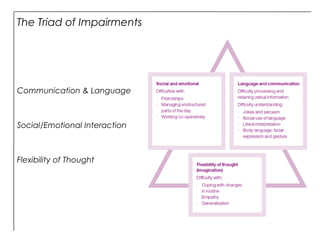
The Triad of Impairments
Communication & Language
Social/Emotional Interaction
Flexibility of Thought
Asperger Syndrome
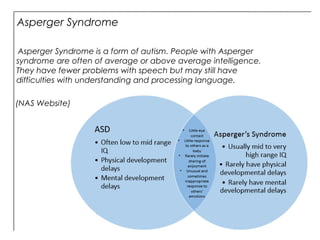
Asperger Syndrome is a form of autism. People with Asperger
syndrome are often of average or above average intelligence.
They have fewer problems with speech but may still have
difficulties with understanding and processing language.
(NAS Website)
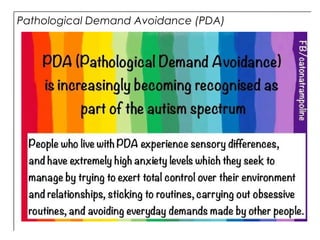
Pathological Demand Avoidance (PDA)
Background
Autism is a neuro-developmental, possibly genetic condition.
It is an inherited, organic condition, it is not due to ‘bad parenting’ or
vaccinations.
Asperger syndrome is part of the Autistic Spectrum. (High functioning
Autism)
Recognised by WHO in 1992.
Prevalence 1 in 100 (National Autistic Society)
Ratio Boys/Girls 4.3 to 1.
Prognosis, with early, appropriate, intervention is good.
Unfortunately ASD has high co-morbidity and can often mask/hinder
the diagnosis of other underlying conditions such as AD/HD, Dyslexia,
OCD etc.
Other Areas
Sensory sensitivity , pupils with ASD can be either hyposensitive or
hypersensitive to touch, taste, smell, sound or sights.
Sensory seeking, many ASD children will seek out specific sensory
inputs such as visual stimuli or deep pressure.
Lack of guile or deceit – sounds good but can lead to many social
and emotional problems.
Motor clumsiness- pupils may have an unusual gait, poor coordination
or have untidy child like handwriting.
Some pupils with ASD have additional learning disabilities.
The Good News
ASD children may also be extremely:
Clever at something specific such as maths or art.
Extremely knowledgeable about something (such as a favourite TV
programme or game) (use this as a motivator to learn/work)
Well mannered, well meaning, very honest and with a good sense
of humour.
Often enjoy repetition of familiar topics.
Teaching a child with
Autistic Spectrum Disorder
A whole school inclusive approach.
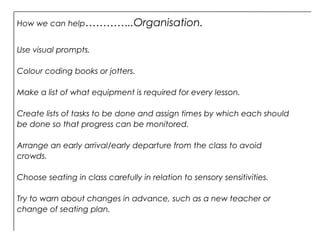
How we can help…………..Organisation.
Use visual prompts.
Colour coding books or jotters.
Make a list of what equipment is required for every lesson.
Create lists of tasks to be done and assign times by which each should
be done so that progress can be monitored.
Arrange an early arrival/early departure from the class to avoid
crowds.
Choose seating in class carefully in relation to sensory sensitivities.
Try to warn about changes in advance, such as a new teacher or
change of seating plan.
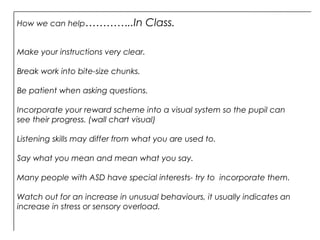
Make your instructions very clear.
Break work into bite-size chunks.
Be patient when asking questions.
Incorporate your reward scheme into a visual system so the pupil can
see their progress. (wall chart visual)
Listening skills may differ from what you are used to.
Say what you mean and mean what you say.
Many people with ASD have special interests- try to incorporate them.
Watch out for an increase in unusual behaviours, it usually indicates an
increase in stress or sensory overload.
How we can help…………..In Class.
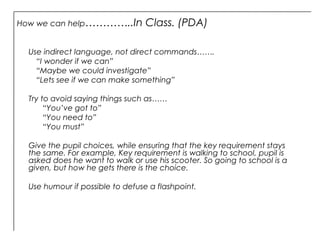
How we can help…………..In Class. (PDA)
Use indirect language, not direct commands…….
“I wonder if we can”
“Maybe we could investigate”
“Lets see if we can make something”
Try to avoid saying things such as……
“You’ve got to”
“You need to”
“You must”
Give the pupil choices, while ensuring that the key requirement stays
the same. For example, Key requirement is walking to school, pupil is
asked does he want to walk or use his scooter. So going to school is a
given, but how he gets there is the choice.
Use humour if possible to defuse a flashpoint.
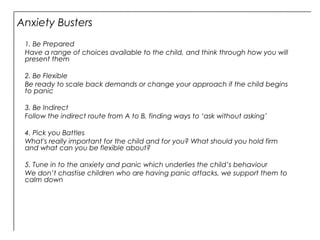
Anxiety Busters
1. Be Prepared
Have a range of choices available to the child, and think through how you will
present them
2. Be Flexible
Be ready to scale back demands or change your approach if the child begins
to panic
3. Be Indirect
Follow the indirect route from A to B, finding ways to ‘ask without asking’
4. Pick you Battles
What's really important for the child and for you? What should you hold firm
and what can you be flexible about?
5. Tune in to the anxiety and panic which underlies the child’s behaviour
We don’t chastise children who are having panic attacks, we support them to
calm down
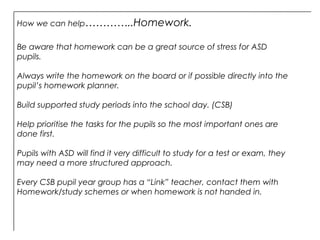
Be aware that homework can be a great source of stress for ASD
pupils.
Always write the homework on the board or if possible directly into the
pupil’s homework planner.
Build supported study periods into the school day. (CSB)
Help prioritise the tasks for the pupils so the most important ones are
done first.
Pupils with ASD will find it very difficult to study for a test or exam, they
may need a more structured approach.
Every CSB pupil year group has a “Link” teacher, contact them with
Homework/study schemes or when homework is not handed in.
How we can help…………..Homework.
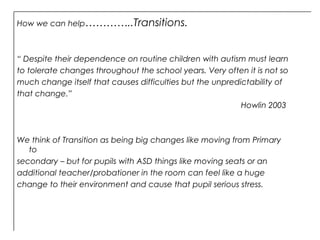
“ Despite their dependence on routine children with autism must learn
to tolerate changes throughout the school years. Very often it is not so
much change itself that causes difficulties but the unpredictability of
that change.”
Howlin 2003
We think of Transition as being big changes like moving from Primary
to
secondary – but for pupils with ASD things like moving seats or an
additional teacher/probationer in the room can feel like a huge
change to their environment and cause that pupil serious stress.
How we can help…………..Transitions.
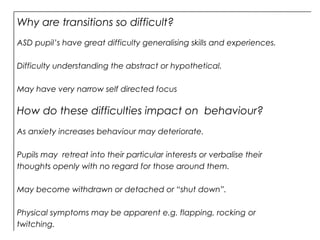
Why are transitions so difficult?
ASD pupil’s have great difficulty generalising skills and experiences.
Difficulty understanding the abstract or hypothetical.
May have very narrow self directed focus
How do these difficulties impact on behaviour?
As anxiety increases behaviour may deteriorate.
Pupils may retreat into their particular interests or verbalise their
thoughts openly with no regard for those around them.
May become withdrawn or detached or “shut down”.
Physical symptoms may be apparent e.g. flapping, rocking or
twitching.
How can you support transitions?
Try to see things from the child’s point of view.
Signal changes in advance if possible.
Make use of visual cues and prompts.
Contact families/CSB staff to see what has worked in the past.
Incorporate specialist interests.
Show it don’t say it. (ASD pupils are predominately visual learners)
“I once asked my son what he dreaded
most in life and he replied…….surprises.”
Parent of a teenager with ASD
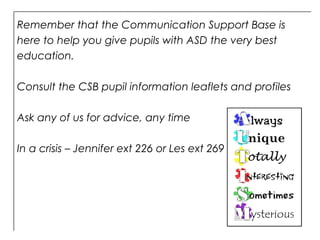
Remember that the Communication Support Base is
here to help you give pupils with ASD the very best
education.
Consult the CSB pupil information leaflets and profiles
Ask any of us for advice, any time
In a crisis – Jennifer ext 226 or Les ext 269

In service day powerpoint

  • 1.
    Teaching Pupils withAutistic Spectrum Disorder Some information and advice from the Communication Support Base
  • 2.
    Definition of Autism Autismis a lifelong development disability that affects how a person communicates with, and relates to, other people. It also affects how they makes sense of the world. (NAS Website)
  • 3.
    The Triad ofImpairments Communication & Language Social/Emotional Interaction Flexibility of Thought
  • 4.
    Asperger Syndrome Asperger Syndromeis a form of autism. People with Asperger syndrome are often of average or above average intelligence. They have fewer problems with speech but may still have difficulties with understanding and processing language. (NAS Website)
  • 5.
  • 6.
    Background Autism is aneuro-developmental, possibly genetic condition. It is an inherited, organic condition, it is not due to ‘bad parenting’ or vaccinations. Asperger syndrome is part of the Autistic Spectrum. (High functioning Autism) Recognised by WHO in 1992. Prevalence 1 in 100 (National Autistic Society) Ratio Boys/Girls 4.3 to 1. Prognosis, with early, appropriate, intervention is good. Unfortunately ASD has high co-morbidity and can often mask/hinder the diagnosis of other underlying conditions such as AD/HD, Dyslexia, OCD etc.
  • 7.
    Other Areas Sensory sensitivity, pupils with ASD can be either hyposensitive or hypersensitive to touch, taste, smell, sound or sights. Sensory seeking, many ASD children will seek out specific sensory inputs such as visual stimuli or deep pressure. Lack of guile or deceit – sounds good but can lead to many social and emotional problems. Motor clumsiness- pupils may have an unusual gait, poor coordination or have untidy child like handwriting. Some pupils with ASD have additional learning disabilities.
  • 8.
    The Good News ASDchildren may also be extremely: Clever at something specific such as maths or art. Extremely knowledgeable about something (such as a favourite TV programme or game) (use this as a motivator to learn/work) Well mannered, well meaning, very honest and with a good sense of humour. Often enjoy repetition of familiar topics.
  • 9.
    Teaching a childwith Autistic Spectrum Disorder A whole school inclusive approach.
  • 10.
    How we canhelp…………..Organisation. Use visual prompts. Colour coding books or jotters. Make a list of what equipment is required for every lesson. Create lists of tasks to be done and assign times by which each should be done so that progress can be monitored. Arrange an early arrival/early departure from the class to avoid crowds. Choose seating in class carefully in relation to sensory sensitivities. Try to warn about changes in advance, such as a new teacher or change of seating plan.
  • 11.
    Make your instructionsvery clear. Break work into bite-size chunks. Be patient when asking questions. Incorporate your reward scheme into a visual system so the pupil can see their progress. (wall chart visual) Listening skills may differ from what you are used to. Say what you mean and mean what you say. Many people with ASD have special interests- try to incorporate them. Watch out for an increase in unusual behaviours, it usually indicates an increase in stress or sensory overload. How we can help…………..In Class.
  • 12.
    How we canhelp…………..In Class. (PDA) Use indirect language, not direct commands……. “I wonder if we can” “Maybe we could investigate” “Lets see if we can make something” Try to avoid saying things such as…… “You’ve got to” “You need to” “You must” Give the pupil choices, while ensuring that the key requirement stays the same. For example, Key requirement is walking to school, pupil is asked does he want to walk or use his scooter. So going to school is a given, but how he gets there is the choice. Use humour if possible to defuse a flashpoint.
  • 13.
    Anxiety Busters 1. BePrepared Have a range of choices available to the child, and think through how you will present them 2. Be Flexible Be ready to scale back demands or change your approach if the child begins to panic 3. Be Indirect Follow the indirect route from A to B, finding ways to ‘ask without asking’ 4. Pick you Battles What's really important for the child and for you? What should you hold firm and what can you be flexible about? 5. Tune in to the anxiety and panic which underlies the child’s behaviour We don’t chastise children who are having panic attacks, we support them to calm down
  • 14.
    Be aware thathomework can be a great source of stress for ASD pupils. Always write the homework on the board or if possible directly into the pupil’s homework planner. Build supported study periods into the school day. (CSB) Help prioritise the tasks for the pupils so the most important ones are done first. Pupils with ASD will find it very difficult to study for a test or exam, they may need a more structured approach. Every CSB pupil year group has a “Link” teacher, contact them with Homework/study schemes or when homework is not handed in. How we can help…………..Homework.
  • 15.
    “ Despite theirdependence on routine children with autism must learn to tolerate changes throughout the school years. Very often it is not so much change itself that causes difficulties but the unpredictability of that change.” Howlin 2003 We think of Transition as being big changes like moving from Primary to secondary – but for pupils with ASD things like moving seats or an additional teacher/probationer in the room can feel like a huge change to their environment and cause that pupil serious stress. How we can help…………..Transitions.
  • 16.
    Why are transitionsso difficult? ASD pupil’s have great difficulty generalising skills and experiences. Difficulty understanding the abstract or hypothetical. May have very narrow self directed focus How do these difficulties impact on behaviour? As anxiety increases behaviour may deteriorate. Pupils may retreat into their particular interests or verbalise their thoughts openly with no regard for those around them. May become withdrawn or detached or “shut down”. Physical symptoms may be apparent e.g. flapping, rocking or twitching.
  • 17.
    How can yousupport transitions? Try to see things from the child’s point of view. Signal changes in advance if possible. Make use of visual cues and prompts. Contact families/CSB staff to see what has worked in the past. Incorporate specialist interests. Show it don’t say it. (ASD pupils are predominately visual learners)
  • 18.
    “I once askedmy son what he dreaded most in life and he replied…….surprises.” Parent of a teenager with ASD
  • 19.
    Remember that theCommunication Support Base is here to help you give pupils with ASD the very best education. Consult the CSB pupil information leaflets and profiles Ask any of us for advice, any time In a crisis – Jennifer ext 226 or Les ext 269