THE ROLE OF ADVERTISING AND SALES PROMOTIONS
IN CREATING BRAND EQUITY OF INTERNATIONAL FAST-
FOOD BRANDS IN PAKISTAN
Prepared By:
Saad Mahmood(6485)
Facilitator:
Sir Muhammad Ali
Introduction
 Now a days the world truth has become to be more alert and more
attractive to something motivating anything which shows them their status
or personality or morals.
 The efforts which marketing manager attempt to accomplish and have
succeeded in a few courses by carrying quality to satisfy their need. By
taking this step many companies are on offering promotions of their
products and goods to create brand loyalty. (Kumar et al, 2015).
 Many studies has been conducted to analyze the relationship between
brand loyalty and different dimensions of brand equity including brand
awareness , perceived quality , brand association of product/services in
different regions worldwide, and various setting of variables.(Muller, et
al., 2013).
Problem statement
 It has been identified that concurrent setting of mentioned four dimensions of brand equity
including brand association, brand awareness, brand loyalty and perceived quality as
impacting factors on advertising and different sales promotions has not been done yet.
 Concentrated on the examining the effect of promoting and deals on brand value
measurements including brand mindfulness, mark affiliation saw quality on brand devotion
of worldwide fast food brands in Pakistan in the simultaneous setting.
 Sometimes Brand may not possess the attributes which consumer seeks, perceived from
fulfilling particular needs related to brand. Hence customers becomes disloyal, dissatisfied
and have the intension of brand switching (Aaker, 1996).
 The attitudes and subjective norms influence intentions, which in turn affect behavior.
Approaching a product decision as a problem-solving process, this hierarchy model suggests
that consumers form beliefs about a product by seeking information about relevant attributes.
(Jaramillo et al., 2006).
Research Objective/s:
To identify the impact of advertisement and sales promotions in creating brand
equity of international fast-food brands in Pakistan.
Research Question/s:
What is the impact of advertising and sales promotions in creating brand
equity of international fast-food brands in Pakistan.
Literature Reviews
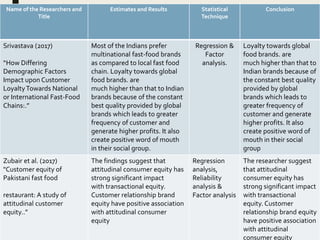
Name of the Researchers and
Title
Estimates and Results Statistical
Technique
Conclusion
Srivastava (2017)
“How Differing
Demographic Factors
Impact upon Customer
LoyaltyTowards National
or International Fast-Food
Chains:.”
Most of the Indians prefer
multinational fast-food brands
as compared to local fast food
chain. Loyalty towards global
food brands. are
much higher than that to Indian
brands because of the constant
best quality provided by global
brands which leads to greater
frequency of customer and
generate higher profits. It also
create positive word of mouth
in their social group.
Regression &
Factor
analysis.
Loyalty towards global
food brands. are
much higher than that to
Indian brands because of
the constant best quality
provided by global
brands which leads to
greater frequency of
customer and generate
higher profits. It also
create positive word of
mouth in their social
group
Zubair et al. (2017)
"Customer equity of
Pakistani fast food
restaurant: A study of
attitudinal customer
equity..”
The findings suggest that
attitudinal consumer equity has
strong significant impact
with transactional equity.
Customer relationship brand
equity have positive association
with attitudinal consumer
equity
Regression
analysis,
Reliability
analysis &
Factor analysis
The researcher suggest
that attitudinal
consumer equity has
strong significant impact
with transactional
equity. Customer
relationship brand equity
have positive association
with attitudinal
consumer equity
Methodology
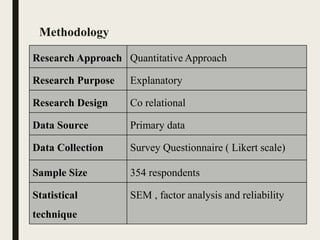
Research Approach Quantitative Approach
Research Purpose Explanatory
Research Design Co relational
Data Source Primary data
Data Collection Survey Questionnaire ( Likert scale)
Sample Size 354 respondents
Statistical
technique
SEM , factor analysis and reliability
Model
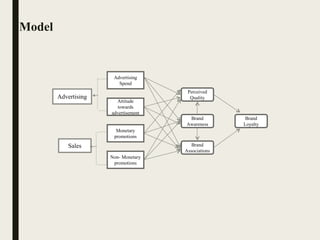
Advertising
Spend
Attitude
towards
advertisement
Non- Monetary
promotions
Monetary
promotions
Perceived
Quality
Brand
Awareness
Brand
Associations
Brand
Loyalty
Advertising
Sales
Hypothesis
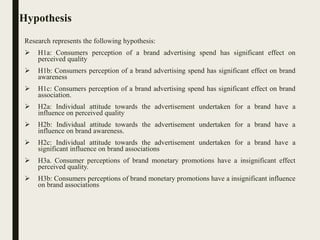
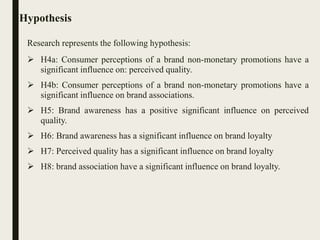
Research represents the following hypothesis:
 H1a: Consumers perception of a brand advertising spend has significant effect on
perceived quality
 H1b: Consumers perception of a brand advertising spend has significant effect on brand
awareness
 H1c: Consumers perception of a brand advertising spend has significant effect on brand
association.
 H2a: Individual attitude towards the advertisement undertaken for a brand have a
influence on perceived quality
 H2b: Individual attitude towards the advertisement undertaken for a brand have a
influence on brand awareness.
 H2c: Individual attitude towards the advertisement undertaken for a brand have a
significant influence on brand associations
 H3a. Consumer perceptions of brand monetary promotions have a insignificant effect
perceived quality.
 H3b: Consumers perceptions of brand monetary promotions have a insignificant influence
on brand associations
Hypothesis
Research represents the following hypothesis:
 H4a: Consumer perceptions of a brand non-monetary promotions have a
significant influence on: perceived quality.
 H4b: Consumer perceptions of a brand non-monetary promotions have a
significant influence on brand associations.
 H5: Brand awareness has a positive significant influence on perceived
quality.
 H6: Brand awareness has a significant influence on brand loyalty
 H7: Perceived quality has a significant influence on brand loyalty
 H8: brand association have a significant influence on brand loyalty.
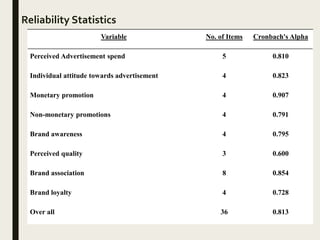
R Reliability Statistics
Variable No. of Items Cronbach's Alpha
Perceived Advertisement spend 5 0.810
Individual attitude towards advertisement 4 0.823
Monetary promotion 4 0.907
Non-monetary promotions 4 0.791
Brand awareness 4 0.795
Perceived quality 3 0.600
Brand association 8 0.854
Brand loyalty 4 0.728
Over all 36 0.813
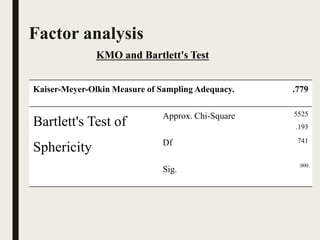
Factor analysis
Kaiser-Meyer-Olkin Measure of Sampling Adequacy. .779
Bartlett's Test of
Sphericity
Approx. Chi-Square 5525
.193
Df 741
Sig.
.000
KMO and Bartlett's Test
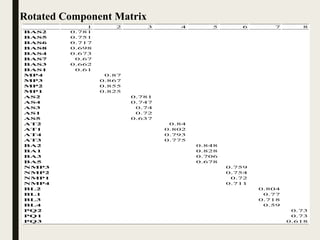
Rotated Component Matrix
  1 2 3 4 5 6 7 8
BAS2 0.781              
BAS5 0.751              
BAS6 0.717              
BAS8 0.698              
BAS4 0.673              
BAS7 0.67              
BAS3 0.662              
BAS1 0.61              
MP4   0.87            
MP3   0.867            
MP2   0.855            
MP1   0.825            
AS2     0.781          
AS4     0.747          
AS3     0.74          
AS1     0.72          
AS5     0.637          
AT2       0.84        
AT1       0.802        
AT4       0.793        
AT3       0.775        
BA2         0.848      
BA1         0.828      
BA3         0.706      
BA5         0.678      
NMP3           0.759    
NMP2           0.754    
NMP1           0.72    
NMP4           0.711    
BL2             0.804  
BL1             0.77  
BL3             0.718  
BL4             0.59  
PQ2               0.73
PQ1               0.73
PQ3               0.618
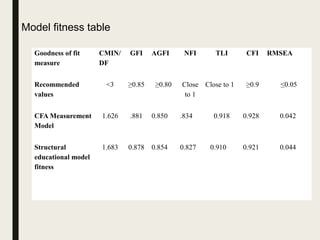
Goodness of fit
measure
CMIN/
DF
GFI AGFI NFI TLI CFI RMSEA
Recommended
values
<3 ≥0.85 ≥0.80 Close
to 1
Close to 1 ≥0.9 ≤0.05
CFA Measurement
Model
1.626 .881 0.850 .834 0.918 0.928 0.042
Structural
educational model
fitness
1.683 0.878 0.854 0.827 0.910 0.921 0.044
Model fitness table
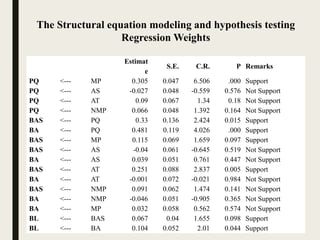
Estimat
e
S.E. C.R. P Remarks
PQ <--- MP 0.305 0.047 6.506 .000 Support
PQ <--- AS -0.027 0.048 -0.559 0.576 Not Support
PQ <--- AT 0.09 0.067 1.34 0.18 Not Support
PQ <--- NMP 0.066 0.048 1.392 0.164 Not Support
BAS <--- PQ 0.33 0.136 2.424 0.015 Support
BA <--- PQ 0.481 0.119 4.026 .000 Support
BAS <--- MP 0.115 0.069 1.659 0.097 Support
BAS <--- AS -0.04 0.061 -0.645 0.519 Not Support
BA <--- AS 0.039 0.051 0.761 0.447 Not Support
BAS <--- AT 0.251 0.088 2.837 0.005 Support
BA <--- AT -0.001 0.072 -0.021 0.984 Not Support
BAS <--- NMP 0.091 0.062 1.474 0.141 Not Support
BA <--- NMP -0.046 0.051 -0.905 0.365 Not Support
BA <--- MP 0.032 0.058 0.562 0.574 Not Support
BL <--- BAS 0.067 0.04 1.655 0.098 Support
BL <--- BA 0.104 0.052 2.01 0.044 Support
The Structural equation modeling and hypothesis testing
Regression Weights
Discussion
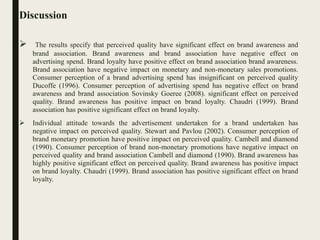
 The results specify that perceived quality have significant effect on brand awareness and
brand association. Brand awareness and brand association have negative effect on
advertising spend. Brand loyalty have positive effect on brand association brand awareness.
Brand association have negative impact on monetary and non-monetary sales promotions.
Consumer perception of a brand advertising spend has insignificant on perceived quality
Ducoffe (1996). Consumer perception of advertising spend has negative effect on brand
awareness and brand association Sovinsky Goeree (2008). significant effect on perceived
quality. Brand awareness has positive impact on brand loyalty. Chaudri (1999). Brand
association has positive significant effect on brand loyalty.
 Individual attitude towards the advertisement undertaken for a brand undertaken has
negative impact on perceived quality. Stewart and Pavlou (2002). Consumer perception of
brand monetary promotion have positive impact on perceived quality. Cambell and diamond
(1990). Consumer perception of brand non-monetary promotions have negative impact on
perceived quality and brand association Cambell and diamond (1990). Brand awareness has
highly positive significant effect on perceived quality. Brand awareness has positive impact
on brand loyalty. Chaudri (1999). Brand association has positive significant effect on brand
loyalty.
Discussion
 According to the first hypothesis, the advertising needs a proper strategy and execution. In
particular, one of the main concerns planning an advertising strategy communicates to the
creative strategy (Kapferer, 2004; Keller, 2007). For e.g. if there is something unethical in
advertising campaigns it will create negative impact of brand the mind of customer.
 Similarly, monetary sales promotions campaigns can erode brandequity. Martínez et al.
(2007) and Montaner and Pina (2008) reported that monetary promotional campaigns have a
negative impact on brand image. In addition, monetary promotion campaigns are too short to
establish long term brand associations and can build doubt about brand quality (Winer, 1986),
which effects in more negative brand perceptions. The frequent use of price promotions has a
negative impression on perceived quality and brand association dimensions because this tool
leads consumers to think primarily about price, and not about the brand (Yoo et al., 2000).
For eg if brand offering price discounts for long time it create perception that consumer is not
giving attention to their brands.
 When consumers acquire a more positive perception of a brand, loyalty results (Oliver,
1999). As such, brand associations and perceived quality are the previous step leading to
brand loyalty (Keller and Lehmann, 2003). Thus, high levels of perceived quality and
positive associations can enhance brand loyalty (Pappu et al., 2005).
Recommendation
 International fast-food chains should focus on advertising and product quality in
terms to reduce brand switching by customer.
 More over companies should pay more attention on sales promotional activities. It
will create positive word of mouth.
 Social media marketing should be taken into serious consideration by
international fast food brands. This will provide beneficial outcomes to enhance
customer engagement and involvement in brand, therefore it create strong
perception about product and services and increase brand loyalty.
 Advertising should be increased through different channels of advertisement to
increase customer engagement towards brand. However enhanced marketing
strategies improve attitude towards international fast.
 It is very important to educate the target audience regarding food health aspects
for these companies should invest more in advertising as it will increase the brand
awareness for target audience as well as increase in terms of sales.
Thank You!

marketing thesis

  • 1.
    THE ROLE OFADVERTISING AND SALES PROMOTIONS IN CREATING BRAND EQUITY OF INTERNATIONAL FAST- FOOD BRANDS IN PAKISTAN Prepared By: Saad Mahmood(6485) Facilitator: Sir Muhammad Ali
  • 2.
    Introduction  Now adays the world truth has become to be more alert and more attractive to something motivating anything which shows them their status or personality or morals.  The efforts which marketing manager attempt to accomplish and have succeeded in a few courses by carrying quality to satisfy their need. By taking this step many companies are on offering promotions of their products and goods to create brand loyalty. (Kumar et al, 2015).  Many studies has been conducted to analyze the relationship between brand loyalty and different dimensions of brand equity including brand awareness , perceived quality , brand association of product/services in different regions worldwide, and various setting of variables.(Muller, et al., 2013).
  • 3.
    Problem statement  Ithas been identified that concurrent setting of mentioned four dimensions of brand equity including brand association, brand awareness, brand loyalty and perceived quality as impacting factors on advertising and different sales promotions has not been done yet.  Concentrated on the examining the effect of promoting and deals on brand value measurements including brand mindfulness, mark affiliation saw quality on brand devotion of worldwide fast food brands in Pakistan in the simultaneous setting.  Sometimes Brand may not possess the attributes which consumer seeks, perceived from fulfilling particular needs related to brand. Hence customers becomes disloyal, dissatisfied and have the intension of brand switching (Aaker, 1996).  The attitudes and subjective norms influence intentions, which in turn affect behavior. Approaching a product decision as a problem-solving process, this hierarchy model suggests that consumers form beliefs about a product by seeking information about relevant attributes. (Jaramillo et al., 2006).
  • 4.
    Research Objective/s: To identifythe impact of advertisement and sales promotions in creating brand equity of international fast-food brands in Pakistan. Research Question/s: What is the impact of advertising and sales promotions in creating brand equity of international fast-food brands in Pakistan.
  • 5.
  • 6.
    Name of theResearchers and Title Estimates and Results Statistical Technique Conclusion Srivastava (2017) “How Differing Demographic Factors Impact upon Customer LoyaltyTowards National or International Fast-Food Chains:.” Most of the Indians prefer multinational fast-food brands as compared to local fast food chain. Loyalty towards global food brands. are much higher than that to Indian brands because of the constant best quality provided by global brands which leads to greater frequency of customer and generate higher profits. It also create positive word of mouth in their social group. Regression & Factor analysis. Loyalty towards global food brands. are much higher than that to Indian brands because of the constant best quality provided by global brands which leads to greater frequency of customer and generate higher profits. It also create positive word of mouth in their social group Zubair et al. (2017) "Customer equity of Pakistani fast food restaurant: A study of attitudinal customer equity..” The findings suggest that attitudinal consumer equity has strong significant impact with transactional equity. Customer relationship brand equity have positive association with attitudinal consumer equity Regression analysis, Reliability analysis & Factor analysis The researcher suggest that attitudinal consumer equity has strong significant impact with transactional equity. Customer relationship brand equity have positive association with attitudinal consumer equity
  • 7.
    Methodology Research Approach QuantitativeApproach Research Purpose Explanatory Research Design Co relational Data Source Primary data Data Collection Survey Questionnaire ( Likert scale) Sample Size 354 respondents Statistical technique SEM , factor analysis and reliability
  • 8.
  • 9.
    Hypothesis Research represents thefollowing hypothesis:  H1a: Consumers perception of a brand advertising spend has significant effect on perceived quality  H1b: Consumers perception of a brand advertising spend has significant effect on brand awareness  H1c: Consumers perception of a brand advertising spend has significant effect on brand association.  H2a: Individual attitude towards the advertisement undertaken for a brand have a influence on perceived quality  H2b: Individual attitude towards the advertisement undertaken for a brand have a influence on brand awareness.  H2c: Individual attitude towards the advertisement undertaken for a brand have a significant influence on brand associations  H3a. Consumer perceptions of brand monetary promotions have a insignificant effect perceived quality.  H3b: Consumers perceptions of brand monetary promotions have a insignificant influence on brand associations
  • 10.
    Hypothesis Research represents thefollowing hypothesis:  H4a: Consumer perceptions of a brand non-monetary promotions have a significant influence on: perceived quality.  H4b: Consumer perceptions of a brand non-monetary promotions have a significant influence on brand associations.  H5: Brand awareness has a positive significant influence on perceived quality.  H6: Brand awareness has a significant influence on brand loyalty  H7: Perceived quality has a significant influence on brand loyalty  H8: brand association have a significant influence on brand loyalty.
  • 11.
    R Reliability Statistics VariableNo. of Items Cronbach's Alpha Perceived Advertisement spend 5 0.810 Individual attitude towards advertisement 4 0.823 Monetary promotion 4 0.907 Non-monetary promotions 4 0.791 Brand awareness 4 0.795 Perceived quality 3 0.600 Brand association 8 0.854 Brand loyalty 4 0.728 Over all 36 0.813
  • 12.
    Factor analysis Kaiser-Meyer-Olkin Measureof Sampling Adequacy. .779 Bartlett's Test of Sphericity Approx. Chi-Square 5525 .193 Df 741 Sig. .000 KMO and Bartlett's Test
  • 13.
    Rotated Component Matrix  1 2 3 4 5 6 7 8 BAS2 0.781               BAS5 0.751               BAS6 0.717               BAS8 0.698               BAS4 0.673               BAS7 0.67               BAS3 0.662               BAS1 0.61               MP4   0.87             MP3   0.867             MP2   0.855             MP1   0.825             AS2     0.781           AS4     0.747           AS3     0.74           AS1     0.72           AS5     0.637           AT2       0.84         AT1       0.802         AT4       0.793         AT3       0.775         BA2         0.848       BA1         0.828       BA3         0.706       BA5         0.678       NMP3           0.759     NMP2           0.754     NMP1           0.72     NMP4           0.711     BL2             0.804   BL1             0.77   BL3             0.718   BL4             0.59   PQ2               0.73 PQ1               0.73 PQ3               0.618
  • 14.
    Goodness of fit measure CMIN/ DF GFIAGFI NFI TLI CFI RMSEA Recommended values <3 ≥0.85 ≥0.80 Close to 1 Close to 1 ≥0.9 ≤0.05 CFA Measurement Model 1.626 .881 0.850 .834 0.918 0.928 0.042 Structural educational model fitness 1.683 0.878 0.854 0.827 0.910 0.921 0.044 Model fitness table
  • 15.
    Estimat e S.E. C.R. PRemarks PQ <--- MP 0.305 0.047 6.506 .000 Support PQ <--- AS -0.027 0.048 -0.559 0.576 Not Support PQ <--- AT 0.09 0.067 1.34 0.18 Not Support PQ <--- NMP 0.066 0.048 1.392 0.164 Not Support BAS <--- PQ 0.33 0.136 2.424 0.015 Support BA <--- PQ 0.481 0.119 4.026 .000 Support BAS <--- MP 0.115 0.069 1.659 0.097 Support BAS <--- AS -0.04 0.061 -0.645 0.519 Not Support BA <--- AS 0.039 0.051 0.761 0.447 Not Support BAS <--- AT 0.251 0.088 2.837 0.005 Support BA <--- AT -0.001 0.072 -0.021 0.984 Not Support BAS <--- NMP 0.091 0.062 1.474 0.141 Not Support BA <--- NMP -0.046 0.051 -0.905 0.365 Not Support BA <--- MP 0.032 0.058 0.562 0.574 Not Support BL <--- BAS 0.067 0.04 1.655 0.098 Support BL <--- BA 0.104 0.052 2.01 0.044 Support The Structural equation modeling and hypothesis testing Regression Weights
  • 16.
    Discussion  The resultsspecify that perceived quality have significant effect on brand awareness and brand association. Brand awareness and brand association have negative effect on advertising spend. Brand loyalty have positive effect on brand association brand awareness. Brand association have negative impact on monetary and non-monetary sales promotions. Consumer perception of a brand advertising spend has insignificant on perceived quality Ducoffe (1996). Consumer perception of advertising spend has negative effect on brand awareness and brand association Sovinsky Goeree (2008). significant effect on perceived quality. Brand awareness has positive impact on brand loyalty. Chaudri (1999). Brand association has positive significant effect on brand loyalty.  Individual attitude towards the advertisement undertaken for a brand undertaken has negative impact on perceived quality. Stewart and Pavlou (2002). Consumer perception of brand monetary promotion have positive impact on perceived quality. Cambell and diamond (1990). Consumer perception of brand non-monetary promotions have negative impact on perceived quality and brand association Cambell and diamond (1990). Brand awareness has highly positive significant effect on perceived quality. Brand awareness has positive impact on brand loyalty. Chaudri (1999). Brand association has positive significant effect on brand loyalty.
  • 17.
    Discussion  According tothe first hypothesis, the advertising needs a proper strategy and execution. In particular, one of the main concerns planning an advertising strategy communicates to the creative strategy (Kapferer, 2004; Keller, 2007). For e.g. if there is something unethical in advertising campaigns it will create negative impact of brand the mind of customer.  Similarly, monetary sales promotions campaigns can erode brandequity. Martínez et al. (2007) and Montaner and Pina (2008) reported that monetary promotional campaigns have a negative impact on brand image. In addition, monetary promotion campaigns are too short to establish long term brand associations and can build doubt about brand quality (Winer, 1986), which effects in more negative brand perceptions. The frequent use of price promotions has a negative impression on perceived quality and brand association dimensions because this tool leads consumers to think primarily about price, and not about the brand (Yoo et al., 2000). For eg if brand offering price discounts for long time it create perception that consumer is not giving attention to their brands.  When consumers acquire a more positive perception of a brand, loyalty results (Oliver, 1999). As such, brand associations and perceived quality are the previous step leading to brand loyalty (Keller and Lehmann, 2003). Thus, high levels of perceived quality and positive associations can enhance brand loyalty (Pappu et al., 2005).
  • 18.
    Recommendation  International fast-foodchains should focus on advertising and product quality in terms to reduce brand switching by customer.  More over companies should pay more attention on sales promotional activities. It will create positive word of mouth.  Social media marketing should be taken into serious consideration by international fast food brands. This will provide beneficial outcomes to enhance customer engagement and involvement in brand, therefore it create strong perception about product and services and increase brand loyalty.  Advertising should be increased through different channels of advertisement to increase customer engagement towards brand. However enhanced marketing strategies improve attitude towards international fast.  It is very important to educate the target audience regarding food health aspects for these companies should invest more in advertising as it will increase the brand awareness for target audience as well as increase in terms of sales.
  • 19.