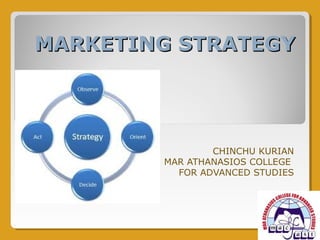
MARKETING STRATEGY


                CHINCHU KURIAN
        MAR ATHANASIOS COLLEGE
          FOR ADVANCED STUDIES
Marketing strategy is a process that can allow an
organization to concentrate its resources on the optimal
opportunities with the goals of increasing sales and
achieving a sustainable competitive advantage.

TYPES OF STRATEGY
Strategies based on Market dominance- firms are
classified based on their market share or dominance of an
industry. Typically there are four types of market dominance
strategies:
•Leader
•Challenger
•Follower
•Nicher
Porter generic strategies - strategy on the dimensions of
strategic scope and strategic strength.

IMPORTANCE OF MARKETING STRATEGY
 A marketing strategy can serve as the foundation of a
marketing plan. A marketing plan contains a set of specific
actions required to successfully implement a marketing
strategy.
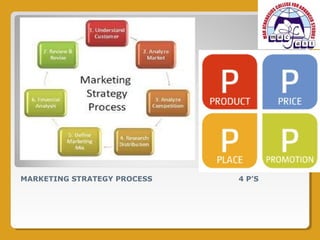
MARKETING STRATEGY PROCESS   4 P’S
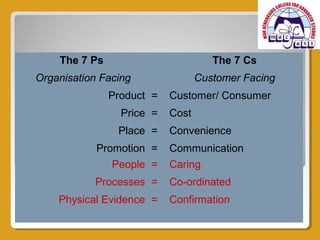
The 7 Ps                         The 7 Cs
Organisation Facing               Customer Facing
               Product =   Customer/ Consumer
                 Price =   Cost
                Place =    Convenience
            Promotion =    Communication
               People =    Caring
           Processes =     Co-ordinated
    Physical Evidence =
        7PS                Confirmation
                                     7CS
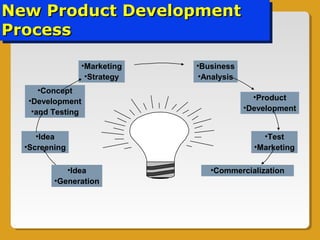
New Product Development
Process
Process
               •Marketing   •Business
                •Strategy    •Analysis
      •Concept
   •Development                            •Product
    •and Testing                         •Development


     •Idea                                   •Test
  •Screening                               •Marketing

            •Idea              •Commercialization
         •Generation
TOOLS OF MARKETING STRATEGY

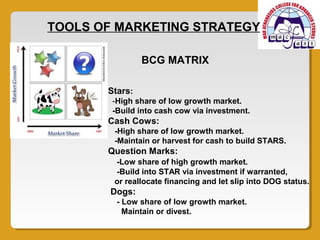
                BCG MATRIX

       Stars:
        -High share of low growth market.
        -Build into cash cow via investment.
       Cash Cows:
        -High share of low growth market.
        -Maintain or harvest for cash to build STARS.
       Question Marks:
        -Low share of high growth market.
        -Build into STAR via investment if warranted,
        or reallocate financing and let slip into DOG status.
        Dogs:
         - Low share of low growth market.
           Maintain or divest.
G. E. multi factoral analysis

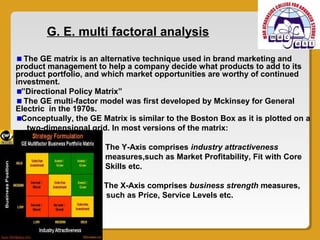
   The GE matrix is an alternative technique used in brand marketing and
product management to help a company decide what products to add to its
product portfolio, and which market opportunities are worthy of continued
investment.
  ”Directional Policy Matrix”
   The GE multi-factor model was first developed by Mckinsey for General
Electric in the 1970s.
  Conceptually, the GE Matrix is similar to the Boston Box as it is plotted on a
    two-dimensional grid. In most versions of the matrix:

                        The Y-Axis comprises industry attractiveness
                        measures,such as Market Profitability, Fit with Core
                        Skills etc.

                       The X-Axis comprises business strength measures,
                       such as Price, Service Levels etc.
ANSOFF MATRIX

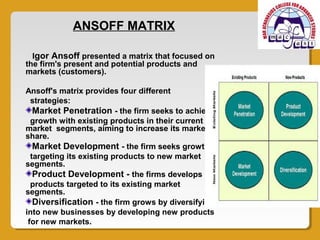
  Igor Ansoff presented a matrix that focused on
the firm's present and potential products and
markets (customers).

Ansoff's matrix provides four different
  strategies:
   Market Penetration - the firm seeks to achieve
  growth with existing products in their current
market segments, aiming to increase its market
share.
   Market Development - the firm seeks growth by
  targeting its existing products to new market
segments.
   Product Development - the firms develops new
  products targeted to its existing market
segments.
   Diversification - the firm grows by diversifying
into new businesses by developing new products
 for new markets.
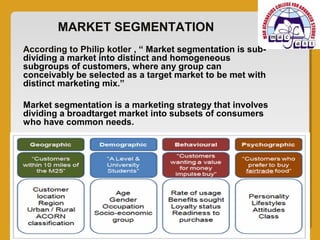
MARKET SEGMENTATION
According to Philip kotler , “ Market segmentation is sub-
dividing a market into distinct and homogeneous
subgroups of customers, where any group can
conceivably be selected as a target market to be met with
distinct marketing mix.”

Market segmentation is a marketing strategy that involves
dividing a broadtarget market into subsets of consumers
who have common needs.
TARGET MARKETING
•   Focusing marketing decisions on a very
    specific group of people an organization
    wants to reach.

•   Identifying and developing products/ services
    for a specific market.
POSITIONING

“Positioning is not what you do to a
  product; it is what you do to the mind
  of a prospect.” Ries and Trout (1972).

Market positioning is the manipulation of a brand
or family of brands to create a positive perception
in the eyes of the public.

If a product is well positioned, it will have strong
sales, and it may become the go-to brand for
people who need that particular product.
O U
             Y
       N K
 H A
T

Marketing strategy

  • 1.
    MARKETING STRATEGY CHINCHU KURIAN MAR ATHANASIOS COLLEGE FOR ADVANCED STUDIES
  • 2.
    Marketing strategy isa process that can allow an organization to concentrate its resources on the optimal opportunities with the goals of increasing sales and achieving a sustainable competitive advantage. TYPES OF STRATEGY Strategies based on Market dominance- firms are classified based on their market share or dominance of an industry. Typically there are four types of market dominance strategies: •Leader •Challenger •Follower •Nicher Porter generic strategies - strategy on the dimensions of strategic scope and strategic strength. IMPORTANCE OF MARKETING STRATEGY A marketing strategy can serve as the foundation of a marketing plan. A marketing plan contains a set of specific actions required to successfully implement a marketing strategy.
  • 3.
  • 4.
    The 7 Ps The 7 Cs Organisation Facing Customer Facing Product = Customer/ Consumer Price = Cost Place = Convenience Promotion = Communication People = Caring Processes = Co-ordinated Physical Evidence = 7PS Confirmation 7CS
  • 5.
    New Product Development NewProduct Development Process Process •Marketing •Business •Strategy •Analysis •Concept •Development •Product •and Testing •Development •Idea •Test •Screening •Marketing •Idea •Commercialization •Generation
  • 6.
    TOOLS OF MARKETINGSTRATEGY BCG MATRIX Stars: -High share of low growth market. -Build into cash cow via investment. Cash Cows: -High share of low growth market. -Maintain or harvest for cash to build STARS. Question Marks: -Low share of high growth market. -Build into STAR via investment if warranted, or reallocate financing and let slip into DOG status. Dogs: - Low share of low growth market. Maintain or divest.
  • 7.
    G. E. multifactoral analysis The GE matrix is an alternative technique used in brand marketing and product management to help a company decide what products to add to its product portfolio, and which market opportunities are worthy of continued investment. ”Directional Policy Matrix” The GE multi-factor model was first developed by Mckinsey for General Electric in the 1970s. Conceptually, the GE Matrix is similar to the Boston Box as it is plotted on a two-dimensional grid. In most versions of the matrix: The Y-Axis comprises industry attractiveness measures,such as Market Profitability, Fit with Core Skills etc. The X-Axis comprises business strength measures, such as Price, Service Levels etc.
  • 8.
    ANSOFF MATRIX Igor Ansoff presented a matrix that focused on the firm's present and potential products and markets (customers). Ansoff's matrix provides four different strategies: Market Penetration - the firm seeks to achieve growth with existing products in their current market segments, aiming to increase its market share. Market Development - the firm seeks growth by targeting its existing products to new market segments. Product Development - the firms develops new products targeted to its existing market segments. Diversification - the firm grows by diversifying into new businesses by developing new products for new markets.
  • 9.
    MARKET SEGMENTATION According toPhilip kotler , “ Market segmentation is sub- dividing a market into distinct and homogeneous subgroups of customers, where any group can conceivably be selected as a target market to be met with distinct marketing mix.” Market segmentation is a marketing strategy that involves dividing a broadtarget market into subsets of consumers who have common needs.
  • 10.
    TARGET MARKETING • Focusing marketing decisions on a very specific group of people an organization wants to reach. • Identifying and developing products/ services for a specific market.
  • 11.
    POSITIONING “Positioning is notwhat you do to a product; it is what you do to the mind of a prospect.” Ries and Trout (1972). Market positioning is the manipulation of a brand or family of brands to create a positive perception in the eyes of the public. If a product is well positioned, it will have strong sales, and it may become the go-to brand for people who need that particular product.
  • 12.
    O U Y N K H A T

Editor's Notes

  • #6 New Product Development Process This CTR corresponds to Figure 9-1 on p. 275 and relates to the discussion on pp. 275-286. Stages in New Product Development Idea Generation. This stage is the systematic search for new product ideas. Sources for new product ideas include internal sources, customers, competitor's products, distributors & suppliers, and other sources. Screening. This stage focuses on reducing the number of ideas by dropping poor ideas as soon as possible. This helps reduce costs and focus attention more productively. Concept Development and Testing. This stage involves translating ideas into product concepts or detailed versions of the ideas stated in meaningful consumer terms. Concepts are then tested on target consumers. Marketing Strategy. This stage consists of three parts. The first part describes the target market, the second part outlines the product's projected price, distribution, and budget for the first year, the third part describes long-term sales, profit goals, and marketing mix strategy. Business Analysis. This stage reviews the sales, costs, and profit projections for the product to find out if they satisfy overall company objectives. Product Development. This stage involves bringing the product concept into existence as a physical product to ensure that the idea is a workable product. Test Marketing. This is the stage at which the product and marketing program are implemented in one or more realistic market settings. Commercialization. This stage involves actually introducing the new product into the competitive marketplace. In this stage, the company must make decisions involving when to introduce, where, to whom, and how.