Strategy – Ansoff’s Matrix
Ansoff’s Matrix
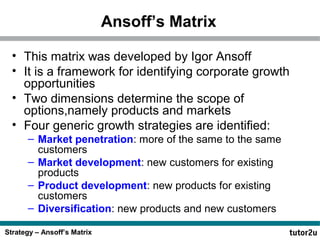
• This matrix was developed by Igor Ansoff
• It is a framework for identifying corporate growth
opportunities
• Two dimensions determine the scope of
options,namely products and markets
• Four generic growth strategies are identified:
– Market penetration: more of the same to the same
customers
– Market development: new customers for existing
products
– Product development: new products for existing
customers
– Diversification: new products and new customers
Strategy – Ansoff’s Matrix
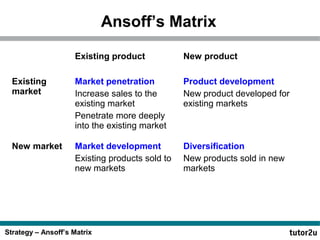
Ansoff’s Matrix
Existing product

New product

Existing
market

Market penetration
Increase sales to the
existing market
Penetrate more deeply
into the existing market

Product development
New product developed for
existing markets

New market

Market development
Existing products sold to
new markets

Diversification
New products sold in new
markets

Strategy – Ansoff’s Matrix
Ansoff’s matrix and risk
• The greater the degree of newness the
greater the risk
• Hence:
• Market penetration - little risk involved
• Market development - moderate risk
• Product development - moderate risk
• Diversification - high risk because both
product and market are new and unknown
Strategy – Ansoff’s Matrix
Example 1 - Growth of Tesco
• Market penetration
– Increase in its share of the grocery business at the expense of
Sainsbury’s and Asda

• Market development
– Movement into the convenience store market
– Expansion abroad

• Product development
– Expansion into petrol sales
– Development of financial services

• Diversification
– Today Tesco is so all embracing that diversification would have to
involve something entirely outside Tesco’s current range of
activities and sold in foreign markets or to business customers

Strategy – Ansoff’s Matrix
Example 2: Growth of Scottish Banks
• In recent years both Royal Bank of Scotland and Bank of
Scotland have grown rapidly through:
• Market penetration
– Increased sales of banking financial services in Scotland

• Market development
– Growing presence south of the border following acquisitions.
– Bank of Scotland and the Halifax Bank merge to create HBOS
– RBS took over Williams and Glyn in 1970 and also runs Tesco’s
banking operation

• Product development
– Growing involvement in insurance
– RBS subsidiary Direct line revolutionised motor insurance

• Diversification
– Selling insurance in England might be seen as new markets and
new products
Strategy – Ansoff’s Matrix
Market Penetration
• Aim of the strategy:
– To maintain or increase share of the current market with current
products
– To secure dominance of a growth market or restructure a mature
market by driving out competition

• Market penetration involves an increase in sales of existing
products to existing markets - selling more of the same to
the same people
• But it is difficult to achieve growth through increased
market penetration if the market is saturated
• In a stagnating market increase in sales is only possible by
grabbing market share from rivals. Hence competition will
be intense in such markets
• Risks are low but the prospects of success are low unless
there is strong growth in the market
Strategy – Ansoff’s Matrix
Market penetration strategies
• How is increased market penetration
achieved?
– Increase usage by existing customers
– Attract customers away from rivals
– Gain market. share at the expense of rivals
– Encourage increase in frequency of use
– Devise and encourage new applications
– Encourage non buyers to buy

• Market penetration requires realignment of
the marketing mix
Strategy – Ansoff’s Matrix
Use market penetration when...
•
•
•
•

The market is not saturated
There is growth in the market
Competitors’ share of the market is falling
Increased volumes lead to economies of
scale
• There is scope for selling more to existing
customers

Strategy – Ansoff’s Matrix
Market development
• This involves
– Selling the same product to different people
– Entering new markets or segments with existing
products
– Gaining new customers,new segments,new markets
– Entering overseas markets

• Market development will require changes to
marketing strategy e.g. new distribution channels,
different pricing policy, now promotional strategy
to attract different types of customers
Strategy – Ansoff’s Matrix
Market development
• Market development is used when…
– Untapped markets are beckoning
– The firm has excess capacity
– There are attractive channels to access new
market

• Market development involves moderate risk
- there is a lack of familiarity with customers
but at least the product is familiar

Strategy – Ansoff’s Matrix
Product development
• This is the development of new products for
the existing market
• New products come in the form of:
– New products to replace current products
– New innovative products
– Product improvements
– Product line extensions
– New products to complement existing products
– Products at a different quality level to existing
products
Strategy – Ansoff’s Matrix
Product development
• Product development is used when:
– The Firm has strong R&D capabilities
– The market is growing
– There is rapid change
– The firm can build on existing brands
– Competitors have better products

• But new product development is costly and
there are moderate risks associated with
this strategy
Strategy – Ansoff’s Matrix
Diversification
• Diversification in the Ansoff Matrix means:
– New products sold to new markets
– New products for new customers

• It is a risky strategy because it involves two unknowns
• Therefore new products and new markets should be
selected which offer the prospect for growth which the
exiting product market mix does not
• One problem is to identify real life examples of firms
developing new products for genuinely new groups of
customers
• Diversification can be sub-divided into related and
unrelated

Strategy – Ansoff’s Matrix
Related diversification
• This is development beyond present product market but
still within the broad confines of the industry
• Markets and products share some commonality with
existing products
• Therefore it builds on assets or activities which the firm has
developed
• Related diversification can also be seen as synergistic
diversification since it involves harnessing exiting product
market knowledge
• This closeness can reduce the risks associated with
diversification
• Example: banks developing insurance products
Strategy – Ansoff’s Matrix
Example: Product mix at PC World
• PC World (part of the Dixons/ Curry’s group) has grown
through market penetration (new stores), product
development (new products) and related diversification
• In the early days, the stock consisted of PCs and
accessories
• Then space was devoted to digital photographic products.
• After that, iPods and similar products became major an
important part of the product range
• Now with flat screen and high definition TV they are
expanding into this market
• All these products are linked in that they involve digital
technology. These developments could be classed as
product development or, especially if they bring new people
into the store, it could be seen as related diversification
Strategy – Ansoff’s Matrix
Related diversification
• Horizontal diversification: when new products
are introduced to current markets
• Vertical diversification: when an organisation
decides to move into its suppliers or customer’s
business to secure supply or to firm up the use of
products in end products
• Concentric diversification: when new products
closely related to current products are introduced
into new markets
• The product might be new but is it genuinely
diversification into new markets?
Strategy – Ansoff’s Matrix
Unrelated diversification
• Features of unrelated diversification
– Growth in products and markets that are completely new
– Development beyond the present industry into products
and markets which bear little relation to the present
product market mix
– No commonality with existing products and markets

• It is also known as conglomerate diversification:
When completely new, technologically unrelated
products are introduced into new markets
• As it represents a departure from existing products
and markets it does represent considerable risk
Strategy – Ansoff’s Matrix
Examples of unrelated diversification
• In each case consider whether it is genuinely unrelated or
whether there is some link be with existing products or
markets
• Water supply companies acquiring or developing hotel
businesses
• Granada TV group developed motorway service areas
(now sold off since the merger of ITV)
• The involvement of Pearson Group (a publisher) in
television production companies and running an exam
board (Edexcel)
• British Gas offers home emergency services covering
plumbing and electrical problems
• Hollywood film studios own hotels, casinos and cruise
liners
Strategy – Ansoff’s Matrix
Uses of the Ansoff Matrix
• The matrix is a framework to explore directions for
strategic growth
• It is the most commonly used model for analysing
the possible strategic direction that a business
should take
• It not only identifies and analyses different growth
opportunities it also encourages planners to
consider both expected returns and risks
• But, as we have seen, real world examples do not
fit neatly into the four cells of the Ansoff’s Matrix
Strategy – Ansoff’s Matrix

Ansoff

  • 1.
  • 2.
    Ansoff’s Matrix • Thismatrix was developed by Igor Ansoff • It is a framework for identifying corporate growth opportunities • Two dimensions determine the scope of options,namely products and markets • Four generic growth strategies are identified: – Market penetration: more of the same to the same customers – Market development: new customers for existing products – Product development: new products for existing customers – Diversification: new products and new customers Strategy – Ansoff’s Matrix
  • 3.
    Ansoff’s Matrix Existing product Newproduct Existing market Market penetration Increase sales to the existing market Penetrate more deeply into the existing market Product development New product developed for existing markets New market Market development Existing products sold to new markets Diversification New products sold in new markets Strategy – Ansoff’s Matrix
  • 4.
    Ansoff’s matrix andrisk • The greater the degree of newness the greater the risk • Hence: • Market penetration - little risk involved • Market development - moderate risk • Product development - moderate risk • Diversification - high risk because both product and market are new and unknown Strategy – Ansoff’s Matrix
  • 5.
    Example 1 -Growth of Tesco • Market penetration – Increase in its share of the grocery business at the expense of Sainsbury’s and Asda • Market development – Movement into the convenience store market – Expansion abroad • Product development – Expansion into petrol sales – Development of financial services • Diversification – Today Tesco is so all embracing that diversification would have to involve something entirely outside Tesco’s current range of activities and sold in foreign markets or to business customers Strategy – Ansoff’s Matrix
  • 6.
    Example 2: Growthof Scottish Banks • In recent years both Royal Bank of Scotland and Bank of Scotland have grown rapidly through: • Market penetration – Increased sales of banking financial services in Scotland • Market development – Growing presence south of the border following acquisitions. – Bank of Scotland and the Halifax Bank merge to create HBOS – RBS took over Williams and Glyn in 1970 and also runs Tesco’s banking operation • Product development – Growing involvement in insurance – RBS subsidiary Direct line revolutionised motor insurance • Diversification – Selling insurance in England might be seen as new markets and new products Strategy – Ansoff’s Matrix
  • 7.
    Market Penetration • Aimof the strategy: – To maintain or increase share of the current market with current products – To secure dominance of a growth market or restructure a mature market by driving out competition • Market penetration involves an increase in sales of existing products to existing markets - selling more of the same to the same people • But it is difficult to achieve growth through increased market penetration if the market is saturated • In a stagnating market increase in sales is only possible by grabbing market share from rivals. Hence competition will be intense in such markets • Risks are low but the prospects of success are low unless there is strong growth in the market Strategy – Ansoff’s Matrix
  • 8.
    Market penetration strategies •How is increased market penetration achieved? – Increase usage by existing customers – Attract customers away from rivals – Gain market. share at the expense of rivals – Encourage increase in frequency of use – Devise and encourage new applications – Encourage non buyers to buy • Market penetration requires realignment of the marketing mix Strategy – Ansoff’s Matrix
  • 9.
    Use market penetrationwhen... • • • • The market is not saturated There is growth in the market Competitors’ share of the market is falling Increased volumes lead to economies of scale • There is scope for selling more to existing customers Strategy – Ansoff’s Matrix
  • 10.
    Market development • Thisinvolves – Selling the same product to different people – Entering new markets or segments with existing products – Gaining new customers,new segments,new markets – Entering overseas markets • Market development will require changes to marketing strategy e.g. new distribution channels, different pricing policy, now promotional strategy to attract different types of customers Strategy – Ansoff’s Matrix
  • 11.
    Market development • Marketdevelopment is used when… – Untapped markets are beckoning – The firm has excess capacity – There are attractive channels to access new market • Market development involves moderate risk - there is a lack of familiarity with customers but at least the product is familiar Strategy – Ansoff’s Matrix
  • 12.
    Product development • Thisis the development of new products for the existing market • New products come in the form of: – New products to replace current products – New innovative products – Product improvements – Product line extensions – New products to complement existing products – Products at a different quality level to existing products Strategy – Ansoff’s Matrix
  • 13.
    Product development • Productdevelopment is used when: – The Firm has strong R&D capabilities – The market is growing – There is rapid change – The firm can build on existing brands – Competitors have better products • But new product development is costly and there are moderate risks associated with this strategy Strategy – Ansoff’s Matrix
  • 14.
    Diversification • Diversification inthe Ansoff Matrix means: – New products sold to new markets – New products for new customers • It is a risky strategy because it involves two unknowns • Therefore new products and new markets should be selected which offer the prospect for growth which the exiting product market mix does not • One problem is to identify real life examples of firms developing new products for genuinely new groups of customers • Diversification can be sub-divided into related and unrelated Strategy – Ansoff’s Matrix
  • 15.
    Related diversification • Thisis development beyond present product market but still within the broad confines of the industry • Markets and products share some commonality with existing products • Therefore it builds on assets or activities which the firm has developed • Related diversification can also be seen as synergistic diversification since it involves harnessing exiting product market knowledge • This closeness can reduce the risks associated with diversification • Example: banks developing insurance products Strategy – Ansoff’s Matrix
  • 16.
    Example: Product mixat PC World • PC World (part of the Dixons/ Curry’s group) has grown through market penetration (new stores), product development (new products) and related diversification • In the early days, the stock consisted of PCs and accessories • Then space was devoted to digital photographic products. • After that, iPods and similar products became major an important part of the product range • Now with flat screen and high definition TV they are expanding into this market • All these products are linked in that they involve digital technology. These developments could be classed as product development or, especially if they bring new people into the store, it could be seen as related diversification Strategy – Ansoff’s Matrix
  • 17.
    Related diversification • Horizontaldiversification: when new products are introduced to current markets • Vertical diversification: when an organisation decides to move into its suppliers or customer’s business to secure supply or to firm up the use of products in end products • Concentric diversification: when new products closely related to current products are introduced into new markets • The product might be new but is it genuinely diversification into new markets? Strategy – Ansoff’s Matrix
  • 18.
    Unrelated diversification • Featuresof unrelated diversification – Growth in products and markets that are completely new – Development beyond the present industry into products and markets which bear little relation to the present product market mix – No commonality with existing products and markets • It is also known as conglomerate diversification: When completely new, technologically unrelated products are introduced into new markets • As it represents a departure from existing products and markets it does represent considerable risk Strategy – Ansoff’s Matrix
  • 19.
    Examples of unrelateddiversification • In each case consider whether it is genuinely unrelated or whether there is some link be with existing products or markets • Water supply companies acquiring or developing hotel businesses • Granada TV group developed motorway service areas (now sold off since the merger of ITV) • The involvement of Pearson Group (a publisher) in television production companies and running an exam board (Edexcel) • British Gas offers home emergency services covering plumbing and electrical problems • Hollywood film studios own hotels, casinos and cruise liners Strategy – Ansoff’s Matrix
  • 20.
    Uses of theAnsoff Matrix • The matrix is a framework to explore directions for strategic growth • It is the most commonly used model for analysing the possible strategic direction that a business should take • It not only identifies and analyses different growth opportunities it also encourages planners to consider both expected returns and risks • But, as we have seen, real world examples do not fit neatly into the four cells of the Ansoff’s Matrix Strategy – Ansoff’s Matrix