
Dr. Aravind.T.S
www.aravindts.com
www.aravindts.com 1
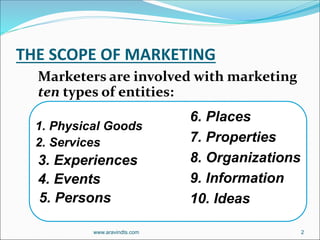
THE SCOPE OF MARKETING
Marketers are involved with marketing
ten types of entities:
1. Physical Goods
2. Services
3. Experiences
4. Events
5. Persons
6. Places
7. Properties
8. Organizations
9. Information
10. Ideas
www.aravindts.com 2
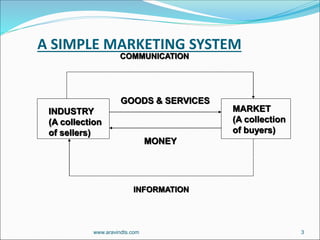
A SIMPLE MARKETING SYSTEM
INDUSTRY
(A collection
of sellers)
MARKET
(A collection
of buyers)
COMMUNICATION
INFORMATION
GOODS & SERVICES
MONEY
www.aravindts.com 3
5concepts of Marketing
 EXCHANGE CONCEPT
 PRODUCTION CONCEPT
 PRODUCT CONCEPT
 SALE CONCEPT
 MARKETING CONCEPT
www.aravindts.com 4
EXCHANGE CONCEPT
 Central idea in Marketing
 Exchange of product between seller and buyer
 Some firm operates with the belief that
business/marketing is simply a matter of giving a
product to someone in exchange of some money from
him .
VERY SHORTSIGHTED VIEW
www.aravindts.com 5
PRODUCTION CONCEPT
There is a category of firms which believes that
business can be managed by the
maximization of production and the
resultant lower unit cost .
‘MAXIMISE OUT PUT’ achieve a lower unit cost ;
and sell at a LOWER PRICE is their Mantra
www.aravindts.com 6
 The PRODUCTION CONCEPT holds that
consumers will prefer products that are widely
available and inexpensive
www.aravindts.com 7
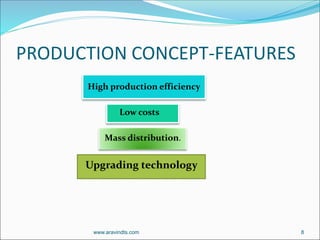
PRODUCTION CONCEPT-FEATURES
High production efficiency
Low costs
Mass distribution.
Upgrading technology
www.aravindts.com 8
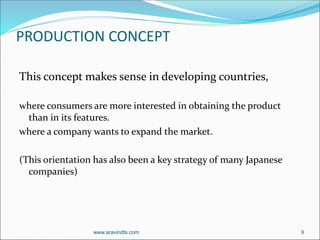
PRODUCTION CONCEPT
This concept makes sense in developing countries,
where consumers are more interested in obtaining the product
than in its features.
where a company wants to expand the market.
(This orientation has also been a key strategy of many Japanese
companies)
www.aravindts.com 9
PRODUCT CONCEPT
 Excellent product is the most important criterion for
the firms
 Obsessed with the product – quality and features
www.aravindts.com 10
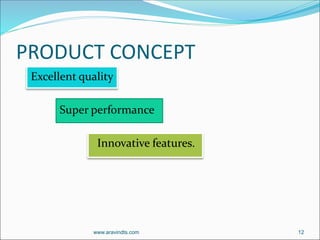
The PRODUCT CONCEPT holds that consumers will
favor those products that offer the most quality,
performance, or innovative features.
www.aravindts.com 11
PRODUCT CONCEPT
Excellent quality
Super performance
Innovative features.
www.aravindts.com 12
PRODUCT CONCEPT
Product-oriented companies often design their products
with little or no customer input, trusting that their
engineers can design exceptional products.
www.aravindts.com 13
PRODUCT CONCEPT
A General Motors executive said years ago:
“How can the public know what kind of car they want
until they see what is available?”
(GM today asks customers what they value in a car and includes marketing people
in the very beginning stages of design)
www.aravindts.com 14
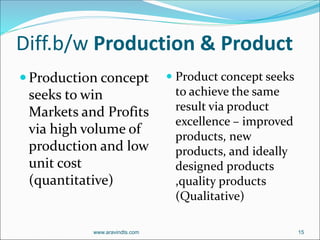
Diff.b/w Production & Product
 Production concept
seeks to win
Markets and Profits
via high volume of
production and low
unit cost
(quantitative)
 Product concept seeks
to achieve the same
result via product
excellence – improved
products, new
products, and ideally
designed products
,quality products
(Qualitative)
www.aravindts.com 15
Selling Concept
These firms believes that marketing’s major
concern is to aggressively push the products
and coax the customer to buy the offered
product.
www.aravindts.com 16
SELLING CONCEPT
The SELLING CONCEPT holds that
consumers and businesses, will ordinarily
not buy enough of the organization’s
products. The organization must therefore,
undertake an aggressive selling and
promotion effort.
www.aravindts.com 17
The Selling Concept
Under this concept the organization must undertake an aggressive
selling and promotion efforts to sell the products.
This concept assumes that consumers
must be coaxed into buying.
The company has to use selling and promotion tools to stimulate
buying.
High power Personal Selling , heavy Advertising ,large
scale sales Promotion ,heavy Price discounts
www.aravindts.com 18
The Selling Concept
The selling concept is practiced most
aggressively when they have overcapacity.
Their aim is to sell what they make rather than make
what the market want
www.aravindts.com 19
The Selling Concept
This theory assumes that customers who are coaxed into
buying a product will like it; and if they don’t, that
they won’t bad-mouth it or complain to consumer
organizations and will forget their disappointment and
buy it again.
(bad news travels fast, something marketers that use hard
selling should bear in mind)
www.aravindts.com 20
MARKETING CONCEPT
 The MARKETING CONCEPT holds that the key to
achieving its organizational goals consists of the
company being more effective than competitors
in creating, delivering, and communicating
customer value to its chosen target markets.
www.aravindts.com 21
MARKETING CONCEPT
The marketing concept holds that the key to
achieving organizational goals consists of the
company being more effective than its
competitors in creating, delivering, and -communicating
customer valueto its chosen target markets.
www.aravindts.com 22
MARKETING CONCEPT
• “Selling focuses on the needs of the seller; Marketing
on the needs of the buyer. Selling is preoccupied with
the seller’s need to convert his product into cash;
Marketing with the idea of satisfying the needs of the
customer by means of the product and the whole
cluster of things associated with creating, delivering
and finally consuming it.”
• (Theodore Levitt – Harvard Business school)
www.aravindts.com 23
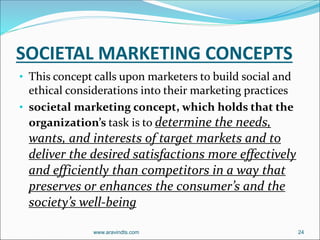
SOCIETAL MARKETING CONCEPTS
• This concept calls upon marketers to build social and
ethical considerations into their marketing practices
• societal marketing concept, which holds that the
organization’s task is to determine the needs,
wants, and interests of target markets and to
deliver the desired satisfactions more effectively
and efficiently than competitors in a way that
preserves or enhances the consumer’s and the
society’s well-being
www.aravindts.com 24
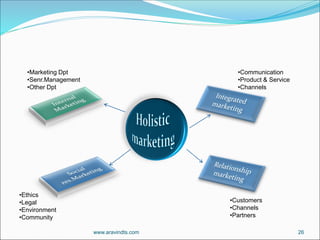
Holistic Marketing
Every thing Matters
www.aravindts.com 25
•Marketing Dpt
•Senr.Management
•Other Dpt
•Communication
•Product & Service
•Channels
•Ethics
•Legal
•Environment
•Community
•Customers
•Channels
•Partners
www.aravindts.com 26
Integrated Marketing
 The Marketers task is to devise activities and assemble
fully integrated marketing programs to create,
communicate, and deliver value for consumers.
Many different marketing activities are employed to
communicate and deliver value
All marketing activities are coordinated to maximize
their joint effort .
www.aravindts.com 27
Design and
Implementation of any
one Marketing activity is
done with all other
activities in Mind.
www.aravindts.com 28
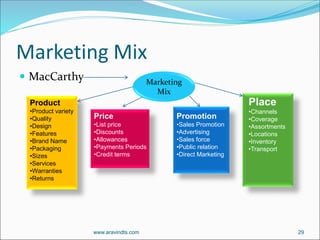
Marketing Mix
 MacCarthy Marketing
Mix
Product
•Product variety
•Quality
•Design
•Features
•Brand Name
•Packaging
•Sizes
•Services
•Warranties
•Returns
Price
•List price
•Discounts
•Allowances
•Payments Periods
•Credit terms
Promotion
•Sales Promotion
•Advertising
•Sales force
•Public relation
•Direct Marketing
Place
•Channels
•Coverage
•Assortments
•Locations
•Inventory
•Transport
www.aravindts.com 29
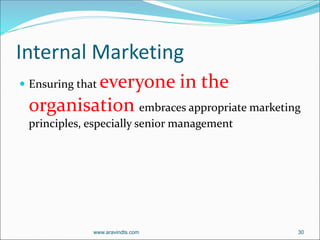
Internal Marketing
 Ensuring that everyone in the
organisation embraces appropriate marketing
principles, especially senior management
www.aravindts.com 30
 Smart marketers – “ Marketing activities with in the
company can be as most important as , or even more
than ,marketing activities directed out side the
company”
www.aravindts.com 31
Social Responsibility Marketing
Marketers plays an important
roll in social welfare
Eg :- Donating a percentage of
revenues to a specific cause
based on the revenue .
ITC note book
www.aravindts.com 32
Relationship marketing
 Key goal of this marketing is to develop deep ,
enduring relationship with all people or
organizations that could directly or indirectly affect
the success of the firm’s marketing activities
 Aims:- Mutually satisfying long-term relationship with
the key parties –
 Customers
 Suppliers
 Distributers
 Other marketing partners
www.aravindts.com 33
Responsive marketing, Anticipative marketing,
and Creative marketing.
A Responsive marketer finds a stated need
and fills it
An Anticipative marketer looks ahead to the
needs that customers may have in the near future.
A Creative marketer discovers and produces
solutions that customers did not ask for, but to
which they enthusiastically respond.
www.aravindts.com 34
Creative marketing
Sony exemplifies a creative marketer because it has
introduced many successful new products that
customers never asked for or even thought were
possible .
Sony goes beyond customer-led marketing: It is a
market-driving firm, not just a market-driven firm.
AkioMorita, founder-Sony corporation,
proclaimed that he doesn’t serve markets; he creates
markets.
www.aravindts.com 35
Company’s Sales come from two groups:
New customers
Repeat customers
Estimates shows that attracting a new customer can
cost five times as much as pleasing an existing one.
And it might cost 16 times as much to bring the
new customer to the same level of profitability as
that of the lost customer.
Customer retention is thus more
important than customer attraction.
www.aravindts.com 36
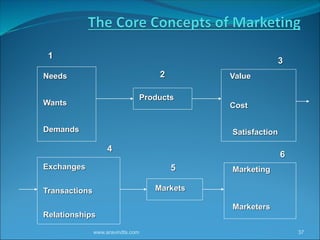
Needs
Wants
Demands
Products
Value
Cost
Satisfaction
Exchanges
Transactions
Relationships
Markets
Marketing
Marketers
1
2
3
4
5
6
www.aravindts.com 37
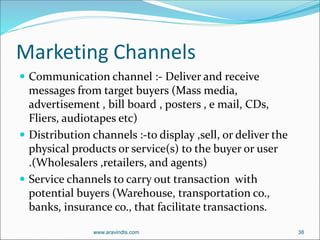
Marketing Channels
 Communication channel :- Deliver and receive
messages from target buyers (Mass media,
advertisement , bill board , posters , e mail, CDs,
Fliers, audiotapes etc)
 Distribution channels :-to display ,sell, or deliver the
physical products or service(s) to the buyer or user
.(Wholesalers ,retailers, and agents)
 Service channels to carry out transaction with
potential buyers (Warehouse, transportation co.,
banks, insurance co., that facilitate transactions.
www.aravindts.com 38
Marketing management
End of session 2
Thank you
www.aravindts.com 39

Marketing management 2

  • 1.
  • 2.
    THE SCOPE OFMARKETING Marketers are involved with marketing ten types of entities: 1. Physical Goods 2. Services 3. Experiences 4. Events 5. Persons 6. Places 7. Properties 8. Organizations 9. Information 10. Ideas www.aravindts.com 2
  • 3.
    A SIMPLE MARKETINGSYSTEM INDUSTRY (A collection of sellers) MARKET (A collection of buyers) COMMUNICATION INFORMATION GOODS & SERVICES MONEY www.aravindts.com 3
  • 4.
    5concepts of Marketing EXCHANGE CONCEPT  PRODUCTION CONCEPT  PRODUCT CONCEPT  SALE CONCEPT  MARKETING CONCEPT www.aravindts.com 4
  • 5.
    EXCHANGE CONCEPT  Centralidea in Marketing  Exchange of product between seller and buyer  Some firm operates with the belief that business/marketing is simply a matter of giving a product to someone in exchange of some money from him . VERY SHORTSIGHTED VIEW www.aravindts.com 5
  • 6.
    PRODUCTION CONCEPT There isa category of firms which believes that business can be managed by the maximization of production and the resultant lower unit cost . ‘MAXIMISE OUT PUT’ achieve a lower unit cost ; and sell at a LOWER PRICE is their Mantra www.aravindts.com 6
  • 7.
     The PRODUCTIONCONCEPT holds that consumers will prefer products that are widely available and inexpensive www.aravindts.com 7
  • 8.
    PRODUCTION CONCEPT-FEATURES High productionefficiency Low costs Mass distribution. Upgrading technology www.aravindts.com 8
  • 9.
    PRODUCTION CONCEPT This conceptmakes sense in developing countries, where consumers are more interested in obtaining the product than in its features. where a company wants to expand the market. (This orientation has also been a key strategy of many Japanese companies) www.aravindts.com 9
  • 10.
    PRODUCT CONCEPT  Excellentproduct is the most important criterion for the firms  Obsessed with the product – quality and features www.aravindts.com 10
  • 11.
    The PRODUCT CONCEPTholds that consumers will favor those products that offer the most quality, performance, or innovative features. www.aravindts.com 11
  • 12.
    PRODUCT CONCEPT Excellent quality Superperformance Innovative features. www.aravindts.com 12
  • 13.
    PRODUCT CONCEPT Product-oriented companiesoften design their products with little or no customer input, trusting that their engineers can design exceptional products. www.aravindts.com 13
  • 14.
    PRODUCT CONCEPT A GeneralMotors executive said years ago: “How can the public know what kind of car they want until they see what is available?” (GM today asks customers what they value in a car and includes marketing people in the very beginning stages of design) www.aravindts.com 14
  • 15.
    Diff.b/w Production &Product  Production concept seeks to win Markets and Profits via high volume of production and low unit cost (quantitative)  Product concept seeks to achieve the same result via product excellence – improved products, new products, and ideally designed products ,quality products (Qualitative) www.aravindts.com 15
  • 16.
    Selling Concept These firmsbelieves that marketing’s major concern is to aggressively push the products and coax the customer to buy the offered product. www.aravindts.com 16
  • 17.
    SELLING CONCEPT The SELLINGCONCEPT holds that consumers and businesses, will ordinarily not buy enough of the organization’s products. The organization must therefore, undertake an aggressive selling and promotion effort. www.aravindts.com 17
  • 18.
    The Selling Concept Underthis concept the organization must undertake an aggressive selling and promotion efforts to sell the products. This concept assumes that consumers must be coaxed into buying. The company has to use selling and promotion tools to stimulate buying. High power Personal Selling , heavy Advertising ,large scale sales Promotion ,heavy Price discounts www.aravindts.com 18
  • 19.
    The Selling Concept Theselling concept is practiced most aggressively when they have overcapacity. Their aim is to sell what they make rather than make what the market want www.aravindts.com 19
  • 20.
    The Selling Concept Thistheory assumes that customers who are coaxed into buying a product will like it; and if they don’t, that they won’t bad-mouth it or complain to consumer organizations and will forget their disappointment and buy it again. (bad news travels fast, something marketers that use hard selling should bear in mind) www.aravindts.com 20
  • 21.
    MARKETING CONCEPT  TheMARKETING CONCEPT holds that the key to achieving its organizational goals consists of the company being more effective than competitors in creating, delivering, and communicating customer value to its chosen target markets. www.aravindts.com 21
  • 22.
    MARKETING CONCEPT The marketingconcept holds that the key to achieving organizational goals consists of the company being more effective than its competitors in creating, delivering, and -communicating customer valueto its chosen target markets. www.aravindts.com 22
  • 23.
    MARKETING CONCEPT • “Sellingfocuses on the needs of the seller; Marketing on the needs of the buyer. Selling is preoccupied with the seller’s need to convert his product into cash; Marketing with the idea of satisfying the needs of the customer by means of the product and the whole cluster of things associated with creating, delivering and finally consuming it.” • (Theodore Levitt – Harvard Business school) www.aravindts.com 23
  • 24.
    SOCIETAL MARKETING CONCEPTS •This concept calls upon marketers to build social and ethical considerations into their marketing practices • societal marketing concept, which holds that the organization’s task is to determine the needs, wants, and interests of target markets and to deliver the desired satisfactions more effectively and efficiently than competitors in a way that preserves or enhances the consumer’s and the society’s well-being www.aravindts.com 24
  • 25.
    Holistic Marketing Every thingMatters www.aravindts.com 25
  • 26.
    •Marketing Dpt •Senr.Management •Other Dpt •Communication •Product& Service •Channels •Ethics •Legal •Environment •Community •Customers •Channels •Partners www.aravindts.com 26
  • 27.
    Integrated Marketing  TheMarketers task is to devise activities and assemble fully integrated marketing programs to create, communicate, and deliver value for consumers. Many different marketing activities are employed to communicate and deliver value All marketing activities are coordinated to maximize their joint effort . www.aravindts.com 27
  • 28.
    Design and Implementation ofany one Marketing activity is done with all other activities in Mind. www.aravindts.com 28
  • 29.
    Marketing Mix  MacCarthyMarketing Mix Product •Product variety •Quality •Design •Features •Brand Name •Packaging •Sizes •Services •Warranties •Returns Price •List price •Discounts •Allowances •Payments Periods •Credit terms Promotion •Sales Promotion •Advertising •Sales force •Public relation •Direct Marketing Place •Channels •Coverage •Assortments •Locations •Inventory •Transport www.aravindts.com 29
  • 30.
    Internal Marketing  Ensuringthat everyone in the organisation embraces appropriate marketing principles, especially senior management www.aravindts.com 30
  • 31.
     Smart marketers– “ Marketing activities with in the company can be as most important as , or even more than ,marketing activities directed out side the company” www.aravindts.com 31
  • 32.
    Social Responsibility Marketing Marketersplays an important roll in social welfare Eg :- Donating a percentage of revenues to a specific cause based on the revenue . ITC note book www.aravindts.com 32
  • 33.
    Relationship marketing  Keygoal of this marketing is to develop deep , enduring relationship with all people or organizations that could directly or indirectly affect the success of the firm’s marketing activities  Aims:- Mutually satisfying long-term relationship with the key parties –  Customers  Suppliers  Distributers  Other marketing partners www.aravindts.com 33
  • 34.
    Responsive marketing, Anticipativemarketing, and Creative marketing. A Responsive marketer finds a stated need and fills it An Anticipative marketer looks ahead to the needs that customers may have in the near future. A Creative marketer discovers and produces solutions that customers did not ask for, but to which they enthusiastically respond. www.aravindts.com 34
  • 35.
    Creative marketing Sony exemplifiesa creative marketer because it has introduced many successful new products that customers never asked for or even thought were possible . Sony goes beyond customer-led marketing: It is a market-driving firm, not just a market-driven firm. AkioMorita, founder-Sony corporation, proclaimed that he doesn’t serve markets; he creates markets. www.aravindts.com 35
  • 36.
    Company’s Sales comefrom two groups: New customers Repeat customers Estimates shows that attracting a new customer can cost five times as much as pleasing an existing one. And it might cost 16 times as much to bring the new customer to the same level of profitability as that of the lost customer. Customer retention is thus more important than customer attraction. www.aravindts.com 36
  • 37.
  • 38.
    Marketing Channels  Communicationchannel :- Deliver and receive messages from target buyers (Mass media, advertisement , bill board , posters , e mail, CDs, Fliers, audiotapes etc)  Distribution channels :-to display ,sell, or deliver the physical products or service(s) to the buyer or user .(Wholesalers ,retailers, and agents)  Service channels to carry out transaction with potential buyers (Warehouse, transportation co., banks, insurance co., that facilitate transactions. www.aravindts.com 38
  • 39.
    Marketing management End ofsession 2 Thank you www.aravindts.com 39