FUNDAMENTALS OF
MARKETING
MKT 201
Content
Introductio
n
Chapter 1
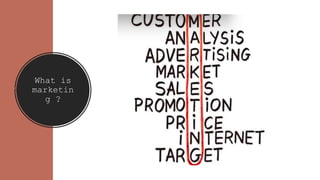
What is
marketin
g ?
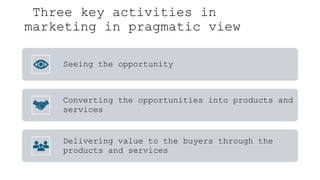
Three key activities in
marketing in pragmatic view
Seeing the opportunity
Converting the opportunities into products and
services
Delivering value to the buyers through the
products and services
• Marketing is not only attracting the customers but
also retaining the customers
Definitio
n of
marketing
-1960
the performance of business
activities that direct the flow
of goods and services from the
producer to consumer or user
American Marketing Association
– 2004
Marketing is an organizational
function and set of process for
creating ,communicating, and
delivering value and customers
and for managing customer
relationships in ways that
benefit the organization and
its stakeholders
• American Marketing association
-2007
Marketing is an activity, a set
of institutions and processes
for creating ,communicating
,delivering, exchanging
offerings that have value for
customers, clients, partners,
and society at large
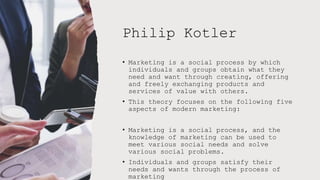
Philip Kotler
• Marketing is a social process by which
individuals and groups obtain what they
need and want through creating, offering
and freely exchanging products and
services of value with others.
• This theory focuses on the following five
aspects of modern marketing:
• Marketing is a social process, and the
knowledge of marketing can be used to
meet various social needs and solve
various social problems.
• Individuals and groups satisfy their
needs and wants through the process of
marketing
• Marketing creates satisfying products
and services.
• The products and services are exchanged
for value in a transaction that provides
mutual benefits to sellers and buyers.
• The exchange must take place in a free-
environment without any external
imposition or compulsion.
Core concepts of marketing
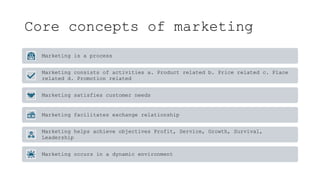
Marketing is a process
Marketing consists of activities a. Product related b. Price related c. Place
related d. Promotion related
Marketing satisfies customer needs
Marketing facilitates exchange relationship
Marketing helps achieve objectives Profit, Service, Growth, Survival,
Leadership
Marketing occurs in a dynamic environment
• Marketing is the process of planning and
executing the conception, pricing, promotion
and distribution of ideas, goods and services
to create exchanges that satisfy individual and
organizational objectives
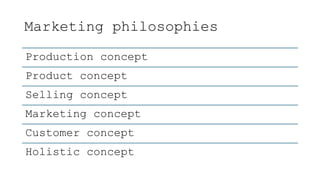
Marketing philosophies
Production concept
Product concept
Selling concept
Marketing concept
Customer concept
Holistic concept
Production concept
• This concept believes that consumers will favor
those products that are widely available and
low in cost
• This concept emerged in 1950’s
• Mass production and wide distribution coverage
• Directed at raising output levels , produce
standardized product and sell at lower price
• Focus on building internal capabilities of an
organization in terms of production and selling
• Use lower costs to cut prices and expand market
sizes
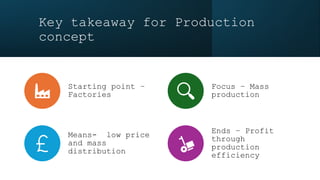
Key takeaway for Production
concept
Starting point –
Factories
Focus – Mass
production
Means- low price
and mass
distribution
Ends – Profit
through
production
efficiency
Productio
n
concept
• Chinese companies
started adopting these
strategy to penetrate
international market
Drawback of production concept
• This concept was abandoned by many companies
when they realized that not all consumers want
cheap products
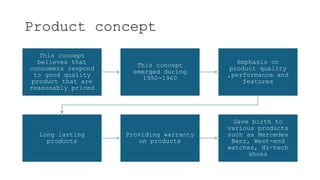
Product concept
This concept
believes that
consumers respond
to good quality
product that are
reasonably priced
This concept
emerged during
1950-1960
Emphasis on
product quality
,performance and
features
Long lasting
products
Providing warranty
on products
Gave birth to
various products
such as Mercedes
Benz, West-end
watches, Hi-tech
shoes
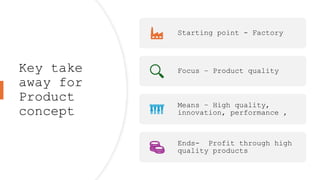
Key take
away for
Product
concept
Starting point - Factory
Focus – Product quality
Means – High quality,
innovation, performance ,
Ends- Profit through high
quality products
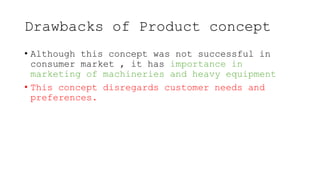
Drawbacks of Product concept
• Although this concept was not successful in
consumer market , it has importance in
marketing of machineries and heavy equipment
• This concept disregards customer needs and
preferences.
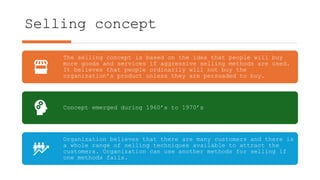
Selling concept
The selling concept is based on the idea that people will buy
more goods and services if aggressive selling methods are used.
It believes that people ordinarily will not buy the
organization’s product unless they are persuaded to buy.
Concept emerged during 1960’s to 1970’s
Organization believes that there are many customers and there is
a whole range of selling techniques available to attract the
customers. Organization can use another methods for selling if
one methods fails.
• Heavy emphasis on convincing
and persuading the buyers
about the super quality and
fair prices.
• Selling concept has been
successful in the field of
political marketing.
• Focused for selling unsought
products which buyers do not
normally think of buying.
• Examples : Life-insurance,
encyclopedia, subscription of
magazines.
• Based on “We sell what we
make.”
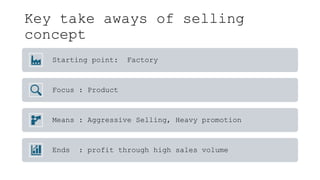
Key take aways of selling
concept
Starting point: Factory
Focus : Product
Means : Aggressive Selling, Heavy promotion
Ends : profit through high sales volume
• Selling concept is successfully implemented in
political marketing and marketing of unsought
products. The Nepalese business sector today is
dominated by selling concept.
• The basic problem with the selling concept is
its assumptions that a majority of the buyers
who have been lured to buy the product would
ultimately like the product. Those who do not
like the product would forget their
disappointment with the product.
Marketing
concept
• The marketing concept believes
that the key to achieving
organizational objectives lies
in being more effective than
competitors in integrating
marketing activities toward
determining and satisfying the
needs and want of the target
markets.
• It is different as of previous
slogan: “We sell what we
make.” Change the business
slogan to: “We make what we
can sell.
• The mean adopted for
achievement of organizational
objective of profit differed
among the production, product
and selling concepts as it
consider buyers an important
variable in the business
environment.
• Managers focus on all
activities at determining
customer needs in the target
market and earn profit through
customer need satisfaction.
• “Think Customer”
• Marketing department is well
coordinated with other
departments like finance,
production, human resources
and research and development
to foster team-work.
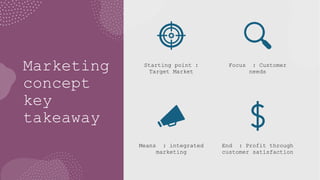
Marketing
concept
key
takeaway
Starting point :
Target Market
Focus : Customer
needs
Means : integrated
marketing
End : Profit through
customer satisfaction
• The marketing concept is a new way of thinking
about organization’s entire activities. The
concept is based on the notion that the main
task of the organization is to know the needs,
wants and value of the target market and then
delivering products that satisfy those needs
and wants.
• It focuses on Target Market, Customer
Orientation, Integrated Marketing , Objectives
Achievement
• Problems: Customer desire versus spending
realities, lack of marketing knowledge, new
features and services, lack of effective
customer service, barriers to communication.
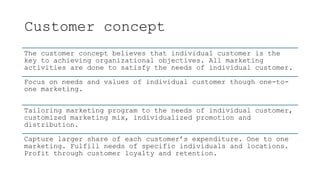
Customer concept
The customer concept believes that individual customer is the
key to achieving organizational objectives. All marketing
activities are done to satisfy the needs of individual customer.
Focus on needs and values of individual customer though one-to-
one marketing.
Tailoring marketing program to the needs of individual customer,
customized marketing mix, individualized promotion and
distribution.
Capture larger share of each customer’s expenditure. One to one
marketing. Fulfill needs of specific individuals and locations.
Profit through customer loyalty and retention.
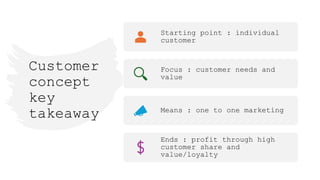
Customer
concept
key
takeaway
Starting point : individual
customer
Focus : customer needs and
value
Means : one to one marketing
Ends : profit through high
customer share and
value/loyalty
• Organizations collect information about the
profile of each customer. They use e-commerce
and the latest information technology.
• This concept is useful to companies selling
high value products. Such products need
periodic replacement or upgrading. Airlines
industry is an example.
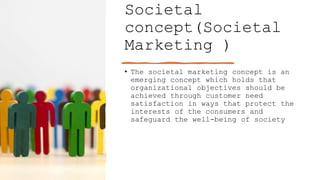
Societal
concept(Societal
Marketing )
• The societal marketing concept is an
emerging concept which holds that
organizational objectives should be
achieved through customer need
satisfaction in ways that protect the
interests of the consumers and
safeguard the well-being of society
Issues raised by societal
concept
• Marketing is blamed for green-house effect leading
to global rise in temperature.
• For depletion of ozone layers leading to a rise in
the incidence of skin cancer.
• For resource shortages due to haphazard use of
limited and non renewable natural resources, such
as oil, coal, forests etc.
• For encouraging over consumption in the developed
world while a large population in the
underdeveloped countries is suffering from hunger,
starvation, disease and premature death.
• For social disharmony by projecting women as wrong
symbols in advertisements.
• Therefore, the societal marketing concept
assumes that along with the consumers wants and
interests, social interests too should be
considered so that long-run social welfare
could be maintained.
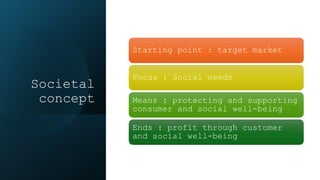
Societal
concept
Starting point : target market
Focus : Social needs
Means : protecting and supporting
consumer and social well-being
Ends : profit through customer
and social well-being
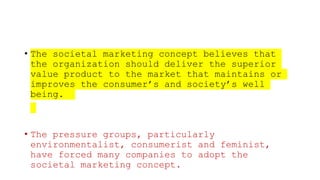
• The societal marketing concept believes that
the organization should deliver the superior
value product to the market that maintains or
improves the consumer’s and society’s well
being.
• The pressure groups, particularly
environmentalist, consumerist and feminist,
have forced many companies to adopt the
societal marketing concept.
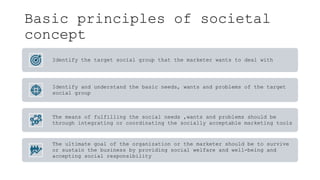
Basic principles of societal
concept
Identify the target social group that the marketer wants to deal with
Identify and understand the basic needs, wants and problems of the target
social group
The means of fulfilling the social needs ,wants and problems should be
through integrating or coordinating the socially acceptable marketing tools
The ultimate goal of the organization or the marketer should be to survive
or sustain the business by providing social welfare and well-being and
accepting social responsibility
Holistic
concept
Holistic marketing concept is a part of
the series on concepts of marketing and
it can be defined as a marketing
strategy which considers the business as
a whole and not as an entity with
various different parts.
According to holistic marketing concept,
even if a business is made of various
departments, the departments have to
come together to project a positive &
united business image in the minds of
the customer.
Holistic marketing concept involves
interconnected marketing activities to
ensure that the customer is likely to
purchase their product rather than
competition.
Holistic
concept
• Philip Kotler- “The holistic marketing
concept is based on the development,
design and implementation of marketing
programs, processes and activities that
recognizes their breadth and
interdependencies.”
Major focus
Societal Marketing
Integrated marketing
Internal marketing
Relationship marketing
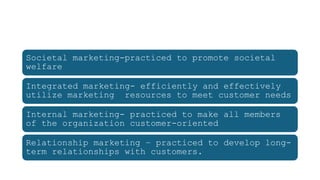
Societal marketing-practiced to promote societal
welfare
Integrated marketing- efficiently and effectively
utilize marketing resources to meet customer needs
Internal marketing- practiced to make all members
of the organization customer-oriented
Relationship marketing – practiced to develop long-
term relationships with customers.
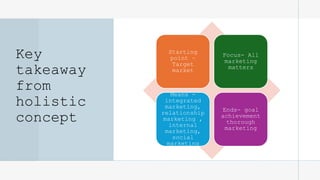
Key
takeaway
from
holistic
concept
Starting
point –
Target
market
Focus- All
marketing
matters
Means -
integrated
marketing,
relationship
marketing ,
internal
marketing,
social
marketing
Ends- goal
achievement
thorough
marketing
`
The holistic
concept emerged
mainly due to
the social and
technological
challenges that
raised serious
questions about
the power of
marketing to
mold and modify
consumer needs
and preferences
in the 21st
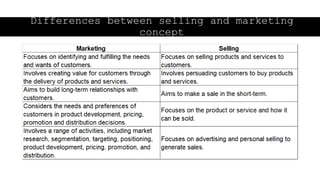
Differences between selling and marketing
concept
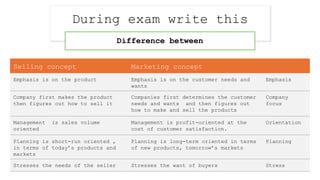
During exam write this
Selling concept Marketing concept
Emphasis is on the product Emphasis is on the customer needs and
wants
Emphasis
Company first makes the product
then figures out how to sell it
Companies first determines the customer
needs and wants and then figures out
how to make and sell the products
Company
focus
Management is sales volume
oriented
Management is profit-oriented at the
cost of customer satisfaction.
Orientation
Planning is short-run oriented ,
in terms of today’s products and
markets
Planning is long-term oriented in terms
of new products, tomorrow’s markets
Planning
Stresses the needs of the seller Stresses the want of buyers Stress
Difference between
Difference between societal
marketing and holistic
approach
• See the word file in desktop
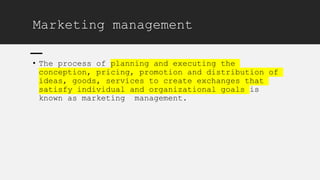
Marketing management
• The process of planning and executing the
conception, pricing, promotion and distribution of
ideas, goods, services to create exchanges that
satisfy individual and organizational goals is
known as marketing management.
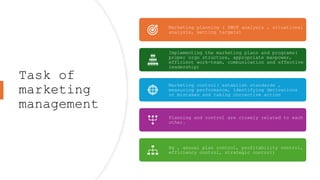
Task of
marketing
management
Marketing planning ( SWOT analysis , situational
analysis, setting targets)
Implementing the marketing plans and programs(
proper orgn structure, appropriate manpower,
efficient work-team, communication and effective
leadership)
Marketing control( establish standards ,
measuring performance, identifying derivations
or mistakes and taking corrective action
Planning and control are closely related to each
other.
Eg , annual plan control, profitability control,
efficiency control, strategic control)
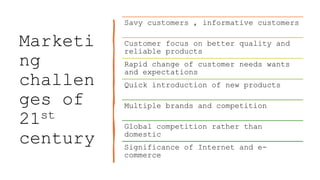
Marketi
ng
challen
ges of
21st
century
Savy customers , informative customers
Customer focus on better quality and
reliable products
Rapid change of customer needs wants
and expectations
Quick introduction of new products
Multiple brands and competition
Global competition rather than
domestic
Significance of Internet and e-
commerce
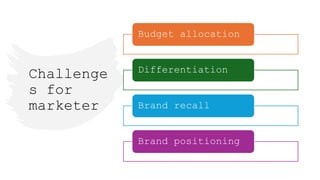
Challenge
s for
marketer
Budget allocation
Differentiation
Brand recall
Brand positioning
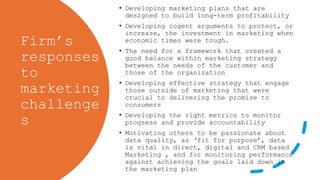
Firm’s
responses
to
marketing
challenge
s
• Developing marketing plans that are
designed to build long-term profitability
• Developing cogent arguments to protect, or
increase, the investment in marketing when
economic times were tough.
• The need for a framework that created a
good balance within marketing strategy
between the needs of the customer and
those of the organization
• Developing effective strategy that engage
those outside of marketing that were
crucial to delivering the promise to
consumers
• Developing the right metrics to monitor
progress and provide accountability
• Motivating others to be passionate about
data quality, as ‘fit for purpose’, data
is vital in direct, digital and CRM based
Marketing , and for monitoring performance
against achieving the goals laid down in
the marketing plan
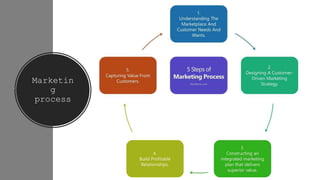
Marketin
g
process
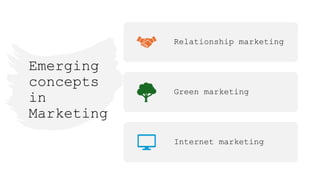
Emerging
concepts
in
Marketing
Relationship marketing
Green marketing
Internet marketing
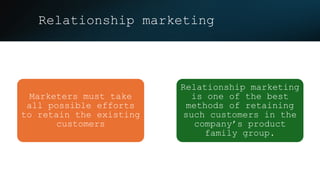
Relationship marketing
Marketers must take
all possible efforts
to retain the existing
customers
Relationship marketing
is one of the best
methods of retaining
such customers in the
company’s product
family group.
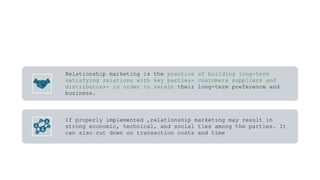
Relationship marketing is the practice of building long-term
satisfying relations with key parties- customers suppliers and
distributors- in order to retain their long-term preference and
business.
If properly implemented ,relationship marketing may result in
strong economic, technical, and social ties among the parties. It
can also cut down on transaction costs and time
Operatin
g
principl
e of
Relation
ship
marketin
g
Build a good network
of relationships with
key stakeholders and
profits will follow
• Ultimate outcome of relationship
marketing is to build a unique company
asset called marketing network.
• A marketing network consists of company and all
its supporting stakeholders: customers,
employees, suppliers, distributors, retailers,
advertising agencies , scientists and others
with whom it has built mutually profitable
business relationship
• The increasing competition between the
companies as well as the whole network has felt
the emergence of Relationship marketing
Customer
developme
nt
process
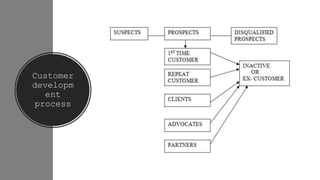
• Customers are not
automatically made, the
marketers develop them.
However, attracting and
keeping customer is
actually a difficult
task. Customer
development process
consists of the
following steps
Customer
developm
ent
process
• The above diagram shows that the main source of
customers is prospect; the main source of
prospect is the suspect.
• Suspects consist of everyone who might
conceivably buy the product or service; they
lack actual need for the company's product.
They become prospects only when the actual need
is created in their mind for the product along
with the money to pay and spend.
• In other words, prospects are the people who have a
strong potential interest in the product and the
ability to pay for it. All suspects cannot be converted
into prospects
• Some of them convert into disqualified prospects, which
have no interest on the product, any money to spend and
lack of willingness to spend it; while some of the
suspects are converted into qualified prospects. The
company usually rejects disqualified prospects because
of their poor credit profile or would be unprofitable
for the company.
• A profitable customer is a person, household, or
company that over time yields a revenue stream that
exceeds by an acceptable amount the company's cost
stream of attracting, selling, and servicing that
If the qualified prospects could be motivated
properly, they may become the first-time customers,
repeat customers, clients, advocates and partners
respectively.
Repeat customers may continue to buy goods
from the competitors as well. But the clients
buy only from the company in the relevant
product categories. If they are fully
satisfied with the company and its products,
they become advocates, who become loyal to the
company and praise the company and encourage
others to buy from it. Lastly, the advocates
may convert into partners, who work actively
with the marketer for common goal.
• However, at every stage of customer-development
process, some of the customers may convert into
inactive or drop out, for reasons of
bankruptcy, moves to other locations,
dissatisfaction, and so on.
Level of Company Investment in
Customer-Relationship Building
• Though developing more loyal customers
increases the company's revenue, the company
has to spend more to build greater customer
loyalty. Marketing veteran
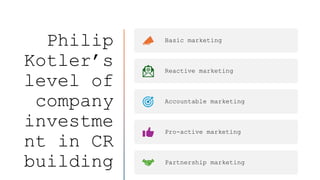
Philip
Kotler’s
level of
company
investme
nt in CR
building
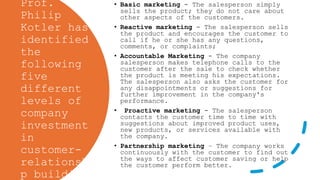
Basic marketing
Reactive marketing
Accountable marketing
Pro-active marketing
Partnership marketing
Prof.
Philip
Kotler has
identified
the
following
five
different
levels of
company
investment
in
customer-
relationshi
p building.
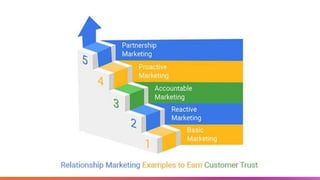
• Basic marketing - The salesperson simply
sells the product; they do not care about
other aspects of the customers.
• Reactive marketing - The salesperson sells
the product and encourages the customer to
call if he or she has any questions,
comments, or complaints;
• Accountable Marketing - The company
salesperson makes telephone calls to the
customer after the sale to check whether
the product is meeting his expectations.
The salesperson also asks the customer for
any disappointments or suggestions for
further improvement in the company's
performance.
• Proactive marketing - The salesperson
contacts the customer time to time with
suggestions about improved product uses,
new products, or services available with
the company.
• Partnership marketing – The company works
continuously with the customer to find out
the ways to affect customer saving or help
the customer perform better.
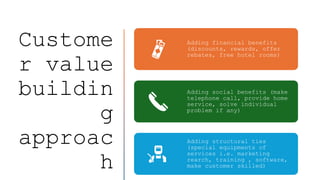
Custome
r value
buildin
g
approac
h
Adding financial benefits
(discounts, rewards, offer
rebates, free hotel rooms)
Adding social benefits (make
telephone call, provide home
service, solve individual
problem if any)
Adding structural ties
(special equipments of
services i.e. marketing
rearch, training , software,
make customer skilled)
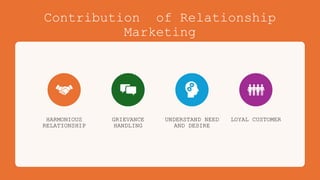
Contribution of Relationship
Marketing
HARMONIOUS
RELATIONSHIP
GRIEVANCE
HANDLING
UNDERSTAND NEED
AND DESIRE
LOYAL CUSTOMER
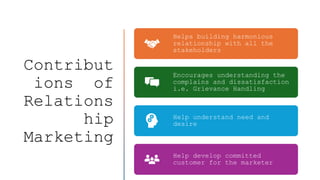
Contribut
ions of
Relations
hip
Marketing
Helps building harmonious
relationship with all the
stakeholders
Encourages understanding the
complains and dissatisfaction
i.e. Grievance Handling
Help understand need and
desire
Help develop committed
customer for the marketer
Conclusion
Relationship marketing is a method of delivering high customer
satisfaction. Through this method, a marketer may be able to be
familiar with the customers, understand their behaviour and know
the ways to provide them better values and satisfaction.
Customer satisfaction should be the prime goal of any firm because
a satisfied customer may buy not only the firm's product
repeatedly, but also create many new customers for the firm; while
a dissatisfied customer may damage not only the goodwill of the
firm but also may cause shifting the regular customers into the
competitors' products. However, a customer may feel satisfaction
only when he becomes confident that the value(benefits) he
received is higher than the cost he sacrificed for the product.
Benefits represent his expectation from the product, service he
is receiving from the marketer, personal care he received from
the marketer, and reputation or image of the firm or its
products.
With the help of a good relationship with the
customers a marketer may be able to give all the
above-mentioned values to them and make them
satisfied, and hence, helps in retaining the existing
customers against shifting them to the
competitive products
Examples of relationship
marketing
1. Starbucks: Starbucks is a classic example of successful relationship
marketing. They offer a welcoming atmosphere, personalized experiences,
and loyalty rewards to build strong customer relationships.
2. Southwest Airlines: Southwest Airlines uses relationship marketing
by engaging with customers through social media, offering personalized
travel recommendations, and providing excellent customer service.
3. Nike: Nike uses relationship marketing by creating a loyalty program
that rewards customers for their purchases and provides personalized
recommendations based on their preferences.
4. Sendoso: Sendoso, a company that provides sales engagement and
account-based marketing solutions, uses relationship marketing by
offering personalized content and experiences to its customers.
• 5. HubSpot: HubSpot, a marketing, sales, and
customer service platform, uses relationship
marketing by providing personalized customer
experiences, offering loyalty rewards, and engaging
with customers through social media.
• 6. Panera Bread: Panera Bread uses relationship
marketing by offering loyalty rewards, personalized
recommendations, and exclusive offers to its
customers.
• 7. Fairway: Fairway, a mortgage lending company,
uses relationship marketing by sending
personalized emails with birthday greetings and
lending offers to its customers.
• 8. Microsoft and Nokia: Microsoft and Nokia
partnered to develop the Windows operating system
that runs on Nokia Lumia devices, demonstrating a
successful example of strategic relationship
marketing.
• 9. Virtual Assistants: Virtual assistants like
Alexa use relationship marketing by keeping
track of customers’ preferences and making
personalized recommendations at opportune
moments.
• 10. Brand Advocacy Programs: Companies
like Panera Bread and Fairway create brand
advocacy programs to reward customers who
provide word-of-mouth advertising and user-
generated content marketing.
• These examples demonstrate how relationship
marketing can be applied in various industries
and contexts to build strong customer
relationships, increase customer retention, and
drive business growth.
Green
Marketing
• Green marketing is a marketing
strategy that focuses on the
environmental and sustainable
benefits of a product or service. It
involves promoting products or services
that are perceived to be environmentally
friendly, sustainable, and eco-conscious.
Green marketing can include activities
such as product modification, changes to
the production process, sustainable
packaging, and modifying advertising to
highlight the environmental benefits of a
product or service.
• Examples of green marketing include
advertising the reduced emissions
associated with a product’s
manufacturing process, or the use of
post-consumer recycled materials for a
product's packaging. Some companies
also may market themselves as being
environmentally-conscious companies
by donating a portion of their sales
proceeds to environmental initiatives,
such as tree planting.
Do you
recogniz
e this
brand?
• Example of Green Marketing
• Starbucks is often cited as a leader in green marketing
practices. The company has invested heavily in various social
and environmental initiatives in recent years. For example, in a
2018 report, Starbucks reported that it had committed over
$140 million to the development of renewable energy
sources. The company purchases enough renewable energy to
power all of its company-operated stores throughout North
America and the United Kingdom. "Starbucks 2019: Global
Social Impact Report
Historica
l
developme
nt of
Green
marketing
• Green marketing approach is assumed
to have developed during 1970’s
when several issues like oil use or
pollution for a narrow range of
industries was framed as something
that was relevant to engineers,
lawyers, and marketers within
companies.
• Came into prominence in the late
1980’s and early 1990’s when the
American Marketing Association
(AMA) held the first workshop on
Ecological Marketing in 1975
• It came due to strong public
opinion and specific legislation
favoring environmentally friendly
marketing
• Europe has been at the forefront of
the Green Marketing
German law
Germany has passed the most stringent green marketing laws that
regulate the management and recycling of packaging waste.
The new packaging law was introduced in three phases:
the first phase requires all transport packaging such as crates,
drums, pallets, and Styrofoam containers to be accepted back by
the manufacturers and distributors for recycling
• The second phase requires
manufacturers, distributers, and
retailers to accept all returned
secondary packaging, including
corrugated boxes, blister packs,
all packaging designed to prevent
theft, packaging for vending
machine applications, packaging for
promotional purposes.
• The third phase requires all
retailers, distributors and
manufacturers to accept returned
sales packaging including cans
,plastic containers for dairy
products, foil wrapping , Styrofoam
packages and folding cartons such
as cereal boxes. The requirements
for retailers to take back sales
packaging has been suspended a long
as the voluntary green dot program
remains viable substitute
First
Phase –
Ecologica
l
Marketing
• Also called- eco-marketing or eco-
friendly marketing
• This approach is concerned with
helping environment problems and
provide remedies for environmental
problems.
• Ecological marketing was based on the
idea that environmental protection and
resource conservation can be better
advanced through the regulation by the
public sector and more enterprise in
the private sector. This idea, in
turn, is based on the premises that
ecologically concern consumer is a
legitimate but largely unused market
segment-one that is identifiable,
accessible and measurable. In 1970’s
the importance of a small number of
environmental issues like oil use or
pollution for a narrow range of
industries was framed as something
that was relevant to engineers,
Second
phase –
Environmen
tal
Marketing
• The term environmental
marketing approach focuses on
shifting on clean technology
that involve designing of
innovative new product which
take care of pollution and
waste issues . The main
premises of this concept is
that environmental issues
should be balanced with
primary customer needs
Third
phase-
Sustainab
le
Marketing
marketing’ approach is
concerned with long lasting
the marketing activities by
addressing the issues and
problems of consumers and
societies relating to several
environmental problems
,eliminating such problems and
then satisfying them through
numerous marketing efforts
such as developing and
promoting products and service
that satisfy customer wants
and needs for quality,
performance, affordable
pricing and convenience
without having a detrimental
input on the environment.
However,
• these three terms green ,
environmental and eco-
marketing are parts of the new
marketing approaches which
donot just refocus, adjust or
enhance existing marketing
thinking and practice, but
seek to challenge those
approaches and provide a
substantially different
perspective. Therefore, these
three terms are
interchangeably used or
applied in business practice.
Components of
green
marketing
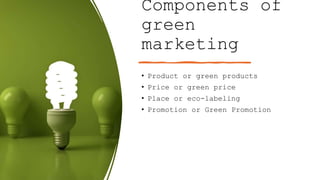
• Product or green products
• Price or green price
• Place or eco-labeling
• Promotion or Green Promotion
Product or green products
• The main focus is that a producer should offer
ecological products which not only must not
contaminate the environment but should protect
it and even liquidate existing environmental
damage.
Green product should not :
• Endanger the health of people or animals
• Damage the environment at any stage
• Consume a disproportionate amount of energy
• Cause unnecessary waste
• Cause cruelty to animals
Price or
green price
• The main focus is
that prices for
such products may be
a little higher than
conventional
alternatives. But
target groups like
for or accept for.
Place or
eco-
labelling
• The main focus is that a
distribution logistics is of
ecological packaging.
Marketing local and seasonal
products example vegetables
from regional farms is easier
to be market green than
product imported . It
emphasizes the distribution of
products by using a simple
logo on packages , eco-labels
offers consumers guidance
based on expert information.
Promotion
or green
promotion
• The main focus is that a
communication with the market
should put stress on environmental
aspects . For eg that the company
possesses a ISO 14000 certified
certificate.
• This may be publicized to improve a
firm’s image.
• Furthermore, the fact that a
company spends expenditures on
environmental protection should be
advertised.
• Third, sponsoring the natural
environment is also very important.
• Ecological products will probably
require special sales promotions
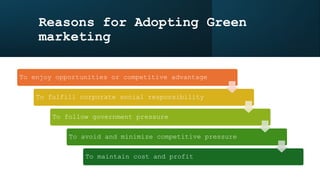
Reasons for Adopting Green
marketing
To enjoy opportunities or competitive advantage
To fulfill corporate social responsibility
To follow government pressure
To avoid and minimize competitive pressure
To maintain cost and profit
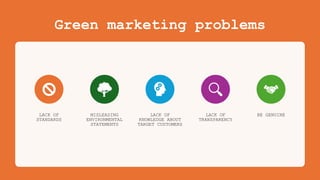
Green marketing problems
LACK OF
STANDARDS
MISLEADING
ENVIRONMENTAL
STATEMENTS
LACK OF
KNOWLEDGE ABOUT
TARGET CUSTOMERS
LACK OF
TRANSPARENCY
BE GENUINE
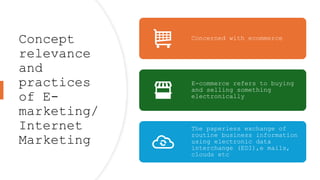
Concept
relevance
and
practices
of E-
marketing/
Internet
Marketing
Concerned with ecommerce
E-commerce refers to buying
and selling something
electronically
The paperless exchange of
routine business information
using electronic data
interchange (EDI),e mails,
clouds etc
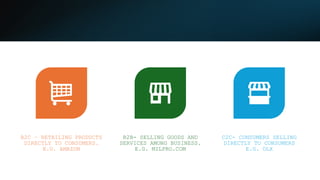
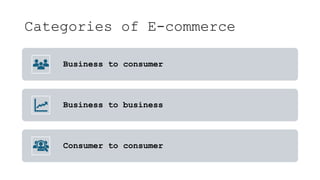
Categories of E-commerce
Business to consumer
Business to business
Consumer to consumer
B2C – RETAILING PRODUCTS
DIRECTLY TO CONSUMERS.
E.G. AMAZON
B2B- SELLING GOODS AND
SERVICES AMONG BUSINESS.
E.G. MILPRO.COM
C2C- CONSUMERS SELLING
DIRECTLY TO CONSUMERS
E.G. OLX
Internet marketing
• This is the age of information technology
• Internet is a global network connecting people
and organizations with each other through
computer networks
• Internet started in 1969 when the US department
of defence commissioned the Advanced research
project agency to create ARPANET- a huge
military computer network
• Its main goal was to create the method for
widely separated computers to transfer
efficiently even in the event of a nuclear
attack.
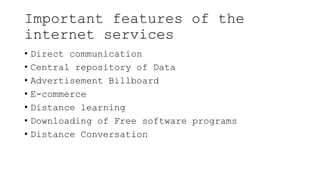
Important features of the
internet services
• Direct communication
• Central repository of Data
• Advertisement Billboard
• E-commerce
• Distance learning
• Downloading of Free software programs
• Distance Conversation
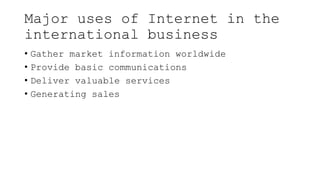
Major uses of Internet in the
international business
• Gather market information worldwide
• Provide basic communications
• Deliver valuable services
• Generating sales
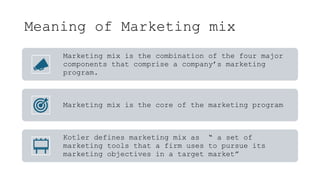
Meaning of Marketing mix
Marketing mix is the combination of the four major
components that comprise a company’s marketing
program.
Marketing mix is the core of the marketing program
Kotler defines marketing mix as “ a set of
marketing tools that a firm uses to pursue its
marketing objectives in a target market”
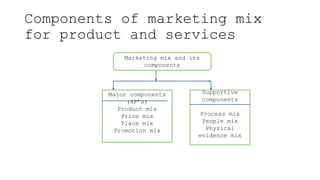
Components of marketing mix
for product and services
Marketing mix and its
components
Major components
(4P’s)
Product mix
Price mix
Place mix
Promotion mix
Supportive
components
Process mix
People mix
Physical
evidence mix
Product
mix
Management needs to plan
and develop a right
product to be marketed.
The firm should properly
analyze the product life
cycle. Based on product
life cycle ,strategies
are needed for changing
products, adding new
products, branding,
packaging and various
other product attributes.
Price mix
• Management needs to
determining a right price for
its products . A right price
is one, which is affordable
and acceptable to the target
customers.
• The price mix includes pricing
objectives, pricing techniques
,sales term , credit term,
pricing strategies such as
price discounts and
allowances, price
discrimination, territorial
price, promotional price,
market entry pricing and other
related factors
Place or
Distribut
ion mix
• Management needs to distribute
products to the right place by
selecting and managing
channels and by developing an
efficient distribution system.
• A right place is one where
maximum demand for its
products exists and maximum of
products is consumed
• Here the marketers needs to
study and analyze channels of
distribution, channel
structure, role and power of
marketing channels such as
wholesalers and retailers,
channel conflict and
techniques of resolving them,
Promotion
mix
• Management needs to informand
persuade through right
promotional media the
customers or markets regarding
its products
• The major promotional
activities or promotion mixes
are advertising, personal
selling, sales promotion,
publicity and public relations
Components of marketing mix are the
marketing variables or marketing
tools used to adjust to the changed
situations. The desired level of
exchange will not be reached if the
product does not match customer
needs, if it is priced too high or
low, if it is promoted poorly, or if
it is distributed improperly.
Therefore, to compete effectively in
today’s business world ,marketers
require a carefully planned and full
satisfactory marketing mix.
For service oriented
organization ,it needs to
manage additional there mixes
to achieve its goal properly
i.e. people, process and
physical evidence .
Service oriented
organizations need to
integrate 7P’s
Process
mix
• Service organizations are
innovative that operations
management ideas are now an
essential input to their
control of costs, systems
improvements and levels of
customer service. The general
principle is that the service
delivery process should be
short and simple.
• These are two major aspects of
the “process“ element of the
marketing mix ,which have a
strategic dimension; they are
• Degree of customer contact and
• Quality control standards
People
mix
When we talk of the ‘people’ element of
the marketing mix, we are talking about
two groups such as ;
• Service personnel and
• Customers
As more and more competitive activity
shifts from tangible to the intangible,
then the selection, recruitment
,motivation training of the right
service personnel become more important
to all organizations. Similarly, the
customer’s perception of service
quality will be made up from a number
of fairly different and diverse factors
such as the attitude of staffs,
internal affairs, the observable
behavior of staff, the level of
service-mindedness in the organization,
the consistent of appearance of staff,
the accessibility of people, customer
contact and so on
Physical
evidence
Physical evidence policy is also becoming
more important in all organizations as it
consists of office-room conditions,
furnishings, layouts and goods associated
with service.
Such atmosphere may influence the psychology
of the customers. If the psychological
influence is positive, it may promote
business opportunities and vice versa
More specifically, physical evidence
describes keeping office premises
resourceful and comfortable to motivate the
clients or customers. It also improves the
level of efficiency of office personnel in
their work performance, which makes them
capable in satisfying customers.
Features
of
Marketing
Mix
It is a combination of four
marketing variable or tools
It is useful for achieving
marketing targets
It is flexible and dynamic
concepts
Marketing acts as a mixture of
ingredients
Customer is the focus point
Important implications of
Marketing Mix
It is the main source
of marketing plan and
program
It is the core
marketing tool for
achieving the desired
result
It is a customer-
focused activity
It is a strategic
marketing tool that
helps long-run
survival and success
in the market-place
Marketing
process
orientati
on
• Market process orientation is a business
approach that prioritizes identifying
the needs and desires of customers
and creating products or services that
satisfy them. It is a customer-centered
approach that focuses on understanding
the customer’s perspective and
designing products or services that meet
their needs and wants.
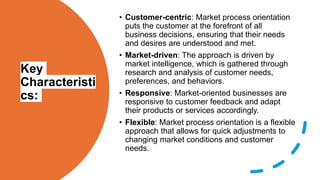
Key
Characteristi
cs:
• Customer-centric: Market process orientation
puts the customer at the forefront of all
business decisions, ensuring that their needs
and desires are understood and met.
• Market-driven: The approach is driven by
market intelligence, which is gathered through
research and analysis of customer needs,
preferences, and behaviors.
• Responsive: Market-oriented businesses are
responsive to customer feedback and adapt
their products or services accordingly.
• Flexible: Market process orientation is a flexible
approach that allows for quick adjustments to
changing market conditions and customer
needs.
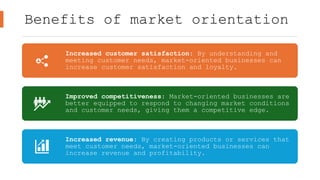
Benefits of market orientation
Increased customer satisfaction: By understanding and
meeting customer needs, market-oriented businesses can
increase customer satisfaction and loyalty.
Improved competitiveness: Market-oriented businesses are
better equipped to respond to changing market conditions
and customer needs, giving them a competitive edge.
Increased revenue: By creating products or services that
meet customer needs, market-oriented businesses can
increase revenue and profitability.
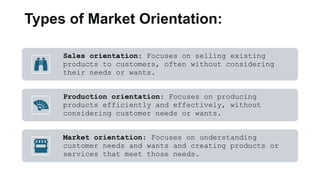
Types of Market Orientation:
Sales orientation: Focuses on selling existing
products to customers, often without considering
their needs or wants.
Production orientation: Focuses on producing
products efficiently and effectively, without
considering customer needs or wants.
Market orientation: Focuses on understanding
customer needs and wants and creating products or
services that meet those needs.
• In conclusion, market process
orientation is a business approach that
prioritizes customer needs and wants,
gathering market intelligence, and
responding to customer feedback. By
adopting a market-oriented approach,
businesses can increase customer
satisfaction, competitiveness, and
revenue.
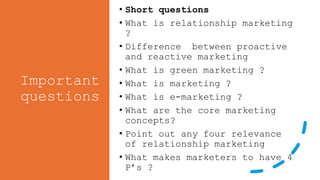
Important
questions
• Short questions
• What is relationship marketing
?
• Difference between proactive
and reactive marketing
• What is green marketing ?
• What is marketing ?
• What is e-marketing ?
• What are the core marketing
concepts?
• Point out any four relevance
of relationship marketing
• What makes marketers to have 4
P’s ?
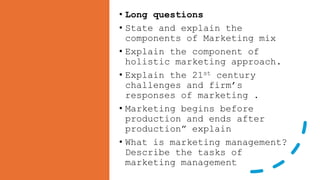
• Long questions
• State and explain the
components of Marketing mix
• Explain the component of
holistic marketing approach.
• Explain the 21st century
challenges and firm’s
responses of marketing .
• Marketing begins before
production and ends after
production” explain
• What is marketing management?
Describe the tasks of
marketing management
THANK YOU

CHAPTER-1-Introduction-to-Marketing.pptx

  • 1.
  • 2.
  • 3.
  • 4.
  • 5.
    Three key activitiesin marketing in pragmatic view Seeing the opportunity Converting the opportunities into products and services Delivering value to the buyers through the products and services
  • 6.
    • Marketing isnot only attracting the customers but also retaining the customers
  • 7.
    Definitio n of marketing -1960 the performanceof business activities that direct the flow of goods and services from the producer to consumer or user American Marketing Association – 2004 Marketing is an organizational function and set of process for creating ,communicating, and delivering value and customers and for managing customer relationships in ways that benefit the organization and its stakeholders
  • 8.
    • American Marketingassociation -2007 Marketing is an activity, a set of institutions and processes for creating ,communicating ,delivering, exchanging offerings that have value for customers, clients, partners, and society at large
  • 9.
    Philip Kotler • Marketingis a social process by which individuals and groups obtain what they need and want through creating, offering and freely exchanging products and services of value with others. • This theory focuses on the following five aspects of modern marketing: • Marketing is a social process, and the knowledge of marketing can be used to meet various social needs and solve various social problems. • Individuals and groups satisfy their needs and wants through the process of marketing
  • 10.
    • Marketing createssatisfying products and services. • The products and services are exchanged for value in a transaction that provides mutual benefits to sellers and buyers. • The exchange must take place in a free- environment without any external imposition or compulsion.
  • 11.
    Core concepts ofmarketing Marketing is a process Marketing consists of activities a. Product related b. Price related c. Place related d. Promotion related Marketing satisfies customer needs Marketing facilitates exchange relationship Marketing helps achieve objectives Profit, Service, Growth, Survival, Leadership Marketing occurs in a dynamic environment
  • 12.
    • Marketing isthe process of planning and executing the conception, pricing, promotion and distribution of ideas, goods and services to create exchanges that satisfy individual and organizational objectives
  • 13.
    Marketing philosophies Production concept Productconcept Selling concept Marketing concept Customer concept Holistic concept
  • 14.
    Production concept • Thisconcept believes that consumers will favor those products that are widely available and low in cost • This concept emerged in 1950’s • Mass production and wide distribution coverage • Directed at raising output levels , produce standardized product and sell at lower price • Focus on building internal capabilities of an organization in terms of production and selling • Use lower costs to cut prices and expand market sizes
  • 15.
    Key takeaway forProduction concept Starting point – Factories Focus – Mass production Means- low price and mass distribution Ends – Profit through production efficiency
  • 16.
    Productio n concept • Chinese companies startedadopting these strategy to penetrate international market
  • 17.
    Drawback of productionconcept • This concept was abandoned by many companies when they realized that not all consumers want cheap products
  • 18.
    Product concept This concept believesthat consumers respond to good quality product that are reasonably priced This concept emerged during 1950-1960 Emphasis on product quality ,performance and features Long lasting products Providing warranty on products Gave birth to various products such as Mercedes Benz, West-end watches, Hi-tech shoes
  • 19.
    Key take away for Product concept Startingpoint - Factory Focus – Product quality Means – High quality, innovation, performance , Ends- Profit through high quality products
  • 20.
    Drawbacks of Productconcept • Although this concept was not successful in consumer market , it has importance in marketing of machineries and heavy equipment • This concept disregards customer needs and preferences.
  • 21.
    Selling concept The sellingconcept is based on the idea that people will buy more goods and services if aggressive selling methods are used. It believes that people ordinarily will not buy the organization’s product unless they are persuaded to buy. Concept emerged during 1960’s to 1970’s Organization believes that there are many customers and there is a whole range of selling techniques available to attract the customers. Organization can use another methods for selling if one methods fails.
  • 22.
    • Heavy emphasison convincing and persuading the buyers about the super quality and fair prices. • Selling concept has been successful in the field of political marketing. • Focused for selling unsought products which buyers do not normally think of buying. • Examples : Life-insurance, encyclopedia, subscription of magazines. • Based on “We sell what we make.”
  • 23.
    Key take awaysof selling concept Starting point: Factory Focus : Product Means : Aggressive Selling, Heavy promotion Ends : profit through high sales volume
  • 24.
    • Selling conceptis successfully implemented in political marketing and marketing of unsought products. The Nepalese business sector today is dominated by selling concept. • The basic problem with the selling concept is its assumptions that a majority of the buyers who have been lured to buy the product would ultimately like the product. Those who do not like the product would forget their disappointment with the product.
  • 25.
    Marketing concept • The marketingconcept believes that the key to achieving organizational objectives lies in being more effective than competitors in integrating marketing activities toward determining and satisfying the needs and want of the target markets. • It is different as of previous slogan: “We sell what we make.” Change the business slogan to: “We make what we can sell.
  • 26.
    • The meanadopted for achievement of organizational objective of profit differed among the production, product and selling concepts as it consider buyers an important variable in the business environment. • Managers focus on all activities at determining customer needs in the target market and earn profit through customer need satisfaction. • “Think Customer”
  • 27.
    • Marketing departmentis well coordinated with other departments like finance, production, human resources and research and development to foster team-work.
  • 28.
    Marketing concept key takeaway Starting point : TargetMarket Focus : Customer needs Means : integrated marketing End : Profit through customer satisfaction
  • 29.
    • The marketingconcept is a new way of thinking about organization’s entire activities. The concept is based on the notion that the main task of the organization is to know the needs, wants and value of the target market and then delivering products that satisfy those needs and wants. • It focuses on Target Market, Customer Orientation, Integrated Marketing , Objectives Achievement
  • 30.
    • Problems: Customerdesire versus spending realities, lack of marketing knowledge, new features and services, lack of effective customer service, barriers to communication.
  • 31.
    Customer concept The customerconcept believes that individual customer is the key to achieving organizational objectives. All marketing activities are done to satisfy the needs of individual customer. Focus on needs and values of individual customer though one-to- one marketing. Tailoring marketing program to the needs of individual customer, customized marketing mix, individualized promotion and distribution. Capture larger share of each customer’s expenditure. One to one marketing. Fulfill needs of specific individuals and locations. Profit through customer loyalty and retention.
  • 32.
    Customer concept key takeaway Starting point :individual customer Focus : customer needs and value Means : one to one marketing Ends : profit through high customer share and value/loyalty
  • 33.
    • Organizations collectinformation about the profile of each customer. They use e-commerce and the latest information technology. • This concept is useful to companies selling high value products. Such products need periodic replacement or upgrading. Airlines industry is an example.
  • 34.
    Societal concept(Societal Marketing ) • Thesocietal marketing concept is an emerging concept which holds that organizational objectives should be achieved through customer need satisfaction in ways that protect the interests of the consumers and safeguard the well-being of society
  • 35.
    Issues raised bysocietal concept • Marketing is blamed for green-house effect leading to global rise in temperature. • For depletion of ozone layers leading to a rise in the incidence of skin cancer. • For resource shortages due to haphazard use of limited and non renewable natural resources, such as oil, coal, forests etc. • For encouraging over consumption in the developed world while a large population in the underdeveloped countries is suffering from hunger, starvation, disease and premature death. • For social disharmony by projecting women as wrong symbols in advertisements.
  • 36.
    • Therefore, thesocietal marketing concept assumes that along with the consumers wants and interests, social interests too should be considered so that long-run social welfare could be maintained.
  • 37.
    Societal concept Starting point :target market Focus : Social needs Means : protecting and supporting consumer and social well-being Ends : profit through customer and social well-being
  • 38.
    • The societalmarketing concept believes that the organization should deliver the superior value product to the market that maintains or improves the consumer’s and society’s well being. • The pressure groups, particularly environmentalist, consumerist and feminist, have forced many companies to adopt the societal marketing concept.
  • 39.
    Basic principles ofsocietal concept Identify the target social group that the marketer wants to deal with Identify and understand the basic needs, wants and problems of the target social group The means of fulfilling the social needs ,wants and problems should be through integrating or coordinating the socially acceptable marketing tools The ultimate goal of the organization or the marketer should be to survive or sustain the business by providing social welfare and well-being and accepting social responsibility
  • 40.
    Holistic concept Holistic marketing conceptis a part of the series on concepts of marketing and it can be defined as a marketing strategy which considers the business as a whole and not as an entity with various different parts. According to holistic marketing concept, even if a business is made of various departments, the departments have to come together to project a positive & united business image in the minds of the customer. Holistic marketing concept involves interconnected marketing activities to ensure that the customer is likely to purchase their product rather than competition.
  • 41.
    Holistic concept • Philip Kotler-“The holistic marketing concept is based on the development, design and implementation of marketing programs, processes and activities that recognizes their breadth and interdependencies.”
  • 42.
    Major focus Societal Marketing Integratedmarketing Internal marketing Relationship marketing
  • 43.
    Societal marketing-practiced topromote societal welfare Integrated marketing- efficiently and effectively utilize marketing resources to meet customer needs Internal marketing- practiced to make all members of the organization customer-oriented Relationship marketing – practiced to develop long- term relationships with customers.
  • 44.
    Key takeaway from holistic concept Starting point – Target market Focus- All marketing matters Means- integrated marketing, relationship marketing , internal marketing, social marketing Ends- goal achievement thorough marketing
  • 45.
    ` The holistic concept emerged mainlydue to the social and technological challenges that raised serious questions about the power of marketing to mold and modify consumer needs and preferences in the 21st
  • 46.
    Differences between sellingand marketing concept
  • 47.
    During exam writethis Selling concept Marketing concept Emphasis is on the product Emphasis is on the customer needs and wants Emphasis Company first makes the product then figures out how to sell it Companies first determines the customer needs and wants and then figures out how to make and sell the products Company focus Management is sales volume oriented Management is profit-oriented at the cost of customer satisfaction. Orientation Planning is short-run oriented , in terms of today’s products and markets Planning is long-term oriented in terms of new products, tomorrow’s markets Planning Stresses the needs of the seller Stresses the want of buyers Stress Difference between
  • 48.
    Difference between societal marketingand holistic approach • See the word file in desktop
  • 49.
    Marketing management • Theprocess of planning and executing the conception, pricing, promotion and distribution of ideas, goods, services to create exchanges that satisfy individual and organizational goals is known as marketing management.
  • 50.
    Task of marketing management Marketing planning( SWOT analysis , situational analysis, setting targets) Implementing the marketing plans and programs( proper orgn structure, appropriate manpower, efficient work-team, communication and effective leadership) Marketing control( establish standards , measuring performance, identifying derivations or mistakes and taking corrective action Planning and control are closely related to each other. Eg , annual plan control, profitability control, efficiency control, strategic control)
  • 51.
    Marketi ng challen ges of 21st century Savy customers, informative customers Customer focus on better quality and reliable products Rapid change of customer needs wants and expectations Quick introduction of new products Multiple brands and competition Global competition rather than domestic Significance of Internet and e- commerce
  • 52.
  • 53.
    Firm’s responses to marketing challenge s • Developing marketingplans that are designed to build long-term profitability • Developing cogent arguments to protect, or increase, the investment in marketing when economic times were tough. • The need for a framework that created a good balance within marketing strategy between the needs of the customer and those of the organization • Developing effective strategy that engage those outside of marketing that were crucial to delivering the promise to consumers • Developing the right metrics to monitor progress and provide accountability • Motivating others to be passionate about data quality, as ‘fit for purpose’, data is vital in direct, digital and CRM based Marketing , and for monitoring performance against achieving the goals laid down in the marketing plan
  • 54.
  • 55.
  • 56.
    Relationship marketing Marketers musttake all possible efforts to retain the existing customers Relationship marketing is one of the best methods of retaining such customers in the company’s product family group.
  • 57.
    Relationship marketing isthe practice of building long-term satisfying relations with key parties- customers suppliers and distributors- in order to retain their long-term preference and business. If properly implemented ,relationship marketing may result in strong economic, technical, and social ties among the parties. It can also cut down on transaction costs and time
  • 58.
    Operatin g principl e of Relation ship marketin g Build agood network of relationships with key stakeholders and profits will follow
  • 59.
    • Ultimate outcomeof relationship marketing is to build a unique company asset called marketing network.
  • 60.
    • A marketingnetwork consists of company and all its supporting stakeholders: customers, employees, suppliers, distributors, retailers, advertising agencies , scientists and others with whom it has built mutually profitable business relationship • The increasing competition between the companies as well as the whole network has felt the emergence of Relationship marketing
  • 61.
    Customer developme nt process • Customers arenot automatically made, the marketers develop them. However, attracting and keeping customer is actually a difficult task. Customer development process consists of the following steps
  • 62.
  • 63.
    • The abovediagram shows that the main source of customers is prospect; the main source of prospect is the suspect. • Suspects consist of everyone who might conceivably buy the product or service; they lack actual need for the company's product. They become prospects only when the actual need is created in their mind for the product along with the money to pay and spend.
  • 64.
    • In otherwords, prospects are the people who have a strong potential interest in the product and the ability to pay for it. All suspects cannot be converted into prospects • Some of them convert into disqualified prospects, which have no interest on the product, any money to spend and lack of willingness to spend it; while some of the suspects are converted into qualified prospects. The company usually rejects disqualified prospects because of their poor credit profile or would be unprofitable for the company. • A profitable customer is a person, household, or company that over time yields a revenue stream that exceeds by an acceptable amount the company's cost stream of attracting, selling, and servicing that
  • 65.
    If the qualifiedprospects could be motivated properly, they may become the first-time customers, repeat customers, clients, advocates and partners respectively. Repeat customers may continue to buy goods from the competitors as well. But the clients buy only from the company in the relevant product categories. If they are fully satisfied with the company and its products, they become advocates, who become loyal to the company and praise the company and encourage others to buy from it. Lastly, the advocates may convert into partners, who work actively with the marketer for common goal.
  • 66.
    • However, atevery stage of customer-development process, some of the customers may convert into inactive or drop out, for reasons of bankruptcy, moves to other locations, dissatisfaction, and so on.
  • 67.
    Level of CompanyInvestment in Customer-Relationship Building • Though developing more loyal customers increases the company's revenue, the company has to spend more to build greater customer loyalty. Marketing veteran
  • 68.
    Philip Kotler’s level of company investme nt inCR building Basic marketing Reactive marketing Accountable marketing Pro-active marketing Partnership marketing
  • 70.
    Prof. Philip Kotler has identified the following five different levels of company investment in customer- relationshi pbuilding. • Basic marketing - The salesperson simply sells the product; they do not care about other aspects of the customers. • Reactive marketing - The salesperson sells the product and encourages the customer to call if he or she has any questions, comments, or complaints; • Accountable Marketing - The company salesperson makes telephone calls to the customer after the sale to check whether the product is meeting his expectations. The salesperson also asks the customer for any disappointments or suggestions for further improvement in the company's performance. • Proactive marketing - The salesperson contacts the customer time to time with suggestions about improved product uses, new products, or services available with the company. • Partnership marketing – The company works continuously with the customer to find out the ways to affect customer saving or help the customer perform better.
  • 71.
    Custome r value buildin g approac h Adding financialbenefits (discounts, rewards, offer rebates, free hotel rooms) Adding social benefits (make telephone call, provide home service, solve individual problem if any) Adding structural ties (special equipments of services i.e. marketing rearch, training , software, make customer skilled)
  • 72.
  • 73.
    Contribut ions of Relations hip Marketing Helps buildingharmonious relationship with all the stakeholders Encourages understanding the complains and dissatisfaction i.e. Grievance Handling Help understand need and desire Help develop committed customer for the marketer
  • 74.
    Conclusion Relationship marketing isa method of delivering high customer satisfaction. Through this method, a marketer may be able to be familiar with the customers, understand their behaviour and know the ways to provide them better values and satisfaction. Customer satisfaction should be the prime goal of any firm because a satisfied customer may buy not only the firm's product repeatedly, but also create many new customers for the firm; while a dissatisfied customer may damage not only the goodwill of the firm but also may cause shifting the regular customers into the competitors' products. However, a customer may feel satisfaction only when he becomes confident that the value(benefits) he received is higher than the cost he sacrificed for the product.
  • 75.
    Benefits represent hisexpectation from the product, service he is receiving from the marketer, personal care he received from the marketer, and reputation or image of the firm or its products. With the help of a good relationship with the customers a marketer may be able to give all the above-mentioned values to them and make them satisfied, and hence, helps in retaining the existing customers against shifting them to the competitive products
  • 76.
    Examples of relationship marketing 1.Starbucks: Starbucks is a classic example of successful relationship marketing. They offer a welcoming atmosphere, personalized experiences, and loyalty rewards to build strong customer relationships. 2. Southwest Airlines: Southwest Airlines uses relationship marketing by engaging with customers through social media, offering personalized travel recommendations, and providing excellent customer service. 3. Nike: Nike uses relationship marketing by creating a loyalty program that rewards customers for their purchases and provides personalized recommendations based on their preferences. 4. Sendoso: Sendoso, a company that provides sales engagement and account-based marketing solutions, uses relationship marketing by offering personalized content and experiences to its customers.
  • 77.
    • 5. HubSpot:HubSpot, a marketing, sales, and customer service platform, uses relationship marketing by providing personalized customer experiences, offering loyalty rewards, and engaging with customers through social media. • 6. Panera Bread: Panera Bread uses relationship marketing by offering loyalty rewards, personalized recommendations, and exclusive offers to its customers. • 7. Fairway: Fairway, a mortgage lending company, uses relationship marketing by sending personalized emails with birthday greetings and lending offers to its customers. • 8. Microsoft and Nokia: Microsoft and Nokia partnered to develop the Windows operating system that runs on Nokia Lumia devices, demonstrating a successful example of strategic relationship marketing.
  • 78.
    • 9. VirtualAssistants: Virtual assistants like Alexa use relationship marketing by keeping track of customers’ preferences and making personalized recommendations at opportune moments. • 10. Brand Advocacy Programs: Companies like Panera Bread and Fairway create brand advocacy programs to reward customers who provide word-of-mouth advertising and user- generated content marketing. • These examples demonstrate how relationship marketing can be applied in various industries and contexts to build strong customer relationships, increase customer retention, and drive business growth.
  • 79.
    Green Marketing • Green marketingis a marketing strategy that focuses on the environmental and sustainable benefits of a product or service. It involves promoting products or services that are perceived to be environmentally friendly, sustainable, and eco-conscious. Green marketing can include activities such as product modification, changes to the production process, sustainable packaging, and modifying advertising to highlight the environmental benefits of a product or service.
  • 80.
    • Examples ofgreen marketing include advertising the reduced emissions associated with a product’s manufacturing process, or the use of post-consumer recycled materials for a product's packaging. Some companies also may market themselves as being environmentally-conscious companies by donating a portion of their sales proceeds to environmental initiatives, such as tree planting.
  • 81.
  • 82.
    • Example ofGreen Marketing • Starbucks is often cited as a leader in green marketing practices. The company has invested heavily in various social and environmental initiatives in recent years. For example, in a 2018 report, Starbucks reported that it had committed over $140 million to the development of renewable energy sources. The company purchases enough renewable energy to power all of its company-operated stores throughout North America and the United Kingdom. "Starbucks 2019: Global Social Impact Report
  • 83.
    Historica l developme nt of Green marketing • Greenmarketing approach is assumed to have developed during 1970’s when several issues like oil use or pollution for a narrow range of industries was framed as something that was relevant to engineers, lawyers, and marketers within companies. • Came into prominence in the late 1980’s and early 1990’s when the American Marketing Association (AMA) held the first workshop on Ecological Marketing in 1975 • It came due to strong public opinion and specific legislation favoring environmentally friendly marketing • Europe has been at the forefront of the Green Marketing
  • 84.
    German law Germany haspassed the most stringent green marketing laws that regulate the management and recycling of packaging waste. The new packaging law was introduced in three phases: the first phase requires all transport packaging such as crates, drums, pallets, and Styrofoam containers to be accepted back by the manufacturers and distributors for recycling
  • 85.
    • The secondphase requires manufacturers, distributers, and retailers to accept all returned secondary packaging, including corrugated boxes, blister packs, all packaging designed to prevent theft, packaging for vending machine applications, packaging for promotional purposes. • The third phase requires all retailers, distributors and manufacturers to accept returned sales packaging including cans ,plastic containers for dairy products, foil wrapping , Styrofoam packages and folding cartons such as cereal boxes. The requirements for retailers to take back sales packaging has been suspended a long as the voluntary green dot program remains viable substitute
  • 86.
    First Phase – Ecologica l Marketing • Alsocalled- eco-marketing or eco- friendly marketing • This approach is concerned with helping environment problems and provide remedies for environmental problems. • Ecological marketing was based on the idea that environmental protection and resource conservation can be better advanced through the regulation by the public sector and more enterprise in the private sector. This idea, in turn, is based on the premises that ecologically concern consumer is a legitimate but largely unused market segment-one that is identifiable, accessible and measurable. In 1970’s the importance of a small number of environmental issues like oil use or pollution for a narrow range of industries was framed as something that was relevant to engineers,
  • 87.
    Second phase – Environmen tal Marketing • Theterm environmental marketing approach focuses on shifting on clean technology that involve designing of innovative new product which take care of pollution and waste issues . The main premises of this concept is that environmental issues should be balanced with primary customer needs
  • 88.
    Third phase- Sustainab le Marketing marketing’ approach is concernedwith long lasting the marketing activities by addressing the issues and problems of consumers and societies relating to several environmental problems ,eliminating such problems and then satisfying them through numerous marketing efforts such as developing and promoting products and service that satisfy customer wants and needs for quality, performance, affordable pricing and convenience without having a detrimental input on the environment.
  • 89.
    However, • these threeterms green , environmental and eco- marketing are parts of the new marketing approaches which donot just refocus, adjust or enhance existing marketing thinking and practice, but seek to challenge those approaches and provide a substantially different perspective. Therefore, these three terms are interchangeably used or applied in business practice.
  • 90.
    Components of green marketing • Productor green products • Price or green price • Place or eco-labeling • Promotion or Green Promotion
  • 91.
    Product or greenproducts • The main focus is that a producer should offer ecological products which not only must not contaminate the environment but should protect it and even liquidate existing environmental damage. Green product should not : • Endanger the health of people or animals • Damage the environment at any stage • Consume a disproportionate amount of energy • Cause unnecessary waste • Cause cruelty to animals
  • 92.
    Price or green price •The main focus is that prices for such products may be a little higher than conventional alternatives. But target groups like for or accept for.
  • 93.
    Place or eco- labelling • Themain focus is that a distribution logistics is of ecological packaging. Marketing local and seasonal products example vegetables from regional farms is easier to be market green than product imported . It emphasizes the distribution of products by using a simple logo on packages , eco-labels offers consumers guidance based on expert information.
  • 94.
    Promotion or green promotion • Themain focus is that a communication with the market should put stress on environmental aspects . For eg that the company possesses a ISO 14000 certified certificate. • This may be publicized to improve a firm’s image. • Furthermore, the fact that a company spends expenditures on environmental protection should be advertised. • Third, sponsoring the natural environment is also very important. • Ecological products will probably require special sales promotions
  • 95.
    Reasons for AdoptingGreen marketing To enjoy opportunities or competitive advantage To fulfill corporate social responsibility To follow government pressure To avoid and minimize competitive pressure To maintain cost and profit
  • 96.
    Green marketing problems LACKOF STANDARDS MISLEADING ENVIRONMENTAL STATEMENTS LACK OF KNOWLEDGE ABOUT TARGET CUSTOMERS LACK OF TRANSPARENCY BE GENUINE
  • 97.
    Concept relevance and practices of E- marketing/ Internet Marketing Concerned withecommerce E-commerce refers to buying and selling something electronically The paperless exchange of routine business information using electronic data interchange (EDI),e mails, clouds etc
  • 98.
    Categories of E-commerce Businessto consumer Business to business Consumer to consumer
  • 99.
    B2C – RETAILINGPRODUCTS DIRECTLY TO CONSUMERS. E.G. AMAZON B2B- SELLING GOODS AND SERVICES AMONG BUSINESS. E.G. MILPRO.COM C2C- CONSUMERS SELLING DIRECTLY TO CONSUMERS E.G. OLX
  • 100.
    Internet marketing • Thisis the age of information technology • Internet is a global network connecting people and organizations with each other through computer networks • Internet started in 1969 when the US department of defence commissioned the Advanced research project agency to create ARPANET- a huge military computer network • Its main goal was to create the method for widely separated computers to transfer efficiently even in the event of a nuclear attack.
  • 101.
    Important features ofthe internet services • Direct communication • Central repository of Data • Advertisement Billboard • E-commerce • Distance learning • Downloading of Free software programs • Distance Conversation
  • 102.
    Major uses ofInternet in the international business • Gather market information worldwide • Provide basic communications • Deliver valuable services • Generating sales
  • 103.
    Meaning of Marketingmix Marketing mix is the combination of the four major components that comprise a company’s marketing program. Marketing mix is the core of the marketing program Kotler defines marketing mix as “ a set of marketing tools that a firm uses to pursue its marketing objectives in a target market”
  • 104.
    Components of marketingmix for product and services Marketing mix and its components Major components (4P’s) Product mix Price mix Place mix Promotion mix Supportive components Process mix People mix Physical evidence mix
  • 105.
    Product mix Management needs toplan and develop a right product to be marketed. The firm should properly analyze the product life cycle. Based on product life cycle ,strategies are needed for changing products, adding new products, branding, packaging and various other product attributes.
  • 106.
    Price mix • Managementneeds to determining a right price for its products . A right price is one, which is affordable and acceptable to the target customers. • The price mix includes pricing objectives, pricing techniques ,sales term , credit term, pricing strategies such as price discounts and allowances, price discrimination, territorial price, promotional price, market entry pricing and other related factors
  • 107.
    Place or Distribut ion mix •Management needs to distribute products to the right place by selecting and managing channels and by developing an efficient distribution system. • A right place is one where maximum demand for its products exists and maximum of products is consumed • Here the marketers needs to study and analyze channels of distribution, channel structure, role and power of marketing channels such as wholesalers and retailers, channel conflict and techniques of resolving them,
  • 108.
    Promotion mix • Management needsto informand persuade through right promotional media the customers or markets regarding its products • The major promotional activities or promotion mixes are advertising, personal selling, sales promotion, publicity and public relations
  • 109.
    Components of marketingmix are the marketing variables or marketing tools used to adjust to the changed situations. The desired level of exchange will not be reached if the product does not match customer needs, if it is priced too high or low, if it is promoted poorly, or if it is distributed improperly. Therefore, to compete effectively in today’s business world ,marketers require a carefully planned and full satisfactory marketing mix.
  • 110.
    For service oriented organization,it needs to manage additional there mixes to achieve its goal properly i.e. people, process and physical evidence . Service oriented organizations need to integrate 7P’s
  • 111.
    Process mix • Service organizationsare innovative that operations management ideas are now an essential input to their control of costs, systems improvements and levels of customer service. The general principle is that the service delivery process should be short and simple. • These are two major aspects of the “process“ element of the marketing mix ,which have a strategic dimension; they are • Degree of customer contact and • Quality control standards
  • 112.
    People mix When we talkof the ‘people’ element of the marketing mix, we are talking about two groups such as ; • Service personnel and • Customers As more and more competitive activity shifts from tangible to the intangible, then the selection, recruitment ,motivation training of the right service personnel become more important to all organizations. Similarly, the customer’s perception of service quality will be made up from a number of fairly different and diverse factors such as the attitude of staffs, internal affairs, the observable behavior of staff, the level of service-mindedness in the organization, the consistent of appearance of staff, the accessibility of people, customer contact and so on
  • 113.
    Physical evidence Physical evidence policyis also becoming more important in all organizations as it consists of office-room conditions, furnishings, layouts and goods associated with service. Such atmosphere may influence the psychology of the customers. If the psychological influence is positive, it may promote business opportunities and vice versa More specifically, physical evidence describes keeping office premises resourceful and comfortable to motivate the clients or customers. It also improves the level of efficiency of office personnel in their work performance, which makes them capable in satisfying customers.
  • 114.
    Features of Marketing Mix It is acombination of four marketing variable or tools It is useful for achieving marketing targets It is flexible and dynamic concepts Marketing acts as a mixture of ingredients Customer is the focus point
  • 115.
    Important implications of MarketingMix It is the main source of marketing plan and program It is the core marketing tool for achieving the desired result It is a customer- focused activity It is a strategic marketing tool that helps long-run survival and success in the market-place
  • 116.
    Marketing process orientati on • Market processorientation is a business approach that prioritizes identifying the needs and desires of customers and creating products or services that satisfy them. It is a customer-centered approach that focuses on understanding the customer’s perspective and designing products or services that meet their needs and wants.
  • 117.
    Key Characteristi cs: • Customer-centric: Marketprocess orientation puts the customer at the forefront of all business decisions, ensuring that their needs and desires are understood and met. • Market-driven: The approach is driven by market intelligence, which is gathered through research and analysis of customer needs, preferences, and behaviors. • Responsive: Market-oriented businesses are responsive to customer feedback and adapt their products or services accordingly. • Flexible: Market process orientation is a flexible approach that allows for quick adjustments to changing market conditions and customer needs.
  • 118.
    Benefits of marketorientation Increased customer satisfaction: By understanding and meeting customer needs, market-oriented businesses can increase customer satisfaction and loyalty. Improved competitiveness: Market-oriented businesses are better equipped to respond to changing market conditions and customer needs, giving them a competitive edge. Increased revenue: By creating products or services that meet customer needs, market-oriented businesses can increase revenue and profitability.
  • 119.
    Types of MarketOrientation: Sales orientation: Focuses on selling existing products to customers, often without considering their needs or wants. Production orientation: Focuses on producing products efficiently and effectively, without considering customer needs or wants. Market orientation: Focuses on understanding customer needs and wants and creating products or services that meet those needs.
  • 120.
    • In conclusion,market process orientation is a business approach that prioritizes customer needs and wants, gathering market intelligence, and responding to customer feedback. By adopting a market-oriented approach, businesses can increase customer satisfaction, competitiveness, and revenue.
  • 121.
    Important questions • Short questions •What is relationship marketing ? • Difference between proactive and reactive marketing • What is green marketing ? • What is marketing ? • What is e-marketing ? • What are the core marketing concepts? • Point out any four relevance of relationship marketing • What makes marketers to have 4 P’s ?
  • 122.
    • Long questions •State and explain the components of Marketing mix • Explain the component of holistic marketing approach. • Explain the 21st century challenges and firm’s responses of marketing . • Marketing begins before production and ends after production” explain • What is marketing management? Describe the tasks of marketing management
  • 123.

Editor's Notes

  • #15 Economies of scale In 1950’s tank manufacturing companies started manufacturing automobiles and uniform manufacturers started producing readymade garments
  • #30 An organization can do better if it can define the boundaries of its operation and follow a market tailored business strategy. All activities of the organization are focused on determining and satisfying customer needs. All organizational activities are customer oriented. All marketing activities are organizationally coordinated under the marketing department. Product management, marketing research, pricing, distributionn, promotion etc. For private business, the objective is profit, market share, sales etc. For non-profit organizations, it is surviving and attracting funds to provide service. The marketing concept stresses that organizations can best achieve objectives through customer values and satisfaction.