5 Competing Marketing
Concepts
5 competing Marketing Concepts to conduc
By. Amir Alagab A.Gadir
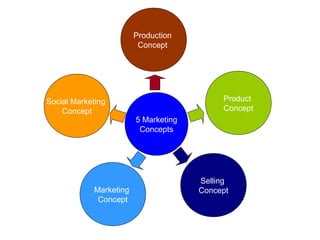
Marketing
Concept
5 Marketing
Concepts
Social Marketing
Concept
Production
Concept
Product
Concept
Selling
Concept
Production Concept
It holds that consumers prefer products that
are widely available and inexpensive.
(key strategy of many Japanese companies)
Product Concept
•It holds that consumers favor those products
that offer the most quality, performance, or
innovative features.
•Product-oriented companies often design their
products with little or no customer input, trusting
that their engineers can design exceptional
products. This may lead to marketing myopia.
Selling Concept
•It holds that consumers will ordinarily not buy
enough of the organization’s products.
•The organization must, therefore, undertake
an aggressive selling and promotion effort.
(Most firms practice the selling concept when they have
overcapacity.)
Marketing Concept
•It holds that the key to achieving organizational goals
consists of the company being more effective than its
competitors in creating, delivering, and communicating
customer value to its chosen target markets.
–Target market
–Customer needs
–Integrated marketing
–Profitability.
The marketing concept rests on four pillars:
Integrated Marketing: takes place on two levels:
oFirst, the various marketing functions—
sales force, advertising, customer service,
product management, marketing research—
must work together.
• Second, marketing must be embraced by the
other departments.
Difference between Selling concept
and Marketing concept:
“Selling focuses on the needs of the seller; marketing
on the needs of the buyer. Selling is preoccupied with
the seller’s need to convert his product into cash;
marketing with the idea of satisfying the needs of the
customer by means of the product and the whole
cluster of things associated with creating, delivering
and finally consuming it”
“Selling concept takes an inside-out perspective while
Marketing concept takes an outside-in perspective.”
Societal Marketing Concept
It holds that the organization’s task is to determine the
needs, wants, and interests of target markets and to
deliver the desired satisfactions more effectively and
efficiently than competitors in a way that preserves or
enhances the consumer’s and the society’s well-being.
Cause-related marketing: activity by which a
company with an image, product, or service
to market builds a relationship or partnership
with a ‘cause,’ or a number of ‘causes,’ for
mutual benefit.

Marketing concept

  • 1.
    5 Competing Marketing Concepts 5competing Marketing Concepts to conduc By. Amir Alagab A.Gadir
  • 2.
  • 3.
    Production Concept It holdsthat consumers prefer products that are widely available and inexpensive. (key strategy of many Japanese companies)
  • 4.
    Product Concept •It holdsthat consumers favor those products that offer the most quality, performance, or innovative features. •Product-oriented companies often design their products with little or no customer input, trusting that their engineers can design exceptional products. This may lead to marketing myopia.
  • 5.
    Selling Concept •It holdsthat consumers will ordinarily not buy enough of the organization’s products. •The organization must, therefore, undertake an aggressive selling and promotion effort. (Most firms practice the selling concept when they have overcapacity.)
  • 6.
    Marketing Concept •It holdsthat the key to achieving organizational goals consists of the company being more effective than its competitors in creating, delivering, and communicating customer value to its chosen target markets. –Target market –Customer needs –Integrated marketing –Profitability. The marketing concept rests on four pillars:
  • 7.
    Integrated Marketing: takesplace on two levels: oFirst, the various marketing functions— sales force, advertising, customer service, product management, marketing research— must work together. • Second, marketing must be embraced by the other departments.
  • 8.
    Difference between Sellingconcept and Marketing concept: “Selling focuses on the needs of the seller; marketing on the needs of the buyer. Selling is preoccupied with the seller’s need to convert his product into cash; marketing with the idea of satisfying the needs of the customer by means of the product and the whole cluster of things associated with creating, delivering and finally consuming it” “Selling concept takes an inside-out perspective while Marketing concept takes an outside-in perspective.”
  • 9.
    Societal Marketing Concept Itholds that the organization’s task is to determine the needs, wants, and interests of target markets and to deliver the desired satisfactions more effectively and efficiently than competitors in a way that preserves or enhances the consumer’s and the society’s well-being.
  • 10.
    Cause-related marketing: activityby which a company with an image, product, or service to market builds a relationship or partnership with a ‘cause,’ or a number of ‘causes,’ for mutual benefit.