Marketing costs
Contents
• Marketing cost - Cost of marketing functions
• Marketing Margins - Margins of intermediaries
Difference b/w price paid and received
Concurrent margin: Diff. b/w prices prevailing at
successive stages of marketing at a given point of
time/date
Lagged margins: Diff. b/w price received by a
seller at a particular stage of marketing and price
paid by him at preceding stage during an earlier
period. Accounts time elapsed b/w purchase and
sale – by a party and b/w farmer and consumer
• Price spread – difference b/w price paid
consumer and price received by the farmer
• Producers' share in the consumer's rupee
Marketing costs
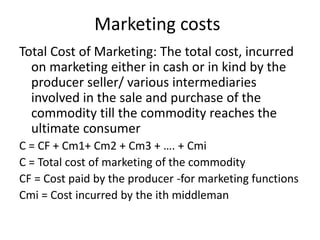
Total Cost of Marketing: The total cost, incurred
on marketing either in cash or in kind by the
producer seller/ various intermediaries
involved in the sale and purchase of the
commodity till the commodity reaches the
ultimate consumer
C = CF + Cm1+ Cm2 + Cm3 + …. + Cmi
C = Total cost of marketing of the commodity
CF = Cost paid by the producer -for marketing functions
Cmi = Cost incurred by the ith middleman
Methods of estimation of marketing
costs
• Three methods are generally used in the computation
of marketing margins and costs
(i) Lot Method
A specific lot or consignment is selected and chased
through the marketing system until it reaches the
ultimate consumer. The cost and margin involved at
each stage are assessed
 Difficult to chase movement
 Most of the lots lose their identity during the process
of marketing
 There is no assurance that the lot selected is
representative of the whole product
ii) Sum of Average Gross Margins Method
• The average gross margin at each successive
level of marketing is worked out by dividing
the difference of the money value of sales and
purchase by the number of units of the
commodity transacted by a particular agency
iii) Comparison of Prices at Successive
Levels of Marketing
• Under this method, prices at successive stages
of marketing at the producer's, wholesaler's
and retailer's levels – are compared.
• The difference is taken as the gross margin
• The margin of an intermediary is worked out
by deducting the ascertainable costs from the
gross margin earned by that intermediary
Difficulties
• Representative and comparable series of prices for the
same quality of successive stages of marketing are not
readily available for all the products
• Adjustment for a loss in the quality of the product at
various stages of marketing due to wastage and
spoilage in processing and handling is difficult
• The price quotation may not cover the price of a
product of a comparable quality
• The time lag between the performance of various
marketing operations is not properly accounted for
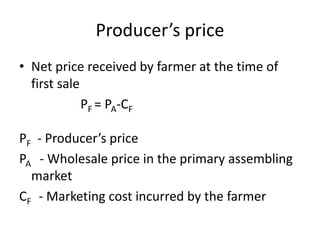
Producer’s price
• Net price received by farmer at the time of
first sale
PF = PA-CF
PF - Producer’s price
PA - Wholesale price in the primary assembling
market
CF - Marketing cost incurred by the farmer
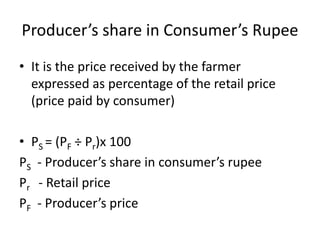
Producer’s share in Consumer’s Rupee
• It is the price received by the farmer
expressed as percentage of the retail price
(price paid by consumer)
• PS = (PF ÷ Pr)x 100
PS - Producer’s share in consumer’s rupee
Pr - Retail price
PF - Producer’s price
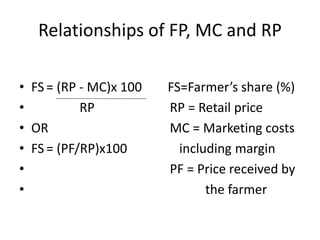
Relationships of FP, MC and RP
• FS = (RP - MC)x 100 FS=Farmer’s share (%)
• RP RP = Retail price
• OR MC = Marketing costs
• FS = (PF/RP)x100 including margin
• PF = Price received by
• the farmer
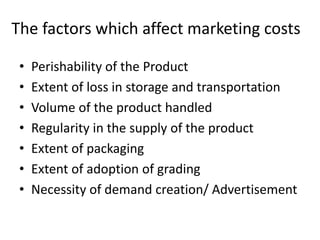
The factors which affect marketing costs
• Perishability of the Product
• Extent of loss in storage and transportation
• Volume of the product handled
• Regularity in the supply of the product
• Extent of packaging
• Extent of adoption of grading
• Necessity of demand creation/ Advertisement
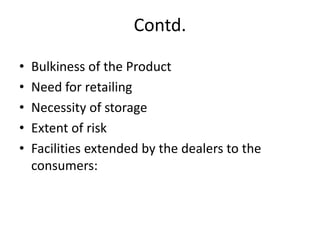
Contd.
• Bulkiness of the Product
• Need for retailing
• Necessity of storage
• Extent of risk
• Facilities extended by the dealers to the
consumers:
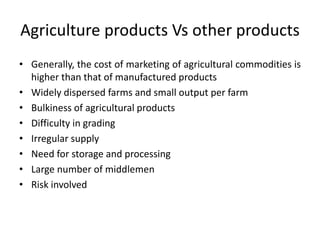
Agriculture products Vs other products
• Generally, the cost of marketing of agricultural commodities is
higher than that of manufactured products
• Widely dispersed farms and small output per farm
• Bulkiness of agricultural products
• Difficulty in grading
• Irregular supply
• Need for storage and processing
• Large number of middlemen
• Risk involved

Marketing costs.pptx

  • 1.
  • 2.
    Contents • Marketing cost- Cost of marketing functions • Marketing Margins - Margins of intermediaries Difference b/w price paid and received Concurrent margin: Diff. b/w prices prevailing at successive stages of marketing at a given point of time/date Lagged margins: Diff. b/w price received by a seller at a particular stage of marketing and price paid by him at preceding stage during an earlier period. Accounts time elapsed b/w purchase and sale – by a party and b/w farmer and consumer
  • 3.
    • Price spread– difference b/w price paid consumer and price received by the farmer • Producers' share in the consumer's rupee
  • 4.
    Marketing costs Total Costof Marketing: The total cost, incurred on marketing either in cash or in kind by the producer seller/ various intermediaries involved in the sale and purchase of the commodity till the commodity reaches the ultimate consumer C = CF + Cm1+ Cm2 + Cm3 + …. + Cmi C = Total cost of marketing of the commodity CF = Cost paid by the producer -for marketing functions Cmi = Cost incurred by the ith middleman
  • 5.
    Methods of estimationof marketing costs • Three methods are generally used in the computation of marketing margins and costs (i) Lot Method A specific lot or consignment is selected and chased through the marketing system until it reaches the ultimate consumer. The cost and margin involved at each stage are assessed  Difficult to chase movement  Most of the lots lose their identity during the process of marketing  There is no assurance that the lot selected is representative of the whole product
  • 6.
    ii) Sum ofAverage Gross Margins Method • The average gross margin at each successive level of marketing is worked out by dividing the difference of the money value of sales and purchase by the number of units of the commodity transacted by a particular agency
  • 7.
    iii) Comparison ofPrices at Successive Levels of Marketing • Under this method, prices at successive stages of marketing at the producer's, wholesaler's and retailer's levels – are compared. • The difference is taken as the gross margin • The margin of an intermediary is worked out by deducting the ascertainable costs from the gross margin earned by that intermediary
  • 8.
    Difficulties • Representative andcomparable series of prices for the same quality of successive stages of marketing are not readily available for all the products • Adjustment for a loss in the quality of the product at various stages of marketing due to wastage and spoilage in processing and handling is difficult • The price quotation may not cover the price of a product of a comparable quality • The time lag between the performance of various marketing operations is not properly accounted for
  • 9.
    Producer’s price • Netprice received by farmer at the time of first sale PF = PA-CF PF - Producer’s price PA - Wholesale price in the primary assembling market CF - Marketing cost incurred by the farmer
  • 10.
    Producer’s share inConsumer’s Rupee • It is the price received by the farmer expressed as percentage of the retail price (price paid by consumer) • PS = (PF ÷ Pr)x 100 PS - Producer’s share in consumer’s rupee Pr - Retail price PF - Producer’s price
  • 11.
    Relationships of FP,MC and RP • FS = (RP - MC)x 100 FS=Farmer’s share (%) • RP RP = Retail price • OR MC = Marketing costs • FS = (PF/RP)x100 including margin • PF = Price received by • the farmer
  • 12.
    The factors whichaffect marketing costs • Perishability of the Product • Extent of loss in storage and transportation • Volume of the product handled • Regularity in the supply of the product • Extent of packaging • Extent of adoption of grading • Necessity of demand creation/ Advertisement
  • 13.
    Contd. • Bulkiness ofthe Product • Need for retailing • Necessity of storage • Extent of risk • Facilities extended by the dealers to the consumers:
  • 14.
    Agriculture products Vsother products • Generally, the cost of marketing of agricultural commodities is higher than that of manufactured products • Widely dispersed farms and small output per farm • Bulkiness of agricultural products • Difficulty in grading • Irregular supply • Need for storage and processing • Large number of middlemen • Risk involved