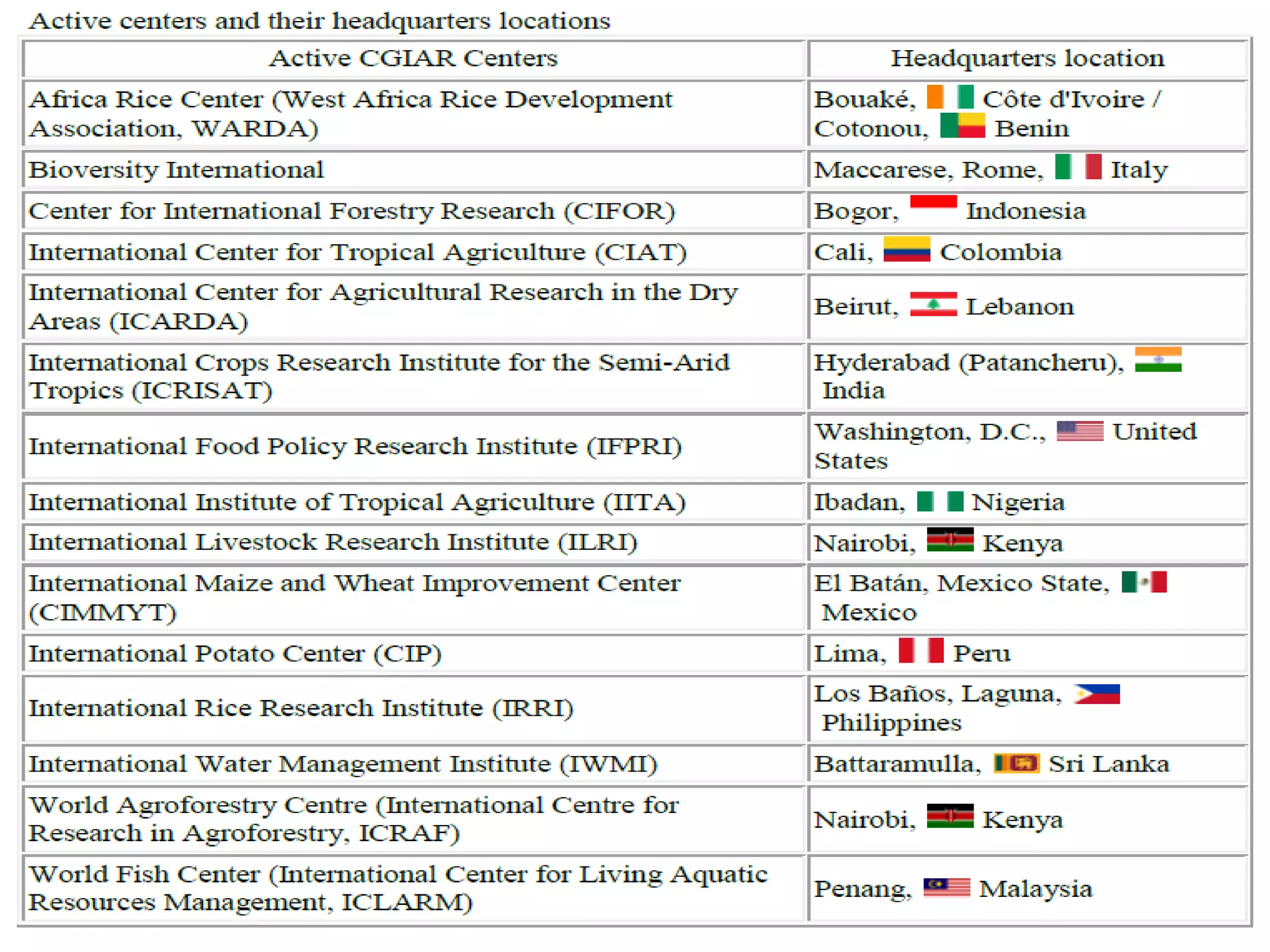
The document discusses the International Agricultural Research System (IARS), specifically the Consultative Group on International Agricultural Research (CGIAR). It notes that CGIAR was established in 1971 with 4 centers focused on reducing poverty and increasing food security. CGIAR now has 15 centers working with over 100 partners on research programs. Key impacts of CGIAR's research include developing resistant crop varieties, improved livestock/fish practices, and furthering more sustainable natural resource management. Overall, CGIAR research has generated significant economic and social benefits globally.
Global Forum onAgricultural
Research
• The Global Forum on Agricultural Research is a
multi stakeholder platform for dialogue on
critical issues related to agricultural research for
development, advocate and facilitate
collaborative action through partnerships and
assess impact of these actions.
3.
IARS
• The globalagricultural research system is
driven by the consultative group on
International Agricultural research system
(CGIAR).
• CGIAR is global partnership that unites
organizations engaged in research for food
secure future.
4.
(Objectives of CGIAR)
•Initiated in the year 1971.
• At that time, it had only four centers and eight
members representing national research system.
• CGIAR research focused on reducing rural
poverty
• Increasing food security.
• Improving human health and nutrition, and
ensuring sustainable management of natural
resources.
5.
CGIAR Scenario
• Atpresent agriculture research is carried out
by 15 of CGIAR centers that are member of
the CGIAR along with 64 country members
and its works in close collaboration with
hundreds of partner including national and
regional research institutes, civil society
organizations , academia and private sector.
6.
Funding Agency
• TheCGIAR Fund was established in January
2010 and is based in Washington, DC.
• The CGIAR fund is a multi donor trust that
finance CGIAR research guided by the
strategy and results framework.
• The CGIAR fund is as administered by the
World bank.
7.
Structure of CGIARConsortium
• The CGIAR Consortium was established in April 2010.
It is based at the Agropolis campus in Montpellier.
• The CGIAR consortium is an international organization
that, together with The CGIAR fund, advances
international agricultural research for a food secure
future by integrating and coordinating the efforts of
those who fund research and those who do research
..
• The CGIAR consortium is made of the consortium
Board : The consortium office : and The Research
centers which are the members of the CGIAR
consortium.
• Now, there are 15 CGIAR institutes/ centers
10.
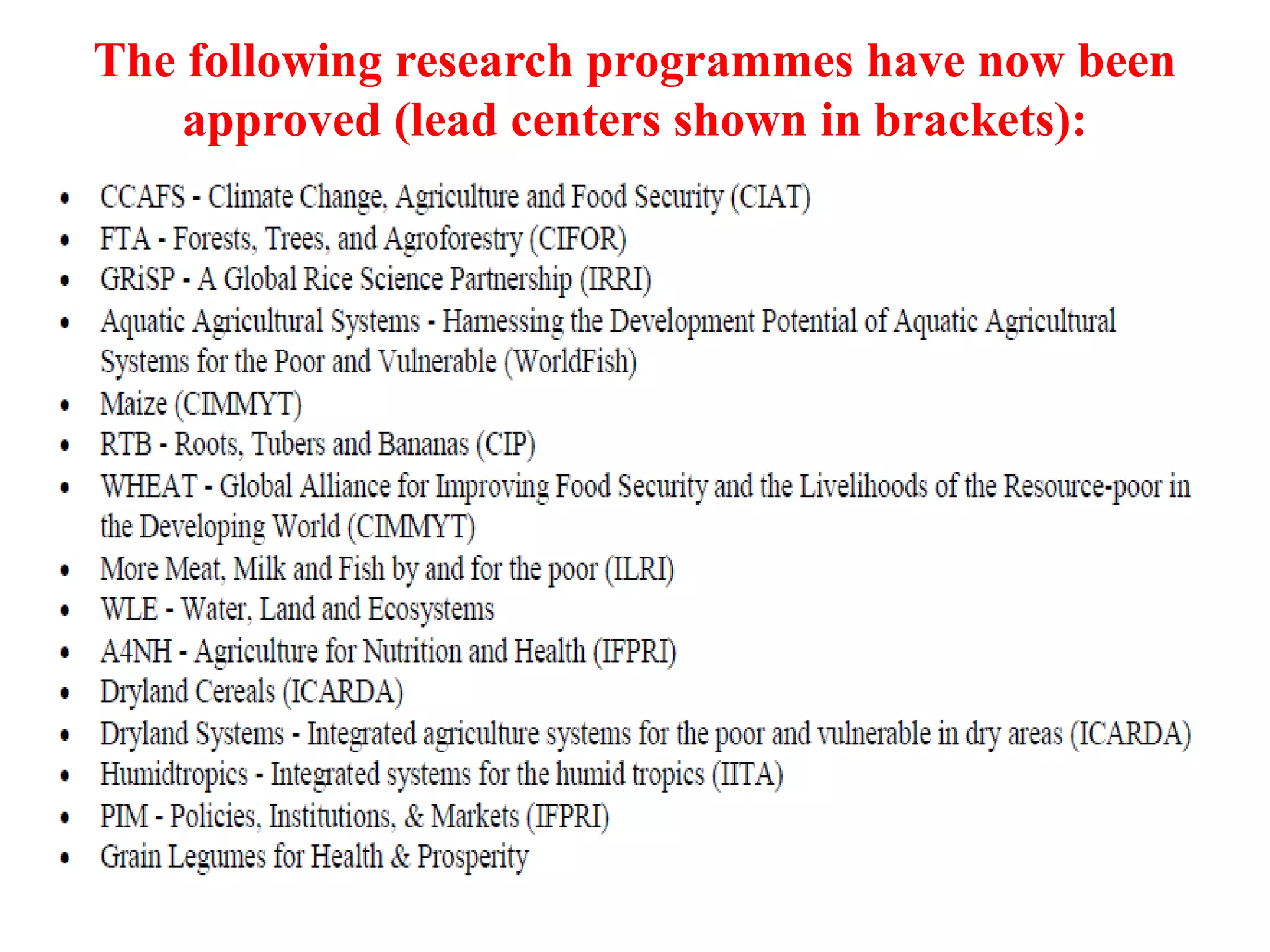
The following researchprogrammes have now been
approved (lead centers shown in brackets):
11.
Continue…..
• A newstrategy and results framework was
approved in 2015 and the portfolio of research
programs revised.
• The systems programs Dryland Systems,
Aquatic Agricultural Systems and Humid
Tropics demised as standalone programs
12.
Need of AgricultureResearch
System
• Publicly-funded agricultural research is
increasingly assessed in terms of its
effectiveness in contributing to poverty
reduction objectives, as measured through the
Millennium Development Goals (MDGs).
Research must be:
13.
Agriculture Research System
•Relevant to poverty reduction (i.e. actions
undertaken by researchers are likely to reduce
poverty)
• Effective in poverty reduction (i.e. researchers
are going about these tasks in the right ways)
• Efficient (i.e. tasks are managed so the desired
output is achieved with the minimum use of
inputs)
14.
Agriculture Research Opportunities
•Expand operations to include planting and
harvesting
• Expanding international level markets
• Partner with firm that only plants and harvests
crops
• Technological development in agriculture
• Agro-based Industry
• Agricultural education
15.
Impacts of CGIAR
•Improving the nutritional value of staple crops; pest and disease
control through breeding resistant varieties, integrated pest
management and biological control (e.g. control of the cassava mealy
bug in sub-Saharan Africa through release of a predatory wasp);
• Improvements in livestock and fish production systems;
• Genetic resources characterization and conservation;
• Improved natural resource management;
• Contributions to improved policies in numerous areas, including
forestry, fertilizer, milk marketing and genetic resources conservation
and use.
• The introduction of no-tillage systems in the rice-wheat systems in the
Indo-Gangetic Plains, for example, generated economic benefits of
about US$165 million between 1990 and 2010 from an investment of
only US$3.5 million.
• Even the most conservative estimate of the measurable benefits of
CGIAR research indicate US$2 in benefits for every US$1 invested.