1
Integrated Marketing Communication (IMC)…
Introduction to
Marketing Communications [MC]
and Integrated Marketing
Communication [IMC]
2
Marketing Communications, and
Integrated Marketing Communication
Marketing communication is the process by which
information about an organization and its offerings is
disseminated to selected markets.
Integrated Marketing Communication (IMC) is the
concept under which a company carefully integrates
and coordinates its many communication channels
(more than one) to deliver a clear, consistent, and
convincing message about the organization and its
products.
- It is also called Communication Mix that consists of the
specific blend of advertising, sales promotion, public
relations, personal selling, and direct-marketing tools
that the company uses to communicate with their
customers and build customer relationships.
3
The Role of Marketing Communications
Marketing communications are the means by
which firms attempt to inform, persuade and
remind consumers – directly or indirectly – about
the products and brands they sell.
In a sense, marketing communications represent
the voice of the company and its brands.
All of their communications must be planned and
blended into carefully integrated marketing
communication programs.
Just as good communication is important in
building and maintaining any kind of relationship,
it is a crucial element in a company’s efforts to
build profitable customer relationships.
4
Building good customer relationships calls for
more than just developing a good product, pricing
it effectively, and making it available to target
customers. Companies must also communicate
their value propositions to customers, and what
they communicate should not be left to chance
The Role of Marketing Communications
The Changing Marketing Communications Environment
Technology and other factors have profoundly changed
the way consumers process communications, and even
whether they choose to process them at all. The rapid
diffusion of multipurpose smart phones, broadband
and wireless Internet connections, and ad-skipping
digital video recorders (DVRs) have eroded the
effectiveness of the mass media.
5
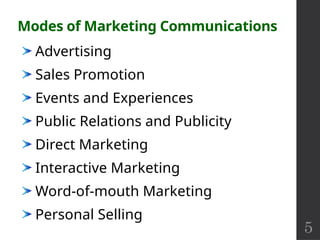
Modes of Marketing Communications
Advertising
Sales Promotion
Events and Experiences
Public Relations and Publicity
Direct Marketing
Interactive Marketing
Word-of-mouth Marketing
Personal Selling
6
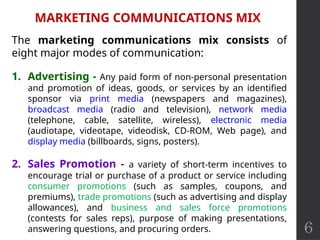
MARKETING COMMUNICATIONS MIX
The marketing communications mix consists of
eight major modes of communication:
1. Advertising - Any paid form of non-personal presentation
and promotion of ideas, goods, or services by an identified
sponsor via print media (newspapers and magazines),
broadcast media (radio and television), network media
(telephone, cable, satellite, wireless), electronic media
(audiotape, videotape, videodisk, CD-ROM, Web page), and
display media (billboards, signs, posters).
2. Sales Promotion - a variety of short-term incentives to
encourage trial or purchase of a product or service including
consumer promotions (such as samples, coupons, and
premiums), trade promotions (such as advertising and display
allowances), and business and sales force promotions
(contests for sales reps), purpose of making presentations,
answering questions, and procuring orders.
7
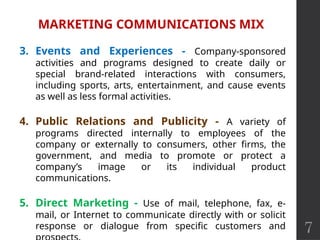
MARKETING COMMUNICATIONS MIX
3. Events and Experiences - Company-sponsored
activities and programs designed to create daily or
special brand-related interactions with consumers,
including sports, arts, entertainment, and cause events
as well as less formal activities.
4. Public Relations and Publicity - A variety of
programs directed internally to employees of the
company or externally to consumers, other firms, the
government, and media to promote or protect a
company’s image or its individual product
communications.
5. Direct Marketing - Use of mail, telephone, fax, e-
mail, or Internet to communicate directly with or solicit
response or dialogue from specific customers and
8
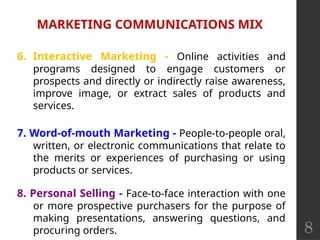
MARKETING COMMUNICATIONS MIX
6. Interactive Marketing - Online activities and
programs designed to engage customers or
prospects and directly or indirectly raise awareness,
improve image, or extract sales of products and
services.
7. Word-of-mouth Marketing - People-to-people oral,
written, or electronic communications that relate to
the merits or experiences of purchasing or using
products or services.
8. Personal Selling - Face-to-face interaction with one
or more prospective purchasers for the purpose of
making presentations, answering questions, and
procuring orders.
9
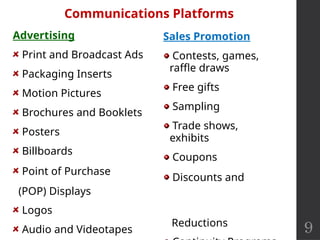
Communications Platforms
Advertising
Print and Broadcast Ads
Packaging Inserts
Motion Pictures
Brochures and Booklets
Posters
Billboards
Point of Purchase
(POP) Displays
Logos
Audio and Videotapes
Sales Promotion
Contests, games,
raffle draws
Free gifts
Sampling
Trade shows,
exhibits
Coupons
Discounts and
Reductions
10
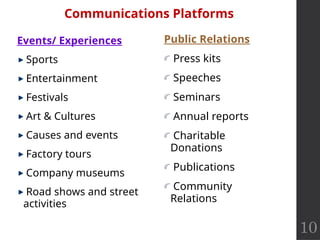
Events/ Experiences
Sports
Entertainment
Festivals
Art & Cultures
Causes and events
Factory tours
Company museums
Road shows and street
activities
Public Relations
Press kits
Speeches
Seminars
Annual reports
Charitable
Donations
Publications
Community
Relations
Communications Platforms
11
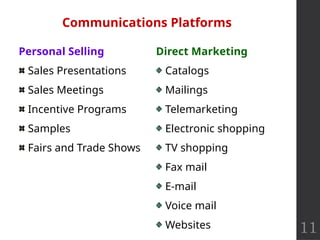
Personal Selling
Sales Presentations
Sales Meetings
Incentive Programs
Samples
Fairs and Trade Shows
Direct Marketing
Catalogs
Mailings
Telemarketing
Electronic shopping
TV shopping
Fax mail
E-mail
Voice mail
Websites
Communications Platforms
12
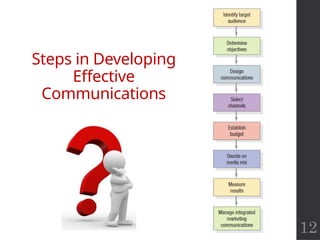
Steps in Developing
Effective
Communications
13
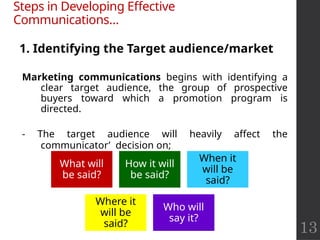
1. Identifying the Target audience/market
What will
be said?
How it will
be said?
When it
will be
said?
Where it
will be
said?
Who will
say it?
Steps in Developing Effective
Communications…
Marketing communications begins with identifying a
clear target audience, the group of prospective
buyers toward which a promotion program is
directed.
- The target audience will heavily affect the
communicator’ decision on;
14
2. Determining the Communications Objectives
Once the target audience has been defined, marketers must
determine the desired response.
Of course, in many cases, they will seek a purchase response. But
purchase may result only after a lengthy consumer decision-
making process. The marketing communicator needs to know
where the target audience now stands and to what stage it needs
to be moved.
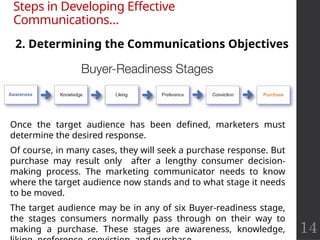
The target audience may be in any of six Buyer-readiness stage,
the stages consumers normally pass through on their way to
making a purchase. These stages are awareness, knowledge,
Steps in Developing Effective
Communications…
3. Designing the Communications
Formulating the communications to achieve
the desired response requires solving three
problems:
What to say (Message Strategy)
How to say it (Content/Creative Strategy)
Who should say it (Message Source)
Steps in Developing Effective
Communications…
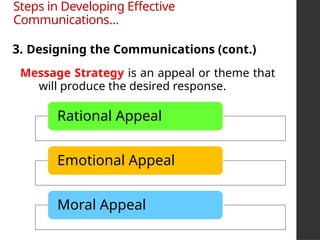
Message Strategy is an appeal or theme that
will produce the desired response.
Rational Appeal
Emotional Appeal
Moral Appeal
Steps in Developing Effective
Communications…
3. Designing the Communications (cont.)
Rational Appeal - Rational appeals relate to the
audience’s self-interest. They show that the product will
produce the desired benefits. Examples are messages
showing a product’s quality, economy, value, or
performance.
Emotional Appeal - Emotional appeals attempt to stir
up either negative or positive emotions that can motivate
purchase. Communicators may use motional appeals
ranging from love, joy, and humor to fear and guilt.
Advocates of emotional messages claim that they attract
more attention and create more belief in the sponsor
and the brand.
Moral Appeal - Moral appeals are directed to an
audience’s sense of what is “right” and “proper.”
They are often used to urge people to support social
causes, such as a cleaner environment or aid to the
Steps in Developing Effective
Communications…
Communications effectiveness depends on how a
message is being expressed, as well as on its
content. If a communication is ineffective, it may
mean the wrong message was used, or the right
one was poorly expressed.
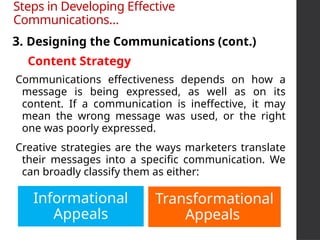
Creative strategies are the ways marketers translate
their messages into a specific communication. We
can broadly classify them as either:
Informational
Appeals
Transformational
Appeals
3. Designing the Communications (cont.)
Steps in Developing Effective
Communications…
Content Strategy
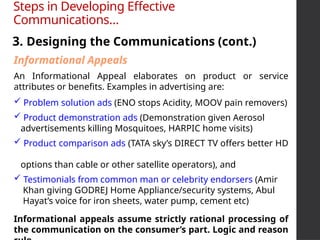
Informational Appeals
An Informational Appeal elaborates on product or service
attributes or benefits. Examples in advertising are:
 Problem solution ads (ENO stops Acidity, MOOV pain removers)
 Product demonstration ads (Demonstration given Aerosol
advertisements killing Mosquitoes, HARPIC home visits)
 Product comparison ads (TATA sky’s DIRECT TV offers better HD
options than cable or other satellite operators), and
 Testimonials from common man or celebrity endorsers (Amir
Khan giving GODREJ Home Appliance/security systems, Abul
Hayat’s voice for iron sheets, water pump, cement etc)
Informational appeals assume strictly rational processing of
the communication on the consumer’s part. Logic and reason
3. Designing the Communications (cont.)
Steps in Developing Effective
Communications…
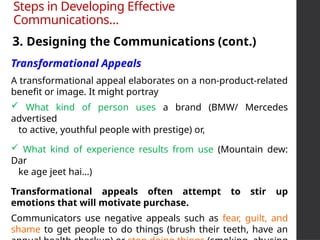
Transformational Appeals
A transformational appeal elaborates on a non-product-related
benefit or image. It might portray
 What kind of person uses a brand (BMW/ Mercedes
advertised
to active, youthful people with prestige) or,
 What kind of experience results from use (Mountain dew:
Dar
ke age jeet hai…)
Transformational appeals often attempt to stir up
emotions that will motivate purchase.
Communicators use negative appeals such as fear, guilt, and
shame to get people to do things (brush their teeth, have an
3. Designing the Communications (cont.)
Steps in Developing Effective
Communications…
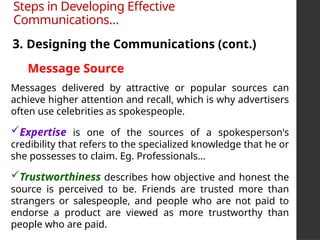
Messages delivered by attractive or popular sources can
achieve higher attention and recall, which is why advertisers
often use celebrities as spokespeople.
Expertise is one of the sources of a spokesperson's
credibility that refers to the specialized knowledge that he or
she possesses to claim. Eg. Professionals…
Trustworthiness describes how objective and honest the
source is perceived to be. Friends are trusted more than
strangers or salespeople, and people who are not paid to
endorse a product are viewed as more trustworthy than
people who are paid.
3. Designing the Communications (cont.)
Steps in Developing Effective
Communications…
Message Source
Likability describes the source’s attractiveness. Qualities
such as openness, humor, and naturalness make a source
more likable. Eg. Celebrities and sport persons.
The most highly credible source would score high on all
three dimensions—expertise, trustworthiness, and
likability.
3. Designing the Communications (cont.)
Steps in Developing Effective
Communications…
Message Source
23
To be Continued…

Chapter_1_Introduction_to_Marketing_Comm (1).pptx

  • 1.
    1 Integrated Marketing Communication(IMC)… Introduction to Marketing Communications [MC] and Integrated Marketing Communication [IMC]
  • 2.
    2 Marketing Communications, and IntegratedMarketing Communication Marketing communication is the process by which information about an organization and its offerings is disseminated to selected markets. Integrated Marketing Communication (IMC) is the concept under which a company carefully integrates and coordinates its many communication channels (more than one) to deliver a clear, consistent, and convincing message about the organization and its products. - It is also called Communication Mix that consists of the specific blend of advertising, sales promotion, public relations, personal selling, and direct-marketing tools that the company uses to communicate with their customers and build customer relationships.
  • 3.
    3 The Role ofMarketing Communications Marketing communications are the means by which firms attempt to inform, persuade and remind consumers – directly or indirectly – about the products and brands they sell. In a sense, marketing communications represent the voice of the company and its brands. All of their communications must be planned and blended into carefully integrated marketing communication programs. Just as good communication is important in building and maintaining any kind of relationship, it is a crucial element in a company’s efforts to build profitable customer relationships.
  • 4.
    4 Building good customerrelationships calls for more than just developing a good product, pricing it effectively, and making it available to target customers. Companies must also communicate their value propositions to customers, and what they communicate should not be left to chance The Role of Marketing Communications The Changing Marketing Communications Environment Technology and other factors have profoundly changed the way consumers process communications, and even whether they choose to process them at all. The rapid diffusion of multipurpose smart phones, broadband and wireless Internet connections, and ad-skipping digital video recorders (DVRs) have eroded the effectiveness of the mass media.
  • 5.
    5 Modes of MarketingCommunications Advertising Sales Promotion Events and Experiences Public Relations and Publicity Direct Marketing Interactive Marketing Word-of-mouth Marketing Personal Selling
  • 6.
    6 MARKETING COMMUNICATIONS MIX Themarketing communications mix consists of eight major modes of communication: 1. Advertising - Any paid form of non-personal presentation and promotion of ideas, goods, or services by an identified sponsor via print media (newspapers and magazines), broadcast media (radio and television), network media (telephone, cable, satellite, wireless), electronic media (audiotape, videotape, videodisk, CD-ROM, Web page), and display media (billboards, signs, posters). 2. Sales Promotion - a variety of short-term incentives to encourage trial or purchase of a product or service including consumer promotions (such as samples, coupons, and premiums), trade promotions (such as advertising and display allowances), and business and sales force promotions (contests for sales reps), purpose of making presentations, answering questions, and procuring orders.
  • 7.
    7 MARKETING COMMUNICATIONS MIX 3.Events and Experiences - Company-sponsored activities and programs designed to create daily or special brand-related interactions with consumers, including sports, arts, entertainment, and cause events as well as less formal activities. 4. Public Relations and Publicity - A variety of programs directed internally to employees of the company or externally to consumers, other firms, the government, and media to promote or protect a company’s image or its individual product communications. 5. Direct Marketing - Use of mail, telephone, fax, e- mail, or Internet to communicate directly with or solicit response or dialogue from specific customers and
  • 8.
    8 MARKETING COMMUNICATIONS MIX 6.Interactive Marketing - Online activities and programs designed to engage customers or prospects and directly or indirectly raise awareness, improve image, or extract sales of products and services. 7. Word-of-mouth Marketing - People-to-people oral, written, or electronic communications that relate to the merits or experiences of purchasing or using products or services. 8. Personal Selling - Face-to-face interaction with one or more prospective purchasers for the purpose of making presentations, answering questions, and procuring orders.
  • 9.
    9 Communications Platforms Advertising Print andBroadcast Ads Packaging Inserts Motion Pictures Brochures and Booklets Posters Billboards Point of Purchase (POP) Displays Logos Audio and Videotapes Sales Promotion Contests, games, raffle draws Free gifts Sampling Trade shows, exhibits Coupons Discounts and Reductions
  • 10.
    10 Events/ Experiences Sports Entertainment Festivals Art &Cultures Causes and events Factory tours Company museums Road shows and street activities Public Relations Press kits Speeches Seminars Annual reports Charitable Donations Publications Community Relations Communications Platforms
  • 11.
    11 Personal Selling Sales Presentations SalesMeetings Incentive Programs Samples Fairs and Trade Shows Direct Marketing Catalogs Mailings Telemarketing Electronic shopping TV shopping Fax mail E-mail Voice mail Websites Communications Platforms
  • 12.
  • 13.
    13 1. Identifying theTarget audience/market What will be said? How it will be said? When it will be said? Where it will be said? Who will say it? Steps in Developing Effective Communications… Marketing communications begins with identifying a clear target audience, the group of prospective buyers toward which a promotion program is directed. - The target audience will heavily affect the communicator’ decision on;
  • 14.
    14 2. Determining theCommunications Objectives Once the target audience has been defined, marketers must determine the desired response. Of course, in many cases, they will seek a purchase response. But purchase may result only after a lengthy consumer decision- making process. The marketing communicator needs to know where the target audience now stands and to what stage it needs to be moved. The target audience may be in any of six Buyer-readiness stage, the stages consumers normally pass through on their way to making a purchase. These stages are awareness, knowledge, Steps in Developing Effective Communications…
  • 15.
    3. Designing theCommunications Formulating the communications to achieve the desired response requires solving three problems: What to say (Message Strategy) How to say it (Content/Creative Strategy) Who should say it (Message Source) Steps in Developing Effective Communications…
  • 16.
    Message Strategy isan appeal or theme that will produce the desired response. Rational Appeal Emotional Appeal Moral Appeal Steps in Developing Effective Communications… 3. Designing the Communications (cont.)
  • 17.
    Rational Appeal -Rational appeals relate to the audience’s self-interest. They show that the product will produce the desired benefits. Examples are messages showing a product’s quality, economy, value, or performance. Emotional Appeal - Emotional appeals attempt to stir up either negative or positive emotions that can motivate purchase. Communicators may use motional appeals ranging from love, joy, and humor to fear and guilt. Advocates of emotional messages claim that they attract more attention and create more belief in the sponsor and the brand. Moral Appeal - Moral appeals are directed to an audience’s sense of what is “right” and “proper.” They are often used to urge people to support social causes, such as a cleaner environment or aid to the Steps in Developing Effective Communications…
  • 18.
    Communications effectiveness dependson how a message is being expressed, as well as on its content. If a communication is ineffective, it may mean the wrong message was used, or the right one was poorly expressed. Creative strategies are the ways marketers translate their messages into a specific communication. We can broadly classify them as either: Informational Appeals Transformational Appeals 3. Designing the Communications (cont.) Steps in Developing Effective Communications… Content Strategy
  • 19.
    Informational Appeals An InformationalAppeal elaborates on product or service attributes or benefits. Examples in advertising are:  Problem solution ads (ENO stops Acidity, MOOV pain removers)  Product demonstration ads (Demonstration given Aerosol advertisements killing Mosquitoes, HARPIC home visits)  Product comparison ads (TATA sky’s DIRECT TV offers better HD options than cable or other satellite operators), and  Testimonials from common man or celebrity endorsers (Amir Khan giving GODREJ Home Appliance/security systems, Abul Hayat’s voice for iron sheets, water pump, cement etc) Informational appeals assume strictly rational processing of the communication on the consumer’s part. Logic and reason 3. Designing the Communications (cont.) Steps in Developing Effective Communications…
  • 20.
    Transformational Appeals A transformationalappeal elaborates on a non-product-related benefit or image. It might portray  What kind of person uses a brand (BMW/ Mercedes advertised to active, youthful people with prestige) or,  What kind of experience results from use (Mountain dew: Dar ke age jeet hai…) Transformational appeals often attempt to stir up emotions that will motivate purchase. Communicators use negative appeals such as fear, guilt, and shame to get people to do things (brush their teeth, have an 3. Designing the Communications (cont.) Steps in Developing Effective Communications…
  • 21.
    Messages delivered byattractive or popular sources can achieve higher attention and recall, which is why advertisers often use celebrities as spokespeople. Expertise is one of the sources of a spokesperson's credibility that refers to the specialized knowledge that he or she possesses to claim. Eg. Professionals… Trustworthiness describes how objective and honest the source is perceived to be. Friends are trusted more than strangers or salespeople, and people who are not paid to endorse a product are viewed as more trustworthy than people who are paid. 3. Designing the Communications (cont.) Steps in Developing Effective Communications… Message Source
  • 22.
    Likability describes thesource’s attractiveness. Qualities such as openness, humor, and naturalness make a source more likable. Eg. Celebrities and sport persons. The most highly credible source would score high on all three dimensions—expertise, trustworthiness, and likability. 3. Designing the Communications (cont.) Steps in Developing Effective Communications… Message Source
  • 23.